


Porsche 907

Encyclopedia
Porsche
Porsche Automobil Holding SE, usually shortened to Porsche SE a Societas Europaea or European Public Company, is a German based holding company with investments in the automotive industry....
in 1967 and 1968.
1967
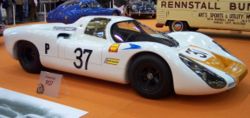
The 907 was introduced at the 1967 24 Hours of Le Mans1967 24 Hours of Le Mans
The 1967 24 Hours of Le Mans was the 35th Grand Prix of Endurance, and took place on June 10 and 11 1967. It was also the seventh round of the World Sportscar Championship....
. As suggested by Ferdinand Piëch
Ferdinand Piëch
Ferdinand Karl Piëch is an Austrian business magnate, engineer and executive who is currently the chairman of the supervisory board of Volkswagen Group....
, the position of the driver was moved from the traditional left (as in German road cars) to the right as this gives advantages on the predominant clockwise race tracks.
With a new longtail body, the 907s reached 302 km/h (190 mph) on the straight even though they used the reliable 220 hp Porsche 910
Porsche 910
The Porsche 910 or Carrera 10 was a race car from Porsche, based upon the Porsche 906. 15 were produced and entered in 1966 and 1967. The factory name for the 910 was the 906/10. The 910 was considered the next sequence in the 906 line...
2000cc 6-cyl rather than the more powerful 8-cyl. Also, vented brake disks were used as standard from now. The best Porsche 907 finished 5th, beaten only by Ford and Ferrari with their much bigger engines.
As the record-breaking performances of the 7.0L V8-powered Ford had triggered rumors about a future rule change, Porsche started to prepare themselves in summer of 1967. The 907 was equipped with the 270 hp 2200cc 8-cyl which was then modified for the rules of the new 3 litre prototype category that was announced in late 1967 to come in effect already in 1968. An engine with the full 3000cc would have to be developed first, though, to be introduced in the future Porsche 908
Porsche 908
The Porsche 908 was a racing car from Porsche, introduced in 1968 to continue the Porsche 906/Porsche 910/Porsche 907 series of models designed under Ferdinand Piech....
.
1968
From 1968, the big V8 and V12 prototypes of Ford and Ferrari were banned, and Porsche hoped to secure the World Sportscar ChampionshipWorld Sportscar Championship
The World Sportscar Championship was the world series run for sports car racing by the FIA from 1953 to 1992.The championship evolved from a small collection of the most important sportscar, endurance and road racing events in Europe and North America with dozens of gentleman drivers at the grid,...
and maybe an overall win at Le Mans as the competition at Ford
Ford Motor Company
Ford Motor Company is an American multinational automaker based in Dearborn, Michigan, a suburb of Detroit. The automaker was founded by Henry Ford and incorporated on June 16, 1903. In addition to the Ford and Lincoln brands, Ford also owns a small stake in Mazda in Japan and Aston Martin in the UK...
, Matra
Matra
Mécanique Aviation Traction or Matra was a French company covering a wide range of activities mainly related to automobile, bicycles, aeronautics and weaponry. In 1994, it became a subsidiary of the Lagardère Group and now operates under that name.Matra was owned by the Floirat family...
and Alfa Romeo
Alfa Romeo in motorsport
During its history, Alfa Romeo has competed successfully in many different categories of motorsport, including Grand Prix motor racing, Formula One, sportscar racing, touring car racing and rallies. They have competed both as a constructor and an engine supplier, via works entries and private...
was not prepared with suitable 3000cc prototypes yet, either. Ferrari
Ferrari
Ferrari S.p.A. is an Italian sports car manufacturer based in Maranello, Italy. Founded by Enzo Ferrari in 1929, as Scuderia Ferrari, the company sponsored drivers and manufactured race cars before moving into production of street-legal vehicles as Ferrari S.p.A. in 1947...
even sat out the whole of 1968 as a protest against the rule change.
Apart from the former 2000cc-class rivals Alfa Romeo T33
Alfa Romeo T33
The Alfa Romeo Tipo 33 was a sports racing prototype raced by the Alfa Romeo factory-backed team between 1967 and 1977. These cars took part for Sport Cars World Championship, Nordic Challenge Cup, Interserie and CanAm series...
/2 and Renault-powered Alpine
Alpine (car)
Alpine was a French manufacturer of racing and sports cars that used rear-mounted Renault engines.Jean Rédélé , the founder of Alpine, was originally a Dieppe garage proprietor, who began to achieve considerable competition success in one of the few French cars produced just after World War...
, 5000cc sportscars were also permitted to enter if at least 50 of them had been built. This loophole was intended to fill the grid with cars dating mainly from 1965, like Ford GT40
Ford GT40
The Ford GT40 was a high performance sports car and winner of the 24 hours of Le Mans four times in a row, from 1966 to 1969...
and Lola T70
Lola T70
The Lola T70 was built for sports car racing, popular in the mid to late 1960s. Developed by Lola Cars in 1965 in Great Britain, the T70 was made for endurance racing...
.
Porsche was serious. Unlike during the rather modest earlier years, four cars were entered in the 1968 24 Hours of Daytona
24 Hours of Daytona
The 24 Hours of Daytona, currently known as the Rolex 24 Daytona for sponsorship reasons, is a 24-hour sports car endurance race held annually at Daytona International Speedway in Daytona Beach, Florida. It is run on a combined road course, utilizing portions of the NASCAR tri-oval and an infield...
, supported by 20 mechanics and engineers. The pilots were fitted with cooling vests developed by NASA
NASA
The National Aeronautics and Space Administration is the agency of the United States government that is responsible for the nation's civilian space program and for aeronautics and aerospace research...
as the oil-cooler and the hot oil pipes caused heat in the closed cockpit.
After the #53 car of Gerhard Mitter
Gerhard Mitter
Gerhard Karl Mitter was a German Formula One and sportscar driver.Mitter was born in Schönlinde in Czechoslovakia, but his family was expelled from there, to Leonberg near Stuttgart....
had a big crash caused by tyre failure in the banking, his teammate Rolf Stommelen
Rolf Stommelen
Rolf Johann Stommelen was a racing driver from Siegen, Germany. He participated in 63 Formula One World Championship Grands Prix, achieving one podium, and scored a total of 14 championship points...
supported the #54 driven by Vic Elford
Vic Elford
Victor Henry Elford is a former sportscar racing, rallying and Formula One driver from England. He participated in 13 World Championship F1 Grands Prix, debuting on 7 July 1968...
/Jochen Neerpasch
Jochen Neerpasch
Jochen Neerpasch is a former German racecar driver and motorsports manager.His racing career began in the 1960s, first on Borgward touring car, then with the 1964 24 Hours of Le Mans as a first major event...
. When the #52 car of the longtime leaders Jo Siffert
Jo Siffert
Joseph Siffert was a Swiss racing driver.Affectionately known as "Seppi" to his family and close friends, Siffert was born in Fribourg, Switzerland, the son of a dairy owner...
/Hans Herrmann
Hans Herrmann
Hans Herrmann is a former Formula One and Sports car racing driver from Stuttgart, Germany.In F1, he participated in 19 World Championship Grands Prix, debuting on August 2, 1953...
dropped to second due to a technical problem, these two also drove on the #54 car in case theirs broke down. Due to this, five pilots won the race, and two of them scored also second. The #51 Jo Schlesser
Jo Schlesser
Joseph Schlesser was a Formula One and sports car racing driver from France. He participated in three World Championship Grands Prix, including the 1968 French Grand Prix in which he was killed...
/Joe Buzzetta car completed the 1-2-3 side-by-side parade finish that the Ferrari prototypes
Ferrari P
The Ferrari P series were prototype sports cars in the 1960s and early 1970s.Although Enzo Ferrari resisted the move even with Cooper dominating F1, Ferrari began producing mid-engined racing cars in 1960 with the Ferrari Dino-V6-engine Formula Two 156, which would be turned into the Formula...
had shown a year earlier at the banked finish line. The three Alfa Romeo T33/2's were even beaten by a Ford Mustang
Ford Mustang
The Ford Mustang is an automobile manufactured by the Ford Motor Company. It was initially based on the second generation North American Ford Falcon, a compact car. Introduced early on April 17, 1964, as a "1964½" model, the 1965 Mustang was the automaker's most successful launch since the Model A...
.
The 1968 12 Hours of Sebring
12 Hours of Sebring
The 12 Hours of Sebring is an annual motorsport endurance race for sports cars held at Sebring International Raceway, a former Army Air Force base in Sebring, Florida...
saw a 1-2 finish for the Porsche 907, with the Jo Siffert
Jo Siffert
Joseph Siffert was a Swiss racing driver.Affectionately known as "Seppi" to his family and close friends, Siffert was born in Fribourg, Switzerland, the son of a dairy owner...
/Hans Herrmann
Hans Herrmann
Hans Herrmann is a former Formula One and Sports car racing driver from Stuttgart, Germany.In F1, he participated in 19 World Championship Grands Prix, debuting on August 2, 1953...
car winning and the Vic Elford
Vic Elford
Victor Henry Elford is a former sportscar racing, rallying and Formula One driver from England. He participated in 13 World Championship F1 Grands Prix, debuting on 7 July 1968...
/Jochen Neerpasch
Jochen Neerpasch
Jochen Neerpasch is a former German racecar driver and motorsports manager.His racing career began in the 1960s, first on Borgward touring car, then with the 1964 24 Hours of Le Mans as a first major event...
car finishing 2nd. The Gerhard Mitter
Gerhard Mitter
Gerhard Karl Mitter was a German Formula One and sportscar driver.Mitter was born in Schönlinde in Czechoslovakia, but his family was expelled from there, to Leonberg near Stuttgart....
/Rolf Stommelen
Rolf Stommelen
Rolf Johann Stommelen was a racing driver from Siegen, Germany. He participated in 63 Formula One World Championship Grands Prix, achieving one podium, and scored a total of 14 championship points...
and Ludovico Scarfiotti
Ludovico Scarfiotti
Ludovico Scarfiotti was a Formula One and sports car driver from Italy. Just prior to entering Formula One, he won the 1963 24 Hours of Le Mans for Ferrari. He later participated in 12 World Championship Formula One grands prix, and many non-championship races. He won one World Championship...
/Joe Buzzetta cars were victims of engine failures. Daytona & Sebring marked the first back-to-back major outright wins for the company, and French journalist (and occasional racer) Bernard Cahier
Bernard Cahier
Bernard Cahier was a French Formula One photo-journalist.Cahier began photographing F1 in 1952 and in 1968 he was one of the founders of the International Racing Press Association which began the process of organising the media in F1...
wrote, "it's hard to imagine that anyone could beat Porsche to the championship this year." Their championship hopes in Sportscars and F1 would be significantly changed soon, though.
The next race was the BOAC 500
BOAC 500
The 1000 km Brands Hatch was an endurance sports car event that was part of the World Sportscar Championship for varying years from 1967 until 1989...
at Brands Hatch
Brands Hatch
Brands Hatch is a motor racing circuit near West Kingsdown in Kent, England. First used as a dirt track motorcycle circuit on farmland, it hosted 12 runnings of the British Grand Prix between 1964 and 1986 and currently holds many British and international racing events...
, on April 7 1968. That fateful day, Jim Clark
Jim Clark
James "Jim" Clark, Jr OBE was a British Formula One racing driver from Scotland, who won two World Championships, in 1963 and 1965....
was supposed to drive one of the new Ford F3L P68 prototypes with the Cosworth DFV
Cosworth DFV
The DFV is an internal combustion engine that was originally produced by Cosworth for Formula One motor racing. Named Four Valve because of the four valves per cylinder, and Double as it was a V8 development of the earlier, four-cylinder FVA , making it a Double Four Valve engine...
engine, entered by Alan Mann Racing. Clark instead was driving a Formula 2 at Hockenheimring
Hockenheimring
The Hockenheimring Baden-Württemberg is an automobile racing track situated near the town of Hockenheim in Baden-Württemberg, Germany, located on Bertha Benz Memorial Route. Amongst other motor racing events, it biennially hosts the Formula One German Grand Prix...
to show the new sponsorship logos for Team Lotus
Team Lotus
Team Lotus was the motorsport sister company of English sports car manufacturer Lotus Cars. The team ran cars in many motorsport series including Formula One, Formula Two, Formula Ford, Formula Junior, IndyCar and sports car racing...
, and was killed. Jo Siffert
Jo Siffert
Joseph Siffert was a Swiss racing driver.Affectionately known as "Seppi" to his family and close friends, Siffert was born in Fribourg, Switzerland, the son of a dairy owner...
/Hans Herrmann
Hans Herrmann
Hans Herrmann is a former Formula One and Sports car racing driver from Stuttgart, Germany.In F1, he participated in 19 World Championship Grands Prix, debuting on August 2, 1953...
were fastest in qualifying ahead of Bruce McLaren
Bruce McLaren
Bruce Leslie McLaren , born in Auckland, New Zealand, was a race-car designer, driver, engineer and inventor....
/Mike Spence
Mike Spence
Michael "Mike" Spence was a British racing driver from England. He participated in 37 Formula One World Championship Grands Prix, debuting on September 8, 1963. He achieved 1 podium, and scored a total of 27 championship points...
in the new Ford, but none finished. It was the updated John Wyer
John Wyer
John Wyer was an English automobile racing engineer and team manager. He is mainly associated with cars running in the lightblue and orange livery of his longtime sponsorship partner Gulf Oil.As team manager and team owner, Wyer won the 24 Hours of Le Mans several times...
-entered Ford GT40
Ford GT40
The Ford GT40 was a high performance sports car and winner of the 24 hours of Le Mans four times in a row, from 1966 to 1969...
of Jacky Ickx
Jacky Ickx
Jacques Bernard "Jacky" Ickx is a Belgian former racing driver who achieved 25 podium finishes in Formula One and six wins in the 24 hours of Le Mans.- Racing career :...
/Brian Redman
Brian Redman
Brian Herman Thomas Redman is a British racing driver from England....
which won ahead of the remaining two Porsche 907's after being only 5th on the grid.
In races on faster tracks like the 1000km Monza
1000km Monza
The 1000 Kilometres of Monza is an endurance race mainly for sports cars held at Autodromo Nazionale Monza in Italy.The "Coppa Inter-Europa" was first held in 1949, on the circuit. The race expanded to 1000 kilometres in 1954, and moved to the 10-kilometre circuit in 1956. The event was...
, these modified old Ford GT40
Ford GT40
The Ford GT40 was a high performance sports car and winner of the 24 hours of Le Mans four times in a row, from 1966 to 1969...
's entered by JWA Gulf Racing Team proved to be an unexpectedly strong force. The loophole for these 5-liter sportscars was opened if at least 50 were built, to let the many existing Lola T70
Lola T70
The Lola T70 was built for sports car racing, popular in the mid to late 1960s. Developed by Lola Cars in 1965 in Great Britain, the T70 was made for endurance racing...
's take part, too. For 1969, the minimum number was lowered to 25, which opened opportunities unexpected by many.
At the twisty Targa Florio
Targa Florio
The Targa Florio was an open road endurance automobile race held in the mountains of Sicily near Palermo. Founded in 1906, it was the oldest sports car racing event, part of the World Sportscar Championship between 1955 and 1973...
, the only privately entered GT40 finished last, but the Alfa Romeo T33/2 were strong. In lap 1, Vic Elford
Vic Elford
Victor Henry Elford is a former sportscar racing, rallying and Formula One driver from England. He participated in 13 World Championship F1 Grands Prix, debuting on 7 July 1968...
had lost 18 minutes due to a tyre failure. Supported by veteran Umberto Maglioli
Umberto Maglioli
Umberto Maglioli was a racing driver from Italy. He participated in 10 Formula One World Championship Grands Prix, debuting on 13 September 1953. He achieved 2 podiums, and scored a total of 3.33 championship points...
, he showed a fantastic race in the 907, reminiscent of Juan Manuel Fangio
Juan Manuel Fangio
Juan Manuel Fangio , nicknamed El Chueco or El Maestro , was a racing car driver from Argentina, who dominated the first decade of Formula One racing...
's legendary 1957 German Grand Prix
1957 German Grand Prix
The 1957 German Grand Prix was a Formula One motor race held on 4 August 1957 at Nürburgring. It was the sixth round of the 1957 World Drivers' Championship. The 22 lap race was won by Juan Manuel Fangio, and is often cited as one of the greatest victories in racing history...
, beating the old lap record by one minute and winning by 3 minutes. Hans Herrmann & Jochen Neerpasch came in 4th among four Alfas. In the Porsche advertising poster celebrating the win, only an exhausted yet smiling Elford was shown, not the cars as usual.
The 1000km Nürburgring
1000km Nürburgring
The ADAC 1000 km Nürburgring is an endurance race for sports cars held on the Nürburgring in Germany and organized by the ADAC since 1953.- History :...
was won with the new Porsche 908
Porsche 908
The Porsche 908 was a racing car from Porsche, introduced in 1968 to continue the Porsche 906/Porsche 910/Porsche 907 series of models designed under Ferdinand Piech....
with its 3000cc engine, but it still was unreliable. The underpowered 2200cc 907 with less than half the Ford's displacement continued as Porsche's best entry in the 1000km Spa
1000km Spa
The 1000 Kilometres of Spa-Francorchamps is an endurance race for sports cars held at Circuit de Spa-Francorchamps in Belgium.- History :The Spa 24 Hours had been introduced in 1924, and other races followed. As on the Nürburgring, both a 24-hour race for touring cars and GTs is held, and an...
, Watkins Glen 6 Hours and 500km Zeltweg, losing to the Ford GT40
Ford GT40
The Ford GT40 was a high performance sports car and winner of the 24 hours of Le Mans four times in a row, from 1966 to 1969...
's.
This set up the stage for a showdown at la Sarthe, as due to political unrest in France, the 1968 24 Hours of Le Mans
1968 24 Hours of Le Mans
The 1968 24 Hours of Le Mans was the 36th Grand Prix of Endurance, and took place on September 28 and 29 1968. It was the tenth and final round of the World Sportscar Championship....
had been postponed from its traditional mid-June date to the end of September. Porsche could not take advantage of the additional time to improve the 908 nor read the French rule book properly. For the first time, Porsche were the fastest in qualifying and the early stages of the race, but troubles with the 908's alternator caused delays and even disqualifications as the new Porsche staff had misinterpreted the repair rules.
For the third time in a row, a V8-powered Ford won the 24h classic. A Porsche 907LH came in second in front of the sole surviving 908. In addition, Ford had taken the World Sportscar Championship
World Sportscar Championship
The World Sportscar Championship was the world series run for sports car racing by the FIA from 1953 to 1992.The championship evolved from a small collection of the most important sportscar, endurance and road racing events in Europe and North America with dozens of gentleman drivers at the grid,...
, too.
At that time, Porsche had already decided to make a risky investment in order to go one step further beyond the 3-liter 908 prototype: they committed themselves to develop a new 5-liter sportscar and built the required number of 25 in advance. This car was the legendary Porsche 917
Porsche 917
The Porsche 917 is a racecar that gave Porsche its first overall wins at the 24 Hours of Le Mans in 1970 and 1971. Powered by the Type 912 flat-12 engine of 4.5, 4.9, or 5 litres, the 917/30 variant was capable of a 0- time of 2.3 seconds, 0– in 5.3 seconds, and a top speed of over .There are 6...
.
1969 - 1971
During the following seasons, several 907's were entered by privateers, scoring occasional top-10 finishes, with a podium at Monza in 1969 and a 7th at the 1971 24 Hours of Le Mans1971 24 Hours of Le Mans
The 1971 24 Hours of Le Mans was the 39th Grand Prix of Endurance, and took place on 12 and 13 June 1971. It was the ninth round of the World Sportscar Championship.-Pre-race:...
being the more remarkable results.