

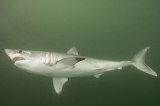
Porbeagle

Encyclopedia
The porbeagle is a species
of mackerel shark
in the family
Lamnidae
, distributed widely in the cold and temperate marine waters of the North Atlantic and Southern Hemisphere
. In the North Pacific, its ecological equivalent is the closely related salmon shark
(L. ditropis). The porbeagle typically reaches 2.5 m (8.2 ft) in length and a weight of 135 kg (297.6 lb); North Atlantic sharks grow larger than Southern Hemisphere sharks and differ in coloration and aspects of life history. Gray above and white below, the porbeagle has a very stout midsection that tapers towards the long, pointed snout and the narrow base of the tail. It has large pectoral and first dorsal fin
s, tiny pelvic, second dorsal, and anal fins, and a crescent-shaped caudal fin. The most distinctive features of this species are its three-cusped teeth, the white blotch on the back of its first dorsal fin, and the two pairs of lateral keels on its tail.
Preying mainly on bony fishes and cephalopod
s, the porbeagle is an opportunistic hunter that regularly moves up and down in the water column, catching prey in midwater as well as off the bottom. It is most commonly found over food-rich banks
on the outer continental shelf
, but does make occasional forays close to shore or into the open ocean, down to a depth of 1360 m (4,461.9 ft). It also conducts long-distance seasonal migrations
, generally shifting between shallower and deeper water. The porbeagle is fast and highly active, with physiological adaptations that enable it to maintain a higher body temperature than the surrounding water. It can be solitary or gregarious, and has been known to perform seemingly playful
behavior. This shark is aplacental viviparous with oophagy
, meaning that the developing embryo
s are retained within the mother's uterus
and subsist on non-viable eggs
. Females typically bear four pups every year.
Only a few shark attack
s of uncertain provenance have been attributed to the porbeagle. It is well regarded as a game fish
by recreational anglers
. The meat and fins of the porbeagle are highly valued, which has led to a long history of intense human exploitation. However, this species cannot sustain heavy fishing pressure due to its low reproductive capacity. Direct commercial fishing
for the porbeagle, principally by Norwegian
longliners, led to stock
collapses in the eastern North Atlantic in the 1950s, and the western North Atlantic in the 1960s. The porbeagle continues to be caught throughout its range, both intentionally and as bycatch
, with varying degrees of monitoring and management. The International Union for Conservation of Nature (IUCN) has assessed the porbeagle as Vulnerable
worldwide, and as either Endangered or Critically Endangered
in different parts of its northern range.
of the word "porbeagle" is obscure. A common suggestion is that it combines "porpoise
" and "beagle
", referencing this shark's shape and tenacious hunting habits. Another is that it is derived from the Cornish
porth, meaning "harbor
", and bugel, meaning "shepherd
". The Oxford English Dictionary
states that the word was either borrowed from Cornish or formed from a Cornish first element with the English "beagle"; however, none of the proposed Cornish root words are fully satisfactory. The Dictionary also notes that there is no evidence for a connection to the French
porc, meaning "swine", or to porpoise, as has been proposed. Other common name
s for the porbeagle include Atlantic mackerel shark, Beaumaris shark, bottle-nosed shark, and blue dog.
The first scientific description of the porbeagle was authored by French naturalist
Pierre Joseph Bonnaterre
in the 1788 Tableau encyclopédique et methodique des trois règnes de la nature
, and based on an earlier 1769 account by Welsh naturalist Thomas Pennant
. Bonnaterre named the shark Squalus nasus, the specific epithet nasus being Latin
for "nose". In 1816, French naturalist Georges Cuvier
placed the porbeagle into its own subgenus, Lamna, which later authors elevated to the rank of full genus.
and mitochondrial DNA
sequences, have established the sister species relationship between the porbeagle and the salmon shark
(L. ditropis), which replaces it in the North Pacific. The genus Lamna evolved 65–45 Ma. When its two extant species diverged
from each other is uncertain, though the precipitating event was likely the formation of the ice cap over the Arctic Ocean
, which would have isolated sharks in the North Pacific from those in the North Atlantic.
Fossil
ized porbeagle remains are known from Late Miocene
epoch (c. 7.2 Ma) deposits in Belgium
and the Netherlands, Pliocene
epoch (5.3–2.6 Ma) deposits in Belgium, Spain
, and Chile
, and Pleistocene
epoch (2.6 Ma to 12,000 BP) deposits in the Netherlands. However, Lamna teeth that closely resemble those of the porbeagle have been found in the La Meseta Formation on Seymour Island
off the Antarctic Peninsula
, which date to the middle to late Eocene
epoch
(50–34 Ma). There is much taxonomic confusion regarding Lamna in the fossil record due to the high degree of variability in adult tooth morphology within species.
is assumed by the salmon shark. It is found mostly within 30–70°N and 30–50°S latitude
s. In the North Atlantic, the northern limit of its range extends from the Newfoundland Grand Banks off Canada
, through southern Greenland
, to Scandinavia
and Russia
; the southern limit of its range extends from New Jersey
and Bermuda
, through the Azores
and Madeira
, to Morocco
. It is found in the Mediterranean Sea
, but not the Black Sea
. Normally, North Atlantic sharks only stray as far south as South Carolina
and the Gulf of Guinea
, but pregnant females from the western North Atlantic population are known to range into the Sargasso Sea
, almost as far as Hispaniola
, to give birth. In the Southern Hemisphere, the porbeagle apparently occupies a continuous band bound in the south by the Antarctic Convergence
, and extending as far north as Chile
and Brazil
, the Western Cape
province
of South Africa
, Australia
to southern Western Australia
and southern Queensland
, and New Zealand
. It is speculated that the porbeagle colonized the Southern Hemisphere during the Quaternary glaciation
(beginning c. 2.6 Ma), when the tropical climate zone was much narrower than it is today.
Offshore fishing banks are the favored habitat of the porbeagle, though it can be found anywhere from a depth of 1360 m (4,461.9 ft) in oceanic basin
s to littoral
(close to shore) waters less than 1 m (3.3 ft) deep, over the entire water column. There is a single, anomalous record from brackish water
, of a juvenile in Mar Chiquita
in Argentina
. A tracking study off the British Isles
has found substantial variation in the short-term movements of this species, both between and within individuals. Vertical movements tended to increase with water depth and corresponding temperature stratification
: in shallow, unstratified waters, sharks either showed no pattern in changing depth or made reverse diel movements
, spending the day in shallow water and descending at night. In deeper, stratified waters, the sharks performed a regular diel migration, spending the day below the thermocline
and rising towards the surface at night. The porbeagle favors water temperatures of 5 to 10 °C (41 to 50 F), though it has been reported across a temperature range of 1 to 23 °C (33.8 to 73.4 F).
Porbeagle populations in the Northern and Southern Hemispheres appear to be completely separate. There are two stocks in the North Atlantic, east and west, that seldom mix; only one individual is known to have crossed the Atlantic, covering 4260 km (2,647 mi) from Ireland
to Canada
. Several discrete stocks are likely present in the Southern Hemisphere as well. This species segregates by size and sex in the North Atlantic, and at least by size in the South Pacific. For example, males outnumber females 2:1 off Spain
, females are 30% more numerous than males off Scotland
, and immature males are predominant in the Bristol Channel
. Older, larger sharks may frequent higher latitudes than younger individuals.
Seasonal migrations
have been observed in porbeagles from both hemispheres. In the western North Atlantic, much of the population spends the spring in the deep waters of the Nova Scotia
continental shelf
, and migrates north a distance of 500–1000 km (310.7–621.4 mi) to spend late summer and fall in the shallow waters of the Newfoundland Grand Banks and the Gulf of St. Lawrence. In December, large mature females migrate south over 2000 km (1,242.7 mi) into the Sargasso Sea for pupping, keeping deeper than 600 m (1,968.5 ft) during the day and 200 m (656.2 ft) at night so as to stay in the cooler waters beneath the Gulf Stream
. In the eastern North Atlantic, porbeagles are believed to spend spring and summer in shallow continental shelf waters, and disperse northwards to overwinter in deeper waters offshore. Migrating sharks may travel upwards of 2300 km (1,429.2 mi), though once they reach their destination they tend to remain within a relatively localized area. In the South Pacific, the population shifts north past 30°S latitude into subtropical waters in winter and spring, and retreats south past 35°S latitude in summer, when sharks are frequently sighted off subantarctic
islands.
rostral cartilage
s. The eyes are large and black, without nictitating membrane
s (protective third eyelids). The small, "S"-shaped nostril
s are positioned in front of and below the level of the eyes. The mouth is large and strongly curved, with moderately protrusible jaws. North Atlantic sharks have 28–29 upper tooth rows and 26–27 lower tooth rows, while Southern Hemisphere sharks have 30–31 upper tooth rows and 27–29 lower tooth rows. Each tooth has a strongly arched base and a nearly straight, awl-like central cusp, which is flanked by a pair of smaller cusplets in all but the smallest individuals. The five pairs of gill slit
s are long and precede the pectoral fin bases.
The pectoral fins are long and narrow. The first dorsal fin is large and high, with a rounded apex and originating just behind the pectoral fin bases. The pelvic fins are much smaller than the first dorsal fin. The second dorsal and anal fins are smaller still, and placed about even with each other on narrow bases that allow pivoting from side to side. The sides of the caudal peduncle are expanded into prominent lateral keels. A second, shorter pair of keels are present below the main keels. The caudal fin is large and crescent-shaped, with the lower lobe almost as long as the upper; there are both dorsal and ventral depressions (precaudal pits) at the caudal fin base, and a deep ventral notch near the tip of the upper caudal fin lobe. The skin is soft and covered by tiny, flattened dermal denticles (scales
), lending a velvet
y texture. Each denticle has three horizontal ridges that lead to teeth on the posterior margin.
The dorsal coloration is a medium to dark gray or slate, extending to the bases of the pectoral fins. The underside is white; adults in the Southern Hemisphere often have dark coloring under the head and dusky blotches scattered over the belly. The free rear tip of the first dorsal fin is abruptly light gray or white, a feature unique to this species. The porbeagle may attain a length of 3.7 m (12.1 ft), though this is uncertain and may have resulted from confusion with other mackerel shark species. A more typical length is 2.5 m (8.2 ft). Female sharks grow larger than males in the North Atlantic, with maximum confirmed fork lengths (snout tip to caudal fin fork) of 2.5 m (8.2 ft) for males and 3 m (9.8 ft) for females. Southern Hemisphere sharks are smaller and the two sexes are similar in size, with males and females attaining fork lengths of 2 m (6.6 ft) and 2.1 m (6.9 ft) respectively. Most porbeagles weigh no more than 135 kg (297.6 lb), with the record being a 230 kg (507.1 lb) individual caught off Caithness
, Scotland
in 1993.
s for efficiently sustaining speed, which have also been independently evolved
by tuna
s, billfish
es, and several other groups of active fishes. It and the salmon shark are the thickest-bodied members of their family (length-depth ratio approaching 4.5), and consequently have the stiffest swimming style: they oscillate their tails while holding their bodies mostly rigid, which confers propulsive power with high energy efficiency, but at the cost of maneuverability. The large gill surface area of the porbeagle allows more oxygen
to be delivered to its tissues. It also has a short band of aerobic "red muscle" along each side, which can contract independently of the regular "white muscle" at a lower energy cost, enhancing the shark's stamina.
Porbeagles are among the few fishes that exhibit apparent play behavior. There are reports, principally off the Cornish
coast, of this species rolling and repeatedly wrapping itself in long kelp
fronds near the surface; this activity may have an exploratory or self-stimulatory purpose, though alternately the shark may be attempting to feed on small kelp organisms or scrape off parasites. In addition, porbeagles within a group have been seen chasing each other, and they will reportedly "play with anything floating on the water": individuals have been observed prodding, tossing, or biting natural and artificial objects, including pieces of driftwood
and balloon floats used by anglers.
Great white shark
s (Carcharodon carcharias) and killer whales (Orcinus orca) are plausible, albeit undocumented, predators of the porbeagle. There is a record of a small individual caught off Argentina
that bore bite marks from a copper shark (Carcharhinus brachyurus) or similar species, but it is uncertain whether the porbeagle was the target of attempted predation or if the two were simply involved in interspecific aggression. Known parasites of this species include the tapeworms Dinobothrium septaria and Hepatoxylon trichiuri, and the copepod
s Dinemoura producta, Laminifera doello-juradoi, and Pandarus floridanus. Natural annual mortality
is low, estimated to be 10% for juveniles, 15% for adult males, and 20% for adult females in the western North Atlantic.
es such as lancet fish, mackerel
, pilchards, herring
, and sauries
and forages near the bottom for groundfish
es such as cod
, hake, icefish
, dories
, sand lance
s, lumpsucker
s, and flatfish
. Cephalopod
s, particularly squid
, also form an important component of its diet, while smaller sharks such as spiny dogfish
(Squalus acanthias) and tope sharks (Galeorhinus galeus) are rarely taken. Examinations of porbeagle stomach contents have also found small shelled molluscs, crustacean
s, echinoderms, and other invertebrate
s, which were likely ingested incidentally, as well as inedible debris such as small stones, feather
s, and garbage fragments.
In the western North Atlantic, porbeagles feed mainly on pelagic fishes and squid in spring, and on groundfishes in the fall; this pattern corresponds to the spring-fall migration of these sharks from deeper to shallower waters, and the most available prey types in those respective habitats. Therefore, the porbeagle seems to be an opportunistic predator without strong diet specificity. During spring and summer in the Celtic Sea
and on the outer Nova Scotian shelf, porbeagles congregate at tidally induced thermal fronts to feed on fish that have been drawn by high concentrations of zooplankton
. Hunting porbeagles regularly dive from the surface all the way to the bottom, cycling back every few hours; this vertical movement may aid in the detection of olfactory
cues. There is a report of a one-year-old porbeagle 1 m (3.3 ft) long, which had fed on krill
and polychaete worms.
. The male bites at the female's pectoral fins, gill region, and flanks while courting and to hold on for copulation. Two mating grounds are known for western North Atlantic porbeagles, one off Newfoundland and the other on Georges Bank
in the Gulf of Maine
. Adult females have a single functional ovary
, on the right, and two functional uteruses. They probably reproduce every year. The litter size is typically four, with two embryos oriented in opposing directions sharing each uterus; on rare occasions a litter may contain as few as one or as many as five pups. The gestation period
is 8–9 months.
Like other members of its family, the porbeagle is aplacental viviparous with oophagy
, i.e. the main source of embryonic nutrition are unfertilized eggs. During the first half of pregnancy, the mother ovulates
enormous numbers of tiny ova
, packed into capsules up to 7.5 cm (3 in) long, into her uteruses. A newly conceived embryo is sustained by a yolk sac
and emerges from its egg capsule at 3.2–4.2 cm (1.3–1.7 in) long. At this time, the embryo has well-developed external gills
and a spiral valve
intestine
. When the embryo is 4.2–9.2 cm (1.7–3.6 in) long, it has resorbed its external gills and most of its yolk sac, but cannot yet feed as it lacks the means to open egg capsules. At a length of 10–12 cm (3.9–4.7 in), the embryo grows two massive, recurved "fangs" in the lower jaw for tearing open capsules, as well as two much smaller teeth in the upper jaw. It begins to feed voraciously on yolk, acquiring an enormously distended stomach; to accommodate this, the muscles on the belly split down the middle and the skin on the abdomen stretches greatly.
At 20–21 cm (7.9–8.3 in) long, the embryo appears pink because it lacks pigment
except in its eyes, and its head and gill region are laterally enlarged and gelatinous. The yolk stomach can comprise up to 81% of the embryo's total weight when it is 30–42 cm (11.8–16.5 in) long. The embryo gains pigment and sheds its fangs at a length of 34–38 cm (13.4–15 in). Around this time, the mother stops producing ova. From then on, the embryo relies mainly on the yolk stored in its stomach, though it may continue to feed on remaining eggs by squishing the capsules between its jaws or swallowing them whole. It begins to transfer its energy stores from its stomach to its liver, causing the former to shrink and the latter to grow exponentially. The embryo is essentially fully pigmented by a length of 40 cm (15.7 in), and has assumed its newborn appearance by a length of 58 cm (22.8 in). By then, its stomach has shrunk enough for the abdominal muscles to close, leaving what has been termed an "umbilical scar" or "yolk sac scar" (neither is accurate). Several series of single-cusped teeth grow in both jaws, though they lie flat and remain non-functional until birth.
Newborn porbeagles measure 58–67 cm (22.8–26.4 in) long and do not exceed 5 kg (11 lb). Up to a tenth of the weight is made up of the liver, though some yolk also remains in its stomach and continues to sustain the pup until it learns to feed. The overall embryonic growth rate is 7–8 cm (2.8–3.1 in) per month. Sometimes one pup in a uterus is much smaller than the other, but otherwise normal. These "runts" may result from a dominant, forward-facing embryo eating most of the eggs as they arrive, and/or the mother being unable to provide an adequate egg supply for all her offspring. Birthing occurs from April to September, peaking in April and May (spring-summer) for North Atlantic sharks and June and July (winter) for Southern Hemisphere sharks. In the western North Atlantic, birth occurs well offshore in the Sargasso Sea at depths of around 500 m (1,640.4 ft).
Both sexes grow at similar rates until the onset of maturation, with females maturing later and at a larger size than males. In the first four years of life, the annual growth rate is 16–20 cm (6.3–7.9 in) and similar in both hemispheres; thereafter, sharks from the western South Pacific begin to grow slower than those from the North Atlantic. In the North Atlantic, males mature at a fork length of 1.6–1.8 m (5.2–5.9 ft) and an age of 6–11 years, and females at a fork length of 2–2.2 m (6.6–7.2 ft) and an age of 12–18 years. In the Southwest Pacific, males mature at a fork length of 1.4–1.5 m (4.6–4.9 ft) and an age of 8–11 years, and females at a fork length of 1.7–1.8 m (5.6–5.9 ft) and an age of 15–18 years. The oldest porbeagle on record was 26 years of age and measured 2.5 m (8.2 ft) long. The maximum lifespan of this species appears to be 30–40 years in the Atlantic, but could be as much as 65 years in the South Pacific.
heat generated by its red muscles is conserved within the body by specialized systems of blood vessel
s called retia mirabilia (Latin
for "wonderful nets"; singular rete mirabile), that act as highly efficient countercurrent
heat exchanger
s. The porbeagle has several rete mirabile systems: the orbital retia accessing its brain and eyes, the lateral cutaneous retia accessing its swimming muscles, the suprahepatic rete accessing its viscera, and the kidney
rete.
Among sharks, the porbeagle's capacity for elevating body temperature is second only to the salmon shark's. Its red muscles are located deep within the body, adjacent to the spine
, and its lateral rete is composed of over 4,000 small arteries
arranged in bands. It has one of the highest core temperatures within its family, 8–10 °C (14–18 °F) warmer than that of the surrounding water. Being warm-bodied may allow this shark to maintain higher cruising speeds, hunt in deep water for extended periods of time, and/or enter higher latitudes during winter to exploit food resources not available to other sharks. The orbital retia of the porbeagle can raise the temperature of its brain and eyes by 3–6 °C (5–11 °F), and likely serve to buffer those sensitive organs against the large temperature shifts that accompany changes in depth; potential benefits of this include increased visual acuity and response times.
swimmers or boats. As of 2009, the International Shark Attack File
attributes three attacks on humans to this species, one provoked and none fatal, and two on boats. One older anecdote tells of a fisherman who provoked a porbeagle into leaping from the water and tearing his clothes. In another account of a swimmer bitten by a "mackerel shark", the species responsible could easily have been a misidentified shortfin mako or great white shark. Recently in the North Sea
, adult porbeagles have been filmed charging at divers working on oil platform
s, sometimes even brushing lightly against them without doing harm. These rushes do not appear to have predatory intent and may instead be motivated by curiosity or defense.
At one time, porbeagles were regarded as nuisances by some commercial fishers because they damaged lighter fishing gear intended for smaller species and stole hooked fish from lines. This shark is highly valued as a game fish
by sport fishers
in Ireland
, the United Kingdom
, and the United States
. It fights strongly on hook-and-line, but does not usually jump into the air like the related shortfin mako. Novice anglers often mistake this shark for the mako, which has earned it the affectionate moniker "fako" in New England
. The International Game Fish Association
keeps records on the porbeagle.
(Prionace glauca). Most of the demand comes from Europe, though the United States and Japan also import this species. The fins are shipped to East Asia
for use in shark fin soup
. The remainder of the shark may also be utilized, for production of leather
, liver oil
, and fishmeal. International trade in the porbeagle appears to be significant, but remains unquantified as shark products tend not to be reported to the species level, and many consist of a mix of various species. This shark is caught most readily on longlines, but is also susceptible to gillnet
s, driftnets, trawls, and handlines. It is valuable enough to be generally retained when caught as bycatch
; if storage space cannot be spared it may be finned
and the carcass discarded.
Intensive fishing for the porbeagle dates back the 1930s, when Norway
and to a lesser extent Denmark
began operating longline vessels in the western North Atlantic. The Norwegian annual catch rose from 279 tons in 1926 to 3,884 tons in 1933, and peaked at around 6,000 tons in 1947, with the resumption of fishing after World War II
. Soon after the stock collapsed: Norwegian annual catches declined steadily to 1,200–1,900 tons from 1953 to 1960, 160–300 tons in the early 1970s, and 10–40 tons in the late 1980s to early 1990s. Similarly, Danish annual catches fell from 1,500 tons in the early 1950s to under 100 tons in the 1990s. Presently, many European countries continue to catch porbeagles in the eastern North Atlantic, with Norway, Denmark, France, and Spain foremost among them. France and Spain began to target porbeagles in the eastern North Atlantic in the 1970s. French fishers operate mainly in the Celtic Sea and the Bay of Biscay
, and saw a decline from an annual catch of over 1,000 tons in 1979 to 300–400 tons in the late 1990s. Catches by Spanish fishers have been highly variable, ranging from negligible to over 4,000 tons per year, which may reflect shifts of fishing effort into historically less-exploited waters.
As porbeagles had become scarce in the eastern North Atlantic, in the 1960s the Norwegian fishing fleet moved west to the waters off New England and Newfoundland. A few years later, they were joined by longline vessels from the Faroe Islands
. Norwegian annual catches rose from 1,900 tons in 1961 to over 9,000 tons in 1965; the catch was largely exported to Italy
, where porbeagle (smerglio) is an extremely popular food fish. Again, the stock collapsed, this time in only six years: by 1970 Norwegian catches had fallen to under 1,000 tons per year, and Faroese catches observed a similar trend. With the population decimated, most fishers moved on or switched to other species. Porbeagle numbers gradually recovered in the ensuing 25 years, to about 30% of pre-exploitation levels. In 1995, Canada
established an Exclusive Economic Zone
(EEZ) and became the primary fisher of porbeagles in the region. Between 1994 and 1998, Canadian fishing vessels landed 1,000–2,000 tons per year, which depleted the population to 11–17% of pre-exploitation levels by 2000. Strict regulations and greatly reduced fishing quotas introduced in 2000 have since begun to reverse the stock decline, though recovery of the stock is projected to take decades due to the low productivity of the species. There is evidence that incidental artificial selection
caused by heavy fishing has led to a compensatory growth
response, i.e. faster growth and earlier maturation.
In the Southern Hemisphere, commercial fishing for the porbeagle is mostly undocumented. Substantial numbers are caught incidentally by pelagic longline fisheries targeting more valuable species such as southern bluefin tuna
(Thunnus maccoyii), swordfish
(Xiphius gladius), and Patagonian toothfish
(Dissostichus eleginoides), including vessels operated by Japan
, Uruguay
, Argentina
, South Africa
, and New Zealand
. Porbeagle catches by the Uruguayan tuna pelagic longline fishery peaked in 1984 with 150 tons landed. Records of catch per unit effort
(CPUE) for this fishery have shown a 90% decline in porbeagle landings from 1988 to 1998, though it is uncertain whether this reflects a real population decline or changing fishing habits. New Zealand has reported annual catches of 150–300 tons, mostly of immature individuals, from 1998 to 2003.
. The International Union for Conservation of Nature has assessed the porbeagle globally as Vulnerable
, Endangered in the western North Atlantic, and Critically Endangered
in the eastern North Atlantic and Mediterranean Sea.
The porbeagle is listed on Annex 1 (Highly Migratory Species) of the UN Convention on the Law of the Sea (UNCLOS), but this has not resulted in any management schemes. Although the Animals Committee of the UN Convention on International Trade in Endangered Species of Wild Fauna and Flora (CITES) recommended additional conservation actions for the porbeagle, CITES rejected proposals to list the species in 2008 and again in 2010. This species benefits from bans on shark finning instituted by several nations and supranational entities, including Canada, the United States, Brazil, Australia
, the European Union
, and the International Commission for the Conservation of Atlantic Tunas
(ICCAT).
The only regulation of porbeagle catches in the Southern Hemisphere is New Zealand's total allowable catch (TAC) of 249 tons per year, instituted in 2004. In the eastern North Atlantic, porbeagle fisheries have never been restricted despite well-documented historical declines. Since 1985, Norway and the Faroe Islands are allowed annual quotas of 200 tons and 125 tons respectively from European Community waters. Although these quotas are lower than the originals set in 1982 (500 tons for Norway and 300 tons for the Faroe Islands), they are still consistently higher than the yearly total porbeagle catch in the region and thus have no practical effect.
In the Mediterranean Sea, the porbeagle is on the verge of extinction, with a population decline of over 99.99% since the mid-20th century. Its range has contracted to the waters around the Italian Peninsula
, where there may be a nursery area. Only a few dozen specimens have been recorded in the past few decades, from scientific surveys, swordfish fishery bycatch, and sport fishers. In 1995, it was included in Annex III ("species whose exploitation is regulated") of the Barcelona Convention Protocol on protected areas and biodiversity in the Mediterranean, which has not been ratified. In 1997, it was listed on Appendix III of the Bern Convention (the Convention on the Conservation of European Wildlife and Natural Habitats). However, these listings have yet to result in the implementation of new management plans, despite the recognized need for urgent action.
The western North Atlantic porbeagle population has a more positive prospect than in the eastern North Atlantic. Fishing in Canadian waters was originally regulated by the 1995 Fisheries Management Plan for pelagic sharks in Atlantic Canada, which established an annual quota of 1,500 tons, restricted the time, place, and gear types allowed for commercial fishing, and set limits for bycatch and recreational fishing. In 2000–2001, Fisheries and Oceans Canada (DFO) prepared a detailed population model and concluded that a quota of 200–250 tons would allow for population growth, resulting in a quota of 250 tons being adopted for the period of 2002–2007. The mating ground off of Newfoundland was also closed to shark fishing. In 2004, the Committee on the Status of Endangered Wildlife in Canada (COSEWIC) listed the porbeagle as Endangered, largely on the basis of the low population abundance (<25% of original numbers). Canada decided not to list the species under its Species At Risk Act, but further reduced the total fishing quota to 185 tons. In US waters, the 1993 Fishery Management Plan for Sharks of the Atlantic Ocean sets an annual quota of 92 tons (post-processing) for the porbeagle. In 2006, this species was listed as a "Species of Concern" by the National Marine Fisheries Service
(NMFS), meaning that it merits conservation concern but there is insufficient data for inclusion on the US Endangered Species Act
.
Species
In biology, a species is one of the basic units of biological classification and a taxonomic rank. A species is often defined as a group of organisms capable of interbreeding and producing fertile offspring. While in many cases this definition is adequate, more precise or differing measures are...
of mackerel shark
Lamniformes
Lamniformes is an order of sharks commonly known as mackerel sharks . It includes some of the most familiar species of sharks, such as the great white shark, as well as more unusual representatives, such as the goblin shark and the megamouth shark.Members of the order are distinguished by...
in the family
Family (biology)
In biological classification, family is* a taxonomic rank. Other well-known ranks are life, domain, kingdom, phylum, class, order, genus, and species, with family fitting between order and genus. As for the other well-known ranks, there is the option of an immediately lower rank, indicated by the...
Lamnidae
Lamnidae
Lamnidae is a family of sharks, commonly known as mackerel sharks or white sharks. They are large, fast-swimming sharks, found in oceans worldwide....
, distributed widely in the cold and temperate marine waters of the North Atlantic and Southern Hemisphere
Southern Hemisphere
The Southern Hemisphere is the part of Earth that lies south of the equator. The word hemisphere literally means 'half ball' or "half sphere"...
. In the North Pacific, its ecological equivalent is the closely related salmon shark
Salmon shark
The salmon shark, Lamna ditropis, is a species of shark occurring in the north Pacific ocean. As an apex predator, the salmon shark feeds on salmon, and also on squid, sablefish, and herring...
(L. ditropis). The porbeagle typically reaches 2.5 m (8.2 ft) in length and a weight of 135 kg (297.6 lb); North Atlantic sharks grow larger than Southern Hemisphere sharks and differ in coloration and aspects of life history. Gray above and white below, the porbeagle has a very stout midsection that tapers towards the long, pointed snout and the narrow base of the tail. It has large pectoral and first dorsal fin
Dorsal fin
A dorsal fin is a fin located on the backs of various unrelated marine and freshwater vertebrates, including most fishes, marine mammals , and the ichthyosaurs...
s, tiny pelvic, second dorsal, and anal fins, and a crescent-shaped caudal fin. The most distinctive features of this species are its three-cusped teeth, the white blotch on the back of its first dorsal fin, and the two pairs of lateral keels on its tail.
Preying mainly on bony fishes and cephalopod
Cephalopod
A cephalopod is any member of the molluscan class Cephalopoda . These exclusively marine animals are characterized by bilateral body symmetry, a prominent head, and a set of arms or tentacles modified from the primitive molluscan foot...
s, the porbeagle is an opportunistic hunter that regularly moves up and down in the water column, catching prey in midwater as well as off the bottom. It is most commonly found over food-rich banks
Bank (topography)
A bank, sometimes referred to as a fishing bank, is an area on the continental shelf which is shallow compared to its surrounding area, such as a shoal or the top of an underwater hill. Somewhat like continental slopes, ocean banks slopes can upwell as tidal and other flows intercept them,...
on the outer continental shelf
Continental shelf
The continental shelf is the extended perimeter of each continent and associated coastal plain. Much of the shelf was exposed during glacial periods, but is now submerged under relatively shallow seas and gulfs, and was similarly submerged during other interglacial periods. The continental margin,...
, but does make occasional forays close to shore or into the open ocean, down to a depth of 1360 m (4,461.9 ft). It also conducts long-distance seasonal migrations
Fish migration
Many types of fish migrate on a regular basis, on time scales ranging from daily to annually or longer, and over distances ranging from a few metres to thousands of kilometres...
, generally shifting between shallower and deeper water. The porbeagle is fast and highly active, with physiological adaptations that enable it to maintain a higher body temperature than the surrounding water. It can be solitary or gregarious, and has been known to perform seemingly playful
Play (activity)
Play is a term employed in ethology and psychology to describe to a range of voluntary, intrinsically motivated activities normally associated with pleasure and enjoyment...
behavior. This shark is aplacental viviparous with oophagy
Oophagy
Oophagy , literally "egg eating", is the practice of embryos feeding on eggs produced by the ovary while still inside the mother's uterus. The word oophagy is formed from the classical Greek ᾠόν and classical Greek φᾱγεῖν ....
, meaning that the developing embryo
Embryo
An embryo is a multicellular diploid eukaryote in its earliest stage of development, from the time of first cell division until birth, hatching, or germination...
s are retained within the mother's uterus
Uterus
The uterus or womb is a major female hormone-responsive reproductive sex organ of most mammals including humans. One end, the cervix, opens into the vagina, while the other is connected to one or both fallopian tubes, depending on the species...
and subsist on non-viable eggs
Ovum
An ovum is a haploid female reproductive cell or gamete. Both animals and embryophytes have ova. The term ovule is used for the young ovum of an animal, as well as the plant structure that carries the female gametophyte and egg cell and develops into a seed after fertilization...
. Females typically bear four pups every year.
Only a few shark attack
Shark attack
A shark attack is an attack on a human by a shark. Every year around 60 shark attacks are reported worldwide, although death is quite unusual. Despite the relative rarity of shark attacks, the fear of sharks is a common phenomenon, having been fueled by the occasional instances of serial attacks,...
s of uncertain provenance have been attributed to the porbeagle. It is well regarded as a game fish
Game fish
Game fish are fish pursued for sport by recreational anglers. They can be freshwater or marine fish. Game fish can be eaten after being caught, though increasingly anglers practise catch and release to improve fish populations. Some game fish are also targeted commercially, particularly...
by recreational anglers
Recreational fishing
Recreational fishing, also called sport fishing, is fishing for pleasure or competition. It can be contrasted with commercial fishing, which is fishing for profit, or subsistence fishing, which is fishing for survival....
. The meat and fins of the porbeagle are highly valued, which has led to a long history of intense human exploitation. However, this species cannot sustain heavy fishing pressure due to its low reproductive capacity. Direct commercial fishing
Commercial fishing
Commercial fishing is the activity of catching fish and other seafood for commercial profit, mostly from wild fisheries. It provides a large quantity of food to many countries around the world, but those who practice it as an industry must often pursue fish far into the ocean under adverse conditions...
for the porbeagle, principally by Norwegian
Norway
Norway , officially the Kingdom of Norway, is a Nordic unitary constitutional monarchy whose territory comprises the western portion of the Scandinavian Peninsula, Jan Mayen, and the Arctic archipelago of Svalbard and Bouvet Island. Norway has a total area of and a population of about 4.9 million...
longliners, led to stock
Fish stock
Fish stocks are subpopulations of a particular species of fish, for which intrinsic parameters are the only significant factors in determining population dynamics, while extrinsic factors are considered to be insignificant.-The stock concept:All species have geographic limits to their...
collapses in the eastern North Atlantic in the 1950s, and the western North Atlantic in the 1960s. The porbeagle continues to be caught throughout its range, both intentionally and as bycatch
Bycatch
The term “bycatch” is usually used for fish caught unintentionally in a fishery while intending to catch other fish. It may however also indicate untargeted catch in other forms of animal harvesting or collecting...
, with varying degrees of monitoring and management. The International Union for Conservation of Nature (IUCN) has assessed the porbeagle as Vulnerable
Vulnerable species
On 30 January 2010, the IUCN Red List of Threatened Species identified 9694 Vulnerable species, subspecies and varieties, stocks and sub-populations.-References:...
worldwide, and as either Endangered or Critically Endangered
Critically Endangered
Critically Endangered is the highest risk category assigned by the IUCN Red List for wild species. Critically Endangered means that a species' numbers have decreased, or will decrease, by 80% within three generations....
in different parts of its northern range.
Taxonomy
The etymologyEtymology
Etymology is the study of the history of words, their origins, and how their form and meaning have changed over time.For languages with a long written history, etymologists make use of texts in these languages and texts about the languages to gather knowledge about how words were used during...
of the word "porbeagle" is obscure. A common suggestion is that it combines "porpoise
Porpoise
Porpoises are small cetaceans of the family Phocoenidae; they are related to whales and dolphins. They are distinct from dolphins, although the word "porpoise" has been used to refer to any small dolphin, especially by sailors and fishermen...
" and "beagle
Beagle
The Beagle is a breed of small to medium-sized dog. A member of the Hound Group, it is similar in appearance to the Foxhound, but smaller, with shorter legs and longer, softer ears. Beagles are scent hounds, developed primarily for tracking hare, rabbit, and other game...
", referencing this shark's shape and tenacious hunting habits. Another is that it is derived from the Cornish
Cornish language
Cornish is a Brythonic Celtic language and a recognised minority language of the United Kingdom. Along with Welsh and Breton, it is directly descended from the ancient British language spoken throughout much of Britain before the English language came to dominate...
porth, meaning "harbor
Harbor
A harbor or harbour , or haven, is a place where ships, boats, and barges can seek shelter from stormy weather, or else are stored for future use. Harbors can be natural or artificial...
", and bugel, meaning "shepherd
Shepherd
A shepherd is a person who tends, feeds or guards flocks of sheep.- Origins :Shepherding is one of the oldest occupations, beginning some 6,000 years ago in Asia Minor. Sheep were kept for their milk, meat and especially their wool...
". The Oxford English Dictionary
Oxford English Dictionary
The Oxford English Dictionary , published by the Oxford University Press, is the self-styled premier dictionary of the English language. Two fully bound print editions of the OED have been published under its current name, in 1928 and 1989. The first edition was published in twelve volumes , and...
states that the word was either borrowed from Cornish or formed from a Cornish first element with the English "beagle"; however, none of the proposed Cornish root words are fully satisfactory. The Dictionary also notes that there is no evidence for a connection to the French
French language
French is a Romance language spoken as a first language in France, the Romandy region in Switzerland, Wallonia and Brussels in Belgium, Monaco, the regions of Quebec and Acadia in Canada, and by various communities elsewhere. Second-language speakers of French are distributed throughout many parts...
porc, meaning "swine", or to porpoise, as has been proposed. Other common name
Common name
A common name of a taxon or organism is a name in general use within a community; it is often contrasted with the scientific name for the same organism...
s for the porbeagle include Atlantic mackerel shark, Beaumaris shark, bottle-nosed shark, and blue dog.
The first scientific description of the porbeagle was authored by French naturalist
Naturalist
Naturalist may refer to:* Practitioner of natural history* Conservationist* Advocate of naturalism * Naturalist , autobiography-See also:* The American Naturalist, periodical* Naturalism...
Pierre Joseph Bonnaterre
Pierre Joseph Bonnaterre
Abbé Pierre Joseph Bonnaterre was a French naturalist who contributed sections on cetaceans, mammals, birds, reptiles, amphibians, and insects to the Tableau encyclopédique et méthodique...
in the 1788 Tableau encyclopédique et methodique des trois règnes de la nature
Tableau encyclopédique et méthodique
The Tableau encyclopédique et méthodique des trois regnes de la nature was an illustrated encyclopedia of plants, animals and minerals, notable for including the first scientific descriptions of many species, and for its attractive engravings. It was published in Paris by Charles Joseph Panckoucke,...
, and based on an earlier 1769 account by Welsh naturalist Thomas Pennant
Thomas Pennant
Thomas Pennant was a Welsh naturalist and antiquary.The Pennants were a Welsh gentry family from the parish of Whitford, Flintshire, who had built up a modest estate at Bychton by the seventeenth century...
. Bonnaterre named the shark Squalus nasus, the specific epithet nasus being Latin
Latin
Latin is an Italic language originally spoken in Latium and Ancient Rome. It, along with most European languages, is a descendant of the ancient Proto-Indo-European language. Although it is considered a dead language, a number of scholars and members of the Christian clergy speak it fluently, and...
for "nose". In 1816, French naturalist Georges Cuvier
Georges Cuvier
Georges Chrétien Léopold Dagobert Cuvier or Jean Léopold Nicolas Frédéric Cuvier , known as Georges Cuvier, was a French naturalist and zoologist...
placed the porbeagle into its own subgenus, Lamna, which later authors elevated to the rank of full genus.
Phylogeny and evolution
Several phylogenetic studies, based on morphological charactersMorphology (biology)
In biology, morphology is a branch of bioscience dealing with the study of the form and structure of organisms and their specific structural features....
and mitochondrial DNA
Mitochondrial DNA
Mitochondrial DNA is the DNA located in organelles called mitochondria, structures within eukaryotic cells that convert the chemical energy from food into a form that cells can use, adenosine triphosphate...
sequences, have established the sister species relationship between the porbeagle and the salmon shark
Salmon shark
The salmon shark, Lamna ditropis, is a species of shark occurring in the north Pacific ocean. As an apex predator, the salmon shark feeds on salmon, and also on squid, sablefish, and herring...
(L. ditropis), which replaces it in the North Pacific. The genus Lamna evolved 65–45 Ma. When its two extant species diverged
Speciation
Speciation is the evolutionary process by which new biological species arise. The biologist Orator F. Cook seems to have been the first to coin the term 'speciation' for the splitting of lineages or 'cladogenesis,' as opposed to 'anagenesis' or 'phyletic evolution' occurring within lineages...
from each other is uncertain, though the precipitating event was likely the formation of the ice cap over the Arctic Ocean
Arctic Ocean
The Arctic Ocean, located in the Northern Hemisphere and mostly in the Arctic north polar region, is the smallest and shallowest of the world's five major oceanic divisions...
, which would have isolated sharks in the North Pacific from those in the North Atlantic.
Fossil
Fossil
Fossils are the preserved remains or traces of animals , plants, and other organisms from the remote past...
ized porbeagle remains are known from Late Miocene
Late Miocene
The Late Miocene is a sub-epoch of the Miocene Epoch made up of two stages. The Tortonian and Messinian stages comprise the Late Miocene sub-epoch....
epoch (c. 7.2 Ma) deposits in Belgium
Belgium
Belgium , officially the Kingdom of Belgium, is a federal state in Western Europe. It is a founding member of the European Union and hosts the EU's headquarters, and those of several other major international organisations such as NATO.Belgium is also a member of, or affiliated to, many...
and the Netherlands, Pliocene
Pliocene
The Pliocene Epoch is the period in the geologic timescale that extends from 5.332 million to 2.588 million years before present. It is the second and youngest epoch of the Neogene Period in the Cenozoic Era. The Pliocene follows the Miocene Epoch and is followed by the Pleistocene Epoch...
epoch (5.3–2.6 Ma) deposits in Belgium, Spain
Spain
Spain , officially the Kingdom of Spain languages]] under the European Charter for Regional or Minority Languages. In each of these, Spain's official name is as follows:;;;;;;), is a country and member state of the European Union located in southwestern Europe on the Iberian Peninsula...
, and Chile
Chile
Chile ,officially the Republic of Chile , is a country in South America occupying a long, narrow coastal strip between the Andes mountains to the east and the Pacific Ocean to the west. It borders Peru to the north, Bolivia to the northeast, Argentina to the east, and the Drake Passage in the far...
, and Pleistocene
Pleistocene
The Pleistocene is the epoch from 2,588,000 to 11,700 years BP that spans the world's recent period of repeated glaciations. The name pleistocene is derived from the Greek and ....
epoch (2.6 Ma to 12,000 BP) deposits in the Netherlands. However, Lamna teeth that closely resemble those of the porbeagle have been found in the La Meseta Formation on Seymour Island
Seymour Island
Seymour Island is an island in the chain of 16 major islands around the tip of the Graham Land on the Antarctic Peninsula. Graham Land is closer to continental land mass than any other part of that Antarctica. It lies within the section of the island chain that resides off the west side of the...
off the Antarctic Peninsula
Antarctic Peninsula
The Antarctic Peninsula is the northernmost part of the mainland of Antarctica. It extends from a line between Cape Adams and a point on the mainland south of Eklund Islands....
, which date to the middle to late Eocene
Eocene
The Eocene Epoch, lasting from about 56 to 34 million years ago , is a major division of the geologic timescale and the second epoch of the Paleogene Period in the Cenozoic Era. The Eocene spans the time from the end of the Palaeocene Epoch to the beginning of the Oligocene Epoch. The start of the...
epoch
Epoch (geology)
An epoch is a subdivision of the geologic timescale based on rock layering. In order, the higher subdivisions are periods, eras and eons. We are currently living in the Holocene epoch...
(50–34 Ma). There is much taxonomic confusion regarding Lamna in the fossil record due to the high degree of variability in adult tooth morphology within species.
Distribution and habitat
The porbeagle has an almost global amphitemperate distribution, i.e. it is absent from the tropics; in the North Pacific, its nicheEcological niche
In ecology, a niche is a term describing the relational position of a species or population in its ecosystem to each other; e.g. a dolphin could potentially be in another ecological niche from one that travels in a different pod if the members of these pods utilize significantly different food...
is assumed by the salmon shark. It is found mostly within 30–70°N and 30–50°S latitude
Latitude
In geography, the latitude of a location on the Earth is the angular distance of that location south or north of the Equator. The latitude is an angle, and is usually measured in degrees . The equator has a latitude of 0°, the North pole has a latitude of 90° north , and the South pole has a...
s. In the North Atlantic, the northern limit of its range extends from the Newfoundland Grand Banks off Canada
Canada
Canada is a North American country consisting of ten provinces and three territories. Located in the northern part of the continent, it extends from the Atlantic Ocean in the east to the Pacific Ocean in the west, and northward into the Arctic Ocean...
, through southern Greenland
Greenland
Greenland is an autonomous country within the Kingdom of Denmark, located between the Arctic and Atlantic Oceans, east of the Canadian Arctic Archipelago. Though physiographically a part of the continent of North America, Greenland has been politically and culturally associated with Europe for...
, to Scandinavia
Scandinavia
Scandinavia is a cultural, historical and ethno-linguistic region in northern Europe that includes the three kingdoms of Denmark, Norway and Sweden, characterized by their common ethno-cultural heritage and language. Modern Norway and Sweden proper are situated on the Scandinavian Peninsula,...
and Russia
Russia
Russia or , officially known as both Russia and the Russian Federation , is a country in northern Eurasia. It is a federal semi-presidential republic, comprising 83 federal subjects...
; the southern limit of its range extends from New Jersey
New Jersey
New Jersey is a state in the Northeastern and Middle Atlantic regions of the United States. , its population was 8,791,894. It is bordered on the north and east by the state of New York, on the southeast and south by the Atlantic Ocean, on the west by Pennsylvania and on the southwest by Delaware...
and Bermuda
Bermuda
Bermuda is a British overseas territory in the North Atlantic Ocean. Located off the east coast of the United States, its nearest landmass is Cape Hatteras, North Carolina, about to the west-northwest. It is about south of Halifax, Nova Scotia, Canada, and northeast of Miami, Florida...
, through the Azores
Azores
The Archipelago of the Azores is composed of nine volcanic islands situated in the middle of the North Atlantic Ocean, and is located about west from Lisbon and about east from the east coast of North America. The islands, and their economic exclusion zone, form the Autonomous Region of the...
and Madeira
Madeira
Madeira is a Portuguese archipelago that lies between and , just under 400 km north of Tenerife, Canary Islands, in the north Atlantic Ocean and an outermost region of the European Union...
, to Morocco
Morocco
Morocco , officially the Kingdom of Morocco , is a country located in North Africa. It has a population of more than 32 million and an area of 710,850 km², and also primarily administers the disputed region of the Western Sahara...
. It is found in the Mediterranean Sea
Mediterranean Sea
The Mediterranean Sea is a sea connected to the Atlantic Ocean surrounded by the Mediterranean region and almost completely enclosed by land: on the north by Anatolia and Europe, on the south by North Africa, and on the east by the Levant...
, but not the Black Sea
Black Sea
The Black Sea is bounded by Europe, Anatolia and the Caucasus and is ultimately connected to the Atlantic Ocean via the Mediterranean and the Aegean seas and various straits. The Bosphorus strait connects it to the Sea of Marmara, and the strait of the Dardanelles connects that sea to the Aegean...
. Normally, North Atlantic sharks only stray as far south as South Carolina
South Carolina
South Carolina is a state in the Deep South of the United States that borders Georgia to the south, North Carolina to the north, and the Atlantic Ocean to the east. Originally part of the Province of Carolina, the Province of South Carolina was one of the 13 colonies that declared independence...
and the Gulf of Guinea
Gulf of Guinea
The Gulf of Guinea is the northeasternmost part of the tropical Atlantic Ocean between Cape Lopez in Gabon, north and west to Cape Palmas in Liberia. The intersection of the Equator and Prime Meridian is in the gulf....
, but pregnant females from the western North Atlantic population are known to range into the Sargasso Sea
Sargasso Sea
The Sargasso Sea is a region in the middle of the North Atlantic Ocean, surrounded by ocean currents. It is bounded on the west by the Gulf Stream; on the north, by the North Atlantic Current; on the east, by the Canary Current; and on the south, by the North Atlantic Equatorial Current. This...
, almost as far as Hispaniola
Hispaniola
Hispaniola is a major island in the Caribbean, containing the two sovereign states of the Dominican Republic and Haiti. The island is located between the islands of Cuba to the west and Puerto Rico to the east, within the hurricane belt...
, to give birth. In the Southern Hemisphere, the porbeagle apparently occupies a continuous band bound in the south by the Antarctic Convergence
Antarctic Convergence
The Antarctic Convergence is a curve continuously encircling Antarctica where cold, northward-flowing Antarctic waters meet the relatively warmer waters of the subantarctic. Antarctic waters predominantly sink beneath subantarctic waters, while associated zones of mixing and upwelling create a zone...
, and extending as far north as Chile
Chile
Chile ,officially the Republic of Chile , is a country in South America occupying a long, narrow coastal strip between the Andes mountains to the east and the Pacific Ocean to the west. It borders Peru to the north, Bolivia to the northeast, Argentina to the east, and the Drake Passage in the far...
and Brazil
Brazil
Brazil , officially the Federative Republic of Brazil , is the largest country in South America. It is the world's fifth largest country, both by geographical area and by population with over 192 million people...
, the Western Cape
Western Cape
The Western Cape is a province in the south west of South Africa. The capital is Cape Town. Prior to 1994, the region that now forms the Western Cape was part of the much larger Cape Province...
province
Provinces of South Africa
South Africa is currently divided into nine provinces. On the eve of the 1994 general election, South Africa's former homelands, also known as Bantustans, were reintegrated and the four existing provinces were divided into nine. The twelfth, thirteenth and sixteenth amendments to the constitution...
of South Africa
South Africa
The Republic of South Africa is a country in southern Africa. Located at the southern tip of Africa, it is divided into nine provinces, with of coastline on the Atlantic and Indian oceans...
, Australia
Australia
Australia , officially the Commonwealth of Australia, is a country in the Southern Hemisphere comprising the mainland of the Australian continent, the island of Tasmania, and numerous smaller islands in the Indian and Pacific Oceans. It is the world's sixth-largest country by total area...
to southern Western Australia
Western Australia
Western Australia is a state of Australia, occupying the entire western third of the Australian continent. It is bounded by the Indian Ocean to the north and west, the Great Australian Bight and Indian Ocean to the south, the Northern Territory to the north-east and South Australia to the south-east...
and southern Queensland
Queensland
Queensland is a state of Australia, occupying the north-eastern section of the mainland continent. It is bordered by the Northern Territory, South Australia and New South Wales to the west, south-west and south respectively. To the east, Queensland is bordered by the Coral Sea and Pacific Ocean...
, and New Zealand
New Zealand
New Zealand is an island country in the south-western Pacific Ocean comprising two main landmasses and numerous smaller islands. The country is situated some east of Australia across the Tasman Sea, and roughly south of the Pacific island nations of New Caledonia, Fiji, and Tonga...
. It is speculated that the porbeagle colonized the Southern Hemisphere during the Quaternary glaciation
Quaternary glaciation
Quaternary glaciation, also known as the Pleistocene glaciation, the current ice age or simply the ice age, refers to the period of the last few million years in which permanent ice sheets were established in Antarctica and perhaps Greenland, and fluctuating ice sheets have occurred elsewhere...
(beginning c. 2.6 Ma), when the tropical climate zone was much narrower than it is today.
Offshore fishing banks are the favored habitat of the porbeagle, though it can be found anywhere from a depth of 1360 m (4,461.9 ft) in oceanic basin
Oceanic basin
Hydrologically, an oceanic basin may be anywhere on Earth that is covered by seawater, but geologically ocean basins are large geologic basins that are below sea level...
s to littoral
Littoral
The littoral zone is that part of a sea, lake or river that is close to the shore. In coastal environments the littoral zone extends from the high water mark, which is rarely inundated, to shoreline areas that are permanently submerged. It always includes this intertidal zone and is often used to...
(close to shore) waters less than 1 m (3.3 ft) deep, over the entire water column. There is a single, anomalous record from brackish water
Brackish water
Brackish water is water that has more salinity than fresh water, but not as much as seawater. It may result from mixing of seawater with fresh water, as in estuaries, or it may occur in brackish fossil aquifers. The word comes from the Middle Dutch root "brak," meaning "salty"...
, of a juvenile in Mar Chiquita
Mar Chiquita
Mar Chiquita is a lagoon in the southeast province of Buenos Aires in eastern Argentina. It is located by the Atlantic coast, 30 km north of Mar del Plata.The area is a natural reserve where a number of species of animals live around the lagoon....
in Argentina
Argentina
Argentina , officially the Argentine Republic , is the second largest country in South America by land area, after Brazil. It is constituted as a federation of 23 provinces and an autonomous city, Buenos Aires...
. A tracking study off the British Isles
British Isles
The British Isles are a group of islands off the northwest coast of continental Europe that include the islands of Great Britain and Ireland and over six thousand smaller isles. There are two sovereign states located on the islands: the United Kingdom of Great Britain and Northern Ireland and...
has found substantial variation in the short-term movements of this species, both between and within individuals. Vertical movements tended to increase with water depth and corresponding temperature stratification
Stratification (water)
Water stratification occurs when water masses with different properties - salinity , oxygenation , density , temperature - form layers that act as barriers to water mixing...
: in shallow, unstratified waters, sharks either showed no pattern in changing depth or made reverse diel movements
Diel vertical migration
Diel vertical migration, also known as diurnal vertical migration, is a pattern of movement that some organisms living in the ocean and in lakes undertake each day. Usually organisms move up to the epipelagic zone at night and return to the mesopelagic zone of the oceans or to the hypolimnion zone...
, spending the day in shallow water and descending at night. In deeper, stratified waters, the sharks performed a regular diel migration, spending the day below the thermocline
Thermocline
A thermocline is a thin but distinct layer in a large body of fluid , in which temperature changes more rapidly with depth than it does in the layers above or below...
and rising towards the surface at night. The porbeagle favors water temperatures of 5 to 10 °C (41 to 50 F), though it has been reported across a temperature range of 1 to 23 °C (33.8 to 73.4 F).
Porbeagle populations in the Northern and Southern Hemispheres appear to be completely separate. There are two stocks in the North Atlantic, east and west, that seldom mix; only one individual is known to have crossed the Atlantic, covering 4260 km (2,647 mi) from Ireland
Ireland
Ireland is an island to the northwest of continental Europe. It is the third-largest island in Europe and the twentieth-largest island on Earth...
to Canada
Canada
Canada is a North American country consisting of ten provinces and three territories. Located in the northern part of the continent, it extends from the Atlantic Ocean in the east to the Pacific Ocean in the west, and northward into the Arctic Ocean...
. Several discrete stocks are likely present in the Southern Hemisphere as well. This species segregates by size and sex in the North Atlantic, and at least by size in the South Pacific. For example, males outnumber females 2:1 off Spain
Spain
Spain , officially the Kingdom of Spain languages]] under the European Charter for Regional or Minority Languages. In each of these, Spain's official name is as follows:;;;;;;), is a country and member state of the European Union located in southwestern Europe on the Iberian Peninsula...
, females are 30% more numerous than males off Scotland
Scotland
Scotland is a country that is part of the United Kingdom. Occupying the northern third of the island of Great Britain, it shares a border with England to the south and is bounded by the North Sea to the east, the Atlantic Ocean to the north and west, and the North Channel and Irish Sea to the...
, and immature males are predominant in the Bristol Channel
Bristol Channel
The Bristol Channel is a major inlet in the island of Great Britain, separating South Wales from Devon and Somerset in South West England. It extends from the lower estuary of the River Severn to the North Atlantic Ocean...
. Older, larger sharks may frequent higher latitudes than younger individuals.
Seasonal migrations
Fish migration
Many types of fish migrate on a regular basis, on time scales ranging from daily to annually or longer, and over distances ranging from a few metres to thousands of kilometres...
have been observed in porbeagles from both hemispheres. In the western North Atlantic, much of the population spends the spring in the deep waters of the Nova Scotia
Nova Scotia
Nova Scotia is one of Canada's three Maritime provinces and is the most populous province in Atlantic Canada. The name of the province is Latin for "New Scotland," but "Nova Scotia" is the recognized, English-language name of the province. The provincial capital is Halifax. Nova Scotia is the...
continental shelf
Continental shelf
The continental shelf is the extended perimeter of each continent and associated coastal plain. Much of the shelf was exposed during glacial periods, but is now submerged under relatively shallow seas and gulfs, and was similarly submerged during other interglacial periods. The continental margin,...
, and migrates north a distance of 500–1000 km (310.7–621.4 mi) to spend late summer and fall in the shallow waters of the Newfoundland Grand Banks and the Gulf of St. Lawrence. In December, large mature females migrate south over 2000 km (1,242.7 mi) into the Sargasso Sea for pupping, keeping deeper than 600 m (1,968.5 ft) during the day and 200 m (656.2 ft) at night so as to stay in the cooler waters beneath the Gulf Stream
Gulf Stream
The Gulf Stream, together with its northern extension towards Europe, the North Atlantic Drift, is a powerful, warm, and swift Atlantic ocean current that originates at the tip of Florida, and follows the eastern coastlines of the United States and Newfoundland before crossing the Atlantic Ocean...
. In the eastern North Atlantic, porbeagles are believed to spend spring and summer in shallow continental shelf waters, and disperse northwards to overwinter in deeper waters offshore. Migrating sharks may travel upwards of 2300 km (1,429.2 mi), though once they reach their destination they tend to remain within a relatively localized area. In the South Pacific, the population shifts north past 30°S latitude into subtropical waters in winter and spring, and retreats south past 35°S latitude in summer, when sharks are frequently sighted off subantarctic
Subantarctic
The Subantarctic is a region in the southern hemisphere, located immediately north of the Antarctic region. This translates roughly to a latitude of between 46° – 60° south of the Equator. The subantarctic region includes many islands in the southern parts of the Indian Ocean, Atlantic Ocean and...
islands.
Description
The porbeagle is a very stout-bodied shark with a spindle-like (fusiform) shape. The long, conical snout tapers to a sharp point, and is supported by enlarged, highly calcifiedCalcification
Calcification is the process in which calcium salts build up in soft tissue, causing it to harden. Calcifications may be classified on whether there is mineral balance or not, and the location of the calcification.-Causes:...
rostral cartilage
Cartilage
Cartilage is a flexible connective tissue found in many areas in the bodies of humans and other animals, including the joints between bones, the rib cage, the ear, the nose, the elbow, the knee, the ankle, the bronchial tubes and the intervertebral discs...
s. The eyes are large and black, without nictitating membrane
Nictitating membrane
The nictitating membrane is a transparent or translucent third eyelid present in some animals that can be drawn across the eye for protection and to moisten it while maintaining visibility. Some reptiles, birds, and sharks have a full nictitating membrane; in many mammals, there is a small...
s (protective third eyelids). The small, "S"-shaped nostril
Nostril
A nostril is one of the two channels of the nose, from the point where they bifurcate to the external opening. In birds and mammals, they contain branched bones or cartilages called turbinates, whose function is to warm air on inhalation and remove moisture on exhalation...
s are positioned in front of and below the level of the eyes. The mouth is large and strongly curved, with moderately protrusible jaws. North Atlantic sharks have 28–29 upper tooth rows and 26–27 lower tooth rows, while Southern Hemisphere sharks have 30–31 upper tooth rows and 27–29 lower tooth rows. Each tooth has a strongly arched base and a nearly straight, awl-like central cusp, which is flanked by a pair of smaller cusplets in all but the smallest individuals. The five pairs of gill slit
Gill slit
Gill slits are individual openings to gills, i.e., multiple gill arches, which lack a single outer cover. Such gills are characteristic of Cartilaginous fish such as sharks, rays, sawfish, and guitarfish. Most of these have five pairs, but a few species have 6 or 7 pairs...
s are long and precede the pectoral fin bases.
The pectoral fins are long and narrow. The first dorsal fin is large and high, with a rounded apex and originating just behind the pectoral fin bases. The pelvic fins are much smaller than the first dorsal fin. The second dorsal and anal fins are smaller still, and placed about even with each other on narrow bases that allow pivoting from side to side. The sides of the caudal peduncle are expanded into prominent lateral keels. A second, shorter pair of keels are present below the main keels. The caudal fin is large and crescent-shaped, with the lower lobe almost as long as the upper; there are both dorsal and ventral depressions (precaudal pits) at the caudal fin base, and a deep ventral notch near the tip of the upper caudal fin lobe. The skin is soft and covered by tiny, flattened dermal denticles (scales
Scale (zoology)
In most biological nomenclature, a scale is a small rigid plate that grows out of an animal's skin to provide protection. In lepidopteran species, scales are plates on the surface of the insect wing, and provide coloration...
), lending a velvet
Velvet
Velvet is a type of woven tufted fabric in which the cut threads are evenly distributed,with a short dense pile, giving it a distinctive feel.The word 'velvety' is used as an adjective to mean -"smooth like velvet".-Composition:...
y texture. Each denticle has three horizontal ridges that lead to teeth on the posterior margin.
The dorsal coloration is a medium to dark gray or slate, extending to the bases of the pectoral fins. The underside is white; adults in the Southern Hemisphere often have dark coloring under the head and dusky blotches scattered over the belly. The free rear tip of the first dorsal fin is abruptly light gray or white, a feature unique to this species. The porbeagle may attain a length of 3.7 m (12.1 ft), though this is uncertain and may have resulted from confusion with other mackerel shark species. A more typical length is 2.5 m (8.2 ft). Female sharks grow larger than males in the North Atlantic, with maximum confirmed fork lengths (snout tip to caudal fin fork) of 2.5 m (8.2 ft) for males and 3 m (9.8 ft) for females. Southern Hemisphere sharks are smaller and the two sexes are similar in size, with males and females attaining fork lengths of 2 m (6.6 ft) and 2.1 m (6.9 ft) respectively. Most porbeagles weigh no more than 135 kg (297.6 lb), with the record being a 230 kg (507.1 lb) individual caught off Caithness
Caithness
Caithness is a registration county, lieutenancy area and historic local government area of Scotland. The name was used also for the earldom of Caithness and the Caithness constituency of the Parliament of the United Kingdom . Boundaries are not identical in all contexts, but the Caithness area is...
, Scotland
Scotland
Scotland is a country that is part of the United Kingdom. Occupying the northern third of the island of Great Britain, it shares a border with England to the south and is bounded by the North Sea to the east, the Atlantic Ocean to the north and west, and the North Channel and Irish Sea to the...
in 1993.
Biology and ecology
Fast and energetic, the porbeagle can be found singly or in groups. Its fusiform body, narrow caudal peduncle with lateral keels, and crescent-shaped tail are adaptationAdaptation
An adaptation in biology is a trait with a current functional role in the life history of an organism that is maintained and evolved by means of natural selection. An adaptation refers to both the current state of being adapted and to the dynamic evolutionary process that leads to the adaptation....
s for efficiently sustaining speed, which have also been independently evolved
Convergent evolution
Convergent evolution describes the acquisition of the same biological trait in unrelated lineages.The wing is a classic example of convergent evolution in action. Although their last common ancestor did not have wings, both birds and bats do, and are capable of powered flight. The wings are...
by tuna
Tuna
Tuna is a salt water fish from the family Scombridae, mostly in the genus Thunnus. Tuna are fast swimmers, and some species are capable of speeds of . Unlike most fish, which have white flesh, the muscle tissue of tuna ranges from pink to dark red. The red coloration derives from myoglobin, an...
s, billfish
Billfish
The term billfish is applied to a number of different large, predatory fish characterised by their large size and their long, sword-like bill. Billfish include the sailfish and marlin, which make up the family Istiophoridae, and the swordfish, sole member of the family Xiphiidae...
es, and several other groups of active fishes. It and the salmon shark are the thickest-bodied members of their family (length-depth ratio approaching 4.5), and consequently have the stiffest swimming style: they oscillate their tails while holding their bodies mostly rigid, which confers propulsive power with high energy efficiency, but at the cost of maneuverability. The large gill surface area of the porbeagle allows more oxygen
Oxygen
Oxygen is the element with atomic number 8 and represented by the symbol O. Its name derives from the Greek roots ὀξύς and -γενής , because at the time of naming, it was mistakenly thought that all acids required oxygen in their composition...
to be delivered to its tissues. It also has a short band of aerobic "red muscle" along each side, which can contract independently of the regular "white muscle" at a lower energy cost, enhancing the shark's stamina.
Porbeagles are among the few fishes that exhibit apparent play behavior. There are reports, principally off the Cornish
Cornwall
Cornwall is a unitary authority and ceremonial county of England, within the United Kingdom. It is bordered to the north and west by the Celtic Sea, to the south by the English Channel, and to the east by the county of Devon, over the River Tamar. Cornwall has a population of , and covers an area of...
coast, of this species rolling and repeatedly wrapping itself in long kelp
Kelp
Kelps are large seaweeds belonging to the brown algae in the order Laminariales. There are about 30 different genera....
fronds near the surface; this activity may have an exploratory or self-stimulatory purpose, though alternately the shark may be attempting to feed on small kelp organisms or scrape off parasites. In addition, porbeagles within a group have been seen chasing each other, and they will reportedly "play with anything floating on the water": individuals have been observed prodding, tossing, or biting natural and artificial objects, including pieces of driftwood
Driftwood
Driftwood is wood that has been washed onto a shore or beach of a sea or river by the action of winds, tides, waves or man. It is a form of marine debris or tidewrack....
and balloon floats used by anglers.
Great white shark
Great white shark
The great white shark, scientific name Carcharodon carcharias, also known as the great white, white pointer, white shark, or white death, is a large lamniform shark found in coastal surface waters in all major oceans. It is known for its size, with the largest individuals known to have approached...
s (Carcharodon carcharias) and killer whales (Orcinus orca) are plausible, albeit undocumented, predators of the porbeagle. There is a record of a small individual caught off Argentina
Argentina
Argentina , officially the Argentine Republic , is the second largest country in South America by land area, after Brazil. It is constituted as a federation of 23 provinces and an autonomous city, Buenos Aires...
that bore bite marks from a copper shark (Carcharhinus brachyurus) or similar species, but it is uncertain whether the porbeagle was the target of attempted predation or if the two were simply involved in interspecific aggression. Known parasites of this species include the tapeworms Dinobothrium septaria and Hepatoxylon trichiuri, and the copepod
Copepod
Copepods are a group of small crustaceans found in the sea and nearly every freshwater habitat. Some species are planktonic , some are benthic , and some continental species may live in limno-terrestrial habitats and other wet terrestrial places, such as swamps, under leaf fall in wet forests,...
s Dinemoura producta, Laminifera doello-juradoi, and Pandarus floridanus. Natural annual mortality
Mortality rate
Mortality rate is a measure of the number of deaths in a population, scaled to the size of that population, per unit time...
is low, estimated to be 10% for juveniles, 15% for adult males, and 20% for adult females in the western North Atlantic.
Feeding
The porbeagle is an active predator that predominantly ingests small to medium-sized bony fishes. It chases down pelagic fishPelagic fish
Pelagic fish live near the surface or in the water column of coastal, ocean and lake waters, but not on the bottom of the sea or the lake. They can be contrasted with demersal fish, which do live on or near the bottom, and reef fish which are associated with coral reefs.The marine pelagic...
es such as lancet fish, mackerel
Mackerel
Mackerel is a common name applied to a number of different species of fish, mostly, but not exclusively, from the family Scombridae. They may be found in all tropical and temperate seas. Most live offshore in the oceanic environment but a few, like the Spanish mackerel , enter bays and can be...
, pilchards, herring
Herring
Herring is an oily fish of the genus Clupea, found in the shallow, temperate waters of the North Pacific and the North Atlantic oceans, including the Baltic Sea. Three species of Clupea are recognized. The main taxa, the Atlantic herring and the Pacific herring may each be divided into subspecies...
, and sauries
Saury
Sauries are fish of the family Scomberesocidae. There are two genera, each containing two species. The name Scomberesocidae is derived from the Greek, skombros = tuna/mackerel, and esox = nursery of salmon....
and forages near the bottom for groundfish
Groundfish
Groundfish are fish that live on, in, or near the bottom of the body of water they inhabit. Some typical saltwater groundfish species are sole, flounder, and halibut....
es such as cod
Gadidae
Gadidae is a family of marine fish, included in the order Gadiformes. It includes the cod, haddock, whiting, and pollock.Most species of gadid are found in temperate waters of the northern hemisphere, although there are some exceptions. They are generally medium sized fish, and are distinguished...
, hake, icefish
Channichthyidae
The crocodile icefish or white-blooded fish are a family of perciform fish found in the cold waters around Antarctica and southern South America. Water temperature can drop below 0°C in the Antarctic sea but stays rather constant. There are sixteen known species of crocodile icefish...
, dories
Zeidae
The Zeidae are a family of large, showy, deep-bodied zeiform marine fish—the "true dories". Found in the Atlantic, Indian, and Pacific Ocean, the family contains just six species in two genera...
, sand lance
Sand lance
A sand lance or sandlance is a fish belonging to the family Ammodytidae. Several species of sand lance are commonly known as "sand eels" or "sandeels", though they are not related to true eels. Another variant name is launce, and all names of the fish are references to its slender body and...
s, lumpsucker
Lumpsucker
Lumpsuckers or lumpfish are mostly small scorpaeniform marine fish of the family Cyclopteridae. They are found in the cold waters of the Arctic, North Atlantic, and North Pacific oceans...
s, and flatfish
Flatfish
The flatfish are an order of ray-finned fish, also called the Heterosomata, sometimes classified as a suborder of Perciformes. In many species, both eyes lie on one side of the head, one or the other migrating through and around the head during development...
. Cephalopod
Cephalopod
A cephalopod is any member of the molluscan class Cephalopoda . These exclusively marine animals are characterized by bilateral body symmetry, a prominent head, and a set of arms or tentacles modified from the primitive molluscan foot...
s, particularly squid
Squid
Squid are cephalopods of the order Teuthida, which comprises around 300 species. Like all other cephalopods, squid have a distinct head, bilateral symmetry, a mantle, and arms. Squid, like cuttlefish, have eight arms arranged in pairs and two, usually longer, tentacles...
, also form an important component of its diet, while smaller sharks such as spiny dogfish
Spiny dogfish
The spiny dogfish, spurdog, mud shark, or piked dogfish, Squalus acanthias, is one of the best known of the dogfish which are members of the family Squalidae in the order Squaliformes. While these common names may apply to several species, Squalus acanthias is distinguished by having two spines ...
(Squalus acanthias) and tope sharks (Galeorhinus galeus) are rarely taken. Examinations of porbeagle stomach contents have also found small shelled molluscs, crustacean
Crustacean
Crustaceans form a very large group of arthropods, usually treated as a subphylum, which includes such familiar animals as crabs, lobsters, crayfish, shrimp, krill and barnacles. The 50,000 described species range in size from Stygotantulus stocki at , to the Japanese spider crab with a leg span...
s, echinoderms, and other invertebrate
Invertebrate
An invertebrate is an animal without a backbone. The group includes 97% of all animal species – all animals except those in the chordate subphylum Vertebrata .Invertebrates form a paraphyletic group...
s, which were likely ingested incidentally, as well as inedible debris such as small stones, feather
Feather
Feathers are one of the epidermal growths that form the distinctive outer covering, or plumage, on birds and some non-avian theropod dinosaurs. They are considered the most complex integumentary structures found in vertebrates, and indeed a premier example of a complex evolutionary novelty. They...
s, and garbage fragments.
In the western North Atlantic, porbeagles feed mainly on pelagic fishes and squid in spring, and on groundfishes in the fall; this pattern corresponds to the spring-fall migration of these sharks from deeper to shallower waters, and the most available prey types in those respective habitats. Therefore, the porbeagle seems to be an opportunistic predator without strong diet specificity. During spring and summer in the Celtic Sea
Celtic Sea
The Celtic Sea is the area of the Atlantic Ocean off the south coast of Ireland bounded to the east by Saint George's Channel; other limits include the Bristol Channel, the English Channel, and the Bay of Biscay, as well as adjacent portions of Wales, Cornwall, Devon, and Brittany...
and on the outer Nova Scotian shelf, porbeagles congregate at tidally induced thermal fronts to feed on fish that have been drawn by high concentrations of zooplankton
Zooplankton
Zooplankton are heterotrophic plankton. Plankton are organisms drifting in oceans, seas, and bodies of fresh water. The word "zooplankton" is derived from the Greek zoon , meaning "animal", and , meaning "wanderer" or "drifter"...
. Hunting porbeagles regularly dive from the surface all the way to the bottom, cycling back every few hours; this vertical movement may aid in the detection of olfactory
Olfaction
Olfaction is the sense of smell. This sense is mediated by specialized sensory cells of the nasal cavity of vertebrates, and, by analogy, sensory cells of the antennae of invertebrates...
cues. There is a report of a one-year-old porbeagle 1 m (3.3 ft) long, which had fed on krill
Krill
Krill is the common name given to the order Euphausiacea of shrimp-like marine crustaceans. Also known as euphausiids, these small invertebrates are found in all oceans of the world...
and polychaete worms.
Life history
The timing of the porbeagle's reproductive cycle is unusual in that it is largely similar in both hemispheres, rather than being offset by six months. This suggests that its reproduction is not significantly affected by temperature or day length, perhaps owing to its endothermic physiology. Mating takes place mainly between September and November, though females with fresh mating scars have been reported as late as January off the Shetland IslandsShetland Islands
Shetland is a subarctic archipelago of Scotland that lies north and east of mainland Great Britain. The islands lie some to the northeast of Orkney and southeast of the Faroe Islands and form part of the division between the Atlantic Ocean to the west and the North Sea to the east. The total...
. The male bites at the female's pectoral fins, gill region, and flanks while courting and to hold on for copulation. Two mating grounds are known for western North Atlantic porbeagles, one off Newfoundland and the other on Georges Bank
Georges Bank
Georges Bank is a large elevated area of the sea floor which separates the Gulf of Maine from the Atlantic Ocean and is situated between Cape Cod, Massachusetts and Cape Sable Island, Nova Scotia ....
in the Gulf of Maine
Gulf of Maine
The Gulf of Maine is a large gulf of the Atlantic Ocean on the east coast of North America.It is delineated by Cape Cod at the eastern tip of Massachusetts in the southwest and Cape Sable at the southern tip of Nova Scotia in the northeast. It includes the entire coastlines of the U.S...
. Adult females have a single functional ovary
Ovary
The ovary is an ovum-producing reproductive organ, often found in pairs as part of the vertebrate female reproductive system. Ovaries in anatomically female individuals are analogous to testes in anatomically male individuals, in that they are both gonads and endocrine glands.-Human anatomy:Ovaries...
, on the right, and two functional uteruses. They probably reproduce every year. The litter size is typically four, with two embryos oriented in opposing directions sharing each uterus; on rare occasions a litter may contain as few as one or as many as five pups. The gestation period
Gestation period
For mammals the gestation period is the time in which a fetus develops, beginning with fertilization and ending at birth. The duration of this period varies between species.-Duration:...
is 8–9 months.
Like other members of its family, the porbeagle is aplacental viviparous with oophagy
Oophagy
Oophagy , literally "egg eating", is the practice of embryos feeding on eggs produced by the ovary while still inside the mother's uterus. The word oophagy is formed from the classical Greek ᾠόν and classical Greek φᾱγεῖν ....
, i.e. the main source of embryonic nutrition are unfertilized eggs. During the first half of pregnancy, the mother ovulates
Ovulation
Ovulation is the process in a female's menstrual cycle by which a mature ovarian follicle ruptures and discharges an ovum . Ovulation also occurs in the estrous cycle of other female mammals, which differs in many fundamental ways from the menstrual cycle...
enormous numbers of tiny ova
Ovum
An ovum is a haploid female reproductive cell or gamete. Both animals and embryophytes have ova. The term ovule is used for the young ovum of an animal, as well as the plant structure that carries the female gametophyte and egg cell and develops into a seed after fertilization...
, packed into capsules up to 7.5 cm (3 in) long, into her uteruses. A newly conceived embryo is sustained by a yolk sac
Yolk sac
The yolk sac is a membranous sac attached to an embryo, providing early nourishment in the form of yolk in bony fishes, sharks, reptiles, birds, and primitive mammals...
and emerges from its egg capsule at 3.2–4.2 cm (1.3–1.7 in) long. At this time, the embryo has well-developed external gills
External gills
External gills are the gills of an animal, most typically an amphibian, that are exposed to the environment, rather than set inside the pharynx and covered by gill slits, as they are in most fishes. Instead, the respiratory organs are set on a frill of stalks protruding from the sides of an animals...
and a spiral valve
Spiral valve
A spiral valve is the lower portion of the intestine of some sharks, rays, skates and bichirs. A modification of the ileum, the spiral valve is internally twisted or coiled to increase the surface area of the intestine, to increase nutrient absorption....
intestine
Intestine
In human anatomy, the intestine is the segment of the alimentary canal extending from the pyloric sphincter of the stomach to the anus and, in humans and other mammals, consists of two segments, the small intestine and the large intestine...
. When the embryo is 4.2–9.2 cm (1.7–3.6 in) long, it has resorbed its external gills and most of its yolk sac, but cannot yet feed as it lacks the means to open egg capsules. At a length of 10–12 cm (3.9–4.7 in), the embryo grows two massive, recurved "fangs" in the lower jaw for tearing open capsules, as well as two much smaller teeth in the upper jaw. It begins to feed voraciously on yolk, acquiring an enormously distended stomach; to accommodate this, the muscles on the belly split down the middle and the skin on the abdomen stretches greatly.
At 20–21 cm (7.9–8.3 in) long, the embryo appears pink because it lacks pigment
Pigment
A pigment is a material that changes the color of reflected or transmitted light as the result of wavelength-selective absorption. This physical process differs from fluorescence, phosphorescence, and other forms of luminescence, in which a material emits light.Many materials selectively absorb...
except in its eyes, and its head and gill region are laterally enlarged and gelatinous. The yolk stomach can comprise up to 81% of the embryo's total weight when it is 30–42 cm (11.8–16.5 in) long. The embryo gains pigment and sheds its fangs at a length of 34–38 cm (13.4–15 in). Around this time, the mother stops producing ova. From then on, the embryo relies mainly on the yolk stored in its stomach, though it may continue to feed on remaining eggs by squishing the capsules between its jaws or swallowing them whole. It begins to transfer its energy stores from its stomach to its liver, causing the former to shrink and the latter to grow exponentially. The embryo is essentially fully pigmented by a length of 40 cm (15.7 in), and has assumed its newborn appearance by a length of 58 cm (22.8 in). By then, its stomach has shrunk enough for the abdominal muscles to close, leaving what has been termed an "umbilical scar" or "yolk sac scar" (neither is accurate). Several series of single-cusped teeth grow in both jaws, though they lie flat and remain non-functional until birth.
Newborn porbeagles measure 58–67 cm (22.8–26.4 in) long and do not exceed 5 kg (11 lb). Up to a tenth of the weight is made up of the liver, though some yolk also remains in its stomach and continues to sustain the pup until it learns to feed. The overall embryonic growth rate is 7–8 cm (2.8–3.1 in) per month. Sometimes one pup in a uterus is much smaller than the other, but otherwise normal. These "runts" may result from a dominant, forward-facing embryo eating most of the eggs as they arrive, and/or the mother being unable to provide an adequate egg supply for all her offspring. Birthing occurs from April to September, peaking in April and May (spring-summer) for North Atlantic sharks and June and July (winter) for Southern Hemisphere sharks. In the western North Atlantic, birth occurs well offshore in the Sargasso Sea at depths of around 500 m (1,640.4 ft).
Both sexes grow at similar rates until the onset of maturation, with females maturing later and at a larger size than males. In the first four years of life, the annual growth rate is 16–20 cm (6.3–7.9 in) and similar in both hemispheres; thereafter, sharks from the western South Pacific begin to grow slower than those from the North Atlantic. In the North Atlantic, males mature at a fork length of 1.6–1.8 m (5.2–5.9 ft) and an age of 6–11 years, and females at a fork length of 2–2.2 m (6.6–7.2 ft) and an age of 12–18 years. In the Southwest Pacific, males mature at a fork length of 1.4–1.5 m (4.6–4.9 ft) and an age of 8–11 years, and females at a fork length of 1.7–1.8 m (5.6–5.9 ft) and an age of 15–18 years. The oldest porbeagle on record was 26 years of age and measured 2.5 m (8.2 ft) long. The maximum lifespan of this species appears to be 30–40 years in the Atlantic, but could be as much as 65 years in the South Pacific.
Thermoregulation
Like other members of its family, the porbeagle is endothermic: metabolicMetabolism
Metabolism is the set of chemical reactions that happen in the cells of living organisms to sustain life. These processes allow organisms to grow and reproduce, maintain their structures, and respond to their environments. Metabolism is usually divided into two categories...
heat generated by its red muscles is conserved within the body by specialized systems of blood vessel
Blood vessel
The blood vessels are the part of the circulatory system that transports blood throughout the body. There are three major types of blood vessels: the arteries, which carry the blood away from the heart; the capillaries, which enable the actual exchange of water and chemicals between the blood and...
s called retia mirabilia (Latin
Latin
Latin is an Italic language originally spoken in Latium and Ancient Rome. It, along with most European languages, is a descendant of the ancient Proto-Indo-European language. Although it is considered a dead language, a number of scholars and members of the Christian clergy speak it fluently, and...
for "wonderful nets"; singular rete mirabile), that act as highly efficient countercurrent
Countercurrent exchange
Countercurrent exchange is a mechanism occurring in nature and mimicked in industry and engineering, in which there is a crossover of some property, usually heat or some component, between two flowing bodies flowing in opposite directions to each other. The flowing bodies can be liquids, gases, or...
heat exchanger
Heat exchanger
A heat exchanger is a piece of equipment built for efficient heat transfer from one medium to another. The media may be separated by a solid wall, so that they never mix, or they may be in direct contact...
s. The porbeagle has several rete mirabile systems: the orbital retia accessing its brain and eyes, the lateral cutaneous retia accessing its swimming muscles, the suprahepatic rete accessing its viscera, and the kidney
Kidney
The kidneys, organs with several functions, serve essential regulatory roles in most animals, including vertebrates and some invertebrates. They are essential in the urinary system and also serve homeostatic functions such as the regulation of electrolytes, maintenance of acid–base balance, and...
rete.
Among sharks, the porbeagle's capacity for elevating body temperature is second only to the salmon shark's. Its red muscles are located deep within the body, adjacent to the spine
Vertebral column
In human anatomy, the vertebral column is a column usually consisting of 24 articulating vertebrae, and 9 fused vertebrae in the sacrum and the coccyx. It is situated in the dorsal aspect of the torso, separated by intervertebral discs...
, and its lateral rete is composed of over 4,000 small arteries
Artery
Arteries are blood vessels that carry blood away from the heart. This blood is normally oxygenated, exceptions made for the pulmonary and umbilical arteries....
arranged in bands. It has one of the highest core temperatures within its family, 8–10 °C (14–18 °F) warmer than that of the surrounding water. Being warm-bodied may allow this shark to maintain higher cruising speeds, hunt in deep water for extended periods of time, and/or enter higher latitudes during winter to exploit food resources not available to other sharks. The orbital retia of the porbeagle can raise the temperature of its brain and eyes by 3–6 °C (5–11 °F), and likely serve to buffer those sensitive organs against the large temperature shifts that accompany changes in depth; potential benefits of this include increased visual acuity and response times.
Human interactions
Although physically capable of doing so, the porbeagle has very rarely, if ever, attackedShark attack
A shark attack is an attack on a human by a shark. Every year around 60 shark attacks are reported worldwide, although death is quite unusual. Despite the relative rarity of shark attacks, the fear of sharks is a common phenomenon, having been fueled by the occasional instances of serial attacks,...
swimmers or boats. As of 2009, the International Shark Attack File
International Shark Attack File
The International Shark Attack File is a global database of shark attacks. It began as an attempt to catalogue shark attacks on servicemen during World War II. The Office of Naval Research funded it from 1958 until 1968. During that time a panel of shark experts developed a standard system for...
attributes three attacks on humans to this species, one provoked and none fatal, and two on boats. One older anecdote tells of a fisherman who provoked a porbeagle into leaping from the water and tearing his clothes. In another account of a swimmer bitten by a "mackerel shark", the species responsible could easily have been a misidentified shortfin mako or great white shark. Recently in the North Sea
North Sea
In the southwest, beyond the Straits of Dover, the North Sea becomes the English Channel connecting to the Atlantic Ocean. In the east, it connects to the Baltic Sea via the Skagerrak and Kattegat, narrow straits that separate Denmark from Norway and Sweden respectively...
, adult porbeagles have been filmed charging at divers working on oil platform
Oil platform
An oil platform, also referred to as an offshore platform or, somewhat incorrectly, oil rig, is a lаrge structure with facilities to drill wells, to extract and process oil and natural gas, and to temporarily store product until it can be brought to shore for refining and marketing...
s, sometimes even brushing lightly against them without doing harm. These rushes do not appear to have predatory intent and may instead be motivated by curiosity or defense.
At one time, porbeagles were regarded as nuisances by some commercial fishers because they damaged lighter fishing gear intended for smaller species and stole hooked fish from lines. This shark is highly valued as a game fish
Game fish
Game fish are fish pursued for sport by recreational anglers. They can be freshwater or marine fish. Game fish can be eaten after being caught, though increasingly anglers practise catch and release to improve fish populations. Some game fish are also targeted commercially, particularly...
by sport fishers
Recreational fishing
Recreational fishing, also called sport fishing, is fishing for pleasure or competition. It can be contrasted with commercial fishing, which is fishing for profit, or subsistence fishing, which is fishing for survival....
in Ireland
Ireland
Ireland is an island to the northwest of continental Europe. It is the third-largest island in Europe and the twentieth-largest island on Earth...
, the United Kingdom
United Kingdom
The United Kingdom of Great Britain and Northern IrelandIn the United Kingdom and Dependencies, other languages have been officially recognised as legitimate autochthonous languages under the European Charter for Regional or Minority Languages...
, and the United States
United States
The United States of America is a federal constitutional republic comprising fifty states and a federal district...
. It fights strongly on hook-and-line, but does not usually jump into the air like the related shortfin mako. Novice anglers often mistake this shark for the mako, which has earned it the affectionate moniker "fako" in New England
New England
New England is a region in the northeastern corner of the United States consisting of the six states of Maine, New Hampshire, Vermont, Massachusetts, Rhode Island, and Connecticut...
. The International Game Fish Association
International Game Fish Association
The International Game Fish Association is the leading authority on angling pursuits and the keeper of the most current World Record fishing catches by fish categories. Fishermen who are sport fishers are careful to follow their stringent rules for fair play and line requirements in order to...
keeps records on the porbeagle.
Commercial fishing
Prized for its meat and fins, the porbeagle has long been under heavy fishing pressure. The meat is sold fresh, frozen, or dried and salted, and ranks among the most valuable of any shark: in 1997 and 1998 it had a wholesale price of EUR 5–7/kg, four times that of the blue sharkBlue shark
The blue shark is a species of requiem shark, family Carcharhinidae, that inhabits deep waters in the world's temperate and tropical oceans. Preferring cooler waters, blue sharks migrate long distances, for example from New England to South America. Although generally lethargic, they can move very...
(Prionace glauca). Most of the demand comes from Europe, though the United States and Japan also import this species. The fins are shipped to East Asia
East Asia
East Asia or Eastern Asia is a subregion of Asia that can be defined in either geographical or cultural terms...
for use in shark fin soup
Shark fin soup
Shark fin soup is a popular soup item of Chinese cuisine usually served at special occasions such as weddings and banquets, or as a luxury item in Chinese culture. The shark fins provide texture while the taste comes from the other soup ingredients.There is controversy over the practice of shark...
. The remainder of the shark may also be utilized, for production of leather
Leather
Leather is a durable and flexible material created via the tanning of putrescible animal rawhide and skin, primarily cattlehide. It can be produced through different manufacturing processes, ranging from cottage industry to heavy industry.-Forms:...
, liver oil
Shark liver oil
Shark liver oil is obtained from sharks that are caught for food purposes and are living in cold, deep oceans. The liver oil from sharks has been used by fishermen for centuries as a folk remedy for general health...
, and fishmeal. International trade in the porbeagle appears to be significant, but remains unquantified as shark products tend not to be reported to the species level, and many consist of a mix of various species. This shark is caught most readily on longlines, but is also susceptible to gillnet
Gillnet
Gillnetting is a common fishing method used by commercial and artisanal fishermen of all the oceans and in some freshwater and estuary areas. The gillnet also is used by fisheries scientists to monitor fish populations. Because gillnets can be so effective their use is closely monitored and...
s, driftnets, trawls, and handlines. It is valuable enough to be generally retained when caught as bycatch
Bycatch
The term “bycatch” is usually used for fish caught unintentionally in a fishery while intending to catch other fish. It may however also indicate untargeted catch in other forms of animal harvesting or collecting...
; if storage space cannot be spared it may be finned
Shark finning
Shark finning refers to the removal and retention of shark fins and the discarding of the rest of the fish. Shark finning takes place at sea so the fishers only have to transport the fins.Shark finning is widespread, and largely unmanaged and unmonitored...
and the carcass discarded.
Intensive fishing for the porbeagle dates back the 1930s, when Norway
Norway
Norway , officially the Kingdom of Norway, is a Nordic unitary constitutional monarchy whose territory comprises the western portion of the Scandinavian Peninsula, Jan Mayen, and the Arctic archipelago of Svalbard and Bouvet Island. Norway has a total area of and a population of about 4.9 million...
and to a lesser extent Denmark
Denmark
Denmark is a Scandinavian country in Northern Europe. The countries of Denmark and Greenland, as well as the Faroe Islands, constitute the Kingdom of Denmark . It is the southernmost of the Nordic countries, southwest of Sweden and south of Norway, and bordered to the south by Germany. Denmark...
began operating longline vessels in the western North Atlantic. The Norwegian annual catch rose from 279 tons in 1926 to 3,884 tons in 1933, and peaked at around 6,000 tons in 1947, with the resumption of fishing after World War II
World War II
World War II, or the Second World War , was a global conflict lasting from 1939 to 1945, involving most of the world's nations—including all of the great powers—eventually forming two opposing military alliances: the Allies and the Axis...
. Soon after the stock collapsed: Norwegian annual catches declined steadily to 1,200–1,900 tons from 1953 to 1960, 160–300 tons in the early 1970s, and 10–40 tons in the late 1980s to early 1990s. Similarly, Danish annual catches fell from 1,500 tons in the early 1950s to under 100 tons in the 1990s. Presently, many European countries continue to catch porbeagles in the eastern North Atlantic, with Norway, Denmark, France, and Spain foremost among them. France and Spain began to target porbeagles in the eastern North Atlantic in the 1970s. French fishers operate mainly in the Celtic Sea and the Bay of Biscay
Bay of Biscay
The Bay of Biscay is a gulf of the northeast Atlantic Ocean located south of the Celtic Sea. It lies along the western coast of France from Brest south to the Spanish border, and the northern coast of Spain west to Cape Ortegal, and is named in English after the province of Biscay, in the Spanish...
, and saw a decline from an annual catch of over 1,000 tons in 1979 to 300–400 tons in the late 1990s. Catches by Spanish fishers have been highly variable, ranging from negligible to over 4,000 tons per year, which may reflect shifts of fishing effort into historically less-exploited waters.
As porbeagles had become scarce in the eastern North Atlantic, in the 1960s the Norwegian fishing fleet moved west to the waters off New England and Newfoundland. A few years later, they were joined by longline vessels from the Faroe Islands
Faroe Islands
The Faroe Islands are an island group situated between the Norwegian Sea and the North Atlantic Ocean, approximately halfway between Scotland and Iceland. The Faroe Islands are a self-governing territory within the Kingdom of Denmark, along with Denmark proper and Greenland...
. Norwegian annual catches rose from 1,900 tons in 1961 to over 9,000 tons in 1965; the catch was largely exported to Italy
Italy
Italy , officially the Italian Republic languages]] under the European Charter for Regional or Minority Languages. In each of these, Italy's official name is as follows:;;;;;;;;), is a unitary parliamentary republic in South-Central Europe. To the north it borders France, Switzerland, Austria and...
, where porbeagle (smerglio) is an extremely popular food fish. Again, the stock collapsed, this time in only six years: by 1970 Norwegian catches had fallen to under 1,000 tons per year, and Faroese catches observed a similar trend. With the population decimated, most fishers moved on or switched to other species. Porbeagle numbers gradually recovered in the ensuing 25 years, to about 30% of pre-exploitation levels. In 1995, Canada
Canada
Canada is a North American country consisting of ten provinces and three territories. Located in the northern part of the continent, it extends from the Atlantic Ocean in the east to the Pacific Ocean in the west, and northward into the Arctic Ocean...
established an Exclusive Economic Zone
Exclusive Economic Zone
Under the law of the sea, an exclusive economic zone is a seazone over which a state has special rights over the exploration and use of marine resources, including production of energy from water and wind. It stretches from the seaward edge of the state's territorial sea out to 200 nautical...
(EEZ) and became the primary fisher of porbeagles in the region. Between 1994 and 1998, Canadian fishing vessels landed 1,000–2,000 tons per year, which depleted the population to 11–17% of pre-exploitation levels by 2000. Strict regulations and greatly reduced fishing quotas introduced in 2000 have since begun to reverse the stock decline, though recovery of the stock is projected to take decades due to the low productivity of the species. There is evidence that incidental artificial selection
Artificial selection
Artificial selection describes intentional breeding for certain traits, or combination of traits. The term was utilized by Charles Darwin in contrast to natural selection, in which the differential reproduction of organisms with certain traits is attributed to improved survival or reproductive...
caused by heavy fishing has led to a compensatory growth
Compensatory growth
Compensatory growth is a type of regenerative growth that can take place a number of human organs after the organs are either damaged, removed, or cease to function. Additionally, increased functional demand can also stimulate this growth in tissues and organs...
response, i.e. faster growth and earlier maturation.
In the Southern Hemisphere, commercial fishing for the porbeagle is mostly undocumented. Substantial numbers are caught incidentally by pelagic longline fisheries targeting more valuable species such as southern bluefin tuna
Southern bluefin tuna
The southern bluefin tuna, Thunnus maccoyii, is a tuna of the family Scombridae found in open southern hemisphere waters of all the world's oceans mainly between 30°S and 50°S, to nearly 60°S...
(Thunnus maccoyii), swordfish
Swordfish
Swordfish , also known as broadbill in some countries, are large, highly migratory, predatory fish characterized by a long, flat bill. They are a popular sport fish of the billfish category, though elusive. Swordfish are elongated, round-bodied, and lose all teeth and scales by adulthood...
(Xiphius gladius), and Patagonian toothfish
Patagonian toothfish
The Patagonian toothfish, Dissostichus eleginoides , is a fish found in the cold, temperate waters of the southern Atlantic, southern Pacific, Indian, and Southern Oceans on seamounts and continental shelves around most sub-Antarctic islands.A close relative, the Antarctic toothfish , is found...
(Dissostichus eleginoides), including vessels operated by Japan
Japan
Japan is an island nation in East Asia. Located in the Pacific Ocean, it lies to the east of the Sea of Japan, China, North Korea, South Korea and Russia, stretching from the Sea of Okhotsk in the north to the East China Sea and Taiwan in the south...
, Uruguay
Uruguay
Uruguay ,officially the Oriental Republic of Uruguay,sometimes the Eastern Republic of Uruguay; ) is a country in the southeastern part of South America. It is home to some 3.5 million people, of whom 1.8 million live in the capital Montevideo and its metropolitan area...
, Argentina
Argentina
Argentina , officially the Argentine Republic , is the second largest country in South America by land area, after Brazil. It is constituted as a federation of 23 provinces and an autonomous city, Buenos Aires...
, South Africa
South Africa
The Republic of South Africa is a country in southern Africa. Located at the southern tip of Africa, it is divided into nine provinces, with of coastline on the Atlantic and Indian oceans...
, and New Zealand
New Zealand
New Zealand is an island country in the south-western Pacific Ocean comprising two main landmasses and numerous smaller islands. The country is situated some east of Australia across the Tasman Sea, and roughly south of the Pacific island nations of New Caledonia, Fiji, and Tonga...
. Porbeagle catches by the Uruguayan tuna pelagic longline fishery peaked in 1984 with 150 tons landed. Records of catch per unit effort
Catch per unit effort
In fisheries and conservation biology, the catch per unit effort is an indirect measure of the abundance of a target species. Changes in the catch per unit effort are inferred to signify changes to the target species' true abundance...
(CPUE) for this fishery have shown a 90% decline in porbeagle landings from 1988 to 1998, though it is uncertain whether this reflects a real population decline or changing fishing habits. New Zealand has reported annual catches of 150–300 tons, mostly of immature individuals, from 1998 to 2003.
Conservation
The rapid collapse of porbeagle stocks on both sides of the North Atlantic is often cited as archetypal of the "boom and bust" pattern of most shark fisheries. Factors including a small litter size, long maturation time, and the capture of multiple age classes all contribute to this shark's susceptibility to overfishingOverfishing
Overfishing occurs when fishing activities reduce fish stocks below an acceptable level. This can occur in any body of water from a pond to the oceans....
. The International Union for Conservation of Nature has assessed the porbeagle globally as Vulnerable
Vulnerable species
On 30 January 2010, the IUCN Red List of Threatened Species identified 9694 Vulnerable species, subspecies and varieties, stocks and sub-populations.-References:...
, Endangered in the western North Atlantic, and Critically Endangered
Critically Endangered
Critically Endangered is the highest risk category assigned by the IUCN Red List for wild species. Critically Endangered means that a species' numbers have decreased, or will decrease, by 80% within three generations....
in the eastern North Atlantic and Mediterranean Sea.
The porbeagle is listed on Annex 1 (Highly Migratory Species) of the UN Convention on the Law of the Sea (UNCLOS), but this has not resulted in any management schemes. Although the Animals Committee of the UN Convention on International Trade in Endangered Species of Wild Fauna and Flora (CITES) recommended additional conservation actions for the porbeagle, CITES rejected proposals to list the species in 2008 and again in 2010. This species benefits from bans on shark finning instituted by several nations and supranational entities, including Canada, the United States, Brazil, Australia
Australia
Australia , officially the Commonwealth of Australia, is a country in the Southern Hemisphere comprising the mainland of the Australian continent, the island of Tasmania, and numerous smaller islands in the Indian and Pacific Oceans. It is the world's sixth-largest country by total area...
, the European Union
European Union
The European Union is an economic and political union of 27 independent member states which are located primarily in Europe. The EU traces its origins from the European Coal and Steel Community and the European Economic Community , formed by six countries in 1958...
, and the International Commission for the Conservation of Atlantic Tunas
International Commission for the Conservation of Atlantic Tunas
The International Commission for the Conservation of Atlantic Tunas is an intergovernmental organisation responsible for the management and conservation of tunas and tuna-like species in the Atlantic Ocean and adjacent seas. The organization was established in 1969, at a conference in Rio de...
(ICCAT).
The only regulation of porbeagle catches in the Southern Hemisphere is New Zealand's total allowable catch (TAC) of 249 tons per year, instituted in 2004. In the eastern North Atlantic, porbeagle fisheries have never been restricted despite well-documented historical declines. Since 1985, Norway and the Faroe Islands are allowed annual quotas of 200 tons and 125 tons respectively from European Community waters. Although these quotas are lower than the originals set in 1982 (500 tons for Norway and 300 tons for the Faroe Islands), they are still consistently higher than the yearly total porbeagle catch in the region and thus have no practical effect.
In the Mediterranean Sea, the porbeagle is on the verge of extinction, with a population decline of over 99.99% since the mid-20th century. Its range has contracted to the waters around the Italian Peninsula
Italian Peninsula
The Italian Peninsula or Apennine Peninsula is one of the three large peninsulas of Southern Europe , spanning from the Po Valley in the north to the central Mediterranean Sea in the south. The peninsula's shape gives it the nickname Lo Stivale...
, where there may be a nursery area. Only a few dozen specimens have been recorded in the past few decades, from scientific surveys, swordfish fishery bycatch, and sport fishers. In 1995, it was included in Annex III ("species whose exploitation is regulated") of the Barcelona Convention Protocol on protected areas and biodiversity in the Mediterranean, which has not been ratified. In 1997, it was listed on Appendix III of the Bern Convention (the Convention on the Conservation of European Wildlife and Natural Habitats). However, these listings have yet to result in the implementation of new management plans, despite the recognized need for urgent action.
The western North Atlantic porbeagle population has a more positive prospect than in the eastern North Atlantic. Fishing in Canadian waters was originally regulated by the 1995 Fisheries Management Plan for pelagic sharks in Atlantic Canada, which established an annual quota of 1,500 tons, restricted the time, place, and gear types allowed for commercial fishing, and set limits for bycatch and recreational fishing. In 2000–2001, Fisheries and Oceans Canada (DFO) prepared a detailed population model and concluded that a quota of 200–250 tons would allow for population growth, resulting in a quota of 250 tons being adopted for the period of 2002–2007. The mating ground off of Newfoundland was also closed to shark fishing. In 2004, the Committee on the Status of Endangered Wildlife in Canada (COSEWIC) listed the porbeagle as Endangered, largely on the basis of the low population abundance (<25% of original numbers). Canada decided not to list the species under its Species At Risk Act, but further reduced the total fishing quota to 185 tons. In US waters, the 1993 Fishery Management Plan for Sharks of the Atlantic Ocean sets an annual quota of 92 tons (post-processing) for the porbeagle. In 2006, this species was listed as a "Species of Concern" by the National Marine Fisheries Service
National Marine Fisheries Service
The National Marine Fisheries Service is a United States federal agency. A division of the National Oceanic and Atmospheric Administration and the Department of Commerce, NMFS is responsible for the stewardship and management of the nation's living marine resources and their habitat within the...
(NMFS), meaning that it merits conservation concern but there is insufficient data for inclusion on the US Endangered Species Act
Endangered Species Act
The Endangered Species Act of 1973 is one of the dozens of United States environmental laws passed in the 1970s. Signed into law by President Richard Nixon on December 28, 1973, it was designed to protect critically imperiled species from extinction as a "consequence of economic growth and...
.