

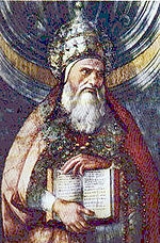
Pope Pius I

Encyclopedia
Pope Saint Pius I was Bishop of Rome, according to the Annuario Pontificio
, from 142 or 146 to 157 or 161, respectively. Others suggest that his pontificate was perhaps from 140 to 154.
, in Northern Italy, during the late 1st century. His father was called "Rufinus", who was also said to be of Aquileia according to the Liber Pontificalis
.
It is stated in the 2nd century Muratorian Canon
, and in the Liberian Catalogue
, that he was the brother of Hermas
, author of the text known as The Shepherd of Hermas
.
The writer of the later text identifies himself as a former slave
. This has led to speculation that both Hermas and Pius were freedmen.
and Marcus Aurelius. He was the ninth successor of Saint Peter
. He decreed that Easter
should only be kept on a Sunday. Although being credited with ordering the publication of the Liber Pontificalis, compilation of that document was not started before the beginning of the 6th century. He is said to have built one of the oldest churches in Rome, Santa Pudenziana
.
St Pius I endured many hardships during his reign. The fact that Saint Justin
taught Christian doctrine
in Rome during the pontificate of St Pius I and that the heretics
Valentinus, Cerdon, and Marcion visited Rome at the same time, is a strong argument for the primacy of the Roman See
during the 2nd century. Pope Pius I opposed the Valentinians and Gnostics under Marcion, whom he excommunicated
.
There is some conjecture that he was a martyr
in Rome, a conjecture that entered earlier editions of the Breviary
. The study that had produced the 1969 revision of the Roman Catholic Calendar of Saints
stated that there were no grounds for his consideration as a martyr, and he is not presented as such in the Roman Martyrology
.
it was given the rank of "Simple" and celebrated as the feast of a martyr. The rank of the feast was reduced to a Commemoration
in the 1955 General Roman Calendar of Pope Pius XII
and the General Roman Calendar of 1962
. Though no longer mentioned in the General Roman Catholic calendar of saints
, he may now, according to the rules in the present-day Roman Missal
, be celebrated everywhere on his feast day with a "Memorial", unless in some locality an obligatory celebration is assigned to that day.
Annuario Pontificio
The Annuario Pontificio is the annual directory of the Holy See. It lists all the popes to date and all officials of the Holy See's departments...
, from 142 or 146 to 157 or 161, respectively. Others suggest that his pontificate was perhaps from 140 to 154.
Early life
Pius is believed to have been born at AquileiaAquileia
Aquileia is an ancient Roman city in what is now Italy, at the head of the Adriatic at the edge of the lagoons, about 10 km from the sea, on the river Natiso , the course of which has changed somewhat since Roman times...
, in Northern Italy, during the late 1st century. His father was called "Rufinus", who was also said to be of Aquileia according to the Liber Pontificalis
Liber Pontificalis
The Liber Pontificalis is a book of biographies of popes from Saint Peter until the 15th century. The original publication of the Liber Pontificalis stopped with Pope Adrian II or Pope Stephen V , but it was later supplemented in a different style until Pope Eugene IV and then Pope Pius II...
.
It is stated in the 2nd century Muratorian Canon
Muratorian fragment
The Muratorian fragment is a copy of perhaps the oldest known list of the books of the New Testament. The fragment, consisting of 85 lines, is a 7th-century Latin manuscript bound in an eighth or 7th century codex that came from the library of Columban's monastery at Bobbio; it contains internal...
, and in the Liberian Catalogue
Liberian Catalogue
In compiling the history of the Early Christian Church, the Liberian Catalogue , which was part of the illuminated manuscript known as the Chronography of 354, is an essential document, for it consists of a list of the popes, designated bishops of Rome, ending with Pope Liberius , hence its name...
, that he was the brother of Hermas
Hermas (freedman)
Hermas was a well-to-do freedman who lived in Ancient Rome. He was a brother of Pius, Bishop of Rome about the middle of the 2nd century. He was an earnest simple-minded Christian, with little education or culture, but typical, no doubt, of many in the Church of his day. Some later writers...
, author of the text known as The Shepherd of Hermas
The Shepherd of Hermas
The Shepherd of Hermas is a Christian literary work of the 1st or 2nd century, considered a valuable book by many Christians, and considered canonical scripture by some of the early Church fathers such as Irenaeus. The Shepherd had great authority in the 2nd and 3rd centuries...
.
The writer of the later text identifies himself as a former slave
Slavery
Slavery is a system under which people are treated as property to be bought and sold, and are forced to work. Slaves can be held against their will from the time of their capture, purchase or birth, and deprived of the right to leave, to refuse to work, or to demand compensation...
. This has led to speculation that both Hermas and Pius were freedmen.
Pontificate
St Pius I governed the Church in the middle of the 2nd century during the reigns of the Emperors Antoninus PiusAntoninus Pius
Antoninus Pius , also known as Antoninus, was Roman Emperor from 138 to 161. He was a member of the Nerva-Antonine dynasty and the Aurelii. He did not possess the sobriquet "Pius" until after his accession to the throne...
and Marcus Aurelius. He was the ninth successor of Saint Peter
Saint Peter
Saint Peter or Simon Peter was an early Christian leader, who is featured prominently in the New Testament Gospels and the Acts of the Apostles. The son of John or of Jonah and from the village of Bethsaida in the province of Galilee, his brother Andrew was also an apostle...
. He decreed that Easter
Easter
Easter is the central feast in the Christian liturgical year. According to the Canonical gospels, Jesus rose from the dead on the third day after his crucifixion. His resurrection is celebrated on Easter Day or Easter Sunday...
should only be kept on a Sunday. Although being credited with ordering the publication of the Liber Pontificalis, compilation of that document was not started before the beginning of the 6th century. He is said to have built one of the oldest churches in Rome, Santa Pudenziana
Santa Pudenziana
The basilica of Santa Pudenziana is a 4th century church in Rome, dedicated to Saint Pudentiana, sister of Saint Praxedis and daughter of Saint Pudens. It is the national church of the Philippines....
.
St Pius I endured many hardships during his reign. The fact that Saint Justin
Justin Martyr
Justin Martyr, also known as just Saint Justin , was an early Christian apologist. Most of his works are lost, but two apologies and a dialogue survive. He is considered a saint by the Roman Catholic Church and the Eastern Orthodox Church....
taught Christian doctrine
Catechism
A catechism , i.e. to indoctrinate) is a summary or exposition of doctrine, traditionally used in Christian religious teaching from New Testament times to the present...
in Rome during the pontificate of St Pius I and that the heretics
Heresy
Heresy is a controversial or novel change to a system of beliefs, especially a religion, that conflicts with established dogma. It is distinct from apostasy, which is the formal denunciation of one's religion, principles or cause, and blasphemy, which is irreverence toward religion...
Valentinus, Cerdon, and Marcion visited Rome at the same time, is a strong argument for the primacy of the Roman See
Holy See
The Holy See is the episcopal jurisdiction of the Catholic Church in Rome, in which its Bishop is commonly known as the Pope. It is the preeminent episcopal see of the Catholic Church, forming the central government of the Church. As such, diplomatically, and in other spheres the Holy See acts and...
during the 2nd century. Pope Pius I opposed the Valentinians and Gnostics under Marcion, whom he excommunicated
Excommunication
Excommunication is a religious censure used to deprive, suspend or limit membership in a religious community. The word means putting [someone] out of communion. In some religions, excommunication includes spiritual condemnation of the member or group...
.
There is some conjecture that he was a martyr
Christian martyrs
A Christian martyr is one who is killed for following Christianity, through stoning, crucifixion, burning at the stake or other forms of torture and capital punishment. The word "martyr" comes from the Greek word μάρτυς, mártys, which means "witness."...
in Rome, a conjecture that entered earlier editions of the Breviary
Breviary
A breviary is a liturgical book of the Latin liturgical rites of the Catholic Church containing the public or canonical prayers, hymns, the Psalms, readings, and notations for everyday use, especially by bishops, priests, and deacons in the Divine Office...
. The study that had produced the 1969 revision of the Roman Catholic Calendar of Saints
Roman Catholic calendar of saints
The General Roman Calendar indicates the days of the year to which are assigned the liturgical celebrations of saints and of the mysteries of the Lord that are to be observed wherever the Roman Rite is used...
stated that there were no grounds for his consideration as a martyr, and he is not presented as such in the Roman Martyrology
Roman Martyrology
The Roman Martyrology is the official martyrology of the Roman Rite of the Roman Catholic Church. It provides an extensive but not exhaustive list of the saints recognized by the Church.-History:...
.
Feast day
St Pius I's feast day is celebrated on July 11. In the Tridentine CalendarTridentine Calendar
The Tridentine Calendar is the calendar of saints to be honoured in the course of the liturgical year in the official liturgy of the Roman Rite as reformed by Pope Pius V, implementing a decision of the Council of Trent, which entrusted the task to the Pope....
it was given the rank of "Simple" and celebrated as the feast of a martyr. The rank of the feast was reduced to a Commemoration
Commemoration (prayer)
In the Roman Rite, when a higher-ranked liturgical celebration impedes the celebration of a lesser one that, either permanently or by coincidence, falls on the same day, the prayer of the lower-ranked celebration is usually added to that of the higher...
in the 1955 General Roman Calendar of Pope Pius XII
General Roman Calendar of Pope Pius XII
In 1955 Pope Pius XII made several changes to the General Roman Calendar of 1954, changes that remained in force only until 1960, when Pope John XXIII, on the basis of further recommendations of the commission that Pius XII had set up, decreed a further revision of the Roman Catholic calendar of...
and the General Roman Calendar of 1962
General Roman Calendar of 1962
This article lists the feast days of the General Roman Calendar as it was in 1962, following the reforms that Pope John XXIII introduced with his motu proprio Rubricarum instructum of 23 July 1960...
. Though no longer mentioned in the General Roman Catholic calendar of saints
Roman Catholic calendar of saints
The General Roman Calendar indicates the days of the year to which are assigned the liturgical celebrations of saints and of the mysteries of the Lord that are to be observed wherever the Roman Rite is used...
, he may now, according to the rules in the present-day Roman Missal
Roman Missal
The Roman Missal is the liturgical book that contains the texts and rubrics for the celebration of the Mass in the Roman Rite of the Catholic Church.-Situation before the Council of Trent:...
, be celebrated everywhere on his feast day with a "Memorial", unless in some locality an obligatory celebration is assigned to that day.