

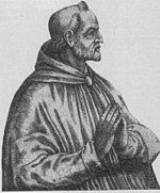
Pope John XXI

Encyclopedia
Pope John XXI, , born Pedro Julião (Latin, Petrus Iulianus (c. 1215 – May 20, 1277), a Portuguese
also called Pedro Hispano (Latin, Petrus Hispanus; English
, Peter of Spain), was Pope
from 1276 until his death about eight months later. He was the only Portuguese
Pope, although Damasus I can also be considered Portuguese, as he was born in territory that is nowadays in Portugal, and Paul IV
also had a Portuguese maternal grandmother.
He was also the only pope to have been a physician.
The previous Pope named John was Pope John XIX
(1024–32) there was no Pope John XX
.
. He started his studies at the episcopal school of Lisbon Cathedral, and later joined the University of Paris
, although some historians claim that he was educated at Montpellier
. Wherever he studied, he concentrated on medicine
, theology
, and Aristotle
's dialectic
, logic
, physics
and metaphysics
.
There are some who believe he must be identified with Peter of Spain
. On the basis of this premise, he is the person who from 1245 to 1250 became known as Pedro Hispano (because he came from Hispania
, the Iberian Peninsula), and who taught medicine at the university of Siena
, where he wrote the Summulae Logicales, a reference manual on Aristotelian logic that remained in use in European universities for more than 300 years (see Peter of Spain
for some controversies). He became famous as a university teacher, then returned to Lisbon. In the courts of Guimarães
he was the councilor and spokesman of the king Afonso III of Portugal
(1248–79) in church matters; later, becoming prior
of Guimarães. He tried to become Bishop of Lisbon
, but he was defeated. Instead, he became the master of the school of Lisbon. A notable philosopher with works in logic
, he was also the responsible for the creation of the Square of opposition
.
Pedro became the physician of Pope Gregory X
(1271–76). In March 1273 he was elected archbishop of Braga
, but did not assume that post because on June 3, 1273 Gregory X created him Cardinal-Bishop of Frascati.
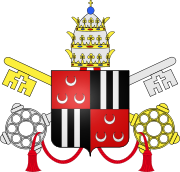 After the death of Pope Adrian V
, on August 18, 1276, Pedro Hispano was elected Pope at the conclave
of cardinals on September 13, and he was crowned a week later. One of John XXI's few acts during his brief rule was to reverse the decree recently passed at the Second Council of Lyon
(1274), which not only confined cardinals in solitude until they elected a successor Pope, but also progressively restricted their supplies of food and wine if their deliberation took too long.
Though much of John XXI's brief papacy was dominated by the powerful Cardinal Giovanni Gaetano Orsini (who succeeded him as Pope Nicholas III
), John attempted to launch a crusade for the Holy Land
, pushed for a union with the Eastern church, and did what he could to maintain peace between the Christian nations. He also launched a drive to convert the Tatars
, which came to nothing.
To secure the necessary quiet for his medicine studies, he had an apartment added to the papal palace at Viterbo, to which he could retire when he wished to work undisturbed. On 14 May 1277, while the pope was alone in this apartment, it collapsed; John was buried under the ruins, and died on 20 May in consequence of the serious injuries he had received. He was buried in the Duomo di Viterbo
where his tomb can still be seen.
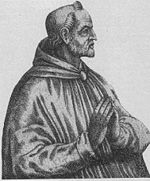 After his death, it was rumored that John XXI had actually been a magician (a suspicion frequently directed towards the preciously few scholars among medieval popes even during their papacy; cf. Sylvester II), and that he was writing a heretical treatise in the room that collapsed on him, by an Act of God
, it was inferred.
In The Divine Comedy
Dante sees John XXI (referred to as "Pietro Spano") in the Heaven of the Sun with the other spirits of great religious scholars.
, 1994). It is not clear, however, if the author of Thesaurus Pauperum was indeed the same person as Pope John XXI.
Portugal
Portugal , officially the Portuguese Republic is a country situated in southwestern Europe on the Iberian Peninsula. Portugal is the westernmost country of Europe, and is bordered by the Atlantic Ocean to the West and South and by Spain to the North and East. The Atlantic archipelagos of the...
also called Pedro Hispano (Latin, Petrus Hispanus; English
English language
English is a West Germanic language that arose in the Anglo-Saxon kingdoms of England and spread into what was to become south-east Scotland under the influence of the Anglian medieval kingdom of Northumbria...
, Peter of Spain), was Pope
Pope
The Pope is the Bishop of Rome, a position that makes him the leader of the worldwide Catholic Church . In the Catholic Church, the Pope is regarded as the successor of Saint Peter, the Apostle...
from 1276 until his death about eight months later. He was the only Portuguese
Portugal
Portugal , officially the Portuguese Republic is a country situated in southwestern Europe on the Iberian Peninsula. Portugal is the westernmost country of Europe, and is bordered by the Atlantic Ocean to the West and South and by Spain to the North and East. The Atlantic archipelagos of the...
Pope, although Damasus I can also be considered Portuguese, as he was born in territory that is nowadays in Portugal, and Paul IV
Pope Paul IV
Pope Paul IV, C.R. , né Giovanni Pietro Carafa, was Pope from 23 May 1555 until his death.-Early life:Giovanni Pietro Carafa was born in Capriglia Irpina, near Avellino, into a prominent noble family of Naples...
also had a Portuguese maternal grandmother.
He was also the only pope to have been a physician.
The previous Pope named John was Pope John XIX
Pope John XIX
Pope John XIX , born Romanus, was Pope from 1024 to 1032.He succeeded his brother, Pope Benedict VIII , both being members of the powerful house of Tusculum...
(1024–32) there was no Pope John XX
Pope John XX
There has never been a Pope John XX, because the 20th pope of this name, formerly Petrus Hispanus, when elected Pope in 1276, decided to skip the number XX and to be counted as John XXI instead...
.
Pre-papal life
Pedro Julião, born between 1210 and 1220, was probably born in LisbonLisbon
Lisbon is the capital city and largest city of Portugal with a population of 545,245 within its administrative limits on a land area of . The urban area of Lisbon extends beyond the administrative city limits with a population of 3 million on an area of , making it the 9th most populous urban...
. He started his studies at the episcopal school of Lisbon Cathedral, and later joined the University of Paris
University of Paris
The University of Paris was a university located in Paris, France and one of the earliest to be established in Europe. It was founded in the mid 12th century, and officially recognized as a university probably between 1160 and 1250...
, although some historians claim that he was educated at Montpellier
Montpellier
-Neighbourhoods:Since 2001, Montpellier has been divided into seven official neighbourhoods, themselves divided into sub-neighbourhoods. Each of them possesses a neighbourhood council....
. Wherever he studied, he concentrated on medicine
Medicine
Medicine is the science and art of healing. It encompasses a variety of health care practices evolved to maintain and restore health by the prevention and treatment of illness....
, theology
Theology
Theology is the systematic and rational study of religion and its influences and of the nature of religious truths, or the learned profession acquired by completing specialized training in religious studies, usually at a university or school of divinity or seminary.-Definition:Augustine of Hippo...
, and Aristotle
Aristotle
Aristotle was a Greek philosopher and polymath, a student of Plato and teacher of Alexander the Great. His writings cover many subjects, including physics, metaphysics, poetry, theater, music, logic, rhetoric, linguistics, politics, government, ethics, biology, and zoology...
's dialectic
Dialectic
Dialectic is a method of argument for resolving disagreement that has been central to Indic and European philosophy since antiquity. The word dialectic originated in Ancient Greece, and was made popular by Plato in the Socratic dialogues...
, logic
Logic
In philosophy, Logic is the formal systematic study of the principles of valid inference and correct reasoning. Logic is used in most intellectual activities, but is studied primarily in the disciplines of philosophy, mathematics, semantics, and computer science...
, physics
Physics
Physics is a natural science that involves the study of matter and its motion through spacetime, along with related concepts such as energy and force. More broadly, it is the general analysis of nature, conducted in order to understand how the universe behaves.Physics is one of the oldest academic...
and metaphysics
Metaphysics
Metaphysics is a branch of philosophy concerned with explaining the fundamental nature of being and the world, although the term is not easily defined. Traditionally, metaphysics attempts to answer two basic questions in the broadest possible terms:...
.
There are some who believe he must be identified with Peter of Spain
Peter of Spain
Peter of Spain or, in Latin, Petrus Hispanus is the Mediaeval author of Tractatus, later known as Summulae logicales magistri Petri Hispani , a standard textbook on logic...
. On the basis of this premise, he is the person who from 1245 to 1250 became known as Pedro Hispano (because he came from Hispania
Hispania
Another theory holds that the name derives from Ezpanna, the Basque word for "border" or "edge", thus meaning the farthest area or place. Isidore of Sevilla considered Hispania derived from Hispalis....
, the Iberian Peninsula), and who taught medicine at the university of Siena
Siena
Siena is a city in Tuscany, Italy. It is the capital of the province of Siena.The historic centre of Siena has been declared by UNESCO a World Heritage Site. It is one of the nation's most visited tourist attractions, with over 163,000 international arrivals in 2008...
, where he wrote the Summulae Logicales, a reference manual on Aristotelian logic that remained in use in European universities for more than 300 years (see Peter of Spain
Peter of Spain
Peter of Spain or, in Latin, Petrus Hispanus is the Mediaeval author of Tractatus, later known as Summulae logicales magistri Petri Hispani , a standard textbook on logic...
for some controversies). He became famous as a university teacher, then returned to Lisbon. In the courts of Guimarães
Guimarães
Guimarães Municipality is located in northwestern Portugal in the province of Minho and in the Braga District. It contains the city of Guimarães.The present Mayor is António Magalhães Silva, elected by the Socialist Party.-Parishes:-Economy:...
he was the councilor and spokesman of the king Afonso III of Portugal
Afonso III of Portugal
Afonso III , or Affonso , Alfonso or Alphonso or Alphonsus , the Bolognian , the fifth King of Portugal and the first to use the title King of Portugal and the Algarve, from 1249...
(1248–79) in church matters; later, becoming prior
Prior
Prior is an ecclesiastical title, derived from the Latin adjective for 'earlier, first', with several notable uses.-Monastic superiors:A Prior is a monastic superior, usually lower in rank than an Abbot. In the Rule of St...
of Guimarães. He tried to become Bishop of Lisbon
Patriarch of Lisbon
The Patriarch of Lisbon is an honorary title possessed by the archbishop of the Archdiocese of Lisbon.The first patriarch of Lisbon was D. Tomás de Almeida, who was appointed in 1716 by Pope Clement XI...
, but he was defeated. Instead, he became the master of the school of Lisbon. A notable philosopher with works in logic
Logic
In philosophy, Logic is the formal systematic study of the principles of valid inference and correct reasoning. Logic is used in most intellectual activities, but is studied primarily in the disciplines of philosophy, mathematics, semantics, and computer science...
, he was also the responsible for the creation of the Square of opposition
Square of opposition
In the system of Aristotelian logic, the square of opposition is a diagram representing the different ways in which each of the four propositions of the system are logically related to each of the others...
.
Pedro became the physician of Pope Gregory X
Pope Gregory X
Pope Blessed Gregory X , born Tebaldo Visconti, was Pope from 1271 to 1276. He was elected by the papal election, 1268–1271, the longest papal election in the history of the Roman Catholic Church....
(1271–76). In March 1273 he was elected archbishop of Braga
Braga
Braga , a city in the Braga Municipality in northwestern Portugal, is the capital of the Braga District, the oldest archdiocese and the third major city of the country. Braga is the oldest Portuguese city and one of the oldest Christian cities in the World...
, but did not assume that post because on June 3, 1273 Gregory X created him Cardinal-Bishop of Frascati.
Papacy and death
Pope Adrian V
Pope Adrian V , born Ottobuono de' Fieschi, was pope in 1276.-Biography:Ottobuono belonged to a feudal family of Liguria, the Fieschi, Counts of Lavagna....
, on August 18, 1276, Pedro Hispano was elected Pope at the conclave
Papal conclave
A papal conclave is a meeting of the College of Cardinals convened to elect a Bishop of Rome, who then becomes the Pope during a period of vacancy in the papal office. The Pope is considered by Roman Catholics to be the apostolic successor of Saint Peter and earthly head of the Roman Catholic Church...
of cardinals on September 13, and he was crowned a week later. One of John XXI's few acts during his brief rule was to reverse the decree recently passed at the Second Council of Lyon
Second Council of Lyon
The Second Council of Lyon was the fourteenth ecumenical council of the Catholic Church, convoked on 31 March 1272 and convened in Lyon, France, in 1274. Pope Gregory X presided over the council, called to act on a pledge by Byzantine emperor Michael VIII to reunite the Eastern church with the West...
(1274), which not only confined cardinals in solitude until they elected a successor Pope, but also progressively restricted their supplies of food and wine if their deliberation took too long.
Though much of John XXI's brief papacy was dominated by the powerful Cardinal Giovanni Gaetano Orsini (who succeeded him as Pope Nicholas III
Pope Nicholas III
Pope Nicholas III , born Giovanni Gaetano Orsini, Pope from November 25, 1277 to his death in 1280, was a Roman nobleman who had served under eight Popes, been made cardinal-deacon of St...
), John attempted to launch a crusade for the Holy Land
Holy Land
The Holy Land is a term which in Judaism refers to the Kingdom of Israel as defined in the Tanakh. For Jews, the Land's identifiction of being Holy is defined in Judaism by its differentiation from other lands by virtue of the practice of Judaism often possible only in the Land of Israel...
, pushed for a union with the Eastern church, and did what he could to maintain peace between the Christian nations. He also launched a drive to convert the Tatars
Tatars
Tatars are a Turkic speaking ethnic group , numbering roughly 7 million.The majority of Tatars live in the Russian Federation, with a population of around 5.5 million, about 2 million of which in the republic of Tatarstan.Significant minority populations are found in Uzbekistan, Kazakhstan,...
, which came to nothing.
To secure the necessary quiet for his medicine studies, he had an apartment added to the papal palace at Viterbo, to which he could retire when he wished to work undisturbed. On 14 May 1277, while the pope was alone in this apartment, it collapsed; John was buried under the ruins, and died on 20 May in consequence of the serious injuries he had received. He was buried in the Duomo di Viterbo
Duomo di Viterbo
Viterbo Cathedral is a Roman Catholic cathedral, and the principal church of the city of Viterbo, Lazio, central Italy. It is the seat of the Bishop of Viterbo and is dedicated to Saint Lawrence....
where his tomb can still be seen.
Afterlife
Act of God
Act of God is a legal term for events outside of human control, such as sudden floods or other natural disasters, for which no one can be held responsible.- Contract law :...
, it was inferred.
In The Divine Comedy
The Divine Comedy
The Divine Comedy is an epic poem written by Dante Alighieri between 1308 and his death in 1321. It is widely considered the preeminent work of Italian literature, and is seen as one of the greatest works of world literature...
Dante sees John XXI (referred to as "Pietro Spano") in the Heaven of the Sun with the other spirits of great religious scholars.
Medical works
One of the most comprehensive recipe books for pre- and post-coital contraception was written by Pedro Hispano, who offered advice on birth control and how to provoke menstruation in his immensely popular Thesaurus Pauperum (Treasure of the Poor). Many of Peter’s recipes have been found surprisingly effective by contemporary research, and it is believed that women in antiquity had more control over their reproduction than previously believed (RiddleJohn Riddle
John Riddle is an Alumni Distinguished Professor emeritus of History at North Carolina State University and a specialist in the history of medicine.His specialization is the history of drugs particularly during the classical and medieval periods....
, 1994). It is not clear, however, if the author of Thesaurus Pauperum was indeed the same person as Pope John XXI.