

Pope Alexander VIII

Encyclopedia
Pope Alexander VIII born Pietro Vito Ottoboni, was Pope
from 1689 to 1691.
family, and was the son of Marco Ottoboni, chancellor of the Republic of Venice
. His early studies were made with marked brilliancy at the University of Padua
, where, in 1627, he earned a doctorate in canon
and civil law.
(1623–44), and was made governor of Terni
, Rieti
, and Spoleto
. For fourteen years he served as auditor of the Rota
. At the request of the Venetian Republic, Ottoboni was made Cardinal-Priest of San Salvatore in Lauro
by Pope Innocent X
(1644–55) in 1652, and was later given the bishopric of Brescia
, in Venetian territory, where he quietly spent the best years of middle life.
(1643–1715) succeeded in procuring his election on 6 October 1689, as successor to Pope Innocent XI
(1676–89); nevertheless, after months of negotiation Alexander VIII finally condemned the declaration
made in 1682 by the French clergy concerning the liberties of the Gallican church.
Alexander VIII was almost an octogenarian when elected to the papacy, and lived but sixteen months, during which time little of importance was done. Louis XIV, whose political situation was now critical, profited by the peaceful dispositions of the new pope, restored Avignon
to him, and renounced the long-abused right of asylum
for the French Embassy.
, he sought to help them by reducing taxes. But this same generous nature led him to bestow on his relations the riches they were eager to accumulate; on their behalf, and to the discredit of his pontificate, he revived sinecure
offices which had been suppressed by Innocent XI. He bought the books and manuscripts of Queen Christina of Sweden
for the Vatican Library
. Alexander VIII assisted his native Venice by generous subsidies in the war against the Turks
, as well as sending seven galleys and 2,000 infantry for the campaign in Albania
.
 In 1690 he condemned the doctrines of the so-called philosophical sin
, taught in the Jesuit
schools. That year he also canonised St. John of God
.
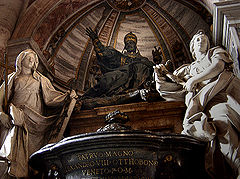
Alexander VIII died on 1 February 1691. His tomb in St. Peter's
was designed by Count Arrigo di San Martino and sculpted (1691–1725) by Angelo de' Rossi and Giuseppe Bertosi.
Pope
The Pope is the Bishop of Rome, a position that makes him the leader of the worldwide Catholic Church . In the Catholic Church, the Pope is regarded as the successor of Saint Peter, the Apostle...
from 1689 to 1691.
Early life
Pietro Ottoboni was born of a noble VenetianVenice
Venice is a city in northern Italy which is renowned for the beauty of its setting, its architecture and its artworks. It is the capital of the Veneto region...
family, and was the son of Marco Ottoboni, chancellor of the Republic of Venice
Republic of Venice
The Republic of Venice or Venetian Republic was a state originating from the city of Venice in Northeastern Italy. It existed for over a millennium, from the late 7th century until 1797. It was formally known as the Most Serene Republic of Venice and is often referred to as La Serenissima, in...
. His early studies were made with marked brilliancy at the University of Padua
University of Padua
The University of Padua is a premier Italian university located in the city of Padua, Italy. The University of Padua was founded in 1222 as a school of law and was one of the most prominent universities in early modern Europe. It is among the earliest universities of the world and the second...
, where, in 1627, he earned a doctorate in canon
Canon law
Canon law is the body of laws & regulations made or adopted by ecclesiastical authority, for the government of the Christian organization and its members. It is the internal ecclesiastical law governing the Catholic Church , the Eastern and Oriental Orthodox churches, and the Anglican Communion of...
and civil law.
Governor of Terni, Rieti and Spoleto
He went to Rome during the reign of Pope Urban VIIIPope Urban VIII
Pope Urban VIII , born Maffeo Barberini, was pope from 1623 to 1644. He was the last pope to expand the papal territory by force of arms, and was a prominent patron of the arts and reformer of Church missions...
(1623–44), and was made governor of Terni
Terni
Terni is a city in southern Umbria, central Italy, capital of the province of Terni, located in the plain of the Nera river. It is 104 km N of Rome, 36 km NW of Rieti, and 29 km S of Spoleto.-History:...
, Rieti
Rieti
Rieti is a city and comune in Lazio, central Italy, with a population of c. 47,700. It is the capital of province of Rieti.The town centre rests on a small hilltop, commanding a wide plain at the southern edge of an ancient lake. The area is now the fertile basin of the Velino River...
, and Spoleto
Spoleto
Spoleto is an ancient city in the Italian province of Perugia in east central Umbria on a foothill of the Apennines. It is S. of Trevi, N. of Terni, SE of Perugia; SE of Florence; and N of Rome.-History:...
. For fourteen years he served as auditor of the Rota
Sacra Rota Romana
The Tribunal Apostolicum Rotae Romanae — also called the Sacred Roman Rota, and anciently the Apostolic Court of Audience — is the highest appellate tribunal of the Roman Catholic Church, with respect to both Latin-rite members and the eastern-rite members and is, with respect to judicial trials...
. At the request of the Venetian Republic, Ottoboni was made Cardinal-Priest of San Salvatore in Lauro
San Salvatore in Lauro
San Salvatore in Lauro is a Catholic church in central Rome, Italy, located in the rione Ponte. It is the "national church" of the marchigiani, the inhabitants of the Marche region of Italy...
by Pope Innocent X
Pope Innocent X
Pope Innocent X , born Giovanni Battista Pamphilj , was Pope from 1644 to 1655. Born in Rome of a family from Gubbio in Umbria who had come to Rome during the pontificate of Pope Innocent IX, he graduated from the Collegio Romano and followed a conventional cursus honorum, following his uncle...
(1644–55) in 1652, and was later given the bishopric of Brescia
Bishopric of Brescia
The Diocese of Brescia is a see of the Catholic Church in Italy. The diocese is suffragan of the Archdiocese of Milan, also in Lombardy...
, in Venetian territory, where he quietly spent the best years of middle life.
Pontificate
The ambassador of Louis XIV of FranceLouis XIV of France
Louis XIV , known as Louis the Great or the Sun King , was a Bourbon monarch who ruled as King of France and Navarre. His reign, from 1643 to his death in 1715, began at the age of four and lasted seventy-two years, three months, and eighteen days...
(1643–1715) succeeded in procuring his election on 6 October 1689, as successor to Pope Innocent XI
Pope Innocent XI
Blessed Pope Innocent XI , born Benedetto Odescalchi, was Pope from 1676 to 1689.-Early life:Benedetto Odescalchi was born at Como in 1611 , the son of a Como nobleman, Livio Odescalchi, and Paola Castelli Giovanelli from Gandino...
(1676–89); nevertheless, after months of negotiation Alexander VIII finally condemned the declaration
Declaration of the Clergy of France
Under the Declaration of the Clergy of France of 1682, the following privileges were claimed by France in relation to the Holy See. They are the framework of Gallicanism, and have never been accepted by the Pope....
made in 1682 by the French clergy concerning the liberties of the Gallican church.
Alexander VIII was almost an octogenarian when elected to the papacy, and lived but sixteen months, during which time little of importance was done. Louis XIV, whose political situation was now critical, profited by the peaceful dispositions of the new pope, restored Avignon
Avignon
Avignon is a French commune in southeastern France in the départment of the Vaucluse bordered by the left bank of the Rhône river. Of the 94,787 inhabitants of the city on 1 January 2010, 12 000 live in the ancient town centre surrounded by its medieval ramparts.Often referred to as the...
to him, and renounced the long-abused right of asylum
Right of asylum
Right of asylum is an ancient juridical notion, under which a person persecuted for political opinions or religious beliefs in his or her own country may be protected by another sovereign authority, a foreign country, or church sanctuaries...
for the French Embassy.
Financial controversies
Charities on a large scale and unbounded nepotism exhausted the papal treasury, reversing the policies of his predecessor. Among the various nominations, his 22-year-old nephew Pietro was made cardinal, nephew Marco was made Duc of Fiano, and nephew Antonio Church was made general. Out of compassion for the poor of the impoverished Papal StatesPapal States
The Papal State, State of the Church, or Pontifical States were among the major historical states of Italy from roughly the 6th century until the Italian peninsula was unified in 1861 by the Kingdom of Piedmont-Sardinia .The Papal States comprised territories under...
, he sought to help them by reducing taxes. But this same generous nature led him to bestow on his relations the riches they were eager to accumulate; on their behalf, and to the discredit of his pontificate, he revived sinecure
Sinecure
A sinecure means an office that requires or involves little or no responsibility, labour, or active service...
offices which had been suppressed by Innocent XI. He bought the books and manuscripts of Queen Christina of Sweden
Christina of Sweden
Christina , later adopted the name Christina Alexandra, was Queen regnant of Swedes, Goths and Vandals, Grand Princess of Finland, and Duchess of Ingria, Estonia, Livonia and Karelia, from 1633 to 1654. She was the only surviving legitimate child of King Gustav II Adolph and his wife Maria Eleonora...
for the Vatican Library
Vatican Library
The Vatican Library is the library of the Holy See, currently located in Vatican City. It is one of the oldest libraries in the world and contains one of the most significant collections of historical texts. Formally established in 1475, though in fact much older, it has 75,000 codices from...
. Alexander VIII assisted his native Venice by generous subsidies in the war against the Turks
Ottoman Empire
The Ottoman EmpireIt was usually referred to as the "Ottoman Empire", the "Turkish Empire", the "Ottoman Caliphate" or more commonly "Turkey" by its contemporaries...
, as well as sending seven galleys and 2,000 infantry for the campaign in Albania
Albania
Albania , officially known as the Republic of Albania , is a country in Southeastern Europe, in the Balkans region. It is bordered by Montenegro to the northwest, Kosovo to the northeast, the Republic of Macedonia to the east and Greece to the south and southeast. It has a coast on the Adriatic Sea...
.
Philosophical sin
The existence of philosophical sin was a debate waged in the Roman Catholic Church in the late seventeenth century. A philosophical sin is a morally bad act which violates the natural order of reason, not the divine law...
, taught in the Jesuit
Society of Jesus
The Society of Jesus is a Catholic male religious order that follows the teachings of the Catholic Church. The members are called Jesuits, and are also known colloquially as "God's Army" and as "The Company," these being references to founder Ignatius of Loyola's military background and a...
schools. That year he also canonised St. John of God
John of God
John of God ) was a Portuguese-born friar and saint, one of Spain's leading religious figures.John of God was born João Cidade in Montemor-o-Novo, Portugal, into a once-prominent family that was impoverished but had great religious faith...
.
Alexander VIII died on 1 February 1691. His tomb in St. Peter's
St. Peter's Basilica
The Papal Basilica of Saint Peter , officially known in Italian as ' and commonly known as Saint Peter's Basilica, is a Late Renaissance church located within the Vatican City. Saint Peter's Basilica has the largest interior of any Christian church in the world...
was designed by Count Arrigo di San Martino and sculpted (1691–1725) by Angelo de' Rossi and Giuseppe Bertosi.