


Pony car

Encyclopedia
Pony car is an American
class of automobile
launched and inspired by the Ford Mustang
in 1964. The term describes an affordable, compact, highly styled car with a sporty or performance-oriented image.
in the late 1950s following the demise of the original, two-seat Ford Thunderbird
. While the Thunderbird's transformation into a larger, four-seat personal luxury car
, starting with the 1958 model year
, proved to be successful in sales terms, dealers and buyers alike lamented the loss of the two-seat Thunderbird, which served as a halo car
(image leader) for the company and a traffic-builder in showrooms, attracting buyers who would ultimately purchase more mundane automobiles. For several years Ford explored various plans for reviving some equivalent of the early Thunderbird.
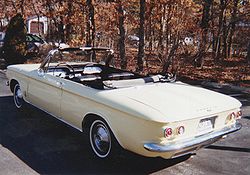 An added impetus came from Chevrolet
, with the popularity of the Chevrolet Corvair
introduced in 1960. The sporty Monza version of the Corvair was the catalyst that Ford needed to create the now instantly recognizable Mustang. The initial Corvair had been positioned as an economy car, but it was much more successful with the plusher trim and sportier image of the Monza model that included bucket seat
s and a floor-mounted transmission shifter, which sold around 144,000 units by 1961—starting a trend toward sportier cars with bucket-seats in all sizes from compacts
to full-size car
s. Ford responded to the compact Corvair Monza with sportier Futura and Futura Sprint versions of its Ford Falcon, and Chrysler
with the Plymouth Valiant Signet
and Dodge Dart GT
, as well as American Motors
(AMC) with the 440-H and Rogue versions of the Rambler American
, and Studebaker
with the sporty Daytona version of its compact Lark
. Other sporty bucket-seat compact cars that appeared during the early 1960s included the Mercury Comet
S-22, Oldsmobile F-85 Cutlass
, Buick Special
Skylark
, and Pontiac Tempest
LeMans
. Most of these sporty compacts came standard with the same economical six-cylinder engines as their more mundane counterparts, but in some cases more powerful V8 engine
s were at least optional along with four-speed manual transmission
s and center consoles
housed between the front bucket seats.
Some technical developments of the early sporty compact cars offered in the U.S. (1961–63) included a turbocharged
six-cylinder in the rear-engine Corvair Monza Spyder/Corsa (1962–66), turbocharged aluminum V8 on the 1962–63 Oldsmobile Cutlass Jetfire and a standard 194 CID four-cylinder engine mated to a rear transaxle on the 1961–63 Pontiac Tempest LeMans in several states of tune, including a four-barrel high-performance option, as well as (in 1963) a large (for a compact car) 326 CID V8 that was optional with up to 280 hp.
Although the sporty compacts were a commercial success for most automakers, some auto executives, however, principally Ford's Lee Iacocca
, believed that sporty versions of mundane compact cars only scratched the surface of the potential market. During this period there was a strong influx of young buyers with discretionary income and a taste for vehicles with a younger image than a standard sedan, and Iacocca's marketing studies revealed that if a unique-looking sporty car could be offered at an affordable price, it would find many buyers. Ford's response to this demand was the Mustang, launched on April 17, 1964, which proved to be an enormous success. The company was forecasting sales for the first year to reach 100,000 units. However, Ford dealers took 22,000 orders the first day and the company had to shift production mid-year. The extended model year sales totaled 618,812 Mustangs.
sounding Ford Mustang", and may also refer to the Ford Mustang's logo (a galloping pony).
Although the Mustang was based on the platform
of the Falcon, it had a unique body (offered as a hardtop
coupé
and a convertible
) with distinctive, "long hood, short deck" proportions. In basic form it was mechanically mundane, with a 170 CID six-cylinder engine
coupled to a three-speed manual transmission. It carried an attractive base price of US$
2,368 that included bucket seats, carpeting, floor shifter, sport steering wheel, and full wheel covers. The Mustang also had an extensive option list offering a range of V8 engines
, Cruise-O-Matic
automatic transmission
or four-speed manual gearbox, radio
s, air conditioning
, power steering
, and other accessories. A V8 Mustang with all available options would cost about 60% more than a basic model with a six-cylinder engine, which made it an extremely profitable model for Ford.
The requirements for these two-door, four passenger capacity models were therefore set:
While most of the pony cars offered more powerful engines and performance packages, enough to qualify some into muscle car
territory, a substantial number were sold with six-cylinder engines or ordinary V8s. For the most part, the high-performance models saw limited sales and were largely limited to drag racing
, road racing
, or racing homologation
purposes.

Despite the immediate success of the Mustang, many (including some within Ford) feared that the bubble would soon burst, and other manufacturers were relatively slow to respond. The first competitor was the Plymouth Barracuda
, which actually went on sale on April 1, 1964, about two weeks before the Mustang. The Barracuda was not a direct response to the Mustang, which had not yet debuted (although Chrysler was certainly aware of the upcoming model), but a low-cost way to expand the sporty appeal of the Valiant. Chrysler's precarious financial situation meant that the Barracuda was compromised, with insufficient distinction from the Valiant and styling that drew mixed reactions; its sales were a fraction of the Mustang's. It has been described that if the Barracuda was successful, as well as the similar fastback Rambler Tarpon
introduced as planned before the Mustang, the term for this class of automobile might have been "fish car," rather than "pony car." However, the Mustang, unlike the Barracuda, featured a completely unique body style from the car on which it was based (the Ford Falcon), making it the first true pony car.
Initially, General Motors believed that the restyled 1965 Corvair
would be an adequate challenger for the Mustang, but when it became clear that the Corvair itself was doomed, the more conventional Chevrolet Camaro
was introduced, going on sale for the 1967 model year
, at the time the Mustang received its first major redesign. They were also joined by the Camaro-based Pontiac Firebird
and the Mustang-based Mercury Cougar
. American Motors
joined late in 1967 with the AMC Javelin
, described by race driver Gordon Johncock
"as a roomy, comfortable, peppy and handsome example of a so-called pony car, the type of automobile that's showing up more and more on US highways." February 1968 was the introduction of AMC's two-seat AMX
at the Daytona International Speedway
. Not much bigger than European sports cars, but with purely American performance, the AMX was "a Walter Mitty
Ferrari" with a "truly distinctive long-hood/really-short-deck profile [that] nearly redefined the pony car image." The U.S. "market was filled with pony cars ... however the AMC Javelin was not the last pony car to hit the showrooms—it was Dodge
's 1970 Challenger
", an enlarged version of the Barracuda.
The pony car classification was applied to all versions of these nameplates, from the base economy models, as well as models with more equipment, features, or the "muscle" performance models. The intention of these performance models and factory support in racing was on developing a competitive marketing image for their pony cars. The automaker's marketing department's strategy was to promote a perception of these as "sports-type" muscle and performance to promote sales. The competition between the manufacturers was so fierce that the Trans-Am Series
from 1966 to 1972 is described as "The Pony Car Wars".
While sales were strong throughout the end of the 1960s, the greater value of the pony cars was in bringing buyers, particularly the crucial youth market, into the fold. In 1970 Car and Driver
reported that while very few pony car drivers bought a second pony car, around 50% moved on to purchase another car of the same make. Nevertheless, even by 1969 sales were beginning to slide, dropping to 9% of the total market, from a peak of 13% in 1967.
The success Ford experienced with the Mustang also inspired Japanese car maker Toyota to introduce the Toyota Celica
.Toyota used Ford's idea of building the Mustang on the economy car Ford Falcon
, and built the first Celica on the Toyota Carina platform. The Celica had a similar appearance to the 1968 Mustang with smaller dimensions. However, "no Asian rival has gone mano a mano with their own V-8-powered, rear-drive sporty coupes." The Japanese automakers "largely stuck with more timid 4- and 6-cylinder models, from the Toyota Celica to the Nissan 240SX
, that accentuated practicality at the expense of personality." The "4-cylinder Honda Prelude
s of 1978-2001, had no trace of the daring, danger and aggression that appeal to fans of powerful American muscle cars."
In Europe, Ford began production of the Lotus Cortina
which was then replaced with the European Ford Capri
, and GM of Europe introduced the Vauxhall Firenza
. In April 1970, Ford began selling the Capri outside Europe, in North America as the Mercury Capri
, South Africa and Australia.
The following is a list of muscle cars and their manufacturers (along with the pony car of the same company):
.jpg) As with most automobile redesigns, each subsequent generation of the pony cars grew somewhat larger, heavier, costlier, and more plush. Big-block engines joined the option list, and both performance and comfort options proliferated. The 1973 Mustang, for example, was 8.5 inches (22 cm) longer, 5.9 inches (15 cm) wider, and over 600 pounds (272 kg) heavier than the original edition. The Dodge Challenger, meanwhile, was only slightly smaller and lighter than Dodge's intermediate
As with most automobile redesigns, each subsequent generation of the pony cars grew somewhat larger, heavier, costlier, and more plush. Big-block engines joined the option list, and both performance and comfort options proliferated. The 1973 Mustang, for example, was 8.5 inches (22 cm) longer, 5.9 inches (15 cm) wider, and over 600 pounds (272 kg) heavier than the original edition. The Dodge Challenger, meanwhile, was only slightly smaller and lighter than Dodge's intermediate
cars. The added bulk left the standard six and V8 engines sorely pressed, while the introduction of powerful big-blocks underscored the limitations of the pony cars' suspension
, brake
s, and tire
s.
By 1970 buyers were moving away from the pony cars, either toward smaller compact car
s (domestic or imported) or toward larger, more luxurious models. Performance of the hottest pony cars began to erode as a result of emissions controls
and the added weight of required safety features. The 1973 oil crisis
left the bulky pony cars out of step with the marketplace.
The Challenger, Barracuda, and Javelin were cancelled after 1974, and the Camaro and Firebird nearly died at the same time, although they received last-minute stays of execution. The Cougar became an upscale personal luxury twin to the Ford Thunderbird, while the Mustang was reinvented as the Mustang II and marketed as fuel efficient compact with luxury or sporting trim packages.
, and TV programs such as The Rockford Files
and Knight Rider, the GM pony cars experienced resurgence in popularity in the late 1970s that helped ensure their continuation. The Mustang was redesigned with a renewed sporty image in 1979, prompting Mercury to reenter the pony car market with a Mercury Capri
twin based on the new Mustang. Chrysler, beset by financial problems, did not revive the pony car, although it did offer other front-wheel drive
performance models with a similar spirit. American Motors
brought back its AMX
model name to the performance-oriented I6 or V8 powered rear-drive Spirit, a similar car to the Mustang hatchback
of that era.
Sales of the Mustang remained strong, although in the 1980s Ford gave serious consideration to replacing it with a front-drive model (which eventually appeared as the Ford Probe
instead). Emissions and fuel economy concerns led many of the latter-day pony cars to offer four-cylinder engines (sometimes with turbocharging
), although they were never as popular as six-cylinder and V8 models.
By the mid 1980s, the pony car survivors (Mustang, Camaro, and Firebird) enjoyed a period of renewed popularity as progressively more and more powerful (yet relatively fuel-efficient) V8 engines were offered in performance-oriented versions of these vehicles. However, declining sales and the growing popularity of rear wheel drive light truck
s and sport utility vehicle
s ultimately led to the demise of the Camaro and Firebird after the 2002 model year.
that is affordable and capable enough to be viable. Unlike the mid-1960s, the large majority of modern compact cars are front-wheel drive, with four- and six-cylinder engines, and the widespread use of unibody construction makes engineering a specialized body an expensive proposition.
In 2005, Ford introduced a new Mustang based on a dedicated platform
which differed from classic pony cars in that it was developed from a full-size car
architecture. The success of this model inspired Dodge to reintroduce the Challenger in 2008 and Chevrolet to reintroduce the Camaro for 2010 whose platforms were also based on full-size car architectures.
NASCAR
is bringing pony cars to its second-tier Nationwide Series at the Subway 250 race at Daytona International Speedway
in Daytona, Florida, on Friday, July 2, 2010. Dodge will race its Challenger, and Ford will race the iconic Mustang. The new cars are seen as a move by NASCAR to re-establish brand identity with fans and the cars on the track. The pony cars are expected eventually to make their way to NASCAR's premier Sprint Cup Series.
United States
The United States of America is a federal constitutional republic comprising fifty states and a federal district...
class of automobile
Automobile
An automobile, autocar, motor car or car is a wheeled motor vehicle used for transporting passengers, which also carries its own engine or motor...
launched and inspired by the Ford Mustang
Ford Mustang
The Ford Mustang is an automobile manufactured by the Ford Motor Company. It was initially based on the second generation North American Ford Falcon, a compact car. Introduced early on April 17, 1964, as a "1964½" model, the 1965 Mustang was the automaker's most successful launch since the Model A...
in 1964. The term describes an affordable, compact, highly styled car with a sporty or performance-oriented image.
Origins of the breed
The pony car had its beginnings at Ford Motor CompanyFord Motor Company
Ford Motor Company is an American multinational automaker based in Dearborn, Michigan, a suburb of Detroit. The automaker was founded by Henry Ford and incorporated on June 16, 1903. In addition to the Ford and Lincoln brands, Ford also owns a small stake in Mazda in Japan and Aston Martin in the UK...
in the late 1950s following the demise of the original, two-seat Ford Thunderbird
Ford Thunderbird
The Thunderbird , is an automobile manufactured by the Ford Motor Company in the United States over eleven model generations from 1955 through 2005...
. While the Thunderbird's transformation into a larger, four-seat personal luxury car
Personal luxury car
A personal luxury car is a highly styled, luxury vehicle with an emphasis on image over practicality. Accenting the comfort and satisfaction of its owner and driver above all else, the personal luxury car sometimes sacrifices passenger capacity, cargo room, and fuel economy in favor of style and...
, starting with the 1958 model year
Model year
The model year of a product is a number used worldwide, but with a high level of prominence in North America, to describe approximately when a product was produced, and indicates the coinciding base specification of that product....
, proved to be successful in sales terms, dealers and buyers alike lamented the loss of the two-seat Thunderbird, which served as a halo car
Halo effect
The halo effect is a cognitive bias whereby one trait influences another trait or traits of that person or object. This is very common among physically attractiveness...
(image leader) for the company and a traffic-builder in showrooms, attracting buyers who would ultimately purchase more mundane automobiles. For several years Ford explored various plans for reviving some equivalent of the early Thunderbird.
Chevrolet
Chevrolet , also known as Chevy , is a brand of vehicle produced by General Motors Company . Founded by Louis Chevrolet and ousted GM founder William C. Durant on November 3, 1911, General Motors acquired Chevrolet in 1918...
, with the popularity of the Chevrolet Corvair
Chevrolet Corvair
-First generation :The 1960 Corvair 500 and 700 series four-door sedans were conceived as economy cars offering few amenities in order to keep the price competitive, with the 500 selling for under $2,000...
introduced in 1960. The sporty Monza version of the Corvair was the catalyst that Ford needed to create the now instantly recognizable Mustang. The initial Corvair had been positioned as an economy car, but it was much more successful with the plusher trim and sportier image of the Monza model that included bucket seat
Bucket seat
A bucket seat is a seat contoured to hold one person, distinct from bench seats which are flat platforms designed to seat multiple people. Bucket seats are standard in fast cars to keep riders in place when making sharp or quick turns...
s and a floor-mounted transmission shifter, which sold around 144,000 units by 1961—starting a trend toward sportier cars with bucket-seats in all sizes from compacts
Compact car
A compact car , or small family car , is a classification of cars which are larger than a supermini but smaller than or equal to a mid-size car...
to full-size car
Full-size car
A full-size car is a marketing term used in North America for an automobile larger than a mid-size car. In the United States, the EPA uses "large car" to denote full-size cars....
s. Ford responded to the compact Corvair Monza with sportier Futura and Futura Sprint versions of its Ford Falcon, and Chrysler
Chrysler
Chrysler Group LLC is a multinational automaker headquartered in Auburn Hills, Michigan, USA. Chrysler was first organized as the Chrysler Corporation in 1925....
with the Plymouth Valiant Signet
Plymouth Valiant
The Plymouth Valiant is an automobile manufactured by the Plymouth division of Chrysler Corporation in the United States from 1960 to 1976. It was created to give the company an entry in the compact car market emerging in the late 1950s...
and Dodge Dart GT
Dodge Dart
The Dodge Dart is an automobile built by the Dodge division of the Chrysler Corporation from 1960-1976 in North America, with production extended to later years in various other markets. The Dart was introduced as a lower-priced, shorter wheelbase, full-size Dodge in 1960 and 1961, became a...
, as well as American Motors
American Motors
American Motors Corporation was an American automobile company formed by the 1954 merger of Nash-Kelvinator Corporation and Hudson Motor Car Company. At the time, it was the largest corporate merger in U.S. history.George W...
(AMC) with the 440-H and Rogue versions of the Rambler American
Rambler American
The Rambler American is an automobile manufactured by the American Motors Corporation between 1958 and 1969. The American was the second incarnation of AMC's forerunner Nash Motors second-generation Rambler compact that was sold under the Nash and Hudson Motors marques from 1954 and 1955.The...
, and Studebaker
Studebaker
Studebaker Corporation was a United States wagon and automobile manufacturer based in South Bend, Indiana. Founded in 1852 and incorporated in 1868 under the name of the Studebaker Brothers Manufacturing Company, the company was originally a producer of wagons for farmers, miners, and the...
with the sporty Daytona version of its compact Lark
Studebaker Lark
The Studebaker Lark is a "compact car" which was produced by Studebaker from 1959 to 1966.From its introduction in early 1959 until 1962, the Lark was a product of the Studebaker-Packard Corporation. In mid-1962, the company dropped "Packard" from its name and reverted to its pre-1954 name, the...
. Other sporty bucket-seat compact cars that appeared during the early 1960s included the Mercury Comet
Mercury Comet
The Mercury Comet is an automobile produced by the Mercury division of the Ford Motor Company from 1960–1969 and 1971-1977 — variously as either a compact or an intermediate car.The Comet was based on the compact Ford Falcon and later the Ford Maverick...
S-22, Oldsmobile F-85 Cutlass
Oldsmobile Cutlass
The Oldsmobile Cutlass is a line of automobiles made by the Oldsmobile division of General Motors. The Cutlass began as a unibody compact car, but saw its greatest success as a body-on-frame intermediate car....
, Buick Special
Buick Special
In 1962, the Special was the first American car to use a V6 engine in volume production; it earned Motor Trends Car of the Year for 1962. This 198 in³ Fireball was engineered down from the 215 and used many of the same design parameters, but was cast in iron. Output was 135 hp at...
Skylark
Buick Skylark
The Buick Skylark was a passenger car produced by the Buick division of General Motors. The model was made in six production runs. In each run, the car design varied dramatically due to changing technology and tastes, as well as new standards implemented over the years.-1953–1954:Introduced to mark...
, and Pontiac Tempest
Pontiac Tempest
The Pontiac Tempest was an entry-level compact produced by the Pontiac Motor Division of General Motors, introduced in September 1960 for the 1961 model year....
LeMans
Pontiac LeMans
The Pontiac LeMans was a model name applied to compact and intermediate-sized automobiles offered by the Pontiac division of General Motors from 1962 to 1981. The LeMans was replaced by the downsized Pontiac Bonneville for the 1982 model year...
. Most of these sporty compacts came standard with the same economical six-cylinder engines as their more mundane counterparts, but in some cases more powerful V8 engine
V8 engine
A V8 engine is a V engine with eight cylinders mounted on the crankcase in two banks of four cylinders, in most cases set at a right angle to each other but sometimes at a narrower angle, with all eight pistons driving a common crankshaft....
s were at least optional along with four-speed manual transmission
Manual transmission
A manual transmission, also known as a manual gearbox or standard transmission is a type of transmission used in motor vehicle applications...
s and center consoles
Center console (automobile)
The center console in an automobile refers to the control-bearing surfaces in the center of the front of the vehicle interior...
housed between the front bucket seats.
Some technical developments of the early sporty compact cars offered in the U.S. (1961–63) included a turbocharged
Turbocharger
A turbocharger, or turbo , from the Greek "τύρβη" is a centrifugal compressor powered by a turbine that is driven by an engine's exhaust gases. Its benefit lies with the compressor increasing the mass of air entering the engine , thereby resulting in greater performance...
six-cylinder in the rear-engine Corvair Monza Spyder/Corsa (1962–66), turbocharged aluminum V8 on the 1962–63 Oldsmobile Cutlass Jetfire and a standard 194 CID four-cylinder engine mated to a rear transaxle on the 1961–63 Pontiac Tempest LeMans in several states of tune, including a four-barrel high-performance option, as well as (in 1963) a large (for a compact car) 326 CID V8 that was optional with up to 280 hp.
Although the sporty compacts were a commercial success for most automakers, some auto executives, however, principally Ford's Lee Iacocca
Lee Iacocca
Lido Anthony "Lee" Iacocca is an American businessman known for engineering the Mustang, the unsuccessful Ford Pinto, being fired from Ford Motor Company, and his revival of the Chrysler Corporation in the 1980s...
, believed that sporty versions of mundane compact cars only scratched the surface of the potential market. During this period there was a strong influx of young buyers with discretionary income and a taste for vehicles with a younger image than a standard sedan, and Iacocca's marketing studies revealed that if a unique-looking sporty car could be offered at an affordable price, it would find many buyers. Ford's response to this demand was the Mustang, launched on April 17, 1964, which proved to be an enormous success. The company was forecasting sales for the first year to reach 100,000 units. However, Ford dealers took 22,000 orders the first day and the company had to shift production mid-year. The extended model year sales totaled 618,812 Mustangs.
Defining the class
The 1964 Mustang provided the template for the new class of automobiles. The term itself "was coined by Dennis Shattuck, who was editor of Car Life magazine" at the time. The term "originates from the equestrianEquestrianism
Equestrianism more often known as riding, horseback riding or horse riding refers to the skill of riding, driving, or vaulting with horses...
sounding Ford Mustang", and may also refer to the Ford Mustang's logo (a galloping pony).
Although the Mustang was based on the platform
Automobile platform
An automobile platform is a shared set of common design, engineering, and production efforts, as well as major components over a number of outwardly distinct models and even types of automobiles, often from different, but related marques...
of the Falcon, it had a unique body (offered as a hardtop
Hardtop
A hardtop is a term for a rigid, rather than canvas, automobile roof. It has been used in several contexts: detachable hardtops, retractable hardtop roofs, and the so-called pillarless hardtop body style....
coupé
Coupé
A coupé or coupe is a closed car body style , the precise definition of which varies from manufacturer to manufacturer, and over time...
and a convertible
Convertible
A convertible is a type of automobile in which the roof can retract and fold away having windows which wind-down inside the doors, converting it from an enclosed to an open-air vehicle...
) with distinctive, "long hood, short deck" proportions. In basic form it was mechanically mundane, with a 170 CID six-cylinder engine
Ford Straight-6 engine
Ford's first straight-6 engine was introduced in 1906 in the Model K. Production ended in 1907. Henry Ford did not like this car, which could overpower its transmission. The next Ford six was introduced in the 1941 Ford. The Ford Motor Company of America continued producing straight six engines...
coupled to a three-speed manual transmission. It carried an attractive base price of US$
United States dollar
The United States dollar , also referred to as the American dollar, is the official currency of the United States of America. It is divided into 100 smaller units called cents or pennies....
2,368 that included bucket seats, carpeting, floor shifter, sport steering wheel, and full wheel covers. The Mustang also had an extensive option list offering a range of V8 engines
Ford Windsor engine
The Windsor is a 90-degree small-block V8 engine from Ford Motor Company. It was introduced in 1962, replacing the previous Ford Y-block engine. Though not all of the engines in this family were produced at the Windsor, Ontario engine plant , the name stuck...
, Cruise-O-Matic
Cruise-O-Matic
Ford-O-Matic was the first automatic transmission used by Ford Motor Company, designed by Borg Warner Corporation. Introduced in 1950, the three-speed Ford-O-Matic evolved into the Cruise-O-Matic in 1958 and the FMX in 1968. This line continued in production until 1980, when the AOD was introduced...
automatic transmission
Automatic transmission
An automatic transmission is one type of motor vehicle transmission that can automatically change gear ratios as the vehicle moves, freeing the driver from having to shift gears manually...
or four-speed manual gearbox, radio
Radio
Radio is the transmission of signals through free space by modulation of electromagnetic waves with frequencies below those of visible light. Electromagnetic radiation travels by means of oscillating electromagnetic fields that pass through the air and the vacuum of space...
s, air conditioning
Air conditioning
An air conditioner is a home appliance, system, or mechanism designed to dehumidify and extract heat from an area. The cooling is done using a simple refrigeration cycle...
, power steering
Power steering
Power steering helps drivers steer vehicles by augmenting steering effort of the steering wheel.Hydraulic or electric actuators add controlled energy to the steering mechanism, so the driver needs to provide only modest effort regardless of conditions. Power steering helps considerably when a...
, and other accessories. A V8 Mustang with all available options would cost about 60% more than a basic model with a six-cylinder engine, which made it an extremely profitable model for Ford.
The requirements for these two-door, four passenger capacity models were therefore set:
- Stylish and sporty styling that included "long hoods, short decksDecklidThe decklid is the cover over the trunk/boot of motor vehicles that allows access to the main storage or luggage compartment...
, and open mouths" - Assembled from "off-the-shelf" mass production components
- Affordable base price (under $2,500 — in 1965 dollar value)
- Wide range of options to individualize each car
- Youth-oriented marketingMarketingMarketing is the process used to determine what products or services may be of interest to customers, and the strategy to use in sales, communications and business development. It generates the strategy that underlies sales techniques, business communication, and business developments...
and advertisingAdvertisingAdvertising is a form of communication used to persuade an audience to take some action with respect to products, ideas, or services. Most commonly, the desired result is to drive consumer behavior with respect to a commercial offering, although political and ideological advertising is also common...
.
While most of the pony cars offered more powerful engines and performance packages, enough to qualify some into muscle car
Muscle car
Muscle car is a term used to refer to a variety of high-performance automobiles. The Merriam-Webster dictionary defines muscle cars as "any of a group of American-made 2-door sports coupes with powerful engines designed for high-performance driving." Usually, a large V8 engine is fitted in a...
territory, a substantial number were sold with six-cylinder engines or ordinary V8s. For the most part, the high-performance models saw limited sales and were largely limited to drag racing
Drag racing
Drag racing is a competition in which specially prepared automobiles or motorcycles compete two at a time to be the first to cross a set finish line, from a standing start, in a straight line, over a measured distance, most commonly a ¼-mile straight track....
, road racing
Road racing
Road racing is a general term for most forms of motor racing held on paved, purpose-built race tracks , as opposed to oval tracks and off-road racing...
, or racing homologation
Homologation
Homologation is a technical term, derived from the Greek homologeo for "to agree", which is generally used in English to signify the granting of approval by an official authority...
purposes.
Pony car competitors
Despite the immediate success of the Mustang, many (including some within Ford) feared that the bubble would soon burst, and other manufacturers were relatively slow to respond. The first competitor was the Plymouth Barracuda
Plymouth Barracuda
The Plymouth Barracuda is a 2-door car that was manufactured by the Plymouth division of the Chrysler Corporation from 1964-1974.The first-generation Barracuda, a fastback A-body coupe based on the Plymouth Valiant, had a distinctive wraparound back glass and was available from 1964-1966.The...
, which actually went on sale on April 1, 1964, about two weeks before the Mustang. The Barracuda was not a direct response to the Mustang, which had not yet debuted (although Chrysler was certainly aware of the upcoming model), but a low-cost way to expand the sporty appeal of the Valiant. Chrysler's precarious financial situation meant that the Barracuda was compromised, with insufficient distinction from the Valiant and styling that drew mixed reactions; its sales were a fraction of the Mustang's. It has been described that if the Barracuda was successful, as well as the similar fastback Rambler Tarpon
Rambler Tarpon
thumb|305px|AMC press release photo of the TarponThe Rambler Tarpon was a concept car, a sporty youth-oriented 2 plus 2 hardtop coupé developed in 1963 by American Motors Corporation .-The Tarpon:...
introduced as planned before the Mustang, the term for this class of automobile might have been "fish car," rather than "pony car." However, the Mustang, unlike the Barracuda, featured a completely unique body style from the car on which it was based (the Ford Falcon), making it the first true pony car.
Initially, General Motors believed that the restyled 1965 Corvair
Chevrolet Corvair
-First generation :The 1960 Corvair 500 and 700 series four-door sedans were conceived as economy cars offering few amenities in order to keep the price competitive, with the 500 selling for under $2,000...
would be an adequate challenger for the Mustang, but when it became clear that the Corvair itself was doomed, the more conventional Chevrolet Camaro
Chevrolet Camaro
The Chevrolet Camaro is an automobile manufactured by General Motors under the Chevrolet brand, classified as a pony car and some versions also as a muscle car. It went on sale on September 29, 1966, for the 1967 model year and was designed as a competing model to the Ford Mustang...
was introduced, going on sale for the 1967 model year
Model year
The model year of a product is a number used worldwide, but with a high level of prominence in North America, to describe approximately when a product was produced, and indicates the coinciding base specification of that product....
, at the time the Mustang received its first major redesign. They were also joined by the Camaro-based Pontiac Firebird
Pontiac Firebird
The Pontiac Firebird was built by the Pontiac division of General Motors between 1967 and 2002. The Firebird was introduced the same year as the automaker's platform-sharing model, the Chevrolet Camaro...
and the Mustang-based Mercury Cougar
Mercury Cougar
The Mercury Cougar is an automobile which was sold under the Mercury brand of the Ford Motor Company's Lincoln-Mercury Division from 1967 to 2002. The name was first used in 1967 and was carried by a diverse series of cars over the next three decades. As is common with Mercury vehicles, the Cougar...
. American Motors
American Motors
American Motors Corporation was an American automobile company formed by the 1954 merger of Nash-Kelvinator Corporation and Hudson Motor Car Company. At the time, it was the largest corporate merger in U.S. history.George W...
joined late in 1967 with the AMC Javelin
AMC Javelin
The Javelin was a production version of one of the AMC AMX prototypes shown during the 1966 AMX project nationwide tour. Intended to rival other pony cars such as the Ford Mustang and Chevrolet Camaro. American Motor's Javelin debuted on 22 August 1967, for the 1968 model year...
, described by race driver Gordon Johncock
Gordon Johncock
Gordon Johncock is a former racing driver, best known as a two-time winner of the Indianapolis 500 and the 1976 USAC Marlboro Championship Trail champion. Johncock was most often simply referred to as "Gordy."...
"as a roomy, comfortable, peppy and handsome example of a so-called pony car, the type of automobile that's showing up more and more on US highways." February 1968 was the introduction of AMC's two-seat AMX
AMC AMX
The AMC AMX is a two-seat GT in style and approach sports car that was produced by American Motors Corporation for the 1968 through 1970 model years. The AMX was also classified as a muscle car, but "unique among other American cars at the time due its short wheelbase"...
at the Daytona International Speedway
Daytona International Speedway
Daytona International Speedway is a race track in Daytona Beach, Florida, United States. Since opening in 1959, it has been the home of the Daytona 500, one of the most prestigious races in NASCAR. In addition to NASCAR, the track also hosts races of ARCA, AMA Superbike, Grand-Am and Motocross...
. Not much bigger than European sports cars, but with purely American performance, the AMX was "a Walter Mitty
Walter Mitty
Walter Mitty is a fictional character in James Thurber's short story "The Secret Life of Walter Mitty", first published in the New Yorker on March 18, 1939, and in book form in My World and Welcome to It in 1942...
Ferrari" with a "truly distinctive long-hood/really-short-deck profile [that] nearly redefined the pony car image." The U.S. "market was filled with pony cars ... however the AMC Javelin was not the last pony car to hit the showrooms—it was Dodge
Dodge
Dodge is a United States-based brand of automobiles, minivans, and sport utility vehicles, manufactured and marketed by Chrysler Group LLC in more than 60 different countries and territories worldwide....
's 1970 Challenger
Dodge Challenger
The Dodge Challenger is the name of three different generations of automobiles marketed by the Dodge division of Chrysler.The first generation Dodge Challenger was a pony car built from 1970 to 1974, using the Chrysler E platform and sharing major components with the Plymouth Barracuda. The second...
", an enlarged version of the Barracuda.
The pony car classification was applied to all versions of these nameplates, from the base economy models, as well as models with more equipment, features, or the "muscle" performance models. The intention of these performance models and factory support in racing was on developing a competitive marketing image for their pony cars. The automaker's marketing department's strategy was to promote a perception of these as "sports-type" muscle and performance to promote sales. The competition between the manufacturers was so fierce that the Trans-Am Series
Trans-Am Series
The Trans-Am Series is an automobile racing series which was created in 1966 by Sports Car Club of America President John Bishop. Originally known as the Trans-American Sedan Championship it has evolved over time from its original format as a manufacturers championship for modified racing sedans...
from 1966 to 1972 is described as "The Pony Car Wars".
While sales were strong throughout the end of the 1960s, the greater value of the pony cars was in bringing buyers, particularly the crucial youth market, into the fold. In 1970 Car and Driver
Car and Driver
Car and Driver is an American automotive enthusiast magazine. Its total circulation is 1.31 million. It is owned by Hearst Magazines, who purchased prior owner Hachette Filipacchi Media U.S. in 2011...
reported that while very few pony car drivers bought a second pony car, around 50% moved on to purchase another car of the same make. Nevertheless, even by 1969 sales were beginning to slide, dropping to 9% of the total market, from a peak of 13% in 1967.
The success Ford experienced with the Mustang also inspired Japanese car maker Toyota to introduce the Toyota Celica
Toyota Celica
The Toyota Celica name has been applied to a series of coupes made by the Japanese company Toyota. The name is ultimately derived from the Latin word coelica meaning "heavenly" or "celestial"....
.Toyota used Ford's idea of building the Mustang on the economy car Ford Falcon
Ford Falcon
The Ford Falcon is a full-size car which has been manufactured by Ford Australia since 1960. Each model from the XA series of 1972 onward has been designed, developed and built in Australia and/or New Zealand, following the phasing out of the American Falcon of 1960–71 which had been re-engineered...
, and built the first Celica on the Toyota Carina platform. The Celica had a similar appearance to the 1968 Mustang with smaller dimensions. However, "no Asian rival has gone mano a mano with their own V-8-powered, rear-drive sporty coupes." The Japanese automakers "largely stuck with more timid 4- and 6-cylinder models, from the Toyota Celica to the Nissan 240SX
Nissan 240SX
The 240SX is a two-door compact car that was introduced to the North American market by Nissan in 1988 for the following model year. It replaced the outgoing 200SX model. Most of the 240SX were equipped with the 2.4-liter inline 4 engine . The KA24E being single over-head cam and KA24DE being dual...
, that accentuated practicality at the expense of personality." The "4-cylinder Honda Prelude
Honda Prelude
The Honda Prelude was a sports coupe produced by Japanese automaker Honda from 1978 until 2001. It replaced the Honda S800, a front-engined, front wheel drive sports car...
s of 1978-2001, had no trace of the daring, danger and aggression that appeal to fans of powerful American muscle cars."
In Europe, Ford began production of the Lotus Cortina
Lotus Cortina
The Lotus-Cortina is a high-performance car, which was produced in the United Kingdom from 1963 to 1970 by the Ford in collaboration with Lotus Cars. The original version, which was based on the Ford Cortina Mark 1, was promoted by Ford as the "Consul Cortina developed by Lotus", with "Consul"...
which was then replaced with the European Ford Capri
Ford Capri
Ford Capri was a name used by the Ford Motor Company for three different automobile models. The Ford Consul Capri coupé was produced by Ford of Britain between 1961 and 1964. The Ford Capri coupé was produced by Ford of Europe from 1969 to 1986...
, and GM of Europe introduced the Vauxhall Firenza
Vauxhall Firenza
The Firenza is a model of car offered by Vauxhall Motors from May 1971 till 1975. It was a development of the Viva, but had a distinctive coupé body style and only two doors....
. In April 1970, Ford began selling the Capri outside Europe, in North America as the Mercury Capri
Mercury Capri
-First Generation :See also Ford CapriThe Mercury Capri was built in Cologne, Germany, and was sold through Lincoln-Mercury dealers in North America. The European Capri was first sold in the US in April 1970 and carried the Mercury marque identification as Ford already had a Mustang for the same...
, South Africa and Australia.
The following is a list of muscle cars and their manufacturers (along with the pony car of the same company):
Expansion and decline
Mid-size car
A mid-size car is the North American/Australian standard for an automobile with a size equal to or greater than that of a compact...
cars. The added bulk left the standard six and V8 engines sorely pressed, while the introduction of powerful big-blocks underscored the limitations of the pony cars' suspension
Suspension (vehicle)
Suspension is the term given to the system of springs, shock absorbers and linkages that connects a vehicle to its wheels. Suspension systems serve a dual purpose — contributing to the car's roadholding/handling and braking for good active safety and driving pleasure, and keeping vehicle occupants...
, brake
Brake
A brake is a mechanical device which inhibits motion. Its opposite component is a clutch. The rest of this article is dedicated to various types of vehicular brakes....
s, and tire
Tire
A tire or tyre is a ring-shaped covering that fits around a wheel rim to protect it and enable better vehicle performance by providing a flexible cushion that absorbs shock while keeping the wheel in close contact with the ground...
s.
By 1970 buyers were moving away from the pony cars, either toward smaller compact car
Compact car
A compact car , or small family car , is a classification of cars which are larger than a supermini but smaller than or equal to a mid-size car...
s (domestic or imported) or toward larger, more luxurious models. Performance of the hottest pony cars began to erode as a result of emissions controls
Air pollution
Air pollution is the introduction of chemicals, particulate matter, or biological materials that cause harm or discomfort to humans or other living organisms, or cause damage to the natural environment or built environment, into the atmosphere....
and the added weight of required safety features. The 1973 oil crisis
1973 oil crisis
The 1973 oil crisis started in October 1973, when the members of Organization of Arab Petroleum Exporting Countries or the OAPEC proclaimed an oil embargo. This was "in response to the U.S. decision to re-supply the Israeli military" during the Yom Kippur war. It lasted until March 1974. With the...
left the bulky pony cars out of step with the marketplace.
The Challenger, Barracuda, and Javelin were cancelled after 1974, and the Camaro and Firebird nearly died at the same time, although they received last-minute stays of execution. The Cougar became an upscale personal luxury twin to the Ford Thunderbird, while the Mustang was reinvented as the Mustang II and marketed as fuel efficient compact with luxury or sporting trim packages.
Later developments
Popularity was culturally promoted by such examples as the Firebird Trans Am in popular movies such as Smokey and the BanditSmokey and the Bandit
Smokey and the Bandit is a 1977 American film starring Burt Reynolds, Sally Field, Jackie Gleason, Jerry Reed, Pat McCormick, Paul Williams, and Mike Henry. It inspired several other trucking films, including two sequels, Smokey and the Bandit II, and Smokey and the Bandit Part 3...
, and TV programs such as The Rockford Files
The Rockford Files
The Rockford Files is an American television drama series which aired on the NBC network between September 13, 1974 and January 10, 1980. It has remained in regular syndication to the present day. The show stars James Garner as Los Angeles-based private investigator Jim Rockford and features Noah...
and Knight Rider, the GM pony cars experienced resurgence in popularity in the late 1970s that helped ensure their continuation. The Mustang was redesigned with a renewed sporty image in 1979, prompting Mercury to reenter the pony car market with a Mercury Capri
Mercury Capri
-First Generation :See also Ford CapriThe Mercury Capri was built in Cologne, Germany, and was sold through Lincoln-Mercury dealers in North America. The European Capri was first sold in the US in April 1970 and carried the Mercury marque identification as Ford already had a Mustang for the same...
twin based on the new Mustang. Chrysler, beset by financial problems, did not revive the pony car, although it did offer other front-wheel drive
Front-wheel drive
Front-wheel drive is a form of engine/transmission layout used in motor vehicles, where the engine drives the front wheels only. Most modern front-wheel drive vehicles feature a transverse engine, rather than the conventional longitudinal engine arrangement generally found in rear-wheel drive and...
performance models with a similar spirit. American Motors
American Motors
American Motors Corporation was an American automobile company formed by the 1954 merger of Nash-Kelvinator Corporation and Hudson Motor Car Company. At the time, it was the largest corporate merger in U.S. history.George W...
brought back its AMX
AMC AMX
The AMC AMX is a two-seat GT in style and approach sports car that was produced by American Motors Corporation for the 1968 through 1970 model years. The AMX was also classified as a muscle car, but "unique among other American cars at the time due its short wheelbase"...
model name to the performance-oriented I6 or V8 powered rear-drive Spirit, a similar car to the Mustang hatchback
Hatchback
A Hatchback is a car body style incorporating a shared passenger and cargo volume, with rearmost accessibility via a rear third or fifth door, typically a top-hinged liftgate—and features such as fold-down rear seats to enable flexibility within the shared passenger/cargo volume. As a two-box...
of that era.
Sales of the Mustang remained strong, although in the 1980s Ford gave serious consideration to replacing it with a front-drive model (which eventually appeared as the Ford Probe
Ford Probe
The Ford Probe was a coupé based on the Mazda GD platform, and powered by a 2.2 L SOHC 4 cylinder Mazda F2 engine.The first generation Probe appeared in 1988 and lasted until 1992 in the United States. In some markets the model years were from 1987 to 1991...
instead). Emissions and fuel economy concerns led many of the latter-day pony cars to offer four-cylinder engines (sometimes with turbocharging
Turbocharger
A turbocharger, or turbo , from the Greek "τύρβη" is a centrifugal compressor powered by a turbine that is driven by an engine's exhaust gases. Its benefit lies with the compressor increasing the mass of air entering the engine , thereby resulting in greater performance...
), although they were never as popular as six-cylinder and V8 models.
By the mid 1980s, the pony car survivors (Mustang, Camaro, and Firebird) enjoyed a period of renewed popularity as progressively more and more powerful (yet relatively fuel-efficient) V8 engines were offered in performance-oriented versions of these vehicles. However, declining sales and the growing popularity of rear wheel drive light truck
Light truck
Light truck or light duty truck is a U.S. classification for trucks or truck-based vehicles with a payload capacity of less than 4,000 pounds...
s and sport utility vehicle
Sport utility vehicle
A sport utility vehicle is a generic marketing term for a vehicle similar to a station wagon, but built on a light-truck chassis. It is usually equipped with four-wheel drive for on- or off-road ability, and with some pretension or ability to be used as an off-road vehicle. Not all four-wheel...
s ultimately led to the demise of the Camaro and Firebird after the 2002 model year.
21st Century revival
The dilemma facing automakers in offering pony cars (or their equivalent) going forward is developing a suitable platformAutomobile platform
An automobile platform is a shared set of common design, engineering, and production efforts, as well as major components over a number of outwardly distinct models and even types of automobiles, often from different, but related marques...
that is affordable and capable enough to be viable. Unlike the mid-1960s, the large majority of modern compact cars are front-wheel drive, with four- and six-cylinder engines, and the widespread use of unibody construction makes engineering a specialized body an expensive proposition.
In 2005, Ford introduced a new Mustang based on a dedicated platform
Ford D2C platform
The Ford D2C platform is Ford's latest rear-wheel drive automobile platform. Currently, the only vehicle using this platform is the 2005-present Ford Mustang and its Shelby derivative....
which differed from classic pony cars in that it was developed from a full-size car
Full-size car
A full-size car is a marketing term used in North America for an automobile larger than a mid-size car. In the United States, the EPA uses "large car" to denote full-size cars....
architecture. The success of this model inspired Dodge to reintroduce the Challenger in 2008 and Chevrolet to reintroduce the Camaro for 2010 whose platforms were also based on full-size car architectures.
NASCAR
NASCAR
The National Association for Stock Car Auto Racing is a family-owned and -operated business venture that sanctions and governs multiple auto racing sports events. It was founded by Bill France Sr. in 1947–48. As of 2009, the CEO for the company is Brian France, grandson of the late Bill France Sr...
is bringing pony cars to its second-tier Nationwide Series at the Subway 250 race at Daytona International Speedway
Daytona International Speedway
Daytona International Speedway is a race track in Daytona Beach, Florida, United States. Since opening in 1959, it has been the home of the Daytona 500, one of the most prestigious races in NASCAR. In addition to NASCAR, the track also hosts races of ARCA, AMA Superbike, Grand-Am and Motocross...
in Daytona, Florida, on Friday, July 2, 2010. Dodge will race its Challenger, and Ford will race the iconic Mustang. The new cars are seen as a move by NASCAR to re-establish brand identity with fans and the cars on the track. The pony cars are expected eventually to make their way to NASCAR's premier Sprint Cup Series.