


Pontifical Croatian College of St. Jerome

Encyclopedia
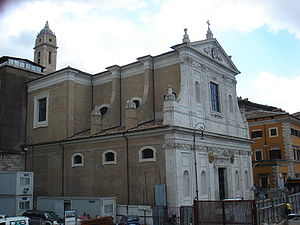
Rome
Rome is the capital of Italy and the country's largest and most populated city and comune, with over 2.7 million residents in . The city is located in the central-western portion of the Italian Peninsula, on the Tiber River within the Lazio region of Italy.Rome's history spans two and a half...
intended for the schooling of Croatia
Croatia
Croatia , officially the Republic of Croatia , is a unitary democratic parliamentary republic in Europe at the crossroads of the Mitteleuropa, the Balkans, and the Mediterranean. Its capital and largest city is Zagreb. The country is divided into 20 counties and the city of Zagreb. Croatia covers ...
n clerics. It is named after Saint Jerome
Saint Jerome
Saint Jerome is a Christian church father, best known for translating the Bible into Latin.Saint Jerome may also refer to:*Jerome of Pavia , Bishop of Pavia...
. Since the founding of the modern college in 1901, it has schooled 311 clerics from all bishoprics of Croatia.
History
In an apostolic letter Piis fidelium votis, dated March 21, 1453, Pope Nicholas VPope Nicholas V
Pope Nicholas V , born Tommaso Parentucelli, was Pope from March 6, 1447 to his death in 1455.-Biography:He was born at Sarzana, Liguria, where his father was a physician...
granted the ruinous church of St. Marina and its precicts to a brotherhood of Croatian
Croats
Croats are a South Slavic ethnic group mostly living in Croatia, Bosnia and Herzegovina and nearby countries. There are around 4 million Croats living inside Croatia and up to 4.5 million throughout the rest of the world. Responding to political, social and economic pressure, many Croats have...
priests on the Borgo San Pietro, Rome. At this location, next to the Mausoleum of Augustus
Mausoleum of Augustus
The Mausoleum of Augustus is a large tomb built by the Roman Emperor Augustus in 28 BC on the Campus Martius in Rome, Italy. The Mausoleum, now located on the Piazza Augusto Imperatore, is no longer open to tourists, and the ravages of time and carelessness have stripped the ruins bare...
on the left bank of the Tiber
Tiber
The Tiber is the third-longest river in Italy, rising in the Apennine Mountains in Emilia-Romagna and flowing through Umbria and Lazio to the Tyrrhenian Sea. It drains a basin estimated at...
, they built a refuge and a hospital, and re-dedicated the institutions to Saint Jerome
Saint Jerome
Saint Jerome is a Christian church father, best known for translating the Bible into Latin.Saint Jerome may also refer to:*Jerome of Pavia , Bishop of Pavia...
.
The brotherhood was renamed Congregatio (congregation) in 1544, and Pope Paul III
Pope Paul III
Pope Paul III , born Alessandro Farnese, was Pope of the Roman Catholic Church from 1534 to his death in 1549. He came to the papal throne in an era following the sack of Rome in 1527 and rife with uncertainties in the Catholic Church following the Protestant Reformation...
sanctioned its bylaws and awarded it a Cardinal
Cardinal (Catholicism)
A cardinal is a senior ecclesiastical official, usually an ordained bishop, and ecclesiastical prince of the Catholic Church. They are collectively known as the College of Cardinals, which as a body elects a new pope. The duties of the cardinals include attending the meetings of the College and...
as a sponsor. Pope Pius V
Pope Pius V
Pope Saint Pius V , born Antonio Ghislieri , was Pope from 1566 to 1572 and is a saint of the Catholic Church. He is chiefly notable for his role in the Council of Trent, the Counter-Reformation, and the standardization of the Roman liturgy within the Latin Church...
raised the Church of San Girolamo to the status of a Cardinal titulus on February 8, 1566. On November 20, 1570, Felice Cardinal Peretti of Montalto became its sponsor cardinal, and remained in this position until March 24, 1585 when he was made Pope Sixtus V
Pope Sixtus V
Pope Sixtus V , born Felice Peretti di Montalto, was Pope from 1585 to 1590.-Early life:The chronicler Andrija Zmajević states that Felice's family originated from modern-day Montenegro...
.
Pope Sixtus V rebuilt the church of Saint Jerome (finished in 1589), to be used specifically for the people who spoke the Illyria
Illyria
In classical antiquity, Illyria was a region in the western part of the Balkan Peninsula inhabited by the Illyrians....
n language, referring to the Croats from the eastern Adriatic, Dalmatia
Dalmatia
Dalmatia is a historical region on the eastern coast of the Adriatic Sea. It stretches from the island of Rab in the northwest to the Bay of Kotor in the southeast. The hinterland, the Dalmatian Zagora, ranges from fifty kilometers in width in the north to just a few kilometers in the south....
and Boka Kotorska. He also established the Capitol, a college of eleven Slavonic clerics at the Church, in his papal bull Sapientiam Sanctorum of August 1, 1589. He named Aleksandar Komulović (1548–1608) from Split
Split (city)
Split is a Mediterranean city on the eastern shores of the Adriatic Sea, centered around the ancient Roman Palace of the Emperor Diocletian and its wide port bay. With a population of 178,192 citizens, and a metropolitan area numbering up to 467,899, Split is by far the largest Dalmatian city and...
the first arch-priest. Between the Capitol's establishment and its abolishment in 1901, over 120 Croatian priests worked in it.
In 1598, Pope Clement VIII
Pope Clement VIII
Pope Clement VIII , born Ippolito Aldobrandini, was Pope from 30 January 1592 to 3 March 1605.-Cardinal:...
gave permission for the hospice by the church to be transformed into a clerical college, but this did not actually happen until two centuries later, when on February 27, 1790 Pope Pius VI
Pope Pius VI
Pope Pius VI , born Count Giovanni Angelo Braschi, was Pope from 1775 to 1799.-Early years:Braschi was born in Cesena...
opened a seminary
Seminary
A seminary, theological college, or divinity school is an institution of secondary or post-secondary education for educating students in theology, generally to prepare them for ordination as clergy or for other ministry...
for men who previously used the services of the St. Jerome Capitol. But even then, the seminary functioned only for brief periods without interruption: 1793-1798, 1863–1871, and finally 1884-1901, after which point the Capitol was abolished.
The College was officially founded on August 1, 1901 by Pope Leo XIII
Pope Leo XIII
Pope Leo XIII , born Vincenzo Gioacchino Raffaele Luigi Pecci to an Italian comital family, was the 256th Pope of the Roman Catholic Church, reigning from 1878 to 1903...
. His apostolic letter Slavorum gentem called it Collegium Hieronymianum pro Croatica Gente ("Hieronymian College for the Croatian people"), but after diplomatic intervention from the Kingdom of Montenegro
Montenegro
Montenegro Montenegrin: Crna Gora Црна Гора , meaning "Black Mountain") is a country located in Southeastern Europe. It has a coast on the Adriatic Sea to the south-west and is bordered by Croatia to the west, Bosnia and Herzegovina to the northwest, Serbia to the northeast and Albania to the...
, on March 7, 1902 it was renamed to Collegium Hieronymianum Illyricorum (Illyria
Illyria
In classical antiquity, Illyria was a region in the western part of the Balkan Peninsula inhabited by the Illyrians....
n Hieronymian College, San Girolamo degli Illirici in Italian).
Some Croatian priests received scholarships from the society in 1907, and in 1911 several students enrolled at the college, but this was again interrupted in 1915 due to the First World War. The College reopened after the war, as Italy and the Kingdom of Serbs, Croats and Slovenes signed the Treaty of Rome, 1924
Treaty of Rome, 1924
The Treaty of Rome of January 27, 1924 was an agreement by which Italy and the Kingdom of Serbs, Croats and Slovenes revoked the parts of the Treaty of Rapallo from 1920, which had created the independent Free State of Fiume...
and acknowledged the clerical institution under the breve Slavorum gentem. A rebuilding of the College's facilities ensued in the period between May 28, 1938 and December 10, 1939, when six existing buildings were torn down to make way for new ones. The College has functioned without interruption ever since.
By decree of Pope Paul VI
Pope Paul VI
Paul VI , born Giovanni Battista Enrico Antonio Maria Montini , reigned as Pope of the Catholic Church from 21 June 1963 until his death on 6 August 1978. Succeeding Pope John XXIII, who had convened the Second Vatican Council, he decided to continue it...
dated July 22, 1971, the College was renamed Pontificium Collegium Chroaticum Sancti Hieronymi (Pontifical Croatian College of St. Jerome), and this was accepted by Italy by decree of the President on October 11, 1982.
In 1999 the College was among the defendants in the Class action suit against the Vatican Bank and others
Class action suit against the Vatican Bank and others
Alperin v. Vatican Bank is a class action suit by Holocaust survivors against the Vatican Bank and Franciscan Order filed in San Francisco, California on November 15, 1999...
to retrieve Nazi gold
Nazi gold
Nazi gold is the gold transferred by Nazi Germany to overseas banks during the Second World War. The regime executed a policy of looting the assets of its victims to finance the war, collecting the looted assets in central depositories. The occasional transfer of gold in return for currency took...
.