
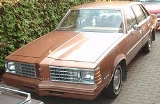
The
Pontiac LeMans was a model name applied to compact and intermediate-sized
automobileAn automobile, motor car or car is a wheeled motor vehicle used for transporting passengers, which also carries its own engine or motor...
s offered by the
PontiacPontiac is a brand of automobiles first produced in 1926, and sold in the United States, Canada, and Mexico by General Motors . Pontiac has been marketed as an "athletic" brand, specializing in mainstream performance vehicles....
division of
General MotorsGeneral Motors Company, often known as simply GM, is a United States based automaker with headquarters in Detroit, Michigan. GM was the world's 18th largest corporate entity and third largest automaker as ranked by 2008 revenues on the Fortune Global 500. Ranked by global unit sales for 2008, it...
from 1962 to 1981. The LeMans was replaced by the downsized
Pontiac BonnevilleThe Pontiac Bonneville is an automobile built by the Pontiac division of General Motors from 1957 to 2005. It was introduced as a limited production performance convertible during the 1957 model year...
for the 1982 model year. In 1988, for the 1989 model year a
badge engineeredBadge engineering is a term that describes the rebadging of one product as another. Due to the high cost of designing and engineering a totally new model, or establishing a new brand , it is often more cost-effective to rebadge a single product multiple times.The term derives from the trademark...
Daewoo LeMans was sold briefly until 1993.
1961-1963
Introduced as the top-of-the-line version of the compact
Pontiac TempestThe Pontiac Tempest was an entry-level compact automobile produced by the Pontiac Motor Division of General Motors, introduced in September 1960 for the 1961 model year. It shared the new monocoque Y platform with the Buick Special and Skylark, and Oldsmobile F-85 and Cutlass...
at the end of 1961 on GM's new
Y body platformThe Y platform, or Y body, designation has been used twice by the General Motors Corporation to describe a series of vehicles all built on the same basic body and sharing many parts and characteristics...
, the Tempest LeMans was essentially a trim package featuring sportier and more luxurious trimmings than the Tempest, including different badging and bucket seats. That year the name was used only on a two-door pillared coupe. In 1962, LeMans continued on this path, adding a convertible to the offerings and I4 4bbl carbureted engine. Though all four body styles—coupe, sedan, convertible and station wagon—were available as Tempests, there was no four-sedan or station wagon LeMans. There was also no pillarless hardtop version of either Pontiac. The next year, in 1963, the LeMans name was still used only on coupes and convertibles, but the name was officially made its own model. This would last for just one year. It's these 1963 cars of both nameplates that had the high-performance 326 CID V8 option (actually 336 cid for that one year only) and specially modified versions of them became the Super Duty cars of racing lore.
1964-1969
The Tempest line was upsized to an intermediate-sized car on the new
GM A platformThe General Motors A platform was a rear wheel drive mid-size car automobile platform designation used from 1964 to 1981...
in 1964, and the LeMans returned to its role of Tempest trim upgrade with a new 215 CID six-cylinder and a redesigned 326 CID V8 (now actually 326 CID). Shortly after the start of the 1964 model year, the LeMans became available with a new
performance packageA performance package is a set of functional enhancements to the driveline of a vehicle, sold and priced as a unit.This package may contain one or more of the following enhancements*Greater engine torque*Greater engine power...
designated as the
GTOGTO is an abbreviation of:* A gate turn-off thyristor*Geographic targeting order, an order issued by the United States Secretary of Treasury* Geostationary transfer orbit, an intermediate orbit around the Earth...
, or Gran Turismo Omologato. The GTO option was priced at just under US$300 and included a larger 389 CID V8 from the full-sized Pontiac line that put out 325 or 335 hp, a four-speed floor shift Muncie
manual transmissionA manual transmission, or manual gearbox is a type of transmission used in motor vehicle applications...
with
HurstHurst Performance Inc. of Warminster, Pennsylvania, manufactured products for enhancing the performance of muscle cars. These included manual transmission shifters and other automobile components...
shifter, heavy-duty suspension, red-line Tiger Paw tires, and GTO nameplates. GTO sales ended up at 32,000 for the first year, well beyond initial estimates of 5,000 units and accounted for a large share of Tempest/LeMans sales. The success and the image of the GTO helped increase sales of lesser Tempest and LeMans models in the coming years, placing the Pontiac brand into third place in total industry sales after
ChevroletChevrolet is a brand of automobile produced by General Motors Company . Founded by Louis Chevrolet and ousted GM founder William C. Durant in 1911, Chevrolet was acquired by General Motors in 1917...
and
FordThe Ford Motor Company is an American multinational corporation based in Dearborn, Michigan, a suburb of Detroit. The automaker was founded by Henry Ford and incorporated on June 16, 1903. In addition to the Ford, Lincoln, and Mercury brands, Ford also owns Volvo Cars of Sweden, and a small stake...
.
The GTO became a separate model of its own for 1966, though retaining the same basic body as the
TempestThe Pontiac Tempest was an entry-level compact automobile produced by the Pontiac Motor Division of General Motors, introduced in September 1960 for the 1961 model year. It shared the new monocoque Y platform with the Buick Special and Skylark, and Oldsmobile F-85 and Cutlass...
and LeMans models. For 1966, all Pontiac intermediates got swoopier styling featuring tunnelback rooflines on two door hardtop and pillared coupes. While the GTO continued as a big-engined muscle car, the Tempest and LeMans models got a new SOHC 230 cubic inch six-cylinder engine as the base engine. The new SOHC I6, the brainchild of Pontiac Chief Engineer
John De LoreanJohn Zachary DeLorean was an American engineer and executive in the U.S. automobile industry, and founder of the DeLorean Motor Company....
(who became Pontiac's general manager in 1965), was available in an economical one-barrel carbureted, 165 hp version that was standard equipment on all Pontiac intermediates except GTOs. Optional on all Tempest and LeMans models except station wagons was a Sprint package that included a hopped-up four-barrel version of the 230 CID OHC six that also included higher compression ratio and hotter cam, resulting in 215 horse power, along with an "all-syncro" floor-mounted three-speed
automatic transmissionAn automatic transmission is an automobile gearbox that can change gear ratios automatically as the vehicle moves, freeing the driver from having to shift gears manually...
with Hurst shifter, suspension kit, and body striping. Those who preferred a V8 engine could get either the base two-barrel 326 CID V8 rated at 250 hp (the most popular Tempest/LeMans engine) or a 285 hp four-barrel 326 HO V8 with higher compression ratio, high performance cam and dual exhausts.
The Sprint-optioned Tempest and LeMans models were not very popular during the mid-to-late 1960s as they were greatly outsold by the bigger-engined GTO that was heating up the muscle car wars. Buyers of regular Tempest and LeMans models definitely preferred V8 power, as the 326 and later 350 CID V8s were the most ordered engines. The Sprint option and SOHC six-cylinder engine were discontinued after 1969 with an ordinary Chevrolet-built 250 CID
OHVAn overhead valve engine, also informally called pushrod engine or I-head engine, is a type of piston engine that places the camshaft within the cylinder block , and uses pushrods or rods to actuate rocker arms above the cylinder...
six-cylinder engine, becoming the base engine from 1970 to 1976 in most Pontiac intermediates.
Initially, the LeMans included a pillared coupe and convertible for 1962 and 1963 as no hardtops were offered in the compact Tempest. For 1964, a hardtop coupe was added followed by a four-door pillared sedan in 1965, which was replaced by a four-door hardtop in 1966 and a four-door Safari
station wagonA station wagon is a passenger automobile with a body style similar to a sedan, or saloon, but with the roofline following the full, sometimes extended rear cargo area and sometimes an extra row of sometimes rear-facing seats, ending with a more vertical door than on a hatchback.Also sometimes...
in 1968. Generally, the four-door and
station wagonA station wagon is a passenger automobile with a body style similar to a sedan, or saloon, but with the roofline following the full, sometimes extended rear cargo area and sometimes an extra row of sometimes rear-facing seats, ending with a more vertical door than on a hatchback.Also sometimes...
models were differentiated from the coupes and convertibles by featuring conventional bench seats or notch-back bench seats with folding armrests as opposed to the Strato buckets seats standard in coupes and convertibles. Other LeMans upgrades over lesser Tempests included carpeted lower door panels, deluxe steering wheels, courtesy lighting, and full
wheel coversA hubcap, wheel cover or wheel trim is a decorative disk on an automobile wheel that covers at least a central portion of the wheel. Cars with stamped steel wheels often use a full wheel cover that conceals the entire wheel...
.
1970-1972
For 1970, Pontiac reshuffled its intermediate lineup a bit with the LeMans nameplate downgraded to the mid-line sub-series previously known as the Tempest Custom and included two and four-door pillared sedans, while the previous top-shelf LeMans series was renamed the LeMans Sport in the same three body styles including a four-door hardtop sedan, two-door hardtop
coupeA coupé or coupe is a closed car body style, the precise definition of which varies from manufacturer to manufacturer, and over time...
and
convertibleA convertible is a type of automobile in which the roof can retract and fold away, converting it from an enclosed to an open-air vehicle. Many different automobile body styles are manufactured and marketed in convertible form....
. This year, bigger
enginesThe internal combustion engine is an engine in which the combustion of a fuel occurs with an oxidizer in a combustion chamber. In an internal combustion engine the expansion of the high temperature and pressure gases, which are produced by the combustion, directly applies force to a movable...
- which had previously reserved for GTOs - were made available on lesser Tempest/LeMans models including a 400 CID V8 rated at 265 hp with a two-barrel carburetor or a 330 hp option with a four-barrel carburetor and dual exhausts.
In 1971, the Tempest nameplate was completely retired and Pontiac promoted the LeMans nameplate to full-series status to identify all of its intermediate models, which still included the GTO. At the bottom of the line was the Pontiac T-37, previously known as the Tempest.
For 1972, all Pontiac intermediates were now LeMans models and the low-priced T-37 line was replaced by a stripped LeMans pillared coupe. The top-line intermediate was the Luxury LeMans, available in hardtop sedan and coupe models, featuring plusher interiors than regular LeMans models. The LeMans Sport was available as a two-door hardtop or convertible featuring Strato bucket seats and plush interior fittings from the Luxury LeMans.
In the
film adaptationThe French Connection is a 1971 American crime film directed by William Friedkin. The film was adapted and fictionalized by Ernest Tidyman from the non-fiction book by Robin Moore. It tells the story of New York Police Department detectives named "Popeye" Doyle and Buddy Russo, whose real-life...
of
The French ConnectionThe French Connection: A True Account of Cops, Narcotics, and International Conspiracy is a non-fiction book by Robin Moore first published in 1969 about the notorious "French Connection" drug trafficking scheme. It is followed by the book The Setup...
, Jimmy "Popeye" Doyle commandeered a 1971 LeMans sedan from a citizen. He then used it to chase an overhead train at high speed through the streets of
New YorkNew York is the most populous city in the United States, and the center of the New York metropolitan area, which is among the most populous urban areas in the world. A leading global city, New York exerts a powerful influence over worldwide commerce, finance, culture, fashion and entertainment...
, in what is widely considered one of the most exciting film chases in cinema history.
1973-1977
From 1973 to 1977, the LeMans and other GM intermediates were much larger in size than previous models due to evolutionary changes that resulted in larger cars year after year and federally-mandated 5 mph crash bumpers that added weight and length. During this period, Pontiac's intermediate lineup included the base LeMans, LeMans Sport Coupe,
GTOThe Pontiac GTO is an automobile built by Pontiac in the United States from 1964 to 1974, and by Holden in Australia from 2004 to 2006. It is often considered the first true muscle car. From 1964 until midway through 1973 it was closely related to the Pontiac Tempest and for the 1974 model year it...
(1973 only), Luxury LeMans (became the Grand LeMans in 1975), the Euro-styled
Grand AmThe Pontiac Grand Am was originally a mid-size car and later a compact car that was produced by the Pontiac division of General Motors. The Grand Am had two separate 3-year runs in the '70s: from 1973 to 1975 and again from 1978 to 1980. It was based on the GM A platform. Production of the Grand Am...
from 1973 to 1975, and the 1977
Can AmThe Pontiac Can Am was a mid size muscle car based on the LeMans. It was a special edition option package, and was only available in 1977.-Background:...
. Body styles were all based on GM's Colonnade hardtop design for both sedans and coupes (no convertibles offered after 1972) that included center pillars for improved rollover safety standards but eliminated true hardtop design, along with frameless windows similar to a hardtop.
1978-1981
In 1978, the LeMans and other GM mid-sized cars were considerably downsized and lost some 600-800 lb in the process, as part of GM's corporate downsizing program to reduce the size and weight of its automobiles in the aftermath of the Arab Oil Embargo induced energy crisis of 1973 to 1974. Engines were downsized as well with engine options reduced to a standard Buick-built 231 CID V6 or an optional Pontiac-built 301 CID V8 for 1978 (some 1978s, the Grand LeMans for sure, were available with the GM small block 5 liter 305 CID motor), compared to larger 350, 400 and 455 CID V8s offered in previous years. From 1978 to 1980, Pontiac's mid-sized lineup included the base LeMans, Grand LeMans and a revived Grand Am that was much more suited in size and concept as a Euro-style sport sedan than the larger 1973 to 1975 models. The Grand Am in this guise was not a tremendous seller as a sedan or coupe. Only a coupe was offered in 1980 before that nameplate was discontinued and mothballed for a few years before the Grand Am name was revived again for 1985 as a new compact car, the form which the Grand Am would take for the next two decades until it was replaced by the
Pontiac G6The Pontiac G6 is a mid-size car produced under the Pontiac brand of American automaker General Motors. It was introduced in the fall of 2004 to replace the Grand Am...
in 2005.
The final year for the mid-sized LeMans was 1981, with the station wagon dropped and only the base and Grand LeMans models offered initially and joined at mid-year by a new
LJ trim level positioned between the base and Grand models. The car was given a new slanted nose which made the 2 door coupe popular in
NASCARThe National Association for Stock Car Auto Racing is a family-owned and operated business venture that sanctions and governs multiple auto racing sports events. It was founded by Bill France Sr. in 1947-48. As of 2009, the CEO for the company is Brian France, grandson of the late Bill France Sr...
, especially as a superspeedway race car in 1981, which was the first year these cars were used in the series. The car had such an aerodynamic advantage over every other body style racable at the time that NASCAR stepped in and reduced the allowable rear spoiler area to a point that made the car dangerous to run on the big tracks. This resulted to most (though not all) of the teams moving to other makes, mostly
Buick RegalThe Buick Regal is a mid-size car introduced by General Motors in 1973. North American production ended in 2004, but the model continued in China...
s. A LeMans driven by Cale Yarborough did win the 1983
Daytona 500The Daytona 500 is a -long NASCAR Sprint Cup Series race held annually at the Daytona International Speedway in Daytona Beach, Florida. It is one of four restrictor plate races on the Cup schedule. Matt Kenseth is the defending champion of the race....
however, and also in the summer of 1983 Tim Richmond won in a LeMans at the
Pocono 500The Pocono 500 is the first of two stock car races held at the Pocono Raceway in Long Pond, Pennsylvania, on the NASCAR Sprint Cup schedule in mid-June, the other being the Pennsylvania 500, usually held in July. The Pocono 500 replaced a 400-mile race at Texas World Speedway on NASCAR's schedule...
. Engine offerings by this time included
BuickBuick is a marque of automobile sold in the United States, Canada, Mexico, China, Taiwan, Qatar, Kuwait, and Israel by General Motors Company...
's 231 CID V6, Pontiac's 4.3 L 265 CID V8, Pontiac's 301 CID V8, Chevrolet's 305 CID V8 (for
CaliforniaCalifornia is the most populous state in the United States, and the third largest by area. California is the second most populous sub-national entity in the Americas, behind only São Paulo, Brazil...
only) and
OldsmobileOldsmobile was a brand of automobile produced for most of its existence by General Motors. It was founded by Ransom E. Olds in 1897. In its 107-year history, it produced 35.2 million cars, including at least 14 million built at its Lansing, Michigan factory...
's 350 CID diesel V8.
For 1982, Pontiac dropped the LeMans nameplate for its mid-size car, rebadging it as the
BonnevilleThe Pontiac Bonneville is an automobile built by the Pontiac division of General Motors from 1957 to 2005. It was introduced as a limited production performance convertible during the 1957 model year...
, which had denoted the division's top-line full-sized cars for many years until the division discontinued all of its big cars after 1981. The LeMans-cum-Bonneville was reduced to one trim line in four-door and Safari wagon models and offered no Pontiac engines as the division discontinued V8 production after 1981 to concentrated on Iron Duke
four-cylinderThe inline-four engine or straight-four engine is a four-cylinder internal combustion engine with all four cylinders mounted in a straight line, or plane along the crankcase. The single bank of cylinders may be oriented in either a vertical or an inclined plane with all the pistons driving a...
engines for GM's smaller cars. The engine lineup now consisted of the Buick V6 or Chevrolet 305 V8, along with the Olds 350 diesel. The mid-sized Bonneville wagon was dropped after 1983 while the sedan lingered until 1986. For 1987, the Bonneville nameplate was moved to a slightly larger front-wheel drive full-sized sedan that shared its
basic platformThe H platform, or H-body designates a General Motors front wheel drive full-sized automobile platform beginning in 1986. It is related to the C, G and K plaforms....
with the
Buick LeSabreThe Buick LeSabre is a full-size car made by the Buick division of General Motors from 1959-2005. For many years, the LeSabre was considered the entry level full-size Buick, carrying the lowest base price in the Buick lineup...
and Oldsmobile Delta 88.
1988-1993
The Pontiac LeMans was the subcompact car Daewoo LeMans manufactured by Daewoo Motors in
South KoreaSouth Korea, officially the Republic of Korea and often simply referred to as Korea, is a country in East Asia, located on the southern half of the Korean Peninsula. It is neighbored by China to the west, Japan to the east, and North Korea to the north. Its capital is Seoul, the second largest...
between 1986 and 1994, although LeMans sales ended in 1993. It was only available as a two door coupe and as a four door sedan. The LeMans took its underpinnings from a European Opel design. In the case of the LeMans, the GM T platform-based
Opel KadettThe Opel Kadett is a small family car produced by the German automaker Opel between 1937 and 1940, then from 1962 to 1992.Delta in South Africa used the Opel Kadett name until 1999.-First generation :...
E was the donor vehicle—badge engineered in the form of the LeMans, and later the facelifted Daewoo Cielo. In markets outside of South Korea, the car bore the Asüna GT, Asüna SE, Daewoo 1.5i, Daewoo Fantasy, Daewoo Pointer, Daewoo Racer, and Passport Optima names.
External links