


Polyptych

Encyclopedia
Panel painting
A panel painting is a painting made on a flat panel made of wood, either a single piece, or a number of pieces joined together. Until canvas became the more popular support medium in the 16th century, it was the normal form of support for a painting not on a wall or vellum, which was used for...
) which is divided into sections, or panels. The terminology that follows is in relevance to the number of panels integrated into a particular piece of work: "diptych
Diptych
A diptych di "two" + ptychē "fold") is any object with two flat plates attached at a hinge. Devices of this form were quite popular in the ancient world, wax tablets being coated with wax on inner faces, for recording notes and for measuring time and direction.In Late Antiquity, ivory diptychs with...
" describes a two-part work of art; "triptych
Triptych
A triptych , from tri-= "three" + ptysso= "to fold") is a work of art which is divided into three sections, or three carved panels which are hinged together and can be folded shut or displayed open. It is therefore a type of polyptych, the term for all multi-panel works...
" describes a three-part work; "tetraptych" describes 4 parts; "pentaptych" describes 5 parts; "hexaptych" describes 6 parts; "heptaptych" describes 7 parts; and "octaptych" is the term used for an eight-part, or eight-panel, work of art.
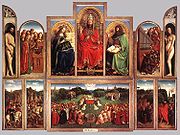
Polyptychs typically display one "central" or "main" panel that is usually the largest of the attachments, while the other panels are called "side" panels, or "wings." Sometimes, as evident in the Ghent and Isenheim works, the hinged panels can be varied in arrangement to show different "views" or "openings" in the piece.
Polyptychs were most commonly created by early Renaissance
Renaissance
The Renaissance was a cultural movement that spanned roughly the 14th to the 17th century, beginning in Italy in the Late Middle Ages and later spreading to the rest of Europe. The term is also used more loosely to refer to the historical era, but since the changes of the Renaissance were not...
painters, the majority of which designed their works to be altarpiece
Altarpiece
An altarpiece is a picture or relief representing a religious subject and suspended in a frame behind the altar of a church. The altarpiece is often made up of two or more separate panels created using a technique known as panel painting. It is then called a diptych, triptych or polyptych for two,...
s in churches and cathedral
Cathedral
A cathedral is a Christian church that contains the seat of a bishop...
s. The polyptych form of art was also quite popular among ukiyo-e
Ukiyo-e
' is a genre of Japanese woodblock prints and paintings produced between the 17th and the 20th centuries, featuring motifs of landscapes, tales from history, the theatre, and pleasure quarters...
printmakers of Edo period
Edo period
The , or , is a division of Japanese history which was ruled by the shoguns of the Tokugawa family, running from 1603 to 1868. The political entity of this period was the Tokugawa shogunate....
Japan.
The term polyptych can also refer to certain medieval manuscripts, particularly of Carolingian works, in which the columns on the page are framed with borders that resemble polyptych paintings. Another meaning of the word may also refer collectively to all multi-panel paintings; it refers not only to a style of art, but also refers to an altar display.
Examples
- The Stefaneschi Polyptych, c. 1320, by Giotto
- The Ghent AltarpieceGhent AltarpieceThe Ghent Altarpiece or Adoration of the Mystic Lamb is a very large and complex Early Netherlandish polyptych panel painting which is considered to be one of Belgium's masterpieces and one of the world's treasures.It was once in the Joost Vijdt chapel at Saint Bavo Cathedral, Ghent, Belgium, but...
, completed in 1432 by Hubert van EyckHubert van EyckHubert van Eyck was a Flemish painter and older brother of Jan van Eyck. He was probably born in Maaseik, Flanders, now in Belgium....
and Jan van EyckJan van EyckJan van Eyck was a Flemish painter active in Bruges and considered one of the best Northern European painters of the 15th century.... - The Isenheim AltarpieceIsenheim AltarpieceThe Isenheim Altarpiece is an altarpiece painted by the German artist Matthias Grünewald in 1506-1515. It is on display at the Unterlinden Museum at Colmar, Alsace, now in France....
by Matthias GrünewaldMatthias GrünewaldMatthias Grünewald or "Mathis" , "Gothart" or "Neithardt" , , was a German Renaissance painter of religious works, who ignored Renaissance classicism to continue the expressive and intense style of late medieval Central European art into the 16th century.Only ten paintings—several consisting... - The Saint Vincent PanelsSaint Vincent PanelsThe Saint Vincent Panels, or The 'Adoration of Saint Vincent' panels, are a polyptych consisting of six panels that were painted in the 1460s. They are attributed to the Portuguese painter Nuno Gonçalves who was active from 1450 to 1471...
(1470–1480) by Nuno GonçalvesNuno GonçalvesNuno Gonçalves was a 15th century Portuguese artist credited for the painting of the paineis de São Vicente de Fora . The panels depict the main elements of Portuguese society in the 15th century: clergy, nobility and common people.... - Polyptych of the Misericordia (1445–1462) by Piero della FrancescaPiero della FrancescaPiero della Francesca was a painter of the Early Renaissance. As testified by Giorgio Vasari in his Lives of the Artists, to contemporaries he was also known as a mathematician and geometer. Nowadays Piero della Francesca is chiefly appreciated for his art. His painting was characterized by its...
- The Last Judgment Polyptych (1450) by Rogier van der Weyden
- Saint Augustine Polyptych (1470) by Perugino
- The Demidoff Altarpiece (1476), by Carlo CrivelliCarlo CrivelliCarlo Crivelli was an Italian Renaissance painter of conservative Late Gothic decorative sensibility, who spent his early years in the Veneto, where he absorbed influences from the Vivarini, Squarcione and Mantegna...
- St. Dominic Polyptych (1506–1508) by Lorenzo LottoLorenzo LottoLorenzo Lotto was a Northern Italian painter draughtsman and illustrator, traditionally placed in the Venetian school. He painted mainly altarpieces, religious subjects and portraits...