


Polyphonic song of Epirus

Encyclopedia
Epirus
The name Epirus, from the Greek "Ήπειρος" meaning continent may refer to:-Geographical:* Epirus - a historical and geographical region of the southwestern Balkans, straddling modern Greece and Albania...
is a form of traditional folk polyphony
Polyphony
In music, polyphony is a texture consisting of two or more independent melodic voices, as opposed to music with just one voice or music with one dominant melodic voice accompanied by chords ....
practiced among Greeks
Greeks
The Greeks, also known as the Hellenes , are a nation and ethnic group native to Greece, Cyprus and neighboring regions. They also form a significant diaspora, with Greek communities established around the world....
, Albanians
Albanians
Albanians are a nation and ethnic group native to Albania and neighbouring countries. They speak the Albanian language. More than half of all Albanians live in Albania and Kosovo...
, Aromanians
Aromanians
Aromanians are a Latin people native throughout the southern Balkans, especially in northern Greece, Albania, the Republic of Macedonia, Bulgaria, and as an emigrant community in Serbia and Romania . An older term is Macedo-Romanians...
and Macedonian Slavs in southern Albania and northwestern Greece
Greece
Greece , officially the Hellenic Republic , and historically Hellas or the Republic of Greece in English, is a country in southeastern Europe....
.
The polyphonic song of Epirus is not to be confused with other varieties of polyphonic singing, such as the yodeling
Yodeling
Yodeling is a form of singing that involves singing an extended note which rapidly and repeatedly changes in pitch from the vocal or chest register to the falsetto/head register; making a high-low-high-low sound.The English word yodel is derived from a German word jodeln meaning "to...
songs of the region of Muotatal
Switzerland
Switzerland name of one of the Swiss cantons. ; ; ; or ), in its full name the Swiss Confederation , is a federal republic consisting of 26 cantons, with Bern as the seat of the federal authorities. The country is situated in Western Europe,Or Central Europe depending on the definition....
, or the Cantu a tenore of Sardinia
Sardinia
Sardinia is the second-largest island in the Mediterranean Sea . It is an autonomous region of Italy, and the nearest land masses are the French island of Corsica, the Italian Peninsula, Sicily, Tunisia and the Spanish Balearic Islands.The name Sardinia is from the pre-Roman noun *sard[],...
.
In Greece
Among GreeksGreeks
The Greeks, also known as the Hellenes , are a nation and ethnic group native to Greece, Cyprus and neighboring regions. They also form a significant diaspora, with Greek communities established around the world....
, polyphonic song is found in the northwestern Greek region of Ioannina
Ioannina
Ioannina , often called Jannena within Greece, is the largest city of Epirus, north-western Greece, with a population of 70,203 . It lies at an elevation of approximately 500 meters above sea level, on the western shore of lake Pamvotis . It is located within the Ioannina municipality, and is the...
(villages of Ano Pogoni
Ano Pogoni
Ano Pogoni is a former municipality in the Ioannina peripheral unit, Epirus, Greece. Since the 2011 local government reform it is part of the municipality Pogoni, of which it is a municipal unit. Population 1,663...
) Parakalamos
Ano Kalamas
Ano Kalamas is a former municipality in the Ioannina peripheral unit, Epirus, Greece. Since the 2011 local government reform it is part of the municipality Pogoni, of which it is a municipal unit. Population 3,070 . The seat of the municipality was in Parakalamos....
and some villages north of Konitsa
Konitsa
Konitsa is a town in Epirus, Greece, near the Albanian border. It lies amphi-theatre shaped on a mountain slope of the Pindos mountain range, overlooking the valley where the river Aoos meets the river Voidomatis. The valley is used for farming. Konitsa is a regional centre for many small Pindos...
), in very few villages in northeastern Thesprotia
Thesprotia
Thesprotia is one of the regional units of Greece. It is part of the Epirus region. Its capital is the town of Igoumenitsa. It is named after the Thesprotians, an ancient Greek tribe that inhabited the region in antiquity.-History:...
(Tsamantas
Tsamantas
Tsamantas is a village located in Epirus. Tsamantas lies near to the border with Albania in northern Greece, in the prefecture of Thesprotia. Indeed, the border is visible from the high lofts that are Tsamantas....
, Lias
Lias
Lias may refer to:*In geology:**The Lias Group, a group in the stratigraphy of Great Britain, formed during the Late Triassic to Early Jurassic epochs. It includes the Blue Lias and White Lias...
, Vavouri, Povla) and mainly among the Greek minorities in southern Albania (Northern Epirus
Northern Epirus
Northern Epirus is a term used to refer to those parts of the historical region of Epirus, in the western Balkans, that are part of the modern Albania. The term is used mostly by Greeks and is associated with the existence of a substantial ethnic Greek population in the region...
), for instance in the Greek-speaking
Greek language
Greek is an independent branch of the Indo-European family of languages. Native to the southern Balkans, it has the longest documented history of any Indo-European language, spanning 34 centuries of written records. Its writing system has been the Greek alphabet for the majority of its history;...
villages such as Delvinë
Delvinë
Delvinë is a small town in Vlorë County in southern Albania, 16 km northeast of Saranda. Delvinë is the seat of the Delvinë District. Delvinë has lost over a third of its citizens since 1990, having a population of 4,200 .The city is built on a mountain slope...
, Dropull
Dropull
Dropull is a predominantly Greek-inhabited region in Gjirokastër District, in southern Albania. The region stretches from south of the city of Gjirokastër to the Greek-Albanian border, along the Drinos river. The region's villages are part of the Greek "minority zone" recognized by the Albanian...
, Pogon
Pogon, Albania
Pogon is a municipality in the Gjirokastër District, Gjirokastër County, southern Albania. It consists of seven villages: Poliçan, Skore, Hllomo, Sopik, Mavrojer, Çatistë and Selckë, of which Poliçan is the administrative center. Greek is widely spoken in the villages.Historically each village of...
(Kato Pogoni), Poliçan, Himara and the cities of Sarandë
Sarandë
Sarandë or Saranda is the capital of the District of Sarandë, Albania, and is one of the most important tourist attractions of the Albanian Riviera. It is situated on an open sea gulf of the Ionian Sea in the Mediterranean 2 nautical miles from the Greek island of Corfu. The city of Saranda has a...
and Gjirokastër
Gjirokastër
Gjirokastër is a city in southern Albania with a population of 43,000. Lying in the historical region of Epirus, it is the capital of both the Gjirokastër District and the larger Gjirokastër County...
. Among Greeks a second kind of polyphonic singing differing in maximum roughness is also performed in Karpathos
Karpathos
Karpathos is the second largest of the Greek Dodecanese islands, in the southeastern Aegean Sea. Together with the neighboring smaller Saria Island it forms the municipality Karpathos, which is part of the Karpathos peripheral unit. From its remote position Karpathos has preserved many...
and Pontos
Pontós
Pontós is a municipality in the comarca of Alt Empordà, Girona, Catalonia, Spain....
.
In Albania
Among Albanians, all four regions of Myzeqe, Toskeri, ChameriaChameria
Chameria is a term used today mostly by Albanians for parts of the coastal region of Epirus in southern Albania and northwestern Greece It was also used by Greeks till the mid of 20th century and is frequently found in Greek literature. Today it is obsolete in Greek, surviving mainly in Greek folk...
, and Labëria
Labëria
Labëria is a region in southern Albania roughly reaching from Vlorë south to the Greek border near Sarandë, incorporating Gjirokastër and extending east to the city of Tepelenë. The people of Labëria are known as Labs, who have their own tradition of songs, dances and costumes....
have the polyphonic song as part of their culture. Among Albanians a related form of polyphonic singing is also found in northern Albania
Albania
Albania , officially known as the Republic of Albania , is a country in Southeastern Europe, in the Balkans region. It is bordered by Montenegro to the northwest, Kosovo to the northeast, the Republic of Macedonia to the east and Greece to the south and southeast. It has a coast on the Adriatic Sea...
in the area of Peshkopi
Peshkopi
Peshkopi is a city in Dibër District, Dibër County, northeastern Albania.It is located away from Tirana, the capital of Albania, and from the Macedonian border. It is situated at 41°40'N and 20°25'. It sits above sea level. In the 2004 census, there were approximately 14,100 residents. It is...
, the Albanian communities of Kaçanik
Kacanik
Kačanik or Kaçanik is a town and municipality in southern Kosovo, in the Uroševac district. The municipality covers an area of , including the town of Kačanik and 31 villages. It has a population of approximately 33,454...
in Kosovo
Kosovo
Kosovo is a region in southeastern Europe. Part of the Ottoman Empire for more than five centuries, later the Autonomous Province of Kosovo and Metohija within Serbia...
, the areas of Polog
Polog
Polog also known as the Polog Valley , is located in the north-western part of the Republic of Macedonia near the border with Serbia.It is divided into Upper and Lower Polog...
, Tetovo
Tetovo
Tetovo is a city in the northwestern part of Macedonia, built on the foothills of Šar Mountain and divided by the Pena River.The city covers an area of at above sea level, with a population of 86,580 citizens in the municipality. Tetovo is home to the State University of Tetovo and South East...
, Kicevo
Kicevo
Kičevo is a city in the western part of the Republic of Macedonia, located in a valley in the south-eastern slopes of Mount Bistra, between the cities of Ohrid and Gostivar. The capital Skopje is 112 km away. The city of Kičevo is the seat of Kičevo Municipality.-Population:The municipality...
and Gostivar
Gostivar
Gostivar , is a city in the Republic of Macedonia, located in the upper Polog valley region. It is one of the largest municipalities in the country with a population of 81,042, and the town also covers . Gostivar has good road and railway connections with the other cities in the region, such as...
in Macedonia
Republic of Macedonia
Macedonia , officially the Republic of Macedonia , is a country located in the central Balkan peninsula in Southeast Europe. It is one of the successor states of the former Yugoslavia, from which it declared independence in 1991...
and the region of Malësia
Malësia
Malësia or Malësia e Madhe, is a historical geographical region in northern Albania and eastern Montenegro. It consists of an area of land that stretches from the southeast of Podgorica to northern shores of Lake Scutari, and includes much of the Malësi e Madhe District of Albania...
in northern Albania and southern Montenegro
Montenegro
Montenegro Montenegrin: Crna Gora Црна Гора , meaning "Black Mountain") is a country located in Southeastern Europe. It has a coast on the Adriatic Sea to the south-west and is bordered by Croatia to the west, Bosnia and Herzegovina to the northwest, Serbia to the northeast and Albania to the...
.
The region of Labëria is a particular region for multipart singing. Songs can be of two, three, or four parts. Two part songs are sung only from women. Three part songs are more diffused and can be sang by men and women. Four part songs are a Labëria specialty. Research has shown that four part songs have come after three part ones and that are the most complex form of polyphonical singing.
The Gjirokastër National Folklore Festival
Gjirokastër National Folklore Festival
Gjirokastër National Folklore Festival is an artistic festival taking place every five years in Gjirokastër Castle in Gjirokastër, southern Albania. The festival showcases Albanian traditional music, dress, and dance from Albanian inhabited lands throughout the Balkans and Southern Italy...
, Albania
Albania
Albania , officially known as the Republic of Albania , is a country in Southeastern Europe, in the Balkans region. It is bordered by Montenegro to the northwest, Kosovo to the northeast, the Republic of Macedonia to the east and Greece to the south and southeast. It has a coast on the Adriatic Sea...
, , has been held every five years in the month of October, starting from 1968 and it has typically included many polyphonic songs.
The tradition of polyphonic singing has been contested and used by both sides of the Greek and Albanian border in a nationalistic manner.
Structure
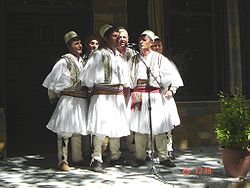
Polyphonic groups of Epirus consist of four members at least. Each group has two soloists and a drone group, which provides and maintains the vocal rhythm of the song.The first soloist (or the taker) ( or "σηκωτής" (sikotis), ) is the voice that sings the main melody. The first soloist performs the beginning of the song , and literally acts as the narrator
Narrator
A narrator is, within any story , the fictional or non-fictional, personal or impersonal entity who tells the story to the audience. When the narrator is also a character within the story, he or she is sometimes known as the viewpoint character. The narrator is one of three entities responsible for...
and leader of the group, singing the main part of the song.
The second soloist (or the turner) answers (or "turns") the voice ( (yirizei, turns) or "τσακίζει" (tsakizei, crimps) ).
Sometimes, instead of the "turner", or according to some musicologists parallel with it, we find the role of the spinner ( (klostis, spinner)). The "spinner" spins the song between the tonic and subtonic of the melody, a technique that reminds the movement of the hand which holds the spindle and spins the thread. This is a role that is often, but not always, found is the one of "rihtis", who drops the song in the end of the introduction of "partis", by singing an exclamation (e.g. (ah oh oh) or , "άντε βρε" (ante vre)), which is a fourth lower than the tonic of the melody, resting "partis" and uniting its introduction with the entrance of the drone group.
The drone group is composed by the rest of the members of the polyphonic group and is also called iso keepers group , and ), from the Greek
Greek language
Greek is an independent branch of the Indo-European family of languages. Native to the southern Balkans, it has the longest documented history of any Indo-European language, spanning 34 centuries of written records. Its writing system has been the Greek alphabet for the majority of its history;...
Isocrates
Isocrates
Isocrates , an ancient Greek rhetorician, was one of the ten Attic orators. In his time, he was probably the most influential rhetorician in Greece and made many contributions to rhetoric and education through his teaching and written works....
"ισοκράτης" and that from the Medieval Greek
Medieval Greek
Medieval Greek, also known as Byzantine Greek, is the stage of the Greek language between the beginning of the Middle Ages around 600 and the Ottoman conquest of the city of Constantinople in 1453. The latter date marked the end of the Middle Ages in Southeast Europe...
"ισοκρατών" (isokraton), "one who holds the ison", the note that holds on the whole length of a song, from Ancient Greek
Ancient Greek
Ancient Greek is the stage of the Greek language in the periods spanning the times c. 9th–6th centuries BC, , c. 5th–4th centuries BC , and the c. 3rd century BC – 6th century AD of ancient Greece and the ancient world; being predated in the 2nd millennium BC by Mycenaean Greek...
"ἴσος" (isos) generally meaning "equal" but here "equal in flight of song" + "κρατέω" (krateo) "to rule, to hold". The words ison and isos literally mean the continuous base note and isocrates creates and holds the modal base of the song. The isokrates role is particularly important; the louder the keeping of the vocal drone, , the more "βρονταριά" (vrontaria) (i.e. better) the song goes, because the rhythm and the vocal base of the song are maintained. The term derives from the Byzantine Greek musical tradition, where the "ίσον" also features.
The perfection of the rendition of the polyphonic song presupposes the existence and the unity of the several voices–roles of the polyphonic group. As a result, polyphonic song presupposes the collectiveness of expression and the firm distinction between the roles it reflects, and the unwritten hierarchy in the composition of the group and the distribution of the roles.
See also
- Music of GreeceMusic of GreeceThe music of Greece is as diverse and celebrated as its history. Greek music separates into two parts: Greek traditional music and Byzantine music, with more eastern sounds...
- Music of AlbaniaMusic of AlbaniaAlbanian music displays a variety of influences. Albanian folk music traditions differ by region, with major stylistic differences between the traditional music of the Ghegs in the north and Tosks in the south. Modern popular music has developed around the centers of Korça, Shkodër and Tirana....
- Music of Epirus (Greece)
- Byzantine musicByzantine musicByzantine music is the music of the Byzantine Empire composed to Greek texts as ceremonial, festival, or church music. Greek and foreign historians agree that the ecclesiastical tones and in general the whole system of Byzantine music is closely related to the ancient Greek system...
- DeropolitissaDeropolitissaDeropolitissa is a Greek polyphonic folk song, popular in the region of Dropull, southern Albania. It is also sung by the rest of the Greeks in Albania, as well as in parts of Greece.-Background and popularity:...
- Song of Çelo MezaniSong of Çelo MezaniThe Song of Çelo Mezani is an Albanian polyphonic folk song. It is considered to be the best-known Cham Albanian song. The song increased the awareness in Albania about the Chameria region and its history.-History:...
- Song of Marko BoçariSong of Marko BoçariThe Song of Marko Boçari from Suli is an Albanian polyphonic folk song of the early 19th century narrating the death of Markos Botsaris, a Souliot leader.- History :...
- YodelingYodelingYodeling is a form of singing that involves singing an extended note which rapidly and repeatedly changes in pitch from the vocal or chest register to the falsetto/head register; making a high-low-high-low sound.The English word yodel is derived from a German word jodeln meaning "to...
Further reading
- World Music: The Rough Guide by Simon Broughton, Mark Ellingham - 1999 - ISBN 1-85828-635-2
- Greek Folk Dances by Rickey Holden, Mary Vouras – 1965
- Engendering Song: Singing and Subjectivity at Prespa by Jane C. Sugarman,1997,ISBN 0-226-77972-6
External links
Songs in Greek
- Greek Polyphonic Song
- Songs from Politsani
- Polyphonic Song from Delvino
- Polyphonic Festival, MySpace
- Polyphonic Singing from Epirus, Greece
- Polyphonic Song from Deropolis
- Greek Polyphonic Song
Songs in Albanian
- Songs from Labëria
- Songs from Skrapar