


Polymerase

Encyclopedia
Enzyme
Enzymes are proteins that catalyze chemical reactions. In enzymatic reactions, the molecules at the beginning of the process, called substrates, are converted into different molecules, called products. Almost all chemical reactions in a biological cell need enzymes in order to occur at rates...
whose central function is associated with polymer
Polymer
A polymer is a large molecule composed of repeating structural units. These subunits are typically connected by covalent chemical bonds...
s of nucleic acid
Nucleic acid
Nucleic acids are biological molecules essential for life, and include DNA and RNA . Together with proteins, nucleic acids make up the most important macromolecules; each is found in abundance in all living things, where they function in encoding, transmitting and expressing genetic information...
s such as RNA
RNA
Ribonucleic acid , or RNA, is one of the three major macromolecules that are essential for all known forms of life....
and DNA
DNA
Deoxyribonucleic acid is a nucleic acid that contains the genetic instructions used in the development and functioning of all known living organisms . The DNA segments that carry this genetic information are called genes, but other DNA sequences have structural purposes, or are involved in...
.
The primary function of a polymerase is the polymerization
Polymerization
In polymer chemistry, polymerization is a process of reacting monomer molecules together in a chemical reaction to form three-dimensional networks or polymer chains...
of new DNA or RNA against an existing DNA or RNA template in the processes of replication
DNA replication
DNA replication is a biological process that occurs in all living organisms and copies their DNA; it is the basis for biological inheritance. The process starts with one double-stranded DNA molecule and produces two identical copies of the molecule...
and transcription
Transcription (genetics)
Transcription is the process of creating a complementary RNA copy of a sequence of DNA. Both RNA and DNA are nucleic acids, which use base pairs of nucleotides as a complementary language that can be converted back and forth from DNA to RNA by the action of the correct enzymes...
. In association with a cluster of other enzymes and proteins, they take nucleotide
Nucleotide
Nucleotides are molecules that, when joined together, make up the structural units of RNA and DNA. In addition, nucleotides participate in cellular signaling , and are incorporated into important cofactors of enzymatic reactions...
s from solvent, and catalyse the synthesis of a polynucleotide sequence against a nucleotide
Nucleotide
Nucleotides are molecules that, when joined together, make up the structural units of RNA and DNA. In addition, nucleotides participate in cellular signaling , and are incorporated into important cofactors of enzymatic reactions...
template strand using base-pairing interactions.
It is an accident of history that the enzymes responsible for the catalytic production of other biopolymer
Biopolymer
Biopolymers are polymers produced by living organisms. Since they are polymers, Biopolymers contain monomeric units that are covalently bonded to form larger structures. There are three main classes of biopolymers based on the differing monomeric units used and the structure of the biopolymer formed...
s are not also referred to as polymerases.
One particular polymerase, from the thermophilic
Thermophile
A thermophile is an organism — a type of extremophile — that thrives at relatively high temperatures, between 45 and 122 °C . Many thermophiles are archaea...
bacterium
Bacteria
Bacteria are a large domain of prokaryotic microorganisms. Typically a few micrometres in length, bacteria have a wide range of shapes, ranging from spheres to rods and spirals...
, Thermus aquaticus
Thermus aquaticus
Thermus aquaticus is a species of bacterium that can tolerate high temperatures, one of several thermophilic bacteria that belong to the Deinococcus-Thermus group...
(Taq) (PDB
Protein Data Bank
The Protein Data Bank is a repository for the 3-D structural data of large biological molecules, such as proteins and nucleic acids....
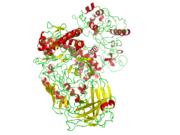
1BGX, EC 2.7.7.7) is of vital commercial importance due to its use in the polymerase chain reaction
Polymerase chain reaction
The polymerase chain reaction is a scientific technique in molecular biology to amplify a single or a few copies of a piece of DNA across several orders of magnitude, generating thousands to millions of copies of a particular DNA sequence....
, a widely used technique of molecular biology
Molecular biology
Molecular biology is the branch of biology that deals with the molecular basis of biological activity. This field overlaps with other areas of biology and chemistry, particularly genetics and biochemistry...
.
Other well-known polymerases include:
- Terminal Deoxynucleotidyl TransferaseTerminal Deoxynucleotidyl TransferaseTerminal deoxynucleotidyl transferase , also known as DNA nucleotidylexotransferase or terminal transferase, is a specialized DNA polymerase expressed in immature, pre-B, pre-T lymphoid cells, and acute lymphoblastic leukemia/lymphoma cells...
(TDT), which lends diversity to antibody heavy chains
- Reverse TranscriptaseReverse transcriptaseIn the fields of molecular biology and biochemistry, a reverse transcriptase, also known as RNA-dependent DNA polymerase, is a DNA polymerase enzyme that transcribes single-stranded RNA into single-stranded DNA. It also helps in the formation of a double helix DNA once the RNA has been reverse...
, an enzyme used by RNARNARibonucleic acid , or RNA, is one of the three major macromolecules that are essential for all known forms of life....
retrovirusRetrovirusA retrovirus is an RNA virus that is duplicated in a host cell using the reverse transcriptase enzyme to produce DNA from its RNA genome. The DNA is then incorporated into the host's genome by an integrase enzyme. The virus thereafter replicates as part of the host cell's DNA...
es like HIVHIVHuman immunodeficiency virus is a lentivirus that causes acquired immunodeficiency syndrome , a condition in humans in which progressive failure of the immune system allows life-threatening opportunistic infections and cancers to thrive...
, which is used to create a complementary strand to the preexisting strand of viral RNARNARibonucleic acid , or RNA, is one of the three major macromolecules that are essential for all known forms of life....
before it can be integrated into the DNADNADeoxyribonucleic acid is a nucleic acid that contains the genetic instructions used in the development and functioning of all known living organisms . The DNA segments that carry this genetic information are called genes, but other DNA sequences have structural purposes, or are involved in...
of the hostHost (biology)In biology, a host is an organism that harbors a parasite, or a mutual or commensal symbiont, typically providing nourishment and shelter. In botany, a host plant is one that supplies food resources and substrate for certain insects or other fauna...
cellCell (biology)The cell is the basic structural and functional unit of all known living organisms. It is the smallest unit of life that is classified as a living thing, and is often called the building block of life. The Alberts text discusses how the "cellular building blocks" move to shape developing embryos....
. It is also a major target for antiviral drugs.
See also
- DNA polymeraseDNA polymeraseA DNA polymerase is an enzyme that helps catalyze in the polymerization of deoxyribonucleotides into a DNA strand. DNA polymerases are best known for their feedback role in DNA replication, in which the polymerase "reads" an intact DNA strand as a template and uses it to synthesize the new strand....
- DNA polymerase IDNA polymerase IDNA Polymerase I is an enzyme that participates in the process of DNA replication in prokaryotes. It is composed of 928 amino acids, and is an example of a processive enzyme - it can sequentially catalyze multiple polymerisations. Discovered by Arthur Kornberg in 1956, it was the first known...
- DNA polymerase IIDNA polymerase IIDNA polymerase II is a prokaryotic DNA polymerase most likely involved in DNA repair.The enzyme is 90 kDa in size and is coded by the polB gene. DNA Pol II can synthesize DNA new base pairs at an average rate of between 40 and 50 nucleotides/second. Strains lacking the gene show no defect in...
- DNA polymerase III holoenzymeDNA polymerase III holoenzymeDNA polymerase III holoenzyme is the primary enzyme complex involved in prokaryotic DNA replication. It was discovered by Thomas Kornberg and Malcolm Gefter in 1970. The complex has high processivity DNA polymerase III holoenzyme is the primary enzyme complex involved in prokaryotic DNA...
- DNA Polymerase IV (DinB) – SOSSOS responseThe SOS response is a global response to DNA damage in which the cell cycle is arrested and DNA repair and mutagenesis are induced. The SOS uses the RecA protein . The RecA protein, stimulated by single-stranded DNA, is involved in the inactivation of the LexA repressor thereby inducing the response...
repair polymerase
- DNA polymerase I
- RNA polymeraseRNA polymeraseRNA polymerase is an enzyme that produces RNA. In cells, RNAP is needed for constructing RNA chains from DNA genes as templates, a process called transcription. RNA polymerase enzymes are essential to life and are found in all organisms and many viruses...
- RNA polymerase IRNA polymerase IRNA polymerase I is, in eukaryotes, the enzyme that only transcribes ribosomal RNA , a type of RNA that accounts for over 50% of the total RNA synthesized in a cell....
- RNA polymerase IIRNA polymerase IIRNA polymerase II is an enzyme found in eukaryotic cells. It catalyzes the transcription of DNA to synthesize precursors of mRNA and most snRNA and microRNA. A 550 kDa complex of 12 subunits, RNAP II is the most studied type of RNA polymerase...
- RNA polymerase IIIRNA polymerase IIIRNA polymerase III transcribes DNA to synthesize ribosomal 5S rRNA, tRNA and other small RNAs. The genes transcribed by RNA Pol III fall in the category of "housekeeping" genes whose expression is required in all cell types and most environmental conditions...
- T7 RNA polymeraseT7 RNA polymeraseT7 RNA Polymerase is an RNA polymerase from the T7 bacteriophage that catalyzes the formation of RNA in the 5'→ 3' direction.- Activity :T7 polymerase is extremely promoter-specific and only transcribes DNA downstream of a T7 promoter. The T7 polymerase also requires a DNA template and Mg2+ ion as...
- RNA polymerase I