
All Topics  
Polymer clay


   Email Print
   Bookmark   Link


Polymer clay


Polymer clay is a sculptable material based on the polymer
Polymer

A polymer is a large molecule composed of repeating structural units typically connected by covalent chemical bonds. While polymer in popular usage suggests plastic, the term actually refers to a large class of natural and synthetic materials with a variety of properties....
 polyvinyl chloride
Polyvinyl chloride

Polyvinyl chloride, commonly abbreviated PVC, is the third most widely used thermoplastic polymer after polyethylene and polypropylene....
 (PVC
PVC

Polyvinyl chloride is a plastic.PVC may also refer to:*Param Vir Chakra, India's highest military honor*Peripheral venous catheter*Permanent virtual circuit, a term used in telecommunications and computer networks...
). It usually contains no clay
Clay

Clay is a naturally occurring material composed primarily of fine-grained minerals, which show plasticity through a variable range of water content, and which can be hardened when dried and/or fired....
 minerals, and is only called "clay" because its texture and working properties resemble those of mineral clay. It is sold in craft
Craft

A craft is a skill, especially involving practical The Arts. It may refer to a trade or particular art.The terms is often used as part of a longer word ....
, hobby
Hobby

A hobby is a leisure recreational pursuit....
, and art
Art

Art is the process or product of deliberately arranging elements in a way that appeals to the senses or emotions. It encompasses a diverse range of human activities, creations, and modes of expression, including music and literature....
 stores, and is used by artists, hobbyists, and children.
mer clays of all brands contain a basis of PVC
PVC

Polyvinyl chloride is a plastic.PVC may also refer to:*Param Vir Chakra, India's highest military honor*Peripheral venous catheter*Permanent virtual circuit, a term used in telecommunications and computer networks...
 and one or more of several kinds of liquid
Liquid

Liquid is one of the principal states of matter. A liquid is a fluid that has the particles loose and can freely form a distinct surface at the boundaries of its bulk material....
 plasticizer
Plasticizer

Plasticizers or Dispersants are additives that increase the plasticity or fluidity of the material to which they are added, these include plastics, cement, concrete, wallboard and clay bodies....
.


Discussion
Ask a question about 'Polymer clay'
Start a new discussion about 'Polymer clay'
Answer questions from other users
Full Discussion Forum


Encyclopedia


Polymer clay is a sculptable material based on the polymer
Polymer

A polymer is a large molecule composed of repeating structural units typically connected by covalent chemical bonds. While polymer in popular usage suggests plastic, the term actually refers to a large class of natural and synthetic materials with a variety of properties....
 polyvinyl chloride
Polyvinyl chloride

Polyvinyl chloride, commonly abbreviated PVC, is the third most widely used thermoplastic polymer after polyethylene and polypropylene....
 (PVC
PVC

Polyvinyl chloride is a plastic.PVC may also refer to:*Param Vir Chakra, India's highest military honor*Peripheral venous catheter*Permanent virtual circuit, a term used in telecommunications and computer networks...
). It usually contains no clay
Clay

Clay is a naturally occurring material composed primarily of fine-grained minerals, which show plasticity through a variable range of water content, and which can be hardened when dried and/or fired....
 minerals, and is only called "clay" because its texture and working properties resemble those of mineral clay. It is sold in craft
Craft

A craft is a skill, especially involving practical The Arts. It may refer to a trade or particular art.The terms is often used as part of a longer word ....
, hobby
Hobby

A hobby is a leisure recreational pursuit....
, and art
Art

Art is the process or product of deliberately arranging elements in a way that appeals to the senses or emotions. It encompasses a diverse range of human activities, creations, and modes of expression, including music and literature....
 stores, and is used by artists, hobbyists, and children.

Material

Polymer clays of all brands contain a basis of PVC
PVC

Polyvinyl chloride is a plastic.PVC may also refer to:*Param Vir Chakra, India's highest military honor*Peripheral venous catheter*Permanent virtual circuit, a term used in telecommunications and computer networks...
 and one or more of several kinds of liquid
Liquid

Liquid is one of the principal states of matter. A liquid is a fluid that has the particles loose and can freely form a distinct surface at the boundaries of its bulk material....
 plasticizer
Plasticizer

Plasticizers or Dispersants are additives that increase the plasticity or fluidity of the material to which they are added, these include plastics, cement, concrete, wallboard and clay bodies....
. Pigments may be added to the translucent base to create a variety of colors, along with small amounts of kaolin or white china clay or other opaquing agents where opacity is desired. Mica
Mica

The mica group of sheet silicate minerals includes several closely related materials having highly perfect basal cleavage. All are monoclinic with a tendency towards pseudo-hexagonal crystals and are similar in chemical composition....
 may also be added to simulate pearlescent and metallic effects.

History

Bakelite
Bakelite

Bakelite is a material based on the thermosetting plastic phenol formaldehyde resin polyoxybenzylmethylenglycolanhydride, developed in 1907?1909 by Demographics of Belgium Dr....
, an early plastic
Plastic

Plastic is the general common term for a wide range of synthetic or semisynthetic organic chemistry solid materials suitable for the manufacture of industrial products....
 used in both practical and decorative applications, was extremely popular with designers and had an early form of polymer clay available in kits, but the phenol base of uncured Bakelite was flammable and these were discontinued. Modern polymer clays are based on a plastic modeling compound brought to the attention of German doll maker Kathe Kruse in the late 1930s as a possible replacement for plastics that had become difficult to obtain during the early days of World War II
World War II

World War II, or the Second World War , was a global military conflict which involved a Participants in World War II, including all of the great powers, organised into two opposing military alliances: the Allies of World War II and the Axis powers....
. It was not suitable for use in her doll factory, so Kruse turned it over to her daughter Maureen, who was known in the family as "Fifi". The formulation was later sold to Eberhardt Faber and marketed under the name "FIMO
FIMO

Fimo is a name for a brand of polymer clay made by Eberhard Faber. According to a 2002 U.S.PIRG report Fimo contains polyvinyl chloride mixed with phthalate....
" (FIfi's MOdeling Compound) in honor of Maureen.

Meanwhile, in the early 1940s, Zenith Products Company was founded in Schiller Park, IL. Zenith began as a company that manufactured coatings for the fastener industry: waxes, hot melt compounds, and electrical insulating varnishes. The product that we know today as "Sculpey" was originally formulated for potential use as a thermal transfer compound - to conduct heat away from the cores of electrical transformers. However, this formulation was not successful for that purpose, so the compound was temporarily shelved. A visitor to the manufacturing plant was "doodling" with a lump of the clay-like substance and created a small figure. It was then baked in a lab testing oven - and Sculpey was "discovered" as a sculpture medium. This happened in the mid 1960's. By 1967, it was being manufactured and sold on a small scale in the United States.

The history of polymer clay as an art medium is only decades long, unlike many media that have been around for centuries and have long traditions. This newness means that there is a great deal of innovation by users of polymer clay. Often, ideas are born by borrowing from the traditions of some other materials, such as metalworking (mokume-gane
Mokume-gane

Mokume-gane is a mixed-metal laminate with distinctive layered patterns. Literally translating as "wood eye metal", the name was borrowed from one type of pattern created in the forging of swords and other edged weapons....
), ceramics, glass (millefiori
Millefiori

Millefiori is a glasswork technique which produces distinctive decorative patterns on glassware.The term millefiori is a combination of the Italian language words "mille" and "fiori" ....
, lampwork), paper, etc.

Properties

Original formulations of polymer clay remain soft until cured at relatively low temperatures, but air-dry polymer clays have recently been added to the market. Traditional polymer clay hardens by curing at temperatures created in a typical home oven, generally at 265 to 275 °F (129 to 135 °C), for 15 minutes per 1/4" (6 mm) of thickness, and does not shrink or change texture during the process. When properly conditioned and cured, most clays create items that will not break if dropped or normally stressed. Cured pieces may have additional layers or enhancements added and be re-cured with no ill effect. As long as the maximum curing temperature is not exceeded, there is no limit to the number of times a piece can be re-cured. After it has cured, the clay surface can be left as is, sanded and buffed, or finished with a water-based varnish.

Leading brands of polymer clay include Fimo
FIMO

Fimo is a name for a brand of polymer clay made by Eberhard Faber. According to a 2002 U.S.PIRG report Fimo contains polyvinyl chloride mixed with phthalate....
; Sculpey
Sculpey

Sculpey is the brand name for a type of polymer clay that can be molded and put into a conventional oven to harden, as opposed to typical modeling clays, which require a much hotter oven, such as a kiln....
, Premo and Studio by Sculpey, created by Polyform Products; Cernit; Formello
Formello

Formello is a town and a comune in the province of Rome. It is located south-west to the Monti Sabatini, within the Regional Park of Veii. The communal territory is mostly composed by tuff, and is intensively cultivated....
; Modello
Modello

A modello, from the Italian, is a preparatory study or model, usually at a smaller scale, for a work of art or architecture, especially one produced for the approval of the commissioning patron....
; and Kato Polyclay
Kato polyclay

Kato Polyclay is a name for a brand of oven-hardening polymer clay. The concept of Kato Polyclay is created by the collaboration of Donna Kato, a polymer clay artist, and Van Aken International, a manufacturer of modeling compounds....
, formulated for Van Aken by Donna Kato, an early artist for Fimo. Though the brands differ slightly in properties such as plasticity, translucence, curing temperature, and flexibility when cured, most are suited to a variety of applications. Specialty formulations include clay that remains permanently flexible when cured, eraser clay, and colorless and tinted liquid "clays" that can be used as slips, glazes, and adhesives.

Polymer clay is available in many colors. "Special-effect" colors such as translucent, fluorescent, glow-in-the-dark
Glow-in-the-dark

Glow-in-the-dark may refer to:*Bioluminescence - the production and emission of light by a living organism as the result of a chemical reaction during which chemical energy is converted to light energy....
, mica
Mica

The mica group of sheet silicate minerals includes several closely related materials having highly perfect basal cleavage. All are monoclinic with a tendency towards pseudo-hexagonal crystals and are similar in chemical composition....
-containing "pearls" and "metallics," and variegated "stone" colors containing contrasting fibers are also available. Standard colors, which vary from brand to brand, can be mixed to create a virtually infinite range of custom colors, gradient blends, and other effects. Judith Skinner is credited with inventing a technique that uses a pasta
Pasta

Pasta is a generic term for Italian cuisine variants of noodles, food made from a dough of flour, water and/or Egg , that is Boiling. The word can also denote dishes in which pasta products are the primary ingredient, served with sauce or seasonings....
 machine to create consistent gradient-blended sheets of color. This technique has many applications and is one of the basic skills developed by hobbyists or artists in the medium.

Polymer clay can be colored with other media. Paint, ink, colored pencil, chalk, metallic or mica-containing powder, metal leaf
Metal leaf

Metal leaf, also called composition leaf or schlagmetal, is a thin foil used for decoration. Metal leaf can come in many different shades....
 and foil, glitter, and embossing powder can be applied to the surface. The same materials also can be mixed in as inclusions; this is often done with translucent clay. When acrylic paint
Acrylic paint

File:Pyrrole Red Dab.JPGAcrylic paint is fast-drying paint containing pigment suspended in an Wiktionary:acrylic polymer emulsion. Acrylic paints can be diluted with water, but become water-resistant when dry....
 is cured onto the surface, it forms a permanent bond with the surface.

Few tools are essential for use with polymer clay, and these can often be found around the house. The most widely used cutting tools are tissue blades
Histology

Histology is the study of the anatomy of cell and tissue of plants and animals. It is performed by examining a thin slice of tissue under a light microscope or electron microscope....
, which are extremely thin and sharp, though craft knives and other blades can be used. A pasta machine is often used to create sheets of uniform thickness, to mix colors, to condition
Condition

Condition can refer to:* A state of being.* Living condition, see Quality of life.* In health, a disease, such as a heart condition, as in Medical condition....
 the clay, and to create patterned sheets. A "clay gun" or extruder with interchangeable die plates allows creation of lengths of clay in a variety of uniform sizes and shapes. Most molding and modeling tools used by traditional sculptors are suitable for polymer clay, but artists often create improvised cutting, piercing, molding, and texturing tools from items used in sewing, cooking, woodworking, and paper crafts.

Uses and techniques

Polymer clay can be used in many ways, a number of which have been generalized from other art or craft techniques. Some uses for polymer clay include:

  • Sculpting. Hand-shaped items can be any size from "miniatures" to quite large. Bas relief can also be created; clay clothing and accessories can be made for sculpted figures.


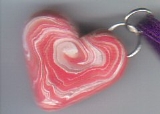
  • Creating beads and jewelry of all kinds, such as pendants, earrings, barrettes, and buttons.


  • "Cover"ing items made from materials such as glass, metal, cardboard, terra cotta, and some plastics. Popular items for covering include pens, eggshells, votive candle-holders, and switch-plates. Larger items, such as tables, can also be veneered.


  • Creating vessels large and small. Jars, boxes, bowls, and container pendants can be created freestanding, or over permanent or removable armature
    Armature

    Armature may refer to:* Armature , the kinematic chains used in computer animation to simulate the motions of virtual characters* Armature , one of the two principal electrical components of an electromechanical machine...
    s.


  • Creating simulations or faux
    Faux

    Faux is a French language word for false or fake. It is often used in English phrases such as faux pearls, faux fur, faux pas and faux news....
    s of many natural and fabricated materials such as jade, turquoise, marble, granite, metal, ivory, wood, leather, stained glass
    Stained glass

    For the Blackford Oakes novel, see Stained Glass The term stained glass can refer to the material of coloured glass or the craft of working with it....
    , mosaic
    Mosaic

    Mosaic is the art of creating images with an assemblage of small pieces of colored glass, stone, or other material. It may be a technique of Decorative arts, an aspect of interior decoration or of cultural and spiritual significance as in a cathedral....
    , and cloisonne
    Cloisonné

    Cloisonn?, an ancient metalworking technique, is a multi-step vitreous enamel process used to produce jewelry, vases, and other decorative items....
    .


  • Onlay
    Onlay

    In dentistry, an inlay is an indirect restoration consisting of a solid substance fitted to a cavity in a tooth and cemented into place. An onlay is the same as an inlay, except that it extends to replace a Cusp_....
    ing clay with other materials to create collages.


  • Creating paintings with polymer pastes, and bas reliefs.


  • Creating practical utility items, such as frames, games and game pieces, dioramas, toys, mini-books, notebook covers, greeting cards, and postcards.


Techniques for working with polymer clay include:

  • Gradient (Skinner) blending of two or more colors using sheets of clay and a pasta machine or rolling pin.


  • Forming "canes," which are logs of clay with patterns running through their entire length, from which identical slices can be cut and used in various ways. The patterns created in canes can be simple, complex, or anything in between; they may be pictorial or simply geometric. Canes (and therefore their images) can be "reduced" so that they become quite small, and then combined to make multiple images (millefiori
    Millefiori

    Millefiori is a glasswork technique which produces distinctive decorative patterns on glassware.The term millefiori is a combination of the Italian language words "mille" and "fiori" ....
    ).


  • Impressing textures, lines or images into raw clay with rubber stamps, texture sheets, sandpaper, needle tools, or other items.


  • Molding
    Molding (process)

    Molding or moulding is the process of manufacturing by shaping pliable raw material using a rigid frame or model called a pattern....
    : pressing raw clay into molds to create casts and to duplicate textures, shapes, etc. Molds made from metal, glass, rubber, and silicone can be purchased, or custom molds can be made from polymer clay or dedicated molding compounds.


  • Extruding
    Extrusion

    Extrusion is a process used to create objects of a fixed cross section profile. A material is pushed or drawn through a Die of the desired cross-section....
     clay through shaped die plates to create strands or ropes of uniform size and cross-section.


  • "Mokume-gane
    Mokume-gane

    Mokume-gane is a mixed-metal laminate with distinctive layered patterns. Literally translating as "wood eye metal", the name was borrowed from one type of pattern created in the forging of swords and other edged weapons....
    ": thin slices shaved from distorted stacks of layered clays, powders, and inks and applied to surfaces.


  • Using clay to accept "transfers" of images from photographs, drawings, computer-created images or text using a solvent or transfer paper
    Transfer paper

    Transfer paper is used in textiles and arts & crafts projects. Often, an ink-jet or other printer is used to print the image on transfer paper....
    . Images can also be transferred onto freestanding liquid clay films or decals.


  • Carving or drilling after the clay has been cured (and backfilled or inlaid, if desired).


  • Inlaying cured or uncured clay tiles or chips to create mosaic
    Mosaic

    Mosaic is the art of creating images with an assemblage of small pieces of colored glass, stone, or other material. It may be a technique of Decorative arts, an aspect of interior decoration or of cultural and spiritual significance as in a cathedral....
    s
    .


  • Multimedia: combining clay with wire, paper, beads, charms, stamps, fabric, etc.


Brand comparison guide

The information provided below is based on the original formulations of these products. All polymer clay brands are undergoing reformulation in response to bans on phthalate esters used as plasticizers, and users have noted dramatically different working properties of the new formulae.

Each brand of polymer clay has inherent characteristics that make it most suitable for certain applications. For instance, the more resistant brands hold their shape well in detailed cane work, but they can be more difficult to condition. Some easy-to-condition clays become brittle after baking. Most brands feature a translucent color in their palette, but some brands are more translucent than others, making them more desirable when mixing tiny inclusions (such as glitter) into the clay or layering thin sheets or slices. Some clays change color after baking, making exact color matching more challenging.

  • Sculpey is easy to condition and is also strong and flexible after baking. It has a tendency to become quite soft after repeated manipulation.


  • Kato polyclay
    Kato polyclay

    Kato Polyclay is a name for a brand of oven-hardening polymer clay. The concept of Kato Polyclay is created by the collaboration of Donna Kato, a polymer clay artist, and Van Aken International, a manufacturer of modeling compounds....
     is both extremely strong and flexible when baked. It is easy to condition and its color does not change or darken regardless of how many times it’s baked. One of its best features is that it never feels sticky or too soft, even after being worked for long periods of time.


  • Fimo
    FIMO

    Fimo is a name for a brand of polymer clay made by Eberhard Faber. According to a 2002 U.S.PIRG report Fimo contains polyvinyl chloride mixed with phthalate....
     Classic is more difficult to condition than Kato but is also great for caning. It holds detail well and is very strong after baking, but without much flexibility.


  • Fimo Soft is easier to condition than the classic variety but it is not as strong and durable after baking.


  • PREMO! Sculpey easy to work right out of the package. Comes in artist's colors.


Health concerns

The safety of using polymer clay is the subject of controversy, specifically the long-term effects of exposure to the phthalate esters used as plasticizers to keep the clay soft and workable until curing. For a summary of the issues and relevant research, see Phthalates
Phthalates

Phthalates, or phthalate esters, are esters of phthalic acid and are mainly used as plasticizers . They are chiefly used to soften polyvinyl chloride....
.

The Arts & Crafts Materials Institute in Boston has tested the major brands of polymer clay and states that they comply with the ASTM D-4236 standard for safety of arts and crafts materials specified by the Consumer Product Safety Commission.. A study conducted at Duke University Health System summarized the toxicology
Toxicology

Toxicology is the study of the adverse effects of chemicals on living organisms. It is the study of symptoms, mechanisms, treatments and detection of poisoning, especially the poisoning of people....
, metabolism
Metabolism

Metabolism is the set of chemical reactions that occur in living organisms in order to maintain life. These processes allow organisms to grow and reproduce, maintain their structures, and respond to their environments....
 and pharmacokinetics
Pharmacokinetics

Pharmacokinetics is a branch of pharmacology dedicated to the determination of the fate of substances administered externally to a living organism....
 of the phthalate esters used in polymer clay formulations and evaluated contamination rates during laboratory simulations and use by professional artists. The study found actual transfer rates to skin, food, and mouth to be lower than expected and ingestion rates significantly below established Acceptable Daily Intake
Acceptable daily intake

Acceptable daily intake or ADI is a measure of the amount of a specific substance in food or drinking water that can be ingested over a lifetime without an appreciable health risk....
 (ADI) for all phthalate esters tested. However, the Vermont Public Interest Research Group, Inc. has concluded that the use of polymer clays may lead to unsafe levels of exposure to phthalate plasticizers, especially in children, through accidental ingestion of residue on hands after use.

Restrictions on use of certain phthalates
Phthalates

Phthalates, or phthalate esters, are esters of phthalic acid and are mainly used as plasticizers . They are chiefly used to soften polyvinyl chloride....
 take effect in 2009 in the European Union
European Union

The European Union is an economic and political union of 27 European Union member state, located primarily in Europe. It was established by the Treaty of Maastricht on 1 November 1993 upon the foundations of the pre-existing European Economic Community....
 and in the U.S. state of California
California

California is a U.S. state on the West Coast of the United States of the United States, along the Pacific Ocean. It is bordered by Oregon to the north, Nevada to the east, Arizona to the southeast, and to the south the Mexico state of Baja California....
. Polymer clays are being reformulated with less toxic plasticizers to meet the new standards.

It is known that incorrectly curing polymer clay by baking it at a temperature higher than that recommended by the manufacturer can produce fumes which may be harmful. However, correctly curing the clay, while it will produce an odor, will not produce harmful fumes.

See also

  • Fimo
    FIMO

    Fimo is a name for a brand of polymer clay made by Eberhard Faber. According to a 2002 U.S.PIRG report Fimo contains polyvinyl chloride mixed with phthalate....
  • Sculpey
    Sculpey

    Sculpey is the brand name for a type of polymer clay that can be molded and put into a conventional oven to harden, as opposed to typical modeling clays, which require a much hotter oven, such as a kiln....
  • Kato Polyclay
    Kato polyclay

    Kato Polyclay is a name for a brand of oven-hardening polymer clay. The concept of Kato Polyclay is created by the collaboration of Donna Kato, a polymer clay artist, and Van Aken International, a manufacturer of modeling compounds....
  • Cernit
  • millefiori
    Millefiori

    Millefiori is a glasswork technique which produces distinctive decorative patterns on glassware.The term millefiori is a combination of the Italian language words "mille" and "fiori" ....


Suggested books


  • Creating with Polymer Clay : Designs, Techniques, and Projects, Steven Ford and Leslie Dierks. ISBN 0-937274-95-X (pbk.)
  • Foundations in Polymer Clay Design, Barbara A. McGuire, ISBN 0-87341-800-X
  • Making Animal Characters in Polymer Clay, Sherian Frey, ISBN 1-58180-041-X (pbk.)
  • Making Gifts in Polymer Clay, Stacey Morgan, ISBN 1-58180-104-1
  • Making Polymer Clay Jewellery, text and illustrations by Sue Heaser, ISBN 0-304-34605-5.
  • Polymer Clay Extravaganza, Lisa Pavelka, ISBN 1-58180-188-2 (pbk.)
  • Polymer Clay for the Fun of It, Kim Cavender, ISBN 1-58180-684-1
  • Polymer Clay: 20 Weekend Projects Using New and Exciting Techniques, Irene Semanchuk Dean, ISBN 1-57990-168-9 (pbk.)
  • Polymer Clay: Creating Functional and Decorative Objects, Jacqueline Gikow, ISBN 0-87341-952-9 (pbk.)
  • The Art of Polymer Clay, Donna Kato, ISBN 0-8230-0278-0, 1997, Watson-Guptill Publications


External links