
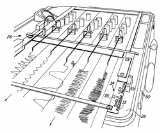
A
polygraph measures and records several physiological indices such as
blood pressureBlood pressure is the pressure exerted by circulating blood upon the walls of blood vessels, and is one of the principal vital signs. When used without further specification, "blood pressure" usually refers to the arterial pressure of the systemic circulation. During each heartbeat, BP varies...
,
pulseIn medicine, one's pulse represents the tactile arterial palpation of the heartbeat by trained fingertips. The pulse may be palpated in any place that allows an artery to be compressed against a bone, such as at the neck , at the wrist , behind the knee , on the inside of the elbow , and near the...
,
respiration'In physiology, respiration is defined as the transport of oxygen from the outside air to the cells within tissues, and the transport of carbon dioxide in the opposite direction...
, and
skin conductivitySkin conductance, also known as galvanic skin response , electrodermal response , psychogalvanic reflex , skin conductance response or skin conductance level , is a method of measuring the electrical conductance of the skin, which varies with its moisture level...
while the subject is asked and answers a series of questions. The belief is that deceptive answers will produce physiological responses that can be differentiated from those associated with non-deceptive answers.
The polygraph was invented in 1921 by
John Augustus LarsonJohn Augustus Larson was a police officer of the Berkeley Police Department, California, United States, and famous for his invention of modern polygraph used in forensic investigations...
, a medical student at the University of California at Berkeley and a police officer of the
Berkeley Police DepartmentThe Berkeley Police Department is the municipal police department for the city of Berkeley, California, USA.-History:Shortly after Berkeley was incorporated in 1878, a town marshal and constables were elected to provide law enforcement. In 1909, the town marshal was appointed to be the first...
in Berkeley, California. According to
Encyclopædia BritannicaThe Encyclopædia Britannica , published by Encyclopædia Britannica, Inc., is a general knowledge English-language encyclopaedia that is available in print, as a DVD, and on the Internet. It is written and continuously updated by about 100 full-time editors and more than 4,000 expert...
, the polygraph was on its 2003 list of greatest inventions, described by the company as inventions that "have had profound effects on human life for better or worse."
Many members of the scientific community consider polygraphy to be
pseudosciencePseudoscience is a claim, belief, or practice which is presented as scientific, but which does not adhere to a valid scientific method, lacks supporting evidence or plausibility, cannot be reliably tested, or otherwise lacks scientific status...
. Nonetheless, in some countries polygraphs are used as an
interrogationInterrogation is interviewing as commonly employed by officers of the police, military, and Intelligence agencies with the goal of extracting a confession or obtaining information. Subjects of interrogation are often the suspects, victims, or witnesses of a crime...
tool with criminal suspects or candidates for sensitive public or private sector employment. US federal government agencies such as the FBI and the CIA and many police departments such as the LAPD use polygraph examinations to interrogate suspects and screen new employees. Within the US federal government, a polygraph examination is also referred to as a
psychophysiological detection of deception (PDD) examination.
History
Early devices for lie detection include an 1895 invention of
Cesare LombrosoCesare Lombroso, born Ezechia Marco Lombroso was an Italian criminologist and founder of the Italian School of Positivist Criminology. Lombroso rejected the established Classical School, which held that crime was a characteristic trait of human nature...
used to measure changes in blood pressure for police cases, a 1904 device by Vittorio Benussi used to measure breathing, and an abandoned project by American
William MarstonDr. William Moulton Marston , also known by the pen name Charles Moulton, was an American psychologist, feminist theorist, inventor and comic book writer who created the character Wonder Woman...
which used blood pressure to examine German prisoners of war (POWs).
Marston wrote a second paper on the concept in 1915, when finishing his undergraduate studies. He entered
Harvard Law SchoolHarvard Law School is one of the professional graduate schools of Harvard University. Located in Cambridge, Massachusetts, it is the oldest continually-operating law school in the United States and is home to the largest academic law library in the world. The school is routinely ranked by the U.S...
and graduated in 1918, re-publishing his earlier work in 1917. According to their son, Marston's wife,
Elizabeth Holloway MarstonElizabeth "Sadie" Holloway Marston was an American psychologist who was a career woman at a time when it was difficult for women to be so. She was involved in the creation of the comic book character, Wonder Woman with her husband, William Moulton Marston...
, was also involved in the development of the systolic blood pressure test: "According to Marston’s son, it was his mother Elizabeth, Marston’s wife, who suggested to him that 'When she got mad or excited, her blood pressure seemed to climb' (Lamb, 2001). Although Elizabeth is not listed as Marston’s collaborator in his early work, Lamb, Matte (1996), and others refer directly and indirectly to Elizabeth’s work on her husband’s deception research. She also appears in a picture taken in his polygraph laboratory in the 1920s (reproduced in Marston, 1938)." The comic book character,
Wonder WomanWonder Woman is a DC Comics superheroine created by William Moulton Marston. She first appeared in All Star Comics #8 . The Wonder Woman title has been published by DC Comics almost continuously except for a brief hiatus in 1986....
, by William Marston (and influenced by Elizabeth Marston) carries a
magic lassoThe Lasso of Truth is a fictional weapon wielded by DC Comics superheroine Wonder Woman, Princess Diana of Themyscira. It is usually referred to as the Magic Lasso or Golden Lasso and forces anyone it captures to obey and tell the truth....
modelled upon the pneumograph (breathing monitor) test.
Despite his predecessor's contributions, Marston styled himself the “father of the polygraph” .
Marston remained the device's primary advocate, lobbying for its use in the courts. In 1938 he published a book,
The Lie Detector Test, wherein he documented the theory and use of the device. In 1938 he appeared in advertising by the Gillette company claiming that the polygraph showed Gillette razors were better than the competition.
A device recording both blood pressure and
galvanic skin responseSkin conductance, also known as galvanic skin response , electrodermal response , psychogalvanic reflex , skin conductance response or skin conductance level , is a method of measuring the electrical conductance of the skin, which varies with its moisture level...
was invented in 1921 by Dr. John A. Larson of the
University of CaliforniaThe University of California is a public university system in the U.S. state of California. Under the California Master Plan for Higher Education, the University of California is a part of the state's three-tier public higher education system, which also includes the California State University...
and first applied in law enforcement work by the
BerkeleyBerkeley is a city on the east shore of the San Francisco Bay in Northern California, United States. Its neighbors to the south are the cities of Oakland and Emeryville. To the north is the city of Albany and the unincorporated community of Kensington...
Police Department under its nationally renowned police chief
August VollmerAugust "Gus" Vollmer was a leading figure in the development of the field of criminal justice in the United States in the early 20th century. He was also the first police chief of Berkeley, California.-Youth:...
. Further work on this device was done by Leonarde Keeler.
Several devices similar to Keeler's polygraph version included the Berkeley Psychograph, a blood pressure-pulse-respiration recorder developed by C. D. Lee in 1936 and the Darrow Behavior Research Photopolygraph, which was developed and intended solely for behavior research experiments.
A device which recorded muscular activity accompanying changes in blood pressure was developed in 1945 by John E. Reid, who claimed that greater accuracy could be obtained by making these recordings simultaneously with standard blood pressure-pulse-respiration recordings.
Testing procedure
Today, polygraph examiners use two types of instrumentation: analog and computerized. In the
United StatesThe United States of America is a federal constitutional republic comprising fifty states and a federal district...
, most examiners now use computerized instrumentation.
A typical polygraph test starts with a pre-test
interviewAn interview is a conversation between two people where questions are asked by the interviewer to obtain information from the interviewee.- Interview as a Method for Qualitative Research:"Definition" -...
to gain some preliminary information which will later be used for "control questions", or CQ. Then the tester will explain how the polygraph is supposed to work, emphasizing that it can detect lies and that it is important to answer truthfully. Then a "stim test" is often conducted: the subject is asked to deliberately lie and then the tester reports that he was able to detect this lie. Then the actual test starts. Some of the questions asked are "irrelevant" or IR ("Is your name Chris?"), others are "probable-lie" control questions that most people will lie about ("Have you ever stolen money?") and the remainder are the "relevant questions", or RQ, that the tester is really interested in. The different types of questions alternate. The test is passed if the physiological responses during the probable-lie control questions (CQ) are larger than those during the relevant questions (RQ). If this is not the case, the tester attempts to elicit admissions during a post-test interview, for example, "Your situation will only get worse if we don't clear this up".
Criticisms have been given regarding the validity of the administration of the Comparative Questions test (CQT). The CQT may be vulnerable to being conducted in an interrogation-like fashion. This kind of interrogation style would elicit a nervous response from innocent and guilty suspects alike. There are several other ways of administrating the questions.
An alternative is the Guilty Knowledge Test (GKT), or the Concealed Information Test (CIT). The administration of this test is given to prevent potential errors that may arise from the questioning style. The test is usually conducted by a tester with no knowledge of the
crimeCrime is the breach of rules or laws for which some governing authority can ultimately prescribe a conviction...
or circumstances in question. The administrator tests the participant on their knowledge of the crime that would not be known to an innocent person. For example: "Was the crime committed with a .45 or a 9 mm?" The questions are in multiple choice and the participant is rated on how they react to the correct answer. If they react strongly to the guilty information, then proponents of the test believe that it is likely that they know facts relevant to the case. This administration is considered more valid by supporters of the test because it contains many safeguards to avoid the risk of the administrator influencing the results.
Validity
Polygraphy has little credibility among scientists. Despite claims of 90-95% validity by polygraph advocates, and 95-100% by businesses providing polygraph services, critics maintain that rather than a "test", the method amounts to an inherently unstandardizable
interrogationInterrogation is interviewing as commonly employed by officers of the police, military, and Intelligence agencies with the goal of extracting a confession or obtaining information. Subjects of interrogation are often the suspects, victims, or witnesses of a crime...
technique whose accuracy cannot be established. A 1997 survey of 421 psychologists estimated the test's average accuracy at about 61%, a little better than chance. Critics also argue that even given high estimates of the polygraph's accuracy a significant number of subjects (e.g. 10% given a 90% accuracy) will appear to be lying, and would unfairly suffer the consequences of "failing" the polygraph. In the 1998
Supreme CourtThe Supreme Court of the United States is the highest court in the United States. It has ultimate appellate jurisdiction over all state and federal courts, and original jurisdiction over a small range of cases...
case,
United States v. SchefferUnited States v. Scheffer, , was the first case in which the Supreme Court issued a ruling with regard to the highly controversial matter of polygraph, or "lie-detector," testing...
, the majority stated that "There is simply no consensus that polygraph evidence is reliable" and "Unlike other expert witnesses who testify about factual matters outside the jurors' knowledge, such as the analysis of fingerprints, ballistics, or DNA found at a crime scene, a polygraph expert can supply the jury only with another opinion..." Also, in 2005 the 11th Circuit Court of Appeals stated that “polygraphy did not enjoy general acceptance from the scientific community”. Charles Honts, a psychology professor at
Boise State UniversityBoise State University is a public university located in Boise, Idaho. Originally founded in 1932 as a junior college by the Episcopal Church, the university became an independent institution in 1934, and has been awarding baccalaureate and master degrees since 1965...
, states that polygraph interrogations give a high rate of false positives on innocent people. In 2001 William G. Iacono, Distinguished McKnight University Professor of Psychology and Neuroscience and Director, Clinical Science and Psychopathology Research Training Program at the University of Minnesota, published a paper titled “Forensic “Lie Detection": Procedures Without Scientific Basis” in the peer reviewed
Journal of Forensic Psychology Practice. He concluded that
Although the CQT [Control Question Test] may be useful as an investigative aid and tool to induce confessions, it does not pass muster as a scientifically credible test. CQT theory is based on naive, implausible assumptions indicating (a) that it is biased against innocent individuals and (b) that it can be beaten simply by artificially augmenting responses to control questions. Although it is not possible to adequately assess the error rate of the CQT, both of these conclusions are supported by published research findings in the best social science journals (Honts et al., 1994; Horvath, 1977; Kleinmuntz & Szucko, 1984; Patrick & Iacono, 1991). Although defense attorneys often attempt to have the results of friendly CQTs admitted as evidence in court, there is no evidence supporting their validity and ample reason to doubt it. Members of scientific organizations who have the requisite background to evaluate the CQT are overwhelmingly skeptical of the claims made by polygraph proponents.
Summarizing the consensus in psychological research, professor David W. Martin, PhD, from North Carolina State University, states that people have tried to use the polygraph for measuring human emotions, but there is simply no royal road to (measuring) human emotions. Therefore, since one cannot reliably measure human emotions (especially when one has an interest in hiding his/her emotions), the idea of valid detection of truth or falsehood through measuring respiratory rate, blood volume, pulse rate and galvanic skin response is a mere pretense. Since psychologists cannot ascertain what emotions one has, polygraph professionals are not able to do that either.
Polygraphy has also been faulted for failing to trap known spies such as double-agent
Aldrich AmesAldrich Hazen Ames is a former Central Intelligence Agency counter-intelligence officer and analyst, who, in 1994, was convicted of spying for the Soviet Union and Russia...
, who passed two polygraph tests while spying for the Soviet Union. Other spies who passed the polygraph include
Karl KoecherKarel František Koecher is the only mole known to have penetrated the CIA.-Early life:Born in Czechoslovakia, he became a radio comedy writer and was allegedly frequently scrutinized by the Communist security forces for his satire that mocked the regime...
,
Ana Belen MontesAna Belen Montes is a former senior analyst at the Defense Intelligence Agency in the United States. On September 21, 2001, she was arrested and subsequently charged with Conspiracy to Commit Espionage for the government of Cuba...
, and
Leandro AragoncilloLeandro Aragoncillo is a former, FBI intelligence analyst, and a retired, United States Marine Corps, gunnery-sergeant who was convicted of spying against the United States Government in 2007...
. However, CIA spy Harold James Nicholson failed his polygraph examinations, which aroused suspicions that led to his eventual arrest. Polygraph examination and background checks failed to detect
Nada Nadim ProutyNada Nadim Prouty, née Al-Aouar is a former American intelligence professional of Lebanese descent who worked in counter-terrorism with the FBI and CIA. She worked on high profile cases like the USS Cole bombing and was stationed in Baghdad during the Iraq War...
, who was not a spy but was convicted for improperly obtaining US citizenship and using it to obtain a restricted position at the FBI.
The polygraph also failed to catch
Gary RidgwayGary Leon Ridgway is an American serial killer known as the Green River Killer. He murdered numerous women in Washington during the 1980s and 1990s, earning his nickname when the first five victims were found in the Green River. He strangled them, usually with his arm but sometimes using ligatures...
, the "Green River Killer". Ridgway passed a polygraph in 1984 and confessed almost 20 years later when confronted with DNA evidence.
Conversely, innocent people have been known to fail polygraph tests. In
Wichita, KansasWichita is the largest city in the U.S. state of Kansas.As of the 2010 census, the city population was 382,368. Located in south-central Kansas on the Arkansas River, Wichita is the county seat of Sedgwick County and the principal city of the Wichita metropolitan area...
in 1986, after failing two polygraph tests (one police administered, the other given by an expert that he had hired), Bill Wegerle had to live under a cloud of suspicion of murdering his wife Vicki Wegerle, even though he was neither arrested nor convicted of her death. In March 2004, a letter was sent to
The Wichita EagleThe Wichita Eagle is a daily newspaper published in Wichita, Kansas. It is owned by The McClatchy Company, which publishes 31 other newspapers, including The Kansas City Star.It is the largest newspaper in Wichita, Kansas and the surrounding area....
reporter Hurst Laviana that contained Vicki's drivers license and what first appeared to be crime scene photographs of her body. The photos had actually been taken by her true murderer,
BTKDennis Lynn Rader is an American serial killer who murdered ten people in Sedgwick County , between 1974 and 1991....
, the serial killer that had plagued the people of Wichita since 1974 and had recently resurfaced in February 2004 after an apparent 25 year period of dormancy (he had actually killed three women between 1985 and 1991, including Wegerle). That effectively cleared Bill Wegerle of the murder of his wife. In 2005 conclusive DNA evidence, including DNA retrieved from under the fingernails of Vicki Wegerle, demonstrated that the BTK Killer was
Dennis RaderDennis Lynn Rader is an American serial killer who murdered ten people in Sedgwick County , between 1974 and 1991....
.
Prolonged polygraph examinations are sometimes used as a tool by which
confessionIn the law of criminal evidence, a confession is a statement by a suspect in crime which is adverse to that person. Some authorities, such as Black's Law Dictionary, define a confession in more narrow terms, e.g...
s are extracted from a defendant, as in the case of Richard Miller, who was persuaded to confess largely by polygraph results combined with appeals from a religious leader.
Law enforcement agencies and intelligence agencies in the United States are by far the biggest users of polygraph technology. In the United States alone all federal law enforcement agencies either employ their own polygraph examiners or use the services of examiners employed in other agencies. This is despite persistent claims of unreliability. For example in 1978
Richard HelmsRichard McGarrah Helms was the Director of Central Intelligence from 1966 to 1973. He was the only director to have been convicted of lying to the United States Congress over Central Intelligence Agency undercover activities. In 1977, he was sentenced to the maximum fine and received a suspended...
, the 8th Director of Central Intelligence, stated that:
- "We discovered there were some Eastern Europeans who could defeat the polygraph at any time. Americans are not very good at it, because we are raised to tell the truth and when we lie it is easy to tell [we] are lying. But we find a lot of Europeans and Asiatics [who] can handle that polygraph without a blip, and you know they are lying and you have evidence that they are lying."
Countermeasures
Several countermeasures designed to pass polygraph tests have been described. Asked how he passed the polygraph test, Ames explained that he sought advice from his Soviet handler and received the simple instruction to: "Get a good night's sleep, and rest, and go into the test rested and relaxed. Be nice to the polygraph examiner, develop a rapport, and be cooperative and try to maintain your calm."
Other suggestions for countermeasures include for the subject to mentally record the control and relevant questions as the examiner reviews them prior to commencing the interrogation. Once the interrogation begins, the subject is then supposed to carefully control their
breathingBreathing is the process that moves air in and out of the lungs. Aerobic organisms require oxygen to release energy via respiration, in the form of the metabolism of energy-rich molecules such as glucose. Breathing is only one process that delivers oxygen to where it is needed in the body and...
during the relevant questions, and to try to artificially increase their
heart rateHeart rate is the number of heartbeats per unit of time, typically expressed as beats per minute . Heart rate can vary as the body's need to absorb oxygen and excrete carbon dioxide changes, such as during exercise or sleep....
during the control questions, such as by thinking of something scary or exciting or by pricking themselves with a pointed object concealed somewhere on their body. In this way the results will not show a significant reaction to any of the relevant questions.
2003 National Academy of Sciences report
The accuracy of the polygraph has been contested almost since the introduction of the device. In 2003, the
National Academy of SciencesThe National Academy of Sciences is a corporation in the United States whose members serve pro bono as "advisers to the nation on science, engineering, and medicine." As a national academy, new members of the organization are elected annually by current members, based on their distinguished and...
(NAS) issued a report entitled "The Polygraph and Lie Detection". The NAS found that the majority of polygraph research was "Unreliable, Unscientific and Biased", concluding that 57 of the approximately 80 research studies that the APA relies on to come to their conclusions were significantly flawed. These studies did show that specific-incident polygraph testing, in a person untrained in counter-measures, could discern the truth at "a level greater than chance, yet short of perfection". However, due to several flaws, the levels of accuracy shown in these studies "are almost certainly higher than actual polygraph accuracy of specific-incident testing in the field".
When polygraphs are used as a screening tool (in
national securityNational security is the requirement to maintain the survival of the state through the use of economic, diplomacy, power projection and political power. The concept developed mostly in the United States of America after World War II...
matters and for
law enforcementIn North American English, a law enforcement agency is a government agency responsible for the enforcement of the laws.Outside North America, such organizations are called police services. In North America, some of these services are called police while others have other names In North American...
agencies for example) the level of accuracy drops to such a level that "Its accuracy in distinguishing actual or potential security violators from innocent test takers is insufficient to justify reliance on its use in employee security screening in
federal agenciesFederal agency may refer to:*United States federal agencies—see List of United States federal agencies*Federal agency -See also:*Government agency*Statutory corporation*Statutory Agency*Crown corporation*Government-owned corporation...
." In fact, the NAS extrapolated that if the test were sensitive enough to detect 80% of spies (a level of accuracy which it did not assume), this would hardly be sufficient anyway. Let us take for example a hypothetical polygraph screening of a body of 10,000 employees among which are 10 spies. With an 80% success rate, the polygraph test would show that 8 spies and 1,992 non-spies fail the test. Thus, roughly 99.6 percent of positives (those failing the test) would be
false positives. The NAS concluded that the polygraph "...may have some utility" but that there is "little basis for the expectation that a polygraph test could have extremely high accuracy.".
The NAS conclusions paralleled those of the earlier
United States CongressThe United States Congress is the bicameral legislature of the federal government of the United States, consisting of the Senate and the House of Representatives. The Congress meets in the United States Capitol in Washington, D.C....
Office of Technology AssessmentThe Office of Technology Assessment was an office of the United States Congress from 1972 to 1995. OTA's purpose was to provide Congressional members and committees with objective and authoritative analysis of the complex scientific and technical issues of the late 20th century, i.e. technology...
report "Scientific Validity of Polygraph Testing: A Research Review and Evaluation”.. Similarly, a report to congress by the
Moynihan Commission on Government SecrecyCommission on Protecting and Reducing Government Secrecy, also called the Moynihan Secrecy Commission, was a bipartisan statutory commission in the United States created under Title IX of the Foreign Relations Authorization Act for Fiscal Years 1994 and 1995 Commission on Protecting and Reducing...
on national security concluded that " The few Government-sponsored scientific research reports on polygraph validity (as opposed to its utility), especially those focusing on the screening of applicants for employment,
indicate that the polygraph is neither scientifically valid nor especially effective beyond its ability to generate admissions..".
United States
, polygraph testimony was admitted by stipulation in 19 states, and was subject to the discretion of the trial judge in federal court. The use of polygraph in court testimony remains controversial, although it is used extensively in post-conviction supervision, particularly of sex offenders. In
Daubert v. Merrell Dow Pharmaceuticals (1993), the old
Frye standardThe Frye standard, Frye test, or general acceptance test is a test to determine the admissibility of scientific evidence. It provides that expert opinion based on a scientific technique is admissible only where the technique is generally accepted as reliable in the relevant scientific community. In...
was lifted and all forensic evidence, including polygraph, had to meet the new
Daubert standardThe Daubert standard is a rule of evidence regarding the admissibility of expert witnesses' testimony during United States federal legal proceedings. Pursuant to this standard, a party may raise a Daubert motion, which is a special case of motion in limine raised before or during trial to exclude...
in which "underlying reasoning or methodology is scientifically valid and properly can be applied to the facts at issue." While polygraph tests are commonly used in police investigations in the US, no defendant or witness can be forced to undergo the test. In
United States v. SchefferUnited States v. Scheffer, , was the first case in which the Supreme Court issued a ruling with regard to the highly controversial matter of polygraph, or "lie-detector," testing...
(1998), the
U.S. Supreme CourtThe Supreme Court of the United States is the highest court in the United States. It has ultimate appellate jurisdiction over all state and federal courts, and original jurisdiction over a small range of cases...
left it up to individual jurisdictions whether polygraph results could be admitted as evidence in court cases. Nevertheless, it is used extensively by
prosecutorThe prosecutor is the chief legal representative of the prosecution in countries with either the common law adversarial system, or the civil law inquisitorial system...
s, defense attorneys, and
law enforcement agenciesLaw enforcement in the United States is one of three major components of the criminal justice system of the United States, along with courts and corrections. Although there exists an inherent interrelatedness between the different groups that make up the criminal justice system based on their...
. In the States of
MassachusettsThe Commonwealth of Massachusetts is a state in the New England region of the northeastern United States of America. It is bordered by Rhode Island and Connecticut to the south, New York to the west, and Vermont and New Hampshire to the north; at its east lies the Atlantic Ocean. As of the 2010...
,
MarylandMaryland is a U.S. state located in the Mid Atlantic region of the United States, bordering Virginia, West Virginia, and the District of Columbia to its south and west; Pennsylvania to its north; and Delaware to its east...
,
New JerseyNew Jersey is a state in the Northeastern and Middle Atlantic regions of the United States. , its population was 8,791,894. It is bordered on the north and east by the state of New York, on the southeast and south by the Atlantic Ocean, on the west by Pennsylvania and on the southwest by Delaware...
,
DelawareDelaware is a U.S. state located on the Atlantic Coast in the Mid-Atlantic region of the United States. It is bordered to the south and west by Maryland, and to the north by Pennsylvania...
and
IowaIowa is a state located in the Midwestern United States, an area often referred to as the "American Heartland". It derives its name from the Ioway people, one of the many American Indian tribes that occupied the state at the time of European exploration. Iowa was a part of the French colony of New...
it is illegal for any employer to order a polygraph either as conditions to gain employment, or if an employee has been suspected of wrongdoing. The
Employee Polygraph Protection ActThe Employee Polygraph Protection Act of 1988 in a United States federal law that generally prevents employers from using polygraph tests, either for pre-employment screening or during the course of employment, with certain exemptions.Under EPPA, most private employers may not require or request...
of 1988 (EPPA) generally prevents employers from using lie detector tests, either for pre-employment screening or during the course of employment, with certain exemptions.
In the United States, the State of
New MexicoNew Mexico is a state located in the southwest and western regions of the United States. New Mexico is also usually considered one of the Mountain States. With a population density of 16 per square mile, New Mexico is the sixth-most sparsely inhabited U.S...
admits polygraph testing in front of
juriesA jury is a sworn body of people convened to render an impartial verdict officially submitted to them by a court, or to set a penalty or judgment. Modern juries tend to be found in courts to ascertain the guilt, or lack thereof, in a crime. In Anglophone jurisdictions, the verdict may be guilty,...
under certain circumstances. In many other states, polygraph examiners are permitted to testify in front of judges in various types of
hearingsIn law, a hearing is a proceeding before a court or other decision-making body or officer, such as a government agency.A hearing is generally distinguished from a trial in that it is usually shorter and often less formal...
(
MotionIn law, a motion is a procedural device to bring a limited, contested issue before a court for decision. A motion may be thought of as a request to the judge to make a decision about the case. Motions may be made at any point in administrative, criminal or civil proceedings, although that right is...
to Revoke
ProbationProbation literally means testing of behaviour or abilities. In a legal sense, an offender on probation is ordered to follow certain conditions set forth by the court, often under the supervision of a probation officer...
, Motion to Adjudicate Guilt).
Europe
In most
EuropeEurope is, by convention, one of the world's seven continents. Comprising the westernmost peninsula of Eurasia, Europe is generally 'divided' from Asia to its east by the watershed divides of the Ural and Caucasus Mountains, the Ural River, the Caspian and Black Seas, and the waterways connecting...
an jurisdictions, polygraphs are not considered reliable evidence and are not generally used by police forces. Courts themselves do not order or pay for polygraph tests. In most cases, polygraph tests are voluntarily taken by a defendant in order to substantiate his or her claims.
The
Federal Court of Justice of GermanyThe Federal Court of Justice of Germany in Karlsruhe is the highest court in the system of ordinary jurisdiction in Germany. It is the supreme court in all matters of criminal and private law...
has ruled that polygraph evidence is not admissible in court.
Canada
In Canada, the polygraph is regularly used as a forensic tool in the investigation of criminal acts and sometimes employed in the screening of employees for government organizations. In the 1987 decision of
R. v. BélandR. v. Béland [1987] 2 S.C.R. 398 is a leading Supreme Court of Canada decision where the Court rejected the use of polygraph results as evidence in court.-Background:...
, the
Supreme Court of CanadaThe Supreme Court of Canada is the highest court of Canada and is the final court of appeals in the Canadian justice system. The court grants permission to between 40 and 75 litigants each year to appeal decisions rendered by provincial, territorial and federal appellate courts, and its decisions...
rejected the use of polygraph results as evidence in court. This decision did not however affect the use of the polygraph in criminal investigations. The polygraph continues to be used as an investigative tool.
Australia
The
High Court of AustraliaThe High Court of Australia is the supreme court in the Australian court hierarchy and the final court of appeal in Australia. It has both original and appellate jurisdiction, has the power of judicial review over laws passed by the Parliament of Australia and the parliaments of the States, and...
has not yet considered the admissibility of polygraph evidence. However, the
New South WalesNew South Wales is a state of :Australia, located in the east of the country. It is bordered by Queensland, Victoria and South Australia to the north, south and west respectively. To the east, the state is bordered by the Tasman Sea, which forms part of the Pacific Ocean. New South Wales...
District Court rejected the use of the device in a criminal trial. In
Raymond George Murray 1982 7A Crim R48 Sinclair DCJ refused to admit polygraph evidence tending to support the defence. The judge rejected the evidence because
- The veracity of the accused and the weight to be given to his evidence, and other witnesses called in the trial, was a matter for the jury.
- The polygraph "expert" sought to express an opinion as to ultimate facts in issue, which is peculiarly the province of the jury.
- The test purported to be expert evidence by the witness who was not qualified as an expert, he was merely an operator and assessor of a polygraph. The scientific premise upon which his assessment was based had not been proved in any Court in Australia.
- Devoid of any proved or accepted scientific basis, the evidence of the operator is hearsay
Hearsay is information gathered by one person from another person concerning some event, condition, or thing of which the first person had no direct experience. When submitted as evidence, such statements are called hearsay evidence. As a legal term, "hearsay" can also have the narrower meaning of...
which is inadmissible.
The Court cited, with approval, the Canadian case of
Phillion v R 1978 1SCR 18.
Lie detector evidence is currently inadmissible in New South Wales courts under the
Lie Detectors Act .
Israel
The High Court of Israel, in Civil Appeal 551/89 (Menora Insurance Vs. Jacob Sdovnik), ruled that as the polygraph has not been recognized as a reliable device, polygraph results are inadmissible as evidence in a civil trial. In other decisions, polygraph results were ruled inadmissible in criminal trials. However, some insurance companies attempt to include a clause in insurance contracts, in which the beneficiary agrees that polygraph results be admissible as evidence. In such cases, where the beneficiary has willingly agreed to such a clause, signed the contract, and taken the test, the courts will honor the contract, and take the polygraph results into consideration. Interestingly, it is common practice for
lawyerA lawyer, according to Black's Law Dictionary, is "a person learned in the law; as an attorney, counsel or solicitor; a person who is practicing law." Law is the system of rules of conduct established by the sovereign government of a society to correct wrongs, maintain the stability of political...
s to advise people who signed such contracts to refuse to take the test. Depending on whether or not the beneficiary signed an agreements clause, and whether the test was already taken or not, such a refusal usually has no ill effects; at worst, the court will simply order the person to take the test as agreed. At best, the court will cancel the clause and release the person from taking the test, or rule the evidence inadmissible.
India
Recently an Indian court adopted the brain electrical oscillations signature test as evidence to convict a woman, who was accused of murdering her fiance. It is the first time that the result of polygraph was used as evidence in court.
On May 5, 2010, The Supreme Court of India declared use of narcoanalysis,
brain mappingBrain mapping is a set of neuroscience techniques predicated on the mapping of quantities or properties onto spatial representations of the brain resulting in maps.- Overview :...
and polygraph tests on suspects as illegal and against the constitution. Article 20(3) of the Indian Constitution-"No person accused of any offence shall be compelled to be a witness against himself." Polygraph tests are still legal if the defendant requests one, however.
Use with espionage and security clearances
In the American military and intelligence communities, polygraphs have been administered both as terms of qualifying for a security clearance and as part of a periodic reinvestigation to retain a clearance. There is no uniform standard for whether the polygraph is needed, as some methods of adjudication do not demand a successful polygraph test to earn a clearance. Other agencies, particularly certain military units, actually prohibit polygraph testing on their members. According to a report to congress, polygraphy in the security clearance context has little utility in detecting untruth, but significant utility in inducing verbal admissions. That is, polygraphy is mainly useful as a prop in the interrogation process. Further, this likely accounts for its continuing use by government agencies.
It is difficult to precisely determine the effectiveness of polygraph results for the detection or deterrence of spying. Failure of a polygraph test could cause revocation of a security clearance, but it is inadmissible evidence in most federal courts and military courts martial. The polygraph is more often used as a deterrent to espionage rather than detection. One exception to this was the case of
Harold James NicholsonFor the English diplomat, author, diarist and politician, see Harold Nicolson.Harold James Nicholson is a former Central Intelligence Agency officer and a twice-convicted spy for Russia's Foreign Intelligence Service...
, a CIA employee later convicted of spying for
RussiaRussia or , officially known as both Russia and the Russian Federation , is a country in northern Eurasia. It is a federal semi-presidential republic, comprising 83 federal subjects...
. In 1995, Nicholson had undergone his periodic five year reinvestigation where he showed a strong probability of deception on questions regarding relationships with a foreign intelligence unit. This polygraph test later launched an investigation which resulted in his eventual arrest and conviction. In most cases, however, polygraphs are more of a tool to "scare straight" those who would consider espionage.
Jonathan PollardJonathan Jay Pollard worked as a civilian intelligence analyst before being convicted of spying for Israel. He received a life sentence in 1987....
was advised by his Israeli handlers that he was to resign his job from American intelligence if he was ever told he was subject to a polygraph test. Likewise,
John Anthony WalkerJohn Anthony Walker, Jr. is a former United States Navy Chief Warrant Officer and communications specialist convicted of spying for the Soviet Union from 1968 to 1985, at the height of the Cold War...
was advised to by his handlers not to engage in espionage until he had been promoted to the highest position for which a polygraph test was not required, to refuse promotion to higher positions for which polygraph tests were required, and to retire when promotion was mandated. As part of his
plea bargainA plea bargain is an agreement in a criminal case whereby the prosecutor offers the defendant the opportunity to plead guilty, usually to a lesser charge or to the original criminal charge with a recommendation of a lighter than the maximum sentence.A plea bargain allows criminal defendants to...
agreement for his case of espionage for the
Soviet UnionThe Soviet Union , officially the Union of Soviet Socialist Republics , was a constitutionally socialist state that existed in Eurasia between 1922 and 1991....
,
Robert HanssenRobert Philip Hanssen is a former American FBI agent who spied for Soviet and Russian intelligence services against the United States for 22 years from 1979 to 2001...
would be made to undergo a polygraph at any time as part of damage assessment. In Hanssen's 25-year career with the FBI, not once was he made to undergo a polygraph. He later said that if he had been ordered to, he may have thought twice about espionage.
Alternatively, the use of polygraph testing, where it causes desperation over dismissal for past dishonesty, may encourage spying. For example,
Edward Lee HowardEdward Lee Victor Howard was a CIA case officer who defected to the Soviet Union....
was dismissed from the CIA when, during a polygraph screening, he truthfully answered a series of questions admitting to minor crimes such as petty theft and drug abuse. The CIA failed to see that the firing was an action that would logically anger Howard, and in retaliation for his perceived unjust punishment for minor offenses, he later sold his knowledge of CIA operations to the Soviet Union.
It is also worth noting that polygraph tests may not deter espionage. From 1945 to the present, at least six Americans had been committing espionage while they successfully passed polygraph tests. Two of the most notable cases of two men who created a false negative result with the polygraphs were
Larry Wu-Tai ChinLarry Wu-tai Chin was a former Chinese language translator working for the CIA's Foreign Broadcast Information Service...
and
Aldrich AmesAldrich Hazen Ames is a former Central Intelligence Agency counter-intelligence officer and analyst, who, in 1994, was convicted of spying for the Soviet Union and Russia...
. Ames was given two polygraph examinations while with the CIA, the first in 1986 and the second in 1991. The CIA reported that he passed both examinations after experiencing initial indications of deception. According to a Senate investigation, an FBI review of the first examination concluded that the indications of deception were never resolved. The Senate committee reported that the second examination, at a time when Ames was under suspicion, resulted in indications of deception and a retest a few days later with a different examiner. The second examiner concluded that there were no further indications of deception. In the CIA's analysis of the second exam, they were critical of their own failure to convey to their examiner the existing suspicions that were not addressed in the examination.
In August 2008, the US
Defense Intelligence AgencyThe Defense Intelligence Agency is a member of the Intelligence Community of the United States, and is the central producer and manager of military intelligence for the United States Department of Defense, employing over 16,500 U.S. military and civilian employees worldwide...
announced that it would subject each of its 5,700 prospective and current employees to a polygraph interrogation at least once annually.
Hand-held lie detector for U.S. military
A hand-held lie detector is being deployed by the U.S. Department of Defense according to a report in 2008 by investigative reporter
Bill DedmanBill Dedman, an American journalist, is an investigative reporter for news site msnbc.com and a recipient of the Pulitzer Prize for Investigative Reporting....
of
msnbc.commsnbc.com is a news website owned and operated as a joint venture by NBCUniversal and Microsoft.In addition to original content from its news staff, msnbc.com is the news website for the NBC News family, with content from the cable television news channel MSNBC, NBC shows such as Today, NBC Nightly...
. The Preliminary Credibility Assessment Screening System, or PCASS, captures less physiological information than a polygraph, and uses an algorithm, not the judgment of a polygraph examiner, to render a decision whether it believes the person is being deceptive or not. The device will be used first in Afghanistan by U.S. Army troops. The Department of Defense ordered to limit its use to non-U.S. persons.
Use with sex offenders
Sexual offenderA sex offender is a person who has committed a sex crime. What constitutes a sex crime differs by culture and by legal jurisdiction. Most jurisdictions compile their laws into sections such as traffic, assault, sexual, etc. The majority of convicted sex offenders have convictions for crimes of a...
s are now routinely polygraphed in many states of the United States and it is often a mandatory condition of
probationProbation literally means testing of behaviour or abilities. In a legal sense, an offender on probation is ordered to follow certain conditions set forth by the court, often under the supervision of a probation officer...
or
paroleParole may have different meanings depending on the field and judiciary system. All of the meanings originated from the French parole . Following its use in late-resurrected Anglo-French chivalric practice, the term became associated with the release of prisoners based on prisoners giving their...
. In Texas, a state
appellate courtAn appellate court, commonly called an appeals court or court of appeals or appeal court , is any court of law that is empowered to hear an appeal of a trial court or other lower tribunal...
has upheld the testing of sex offenders under community supervision and has also upheld written statements given by sex offenders if they have committed a further offense with new victims. These statements are then used when a motion is filed to revoke probation and the probationer may then be sentenced to prison for having violated his or her probation.
Regular polygraph testing is sometimes also used during the rehabilitation of convicted sex offenders. Questioning the offender specifically about their inner thoughts,
desiresDesire is a sense of longing for a person or object or hoping for an outcome. Desire is the fire that sets action aflame. The same sense is expressed by emotions such as "craving" or "hankering". When a person desires something or someone, their sense of longing is excited by the enjoyment or the...
, and
impulsesAn impulse is a wish or urge, particularly a sudden one. It can be considered as a normal and fundamental part of human thought processes, but also one that can become problematic, as in a condition like obsessive-compulsive disorder....
is intended to give a general indication of their treatment progress and likelihood of future offenses. Similarly, predatory or violent offenders at some facilities may also undergo
testingPenile plethysmography , or "phallometry", refers to measurement of bloodflow to the male genital. The most commonly reported methods of conducting penile plethysmography involve the measurement of the circumference of the penis with a mercury-in-rubber strain gauge, or the volume of the penis with...
for involuntary physical arousal when shown provocative images relating to their past crimes. Perhaps the most well-known example of this rehabilitation technique is practiced at
Coalinga State HospitalCoalinga State Hospital is a state mental hospital in Coalinga, California.The facility opened on September 5, 2005 and was California’s newest state hospital, the first to be constructed in the state in more than 50 years. It is a maximum security civil-commitment facility built to ensure that...
in California.
A significant number of Federal appeals courts have upheld polygraph testing for Federal probationers as well. The most recent decision was by the Second Circuit Court of Appeals regarding a New York sex offender.
The UK will soon allow compulsory polygraph tests for convicted sex offenders released on licence.
Polygraphy in popular culture
Lie detection has a long history in mythology and fairy tales; the polygraph has allowed modern fiction to use a device more easily seen as scientific and plausible. Notable instances of polygraph usage include uses in crime and espionage themed television shows and some
daytime televisionDaytime television is the general term for television shows produced that are intended to air during the daytime hours on weekdays. This article is about American daytime television, for information about international daytime television see Daytime television....
talk shows, cartoons and films. The most notable polygraph TV show is
Lie Detector, which first aired in the 1950s created and hosted by
Ralph AndrewsRalph Andrews is an American television producer best known for producing the hit 1960s game show You Don't Say!, the 1970s game show Celebrity Sweepstakes, and the original 1987 version of Lingo....
. Then in the 1960s Ralph produced a series of specials hosted by
Melvin BelliMelvin Mouron Belli was a prominent American lawyer known as "The King of Torts" and by detractors as 'Melvin Bellicose'. He had many celebrity clients, including Zsa Zsa Gabor, Errol Flynn, Chuck Berry, Muhammad Ali, Sirhan Sirhan, the Rolling Stones, Jim Bakker and Tammy Faye Bakker, Martha...
, then in the 1970s hosted by Jack Anderson. In 1998 TV producer
Mark PhillipsMark Phillips is the owner of Mark Phillips Philms & Telephision, located in Los Angeles, California. He is currently the executive producer of My Ghost Story on bio and The Protectors on A&E...
with his Mark Phillips Philms & Telephision put
Lie Detector back on the air on the FOX Network—on that program Dr. Ed Gelb with host
Marcia ClarkMarcia Rachel Clark is an American prosecutor, author, and television correspondent who gained fame as the head prosecutor in the O.J. Simpson murder case.-Early life:...
cleared
Mark FuhrmanMark Fuhrman is a former detective of the Los Angeles Police Department , known for his part in the investigation of the murders of Nicole Brown Simpson and Ronald Goldman and his subsequent felony conviction for perjury...
from the allegation that he "planted the bloody glove." Later Phillips produced
Lie Detector as a series for PAX/ION—some of the guests included
Paula JonesPaula Corbin Jones is a former Arkansas state employee who sued U.S. President Bill Clinton for sexual harassment. The lawsuit was dismissed before trial on the grounds that Jones failed to demonstrate any damages...
, Reverend
Paul CrouchPaul Franklin Crouch is a religious broadcaster and, along with his wife Jan, co-founder of the Trinity Broadcasting Network .-Biography:...
accuser Lonny Ford, Ben Rowling,
Jeff GannonJames Dale Guckert is a conservative columnist better known by the pseudonym Jeff Gannon. Between 2003 and 2005, he was given credentials as a White House reporter. He was eventually employed by the conservative website Talon News during the latter part of this period...
and
Swift Boat VetSwift Vets and POWs for Truth, formerly known as the Swift Boat Veterans for Truth , was a political group of United States Swift boat veterans and former prisoners of war of the Vietnam War, formed during the 2004 presidential election campaign for the purpose of opposing John Kerry's candidacy...
, Steve Garner.
FOX has taken this one step further with their game show
The Moment of Truth which pits people's honesty against their own sense of modesty, propriety, etc. Contestants are given a polygraph test administered by a polygraph expert in a pre-screening session answering over 50 questions. Later they must sit in front of a studio audience including their friends & family for the televised portion of the show. There they need only answer 21 answers truthfully "as determined by the polygraph" to win $500,000. The questions get more personal and/or more revealing as they advance. Most polygraph experts caution that the polygraph techniques used on Moment of Truth do not conform to any known or accepted methods of polygraphy.
Daytime talk shows, such as
Maury PovichMaurice Richard "Maury" Povich is an American TV talk show host who currently hosts his self-titled talk show Maury.-Personal background:...
and
Steve WilkosSteven John "Steve" Wilkos is an American television personality, a former U.S. Marine and officer with the Chicago police. He currently hosts his own talk show, The Steve Wilkos Show, but is best known as the former director of security on The Jerry Springer Show...
, frequently use lie detectors to tell if someone is cheating on their significant other.
In one
MacGyverMacGyver is an American action-adventure television series created by Lee David Zlotoff. Henry Winkler and John Rich were the executive producers. The show ran for seven seasons on ABC in the United States and various other networks abroad from 1985 to 1992. The series was filmed in Los Angeles...
episode 'Slow Death', MacGyver assists the Indian tribesmen by improvising a polygraph to weed out the crooked doctor. This is made possible by using an analog
sphygmomanometerA sphygmomanometer or blood pressure meter is a device used to measure blood pressure, comprising an inflatable cuff to restrict blood flow, and a mercury or mechanical manometer to measure the pressure. It is always used in conjunction with a means to determine at what pressure blood flow is just...
to monitor blood pressure change, and an electronic alarm clock to detect sweat. To test its reliability, MacGyver asked a passenger on the train a few 'placebo' questions. The culprit was only discovered when he was trying to hide his crime, thus his sweat triggered the alarm clock and blood pressure climbed up.
In the movie
Harsh TimesHarsh Times is a 2006 American crime film set in South Los Angeles. The film stars Christian Bale and Freddy Rodriguez, and was written and directed by David Ayer, who wrote the script for the Academy Award-winning film Training Day. The film was distributed by Metro-Goldwyn-Mayer Pictures and...
the protagonist, played by actor
Christian BaleChristian Charles Philip Bale is an English actor. Best known for his roles in American films, Bale has starred in both big budget Hollywood films and the smaller projects from independent producers and art houses....
, is caught trying to "beat" a polygraph test during a pre-employment screening for a federal law enforcement job. He stores a tack in the toe of his shoe and uses the pain sensation to mask his true apprehension of certain questions. The polygrapher is immediately suspicious and the examination is ended.
In the movie
Ocean's 13, one of the characters beats a polygraph test by stepping on a tack when answering truthfully, which supposedly raises the polygraph's readings for the truthful answers so they equal the deceptive ones.
In the television series
ProfitProfit is an American television series that originally aired on the Fox Broadcasting Company in 1996. The series was created by David Greenwalt and John McNamara, and starred Adrian Pasdar as the titular character, Jim Profit. In February 2008, episodes began airing on Chiller in the USA...
, there is a memorable sequence at the end of episode "Healing" where the eponymous character, Jim Profit, manages to fool a polygraph. He does that by putting a nail through the sole of his shoe and pushing it inside of his heel while answering every question in order to even out the readings. This scene is very graphic, especially for its time, 1996. During a voice over, Profit explains the theory behind the polygraph and the flaws he intends to exploit in it.
In episode 93 of the USA popular science show
MythbustersMythBusters is a science entertainment TV program created and produced by Beyond Television Productions for the Discovery Channel. The series is screened by numerous international broadcasters, including Discovery Channel Australia, Discovery Channel Latin America, Discovery Channel Canada, Quest...
, they attempted to fool the polygraph by using pain to try to increase the readings when answering truthfully (so the machine will supposedly interpret the truthful and non-truthful answers as the same.) They also attempted to fool the polygraph by thinking happy thoughts when lying and thinking stressful thoughts when telling the truth to try to confuse the machine. However, neither technique was successful for a number of reasons. Michael Martin correctly identified each guilty and innocent subject. The show also noted the opinion that, when done properly, polygraphs are correct 80-99% of the time.
In season 7, episode 5 of Penn & Teller's Showtime series
Bullshit!Penn & Teller: Bullshit! is an American documentary television series that aired from 2003 to 2010 on the premium cable channel Showtime. In Canada, the series aired on The Movie Network and Movie Central.- Overview :...
, it was claimed and appeared to have been demonstrated that polygraphs can be confused or beaten by tightening up one's anal
sphincterA sphincter is an anatomical structure, or a circular muscle, that normally maintains constriction of a natural body passage or orifice and which relaxes as required by normal physiological functioning...
. Doug Williams, a former Oklahoma City police polygraph examiner, explained that many large arteries exist around the anal sphincter and that by tightening the muscles, the arteries will constrict, raising one's blood pressure, and registering a lie. It was then demonstrated by having a woman hooked up to a polygraph, having her write a number from 1-10 on a piece of paper (she chose 7), deny that she chose each number as asked by the examiner but tighten up her anal sphincter on the number 6. Doing this on the number 6 caused it to register as a lie, even though she was telling the truth. This episode also touched on people who have lost their security clearances, and subsequently their jobs, due to failing a polygraph even though they claimed to have told the complete and honest truth.
In the season 6 premiere of
PsychPsych is an American detective comedy-drama television series created by Steve Franks and broadcast on USA Network. It stars James Roday as Shawn Spencer, a young crime consultant for the Santa Barbara Police Department whose "heightened observational skills" and impressive detective instincts...
, "Shawn Rescues Darth Vader", fake psychic detective Shawn Spencer is hooked up to a polygraph and subsequently questioned as to if he is really psychic. It is revealed that Shawn's father, a retired police officer, taught him how to beat a lie detector test by believing your lie and breathing properly. Thus, Shawn is able to fool everyone once again.
See also
- Brain fingerprinting
P300 - Brain Fingerprinting is a discarded and highly controversial forensic science technique that uses electroencephalography to determine whether specific information is stored in a subject’s brain...
- Cleve Backster
Cleve Backster is a best known for his experiments with biocommunication in plant and animal cells using a polygraph machine in the 1960s which led to his theory of "primary perception." Backster began his career as an Interrogation Specialist with the CIA, and went on to become Chairman of the...
- Ecological fallacy
An ecological fallacy is a logical fallacy in the interpretation of statistical data in an ecological study, whereby inferences about the nature of specific individuals are based solely upon aggregate statistics collected for the group to which those individuals belong...
- Lie detection
Lie detection is the practice of attempting to determine whether someone is lying. Activities of the body not easily controlled by the conscious mind are compared under different circumstances. Usually this involves asking the subject control questions where the answers are known to the examiner...
- Voice stress analysis
Voice Stress Analysis technology is said to record psychophysiological stress responses that are present in human voice, when a person suffers psychological stress in response to a stimulus and where the consequences may be dire for the subject being 'tested'.In the Detection Of Deception ...
- Ronald Pelton
Ronald William Pelton was an National Security Agency intelligence analyst who was convicted in 1986 of spying for and selling secrets to the Soviet Union. He reportedly has a photographic memory as he passed no documents to the Soviets...
Further reading
- Blinkhorn, S.
Stephen F. Blinkhorn is a British occupational psychologist and psychometrician , who continues to contribute to psychology and psychometric testing....
(1988) "Lie Detection as a psychometric procedure" In "The Polygraph Test" (Gale, A. ed. 1988) 29-39.
- Maschke, G.W. & Scalabrini, G.J. (2005) The Lie Behind the Lie Detector. 3rd ed. Available on-line at http://antipolygraph.org.
External links
- American Association of Police Polygraphists
- American Polygraph Association
- AntiPolygraph.org, a website critical of polygraphy
- History of the Polygraph by Jim Fisher
- Interviewing with an Intelligence Agency First person account of NSA interview (including polygraph)
- Limestone Technologies Inc. Polygraph Software and Instrumentation.
- The Polygraph Museum Historical photographs and descriptions of polygraph instruments.
- Technology of Truth by Ken Alder. Magazine article about the history of the lie detector.
- The North American Polygraph and Psychophysiology: Disinterested, Uninterested, and Interested Perspectives by John J. Furedy, International Journal of Psychophysiology, Spring/Summer 1996
- Trial By Ordeal? Polygraph Testing In Australia
- New U.S. weapon Hand-held lie detector MSNBC
MSNBC is a cable news channel based in the United States available in the US, Germany , South Africa, the Middle East and Canada...
April 9, 2008.
- "Thought Wave Lie Detector Measures Current in Nerves" Popular Mechanics, July 1937