

Politics of Iraq

Encyclopedia
The politics of Iraq
takes place in a framework of a federal
parliamentary
representative democratic
republic
. It is a multi-party system
whereby the executive power
is exercised by the Prime Minister
of the Council of Ministers
as the head of government
, as well as the President of Iraq
, and legislative power is vested in the Council of Representatives
and the Federation Council.
The current Prime Minister of Iraq
is Nouri al-Maliki
, who holds most of the executive authority and appoints the Council of Ministers
, which acts as a cabinet and/or government. The current Presidency Council
, a transitional replacement for the President of Iraq
who serves largely as a figurehead
with few powers, is composed of Jalal Talabani
, Tariq al-Hashimi
, and Adel Abdul Mehdi.
in 2003, the Ba'ath Party officially ruled. Iraq was occupied by foreign troops beginning with the 2003 invasion of Iraq
, with military forces coming primarily from the United States
and the United Kingdom
. Most foreign militaries operated under the umbrella of the Multinational force in Iraq
(the MNF–I), authorized under United Nations Security Council Resolution 1546
, 1637
, 1723
, and 1790
until December 31, 2008. On January 1, 2009 the U.S.–Iraq Status of Forces Agreement entered into force.
The occupation yielded to a transitional administrative law
, which was replaced by the Constitution of Iraq
following approval in a referendum
held on October 15, 2005. A permanent 275-member Council of Representatives was elected in the December 2005 Iraqi legislative elections
, initiating the formation of the Government of Iraq, 2006-2010. The last elections were the January 2010 Iraqi legislative elections.
government
of Iraq
is defined under the current Constitution
as an Islam
ic, democratic
, federal
parliamentary
republic
. The federal government is composed of the executive, legislative, and judicial branches, as well as numerous independent commissions.
/ Presidency Council
and the Council of Ministers
.
, the Court of Cassation, the Public Prosecution Department, the Judiciary Oversight Commission, and other federal courts that are regulated by law. One such court is the Central Criminal Court
.
, the Board of Supreme Audit, the Communications and Media Commission
, and the Endowment Commission are financially and administratively independent institutions. The Foundation of Martyrs is attached to the Council of Ministers. The Federal Public Service Council regulates the affairs of the federal public service, including appointment and promotion.
, Sadrist Movement
and Islamic Virtue Party
all opposed the bill.
Under the law, a region can be created out of one or more existing governorates
or two or more existing regions, and a governorate can also join an existing region to create a new region. A new region can be proposed by one third or more of the council members in each affected governorate plus 500 voters or by one tenth or more voters in each affected governorate. A referendum must then be held within three months, which requires a simple majority in favour to pass. In the event of competing proposals, the multiple proposals are put to a ballot and the proposal with the most supporters is put to the referendum. In the event of an affirmative referendum a Transitional Legislative Assembly is elected for one year, which has the task of writing a constitution for the Region, which is then put to a referendum requiring a simple majority to pass. The President, Prime Minister and Ministers of the region are elected by simple majority, in contrast to the Iraqi Council of Representatives which requires two thirds support.
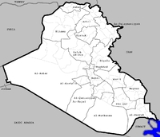
is divided into 18 governorate
s, which are further divided into district
s:
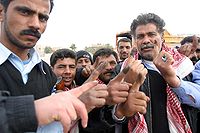 Elections for the National Assembly of Iraq
were held on January 30, 2005 in Iraq
. The 275-member National Assembly was a parliament
created under the Transitional Law
during the Occupation of Iraq. The newly-elected transitional Assembly was given a mandate to write the new and permanent Constitution of Iraq
and exercised legislative functions until the new Constitution came into effect, and resulted in the formation of the Iraqi Transitional Government
.
The United Iraqi Alliance
, tacitly backed by Shia Grand Ayatollah Ali al-Sistani, led with some 48% of the vote. The Democratic Patriotic Alliance of Kurdistan
was in second place with some 26% of the vote. Prime Minister Ayad Allawi's party, the Iraqi List
, came third with some 14%. In total, twelve parties received enough votes to win a seat in the assembly.
Low Arab Sunni turnout threatened the legitimacy of the election, which was as low as 2% in Anbar
province. More than 100 armed attacks on polling places took place, killing at least 44 people (including nine suicide bombers) across Iraq, including at least 20 in Baghdad
.
 Following the ratification
of the Constitution of Iraq
on 15 October 2005, a general election was held on 15 December to elect the permanent 275-member Iraqi Council of Representatives.
The elections took place under a list system, whereby voters chose from a list of parties and coalitions. 230 seats were apportioned among Iraq's 18 governorates
based on the number of registered voters in each as of the January 2005 elections
, including 59 seats for Baghdad Governorate. The seats within each governorate were allocated to lists through a system of Proportional Representation
. An additional 45 "compensatory" seats were allocated to those parties whose percentage of the national vote total (including out of country votes) exceeds the percentage of the 275 total seats that they have been allocated. Women were required to occupy 25% of the 275 seats. The change in the voting system gave more weight to Arab Sunni
voters, who make up most of the voters in several provinces. It was expected that these provinces would thus return mostly Sunni Arab representatives, after most Sunnis boycotted the last election.
Turnout was high (79.6%). The White House
was encouraged by the relatively low levels of violence during polling, with one insurgent group making good on a promised election day moratorium on attacks, even going so far as to guard the voters from attack. President Bush frequently pointed to the election as a sign of progress in rebuilding Iraq. However, post-election violence threatened to plunge the nation into civil war, before the situation began to calm in 2007. The election results themselves produced a shaky coalition government headed by Nouri al-Maliki
.
on 7 March 2010. The election decided the 325 members of the Council of Representatives of Iraq who will elect the Iraqi Prime Minister
and President
. The election resulted in a partial victory for the Iraqi National Movement
, led by former Interim Prime Minister Ayad Allawi, which won a total of 91 seats, making it the largest alliance in the Council. The State of Law Coalition
, led by incumbent Prime Minister Nouri Al-Maliki
, was the second largest grouping with 89 seats.
The election was rife with controversy. Prior to the election, the Supreme Court in Iraq ruled that the existing electoral law/rule was unconstitutional, and a new elections law made changes in the electoral system. On 15 January 2010, the Independent High Electoral Commission (IHEC) banned 499 candidates from the election due to alleged links with the Ba'ath Party. Before the start of the campaign on 12 February 2010, IHEC confirmed that most of the appeals by banned candidates had been rejected and 456 of the initially banned candidates would not be allowed to run for the election. There were numerous allegations of fraud, and a recount of the votes in Baghdad was ordered on 19 April 2010. On May 14, IHEC announced that after 11,298 ballot boxes had been recounted, there was no sign of fraud or violations.
The new parliament opened on 14 June 2010. After months of fraught negotiations, an agreement was reached on the formation of a new government on November 11. Talabani would continue as president, Al-Maliki would stay on as prime minister and Allawi would head a new security council.
, Iraq's is the most corrupt government in the Middle East
, and is described as a “hybrid regime” (between a “flawed democracy” and an “authoritarian regime”). The 2011 report "Costs of War" from Brown University
's Watson Institute for International Studies
concluded that U.S. military presence in Iraq has not been able to prevent this corruption, noting that as early as 2006, "there were clear signs that post-Saddam Iraq was not going to be the linchpin for a new democratic Middle East."
Iraq
Iraq ; officially the Republic of Iraq is a country in Western Asia spanning most of the northwestern end of the Zagros mountain range, the eastern part of the Syrian Desert and the northern part of the Arabian Desert....
takes place in a framework of a federal
Federation
A federation , also known as a federal state, is a type of sovereign state characterized by a union of partially self-governing states or regions united by a central government...
parliamentary
Parliamentary system
A parliamentary system is a system of government in which the ministers of the executive branch get their democratic legitimacy from the legislature and are accountable to that body, such that the executive and legislative branches are intertwined....
representative democratic
Representative democracy
Representative democracy is a form of government founded on the principle of elected individuals representing the people, as opposed to autocracy and direct democracy...
republic
Republic
A republic is a form of government in which the people, or some significant portion of them, have supreme control over the government and where offices of state are elected or chosen by elected people. In modern times, a common simplified definition of a republic is a government where the head of...
. It is a multi-party system
Multi-party system
A multi-party system is a system in which multiple political parties have the capacity to gain control of government separately or in coalition, e.g.The Conservative-Liberal Democrat coalition in the United Kingdom formed in 2010. The effective number of parties in a multi-party system is normally...
whereby the executive power
Executive Power
Executive Power is Vince Flynn's fifth novel, and the fourth to feature Mitch Rapp, an American agent that works for the CIA as an operative for a covert counter terrorism unit called the "Orion Team."-Plot summary:...
is exercised by the Prime Minister
Prime Minister of Iraq
The Prime Minister of Iraq is Iraq's head of government. Prime Minister was originally an appointed office, subsidiary to the head of state, and the nominal leader of the Iraqi parliament. Under the newly adopted constitution the Prime Minister is to be the country's active executive authority...
of the Council of Ministers
Council of Ministers of Iraq
The Cabinet of Iraq is the executive branch of the government of Iraq.The National Assembly of Iraq elects a President of State who along with two deputies form the Presidency Council. The Presidency Council appoints the Prime Minister who appoints the Council of Ministers, all of whom must be...
as the head of government
Head of government
Head of government is the chief officer of the executive branch of a government, often presiding over a cabinet. In a parliamentary system, the head of government is often styled prime minister, chief minister, premier, etc...
, as well as the President of Iraq
President of Iraq
The President of Iraq is the head of state of Iraq and "safeguards the commitment to the Constitution and the preservation of Iraq's independence, sovereignty, unity, the security of its territories in accordance with the provisions of the Constitution." The President is elected by the Council of...
, and legislative power is vested in the Council of Representatives
National Assembly of Iraq
The Council of Representatives of Iraq is the main elected body of representatives in Iraq. It is currently composed of 325 seats and meets in Baghdad inside the International Zone . It is governed by bylaws that can be found -The monarchy:...
and the Federation Council.
The current Prime Minister of Iraq
Prime Minister of Iraq
The Prime Minister of Iraq is Iraq's head of government. Prime Minister was originally an appointed office, subsidiary to the head of state, and the nominal leader of the Iraqi parliament. Under the newly adopted constitution the Prime Minister is to be the country's active executive authority...
is Nouri al-Maliki
Nouri al-Maliki
Nouri Kamil Mohammed Hasan al-Maliki , also known as Jawad al-Maliki or Abu Esraa, is the Prime Minister of Iraq and the secretary-general of the Islamic Dawa Party. Al-Maliki and his government succeeded the Iraqi Transitional Government. He is currently in his second term as Prime Minister...
, who holds most of the executive authority and appoints the Council of Ministers
Council of Ministers of Iraq
The Cabinet of Iraq is the executive branch of the government of Iraq.The National Assembly of Iraq elects a President of State who along with two deputies form the Presidency Council. The Presidency Council appoints the Prime Minister who appoints the Council of Ministers, all of whom must be...
, which acts as a cabinet and/or government. The current Presidency Council
Presidency Council of Iraq
The Presidency Council of Iraq is an entity currently operating under the auspices of the "transitional provisions" of the Constitution of Iraq and previously under the Transitional Administrative Law....
, a transitional replacement for the President of Iraq
President of Iraq
The President of Iraq is the head of state of Iraq and "safeguards the commitment to the Constitution and the preservation of Iraq's independence, sovereignty, unity, the security of its territories in accordance with the provisions of the Constitution." The President is elected by the Council of...
who serves largely as a figurehead
Figurehead (metaphor)
In politics, a figurehead is a person who holds de jure an important title or office yet de facto executes little actual power, most commonly limited by convention rather than law. The metaphor derives from the carved figurehead at the prow of a sailing ship...
with few powers, is composed of Jalal Talabani
Jalal Talabani
Jalal Talabani is the sixth and current President of Iraq, a leading Kurdish politician. He is the first non-Arab president of Iraq, although Abdul Kareem Qasim was half Kurdish....
, Tariq al-Hashimi
Tariq Al-Hashimi
Tariq al-Hashimi is an Iraqi politician and was general secretary of the Iraqi Islamic Party until May 2009. Along with Adil Abdul Mahdi, he is a Vice President of Iraq in the government formed after the December 2005 elections...
, and Adel Abdul Mehdi.
History
Before the fall of Saddam HusseinSaddam Hussein
Saddam Hussein Abd al-Majid al-Tikriti was the fifth President of Iraq, serving in this capacity from 16 July 1979 until 9 April 2003...
in 2003, the Ba'ath Party officially ruled. Iraq was occupied by foreign troops beginning with the 2003 invasion of Iraq
2003 invasion of Iraq
The 2003 invasion of Iraq , was the start of the conflict known as the Iraq War, or Operation Iraqi Freedom, in which a combined force of troops from the United States, the United Kingdom, Australia and Poland invaded Iraq and toppled the regime of Saddam Hussein in 21 days of major combat operations...
, with military forces coming primarily from the United States
United States
The United States of America is a federal constitutional republic comprising fifty states and a federal district...
and the United Kingdom
United Kingdom
The United Kingdom of Great Britain and Northern IrelandIn the United Kingdom and Dependencies, other languages have been officially recognised as legitimate autochthonous languages under the European Charter for Regional or Minority Languages...
. Most foreign militaries operated under the umbrella of the Multinational force in Iraq
Multinational force in Iraq
The Multi-National Force – Iraq was a military command, led by the United States, which was responsible for Operation Iraqi Freedom. Multi-National Force – Iraq replaced the previous force, Combined Joint Task Force 7, on 15 May 2004, and was later itself reorganized into its successor, United...
(the MNF–I), authorized under United Nations Security Council Resolution 1546
United Nations Security Council Resolution 1546
United Nations Security Council Resolution 1546, adopted unanimously on June 8, 2004, after reaffirming previous resolutions on Iraq, the Council endorsed the formation of the Iraqi Interim Government, welcomed the end of the occupation and determined the status of the multinational force and its...
, 1637
United Nations Security Council Resolution 1637
United Nations Security Council Resolution 1637, adopted unanimously on November 8, 2005, after reaffirming previous resolutions on Iraq, the Council extended the mandate of the multinational force until the end of 2006....
, 1723
United Nations Security Council Resolution 1723
United Nations Security Council Resolution 1723, adopted unanimously on November 28, 2006, after recalling previous resolutions on Iraq, the Council extended the mandate of the multinational force until the end of 2007....
, and 1790
United Nations Security Council Resolution 1790
United Nations Security Council Resolution 1790 was adopted unanimously by the United Nations Security Council on December 18, 2007, extending the mandate of the multinational force in Iraq until December 31, 2008...
until December 31, 2008. On January 1, 2009 the U.S.–Iraq Status of Forces Agreement entered into force.
The occupation yielded to a transitional administrative law
Law of Administration for the State of Iraq for the Transitional Period
The Law of Administration for the State of Iraq for the Transitional Period , was Iraq's provisional constitution following the 2003 Iraq War. It was signed on March 8, 2004 by the Iraqi Governing Council...
, which was replaced by the Constitution of Iraq
Constitution of Iraq
The Constitution of Iraq is Iraq's fundamental law.-History:Iraq's first constitution, which established a constitutional monarchy, entered into force under the auspices of a British military occupation in 1925 and remained in effect until the 1958 revolution established a republic...
following approval in a referendum
Iraqi constitution ratification vote, 2005
The electorate of Iraq went to the polls on 15 October 2005 to vote in a referendum on whether or not to ratify the proposed constitution of Iraq. After 10 days of counting votes, the country's electoral commission announced that the constitution had been approved by a wide margin nationwide...
held on October 15, 2005. A permanent 275-member Council of Representatives was elected in the December 2005 Iraqi legislative elections
Iraqi legislative election, December 2005
Following the ratification of the Constitution of Iraq on 15 October 2005, a general election was held on 15 December to elect a permanent 275-member Iraqi Council of Representatives....
, initiating the formation of the Government of Iraq, 2006-2010. The last elections were the January 2010 Iraqi legislative elections.
Federal government
The federalFederalism
Federalism is a political concept in which a group of members are bound together by covenant with a governing representative head. The term "federalism" is also used to describe a system of the government in which sovereignty is constitutionally divided between a central governing authority and...
government
Government
Government refers to the legislators, administrators, and arbitrators in the administrative bureaucracy who control a state at a given time, and to the system of government by which they are organized...
of Iraq
Iraq
Iraq ; officially the Republic of Iraq is a country in Western Asia spanning most of the northwestern end of the Zagros mountain range, the eastern part of the Syrian Desert and the northern part of the Arabian Desert....
is defined under the current Constitution
Constitution of Iraq
The Constitution of Iraq is Iraq's fundamental law.-History:Iraq's first constitution, which established a constitutional monarchy, entered into force under the auspices of a British military occupation in 1925 and remained in effect until the 1958 revolution established a republic...
as an Islam
Islam
Islam . The most common are and . : Arabic pronunciation varies regionally. The first vowel ranges from ~~. The second vowel ranges from ~~~...
ic, democratic
Representative democracy
Representative democracy is a form of government founded on the principle of elected individuals representing the people, as opposed to autocracy and direct democracy...
, federal
Federation
A federation , also known as a federal state, is a type of sovereign state characterized by a union of partially self-governing states or regions united by a central government...
parliamentary
Parliamentary system
A parliamentary system is a system of government in which the ministers of the executive branch get their democratic legitimacy from the legislature and are accountable to that body, such that the executive and legislative branches are intertwined....
republic
Republic
A republic is a form of government in which the people, or some significant portion of them, have supreme control over the government and where offices of state are elected or chosen by elected people. In modern times, a common simplified definition of a republic is a government where the head of...
. The federal government is composed of the executive, legislative, and judicial branches, as well as numerous independent commissions.
Legislative branch
The legislative branch is composed of the Council of Representatives and a Federation Council.Executive branch
The executive branch is composed of the PresidentPresident of Iraq
The President of Iraq is the head of state of Iraq and "safeguards the commitment to the Constitution and the preservation of Iraq's independence, sovereignty, unity, the security of its territories in accordance with the provisions of the Constitution." The President is elected by the Council of...
/ Presidency Council
Presidency Council of Iraq
The Presidency Council of Iraq is an entity currently operating under the auspices of the "transitional provisions" of the Constitution of Iraq and previously under the Transitional Administrative Law....
and the Council of Ministers
Council of Ministers of Iraq
The Cabinet of Iraq is the executive branch of the government of Iraq.The National Assembly of Iraq elects a President of State who along with two deputies form the Presidency Council. The Presidency Council appoints the Prime Minister who appoints the Council of Ministers, all of whom must be...
.
Judicial branch
The federal judiciary is composed of the Higher Judicial Council, the Supreme CourtSupreme Court of Iraq
The Supreme Court of Iraq is the independent judicial body of Iraq that interprets the constitution and determines the constitutionality of laws and regulations...
, the Court of Cassation, the Public Prosecution Department, the Judiciary Oversight Commission, and other federal courts that are regulated by law. One such court is the Central Criminal Court
Central Criminal Court of Iraq
The Central Criminal Court of Iraq, or CCCI, is a criminal court of Iraq. The CCCI is based on an inquisitorial system and consists of two chambers: an investigative court and a criminal court...
.
Independent commissions and institutions
The High Commission for Human Rights, the Independent High Electoral Commission, and the Commission on Integrity are independent commissions subject to monitoring by the Council of Representatives. The Central Bank of IraqCentral Bank of Iraq
-History:The Central Bank of Iraq was established as Iraq's central bank by Central Bank of Iraq Law 2004 with authorised capital of 100 billion dinars. The current Governor of the Central Bank of Iraq is Sinan Al Shabibi.-Architecture:...
, the Board of Supreme Audit, the Communications and Media Commission
Iraqi Communications and Media Commission
The National Communications and Media Commission of Iraq was established in 2004 to monitor media and communications in Iraq....
, and the Endowment Commission are financially and administratively independent institutions. The Foundation of Martyrs is attached to the Council of Ministers. The Federal Public Service Council regulates the affairs of the federal public service, including appointment and promotion.
Local government
The basic subdivisions of the country are the regions and the governorates. Both regions and governorates are given broad autonomy with regions given additional powers such as control of internal security forces for the region such as police, security forces, and guards. The last local elections for the governorates were held in the 2009 Iraqi governorate elections on 31 January 2009.Regions
The constitution requires that the Council of Representatives enact a law which provides the procedures for forming a new region 6 months from the start of its first session. A law was passed 11 October 2006 by a unanimous vote with only 138 of 275 representatives present, with the remaining representatives boycotting the vote. Legislators from the Iraqi Accord FrontIraqi Accord Front
The Iraqi Accord Front or Iraqi Accordance Front also known as Tawafuq is an Iraqi Sunni-Islamist political coalition created on October 26, 2005 by the Iraqi Islamic Party to contest the December 2005 general election...
, Sadrist Movement
Sadrist Movement
The Sadrist Movement is an Iraqi Islamist national movement led by Muqtada al-Sadr. The movement draws wide support from across Iraqi society and especially from the Shi'a poor in the country. The most important person in setting the goals and the philosophy of the movement was Grand Ayatollah...
and Islamic Virtue Party
Islamic Virtue Party
Islamic Virtue Party is an Iraqi political party. It follows ayatollah Muhammad Ya`qubi a student of Mohammad Sadeq al-Sadr and thus represent a branch of the Sadrist Movement, however the party is not affiliated with Muqtada al-Sadr and is in fact a rival to his branch of the Sadrists...
all opposed the bill.
Under the law, a region can be created out of one or more existing governorates
Governorates of Iraq
||Iraq is composed of 18 provinces :#Baghdād #Salāh ad-Dīn #Diyālā #Wāsit #Maysān #Al-Basrah #Dhī Qār #Al-Muthannā #Al-Qādisiyyah...
or two or more existing regions, and a governorate can also join an existing region to create a new region. A new region can be proposed by one third or more of the council members in each affected governorate plus 500 voters or by one tenth or more voters in each affected governorate. A referendum must then be held within three months, which requires a simple majority in favour to pass. In the event of competing proposals, the multiple proposals are put to a ballot and the proposal with the most supporters is put to the referendum. In the event of an affirmative referendum a Transitional Legislative Assembly is elected for one year, which has the task of writing a constitution for the Region, which is then put to a referendum requiring a simple majority to pass. The President, Prime Minister and Ministers of the region are elected by simple majority, in contrast to the Iraqi Council of Representatives which requires two thirds support.
Governorates
IraqIraq
Iraq ; officially the Republic of Iraq is a country in Western Asia spanning most of the northwestern end of the Zagros mountain range, the eastern part of the Syrian Desert and the northern part of the Arabian Desert....
is divided into 18 governorate
Governorates of Iraq
||Iraq is composed of 18 provinces :#Baghdād #Salāh ad-Dīn #Diyālā #Wāsit #Maysān #Al-Basrah #Dhī Qār #Al-Muthannā #Al-Qādisiyyah...
s, which are further divided into district
Districts of Iraq
Iraq's 18 provinces are subdivided into 111 districts .The district usually bears the same name as the district capital. The districts are also separated into sub-districts.The districts are listed below, by governorate :...
s:
|
|
Iraqi parliamentary election, January 2005
National Assembly of Iraq
The Council of Representatives of Iraq is the main elected body of representatives in Iraq. It is currently composed of 325 seats and meets in Baghdad inside the International Zone . It is governed by bylaws that can be found -The monarchy:...
were held on January 30, 2005 in Iraq
Iraq
Iraq ; officially the Republic of Iraq is a country in Western Asia spanning most of the northwestern end of the Zagros mountain range, the eastern part of the Syrian Desert and the northern part of the Arabian Desert....
. The 275-member National Assembly was a parliament
Parliament
A parliament is a legislature, especially in those countries whose system of government is based on the Westminster system modeled after that of the United Kingdom. The name is derived from the French , the action of parler : a parlement is a discussion. The term came to mean a meeting at which...
created under the Transitional Law
Law of Administration for the State of Iraq for the Transitional Period
The Law of Administration for the State of Iraq for the Transitional Period , was Iraq's provisional constitution following the 2003 Iraq War. It was signed on March 8, 2004 by the Iraqi Governing Council...
during the Occupation of Iraq. The newly-elected transitional Assembly was given a mandate to write the new and permanent Constitution of Iraq
Constitution of Iraq
The Constitution of Iraq is Iraq's fundamental law.-History:Iraq's first constitution, which established a constitutional monarchy, entered into force under the auspices of a British military occupation in 1925 and remained in effect until the 1958 revolution established a republic...
and exercised legislative functions until the new Constitution came into effect, and resulted in the formation of the Iraqi Transitional Government
Iraqi Transitional Government
The Iraqi Transitional Government was the government of Iraq from May 3rd, 2005, when it replaced the Iraqi Interim Government, until May 20th, 2006, when it was replaced by the first permanent government....
.
The United Iraqi Alliance
United Iraqi Alliance
The National Iraqi Alliance , also known as the Watani List, is an Iraqi electoral coalition that contested the Iraqi legislative election, 2010. The Alliance is mainly composed of Shi'a Islamist parties...
, tacitly backed by Shia Grand Ayatollah Ali al-Sistani, led with some 48% of the vote. The Democratic Patriotic Alliance of Kurdistan
Democratic Patriotic Alliance of Kurdistan
The Democratic Patriotic Alliance of Kurdistan sometimes referred to simply as the Kurdistan Alliance is the name of the electoral coalition first presented as a united Kurdish list in the January 2005 election in Iraq. Elections were held simultaneously for the assembly of the Kurdistan Regional...
was in second place with some 26% of the vote. Prime Minister Ayad Allawi's party, the Iraqi List
Iraqi List
The Iraqi List is a political party list in the Iraqi National Assembly election, 2005, consisting of mainly secular Shia. It is dominated by the Iraqi National Accord led by former exile and interim prime minister Iyad Allawi...
, came third with some 14%. In total, twelve parties received enough votes to win a seat in the assembly.
Low Arab Sunni turnout threatened the legitimacy of the election, which was as low as 2% in Anbar
Anbar
Anbar was a town in Iraq, at lat. 33 deg. 22' N., long. 43 deg. 49' E, on the east bank of the Euphrates, just south of the Nahr 'Isa, or Sakhlawieh canal, the northernmost of the canals connecting that river with the Tigris.-History:...
province. More than 100 armed attacks on polling places took place, killing at least 44 people (including nine suicide bombers) across Iraq, including at least 20 in Baghdad
Baghdad
Baghdad is the capital of Iraq, as well as the coterminous Baghdad Governorate. The population of Baghdad in 2011 is approximately 7,216,040...
.
Iraqi parliamentary election, December 2005
Iraqi constitution ratification vote, 2005
The electorate of Iraq went to the polls on 15 October 2005 to vote in a referendum on whether or not to ratify the proposed constitution of Iraq. After 10 days of counting votes, the country's electoral commission announced that the constitution had been approved by a wide margin nationwide...
of the Constitution of Iraq
Constitution of Iraq
The Constitution of Iraq is Iraq's fundamental law.-History:Iraq's first constitution, which established a constitutional monarchy, entered into force under the auspices of a British military occupation in 1925 and remained in effect until the 1958 revolution established a republic...
on 15 October 2005, a general election was held on 15 December to elect the permanent 275-member Iraqi Council of Representatives.
The elections took place under a list system, whereby voters chose from a list of parties and coalitions. 230 seats were apportioned among Iraq's 18 governorates
Governorates of Iraq
||Iraq is composed of 18 provinces :#Baghdād #Salāh ad-Dīn #Diyālā #Wāsit #Maysān #Al-Basrah #Dhī Qār #Al-Muthannā #Al-Qādisiyyah...
based on the number of registered voters in each as of the January 2005 elections
Iraqi legislative election, January 2005
Elections for the National Assembly of Iraq were held on January 30, 2005 in Iraq. The 275-member National Assembly was a parliament created under the Transitional Law during the Occupation of Iraq...
, including 59 seats for Baghdad Governorate. The seats within each governorate were allocated to lists through a system of Proportional Representation
Proportional representation
Proportional representation is a concept in voting systems used to elect an assembly or council. PR means that the number of seats won by a party or group of candidates is proportionate to the number of votes received. For example, under a PR voting system if 30% of voters support a particular...
. An additional 45 "compensatory" seats were allocated to those parties whose percentage of the national vote total (including out of country votes) exceeds the percentage of the 275 total seats that they have been allocated. Women were required to occupy 25% of the 275 seats. The change in the voting system gave more weight to Arab Sunni
Sunni Islam
Sunni Islam is the largest branch of Islam. Sunni Muslims are referred to in Arabic as ʾAhl ūs-Sunnah wa āl-Ǧamāʿah or ʾAhl ūs-Sunnah for short; in English, they are known as Sunni Muslims, Sunnis or Sunnites....
voters, who make up most of the voters in several provinces. It was expected that these provinces would thus return mostly Sunni Arab representatives, after most Sunnis boycotted the last election.
Turnout was high (79.6%). The White House
White House
The White House is the official residence and principal workplace of the president of the United States. Located at 1600 Pennsylvania Avenue NW in Washington, D.C., the house was designed by Irish-born James Hoban, and built between 1792 and 1800 of white-painted Aquia sandstone in the Neoclassical...
was encouraged by the relatively low levels of violence during polling, with one insurgent group making good on a promised election day moratorium on attacks, even going so far as to guard the voters from attack. President Bush frequently pointed to the election as a sign of progress in rebuilding Iraq. However, post-election violence threatened to plunge the nation into civil war, before the situation began to calm in 2007. The election results themselves produced a shaky coalition government headed by Nouri al-Maliki
Nouri al-Maliki
Nouri Kamil Mohammed Hasan al-Maliki , also known as Jawad al-Maliki or Abu Esraa, is the Prime Minister of Iraq and the secretary-general of the Islamic Dawa Party. Al-Maliki and his government succeeded the Iraqi Transitional Government. He is currently in his second term as Prime Minister...
.
Iraqi parliamentary election, 2010
A parliamentary election was held in IraqIraq
Iraq ; officially the Republic of Iraq is a country in Western Asia spanning most of the northwestern end of the Zagros mountain range, the eastern part of the Syrian Desert and the northern part of the Arabian Desert....
on 7 March 2010. The election decided the 325 members of the Council of Representatives of Iraq who will elect the Iraqi Prime Minister
Prime Minister of Iraq
The Prime Minister of Iraq is Iraq's head of government. Prime Minister was originally an appointed office, subsidiary to the head of state, and the nominal leader of the Iraqi parliament. Under the newly adopted constitution the Prime Minister is to be the country's active executive authority...
and President
President of Iraq
The President of Iraq is the head of state of Iraq and "safeguards the commitment to the Constitution and the preservation of Iraq's independence, sovereignty, unity, the security of its territories in accordance with the provisions of the Constitution." The President is elected by the Council of...
. The election resulted in a partial victory for the Iraqi National Movement
Iraqi National Movement
The Iraqi National Movement , more commonly known as the al-Iraqiya List is an Iraqi political coalition formed to contest the Iraqi parliamentary election, 2010 by Iraqi Vice President Tariq al-Hashimi's Renewal List, the Iraqi National List led by former Prime Minister Iyad Allawi and the Iraqi...
, led by former Interim Prime Minister Ayad Allawi, which won a total of 91 seats, making it the largest alliance in the Council. The State of Law Coalition
State of Law Coalition
The State of Law Coalition also known as Rule of Law Coalition is an Iraqi political coalition formed for the Iraqi governorate elections, 2009 by Prime Minister of Iraq, Nouri al-Maliki and his Islamic Dawa Party....
, led by incumbent Prime Minister Nouri Al-Maliki
Nouri al-Maliki
Nouri Kamil Mohammed Hasan al-Maliki , also known as Jawad al-Maliki or Abu Esraa, is the Prime Minister of Iraq and the secretary-general of the Islamic Dawa Party. Al-Maliki and his government succeeded the Iraqi Transitional Government. He is currently in his second term as Prime Minister...
, was the second largest grouping with 89 seats.
The election was rife with controversy. Prior to the election, the Supreme Court in Iraq ruled that the existing electoral law/rule was unconstitutional, and a new elections law made changes in the electoral system. On 15 January 2010, the Independent High Electoral Commission (IHEC) banned 499 candidates from the election due to alleged links with the Ba'ath Party. Before the start of the campaign on 12 February 2010, IHEC confirmed that most of the appeals by banned candidates had been rejected and 456 of the initially banned candidates would not be allowed to run for the election. There were numerous allegations of fraud, and a recount of the votes in Baghdad was ordered on 19 April 2010. On May 14, IHEC announced that after 11,298 ballot boxes had been recounted, there was no sign of fraud or violations.
The new parliament opened on 14 June 2010. After months of fraught negotiations, an agreement was reached on the formation of a new government on November 11. Talabani would continue as president, Al-Maliki would stay on as prime minister and Allawi would head a new security council.
Corruption
According to Transparency InternationalTransparency International
Transparency International is a non-governmental organization that monitors and publicizes corporate and political corruption in international development. It publishes an annual Corruption Perceptions Index, a comparative listing of corruption worldwide...
, Iraq's is the most corrupt government in the Middle East
Middle East
The Middle East is a region that encompasses Western Asia and Northern Africa. It is often used as a synonym for Near East, in opposition to Far East...
, and is described as a “hybrid regime” (between a “flawed democracy” and an “authoritarian regime”). The 2011 report "Costs of War" from Brown University
Brown University
Brown University is a private, Ivy League university located in Providence, Rhode Island, United States. Founded in 1764 prior to American independence from the British Empire as the College in the English Colony of Rhode Island and Providence Plantations early in the reign of King George III ,...
's Watson Institute for International Studies
Watson Institute for International Studies
The Watson Institute for International Studies is a center for the analysis of international issues at Brown University, focusing mainly on global security and political economy and society. Its faculty span a wide range of disciplines, including, anthropology, economics, political science, and...
concluded that U.S. military presence in Iraq has not been able to prevent this corruption, noting that as early as 2006, "there were clear signs that post-Saddam Iraq was not going to be the linchpin for a new democratic Middle East."
See also
- Reconstruction of IraqReconstruction of IraqInvestment in post-2003 Iraq refers to international efforts to rebuild the infrastructure of Iraq since the Iraq War in 2003.Along with the economic reform of Iraq, international projects have been implemented to repair and upgrade Iraqi water and sewage treatment plants, electricity production,...
- Human rights abuses in Iraq
- Post-invasion Iraq, 2003–present
External links
- Who Are Iraq's New Leaders? What Do They Want? U.S. Institute of Peace Special Report, March 2006
- BBC Report: Who's Who in Post-Saddam Iraq
- Iraq Elections newswire
- Video Seminar on Iraq Coalition Politics: April 20, 2005, sponsored by the Program in Arms Control, Disarmament, and International Security at the University of Illinois.
- Global Justice Project: Iraq
- M. Ismail Marcinkowski, Religion and Politics in Iraq. Shiite Clerics between Quietism and Resistance, with a foreword by Professor Hamid Algar of the University of California at Berkeley. Singapore: Pustaka Nasional, 2004 (ISBN 9971-77-513-1)
- Iraq Inter-Agency Information & Analysis Unit Reports, Maps and Assessments of Iraq's Governorates from the UN Inter-Agency Information & Analysis Unit