
All Topics  
Polish zloty

 
Polish Zloty

   Email Print
   Bookmark   Link


Polish zloty


The zloty (pron. , the nominative plural used for numbers ending in 2, 3 and 4 (except ending in 12, 13 and 14): zlote , the genitive plural used for all other numbers: zlotych , (sign
Currency sign

A currency sign is a graphic symbol often used as a shorthand for a currency's name. Internationally, ISO 4217 codes are used instead of currency signs, though currency signs may be in common use in their respective countries....
: zl; code
ISO 4217

ISO 4217 is the international standard describing three-letter codes to define the names of currency established by the International Organization for Standardization ....
: PLN) literally meaning "golden", is the currency of Poland
Poland

Poland , officially the Republic of Poland , is a country in Central Europe. Poland is bordered by Germany to the west; the Czech Republic and Slovakia to the south; Ukraine, Belarus and Lithuania to the east; and the Baltic Sea and Kaliningrad Oblast, a Russian Enclave and exclave, to the north....
. The modern zloty is subdivided into 100 groszy (singular: grosz, alternative plural form: grosze).

As a result of inflation
Inflation

In economics, inflation is a rise in the general price level of goods and services in an economy over a period of time. The term "inflation" once referred to increases in the money supply ; however, economic debates about the relationship between money supply and price levels have led to its primary use today in describing price inflatio...
 in the early 1990s, the currency underwent redenomination
Denomination (currency)

Denomination is a proper description of a currency amount, usually for coins or banknotes. Denominations may also be used with other means of payment like Scrips....
.


Discussion
Ask a question about 'Polish zloty'
Start a new discussion about 'Polish zloty'
Answer questions from other users
Full Discussion Forum


Encyclopedia


The zloty (pron. , the nominative plural used for numbers ending in 2, 3 and 4 (except ending in 12, 13 and 14): zlote , the genitive plural used for all other numbers: zlotych , (sign
Currency sign

A currency sign is a graphic symbol often used as a shorthand for a currency's name. Internationally, ISO 4217 codes are used instead of currency signs, though currency signs may be in common use in their respective countries....
: zl; code
ISO 4217

ISO 4217 is the international standard describing three-letter codes to define the names of currency established by the International Organization for Standardization ....
: PLN) literally meaning "golden", is the currency of Poland
Poland

Poland , officially the Republic of Poland , is a country in Central Europe. Poland is bordered by Germany to the west; the Czech Republic and Slovakia to the south; Ukraine, Belarus and Lithuania to the east; and the Baltic Sea and Kaliningrad Oblast, a Russian Enclave and exclave, to the north....
. The modern zloty is subdivided into 100 groszy (singular: grosz, alternative plural form: grosze).

As a result of inflation
Inflation

In economics, inflation is a rise in the general price level of goods and services in an economy over a period of time. The term "inflation" once referred to increases in the money supply ; however, economic debates about the relationship between money supply and price levels have led to its primary use today in describing price inflatio...
 in the early 1990s, the currency underwent redenomination
Denomination (currency)

Denomination is a proper description of a currency amount, usually for coins or banknotes. Denominations may also be used with other means of payment like Scrips....
. Thus, on 1 January 1995, 10 000 old zlotych (PLZ) became one new zloty (PLN).

History


First zloty, until 1850


Kingdom of Poland and Polish-Lithuanian Commonwealth
The zloty is a traditional Polish currency unit dating back to the Middle Ages. Initially, in the 14th and 15th centuries, the name was used for all kinds of foreign gold coins used in Poland, most notably German and Ruthenian ducat
Ducat

The ducat is a gold coin that was used as a trade currency throughout Europe before World War I. Its weight is 3.4909 grams of .986 gold, which is 0.1107 troy ounce, actual gold weight, actual gold weight....
s. In 1496 the Sejm
Sejm

The Sejm is the lower house of the Poland parliament.Before the 20th century, the term "Sejm" referred to the entire three-Chambers of parliament Polish parliament, comprising the lower house , the upper house and the monarch....
 approved the creation of a national currency, the zloty, and its value was set at 30 groszy, a coin minted since 1347 and modelled on the Prague groschen. The grosz was subdivided into 2 poltura or 3 solidi.

The name zloty (sometimes referred to as the florin
Florin

Florin may refer to:Modern currency* The Netherlands Antillean guilder is also known as a "florin", and abbreviated NAFl* Aruban florin, the currency of Aruba...
) was used for a number of different coins, including the 30 groszy coin called the polski zloty, the czerwony zloty (Red gulden) and the zloty renski (the Rhine ducat), which were in circulation at the time. However, the value of the Polish zloty dropped over time relative to these foreign coins and it became a silver coin, with the foreign ducats eventually circulating at approximately 5 zlotych.

Following the monetary reform
Monetary reform

Monetary reform describes any movement or theory that proposes a different system of supplying money and financing the economy than the current system....
 carried out by King Stanislaw August Poniatowski, the zloty became Poland's official currency and the exchange rate of 1 zloty to 30 groszy was confirmed. Until 1787, the zloty was tied to the Conventionsthaler
Conventionsthaler

The Conventionstaler was a standard silver coin of the Holy Roman Empire. It was introduced in 1754 and contained one tenth of a Cologne mark of silver ....
 of the Holy Roman Empire
Holy Roman Empire

The Holy Roman Empire was a union of territories in Central Europe during the Middle Ages and the Early modern Europe under a Holy Roman Emperor....
, with 8 zloty equal to one Conventionsthaler and, consequently, 4 groschen
Groschen

Groschen was the name for a coin used in various German language-speaking states as well as some non-German-speaking countries of Central Europe , the Danubian principalities....
 equal to the zloty. Two debasements of the currency occurred in the years before the final partition of Poland.

Duchy of Warsaw
The zloty remained in circulation after the Partitions of Poland
Partitions of Poland

The Partitions of Poland or Partitions of the Polish Lithuanian Commonwealth took place in the second half of the 18th century and ended the existence of the Polish?Lithuanian Commonwealth....
 and the Duchy of Warsaw
Duchy of Warsaw

The Duchy of Warsaw was a Poland state established by Napoleon Bonaparte in 1807 from the Polish lands ceded by the Kingdom of Prussia under the terms of the Treaties of Tilsit....
 issued coins denominated in grosz, zloty and talar (plurals talary and talarów), worth 6 zloty. Talar banknotes were also issued.

Congress Kingdom, 1815-1850
From 1816, the zloty currency was issued by the Russian controlled Congress Kingdom, with a fixed exchange rate between the Polish and Russian currencies of 1 kopeck
Russian ruble

The ruble or rouble is the currency of the Russia and the two partially recognized republics of Abkhazia and South Ossetia. Formerly, the ruble was also the currency of the Soviet Union and the Russian Empire prior to their breakups....
 = 2 grosze, or 15 kopeck = 1 zloty. The Warsaw
Warsaw

Warsaw is the Capital and World's largest cities of Poland. It is located on the Vistula River roughly from both the Baltic Sea coast and the Carpathian Mountains....
 mint issued grosz and zloty until 1832, when it began to issue coins denominated in both Polish and Russian currencies. From 1842, the Warsaw mint issued regular type Russian coins along with some coins denominated in both grosz and kopeck. In 1850, the last coins bearing Polish denominations were minted. Between 1835 and 1846, the Republic of Kraków also issued a currency, the Kraków zloty
Kraków zloty

The zloty was a currency issued in the independent Republic of Cracow in 1835. It was subdivided into 30 groszy.For an earlier coin of Krak?w, issued in the 14th century, see Krak?w grosz....


Currencies of Congress Kingdom Ruble
Ruble

File:Banknote 5000 rubles front.jpgFile:100000 rubles Belarus 2000 obverse.jpgFile:Transnistria rubla 2000.jpgThe ruble or rouble is a unit of currency....
 and Mark, 1850-1924

From 1850, the only currency issued for use in Congress Kingdom was the rubel
Polish rubel

The rubel was the currency of Poland from 1841 until 1917. It consisted of Russian coins and banknotes, together with notes issued by the Bank Polski....
 consisting of Russian currency and notes of the Bank Polski. The monetary system of Congress Kingdom was unified with the Russian Empire
Russian Empire

File:Russian Emperor Flag.jpgFile:Romanov Flag.svgThe Russian Empire was a state that existed from 1721 until the Russian Revolution of 1917....
 following the failed January Uprising in 1863. However, the gold coins remained in use until the early 20th century, much like other gold coins of the epoch, most notably gold roubles (dubbed swinka, or piggy) and sovereigns
British Sovereign coin

A Gold Sovereign is a gold coin first issued in 1489 for Henry VII of England and still in production as of 2009. While the coin typically had a money of account of one pound sterling or 20 shillings, the sovereign was primarily an official piece of bullion with no mark of value anywhere on the coin itself....
. Following occupation of the Congress Kingdom by Germans during World War I in 1917, the rubel was replaced by the marka
Polish marka

The marka was the currency of the Kingdom of Poland and of the Second Polish Republic between 1917 and 1924. It was subdivided into 100 fenigow , much like its Germany original after which it was modelled ....
 (plurals marki and marek), a currency initially equivalent to the German Papiermark
German papiermark

The name Papiermark is applied to the Germany currency from the point in 1914 when the link between the German gold mark and gold was abandoned, due to the outbreak of the First World War....
.

Second zloty, 1924-1950


Second Republic, 1924-1939
1936
The zloty was reintroduced as Poland's currency by Wladyslaw Grabski
Wladyslaw Grabski

Wladyslaw Grabski [] was a Polish politician, economist and historian. He was the main proponent of currency reform in the Second Polish Republic and served as Prime Minister of Poland in 1920 and from 1923-1925....
 in 1924, following the hyperinflation
Hyperinflation

File:Bundesarchiv Bild 102-00104, Inflation, Tapezieren mit Geldscheinen.jpgIn economics, hyperinflation is inflation that is very high or "out of control", a condition in which prices increase rapidly as a currency loses its value....
 and monetary chaos of the years after World War I. It replaced the marka
Polish marka

The marka was the currency of the Kingdom of Poland and of the Second Polish Republic between 1917 and 1924. It was subdivided into 100 fenigow , much like its Germany original after which it was modelled ....
 at a rate of 1 zloty = 1,800,000 marek and was subdivided into 100 groszy. The zloty was pegged at 0.1687 grams pure gold
Gold

Gold is a chemical element with the symbol Au and atomic number 79. It is a highly sought-after precious metal, having been used as money, as a store of value, in jewelry, in sculpture, and for ornamentation since the beginning of recorded history....
. 1 1939 zloty = 8 2004 zloty.

General Government, 1939-1944
1940 50
On 15 December 1939, the new Bank Emisyjny was established by the General Government
General Government

The General Government refers to a part of the territories of Poland under German military occupation during World War II by Nazi Germany and was an autonomous part of "Greater Germany"....
, itself set up by Nazi Germany
Nazi Germany

Nazi Germany and the Third Reich are the colloquial English names for Germany under the regime of Adolf Hitler and the Nazi Party , which established a Totalitarianism dictatorship that existed from 1933 to 1945....
. In May 1940, old banknotes of 1924-1939 were stamped by the new entity. The money exchange was limited per individual, the limits varied according to the status of the person (Pole, Jew, etc.). The fixed exchange rate 1 Reichsmark
German reichsmark

The Reichsmark was the currency in Germany from 1924 until June 20, 1948. The Reichsmark was subdivided into 100 Reichspfennig....
 = 2 zlote was established. A new issue of notes appeared in 1941. The General Government also issued coins using similar designs to earlier types but with cheaper metals.

Lublin Poland, 1944-1950
New zloty banknotes were introduced after 22 July 1944 by the Narodowy Bank Polski. They circulated until 1950.

Third zloty (PLZ), 1950-1994

50zl A (1950 1978)
50 Zl A 1975
5000 Zl A 1982
In 1950, a new zloty was introduced, replacing all earlier issues at a rate of one hundred to one. The new banknotes were dated 1948, whilst the new coins were dated 1949. From 1 January 1990 it was a convertible currency.

Between 1950 and 1990, a unit known as the zloty dewizowy (which can be roughly translated as the foreign exchange zloty) was used as an artificial currency for calculation purposes only. It existed because at the time the zloty was not convertible and its official rate of exchange was set by the Government, and there existed several exchange rates depending on the purpose of the transaction and who was exchanging, i.e. given amount in zloty could be exchanged for say US dollars at one of several official exchange rates depending on what was to be bought for the hard currency and the company that was buying foreign exchange; it worked similarly when a company had some earnings in Western currency and wanted (or had) to convert them into zlotych. The exchange rate did not depend on the amount being converted. Visitors from countries outside of the Soviet Bloc were offered a particularly poor exchange rate. Concurrently, the private black-market exchange rate contrasted sharply with the official government exchange rate until the end of Communist rule in 1989 when official rates were tied to market rates.

Fourth zloty (PLN), 1995-

The new Polish zloty is the unofficial name of the current currency of Poland, introduced on 1 January 1995 as a result of the redenomination
Denomination (currency)

Denomination is a proper description of a currency amount, usually for coins or banknotes. Denominations may also be used with other means of payment like Scrips....
 of the old currency. The official name of the Polish currency did not change since the Polish currency law of 1950 (DZ.U nr 50. poz. 459 with later changes), which defines the official currency as the zloty, remains in effect. The redenomination rate was 10 000 old Polish zloty to 1 new Polish zloty. The issuing bank is the Narodowy Bank Polski.

Future

Conditions of the Poland's accession to the European Union
European Union

The European Union is an economic and political union of 27 European Union member state, located primarily in Europe. It was established by the Treaty of Maastricht on 1 November 1993 upon the foundations of the pre-existing European Economic Community....
 (in May 2004) oblige the country to eventually adopt the euro
Euro

The euro is the official currency of 16 out of 27 European Union member state of the European Union . The states, known collectively as the Eurozone are: Austria, Belgium, Cyprus, Finland, France, Germany, Greece, Republic of Ireland, Italy, Luxembourg, Malta, the Netherlands, Portugal, Slovakia, Slovenia, and Spain....
, though not at any specific date and only after Poland would be able to meet the necessary stability criteria
Convergence criteria

Convergence criteria are the criteria for European Union member states to enter the third stage of European Economic and Monetary Union of the European Union and adopt the euro....
. On 10 September 2008, speaking at the launch of an economic forum in a Polish resort of Krynica-Zdrój, Polish Prime Minister Donald Tusk
Donald Tusk

Donald Franciszek Tusk is a center-right Poland politician, co-founder and chairman of the Civic Platform , and the Prime Minister of the Republic of Poland of the Republic of Poland....
 announced the ruling government's objective to join the Eurozone
Eurozone

The Eurozone is a currency union of 16 Member State of the European Union which have adopted the euro as their sole legal tender. It currently consists of Austria, Belgium, Cyprus, Finland, France, Germany, Greece, Republic of Ireland, Italy, Luxembourg, Malta, the Netherlands, Portugal, Slovakia, Slovenia and Spain....
 in 2012, by holding a referendum in 2010 and been approved by the European Central Bank
European Central Bank

The European Central Bank is one of the world's most important central banks, responsible for monetary policy covering the 16 member States of the Eurozone....
 in 2011. However article 227 of the Constitution of the Republic of Poland will need to be changed first and they will have to join the ERM 2 before second quarter 2009, this target date is still very aggressive.

Coins


First zloty

In the late eighteenth century, coins were issued in denominations of ?, ½, 1, 3, 6, 7½, 10 and 15 groszy, 1, 2, 4, 6 and 8 zlotych. The ? and ½ grosz were denominated as the solidus and poltura, whilst the 7½ and 15 groszy were denominated as 1 and 2 groschen. Coins up to 3 grosz were minted in copper, those between 6 and 15 grosz were billon whilst the denominations from 1 zloty upward were in silver.

The Duchy of Warsaw
Duchy of Warsaw

The Duchy of Warsaw was a Poland state established by Napoleon Bonaparte in 1807 from the Polish lands ceded by the Kingdom of Prussia under the terms of the Treaties of Tilsit....
 issued copper 1 and 3 grosze, billon 5 and 10 groszy and silver , ? and 1 talar. After 1816, the Congress Kingdom of Poland issued copper 1 and 3 grosze, billon 5 and 10 groszy, silver 1, 2, 5 and 10 zlotych, and gold 25 and 50 zlotych. During the insurrection of 1831, coins were minted for 3 and 10 groszy, 2 and 5 zlotych.

Between 1832 and 1834, coins denominated in both Polish and Russian currencies were issued, for 1 zloty (15 kopeck), 2 zlote (30 kopeck), 5 zlotych (¾ ruble), 10 zlotych (1½ ruble) and 20 zlotych (3 ruble). These were issued, along with the copper and billon coins, until 1841. In 1842, Russian coins were introduced, supplemented by 40 groszy (20 kopeck) and 50 groszy (25 kopeck) coins. These two coins were issued until 1850.

Second zloty

In 1924, coins were introduced in denominations of 1, 2, 5, 10, 20 and 50 groszy, 1 and 2 zlote. The lowest three denominations were first minted in brass, then in bronze. The 10, 20 and 50 groszy were in nickel, with the higher denominations in silver. Gold 10 and 20 zlotych coins were minted in 1925. Silver 5 zlotych coins were introduced in 1928. The size of the silver coins was reduced in 1932, a move accompanied by the introduction of silver 10 zlotych coins. During the German occupation of World War II, 1, 5, 10 and 20 groszy coins were issued (dated 1923) in zinc and 50 groszy (dated 1938) in nickel plated iron or iron.

Third zloty

In 1950, coins were issued for 1, 2, 5, 10, 20 and 50 groszy and 1 zloty. All denominations were minted in aluminium, with the 5 groszy also minted in bronze and the denominations above 5 groszy also minted in cupro-nickel. From 1957, aluminium coins for 5, 10, 20 and 50 groszy and 1 zloty were issued, with aluminium 2 and 5 zlotych introduced in 1958. Cupro-nickel 10 and 20 zlotych followed in 1959 and 1973, respectively. Brass 2 and 5 zlotych were introduced in 1975, reverting to aluminium in 1989. In 1990, 50 and 100 zlotych coins were issued, although they saw little circulation due to the high inflation occurring at that time.

Fourth zloty

Coins were introduced in 1995 (dated from 1990) in denominations of 1, 2, 5, 10, 20 and 50 groszy, 1 (colloquially called zlotówka), 2 and 5 zlotych (colloquially called piatka). The 1, 2, and 5 groszy are minted in brass, and the 10, 20 and 50 groszy and 1 zloty in cupro-nickel, whilst the 2 and 5 zlotych are bimetallic. 10, 20, 50, 100, 200 and 500 zlotych coins also exist and are legal tender, but are not in circulation.

Banknotes


First zloty

In 1794, treasury notes were issued in denominations of 5 and 10 groszy, 1, 4, 5, 10, 25, 50, 100, 500 and 1000 zlotych. The Duchy of Warsaw issued notes for 1, 2 and 5 talarów.

In 1824, the Kassowy Krolestwa Polskiego issued notes for 10, 50 and 100 zlotych. The Bank Polski issued notes dated 1830 and 1831 in denominations of 1, 5, 50 and 100 zlotych, whilst assignats for 200 and 500 zlotych were issued during the insurrection of 1831. From 1841, the Bank Polski issued notes denominated in rubel
Polish rubel

The rubel was the currency of Poland from 1841 until 1917. It consisted of Russian coins and banknotes, together with notes issued by the Bank Polski....
.

Second zloty

In 1924, along with provisional notes (overprints on old, bisected notes) for 1 and 5 groszy, the Ministry of Finance issued notes for 10, 20 and 50 groszy, whilst the Bank Polski introduced 1, 2, 5, 10, 20, 50, 100, 500 and 1000 zlotych. From 1925, the Ministry of Finance issued 2 and 5 zlotych notes, before they were replaced by silver coins, and the Bank Polski issued 5, 10, 20 and 50 zlotych notes, with 100 zlotych only reintroduced in 1932. In 1936, the Bank Polski issued 2 zlote notes, followed in 1938 by Ministry of Finance notes for 1 zloty.

In 1939, the General Government
General Government

The General Government refers to a part of the territories of Poland under German military occupation during World War II by Nazi Germany and was an autonomous part of "Greater Germany"....
 overprinted 100 zlotych notes for use before, in 1940, the Bank Emisyjny w Polsce was set up and issued notes for 1, 2, 5, 10, 20, 50, 100 and 500 zlotych. After liberation, notes (dated 1944) were introduced by the Narodowy Bank Polski for 50 groszy, 1, 2, 5, 10, 20, 50, 100 and 500 zlotych, with 1000 zlotych notes added in 1945.

Third zloty

In 1950, new notes (dated 1948), were introduced for 2, 5, 10, 20, 50, 100 and 500 zlotych. 1000 zlotych notes were added in 1962. 200 and 2000 zlotych notes were added in 1976 and 1977, followed by 5000 zlotych notes in 1982. The late 1980s and early 1990s saw high inflation in Poland and lead to the introduction of notes in denominations of 10,000 (in 1987), 20,000 (1989), 50,000 (1989), 100,000 (1990), 200,000 (1989), 500,000 (1990), 1,000,000 (1991) and 2,000,000 zlotych (1992). These notes (and coins of course) were valid until the end of 1996. Currently they are no longer a legal tender and can be exchanged only at the National Bank of Poland (and some banks obligated to it by the NBP) until December 31, 2010.

Fourth zloty

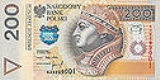
In 1995, notes (dated 1994) were introduced in denominations of 10 (colloquially called dycha), 20, 50 (two varieties, one of which was issued for collectors), 100 (colloquially called stówa) and 200 zlotych. 10,000 Third zlotych = 1 Fourth "new" zloty. Oft used notes: 10, 20, 50 and 100 PLN. Rarely used note: 200 PLN. After years New Polish Zloty (PLN) is fully convertible currency well known by travellers and investors from all the World.

See also

  • Polish coins and banknotes
    Polish coins and banknotes

    Current Polish coins and banknotes issued by the National Bank of Poland. For historical ones, Historical coins and banknotes of Poland....
  • Commemorative coins of Poland
    Commemorative coins of Poland

    Commemorative coins in Poland are special coin Mint by the Polish Mint and issued by the National Bank of Poland . Each year several collector and commemorative coins are minted to mark political, historical, scientific, cultural, sporting, humanitarian and other similar events of general importance to Poland or with wider international s...
  • Historical coins and banknotes of Poland
    Historical coins and banknotes of Poland

    Historical coins and banknotes of Poland, see also Polish zloty.Before 20th century 20th century Interwar Post WWII ...
  • Poland and the euro
  • Economy of Poland
    Economy of Poland

    Poland is considered to currently have one of the fastest growing economies in Central European nations, with an annual growth rate of over 6.0%.Poland has steadfastly pursued a policy of economic liberalization throughout the 1990s, with positive results for economic growth but negative results for some sectors of the population....


External links


Footnotes