


Polish Round Table Agreement

Encyclopedia
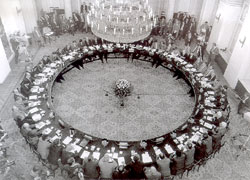
Round Table Talks
The Round Table Talks were a series of negotiations that took place in several countries of the Eastern Bloc between Communists and the opposition...
took place in Warsaw
Warsaw
Warsaw is the capital and largest city of Poland. It is located on the Vistula River, roughly from the Baltic Sea and from the Carpathian Mountains. Its population in 2010 was estimated at 1,716,855 residents with a greater metropolitan area of 2,631,902 residents, making Warsaw the 10th most...
, Poland from February 6 to April 4, 1989. The government initiated the discussion with the banned trade union Solidarność and other opposition groups in an attempt to defuse growing social unrest.
History
Following the factory strikes of the early 1980s and the subsequent formation of the (then still underground) Solidarity movement under the leadership of Lech WałęsaLech Wałęsa
Lech Wałęsa is a Polish politician, trade-union organizer, and human-rights activist. A charismatic leader, he co-founded Solidarity , the Soviet bloc's first independent trade union, won the Nobel Peace Prize in 1983, and served as President of Poland between 1990 and 95.Wałęsa was an electrician...
the political situation in Poland started relaxing somewhat. Despite an attempt by the government to crack down on the anti-Communist sentiments, the movement had gained too much momentum and it became impossible to hold off change anymore. In addition there was fear of a social explosion due to economic malaise and runaway inflation that had depressed Polish living standards and deepened public anger and frustration. By 1988 the authorities began serious talks with the opposition.
In September 1988, when a wave of strikes
1988 Polish strikes
The 1988 Polish strikes were a massive wave of workers' strikes which broke out in 1988 in the People’s Republic of Poland. The strikes, as well as street demonstrations, continued throughout spring and summer, ending in early September 1988. These actions shook the Communist regime of the country...
was coming to an end, a secret meeting was held which included amongst others the opposition leader Lech Wałęsa and Minister of Internal Affairs Czesław Kiszczak. They agreed on holding the so-called Round Table talks in the near future to plan out the course of action to be undertaken in the country. The Round Table talks began on February 6th 1989. They included the solidarity opposition faction and the coalition government faction. The talks were held in the Council of Ministers Office. The meetings were co-chaired by Lech Wałęsa and Czesław Kiszczak.
The Polish Communists, led by General Jaruzelski
Wojciech Jaruzelski
Wojciech Witold Jaruzelski is a retired Polish military officer and Communist politician. He was the last Communist leader of Poland from 1981 to 1989, Prime Minister from 1981 to 1985 and the country's head of state from 1985 to 1990. He was also the last commander-in-chief of the Polish People's...
, hoped to co-opt prominent opposition leaders into the ruling group without making major changes in the political power structure. In reality, the talks radically altered the shape of the Polish government and society. The events in Poland precipitated and gave momentum to the fall of the entire Communist bloc; the Yalta arrangement collapsed soon after the events in Poland.
Sessions
The sessions were divided into three main work groups:- Political reform workgroup
- Union pluralism and party pluralism workgroup
- Economy and social issues workgroup
Specific issues were handled by these work groups. The meetings often ground to a halt. This was caused by a mutual distrust of the factions and an obvious unwillingness of the government faction to relinquish power. The most controversial questions were:
- Pay raises and indexation
- Future pluralist elections
- The limit of the future president's competence
- The limit of competence for the future SejmSejmThe Sejm is the lower house of the Polish parliament. The Sejm is made up of 460 deputies, or Poseł in Polish . It is elected by universal ballot and is presided over by a speaker called the Marshal of the Sejm ....
and SenateSenate of PolandThe Senate is the upper house of the Polish parliament, the lower house being the 'Sejm'. The history of the Polish Senate is rich in tradition and stretches back over 500 years, it was one of the first constituent bodies of a bicameral parliament in Europe and existed without hiatus until the... - The access to mass communication mediaMass mediaMass media refers collectively to all media technologies which are intended to reach a large audience via mass communication. Broadcast media transmit their information electronically and comprise of television, film and radio, movies, CDs, DVDs and some other gadgets like cameras or video consoles...
by opposition forces
A number of (radical) opposition organisations were quite opposed to the talks. They did not believe in the good intentions of the sitting government. Despite their fears a number of important documents were signed on April 5th at the conclusion of the sessions. These documents became known as the Round Table Agreement.
Results
An agreement ("Round Table Agreement") was signed on April 4, 1989. The most important demands, including those reflected in the April NovelizationApril Novelization
April Novelization refers to the changes to the 1952 Constitution of the People's Republic of Poland, agreed in April 1989, in the aftermath of the Polish Round Table Agreement.Among key changes were:...
, were:
- Legalization of independent trade unions
- The introduction of the office of President (thereby annulling the power of the Communist party general secretary), who would be elected to a 6-year term
- The formation of a Senate
As a result, real political power was vested in a newly created bicameral legislature and in a president
President
A president is a leader of an organization, company, trade union, university, or country.Etymologically, a president is one who presides, who sits in leadership...
who would be the chief executive
Executive (government)
Executive branch of Government is the part of government that has sole authority and responsibility for the daily administration of the state bureaucracy. The division of power into separate branches of government is central to the idea of the separation of powers.In many countries, the term...
. Solidarność became a legitimate and legal political party. Free election to 35% of the seats in Sejm and an entirely free election to the Senate
Senate
A senate is a deliberative assembly, often the upper house or chamber of a legislature or parliament. There have been many such bodies in history, since senate means the assembly of the eldest and wiser members of the society and ruling class...
was assured.
The election of 4 June 1989
Contract Sejm
Contract Sejm is a term commonly applied to the Polish Parliament elected in the Polish parliamentary elections of 1989. The contract refers to an agreement reached by the Communist Party and the Solidarity movement during the Polish Round Table Agreement. The final agreement was signed on April...
brought a landslide victory to Solidarność: 99% of all the seats in the Senate and all of the 35% possible seats in Sejm. Jaruzelski, whose name was the only one the Communist Party
Communist party
A political party described as a Communist party includes those that advocate the application of the social principles of communism through a communist form of government...
allowed on the ballot for the presidency, won by just one vote in the National Assembly. The 65–35 division was soon abolished as well, after the first truly free Sejm elections.
The Round Table sessions were of momentous importance to the future political developments in Poland. They paved the way to a free and democratic Poland as well as the final abolition of communism in Poland.
Opposition players
- Piotr Baumgart
- Zbigniew BujakZbigniew BujakZbigniew Bujak was an electrician and foreman in 1980 at the Ursus tractor factory near Warsaw, Poland. He became engaged with trade union activists, and during the strike action, he organized strike committees at the Ursus factory...
- Andrzej CelińskiAndrzej CelinskiAndrzej Celiński is a Polish socialist politician, a prominent leader of the Democratic opposition to the communist regime, and after 1989, a member of the Sejm and Senate and Minister of Culture....
- Jan Dworak
- Marek EdelmanMarek EdelmanMarek Edelman was a Jewish-Polish political and social activist and cardiologist.Before World War II, he was a General Jewish Labour Bund activist. During the war he co-founded the Jewish Combat Organization. He took part in the 1943 Warsaw Ghetto Uprising, becoming its leader after the death of...
- Władysław Frasyniuk
- Bronisław Geremek
- Jarosław Kaczyński
- Lech KaczyńskiLech KaczynskiLech Aleksander Kaczyński was Polish lawyer and politician who served as the President of Poland from 2005 until 2010 and as Mayor of Warsaw from 2002 until 22 December 2005. Before he became a president, he was also a member of the party Prawo i Sprawiedliwość...
- Krzysztof Kozłowski
- Wiktor Kulerski
- Zofia Kuratowska
- Jacek KurońJacek KuronJacek Jan Kuroń was one of the democratic leaders of opposition in the People's Republic of Poland. Kuroń was a prominent Polish social and political figure; educator and historian; an activist of the Polish Scouting Association; co-founder of the Workers' Defence Committee; twice a Minister of...
- Marta Dzy
- Bogdan LisBogdan LisBogdan Lis is a Polish politician, known for his involvement with the anti-communist Solidarity social movement.Born in Gdańsk in 1952, he worked in Port of Gdańsk and Elmor company. Between 1971 and 1972 he was imprisoned for his participation in the anti-governmental coastal cities protests...
- Tadeusz MazowieckiTadeusz MazowieckiTadeusz Mazowiecki is a Polish author, journalist, philanthropist and Christian-democratic politician, formerly one of the leaders of the Solidarity movement, and the first non-communist prime minister in Central and Eastern Europe after World War II.-Biography:Mazowiecki comes from a Polish...
- Jacek Merkel
- Adam MichnikAdam MichnikAdam Michnik is the editor-in-chief of Gazeta Wyborcza, where he sometimes writes under the pen-names of Andrzej Zagozda or Andrzej Jagodziński. In 1966–1989 he was one of the leading organizers of the illegal, democratic opposition in Poland...
- Jan OlszewskiJan OlszewskiJan Ferdynand Olszewski is a Polish lawyer and political figure. He is best known for serving as Prime Minister of the Republic of Poland from 1991 to 1992....
- Janusz OnyszkiewiczJanusz OnyszkiewiczJanusz Adam Onyszkiewicz is a Polish mathematician, alpinist, politician and was a vice-president of the European Parliament's Foreign Affairs Committee from January 2007 until mid-2009.-Biographical note:...
- Alojzy Pietrzyk
- Jan RokitaJan RokitaJan Rokita is a Polish conservative politician, a member of the Sejm, the lower chamber of the Polish parliament. He was chairman of the parliamentary club of Platforma Obywatelska from 2003 to 2005....
- Janusz Sanocki
- Jakub Siekielewski
- Krystyna Starczewska
- Andrzej StelmachowskiAndrzej Stelmachowski-Life:Stelmachowski was a member of Armia Krajowa, the Polish resistance during Second World War. A Lawyer, professor of University of Wrocław and University of Warsaw , he was a Solidarity advisor in 1980 and took part in the Polish Round Table Agreement...
- Jerzy TurowiczJerzy TurowiczJerzy Turowicz was a leading Polish Catholic journalist and editor for much of the post-Second World War period.He edited the Catholic weekly Tygodnik Powszechny from 1945 until his death in 1999, with only a three-year interruption beginning in 1953....
- Lech WałęsaLech WałęsaLech Wałęsa is a Polish politician, trade-union organizer, and human-rights activist. A charismatic leader, he co-founded Solidarity , the Soviet bloc's first independent trade union, won the Nobel Peace Prize in 1983, and served as President of Poland between 1990 and 95.Wałęsa was an electrician...
- Andrzej Wielowieyski
- Stefan Zagrzebski
Communist coalition
- Władysław Baka
- Włodzimierz Cimoszewicz
- Stanisław Ciosek
- Kazimierz Cypryniak
- Andrzej Gdula
- Czesław Kiszczak
- Mikołaj Kozakiewicz
- Aleksander KwaśniewskiAleksander KwasniewskiAleksander Kwaśniewski is a Polish politician who served as the President of Poland from 1995 to 2005. He was born in Białogard, and during communist rule he was active in the Socialist Union of Polish Students and was the Minister for Sport in the communist government in the 1980s...
- Leszek MillerLeszek MillerLeszek Cezary Miller is a Polish central-left-wing politician, leader of the Democratic Left Alliance , Prime Minister of the government of the Republic of Poland in 2001-2004.-Childhood and youth:...
- Antonio Blusiewicz-Haftka
- Michał Kuszner
- Basia Hryciuk
- Łukasz Mielczarek
- Alfred MiodowiczAlfred MiodowiczAlfred Miodowicz is a former Polish politician and trade union activist. Member of communist Polish United Workers Party, he held posts in the State National Council, Central Committee and Political Bureau. He was also the leader of the All-Poland Alliance of Trade Unions and took part in the...
- Andrzej OlechowskiAndrzej OlechowskiAndrzej Marian Olechowski is a Polish politician. He was one of the co-founders of conservative liberal party Civic Platform in 2001 with Maciej Płażyński and Donald Tusk...
- Józef OleksyJózef OleksyJózef Oleksy is a post-communist Polish politician, former chairman of Democratic Left Alliance ....
- Robert Ostapczuk
- Janusz Reykowski
- Mariusz Szostało
- Marcin Święcicki
External links
- http://wirtualnepodroze.dziennik.pl/palac_prezydencki/pokoj,102.html