
All Topics  
Pokeweed

 
Pokeweed

   Email Print
   Bookmark   Link


Pokeweed


For the Hawaiian fish salad, see Poke (Hawaii).

The pokeweeds, also known as poke, pokebush, pokeberry, pokeroot, polk salad, polk sallet, inkberry or ombú, comprise the genus
Genus

A genus is a low-level taxonomic rank used in the classification of living and fossil organisms. The taxonomic ranks are domain , kingdom , phylum, class , order , family , genus, and species....
 Phytolacca, perennial plant
Perennial plant

A perennial plant or perennial is a plant that lives for more than two years. When used by gardeners or horticulturalists, this term applies specifically to perennial herbaceous plants....
s native to North America
North America

North America is the northern continent of the Americas, situated in the Earth's northern hemisphere and almost totally in the western hemisphere....
, South America
South America

South America is the southern continent of the Americas, situated entirely in the Western Hemisphere and mostly in the Southern Hemisphere, with a relatively small portion in the Northern Hemisphere....
, East Asia
East Asia

East Asia is a subregion of Asia that can be defined in either Geography or cultural terms. Geography and geopolitically, it covers about 12,000,000 km?, or about 28 percent of the Asian continent, about 15 percent bigger than the area of Europe, though some categorize Tibet, Xinjiang, and Mongolia as Central Asia....
 and New Zealand
New Zealand

New Zealand is an island country in the south-western Pacific Ocean comprising two main landmasses , and numerous Islands of New Zealand, most notably Stewart Island/Rakiura and the Chatham Islands....
. Pokeweed contains phytolaccatoxin and phytolaccigenin, which are poisonous to mammal
Mammal

Mammals are a class of vertebrate animals whose name is derived from their distinctive feature, mammary glands, with which they feed their young....
s.


Discussion
Ask a question about 'Pokeweed'
Start a new discussion about 'Pokeweed'
Answer questions from other users
Full Discussion Forum


Encyclopedia


For the Hawaiian fish salad, see Poke (Hawaii).

The pokeweeds, also known as poke, pokebush, pokeberry, pokeroot, polk salad, polk sallet, inkberry or ombú, comprise the genus
Genus

A genus is a low-level taxonomic rank used in the classification of living and fossil organisms. The taxonomic ranks are domain , kingdom , phylum, class , order , family , genus, and species....
 Phytolacca, perennial plant
Perennial plant

A perennial plant or perennial is a plant that lives for more than two years. When used by gardeners or horticulturalists, this term applies specifically to perennial herbaceous plants....
s native to North America
North America

North America is the northern continent of the Americas, situated in the Earth's northern hemisphere and almost totally in the western hemisphere....
, South America
South America

South America is the southern continent of the Americas, situated entirely in the Western Hemisphere and mostly in the Southern Hemisphere, with a relatively small portion in the Northern Hemisphere....
, East Asia
East Asia

East Asia is a subregion of Asia that can be defined in either Geography or cultural terms. Geography and geopolitically, it covers about 12,000,000 km?, or about 28 percent of the Asian continent, about 15 percent bigger than the area of Europe, though some categorize Tibet, Xinjiang, and Mongolia as Central Asia....
 and New Zealand
New Zealand

New Zealand is an island country in the south-western Pacific Ocean comprising two main landmasses , and numerous Islands of New Zealand, most notably Stewart Island/Rakiura and the Chatham Islands....
. Pokeweed contains phytolaccatoxin and phytolaccigenin, which are poisonous to mammal
Mammal

Mammals are a class of vertebrate animals whose name is derived from their distinctive feature, mammary glands, with which they feed their young....
s. However, the berries are eaten by birds, which are not affected by the toxin
Toxin

A toxin is a poisonous substance produced by living cells or organisms. For a toxic substance not produced by living organisms, "toxicant" is the more appropriate term, and "toxics" is an acceptable plural....
 because the small seeds with very hard outer shells remain intact in the digestive system and are eliminated whole.

Pokeweeds are herb
Herb

A herb is a plant that is valued for qualities such as medicinal properties, flavor, scent, or the like....
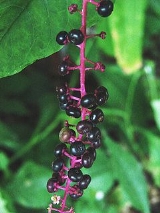
s growing from 1 to 10 ft. tall. They have single alternate leaves, pointed at the end, with crinkled edges. The stems are often pink or red. The flower
Flower

A flower, sometimes known as a bloom or blossom, is the reproduction structure found in flowering plants . The biological function of a flower is to mediate the union of male sperm with female ovum in order to produce seeds....
s are greenish-white, in long clusters at the ends of the stems. They develop into dark purple berries
Berry

In everyday English, a berry is a broad term for any small edible fruit. Most berries are juicy, round or semi-oblong, brightly coloured, sweet or sour, and don't have a stone or pit....
.

Phytolacca dioica, the ombú
Ombú

The omb? is a massive evergreen herb native to the Pampas of South America. The tree has an umbrella-like Canopy that spreads to a girth of 12 to 15 meters and can attain a height of 12 to 18 meters ....
, grows as a tree on the pampas of South America and is one of the few providers of shade on the open grassland. It is a symbol of Argentina
Argentina

Argentina, officially the Argentine Republic , is a country in South America, constituted as a federation of 23 provinces and an autonomous city....
 and gaucho
Gaucho

File:Gaucho1868b.jpgGaucho is a term commonly used to describe residents of the South American pampas, chacos or Patagonian pampa, found principally in parts of Argentina, Uruguay, Zona Austral and Rio Grande do Sul, the southernmost state of Brazil....
 culture.

Woman Preparing Poke Salad

Uses

Young pokeweed leaves can be boil
Boiling

Boiling, a type of phase transition, is the rapid vaporization of a liquid, which typically occurs when a liquid is heated to its boiling point, the temperature at which the vapor pressure of the liquid is equal to the pressure exerted on the liquid by the surrounding environmental pressure....
ed three times to reduce the toxin, discarding the water after each boiling. The result is known as poke salit, or poke salad, and is occasionally available commercially. Many authorities advise against eating pokeweed even after thrice boiling, as traces of the toxin may still remain. For many decades, poke salad has been a staple of southern U.S. cuisine, despite campaigns by doctors who believed pokeweed remained toxic even after being boiled. The lingering cultural significance of Poke salad can be found in the 1969 hit song "Polk Salad Annie," written and performed by Tony Joe White
Tony Joe White

Tony Joe White is an United States singer-songwriter and guitarist best known for his 1969 hit record "Polk Salad Annie", and for "Rainy Night in Georgia" which he wrote but was firstly made popular by Brook Benton, and "Steamy Windows" - a hit for Tina Turner in 1989....
, and famously covered by Elvis Presley
Elvis Presley

Elvis Aaron Presley was an United Statesn singer, actor, and musician. A cultural icon, he is commonly known simply as "Elvis", and is also sometimes referred to as "List of honorific titles in popular music" or "The King"....
 and the El Orbits. Pokeberry juice is added to other juices for jelly by those who believe it can relieve the pain of arthritis. There is a poke salad festival held annually in Gainesboro, TN; and a Polk Sallet Festival in Harlan, KY.


Pokeweed
Pokeweed is used as a folk remedy to treat many ailments. It can be applied topically or taken internally. Topical treatments have been used for acne and other ailments. Internal treatments include tonsilitis, swollen glands and weight loss. Grated pokeroot was used by Native Americans as a poultice to treat inflammations and rashes of the breast. These uses of pokeweed are scientifically unproven, dangerous, and may cause death.

Pokeweed berries yield a red ink
Ink

An ink is a liquid containing various pigments and/or dyes used for coloring a surface to produce an , writing, or design. Ink is used for drawing and/or writing with a pen, brush or quill....
 or dye
Dye

A dye can generally be described as a colored substance that has an Chemical affinity to the Wiktionary:substrate to which it is being applied....
, which was once used by Native Americans
Indigenous peoples of the Americas

The indigenous peoples of the Americas are the pre-Columbian inhabitants of the Americas, their descendants, and many ethnic groups who identify with those peoples....
 to decorate their horse
Horse

The horse is a hoofed mammal, a subspecies of one of seven extant species of the family Equidae. The horse has evolution of the horse over the past 45 to 55 million years from a small multi-toed creature into the large, odd-toed ungulate animal of today....
s. The United States Declaration of Independence
United States Declaration of Independence

The United States Declaration of Independence is a statement adopted by the Second Continental Congress on July 4, 1776, which announced that the Thirteen Colonies then at war with Kingdom of Great Britain were now independent states, and thus no longer a part of the British Empire....
 was written in fermented pokeberry juice (hence the common name 'inkberry'). Many letters written home during the American Civil War
American Civil War

The American Civil War , also known as the War Between the States and several Naming the American Civil War, was a civil war in the United States....
 were written in pokeberry ink; the writing in these surviving letters appears brown. The red juice has also been used to symbolize blood, as in the anti-slavery protest of Benjamin Lay
Benjamin Lay

Benjamin Lay was a Quaker philanthropist and abolitionist.Lay was born in Colchester, England. In 1710 he moved to Barbados as a merchant, but his abolition principles, fueled by his Quaker radicalism, became obnoxious to the people who lived there so he moved to Abington, Pennsylvania....
. A rich brown dye can be made by soaking fabrics in fermenting berries in a hollowed-out pumpkin
Pumpkin

Pumpkin is a gourd-like Squash of the genus Cucurbita and the family Cucurbitaceae . It is a common name of or can refer to cultivars of any one of the following species: Cucurbita pepo, Cucurbita mixta, Cucurbita maxima, and Cucurbita moschata....
.

Some pokeweeds are also grown as ornamental plant
Ornamental plant

Ornamental plants are typically grown in the flower garden or as house plants. Most commonly they are grown for the display of their flowers. Other common ornamental features include leaves, scent, fruit, Plant stem and bark....
s, mainly for their attractive berries; a number of cultivar
Cultivar

A cultivar is a cultivated plant that has been selected and given a unique name because of its decorative or useful characteristics; it is usually distinct from similar plants and when Plant propagation it retains those characteristics....
s have been selected for larger fruit panicles.

Pokeweeds are used as food plants by the larva
Larva

A larva is a young form of animal with indirect developmental biology, going through or undergoing metamorphosis .The larva can look completely different from the adult form, for example, a caterpillar differs from a butterfly....
e of some Lepidoptera
Lepidoptera

Lepidoptera is an order of insect that includes moths and butterfly. It is one of the most speciose orders in the class Insecta, encompassing moths and the three superfamilies of butterfly, skipper , and Hedylidae....
 species including Giant Leopard Moth
Giant Leopard Moth

The Giant Leopard Moth or Eyed Tiger Moth is a moth of the family Arctiidae. It is distributed throughout the Southern and Eastern United States from New England to Mexico....
.

Toxic Principle toxic constituents have been identified including the alkaloid phytolaccine ( and the alkaloid phytolaccotoxin, as well as a glycoprotein
Glycoprotein

Not to be confused with peptidoglycan or proteoglycan.Glycoproteins are proteins that contain oligosaccharide chains covalently attached to their Peptide side-chains....
. When pokeweed is used as food, the water in which it is boiled must be discarded. The roots are particularly toxic.

Clinical signs

In humans:
The eating of limited quantities of poke, perhaps of the shoots, may cause retching or vomiting after two hours or more. These signs may be followed by dyspnea, perspiration, spasms, severe purging, prostration, tremors, watery diarrhea and vomiting (sometimes bloody) and, sometimes, convulsions. In severe poisonings, symptoms are weakness, excessive yawning, slowed breathing, fast heartbeat, dizziness, and possibly seizures, coma and death.
In horses:
Colic, diarrhea, respiratory failure.

In swine:
Unsteadiness, inability to rise, retching. Jerking movements of the legs. Below-normal temperature.

In cattle:
Same general signs plus a decrease in milk production.

See also

  • Puccoon
    Puccoon

    Puccoon is a common name that refers to any of several plants formerly used by certain Indigenous peoples of the Americas for dyes. The dyes were made from the plants' roots....
  • List of plants poisonous to equines
    List of plants poisonous to equines

    This is a list of plants which are poisonous to equines. Some may cause mild reactions, such as diarrhea, others can lead to serious problems including horse colic, laminitis, and neurological problems, which, in some circumstances, can be fatal....