
All Topics  
Points of sail


   Email Print
   Bookmark   Link


Points of sail


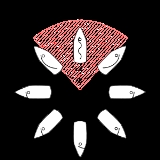
Points of sail describes a sailing boat's course in relation to the wind direction.

First, there is a distinction between the port
Port (nautical)

Port is the List of nautical terms that refers to the left and right side of a ship, as perceived by a person on board the ship and facing towards the Bow ....
 tack and the starboard
Starboard

Starboard is the List of nautical terms that refers to the left and right side of a vessel as perceived by a person on board a vessel and facing the Bow ....
 tack. If the wind is coming from anywhere on the port side, the boat is on port tack. Likewise if the wind is coming from the starboard side, the boat is on starboard tack. Except when head to wind, a boat will be on either port or starboard tack while on any point of sail.


Discussion
Ask a question about 'Points of sail'
Start a new discussion about 'Points of sail'
Answer questions from other users
Full Discussion Forum


Encyclopedia


Points of sail describes a sailing boat's course in relation to the wind direction.

First, there is a distinction between the port
Port (nautical)

Port is the List of nautical terms that refers to the left and right side of a ship, as perceived by a person on board the ship and facing towards the Bow ....
 tack and the starboard
Starboard

Starboard is the List of nautical terms that refers to the left and right side of a vessel as perceived by a person on board a vessel and facing the Bow ....
 tack. If the wind is coming from anywhere on the port side, the boat is on port tack. Likewise if the wind is coming from the starboard side, the boat is on starboard tack. Except when head to wind, a boat will be on either port or starboard tack while on any point of sail. For purposes of the racing rules and "rules of the road," the wind is assumed to be coming from the side opposite that which the boom is carried.

Head To Wind

At this point of sail the boat is headed directly into the wind. A boat turns through this point of sail as it performs a tack
Tack (sailing)

Tack is a term used in sailing that has different meanings in different contexts....
. The boat is on neither port nor starboard tack. Since a boat cannot sail directly into the wind, if a boat comes head to wind, and loses steerage it is said to be "in irons," and may begin to travel slowly backwards. To recover, the jib
Jib

A jib is a triangular staysail set ahead of the foremost mast of a sailing boat. Its Tack is fixed to the bowsprit, to the bow , or to the deck between the bowsprit and the foremost mast....
 (headsail) is backed to one side, and the tiller
Tiller

A tiller or till is a lever attached to a rudder post or rudder stock of a boat in order to provide the leverage for the helmsman to turn the rudder....
 is moved to the same side. In a single sailed boat the "push, push, pull, pull" technique (i.e. "push" the boom towards the wind, "push" the tiller away, and then "pull" the boom and tiller back to their normal positions) can be used which sails the boat backwards and steers the stern towards the wind. This results in the bow being pushed away from the wind and out of the no-go zone. Sailboats are usually put head to wind when raising or lowering sails. In this case, auxiliary (motorized) sailboats will typically be under power (engine running).

In the sport of yacht racing
Yacht racing

Yacht racing is the sport of competitive yachting. There is a broad variety of kinds of races and sailboats used for racing. Much racing is done around buoys or similar marks in protected waters, while some longer offshore races cross open water....
, the current rules do not recognize a state in which a boat is on neither port nor starboard tack. Boats which are lying head to wind are either considered to be on their old tack, or on their new tack but in the act of tacking
Tack (sailing)

Tack is a term used in sailing that has different meanings in different contexts....
, and therefore required to stay clear of other boats.

In the Irons

The boat is pointed too close to the wind for the sails to generate any power (unless they are backed, see above). The sails will be luffing ("flapping") in the breeze and making noise, like a flag.

The size of the no-go zone will differ based on the performance characteristics of the particular sailboat. For example, racing sailboats can usually sail much closer to the wind (i.e., fewer degrees off the wind direction) than cruising yachts. This is known as "pointing higher." Pointing ability is very important for racing sailboats as the real goal in a race is almost always velocity made good
Velocity made good

Velocity made good, or "vmg," is a term in sailing, and specifically yacht racing, that refers to the component of a sailboat's velocity that is in the direction of the next mark....
 (VMG). VMG is the speed at which the boat is approaching the destination (usually a buoy
Buoy

A buoy is a floating device that can have many different purposes. It can be anchored or allowed to drift. The word, of Old French or Middle Dutch origin, is now most commonly , although some orthoepy have traditionally prescribed the pronunciation ....
 or mark
Mark

Mark may refer to:...
) as opposed to the speed at which the boat is moving through the water (boat speed). These two speeds almost always vary because, during a race, a boat usually cannot sail directly to the next mark. VMG may also refer to the upwind vector of boat speed (this is often the VMG expressed on sailing instruments).

If a sailboat is tacking and turning into the wind with sufficient speed to complete the tack, when the boat is facing into the wind, the tacking boat is "luffing" but, due to forward speed, is still turning under control.

If the boat attempts to tack with a slow initial speed, or otherwise stops forward motion while heading into the wind, the sailboat is said to be "in irons." Since there is no speed (no water flow past the rudder) there is no normal control of the direction of the boat, and it tends to drift directly backwards. To recover from this situation, the jib or forward most sail, can be backed (tightened and pushed out) on the side that is the desired tack until the boat is at a sufficient angle to the wind for sailing, and/or the rudder can be turned to the side that is the desired tack (the tiller pointed in the desired direction that you wish to go) and held until the boat is at the correct angle to the wind and resumes forward motion. For single sailed dingies (that have no jib or foresail) the mainsail can be backed (forced to windward with hand pressure on the boom) to achieve a similar result.

Close Hauled

A boat is sailing close hauled when its sails are trimmed in tightly and it is sailing as close to the wind as it can without entering the No-Go Zone. This point of sail lets the boat travel diagonally upwind. This is a precise point of sail. However, the exact angle relative to the wind direction varies from boat to boat. A boat is considered to be "pinching" if the helmsman tries to sail above an efficient close-hauled course and the sails begin to luff slightly.

A square rigged ship cannot operate well in the close hauled position, as the maximum deflection offered by the braces is typically 45 degrees off the running position. When heading up beyond a beam reach, a square-rigger must rely on its staysails and spanker
Spanker

Spanker can refer to:* One who administers a spanking* Spanker , a type of sail on a sailboat* Spanker , a famous 18th century famous thoroughbred race horse...
.

Reaching

When the boat is traveling approximately perpendicular to the wind, this is called reaching. A 'close' reach is somewhat toward the wind, and 'broad' reach is a little bit away from the wind (a 'beam' reach is with the wind precisely at a right angle to the boat). For most modern sailboats, reaching is the fastest way to travel. Different boats have different performance characteristics -- on some boats, the beam reach is the fastest point of sail; on others, a broad reach is faster.

Close Reach

This is any upwind angle between Close Hauled and a Beam Reach. "Fetch" (or "fetching") is a synonym in many English-speaking countries for a close reach.

Beam Reach

This is a course steered at right angles to the wind. This is a precise point of sail. Sails are put out at roughly 45 degrees.

Broad Reach

The wind is coming from behind the boat at an angle. This represents a range of wind angles between Beam Reach and Running Downwind. The sails are eased out away from the boat, but not as much as on a run or dead run (downwind run).

Running Downwind

On this point of sail, the wind is coming from directly behind the boat. Because running is the most difficult point of sail for modern yachts, and can be dangerous to those on board in the event of an accidental jibe
Jibe

A jibe or gybe is a sailing maneuver where a sailing vessel turns its stern through the wind, such that the wind direction changes from one side of the boat to the other....
, it is often called the "don't go zone". Modern racing yacht design favors sailing rigs that can point very high to windward, which means a high aspect ratio
Aspect ratio (wing)

In aerodynamics, the aspect ratio of a wing is defined as the square of the wing span divided by the wing area.whereInformally, a high aspect ratio indicates long, narrow wings, whereas a low aspect ratio indicates short, stubby wings....
 sail. Downwind performance suffers, but that is overcome by the use of a low aspect ratio spinnaker
Spinnaker

A spinnaker is a special type of sail that is designed specifically for sailing off the wind from a Points of sail#Reaching to a downwind, i.e....
 for running.

When running, the mainsail is eased out as far as it will go. The jib will collapse because the mainsail blocks its wind, and must either be lowered and replaced by a spinnaker or set instead on the windward side of the boat. Running with the jib to windward is known as gull wing, goose wing, butterflying or wing and wing. A genoa
Genoa (sail)

The genoa or jenny was originally referred to as the 'overlapping jib' or the Genoa jib, being named after the city of Genoa as explained below....
 gull-wings well, especially if stabilized by a whisker pole, which is similar to, but lighter than a spinnaker pole
Spinnaker pole

A spinnaker pole is a spar used in sailboats to help support and control a variety of headsails, particularly the spinnaker. However, it is also used with other sails, such as genoa and jibs, when sailing downwind with no spinnaker hoisted....
. In 'non-extras' or 'no flying sails' class races where spinnakers are not permitted, poled-out genoas are often used when running downwind.

Cruising yachtsmen, when running downwind, will often set either a poled-out genoa or a pole-less cruising 'chute (or gennaker
Gennaker

Sorry, no overview for this topic
). When running downwind for protracted periods, for example when ocean-crossing in steady trade winds, cruisers sometimes set twin poled-out jibs without a mainsail. All of these options are more stable and require less trimming effort than a spinnaker.

Steering is difficult when running because there is often little or no pressure on the tiller to provide feedback to the helmsman, so the boat may easily go off course. This tendency to turn off course when running can be dangerous, as the boat is least stable and can jibe accidentally if the lee side of the sail catches the wind. A preventer
Preventer

A preventer, or jibe-guard, is a mechanical device on a sailing vessel which limits the Boom 's ability to swing dangerously across the boat during an accidental jibe....
 can be used on yachts to avoid this. Another problem with running in modern high aspect rigs is the fact that having the sail set at right angles to the wind guarantees a stall, and the stalled out wing sheds 'bubbles' of turbulence
Turbulence

In fluid dynamics, turbulence or turbulent flow is a fluid regime characterized by chaotic, stochastic property changes. This includes low momentum diffusion, high momentum convection, and rapid variation of pressure and velocity in space and time....
. Combined with the sea- and steering-induced rolling of the boat, this can build up a rolling resonance
Resonance

In physics, resonance is the tendency of a system to oscillate at maximum amplitude at certain Frequency, known as the system's resonance frequencies ....
 and lead to a broach
Broach (sailing)

A sailboat broaches when its Course suddenly changes towards the wind due to wind/sail interactions for which hull hydrodynamic reactions cannot compensate....
 or a death roll
Death roll

In a keel boat, a death roll is the act of broach ing to windward, putting the spinnaker pole into the water and causing a crash-jibe of the boom and mainsail, which sweep across the deck and plunge down into the water....
.

Square rig
Square rig

Square rig is a generic type of Sail-plan in which the primary driving sails are carried on horizontal spars which are perpendicular, or , to the keel of the vessel and to the masts....
ged ships, since the sails develop lift off the top edges of the sails, and so are not necessarily stalled even on a dead run, are far better at running, since the conditions that lead to broaching are not present. They still, however, are difficult to keep on course, and require constant attention at the helm; when sailing on a reaching course, the boat is in a stable state, and it is possible to tie off the wheel and still maintain a steady course.

External links