

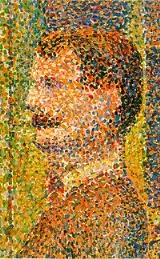
Pointillism

Encyclopedia
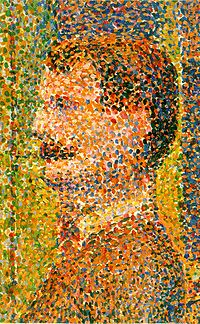
Pointillism is a technique of painting
Painting
Painting is the practice of applying paint, pigment, color or other medium to a surface . The application of the medium is commonly applied to the base with a brush but other objects can be used. In art, the term painting describes both the act and the result of the action. However, painting is...
in which small, distinct dots of pure color
Color
Color or colour is the visual perceptual property corresponding in humans to the categories called red, green, blue and others. Color derives from the spectrum of light interacting in the eye with the spectral sensitivities of the light receptors...
are applied in patterns to form an image. Georges Seurat developed the technique in 1886, branching from Impressionism
Impressionism
Impressionism was a 19th-century art movement that originated with a group of Paris-based artists whose independent exhibitions brought them to prominence during the 1870s and 1880s...
. The term Pointillism was first coined by art critics in the late 1880s to ridicule the works of these artists, and is now used without its earlier mocking connotation. Neo-impressionism
Neo-impressionism
Neo-impressionism was coined by French art critic Félix Fénéon in 1886 to describe an art movement founded by Georges Seurat. Seurat’s greatest masterpiece, A Sunday Afternoon on the Island of La Grande Jatte, marked the beginning of this movement when it first made its appearance at an exhibition...
and Divisionism
Divisionism
Divisionism was the characteristic style in Neo-Impressionist painting defined by the separation of colors into individual dots or patches which interacted optically....
are also terms used to describe this technique of painting.
Technique
The technique relies on the ability of the eye and mind of the viewer to blend the color spots into a fuller range of tones. It is related to DivisionismDivisionism
Divisionism was the characteristic style in Neo-Impressionist painting defined by the separation of colors into individual dots or patches which interacted optically....
, a more technical variant of the method. Divisionism is concerned with color theory, whereas pointillism is more focused on the specific style of brushwork used to apply the paint. It is a technique with few serious practitioners today, and is notably seen in the works of Seurat, Signac
Paul Signac
Paul Signac was a French neo-impressionist painter who, working with Georges Seurat, helped develop the pointillist style.-Biography:Paul Victor Jules Signac was born in Paris on 11 November 1863...
and Cross
Henri-Edmond Cross
Henri-Edmond Cross was a French pointillist painter.- Life and career :Cross was born in Douai and grew up in Lille. He studied at the École des Beaux-Arts. His early works, portraits and still lifes, were in the dark colors of realism, but after meeting with Claude Monet in 1883, he painted in...
. However, see also Andy Warhol
Andy Warhol
Andrew Warhola , known as Andy Warhol, was an American painter, printmaker, and filmmaker who was a leading figure in the visual art movement known as pop art...
's early works, and pop art
Pop art
Pop art is an art movement that emerged in the mid 1950s in Britain and in the late 1950s in the United States. Pop art challenged tradition by asserting that an artist's use of the mass-produced visual commodities of popular culture is contiguous with the perspective of fine art...
.
The practice of Pointillism is in sharp contrast to the traditional methods of blending pigments on a palette
Palette (painting)
A palette , in the original sense of the word, is a rigid, flat surface on which a painter arranges and mixes paints. A palette is usually made of wood, plastic, ceramic, or other hard, inert, nonporous material, and can vary greatly in size and shape...
. Pointillism is analogous to the four-color CMYK
CMYK color model
The CMYK color model is a subtractive color model, used in color printing, and is also used to describe the printing process itself. CMYK refers to the four inks used in some color printing: cyan, magenta, yellow, and key...
printing process used by some color printers and large presses that place dots of Cyan (blue), Magenta (red), Yellow, and Key (black). Televisions and computer monitors use a similar technique to represent image colors using Red, Green, and Blue
RGB color model
The RGB color model is an additive color model in which red, green, and blue light is added together in various ways to reproduce a broad array of colors...
(RGB) colors.
Practice
If red, blue, and green light (the additive primaries) are mixed, the result is something close to white light (see Prism (optics)Prism (optics)
In optics, a prism is a transparent optical element with flat, polished surfaces that refract light. The exact angles between the surfaces depend on the application. The traditional geometrical shape is that of a triangular prism with a triangular base and rectangular sides, and in colloquial use...
). Painting is inherently subtractive, but pointillist colors often seem brighter than typical mixed subtractive colors. This may be partly because subtractive mixing of the pigments is avoided, and partly because some of the white canvas may be showing between the applied dots.
The painting technique used for pointillist color mixing is at the expense of the traditional brushwork used to delineate texture
Texture (painting)
Texture in painting is the look and feel of the canvas. It is based on the paint, and its application, or the addition of materials such as ribbon, metal, wood, lace, leather and sand. The concept of 'painterliness' also has bearing on texture. The texture stimulates two different senses; sight...
.
The majority of pointillism is done in oil paints. Anything may be used in its place, but oils are preferred for their thickness and tendency not to run or bleed.
Music
Pointillism also refers to a style of 20th-century music composition. Different musical notes are made in seclusion, rather than in a linear sequence, giving a sound texture similar to pointillism. This type of music is also known as punctualismPunctualism
Punctualism is a style of musical composition prevalent in Europe between 1949 and 1955 "whose structures are predominantly effected from tone to tone, without superordinate formal conceptions coming to bear"...
or klangfarbenmelodie
Klangfarbenmelodie
Klangfarbenmelodie is a musical technique that involves distributing a musical line or melody to several instruments, rather than assigning it to just one instrument, thereby adding color and texture to the melodic line...
.
Notable artists
- Georges Seurat
- Paul SignacPaul SignacPaul Signac was a French neo-impressionist painter who, working with Georges Seurat, helped develop the pointillist style.-Biography:Paul Victor Jules Signac was born in Paris on 11 November 1863...
- Henri-Edmond CrossHenri-Edmond CrossHenri-Edmond Cross was a French pointillist painter.- Life and career :Cross was born in Douai and grew up in Lille. He studied at the École des Beaux-Arts. His early works, portraits and still lifes, were in the dark colors of realism, but after meeting with Claude Monet in 1883, he painted in...
- Charles AngrandCharles AngrandCharles Angrand was a French artist who gained renown for his Neo-Impressionist paintings and drawings. He was an important member of the Parisian avant-garde art scene in the late 1880s and early 1890s.-Early life and work:...
- John RoyJohn RoyJohn Roy was a noted professor in the Art Department at the University of Massachusetts, Amherst from 1964 until his retirement in 1994. He continued to paint until his death in 2001...
- Maximilien LuceMaximilien LuceMaximilien Luce was a French Neo-impressionist artist. A printmaker, painter, and anarchist, Luce is best known for his pointillist canvases. He grew up in the working class Montparnasse, and became a painter of landscapes and urban scenes which frequently emphasize the activities of people at work...
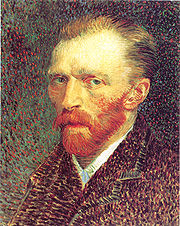
- Vincent van GoghVincent van GoghVincent Willem van Gogh , and used Brabant dialect in his writing; it is therefore likely that he himself pronounced his name with a Brabant accent: , with a voiced V and palatalized G and gh. In France, where much of his work was produced, it is...
- Camille PissarroCamille PissarroCamille Pissarro was a French Impressionist and Neo-Impressionist painter born on the island of St Thomas . His importance resides in his contributions to both Impressionism and Post-Impressionism, as he was the only artist to exhibit in both forms...
- Théo van RysselbergheThéo van RysselbergheThéo van Rysselberghe was a Belgian neo-impressionist painter, who played a pivotal role in the European art scene at the turn of the century.-Early years:...
- Chuck CloseChuck CloseCharles Thomas "Chuck" Close is an American painter and photographer who achieved fame as a photorealist, through his massive-scale portraits...
- Georges LemmenGeorges LemmenGeorges Lemmen was a Belgian neo-impressionist painter. He was a member of Les XX from 1888. His works include The Beach at Heist, Aline Marechal and Vase of Flowers...
Notable paintings
- A Sunday Afternoon on the Island of La Grande Jatte by Georges Seurat
- Bathing at Asnieres by Georges Seurat
- The Windmills at Overschie by Paul SignacPaul SignacPaul Signac was a French neo-impressionist painter who, working with Georges Seurat, helped develop the pointillist style.-Biography:Paul Victor Jules Signac was born in Paris on 11 November 1863...
- Banks of Seine by Georges Seurat
- Une baignade, Asnières by Georges Seurat
- A Coastal Scene by Theo Van RysselbergheThéo van RysselbergheThéo van Rysselberghe was a Belgian neo-impressionist painter, who played a pivotal role in the European art scene at the turn of the century.-Early years:...
- Family in the Orchard by Theo Van RysselbergheThéo van RysselbergheThéo van Rysselberghe was a Belgian neo-impressionist painter, who played a pivotal role in the European art scene at the turn of the century.-Early years:...
- Countryside at Noon by Theo Van RysselbergheThéo van RysselbergheThéo van Rysselberghe was a Belgian neo-impressionist painter, who played a pivotal role in the European art scene at the turn of the century.-Early years:...
- Afternoon at Pardigon by Henri-Edmond CrossHenri-Edmond CrossHenri-Edmond Cross was a French pointillist painter.- Life and career :Cross was born in Douai and grew up in Lille. He studied at the École des Beaux-Arts. His early works, portraits and still lifes, were in the dark colors of realism, but after meeting with Claude Monet in 1883, he painted in...
- Rio San Trovaso, Venice by Henri-Edmond CrossHenri-Edmond CrossHenri-Edmond Cross was a French pointillist painter.- Life and career :Cross was born in Douai and grew up in Lille. He studied at the École des Beaux-Arts. His early works, portraits and still lifes, were in the dark colors of realism, but after meeting with Claude Monet in 1883, he painted in...
- The Seine in front of the Trocadero by Henri-Edmond CrossHenri-Edmond CrossHenri-Edmond Cross was a French pointillist painter.- Life and career :Cross was born in Douai and grew up in Lille. He studied at the École des Beaux-Arts. His early works, portraits and still lifes, were in the dark colors of realism, but after meeting with Claude Monet in 1883, he painted in...
- The Pine Tree at St. Tropez by Paul SignacPaul SignacPaul Signac was a French neo-impressionist painter who, working with Georges Seurat, helped develop the pointillist style.-Biography:Paul Victor Jules Signac was born in Paris on 11 November 1863...
- Against the Enamel of Background Rhythmic with Beats and Angels by Paul SignacPaul SignacPaul Signac was a French neo-impressionist painter who, working with Georges Seurat, helped develop the pointillist style.-Biography:Paul Victor Jules Signac was born in Paris on 11 November 1863...
- The Yellow Sail, Venice by Paul SignacPaul SignacPaul Signac was a French neo-impressionist painter who, working with Georges Seurat, helped develop the pointillist style.-Biography:Paul Victor Jules Signac was born in Paris on 11 November 1863...
- Notre Dame Cathedral by Maximilien LuceMaximilien LuceMaximilien Luce was a French Neo-impressionist artist. A printmaker, painter, and anarchist, Luce is best known for his pointillist canvases. He grew up in the working class Montparnasse, and became a painter of landscapes and urban scenes which frequently emphasize the activities of people at work...
- Le Pont De Pierre, Rouen by Charles AngrandCharles AngrandCharles Angrand was a French artist who gained renown for his Neo-Impressionist paintings and drawings. He was an important member of the Parisian avant-garde art scene in the late 1880s and early 1890s.-Early life and work:...
- The Beach at Heist by Georges LemmenGeorges LemmenGeorges Lemmen was a Belgian neo-impressionist painter. He was a member of Les XX from 1888. His works include The Beach at Heist, Aline Marechal and Vase of Flowers...
- Aline Marechal by Georges LemmenGeorges LemmenGeorges Lemmen was a Belgian neo-impressionist painter. He was a member of Les XX from 1888. His works include The Beach at Heist, Aline Marechal and Vase of Flowers...
- Vase of Flowers by Georges LemmenGeorges LemmenGeorges Lemmen was a Belgian neo-impressionist painter. He was a member of Les XX from 1888. His works include The Beach at Heist, Aline Marechal and Vase of Flowers...
See also
- Neo-impressionismNeo-impressionismNeo-impressionism was coined by French art critic Félix Fénéon in 1886 to describe an art movement founded by Georges Seurat. Seurat’s greatest masterpiece, A Sunday Afternoon on the Island of La Grande Jatte, marked the beginning of this movement when it first made its appearance at an exhibition...
- StipplingStipplingStippling is the creation of a pattern simulating varying degrees of solidity or shading by using small dots. Such a pattern may occur in nature and these effects are frequently emulated by artists.-Art:...
- DivisionismDivisionismDivisionism was the characteristic style in Neo-Impressionist painting defined by the separation of colors into individual dots or patches which interacted optically....
- PunctualismPunctualismPunctualism is a style of musical composition prevalent in Europe between 1949 and 1955 "whose structures are predominantly effected from tone to tone, without superordinate formal conceptions coming to bear"...
- Micromontage, similar technique in music