


Poeticon astronomicon

Encyclopedia
Hyginus
Hyginus can refer to:People:*Gaius Julius Hyginus , Roman poet, author of Fabulae, reputed author of Poeticon astronomicon*Hyginus Gromaticus, Roman surveyor*Pope Hyginus, also a saint, Bishop of Rome about 140...
", though the true authorship is disputed. During the Renaissance
Renaissance
The Renaissance was a cultural movement that spanned roughly the 14th to the 17th century, beginning in Italy in the Late Middle Ages and later spreading to the rest of Europe. The term is also used more loosely to refer to the historical era, but since the changes of the Renaissance were not...
, the work was attributed to the Roman
Rome
Rome is the capital of Italy and the country's largest and most populated city and comune, with over 2.7 million residents in . The city is located in the central-western portion of the Italian Peninsula, on the Tiber River within the Lazio region of Italy.Rome's history spans two and a half...
historian Gaius Julius Hyginus
Gaius Julius Hyginus
Gaius Julius Hyginus was a Latin author, a pupil of the famous Cornelius Alexander Polyhistor, and a freedman of Caesar Augustus. He was by Augustus elected superintendent of the Palatine library according to Suetonius' De Grammaticis, 20...
who lived during the 1st century BC However, the fact that the book lists most of the constellation
Constellation
In modern astronomy, a constellation is an internationally defined area of the celestial sphere. These areas are grouped around asterisms, patterns formed by prominent stars within apparent proximity to one another on Earth's night sky....
s north of the ecliptic
Ecliptic
The ecliptic is the plane of the earth's orbit around the sun. In more accurate terms, it is the intersection of the celestial sphere with the ecliptic plane, which is the geometric plane containing the mean orbit of the Earth around the Sun...
in the same order as Ptolemy
Ptolemy
Claudius Ptolemy , was a Roman citizen of Egypt who wrote in Greek. He was a mathematician, astronomer, geographer, astrologer, and poet of a single epigram in the Greek Anthology. He lived in Egypt under Roman rule, and is believed to have been born in the town of Ptolemais Hermiou in the...
's Almagest
Almagest
The Almagest is a 2nd-century mathematical and astronomical treatise on the apparent motions of the stars and planetary paths. Written in Greek by Claudius Ptolemy, a Roman era scholar of Egypt,...
(written in the 2nd century AD) has led many to believe that a more recent Hyginus created the text.
The text describes 47 of the 48 Ptolemaic constellations, centering primarily on the Greek
Greek mythology
Greek mythology is the body of myths and legends belonging to the ancient Greeks, concerning their gods and heroes, the nature of the world, and the origins and significance of their own cult and ritual practices. They were a part of religion in ancient Greece...
and Roman mythology
Roman mythology
Roman mythology is the body of traditional stories pertaining to ancient Rome's legendary origins and religious system, as represented in the literature and visual arts of the Romans...
surrounding the constellations, though there is some discussion of the relative positions of stars. The first known printing was in 1475, attributed to "Ferrara."
The Poeticon astronomicon was not formally published until 1482, by Erhard Ratdolt
Erhard Ratdolt
Erhard Ratdolt was an early German printer. From Augsburg, he was active printing in Venice, where he worked from 1476 to 1486.There he produced a Kalendario for Regiomontanus, and editions of the Historia Romana of Appianus , and Euclid's Elements , solving the problem of reproducing...
in Venice
Venice
Venice is a city in northern Italy which is renowned for the beauty of its setting, its architecture and its artworks. It is the capital of the Veneto region...
, Italy
Italy
Italy , officially the Italian Republic languages]] under the European Charter for Regional or Minority Languages. In each of these, Italy's official name is as follows:;;;;;;;;), is a unitary parliamentary republic in South-Central Europe. To the north it borders France, Switzerland, Austria and...
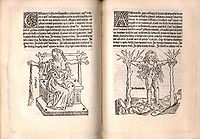
. This edition carried the full title Clarissimi uiri Hyginii Poeticon astronomicon opus utilissimum. Ratdolt commissioned a series of woodcuts depicting the constellations to accompany Hyginus' text. As with many other star atlases that would follow it, the positions of various stars are indicated overlaid on the image of each constellation. However, the relative positions of the stars in the woodcuts bear little resemblance to the descriptions given by Hyginus in the text or the actual positions of the stars in the sky.
As a result of the inaccuracy of the depicted star positions and the fact that the constellations are not shown with any context, the Poeticon astronomicon is not particularly useful as a guide to the night sky. However, the illustrations commissioned by Ratdolt served as a template for future sky atlas renderings of the constellation figures. The text, by contrast, is an important source, and occasionally the only source, for some of the more obscure Greek myths.