
All Topics  
Plymouth Road Runner

 
Plymouth Road Runner

   Email Print
   Bookmark   Link


Plymouth Road Runner


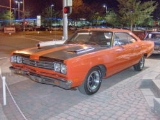
The Plymouth Road Runner was the no-frills muscle car
Muscle car

Muscle car is a term used to refer to a variety of high performance automobiles. At its most widely accepted the term refers to American 2-door rear wheel drive mid-size cars of the late 1960s and early 1970s equipped with large, powerful V8 engines and sold at an affordable price for street use and automobile racing, formally and informal...
 version of intermediate Belvedere
Plymouth Belvedere

The Plymouth Belvedere was an American automobile produced by Plymouth automobile from 1951 through 1970....
 and Satellite
Plymouth Satellite

The Plymouth Satellite was an automobile introduced in 1965 as the top model in Plymouth mid-size Belvedere line. The Satellite remained the top of the line model until the 1967 model year, where it became the mid-cost model with the GTX taking its place as the top model....
 built by the Plymouth division of the Chrysler Corporation in the United States
United States

The United States of America is a Federal government constitutional republic comprising U.S. state and a federal district. The country is situated mostly in central North America, where its Contiguous United States and Washington, D.C., the Capital districts and territories, lie between the Pacific Ocean and Atlantic Oceans, Borders of the U...
 between 1968 and 1980. In 1968, the first muscle cars were, in the opinion of many, moving away from their roots as relatively cheap, fast cars as they gained options. Although Plymouth already had a performance car in the GTX
Plymouth GTX

The Plymouth GTX was introduced as the Plymouth Belvedere GTX in 1967 by the Plymouth division to be a "gentleman's" muscle car. It was to be an exceptional blend of style and performance....
, designers decided to go back to the drawing board and reincarnate the original muscle car concept.


Discussion
Ask a question about 'Plymouth Road Runner'
Start a new discussion about 'Plymouth Road Runner'
Answer questions from other users
Full Discussion Forum


Encyclopedia


The Plymouth Road Runner was the no-frills muscle car
Muscle car

Muscle car is a term used to refer to a variety of high performance automobiles. At its most widely accepted the term refers to American 2-door rear wheel drive mid-size cars of the late 1960s and early 1970s equipped with large, powerful V8 engines and sold at an affordable price for street use and automobile racing, formally and informal...
 version of intermediate Belvedere
Plymouth Belvedere

The Plymouth Belvedere was an American automobile produced by Plymouth automobile from 1951 through 1970....
 and Satellite
Plymouth Satellite

The Plymouth Satellite was an automobile introduced in 1965 as the top model in Plymouth mid-size Belvedere line. The Satellite remained the top of the line model until the 1967 model year, where it became the mid-cost model with the GTX taking its place as the top model....
 built by the Plymouth division of the Chrysler Corporation in the United States
United States

The United States of America is a Federal government constitutional republic comprising U.S. state and a federal district. The country is situated mostly in central North America, where its Contiguous United States and Washington, D.C., the Capital districts and territories, lie between the Pacific Ocean and Atlantic Oceans, Borders of the U...
 between 1968 and 1980. In 1968, the first muscle cars were, in the opinion of many, moving away from their roots as relatively cheap, fast cars as they gained options. Although Plymouth already had a performance car in the GTX
Plymouth GTX

The Plymouth GTX was introduced as the Plymouth Belvedere GTX in 1967 by the Plymouth division to be a "gentleman's" muscle car. It was to be an exceptional blend of style and performance....
, designers decided to go back to the drawing board and reincarnate the original muscle car concept. Plymouth wanted a car able to run 14-second times in the quarter mile (402 m) and sell for less than US$
United States dollar

The United States dollar is the unit of currency of the United States and was defined by the Coinage Act of 1792 to be between 371 and 416 grains of silver ....
3000. Both goals were met, and the low-cost muscle car hit the street. The success of the Road Runner would far outpace the upscale and lower volume GTX
Plymouth GTX

The Plymouth GTX was introduced as the Plymouth Belvedere GTX in 1967 by the Plymouth division to be a "gentleman's" muscle car. It was to be an exceptional blend of style and performance....
, with which it was often confused.


1968 to 1970


Paying $50,000 to Warner Brothers to use the name and likeness of their Road Runner
Wile E. Coyote and Road Runner

Wile E. Coyote and the Road Runner are cartoon characters from a series of Looney Tunes and Merrie Melodies cartoons. The characters were created by animation director Chuck Jones in 1948 for Warner Brothers, while the template for their adventures was the work of writer Michael Maltese....
 cartoon character (as well as a "beep, beep" horn, which Plymouth paid $10,000 to develop), and using the Chrysler B platform
Chrysler B platform

The Chrysler B platform was the basis for rear-wheel drive Chrysler cars from 1962 through 1979. All of the B-body cars in a given model year for either make were built upon the same chassis....
 as a base (the same as the Belvedere, Satellite, and GTX), Plymouth set out to build a back-to-basics muscle car. Everything essential to performance and handling was beefed-up and improved; everything nonessential was left out. The interior was spartan, lacking even carpets in early models, and few options were available. A floor-mounted shifter featured only a rubber boot and no console so that a bench seat could be used. The earliest of the 1968 models were available only as 2-door coupes (with a centerpost between the front and rear windows), but later in the model year a 2-door "hardtop
Hardtop

A hardtop is a term for a rigid, rather than canvas, automobile roof. It has been used in several contexts: detachable hardtops, retractable hardtop roofs, and the so-called pillarless hardtop body style....
" model (sans centerpost) was offered. The Road Runner of 1968-1970 was based on the Belvedere, while the GTX was based on the Satellite, a car with higher level trim and slight differences in the grilles and taillights.
70roadrunnerjacket
The standard engine
Internal combustion engine

The internal combustion engine is an engine in which the combustion of a fuel occurs in a combustion chamber inside and integral to the engine. In an internal combustion engine it is always the expansion of the high temperature and pressure gases that are produced by the combustion which apply force to the movable component of the engine, such as...
 was a 383 CID (6.3 L) Roadrunner
Chrysler B engine

Chrysler Corporation's B engine was a big-block V8 which replaced the early Chrysler FirePower engine in 1958. It did not have hemispherical heads like the FirePower ? rather it had wedge-shaped heads....
 V8 rated at and of torque
Torque

Torque is the tendency of a force to rotate an object about an axis . Just as a force is a push or a pull, a torque can be thought of as a twist....
. For an extra $714, Plymouth would install a 426 CID Hemi
Chrysler Hemi engine

A Chrysler Hemi engine, known by the trademark Hemi, is an internal combustion engine built by Chrysler that utilizes a Sphere combustion chamber....
 rated at and of torque. Combined with low weight, the 6-passenger Road Runner could run the 1/4 mile
Mile

A mile is a Units of measurement of length, usually used to measure distance, in a number of different systems. In contemporary English contexts, mile most commonly refers to the statute mile of 5,280 Feet or the nautical mile of 1,852 meters ....
 in 13.4 seconds at 105 mph (169 km/h). It would prove to be one of the best engines of the muscle car era, and the Road Runner one of the best platforms to utilize it. Plymouth expected to sell about 2,000 units in 1968; actual sales numbered around 45,000. (It should also be noted Dodge debuted the Road Runner's cousin, the Super Bee
Dodge Super Bee

The Dodge Super Bee was a limited-production muscle car from Chrysler's Dodge division produced from 1968 through 1971. The Super Bee mascot was resurrected for the 2004 Dodge Ram Rumble Bee model, and the 2007 and 2008 Dodge Charger #Super_Bee....
, that same year.)

The 1969 model kept the same basic look and was slightly changed cosmetically (i.e. rear tail lights, optional bucket seats, new Road Runner decals). The Road Runner added a convertible
Convertible

A convertible is a type of automobile in which the roof can retract and fold away, converting it from an enclosed to an open-air vehicle. Many different car body styles are manufactured and marketed in convertible form....
 option for 1969, although fewer than 2000 droptop models were produced for the year, and only nine with the Hemi.

An "Air Grabber" option was introduced this year; it consisted of an air duct assembly bolted under the hood, that connected to twin rectangular scoops in the hood. When the hood was closed, this assembly fitted over a special air cleaner assembly to force air directly into the engine. The scoops in the hood could be opened and closed via a lever under the dashboard. The design and functionality of the "Air Grabber" option was changed after 1969.

While the 383 engine remained the standard powerplant, a 440 CID engine
Chrysler RB engine

The RB engine is a big-block V8 engine from Chrysler. It first appeared in 1959 and was a raised-deck version of the Chrysler B engine. The big-block RB lasted until 1978....
 with three two-barrel carburetors, known as the "440 Six Pack" (6-BBL), was added to the lineup at mid-year to qualify the engine for the "Super Stock" drag racing class. The Six Pack Road Runners had no wheel covers or hubcaps and a flat black lift-off fiberglass hood with functional hood scoop. Its 440 engine produced and of torque at 3200 rpm, very similar numbers to the Hemi and at a lower engine speed. This meant the cheaper 440 6-BBL was nearly as fast as the 426 Hemi, at least up to highway speeds. This option, along with the economical yet fast 383 and the outrageously fast Hemi helped propel Plymouth, and corporate sibling Dodge
Dodge

Dodge is a United States-based brand of automobiles, minivans, sport utility vehicles, and trucks, manufactured and marketed by Chrysler LLC in more than 60 different countries and territories worldwide....
, to the top of the dragstrip
Dragstrip

File:DragStrip Nitrolympics 2005.jpgFile:Dragstrip.jpgFile:WIRDragStreetEliminators.jpgFile:WIRDragSnowmobileProBike2.jpgA dragstrip is a facility for conducting automobile and motorcycle acceleration events such as drag racing....
 echelon.

The Road Runner was named Motor Trend
Motor Trend

File:motor trend cover.jpgMotor Trend is an automobile magazine. It first appeared in September 1949, issued by Petersen Publishing Company in Los Angeles, California, and bearing the tag line The Magazine for a Motoring World. Petersen Publishing was sold to British publisher EMAP in 1998, who sold the former Petersen magazines to...
 Car of the Year
Car of the Year

Car of the Year is a phrase usually considered to have been invented by Motor Trend magazine in the 1950s for their annual award for best automobile....
 for 1969. Sales almost doubled to 82,109.

1970 brought new front and rear end looks to the basic 1968 body, and it would prove to be another success. An updated version of the "Air Grabber" hood was introduced this year. A switch below the dash would open the hood and sharklike teeth "Air Grabber" graphics would be exposed. "High Impact" colors, like In-Violet, Moulin Rouge, Vitamin C, were options available for that year. The 1970 Road Runner and GTX continued to be attractive and popular cars. The engine lineup was left unchanged.

Plymouth Duster I

The Plymouth Duster I was a high-performance concept car of the Road Runner in the late 1960s. It featured the usual low curved racing type of windshield and had airplane-type flaps on the top and sides. There was a set adjustable spoilers on the side of the rear fender near the gas tank filler cap to prevent side-to-side yaw when slipstreaming in a race, with two more of them on top behind the driver, plus spoilers in the front rock shields to reduce frontal lift. It was powered by a 426 Hemi.

1970 Superbird


Plymouth Superbird


With success of the aero-warrior
Aero Warriors

Aero Warriors is a nickname for four automobiles, also called aero-cars, developed specifically to race on the NASCAR circuit by Dodge, Plymouth , Ford and Mercury for the 1969 and 1970 racing seasons....
 NASCAR
NASCAR

The National Association for Stock Car Auto Racing is the largest sanctioning body of stock cars in the United States. The three largest racing series sanctioned by NASCAR are the Sprint Cup Series, the Nationwide Series and the Camping World Truck Series....
 Dodge Charger Daytona
Dodge Charger Daytona

Dodge, an United States automobile brand, has produced three separate vehicles with the name Dodge Charger Daytona, all of which were modified Dodge Charger s....
 against fastback Ford Torino
Ford Torino

The Ford Torino is an mid-size car car produced bythe Ford Motor Company for the North American market between 1968 and 1976. It was initially an upscale version of the intermediate sized Ford Fairlane, which Ford produced between 1962 and 1970....
s and Mercury Cyclone
Mercury Cyclone

The Mercury automobile Cyclone was produced from 1964 to 1972, beginning as an option for the 1964 Mercury Comet, and continuing as a Mercury Comet Cyclone for the next three years....
s, Plymouth would get its own version of this winged wonder. This model added a goalpost spoiler to catch wind well above the body, and a shark shaped nose cap. It would also lure Richard Petty
Richard Petty

Richard Lee Petty is a former NASCAR driver who raced in the Strictly Stock/Grand National Era and the Winston Cup Series. "The King", as he is nicknamed, is most well-known for winning the Nascar Championship seven times , winning a record 200 races during his career, winning the Daytona 500 a record seven times, and winning a record 27 rac...
 back to Plymouth after defecting to Ford
Ford Motor Company

The Ford Motor Company is an United States multinational corporation and the world's List of automobile manufacturers#World Motor Vehicle Production by Manufacturer based on worldwide vehicle sales, following Toyota, General Motors, and Volkswagen Group....
 for a year. While spectacular on the track, consumer response was luke-warm, leading some dealers to remove the wing and nose, making them appear more like normal Road Runners. In the 2000s, these would fetch among the highest prices of any muscle car at auctions.

Trying to capture some of the success that their Dodge brothers had in 1969 with the Charger Daytona, Plymouth tried the same thing in 1970 with their creation, the Plymouth Superbird. According to Road Test magazine, performance was around 0 to in 5.5 seconds, 1/4 mile in 14.3 seconds at 104 mph
Miles per hour

The mile per hour is a physical unit of speed, expressing the number of Mile covered per hour.It is currently the Unit of measurement used for speed limits, and speeds, on roads in the United Kingdom and United States....
 with the Hemi . Although similar in appearance, the Superbird was actually quite different from the Daytona. The Superbird was based on the Plymouth Road Runner and the nose, airfoil, and basic sheet metal was different between the Daytona and Superbird. The special nose added 19-inches (483 mm) to the overall length (the Daytona's was 18-inches or 457 mm), and the trunk spoiler was more angled and higher than the Daytonas. On both models, the spoiler was three feet high. Although it created quite an impression on the street, the wing was not needed at normal highway speeds; it was designed for speedways, to keep the rear wheels to the ground at and higher speeds.

NASCAR
NASCAR

The National Association for Stock Car Auto Racing is the largest sanctioning body of stock cars in the United States. The three largest racing series sanctioned by NASCAR are the Sprint Cup Series, the Nationwide Series and the Camping World Truck Series....
 only required 500 copies to be built in 1969, but in 1970, NASCAR required a manufacturer to build one unit per dealer. In the end, Plymouth built a total of 1,920 Super Birds. Super Birds were available with three different engines. The most popular was the basic Super Commando 440 V8 with a single four barrel carburetor
Carburetor

A carburetor or carburettor , is a device that blends Earth's atmosphere and fuel for an internal combustion engine. It was invented by Karl Benz before 1885 and patented in 1886....
 rated at . Next up was the 440 Six Barrel rated at . At the top, and ordered by just 93 buyers, was the mighty 426 Hemi, rated at . Despite the success of the Super Bird on the tracks, 1970 would be the only year it was made.

The reason for using such a large spoiler is unclear, since the engineers said they started out with a much smaller version. One story has it that the aerodynamics became more favorable as they made the spoiler taller; another story is that it was raised to allow the trunk to be opened; although one could argue that changing to a trunk mount (from a rear-fender mount) would have solved that problem.

1971 - 1975


In 1971, the coupe bodywork was completely changed to a more rounded "fuselage" design in keeping with then-current Chrysler styling trends, including a steeply raked windshield, hidden cowl, and deeply inset grille and headlights. In a departure from previous thinking, the B-Body two-door bodies shared little if any sheet metal, glass, or trim with the four-door bodies. The convertible was canceled. 1971 was a high-water year for ride and handling for the Road Runner. The overall length was decreased, but the wheelbase was increased, and a rear sway bar was used in place of staggered rear leaf springs, resulting in better handling and cornering without the stiff ride. Aerodynamics were much improved over the first generation Road Runners, resulting in much-improved high-speed handling. 1972 saw new emission regulations drive power down and 1/4 mile times up. The 1972 model was nearly identical to the 1971 with a few minor changes. The grille design was cleaned up, and the tail lights were changed to match the new aerodynamic look of the grille. The optional bumper guards for 1972 included a rubber strip surrounding the tail lights and a rubber strip below the grille. The big difference came in the engines, with the big-block 383 being replaced by a larger-bore 400 CID version and a small-block, the 340, now optional for the first time. Also, for the first time, a 440 CID engine with a 4-barrel carburetor was available. This engine was the basis for the "GTX" package (as the GTX was no longer available as a separate model) that was available on Road Runners from 1972 to 1974.

Power ratings on all engines looked much lower on paper due to the new SAE net
Horsepower

Horsepower is the name of several non-International System of Units units of power . It was originally defined to allow the output of steam engines to be measured and compared with the power output of draft horses....
 measurement system. The famed 426 Hemi was gone for 1972, and less than five 440 Six Barrels were produced. The 1973-74 models had more conventional squared-up front-end styling and minor changes to the rear that more closely resembled the four-door models than the 71-72s. 1/4 mile times were getting close to the 16s and further away from "musclecar" status. The base engine for the 1973-74 models had dropped down to Chrysler's workaday 318 CID V8; however, dual exhaust (which bumped the power up to 170 hp) was still standard. After 1972, no 440 with four speed manual
Manual transmission

A manual transmission is a type of Transmission used in automotive applications. It generally utilizes a driver-operated clutch operated by a pedal or lever, for regulating torque transfer from the engine to the transmission, and a gear-shift either operated by hand or by foot ....
 cars were built. The 400 was the biggest engine Plymouth offered with the four speed, which could also be had with the 340 (1973) and 360 (1974) engines. The 440 was still available for 1973 and 1974, but only mated to the 727 TorqueFlite
TorqueFlite

TorqueFlite was the registered trademark name of Chrysler Corporation's three-speed automatic transmission, which was introduced late in the 1956 model year....
 automatic
Automatic transmission

An automatic transmission is an automobile gearbox that can change gear ratios automatically as the vehicle moves, freeing the driver from having to shift gears manual transmission....
.

The 1975 model was based on the newly restyled, more formal-looking B-body which was now called the Fury
Plymouth Fury

The Plymouth Fury was an automobile made by the Plymouth automobile division of the Chrysler Corporation from 1956 to 1978. The Fury was introduced as a premium-priced halo vehicle ....
 (the former full-sized Fury being called "Gran Fury
Plymouth Gran Fury

The Plymouth automobile Gran Fury was an automobile manufactured by the Chrysler Corporation from 1975 to 1977, and again from 1980 to 1989.Before 1975, the top line models in Plymouth's Fury series were known as the "Fury Gran Coupe" and "Fury Gran Sedan"?....
"). The Road Runner came with a blacked out grille and a special stripe treatment to distinguish it from the Fury. As before the 318 was the standard engine, but it was now just with a single exhaust. The 360 (220 hp) and the now largest engine was the 400 (though still with a four barrel and dual exhausts, the horsepower was down to 230) were also available. In Car and Driver
Car and Driver

Car and Driver is an United States automobile enthusiast magazine. Its total Magazine circulation is 1.31 million. It is owned by Hachette Filipacchi M?dias....
 magazine testing, 0-60 happened in 8.1 seconds and quarter-mile times were solidly in the 16-second range. While just a shadow of the 74 figures, this performance was at least respectible for the times. Plymouth's most powerful engine, the 440, was restricted to police models, though it has been rumoured that a few were built (via secial factory order) with the 240 hp police spec 440. Very few, perhaps 4,000 Road Runners were built in 1975, and most (over 50%) had just the 318 engine.

Though the name of the car the Road Runner was based on changed from Belvedere to Satellite to Fury, the Road Runner remained a B-body through 1975. While the Road Runner name was planned to be on a B-body in Plymouth's published literature for the 1976 model year, the name was transferred to an optional appearance package for the all-new Volare
Volare

Volare is the Latin and Italian word for the verb to fly; adding an acute accent on the final e it is also the Spanish word for I will fly....
.

1976-1980: F-body


In 1976 the Road Runner name was switched to the 2-door model of the replacement for the compact
Compact car

A compact , small family or c-segment car is a car classification of automobile which are larger than a supermini car and smaller than a large family car....
 A-body
Chrysler A platform

Chrysler's A platform was the basis for smaller rear wheel drive cars in the 1960s. These cars are sometimes referred to as A-body cars....
 Valiant
Plymouth Valiant

The Plymouth Valiant is an automobile manufactured by the Plymouth automobile division of Chrysler Corporation in the United States from 1960 to 1976....
/Duster
Plymouth Duster

The first Plymouth Duster was a semi-fastback version of the Plymouth Valiant automobile, produced in the United States from 1970 to 1976....
 series. This car, based on the new F platform
Chrysler F platform

Chrysler's rear wheel drive F platform was used from 1976 to 1980. It was replaced by the nearly-identical Chrysler M platform. There were two wheelbases: 108.7 in for 2-door models, and 112.7 in for four-doors....
, would be known as "Volaré". The new Road Runner was little more than a trim and graphics package; however, many suspension parts were borrowed from the police packages. A 360 CID engine was eventually offered as an option (but only came with a two barrel carb and sincle exhaust) to the standard 318 V8, but only paired with the 3-speed automatic transmission. Rated at , the F platform's best 1/4 mile times would be just inside 16-seconds at . Although no comparison to the earlier stormers, the 360 powered models were respectable performers in their time. However, performance continued to suffer, and by 1979 the 225 CID "Slant 6
Chrysler Slant 6 engine

The Slant-6, known within Chrysler as the G-engine, is one of Chrysler's two best known automobile engines, along with the Chrysler Hemi engine V8....
" became standard. The Road Runner continued as part of the Volaré line until its discontinuation in 1980.

Concepts


Mopar Enthusiast magazine has released a concept rendering of a potential 2010 Roadrunner, with design cues based on the 1971-72 model.

TV and film

  • There are numerous references to Road Runners in movies, including many exterior and interior sequences in "Bad Georgia Road" and a moderate role in Joe Dirt
    Joe Dirt

    Joe Dirt is a 2001 in film comedy film starring David Spade, Dennis Miller, Christopher Walken, Brittany Daniel, Jaime Pressly, Erik Per Sullivan, Adam Beach and Kid Rock....
     as the hero's (impounded) car; it was also Shaft's car in several movies


  • In an episode of The Simpsons
    The Simpsons

    The Simpsons is an Television in the United States animated cartoon Situation comedy created by Matt Groening for the Fox Broadcasting Company....
    , an old home movie of high-school-age (approximately) Homer shows a green car with dented quarter panel and fender, assumed to be a Medium Green 1970 Road Runner. It also had a air grabber hood.


  • The car is featured at Need for speed Carbon at the Downhill race chasing a Chrysler 300C.


  • This car's cousin GTX "Hammer" version was featured in the end of The Fast & The Furious: Tokyo Drift in the last scene in an underground garage


The CBS TV series Jericho also had a Plymouth Road runner which was used through out the whole show.

See also

  • Muscle car
    Muscle car

    Muscle car is a term used to refer to a variety of high performance automobiles. At its most widely accepted the term refers to American 2-door rear wheel drive mid-size cars of the late 1960s and early 1970s equipped with large, powerful V8 engines and sold at an affordable price for street use and automobile racing, formally and informal...
  • Dodge Super Bee
    Dodge Super Bee

    The Dodge Super Bee was a limited-production muscle car from Chrysler's Dodge division produced from 1968 through 1971. The Super Bee mascot was resurrected for the 2004 Dodge Ram Rumble Bee model, and the 2007 and 2008 Dodge Charger #Super_Bee....


External links