
All Topics  
Plotter

 
Plotter

   Email Print
   Bookmark   Link


Plotter


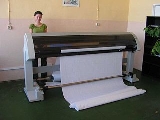
A plotter is a vector graphics
Vector graphics

Vector graphics is the use of geometrical Primitive s such as point s, line , curves, and shapes or polygon, which are all based upon mathematical equations, to represent s in computer graphics....
 printing device
Computer printer

File:Lexmark X5100 Series.jpgIn computing, a printer is a peripheral which produces a hard copy of documents stored in computer file form, usually on physical print media such as paper or Transparency ....
 to print graphical plots
Plot (graphics)

A plot is is a graphical technique for presenting a data set drawn by hand or produced by a mechanical or electronic plotter. It is a graph depicting the relationship between two or more variables used, for instance, in visualising scientific data....
, that connects to a computer
Computer

A computer is a machine that manipulates Data according to a list of Code .The first devices that resemble modern computers date to the mid-20th century , although the computer concept and various machines similar to computers existed earlier....
. There are two types of main plotters. Those are pen plotters and electrostatic plotters.

plotters print by moving a pen
Pen

File:03-BICcristal2008-03-26.jpgA pen is a writing instrument used to apply ink to a surface, usually paper. There are several different types, including ballpoint pen, rollerball pen, fountain pen, felt-tip....
 across the surface of a piece of paper.


Discussion
Ask a question about 'Plotter'
Start a new discussion about 'Plotter'
Answer questions from other users
Full Discussion Forum


Encyclopedia


Plotter Gerber Infinity
A plotter is a vector graphics
Vector graphics

Vector graphics is the use of geometrical Primitive s such as point s, line , curves, and shapes or polygon, which are all based upon mathematical equations, to represent s in computer graphics....
 printing device
Computer printer

File:Lexmark X5100 Series.jpgIn computing, a printer is a peripheral which produces a hard copy of documents stored in computer file form, usually on physical print media such as paper or Transparency ....
 to print graphical plots
Plot (graphics)

A plot is is a graphical technique for presenting a data set drawn by hand or produced by a mechanical or electronic plotter. It is a graph depicting the relationship between two or more variables used, for instance, in visualising scientific data....
, that connects to a computer
Computer

A computer is a machine that manipulates Data according to a list of Code .The first devices that resemble modern computers date to the mid-20th century , although the computer concept and various machines similar to computers existed earlier....
. There are two types of main plotters. Those are pen plotters and electrostatic plotters.

Overview

Pen plotters print by moving a pen
Pen

File:03-BICcristal2008-03-26.jpgA pen is a writing instrument used to apply ink to a surface, usually paper. There are several different types, including ballpoint pen, rollerball pen, fountain pen, felt-tip....
 across the surface of a piece of paper. This means that plotters are restricted to line art, rather than raster graphics
Raster graphics

In computer graphics, a raster graphics image or bitmap, is a data structure representing a generally Rectangle grid of pixels, or points of color, viewable via a Computer display, paper, or other display medium....
 as with other printers
Computer printer

File:Lexmark X5100 Series.jpgIn computing, a printer is a peripheral which produces a hard copy of documents stored in computer file form, usually on physical print media such as paper or Transparency ....
. Pen plotters can draw complex line art, including text, but do so very slowly because of the mechanical movement of the pens. Pen Plotters are incapable of creating a solid region of color; but can hatch
Hatching

Hatching is an artistic technique used to create tonal or shading effects by drawing closely spaced parallel lines. When lines are placed at an angle to one another, it is called cross-hatching....
 an area by drawing a number of close, regular lines. When computer memory
Computer memory

Computer memory is usually meant to refer to the semiconductor technology that is used to store information in Electronics devices. Current primary computer memory makes use of integrated circuits consisting of silicon-based transistors....
 was very expensive, and processor power was very limited, this was often the fastest way to produce color high-resolution vector-based artwork, or very large drawings efficiently.

Traditionally, printers are primarily for printing text. This makes it fairly easy to control, simply sending the text to the printer is usually enough to generate a page of output. This is not the case of the line art on a plotter, where a number of printer control languages were created to send the more detailed commands like "lift pen from paper", "place pen on paper", or "draw a line from here to here". The two common ASCII
ASCII

American Standard Code for Information Interchange , is a coding standard that can be used for interchanging information, if the information is expressed mainly by the written form of English words....
-based plotter control languages are Hewlett-Packard
Hewlett-Packard

The Hewlett-Packard Company , commonly referred to as HP, is a technology corporation headquartered in Palo Alto, California, United States....
's HPGL
HPGL

HPGL, sometimes hyphenated as HP-GL, is the primary printer control language used by Hewlett-Packard plotters. The name is an initialism for Hewlett-Packard Graphics Language....
2 or Houston Instruments
Houston Instruments

Houston Instruments was a manufacturer of pen plotters. They used the DMPL plotting control language. They competed with Hewlett Packard plotters such as the HP 7470....
 DMPL
DMPL

Digital Microprocessor Plotter Language is a vector graphics file format from Houston Instruments developed to control pen plotters and later used on cutting plotters....
 with commands such as "PA 3000, 2000; PD".

Programmers using FORTRAN
Fortran

Fortran is a general-purpose programming language, procedural programming language, imperative programming language programming language that is especially suited to numerical analysis and scientific computing....
 or BASIC
BASIC

In computer programming, BASIC is a family of high-level programming languages. The Dartmouth BASIC was designed in 1964 by John George Kemeny and Thomas Eugene Kurtz at Dartmouth College in New Hampshire, United States to provide computer access to non-science students....
 generally did not program these directly, but used software packages such as the Calcomp library, or device independent
Device independent

A computer program or computer file is device independent when its function is universal on different types of device.For the Web, this means writing simple common denominator HTML&CSS so that most Web browsers on most devices can render it....
 graphics packages such as Hewlett-Packard's AGL
A Graphics Language

A Graphics Language is an extension of the BASIC programming language, implemented on Hewlett-Packard minicomputers to simplify controlling a plotter....
 libraries or BASIC extensions or high end packages such as DISSPLA. These would establish scaling factors from world coordinates to device coordinates, and translating to the low level device commands. For example to plot X*X in HP 9830
HP 9830

The HP 9800 was a family of what were initially called programmable calculators and later desktop computers made by Hewlett-Packard which replaced their first HP 9100 calculator....
 BASIC, the program would be

10 SCALE -1,1,1,1 20 FOR X =-1 to 1 STEP 0.1 30 PLOT X, X*X 40 NEXT X 50 PEN 60 END

Early plotters (e.g. the Calcomp 565
Calcomp plotter

The Calcomp 560 drum plotter, introduced in 1959, was one of the first computer graphics output devices sold. The computer could control in 0.01 inch increments the rotation of an 11 inch wide drum and the horizontal movement of a pen holder over the drum....
 of 1959) worked by placing the paper over a roller which moved the paper back and forth for X motion, while the pen moved back and forth on a single arm for Y motion. Another approach (e.g. Computervision
Computervision

Computervision, Inc. was an early pioneer in turnkey Computer Aided Design and Manufacturing company. Computervision was founded in 1969 by Marty Allen and Philippe Villers, and headquartered in Massachusetts, USA....
's Interact I) involved attaching ball-point pens to drafting pantograph
Pantograph

A pantograph is a Linkage connected in a special manner based on parallelograms so that the movement of one specified point is an amplified version of the movement of another point....
s and driving the machines with motors controlled by the computer. This had the disadvantage of being somewhat slow to move, as well as requiring floor space equal to the size of the paper, but could double as a digitizer. A later change was the addition of an electrically controlled clamp to hold the pens, which allowed them to be changed and thus create multi-colored output.

Hewlett Packard and Tektronix
Tektronix

Tektronix, Inc. is a United States company best known for its test and measurement equipment such as oscilloscopes, logic analyzers, and video and mobile test protocol equipment....
 created desk-sized flatbed plotters in the late 1970s. In the 1980s, the small and lightweight HP 7470
HP 7470

The HP 7470 was a small low-cost desktop pen plotter introduced by Hewlett Packard's San Diego division. It used a revolutionary "grit wheel" design which moved the paper held in place by a wheel with embedded grit and a pinch roller....
 used an innovative "grit wheel" mechanism which moved only the paper. Modern desktop scanners use a somewhat similar arrangement. These smaller "home-use" plotters became popular for desktop business graphics, but their low speed meant they were not useful for general printing purposes, and another conventional printer would be required for those jobs. One category introduced by Hewlett Packard's MultiPlot for the HP 2647 was the "word chart" which used the plotter to draw large letters on a transparency. This was the forerunner of the modern Powerpoint chart. With the widespread availability of high-resolution inkjet
Inkjet printer

File:Canon BJ-10v Lite inkjet printer with Scale.JPGInkjet printers operate by propelling variably-sized droplets of liquid or molten material onto almost any sized page....
 and laser printer
Laser printer

A laser printer is a common type of computer printer that rapidly produces high quality text and graphics on plain paper. As with digital photocopiers and multifunction printers , laser printers employ a Xerography printing process but differ from analog photocopiers in that the image is produced by the direct scanning of a laser beam acros...
s, inexpensive memory and computers fast enough to rasterize color images, pen plotters have all but disappeared.

Plotters were also used in the Create-A-Card kiosks that were available for a while in the greeting card area of supermarkets that used the HP 7475 6 pen plotter.

Plotters are used primarily in technical drawing
Technical drawing

File:Drafter at work.jpgFile:Bundesarchiv B 145 Bild-F038800-0010, Wolfsburg, VW Autowerk.jpgTechnical drawing is the discipline of creating Standardization technology drawing by architects, CAD drafters, design engineers, and related professionals....
 and CAD applications, where they have the advantage of working on very large paper sizes while maintaining high resolution. Another use has been found by replacing the pen with a cutter, and in this form plotters can be found in many garment and sign shops.

If a plotter was commanded to use different colors it had to replace the pen and select the wanted color and/or width.

A niche application of plotters is in creating tactile images for visually handicapped people on special thermal cell paper.

Pen plotters have essentially become obsolete, and have been replaced by large-format inkjet printer
Inkjet printer

File:Canon BJ-10v Lite inkjet printer with Scale.JPGInkjet printers operate by propelling variably-sized droplets of liquid or molten material onto almost any sized page....
s and LED toner based printers. Such printers are often still known as plotters, even though they are raster devices rather than pen based plotters by the definition of this article. The newer plotters still understand vector languages such as HPGL2. This is because the language is an efficient way to describe how to draw the file using just text commands. A technical drawing in HPGL2 can be quite a bit smaller file than the same drawing in a pure raster form.

A pen plotter's speed is primarily limited by the type of pen used. The typical plotter pen uses a cellulose fiber rod inserted through a circular foam tube saturated with ink, with the end of the rod sharpened into a conical tip. As the pen moves across the paper surface, capillary wicking draws the ink from the foam, down the rod, and onto the paper. As the ink supply in the foam is depleted, the migration of ink to the tip begins to slow down, resulting in faint lines. Slowing the plotting speed will allow the lines drawn by a worn-out pen to remain dark, but the fading will continue until the foam is completely depleted. Also as the fiber tip pen is used, the fiber tip slowly wears away from rubbing against the media, wearing down the thin conical tip into a thicker smudged line.

Ball-point plotter pens with refillable clear plastic ink reservoirs are available. They do not have the fading or wear effects of fiber pens, but are generally more expensive and uncommon.

Vinyl Sign Cutter

A vinyl sign cutter (sometimes known as a cutting plotter) is used by professional poster and billboard sign-making businesses to produce brilliant weather-resistant signs, posters, and billboards using self-colored adhesive-backed vinyl film that has a removable paper backing material. The vinyl can also be applied to car bodies and windows for large, bright company advertising and to sailboat transoms. A similar process is used to cut tinted vinyl for automotive windows.

Colors available are generally limited only by the collection of vinyl on hand. To prevent creasing of the material, it is stored in rolls. Typical vinyl roll sizes are 24-inch and 36-inch width.

Generally the hardware is identical to a traditional plotter except that the ink pen is replaced by a very sharp knife that is use to cut out each shape, and the plotter may have a pressure control to adjust how hard the knife presses down into the vinyl film, allowing designs to be fully or partly cut out. The vinyl knife is usually shaped like a plotter pen and is mounted on ball-bearings so that the knife edge rotates to face the correct direction as the plotter head moves.

Once the letters or designs have been cut out, there are two methods for handling the application.

The most common method:
  • From the front surface, peel off the surround and unwanted areas of shapes from the letters or design.
  • Apply a slightly tacky carrier film over the letters or design (this film is similar to masking tape
    Masking tape

    Masking tape is a type of pressure sensitive tape made of a thin and easy-to-tear paper, and an easily released pressure sensitive adhesive. It is available in a variety of widths....
     though clear carrier films are also used.
  • Cut out the area which includes the desired design, including the carrier film, vinyl and vinyl backing material.
  • Apply a small piece of masking tape to the sides of the resulting sandwich to ease positioning.
  • Ensuring that the area to which the vinyl is to be applied is clean, position the sandwich. When it is in the desired position, apply a hinge of masking tape to the lower edge. Remove the two side pieces of masking tape and the sandwich will fold down along the hinge.
  • Carefully remove the backing paper by peeling sideways, not away from the letters or design.
  • The cut vinyl is now held in position by the carrier film.
  • With a small plastic wiper (a credit card will also do), sweep the cut vinyl into contact with the mounting surface, stroking upwards and outwards, taking care to leave no air bubbles.
  • When all parts of the cut vinyl is in contact with the mounting surface, gently peel off the front paper sideways, and apply final pressure to the front face of the cut vinyl to produce a weather-resistant sign.


An older method:
  • Once the vinyl has been cut, the individual cut-out pieces are peeled off the backing paper and carefully assembled by hand on the mounting surface to form the final image.
  • A heat gun may be used to melt/bond the vinyl pieces to the substrate.


Sign cutters are primarily used to produce single-color line art
Line art

Line art is any image that consists of distinct straight and curved lines placed against a background, without gradations in shading or hue to represent two-dimensional or three-dimensional objects....
. Multiple colors can be cut and assembled but the assembly process is extremely painstaking if the cut sections are thin and flexible.

As with the pen plotter, sign cutting plotters are in decline for general billboard and sign design. They are being replaced by wide-format
Wide-format printer

Wide-format printers are generally accepted to be any Computer printer with a print width between 17" and 100". Printers over the 100" mark may be called Super-Wide or Grand format....
 inkjet printers that use special fade-resistant UV-protected solvent-based inks, which can directly print onto fabrics, vinyls, or plastic sheeting. These large inkjet printers have the added advantage of performing smooth color transitions and photo printing, which sign cutters cannot duplicate.

However, sign cutting plotters are still very much in use for precision cutting of graphics produced by wide-format inkjet printers, for example to produce shaped stickers and window graphics.

Static Cutting Table

A sign cutter typically functions like a traditional roll-fed or sheet-fed plotter, in that the media to be cut is kept rigid by a backing sheet as pieces of vinyl are cut out. As the letters are cut, the backing keeps the material properly aligned in the moving rollers. This does not work when cutting a non-rigid material with no backing, such as fabric textiles or leather. Cutting a hole or slit will cause the unsupported material to droop and fall out of alignment.

The static cutting table uses a large flat vacuum cutting table instead of a roll feed. The surface of the table has a series of small pinholes drilled in it. Material is placed on the table, and a sheet of plastic overlaid onto the fabric. A vacuum pump is turned on, and air pressure pushes down on the plastic cover sheet to hold the fabric in place. The table then operates like a normal vector plotter, using various cutting tools to cut holes or slits into the fabric. The plastic overlay is also cut, which leads to a slight loss of vacuum, but this loss is usually not significant.

This configuration allows static cutting tables to cut flexible and non-rigid materials that are difficult or impossible to cut with roll-fed plotters. Static cutters are also capable of cutting much thicker and heavier materials than a typical roll-fed or sheet-fed plotter.