
All Topics  
Pleural effusion

 
Pleural Effusion

   Email Print
   Bookmark   Link


Pleural effusion


Pleural effusion is excess fluid that accumulates in the pleural cavity
Pleural cavity

In human anatomy, the pleural cavity is the body cavity that surrounds the lungs. The lungs are surrounded by the pleurae, a serous membrane which folds back upon itself to form a two-layered, membrane structure....
, the fluid-filled space that surrounds the lung
Lung

The lung is the essential respiration organ in air-breathing animals, including most tetrapods, a few fish and a few snails. In mammals and the more complex life forms, the two lungs are located in the chest on either side of the heart....
s. Excessive amounts of such fluid can impair breathing by limiting the expansion of the lungs during inhalation
Inhalation

Inhalation is the movement of air from the external environment, through the air ways, and into the alveoli.Inhalation begins with the onset of contraction of the diaphragm , which results in expansion of the intrapleural space and an increase in negative pressure according to Boyle's Law....
.

types of fluids can accumulate in the pleural space:

ral effusion is usually diagnosed on the basis of medical history
Medical history

The medical history or anamnesis J - jaundice T - tuberculosis H - hypertension & heart disease R - rheumatic fever...
 and physical exam, and confirmed by chest x-ray
Chest X-ray

A chest X-ray, commonly Abbreviation CXR, is a projection radiograph , taken by a radiographer, of the thorax which is used to diagnose problems with that area....
.


Discussion
Ask a question about 'Pleural effusion'
Start a new discussion about 'Pleural effusion'
Answer questions from other users
Full Discussion Forum


Encyclopedia


Pleural Effusion
Pleural effusion is excess fluid that accumulates in the pleural cavity
Pleural cavity

In human anatomy, the pleural cavity is the body cavity that surrounds the lungs. The lungs are surrounded by the pleurae, a serous membrane which folds back upon itself to form a two-layered, membrane structure....
, the fluid-filled space that surrounds the lung
Lung

The lung is the essential respiration organ in air-breathing animals, including most tetrapods, a few fish and a few snails. In mammals and the more complex life forms, the two lungs are located in the chest on either side of the heart....
s. Excessive amounts of such fluid can impair breathing by limiting the expansion of the lungs during inhalation
Inhalation

Inhalation is the movement of air from the external environment, through the air ways, and into the alveoli.Inhalation begins with the onset of contraction of the diaphragm , which results in expansion of the intrapleural space and an increase in negative pressure according to Boyle's Law....
.

Types of fluids

Four types of fluids can accumulate in the pleural space:
  • Serous fluid
    Serous fluid

    In physiology, the term serous fluid is used for various bodily fluids that are typically pale yellow and transparent, and of a benign nature, that fill the inside of body cavities....
     (hydrothorax
    Hydrothorax

    A hydrothorax is a condition that results from serous fluid accumulating in the pleural cavity. This specific condition can be related to cirrhosis with ascites in which ascitic fluid leaks into the pleural cavity....
    )
  • Blood
    Blood

    Blood is a specialized bodily fluid that delivers necessary substances to the body's Cell s ? such as nutrients and oxygen ? and transports waste products away from those same cells....
     (hemothorax
    Hemothorax

    A hemothorax is a condition that results from blood accumulating in the pleural cavity....
    )
  • Chyle
    Chyle

    Chyle is a milky fluid consisting of lymph and emulsified fats, or free fatty acids . It is formed in the small intestine during digestion of ingested fatty foods and taken up by lymph vessels specifically known as lacteals, unlike other components of digested food that are conveyed by veins....
     (chylothorax
    Chylothorax

    A chylothorax is a type of pleural effusion. It results from lymphatic fluid accumulating in the pleural cavity....
    )
  • Pus
    Pus

    Pus is a whitish-yellow, yellow or yellow-brown substance produced during inflammatory pyogenic bacteriuml infection. An accumulation of pus in an enclosed tissue space is known as an abscess....
     (pyothorax or empyema
    Empyema

    A pleural empyema is an accumulation of pus in the pleural cavity. Most pleural empyemas arise from an infection within the lung , often associated with parapneumonic effusions....
    )


Diagnosis

Pleural effusion is usually diagnosed on the basis of medical history
Medical history

The medical history or anamnesis J - jaundice T - tuberculosis H - hypertension & heart disease R - rheumatic fever...
 and physical exam, and confirmed by chest x-ray
Chest X-ray

A chest X-ray, commonly Abbreviation CXR, is a projection radiograph , taken by a radiographer, of the thorax which is used to diagnose problems with that area....
. Chest films acquired in the lateral decubitus
Decubitus

Commonly used in medicine, the word decubitus is used to mean "lying down". It originates from the Latin term decumbere meaning "to lie down"....
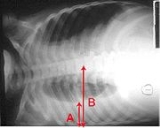
 position (with the patient lying on his side) are more sensitive, and can pick up as little as 50 ml of fluid. At least 300 ml of fluid must be present before upright chest films can pick up signs of pleural effusion (e.g., blunted costophrenic angle
Costophrenic angle

In anatomy, the costophrenic angles are the places where the Diaphragm meet the ribs .Each costophrenic angle can normally be seen as on chest x-ray as a sharply-pointed, downward indentation between each hemi-diaphragm and the adjacent chest wall ....
s). Once accumulated fluid is more than 500 ml, there are usually detectable clinical signs in the patient, such as decreased movement of the chest on the affected side, dullness to percussion over the fluid, diminished breath sounds
Breath sounds

Respiratory sounds refer to the specific sounds identified through auscultation of the respiratory system with a stethoscope.In this context, "adventitious" refers to sounds heard apart from the normal sounds of Inhalation and expiration....
 on the affected side, decreased vocal resonance and fremitus
Fremitus

Fremitus is a palpable vibration on the human body. In common medical usage, it usually refers to vocal fremitus, although there are several other types....
 (though this is an inconsistent and unreliable sign), pleural friction rub
Pleural friction rub

A pleural friction rub is a medical sign, audible via auscultation, that is used in the diagnosis of pleurisy and other conditions affecting the chest cavity....
. Above the effusion, where the lung is compressed, there may be bronchial breathing and egophony
Egophony

Egophony is an increased resonance of voice sounds heard when auscultating the lungs, often caused by consolidated or compressed lung tissue due to an infection, pleural effusion, tumor, or congestion....
. In large effusion there may be tracheal deviation away from the effusion.

Once a pleural effusion is diagnosed, the cause must be determined. Pleural fluid is drawn out of the pleural space in a process called thoracentesis
Thoracentesis

Thoracentesis is an invasive procedure to remove pleural effusion or pneumothorax from the pleural cavity for diagnostic or therapeutic purposes....
. A needle is inserted through the back of the chest wall in sixth, seventh or eight intercostal space in midaxillary line, into the pleural space. The fluid may then be evaluated for the following:

  1. Chemical composition including protein
    Protein

    Proteins are organic compounds made of amino acids arranged in a linear chain and joined together by peptide bonds between the carboxyl and amino groups of adjacent amino acid Residue ....
    , lactate dehydrogenase
    Lactate dehydrogenase

    Lactate dehydrogenase is an enzyme present in a wide variety of organisms, including plants and animals....
     (LDH), albumin
    Serum albumin

    Serum albumin, often referred to simply as albumin, is the most abundant plasma protein in humans and other mammals. Albumin is essential for maintaining the osmotic pressure needed for proper distribution of body fluids between intravascular compartments and body tissues....
    , amylase
    Amylase

    Amylase is an enzyme that breaks starch down into sugar. Amylase is present in human saliva, where it begins the chemical process of digestion....
    , pH
    PH

    pH is a measure of the Acid or Base of a solution. It is defined as the cologarithm of the Activity of dissolved hydrogen ions . Hydrogen ion activity coefficients cannot be measured experimentally, so they are based on theoretical calculations....
     and glucose
    Glucose

    Glucose , a monosaccharide also known as grape sugar, blood sugar, or corn sugar, is a very important carbohydrate in biology....
  2. Gram stain and culture to identify possible bacterial infections
  3. Cell
    Cell (biology)

    The cell is the structural and functional unit of all known Life organisms. It is the smallest unit of an organism that is classified as living, and is often called the building bricks of life....
     count and differential
  4. Cytology
    Cytology

    Cytology means "the study of cell s".Cytology is that branch of life science, which deals with the study of cells in terms of structure, function and chemistry....
     to identify cancer cells, but may also identify some infective organisms
  5. Other tests as suggested by the clinical situation - lipid
    Lipid

    Lipids are broadly defined as any fat-soluble , naturally-occurring molecule, such as fats, oils, waxes, cholesterol, sterols, fat-soluble vitamins , monoglycerides, diglycerides, phospholipids, and others....
    s, fungal culture
    Fungus

    A fungus is a Eukaryote organism that is a member of the Kingdom Fungi . The fungi are a monophyletic group, also called the Eumycota , that is phylogeny distinct from the morphologically similar slime molds and water molds ....
    , viral culture
    Virus

    A virus is a Optical microscope#Limitations of light microscopes infectious agent that is unable to grow or reproduce outside a host cell . Viruses infect all cellular life....
    , specific immunoglobulins


Transudate vs. exudate

The third step in the evaluation of pleural fluid is to determine whether the effusion is a transudate or an exudate. Transudative pleural effusions are caused by systemic factors that alter the balance of the formation and absorption of pleural fluid (e.g., left ventricular failure, and cirrhosis
Cirrhosis

Cirrhosis is a consequence of chronic liver disease characterized by replacement of liver Tissue by fibrous scar tissue as well as regenerative Nodule , leading to progressive loss of liver function....
), while exudative pleural effusions are caused by alterations in local factors that influence the formation and absorption of pleural fluid (e.g., bacterial pneumonia
Bacterial pneumonia

Bacterial pneumonia is a type of pneumonia associated with bacterial infection....
, cancer
Cancer

Cancer is a class of diseases in which a group of cell display uncontrolled growth , invasion , and sometimes metastasis . These three malignant properties of cancers differentiate them from benign tumors, which are self-limited, do not invade or metastasize....
, pulmonary embolism
Pulmonary embolism

Pulmonary embolism is a blockage of the pulmonary artery or one of its branches, usually occurring when a deep vein thrombosis becomes dislodged from its site of formation and travels, or embolism, to the pulmonary artery blood supply of one of the lungs....
, and viral infection).

Transudative and exudative pleural effusions are differentiated by comparing chemistries in the pleural fluid to those in the blood. According to a meta-analysis
Meta-analysis

In statistics, a meta-analysis combines the results of several studies that address a set of related research hypotheses. This is normally done by identification of a common measure of effect size, which is modelled using a form of meta-regression....
, exudative pleural effusions meet at least one of the following criteria :
  1. Pleural fluid protein >2.9 g/dL (29 g/L)
  2. Pleural fluid cholesterol >45 mg/dL (1.16 mmol/L)
  3. Pleural fluid LDH >60 percent of upper limit for serum


Previously criteria proposed by Light for an exudative effusion are met if at least one of the following exists (Light's criteria) :
  1. The ratio of pleural fluid protein to serum protein is greater than 0.5
  2. The ratio of pleural fluid LDH and serum LDH is greater than 0.6
  3. Pleural fluid LDH is more than two-thirds normal upper limit for serum


Twenty-five percent of patients with transudative pleural effusions are mistakenly identified as having exudative pleural effusions by Light's criteria. Therefore, additional testing is needed if a patient identified as having an exudative pleural effusion appears clinically to have a condition that produces a transudative effusion. In such cases albumin
Serum albumin

Serum albumin, often referred to simply as albumin, is the most abundant plasma protein in humans and other mammals. Albumin is essential for maintaining the osmotic pressure needed for proper distribution of body fluids between intravascular compartments and body tissues....
 levels in blood and pleural fluid are measured. If the difference between the albumin levels in the blood and the pleural fluid is greater than 1.2 g/dL (12 g/L), it can be assumed that the patient has a transudative pleural effusion.

If the fluid is definitively identified as exudative, additional testing is necessary to determine the local factors causing the exudate.

Exudative pleural effusions

Once identified as exudative, additional evaluation is needed to determine the cause of the excess fluid, and pleural fluid amylase, glucose, pH and cell counts are obtained. The fluid is also sent for Gram staining
Gram staining

Gram staining is an empiricism method of differentiating bacterium species into two large groups based on the chemical and physical properties of their cell walls....
 and culture, and, if suspicious for tuberculosis, examination for TB markers (adenosine deaminase
Adenosine deaminase

Adenosine deaminase is an enzyme involved in Purine#Metabolism. It is needed for the breakdown of adenosine from food and for the turnover of nucleic acids in tissues....
 > 45 IU/L, interferon gamma > 140 pg/mL, or positive polymerase chain reaction
Polymerase chain reaction

The polymerase chain reaction is a technique widely used in molecular biology. It derives its name from one of its key components, a DNA polymerase used to amplify a piece of DNA by in vitro enzyme DNA replication....
 (PCR) for tuberculous DNA).

Pleural fluid amylase is elevated in cases of esophageal rupture, pancreatic pleural effusion
Pancreatic fistula

A pancreatic fistula is an abnormal communication between the pancreas and other organs due to leakage of pancreatic secretions from damaged pancreatic ducts....
, or cancer. Glucose is decreased with cancer, bacterial infections, or rheumatoid pleuritis
Rheumatoid pleuritis

Rheumatoid pleuritis, a form of pleural effusion, is an uncommon complication of rheumatoid arthritis, occurring in 2-3% of patients ...
. Pleural fluid pH is low in empyema (<7.2) and may be low in cancer. If cancer is suspected, the pleural fluid is sent for cytology. If cytology is negative, and cancer is still suspected, either a thoracoscopy
Thoracoscopy

Thoracoscopy is a medical procedure involving internal inspection of the pleural cavity. It was developed by Hans Christian Jacobaeus, a Sweden internist in 1910 for the treatment of tuberculosis intra-thoracic adhesions....
, or needle biopsy of the pleura may be performed.

Causes

The most common causes of transudative pleural effusions in the United States are left ventricular failure, pulmonary embolism
Pulmonary embolism

Pulmonary embolism is a blockage of the pulmonary artery or one of its branches, usually occurring when a deep vein thrombosis becomes dislodged from its site of formation and travels, or embolism, to the pulmonary artery blood supply of one of the lungs....
, and cirrhosis
Cirrhosis

Cirrhosis is a consequence of chronic liver disease characterized by replacement of liver Tissue by fibrous scar tissue as well as regenerative Nodule , leading to progressive loss of liver function....
 (causing hepatic hydrothorax), while the most common causes of exudative pleural effusions are bacterial pneumonia
Pneumonia

Pneumonia is an Inflammation illness of the lung. Frequently, it is described as lung parenchyma/alveolus inflammation and abnormal alveolar filling with fluid ....
, cancer (with lung cancer
Lung cancer

Lung cancer is a disease of uncontrolled cell growth in tissue of the lung. This growth may lead to metastasis, which is the invasion of adjacent tissue and infiltration beyond the lungs....
, breast cancer
Breast cancer

Breast cancer is a cancer that starts in the Cell of the breast in women and men. Worldwide, breast cancer is the second most common type of cancer after lung cancer and the fifth most common cause of cancer death....
, and lymphoma
Lymphoma

Lymphoma is a type of cancer that originates in lymphocytes of the immune system. They often originate in lymph nodes, presenting as an enlargement of the node ....
 causing approximately 75% of all malignant pleural effusions), viral infection, and pulmonary embolism
Pulmonary embolism

Pulmonary embolism is a blockage of the pulmonary artery or one of its branches, usually occurring when a deep vein thrombosis becomes dislodged from its site of formation and travels, or embolism, to the pulmonary artery blood supply of one of the lungs....
. Although pulmonary embolism can produce either transudative or exudative pleural effusions, the latter is more common.

Other causes of pleural effusion include tuberculosis
Tuberculosis

Tuberculosis is a common and often deadly infectious disease caused by mycobacterium, mainly Mycobacterium tuberculosis . Tuberculosis usually attacks the lungs but can also affect the central nervous system, the lymphatic system, the circulatory system, the genitourinary system, the gastrointestinal system, bones, joints, and even the...
 (though pleural fluid smears are rarely positive for AFB, this is the most common cause of pleural effusion in some developing countries), autoimmune disease such as systemic lupus erythematosus
Systemic lupus erythematosus

Systemic lupus erythematosus is a chronic Autoimmunity connective tissue disease that can affect any part of the body. As occurs in other autoimmune diseases, the immune system attacks the body?s cells and tissue, resulting in inflammation and tissue damage....
, bleeding (often due to chest trauma), chylothorax (most commonly caused by trauma), and accidental infusion of fluids. Less common causes include esophageal rupture or pancreatic disease, intraabdominal abscess, rheumatoid arthritis
Rheumatoid arthritis

Rheumatoid arthritis is a chronic, systemic disease inflammation that may affect many tissues and organs, but principally attacks the joints producing a inflammatory synovitis that often progresses to destruction of the articular cartilage and ankylosis of the joints....
, asbestos pleural effusion, Meigs syndrome
Meigs syndrome

In medicine, Meigs syndrome, also Meigs' syndrome, is the triad of ascites, pleural effusion and benign ovarian tumor . It resolves after the resection of the tumor....
 (ascites and pleural effusion due to a benign ovarian tumor), and ovarian hyperstimulation syndrome
Ovarian hyperstimulation syndrome

Ovarian hyperstimulation syndrome is a complication from some forms of fertility medication. Most cases are mild, but a small proportion is severe....
.

Pleural effusions may also occur through medical/surgical interventions, including the use of medications (pleural fluid is usually eosinophilic
Eosinophilic

Eosinophilic means loves eosin, and refers to the staining of certain Biological tissue, cell , or organelles after they have been washed with eosin, a dye....
), coronary artery bypass surgery
Coronary artery bypass surgery

Coronary artery bypass surgery, also coronary artery bypass graft surgery, and colloquially heart bypass or bypass surgery is a surgery performed to relieve Angina pectoris and reduce the risk of death from Coronary heart disease....
, abdominal surgery, endoscopic variceal sclerotherapy, radiation therapy
Radiation therapy

Radiation therapy is the medicine use of ionizing radiation as part of cancer oncology to control malignant cell s . Radiotherapy may be used for curative or Adjuvant chemotherapy cancer treatment....
, liver
Liver transplantation

Liver transplantation or hepatic transplantation is the replacement of a diseased liver with a healthy liver allograft. The most commonly used technique is orthotopic transplantation, in which the native liver is removed and the donor organ is placed in the same anatomic location as the original liver....
 or lung transplantation
Lung transplantation

Lung transplantation is a surgical procedure in which a patient's diseased lungs are partially or totally replaced by lungs which come from a donor....
, and intra- or extravascular insertion of central lines
Central venous catheter

In medicine, a central venous catheter is a catheter placed into a large vein in the neck , chest or groin . It is used to administer medication or fluids, obtain blood tests , and directly obtain cardiovascular measurements such as the central venous pressure....
.

Treatment

Treatment depends on the underlying cause of the pleural effusion. Therapeutic aspiration may be sufficient; larger effusions may require insertion of an intercostal drain
Chest tube

A chest tube is a flexible plastic tube that is inserted through the side of the chest into the pleural cavity. It is used to remove air or fluid , or pus from the intrathoracic space....
 (either pigtail or surgical). Repeated effusions may require chemical (talc
Talc

Talc is a mineral composed of hydrated magnesium silicate with the chemical formula Hydrogen2Magnesium34 or Magnesium3Silicon4Oxygen102....
, bleomycin
Bleomycin

Bleomycin is a glycopeptide antibiotic produced by the bacterium Streptomyces verticillus. Bleomycin refers to a family of structurally related compounds....
, tetracycline
Tetracycline

Tetracycline is a broad-spectrum polyketide antibiotic produced by the Streptomyces genus of Actinobacteria, indicated for use against many bacterial infections....
/doxycycline
Doxycycline

Doxycycline is a member of the tetracycline antibiotics group and is commonly used to treat a variety of infections. Doxycycline is a semi-synthetic tetracycline invented and clinically developed in the early 1960s by Pfizer and marketed under the brand name Vibramycin....
) or surgical pleurodesis
Pleurodesis

Pleurodesis is the artificial obliteration of the pleural cavity....
, in which the two pleural surfaces are attached to each other so that no fluid can accumulate between them.

See also

  • Empyema
    Empyema

    A pleural empyema is an accumulation of pus in the pleural cavity. Most pleural empyemas arise from an infection within the lung , often associated with parapneumonic effusions....
  • Heart failure
  • Pulmonary embolism
    Pulmonary embolism

    Pulmonary embolism is a blockage of the pulmonary artery or one of its branches, usually occurring when a deep vein thrombosis becomes dislodged from its site of formation and travels, or embolism, to the pulmonary artery blood supply of one of the lungs....
  • Thoracentesis
    Thoracentesis

    Thoracentesis is an invasive procedure to remove pleural effusion or pneumothorax from the pleural cavity for diagnostic or therapeutic purposes....


External links

  • Virtual Cancer Centre
  • Images from MedPix