
Home      Discussion      Topics      Dictionary      Almanac
Signup       Login
Platform game

Platform game

Overview
A platform game is a video game characterized by requiring the player to jump to and from suspended platforms or over obstacles (jumping puzzles). It must be possible to control these jumps and to fall from platforms or miss jumps. The most common unifying element to games in this video game genre is a jump button; other jump mechanics include swinging from extendable arms, as in Ristar
Ristar
Ristar, known as in Japan, is a platform game developed by Sonic Team and published by Sega for the Sega Mega Drive/Sega Genesis in 1995. A Sega Game Gear version, which features different levels than the Mega Drive version, was also released in the same year.The game stars a humanoid cartoon star...

or Bionic Commando, or bouncing from springboards or trampolines, as in Alpha Waves
Alpha Waves
Alpha Waves is an early 3D game that combines labyrinthine exploration with platform gameplay. By most definitions of the genre it could be considered to be the first 3D platform game, released in 1990, 6 years before the genre's seminal classic Super Mario 64...

. These mechanics, even in the context of other genres, are commonly called platforming, a verbification of platform. Games where jumping is automated completely, such as The Legend of Zelda: Ocarina of Time
The Legend of Zelda: Ocarina of Time
is an action-adventure video game developed by Nintendo's Entertainment Analysis and Development division for the Nintendo 64 video game console. It was released in Japan on November 21, 1998; in North America on November 23, 1998; and in Europe on December 11, 1998...

, fall outside of the genre.
Discussion
Ask a question about 'Platform game'
Start a new discussion about 'Platform game'
Answer questions from other users
Full Discussion Forum
 
Recent Discussions
Encyclopedia
A platform game is a video game characterized by requiring the player to jump to and from suspended platforms or over obstacles (jumping puzzles). It must be possible to control these jumps and to fall from platforms or miss jumps. The most common unifying element to games in this video game genre is a jump button; other jump mechanics include swinging from extendable arms, as in Ristar
Ristar
Ristar, known as in Japan, is a platform game developed by Sonic Team and published by Sega for the Sega Mega Drive/Sega Genesis in 1995. A Sega Game Gear version, which features different levels than the Mega Drive version, was also released in the same year.The game stars a humanoid cartoon star...

or Bionic Commando, or bouncing from springboards or trampolines, as in Alpha Waves
Alpha Waves
Alpha Waves is an early 3D game that combines labyrinthine exploration with platform gameplay. By most definitions of the genre it could be considered to be the first 3D platform game, released in 1990, 6 years before the genre's seminal classic Super Mario 64...

. These mechanics, even in the context of other genres, are commonly called platforming, a verbification of platform. Games where jumping is automated completely, such as The Legend of Zelda: Ocarina of Time
The Legend of Zelda: Ocarina of Time
is an action-adventure video game developed by Nintendo's Entertainment Analysis and Development division for the Nintendo 64 video game console. It was released in Japan on November 21, 1998; in North America on November 23, 1998; and in Europe on December 11, 1998...

, fall outside of the genre.

Platform games originated in the early 1980s, and 3D
3D computer graphics
3D computer graphics are graphics that use a three-dimensional representation of geometric data that is stored in the computer for the purposes of performing calculations and rendering 2D images...

 successors were popularized in the mid-1990s. The term itself describes games where jumping on platforms is an integral part of the gameplay
Gameplay
Gameplay is the specific way in which players interact with a game, and in particular with video games. Gameplay is the pattern defined through the game rules, connection between player and the game, challenges and overcoming them, plot and player's connection with it...

, and came into use some time after the genre had been established, but no later than 1983. However, it is not a pure genre and is very frequently coupled with elements of other genres, such as the shooter
Shooter game
Shooter games are a sub-genre of action game, which often test the player's speed and reaction time. It includes many subgenres that have the commonality of focusing "on the actions of the avatar using some sort of weapon. Usually this weapon is a gun, or some other long-range weapon". A common...

 elements in Contra, the adventure
Adventure game
An adventure game is a video game in which the player assumes the role of protagonist in an interactive story driven by exploration and puzzle-solving instead of physical challenge. The genre's focus on story allows it to draw heavily from other narrative-based media such as literature and film,...

 elements of Flashback
Flashback: The Quest for Identity
Flashback, released as Flashback: The Quest for Identity in the US, is a cinematic platformer developed by Delphine Software of France, a now defunct company, and published by U.S...

or the RPG elements of Castlevania: Symphony of the Night
Castlevania: Symphony of the Night
Castlevania: Symphony of the Night, known in Japan as , is an action-adventure game developed and published by Konami in 1997. It is the 14th installment of the Castlevania series, the first installment released for the PlayStation, and a direct sequel to Castlevania: Rondo of Blood.Symphony of the...

.

While commonly associated with console gaming, there have been many important platform games released to arcades
Video arcade
An amusement arcade or video arcade is a venue where people play arcade games such as video games, pinball machines, electro-mechanical games, redemption games, merchandisers , or coin-operated billiards or air hockey tables...

, as well as for handheld systems
Handheld game console
A handheld game console is a lightweight, portable electronic device with a built-in screen, game controls and speakers. Handheld game consoles are run on machines of small size allowing people to carry them and play them at any time or place...

 and home computers
Personal computer
A personal computer is any general-purpose computer whose size, capabilities, and original sales price make it useful for individuals, and which is intended to be operated directly by an end-user with no intervening computer operator...

. Europe, North America, and Japan have played major parts in the genre's evolution. Platform themes range from cartoony "mascot" games to science fiction
Science fiction
Science fiction is a genre of fiction dealing with imaginary but more or less plausible content such as future settings, futuristic science and technology, space travel, aliens, and paranormal abilities...

 and fantasy
Fantasy
Fantasy is a genre of fiction that commonly uses magic and other supernatural phenomena as a primary element of plot, theme, or setting. Many works within the genre take place in imaginary worlds where magic is common...

 epics.

Platform games were, at one point, the most popular genre of video game. At the peak of their popularity, it is estimated that between one-quarter and one-third of console games were platformers. No genre before or since has been able to achieve a similar market share. As of 2006, the genre is far less dominant, representing a 2% market share (compared to 15% in 1998), but still commercially viable, with a number of games selling in the millions of units.


Single screen movement


Platform games appeared at the beginning of the 1980s. Because of the technical limitations of the day, early examples were confined to a static playing field, generally viewed in profile. The earliest video games to feature jumping were sports game
Sports game
A sports game is a computer or video game that simulates the practice of traditional sports. Most sports have been recreated with a game, including team sports, athletics and extreme sports. Some games emphasize actually playing the sport , whilst others emphasize strategy and organization...

s based on basketball
Basketball
Basketball is a team sport in which two teams of five players try to score points by throwing or "shooting" a ball through the top of a basketball hoop while following a set of rules...

; while earlier titles like Taito
Taito Corporation
The is a Japanese publisher of video game software and arcade hardware wholly owned by publisher Square Enix. Taito has their headquarters in the Shinjuku Bunka Quint Building in Yoyogi, Shibuya, Tokyo, sharing the facility with its parent company....

's Basketball (1974) could not accurately represent jumping due to simple paddle
Paddle (game controller)
A paddle is a game controller with a round wheel and one or more fire buttons, where the wheel is typically used to control movement of the player object along one axis of the video screen...

 controls, later titles such as Atari
Atari
Atari is a corporate and brand name owned by several entities since its inception in 1972. It is currently owned by Atari Interactive, a wholly owned subsidiary of the French publisher Atari, SA . The original Atari, Inc. was founded in 1972 by Nolan Bushnell and Ted Dabney. It was a pioneer in...

's Basketball (1978) could more accurately represent jumps using a joystick
Joystick
A joystick is an input device consisting of a stick that pivots on a base and reports its angle or direction to the device it is controlling. Joysticks, also known as 'control columns', are the principal control in the cockpit of many civilian and military aircraft, either as a center stick or...

 button. Frogs
Frogs (video game)
Frogs is a single-player action / platform arcade game released by Sega-Gremlin in 1978. It is the first video game with a jumping character , which by some definitions could make it the first platform game...

, an arcade game
Arcade game
An arcade game is a coin-operated entertainment machine, usually installed in public businesses such as restaurants, bars, and amusement arcades. Most arcade games are video games, pinball machines, electro-mechanical games, redemption games, and merchandisers...

 released by Sega
Sega
, usually styled as SEGA, is a multinational video game software developer and an arcade software and hardware development company headquartered in Ōta, Tokyo, Japan, with various offices around the world...

/Gremlin
Gremlin Industries
Gremlin Industries was arcade game manufacturer active from the 1970s to early 1980s, and based San Diego, California, USA .Gremlin was founded in 1973 as a manufacturer of coin-operated wall games. Gremlin's first wall game, Play Ball, was fairly successful.- History :Gremlin joined the video game...

 in 1978, was the first non-sports game to feature a jumping character, making it an early ancestor of the genre. Players could not control the direction of the jump however, nor was it possible to jump between different platforms, only to fall off either side of the one platform on screen
Display device
A display device is an output device for presentation of information in visual or tactile form...

.

Space Panic
Space Panic
Space Panic is a 1980 arcade game designed by Universal, which Chris Crawford calls the first ever platform game, as it pre-dates Nintendo's Donkey Kong which is often cited as the original platform game. Space Panic lacks Donkey Kongs jump mechanic, disqualifying it as a platformer for some...

, a 1980 arcade release by Universal
Aruze
, is a Japanese manufacturer of pachinko, slot machines, arcade games and other gaming products, and a publisher of video games. Aruze possesses licenses to both manufacture and distribute casino machines in the American states of Nevada, Mississippi and New Jersey. The company's corporate...

, is sometimes credited as the first platform game, though the distinction is contentious, since the player had no ability to jump, swing, bounce, or fall, and as such, does not satisfy most modern definitions of the genre. However, it was clearly an influence on the genre, with gameplay centered on climbing ladders between different floors, a common element in many early platform games. Another precursor to the genre released that same year was Nichibutsu's Crazy Climber
Crazy Climber
is a coin-operated arcade game produced by Nichibutsu in 1980. It was also released in North America by Taito America Corporation by UA Ltd. in 1982 for the Emerson Arcadia 2001 and other video game consoles. It is one of Nichibutsu's most highly-acclaimed video games in its library...

, which revolved around the concept of climbing buildings.

Donkey Kong
Donkey Kong (video game)
is an arcade game released by Nintendo in 1981. It is an early example of the platform game genre, as the gameplay focuses on maneuvering the main character across a series of platforms while dodging and jumping over obstacles. In the game, Jumpman must rescue a damsel in distress, Lady, from a...

, an arcade game
Arcade game
An arcade game is a coin-operated entertainment machine, usually installed in public businesses such as restaurants, bars, and amusement arcades. Most arcade games are video games, pinball machines, electro-mechanical games, redemption games, and merchandisers...

 created by Nintendo
Nintendo
is a multinational corporation located in Kyoto, Japan. Founded on September 23, 1889 by Fusajiro Yamauchi, it produced handmade hanafuda cards. By 1963, the company had tried several small niche businesses, such as a cab company and a love hotel....

, released in July 1981, was the first game that allowed players to jump over obstacles and across gaps, making it the first true platformer. Donkey Kong had a limited amount of platforming in its first two screens, but its other two accessible screens have a more pronounced platform jumping component. This game also introduced Mario
Mario
is a fictional character in his video game series, created by Japanese video game designer Shigeru Miyamoto. Serving as Nintendo's mascot and the main protagonist of the series, Mario has appeared in over 200 video games since his creation...

, an icon of the genre. Donkey Kong was ported to many consoles and computers at the time, and the title helped to cement Nintendo's position as an important name internationally in the video game industry.

The following year, Donkey Kong had a sequel, Donkey Kong Jr.. The third game in the series, Donkey Kong 3
Donkey Kong 3
is the third video game in the original Donkey Kong series by Nintendo. Released near simultaneously for the Family Computer and arcade, and later released in America on the Nintendo Entertainment System in 1986. The game was re-released on the Wii Virtual Console in North America on July 14, 2008...

, was not a platformer, but it was succeeded by Mario Bros, a platform game that offered two-player simultaneous cooperative play
Cooperative gameplay
Cooperative gameplay is a feature in video games that allows players to work together as teammates. It is distinct from other multiplayer modes, such as competitive multiplayer modes like player versus player or deathmatch...

. This title laid the groundwork for other popular two-player cooperative platformers, like Fairyland Story
Fairyland Story
The Fairyland Story is a classical arcade platform video game released by Taito in 1985 in its arcade form. The game has two known conversions, to the MSX and X68000 computer families....

and Bubble Bobble
Bubble Bobble
is an arcade game by Taito, first released in 1986 and later ported to numerous home computers and game consoles. The game, starring the twin Bubble Dragons and , is an action-platform game in which players travel through one hundred different stages, blowing and bursting bubbles, avoiding...

, which, in turn, influenced many of the single-screen platformers that would follow. Bubble Bobble was also an early example of a game with multiple endings
Multiple endings
Multiple endings refer to a case in entertainment where the story could end in different ways, described as an alternate ending.-Literature:...

, which depended on the player's skill and discovered secrets.

Beginning in 1982, transitional games emerged that did not feature scrolling
Scrolling
In computer graphics, filmmaking, television production, and other kinetic displays, scrolling is sliding text, images or video across a monitor or display. "Scrolling", as such, does not change the layout of the text or pictures, or but incrementally moves the user's view across what is...

 graphics but had levels that spanned several screens
Flip-screen
In video games, flip-screen is a principle whereby the playing environment is divided into single-screen portions...

 that could be traveled between. Pitfall!
Pitfall!
Pitfall! is a video game released by Activision for the Atari 2600 in 1982. It is the second best selling game made for the Atari 2600, with over 4 million copies sold.-Gameplay:...

, released for the Atari 2600
Atari 2600
The Atari 2600 is a video game console released in October 1977 by Atari, Inc. It is credited with popularizing the use of microprocessor-based hardware and cartridges containing game code, instead of having non-microprocessor dedicated hardware with all games built in...

, featured broad, horizontally-extended levels. It became one of the best selling games on the system and was a breakthrough for the genre. Smurf: Rescue in Gargamel's Castle was released on the ColecoVision
ColecoVision
The ColecoVision is Coleco Industries' second generation home video game console which was released in August 1982. The ColecoVision offered arcade-quality graphics and gaming style, and the means to expand the system's basic hardware...

 that same year, adding uneven terrain and scrolling pans between static screens. Manic Miner
Manic Miner
Manic Miner is a platform game originally written for the ZX Spectrum by Matthew Smith and released by Bug-Byte in 1983 . It is the first game in the Miner Willy series and among the pioneers of the platform game genre. The game itself was inspired by the Atari 800 game Miner 2049er...

(1983) and its sequel Jet Set Willy
Jet Set Willy
Jet Set Willy is a computer game originally written for the ZX Spectrum home computer. It was published in 1984 by Software Projects and ported to most home computers of the time....

(1984) continued this style of multi-screen levels on home computer
Home computer
Home computers were a class of microcomputers entering the market in 1977, and becoming increasingly common during the 1980s. They were marketed to consumers as affordable and accessible computers that, for the first time, were intended for the use of a single nontechnical user...

s. Later that same year Epyx
Epyx
Epyx, Inc. was a video game developer and publisher in the late 1970s and throughout the 1980s. The company was founded as Automated Simulations by Jim Connelley and Jon Freeman, originally using Epyx as a brand name for action-oriented games before renaming the company to match in 1983...

 released Impossible Mission
Impossible Mission
Impossible Mission is a platform computer game for several home computers. The original version for the Commodore 64 was programmed by Dennis Caswell and published by Epyx in 1984.-Description:...

, which further expanded on the exploration aspect and laid the groundwork for such games as Prince of Persia
Prince of Persia
Prince of Persia is a platform game, originally developed by Jordan Mechner and released in 1989 for the Apple II, that represented a great leap forward in the quality of animation seen in video games....

.

Scrolling movement


The first platform game to use scrolling
Scrolling
In computer graphics, filmmaking, television production, and other kinetic displays, scrolling is sliding text, images or video across a monitor or display. "Scrolling", as such, does not change the layout of the text or pictures, or but incrementally moves the user's view across what is...

 graphics came years before they were the trend. Jump Bug
Jump Bug
Jump Bug was the first platform game to include smooth horizontal scrolling. It was developed by Alpha Denshi under contract for Hoei/Coreland and released to arcades in 1981, only five months after Donkey Kong.-Gameplay:...

was a simple platform-shooter, developed by Alpha Denshi under contract for Hoei/Coreland
Banpresto
is a Japanese toy company, best known in America for game development, headquartered in the Shinagawa Seaside West Building in Shinagawa, Tokyo. It was founded April 1977 as Hoei Sangyo, Co. Ltd. The company was renamed Coreland in 1982, and during the 1980s it worked mainly as a subcontractor for...

 and released to arcades in 1981, only five months after Donkey Kong
Donkey Kong (video game)
is an arcade game released by Nintendo in 1981. It is an early example of the platform game genre, as the gameplay focuses on maneuvering the main character across a series of platforms while dodging and jumping over obstacles. In the game, Jumpman must rescue a damsel in distress, Lady, from a...

. Players controlled a bouncing car and navigated it to jump on various platforms like buildings, clouds and hills. As part of a nascent genre, it was not strongly influenced by existing conventions, nor was it a major influence on games after it. In the years that followed, Jump Bug was largely forgotten, but it offered an early foreshadowing of what was to come, with uneven, independently suspended platforms and levels that scrolled both horizontally and vertically.

In August 1982, Taito
Taito
Taito may mean:*Taito Corporation, a Japanese developer of video game software and arcade hardware*Taito, Tokyo, a special ward located in Tokyo, Japan*Taito, also known as matai, paramount chiefs according to Fa'a Samoa...

 released Jungle King
Jungle Hunt
Jungle Hunt is a one- or two-player side-scrolling arcade platform game produced by Taito in 1982.The player controls a jungle explorer who sports a pith helmet and a safari suit. The player must rescue his girl from a tribe of hungry cannibals...

. The title featured Tarzan
Tarzan
Tarzan is a fictional character, an archetypal feral child raised in the African jungles by the Mangani "great apes"; he later experiences civilization only to largely reject it and return to the wild as a heroic adventurer...

 (an unauthorized use of the character that would result in a lawsuit
Lawsuit
A lawsuit or "suit in law" is a civil action brought in a court of law in which a plaintiff, a party who claims to have incurred loss as a result of a defendant's actions, demands a legal or equitable remedy. The defendant is required to respond to the plaintiff's complaint...

), with vine-swinging mechanics similar to those in Pitfall!
Pitfall!
Pitfall! is a video game released by Activision for the Atari 2600 in 1982. It is the second best selling game made for the Atari 2600, with over 4 million copies sold.-Gameplay:...

released a month later. Jungle King also featured a scrolling jump and run sequences that had players hopping over obstacles. In many ways, the gameplay was more simplistic than Pitfall!, but the scrolling proved a compelling addition to the formula. This same year Irem released Moon Patrol
Moon Patrol
is a classic arcade game by Irem that was first released in 1982. It was licensed to Williams for distribution in North America.The player controls a moon buggy, viewing it from the side, that travels over the moon's surface. While driving it, obstacles such as craters and mines must be avoided....

, a side-scrolling
Side-scrolling video game
A side-scrolling game or side-scroller is a video game in which the gameplay action is viewed from a side-view camera angle, and the onscreen characters generally move from the left side of the screen to the right. These games make use of scrolling computer display technology...

 shooter with light jumping elements that introduced layered parallax scrolling
Parallax scrolling
Parallax scrolling is a special scrolling technique in computer graphics, popularized in the 1982 arcade game Moon Patrol. In this pseudo-3D technique, background images move by the camera slower than foreground images, creating an illusion of depth in a 2D video game and adding to the immersion...

 to give an early pseudo-3D effect.

In the early 1980s, home consoles - except for the Atari 2600
Atari 2600
The Atari 2600 is a video game console released in October 1977 by Atari, Inc. It is credited with popularizing the use of microprocessor-based hardware and cartridges containing game code, instead of having non-microprocessor dedicated hardware with all games built in...

 (vertical scrolling only), Atari 5200
Atari 5200
The Atari 5200 SuperSystem, commonly known as the Atari 5200, is a video game console that was introduced in 1982 by Atari Inc. as a higher end complementary console for the popular Atari 2600...

 and Emerson
Emerson Radio
Emerson Radio Corporation was founded in 1948. It is one of the United States’ largest volume consumer electronics distributors and has a recognized trademark in continuous use since 1912...

 Arcadia 2001
Arcadia 2001
The Arcadia 2001 is a second-generation 8-bit console released by Emerson Radio Corp. The game library was composed of 51 unique games and about 10 variations. The graphic quality is similar to that of the Intellivision and the Odyssey²....

 - did not yet have hardware support for scrolling. This made it very difficult to produce a scrolling effect smoothly on a console. Despite this, Sydney Development released B.C.'s Quest For Tires
B.C.'s Quest For Tires
B.C.'s Quest for Tires is a 1983 video game developed by Sydney Development Corp. and published by Sierra On-Line. It was released for the Commodore 64, Atari 8-bit, ColecoVision, ZX Spectrum, MSX, and Apple II, based on the comic strip B.C. by Johnny Hart...

in 1983 on the ColecoVision
ColecoVision
The ColecoVision is Coleco Industries' second generation home video game console which was released in August 1982. The ColecoVision offered arcade-quality graphics and gaming style, and the means to expand the system's basic hardware...

, as well as several home computer platforms. The game features large, smooth-scrolling levels and simplistic platform gameplay in which players jumped over oncoming pitfalls and obstacles, much like Moon Patrol. Not long after this, a scrolling platform game appeared on the Commodore 64
Commodore 64
The Commodore 64 is an 8-bit home computer introduced by Commodore International in January 1982.Volume production started in the spring of 1982, with machines being released on to the market in August at a price of US$595...

and Atari 800 computers called Snokie. It began to bridge the gap between these earlier scrolling arcade-style games and a more mature vision of the genre, with uneven terrain and an emphasis on precision jumping.

Namco took the scrolling platformer a step further with the 1984 release Pac-Land
Pac-Land
is an entry in the Pac-Man series of arcade video games, released into arcades by Namco, and its American distributor Bally Midway , in 1984. It was the first Namco arcade game to use the then-new arcade system later titled as Namco Pac-Land...

. Pac-Land came after the genre had a few years to develop, and was an evolution of earlier platform games, aspiring to be more than a simple game of hurdle jumping, like some of its predecessors. It was not only a very successful title (and later ported to many consoles), but it more closely resembled later scrolling platformers like Wonder Boy
Wonder Boy
is a series of video games published by SEGA and developed by Westone Bit Entertainment .The series itself consists of the main Wonder Boy series, and the Monster World sub-series. Games may be part of one, the other, or both. This has resulted in a sometimes confusing naming structure resulting in...

and Super Mario Bros and was probably a direct influence on them. It even had multi-layered parallax scrolling
Parallax scrolling
Parallax scrolling is a special scrolling technique in computer graphics, popularized in the 1982 arcade game Moon Patrol. In this pseudo-3D technique, background images move by the camera slower than foreground images, creating an illusion of depth in a 2D video game and adding to the immersion...

, an effect that would become much more common during the second generation of scrollers.

1984 continued to be a big year for scrolling platformers. Taito
Taito
Taito may mean:*Taito Corporation, a Japanese developer of video game software and arcade hardware*Taito, Tokyo, a special ward located in Tokyo, Japan*Taito, also known as matai, paramount chiefs according to Fa'a Samoa...

 released Legend of Kage
Legend of Kage
The Legend of Kage is a 1985 arcade game by Taito and was released for several contemporary home computer systems in 1986.-Story:...

, which offered levels that extended in all directions. Sega
Sega
, usually styled as SEGA, is a multinational video game software developer and an arcade software and hardware development company headquartered in Ōta, Tokyo, Japan, with various offices around the world...

 released Flicky
Flicky
Flicky is an arcade game made by Sega. First released in arcades in 1984, Flicky was also released at the time for the SG-1000, and then ported to the MSX and Japanese computers Sharp X1, Fujitsu FM-7 and NEC PC-8801. It was later ported to the Sega Mega Drive/Genesis in 1991...

, a simple platformer with horizontally scrolling levels that featured their first mascot character. Namco
Namco
is a Japanese corporation best known as a former video game developer and publisher. Following a merger with Bandai in September 2005, the two companies' game production assets were spun off into Namco Bandai Games on March 31, 2006. Namco Ltd. was re-established to continue domestic operation of...

 followed up Pac-Land with the fantasy-themed Dragon Buster
Dragon Buster
is a dungeon crawl action role-playing platform arcade game that was released by Namco in 1984. It runs on Namco Pac-Land hardware, modified to support vertical scrolling. In Japan, the game was ported to the MSX and Famicom; the latter version was later released for the Virtual Console in the same...

, a game notable for introducing the hub level similar to the ones used in later 2D Super Mario games. It was also the first video game to feature a life meter, called "Vitality" in the game. By the end of the year the scrolling platform game had been firmly established, but it was not until these made their way to home consoles that the genre would be propelled to a new level of mainstream popularity.

Nintendo's platform game Super Mario Bros.
Super Mario Bros.
is a 1985 platform video game developed by Nintendo, published for the Nintendo Entertainment System as a sequel to the 1983 game Mario Bros. In Super Mario Bros., the player controls Mario as he travels through the Mushroom Kingdom in order to rescue Princess Toadstool from the antagonist...

, released for the Nintendo Entertainment System
Nintendo Entertainment System
The Nintendo Entertainment System is an 8-bit video game console that was released by Nintendo in North America during 1985, in Europe during 1986 and Australia in 1987...

 in 1985, became the archetype for many platformers to follow. The title was bundled with Nintendo's systems in North America, Japan, and Europe, and went on to sell over 40 million copies according to the 1999 Guinness Book of World Records. Its success as a pack-in led many companies to see platform games as vital to their success, and certainly contributed greatly to popularizing the genre during the 8-bit console generation.

Sega
Sega
, usually styled as SEGA, is a multinational video game software developer and an arcade software and hardware development company headquartered in Ōta, Tokyo, Japan, with various offices around the world...

 attempted to emulate this success with their Alex Kidd
Alex Kidd
is a video game character whose popularity peaked during the late 1980s and who was the protagonist of both a series of video games released by Sega and their fictional universe, as well as in numerous spin-off merchandise such as novelizations and comics...

series, which began in 1986 on the Master System with Alex Kidd in Miracle World
Alex Kidd in Miracle World
is a platform game for the 8-bit Sega Master System video game console. It was first released in Japan on Saturday, November 1, 1986, and then was distributed to Europe, Australia and the United States in 1987...

, an ambitious platformer that featured horizontal and vertical scrolling levels, the ability to punch enemies as well as rocks, and shops where the player could buy power-ups such as a shooting power wave and vehicles such as a motorbike that can plow straight through rock, helicopter powered by pedaling, and speedboat. The bosses were fought through a minigame
Minigame
A minigame is a short video game often contained within another video game. A minigame is always smaller or more simplistic than the game in which it is contained. Minigames are sometimes also offered separately for free to promote the main game...

 of rock-paper-scissors
Rock-paper-scissors
Rock-paper-scissors is a hand game played by two people. The game is also known as roshambo, or another ordering of the three items ....

, the game could be continued through passwords
Password (video games)
In many video games of the 8-bit and, to a lesser extent, 16-bit eras , after a level was beaten and/or when all continues were used, the game would display a password, that when entered in the game would allow the player to return to this part in the game...

, and the environments were varied, including mountains, caves, oceans, forests, and underwater segments. Another Sega platformer series that began that same year was Wonder Boy
Wonder Boy
is a series of video games published by SEGA and developed by Westone Bit Entertainment .The series itself consists of the main Wonder Boy series, and the Monster World sub-series. Games may be part of one, the other, or both. This has resulted in a sometimes confusing naming structure resulting in...

. The original Wonder Boy
Wonder Boy (video game)
is a 1986 video game published by Sega and developed by Escape...

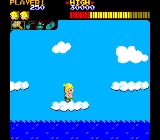
 in 1986 was inspired more by Pac-Land rather than Super Mario Bros and featured skateboarding segments that gave the game a greater sense of speed than other platformers at the time, while its sequel Wonder Boy in Monster Land
Wonder Boy in Monster Land
Wonder Boy in Monster Land is an action role-playing platform video game developed by Westone. It was released by Sega for the arcades in 1987 and for the Sega Master System in 1988; Activision released the game for the Amiga, Commodore 64, Amstrad CPC, ZX Spectrum, and Atari ST...

took the series in a new direction by combining action-adventure
Action-adventure game
An action-adventure game is a video game that combines elements of the adventure game genre with various action game elements. It is perhaps the broadest and most diverse genre in gaming, and can include many games which might better be categorized under narrow genres...

 and action role-playing
Action role-playing game
Action role-playing games form a loosely defined sub-genre of role-playing video games that incorporate elements of action or action-adventure games, emphasizing real-time action where the player has direct control over characters, instead of turn-based or menu-based combat...

 elements with traditional platforming. Wonder Boy in turn inspired platformers such as Adventure Island
Adventure Island (video game)
Hudson's Adventure Island, also known simply as Adventure Island and released in Japan as , is a side-scrolling platform game produced by Hudson Soft that was first released in Japan for the Family Computer and MSX on September 12, 1986...

, Dynastic Hero, Popful Mail
Popful Mail
is a side-scrolling platform game. Popful Mail was developed by Nihon Falcom for the NEC PC-8801 computer in 1991 and for the PC-9801 in 1992. It was later ported to PC Engine CD-ROM by NEC Home Electronics and to the Sega CD by "Sega Falcom", an alliance of the two game companies Sega and Falcom...

and Shantae
Shantae
Shantae is a platform video game developed by WayForward Technologies and published by Capcom for the Game Boy Color.-Plot:From the official website:...

.

Platformers went portable in the late 1980s with games such as Super Mario Land
Super Mario Land
is a platforming video game developed by Nintendo for the Game Boy handheld game console. It and the Game Boy debuted in Japan on April 21, 1989, in the United States on July 31, 1989, and in Europe on September 28, 1990...

and continued to maintain the genre's popularity, with many titles being released for the handheld Game Boy
Game Boy
The , is an 8-bit handheld video game device developed and manufactured by Nintendo. It was released in Japan on , in North America in , and in Europe on...

 and Game Gear
Sega Game Gear
The was Sega's first handheld game console. It was the third commercially available color handheld console, after the Atari Lynx and the TurboExpress....

. Because of the small size, technical constraints, and blurring associated with early LCD technology, fast paced action-based platformers were more difficult to execute on handheld systems. Because of this, many handheld platformers leaned toward slower paced play styles and a greater emphasis on puzzles. After the transition of home consoles to 3D, handhelds became a bastion for 2D platform games, and they still remain popular to this day with New Super Mario Bros being a recent example of a very successful traditional platform game, selling more than five million copies in Japan and North America during its first year of release.

On the NES
Nintendo Entertainment System
The Nintendo Entertainment System is an 8-bit video game console that was released by Nintendo in North America during 1985, in Europe during 1986 and Australia in 1987...

, as well as on most 8-bit arcade hardware, platform games generally only scrolled in one direction at a time (usually horizontally). This meant designers had to use a very narrow level progression, or break levels up into areas that scrolled in one direction at a time (as was the case in Metroid
Metroid
is an action-adventure video game, and the first entry in the Metroid series. It was co-developed by Nintendo's Research and Development 1 division and Intelligent Systems, and was released in Japan in August 1986, in North America in August 1987, and in Europe in January 1988...

and Mega Man
Mega Man (video game)
Mega Man, known as in Japan, is a video game developed and published by Capcom for the Nintendo Entertainment System . It is the first game in the original Mega Man series and the entire Mega Man franchise...

). The first platform game to scroll in all four directions freely and follow the on-screen character's movement was in a vector game called Major Havoc
Major Havoc
Major Havoc is an upright cabinet vector-based arcade game made by Atari in 1983.The game was initially released as a dedicated cabinet in 1983 and then one year later as a conversion kit for older vector arcade games like Tempest.Dedicated versions of the game used a roller control for left-right...

. Major Havoc was composed of a number of mini-games, including a simple platformer (the largest of the mini-games), along with a shoot 'em up
Shoot 'em up
Shoot 'em up is a subgenre of shooter video games. In a shoot 'em up, the player controls a lone character, often in a spacecraft or aircraft, shooting large numbers of enemies while dodging their attacks. The genre in turn encompasses various types or subgenres and critics differ on exactly what...

 sequence, a landing sequence, and even a Breakout clone
Breakout clone
A Breakout clone is a sub-class of the "bat-and-ball" genre introduced with the Magnavox Odyssey's Tennis and Atari's Pong...

. The first raster
Raster graphics
In computer graphics, a raster graphics image, or bitmap, is a data structure representing a generally rectangular grid of pixels, or points of color, viewable via a monitor, paper, or other display medium...

-based platform game to scroll fluidly in all directions in this manner is the 1984 classic, Legend of Kage
Legend of Kage
The Legend of Kage is a 1985 arcade game by Taito and was released for several contemporary home computer systems in 1986.-Story:...

, mentioned earlier.

In 1985, Enix
Enix
The was a Japanese company that produced video games, anime and manga. The company was founded by Yasuhiro Fukushima on September 22, 1975 as and renamed Enix in 1982...

 released an early open world
Open world
An open world is a type of video game level design where a player can roam freely through a virtual world and is given considerable freedom in choosing how to approach objectives...

 platform-adventure game, Brain Breaker.
The following year saw the release of a more successful open-world platform-adventure, Nintendo's Metroid
Metroid
is an action-adventure video game, and the first entry in the Metroid series. It was co-developed by Nintendo's Research and Development 1 division and Intelligent Systems, and was released in Japan in August 1986, in North America in August 1987, and in Europe in January 1988...

, which was critically acclaimed for having a balance between open-ended exploration and knowing where to go. Another platform-adventure was released that year as well, Pony Canyon
Pony Canyon
is a Japanese company, established on October 1, 1966 , which publishes music, DVD and VHS videos, movies and video games. It is a subsidiary of Japanese Media Group, Fujisankei Communications Group.-History:...

's Super Pitfall
Super Pitfall
is a 1986 Japanese video game for the Nintendo Famicom and PC-8801 by Pony Inc. It was released for the Famicom as platformer with seamless scrolling in September 1986. Two months later, the PC8801 version was released with switching screens...

, which was critically panned for its vagueness and weak game design. That same year, Jaleco
Jaleco
is a Japanese video game publisher and developer established in 2006.The original Jaleco Ltd was founded in 1974. In 2006, it decided to become a pure holding company by renaming itself Jaleco Holding and splitting its video game operations into a newly created subsdiary that took its former name...

 released Esper Boukentai, a platform-action sequel to Psychic 5 that scrolled in all directions and where the player character can make huge jumps several stories tall, which are needed in order to navigate the giant vertically-oriented levels. Telenet Japan
Telenet Japan
was a Japanese video game and software developer founded in October 1983 by Kazuyuki Fukushima. The company was also known as Nippon Telenet . The company was best known for the Valis series as well as its Wolfteam & RiOT divisions...

 also released its own take on the platform-action game, Valis, with its anime
Anime
is the Japanese abbreviated pronunciation of "animation". The definition sometimes changes depending on the context. In English-speaking countries, the term most commonly refers to Japanese animated cartoons....

-style story cut scenes.

In 1987, Capcom
Capcom
is a Japanese developer and publisher of video games, known for creating multi-million-selling franchises such as Devil May Cry, Chaos Legion, Street Fighter, Mega Man and Resident Evil. Capcom developed and published Bionic Commando, Lost Planet and Dark Void too, but they are less known. Its...

's Mega Man
Mega Man (video game)
Mega Man, known as in Japan, is a video game developed and published by Capcom for the Nintendo Entertainment System . It is the first game in the original Mega Man series and the entire Mega Man franchise...

introduced a non-linear "level select" option. This was a stark contrast to both linear games (like Super Mario Bros.) and open-world games (like Metroid). GamesRadar
GamesRadar
GamesRadar is a multi-format video game website featuring regular news, previews, reviews, videos, and guides. It is owned and operated simultaneously in the UK and US by worldwide publisher Future Publishing...

 credits the "level select" feature of Mega Man as the basis for the non-linear mission structure found in most open-world, multi-mission, sidequest-heavy games. Another Capcom platformer that year was Bionic Commando
Bionic Commando (arcade game)
Bionic Commando, released in Japan as , is a action platform game released by Capcom for the arcades. It was later released for several home computers...

, a multi-scrolling platform-action game known for introducing the grappling hook
Grappling hook
A grappling hook is an anchor with multiple hooks , attached to a rope; it is thrown, dropped, sunk, projected, or fastened directly by hand to where at least one hook may catch and hold. Generally, grappling hooks are used to temporarily secure one end of a rope. They may also be used to dredge...

 mechanic that has since appeared in dozens of later platform games, including Earthworm Jim
Earthworm Jim
Earthworm Jim is a run and gun platform video game starring an earthworm named Jim in a robotic suit who battles evil. Created by Doug TenNapel and designed by David Perry, the game was developed by Shiny Entertainment and Playmates Interactive Entertainment, released by Sega for the Mega...

and Tomb Raider
Tomb Raider
Tomb Raider is an action-adventure video game developed by Core Design and published by Eidos Interactive. It was originally released in 1996 for the Sega Saturn, with MS-DOS and PlayStation versions following shortly thereafter...

. Though multi-directional scrolling did not seem like a big deal at the time, it would become a distinguishing feature of the next generation of platformers.

Second-generation side-scrollers


The advent of 16-bit home consoles marked an evolutionary step for the genre. By the time the Sega Genesis and Super Nintendo launched, platform games were the most popular genre in home console gaming and were seen as vital for winning the console war. There was a particular emphasis on having a flagship platform title exclusive to a format, featuring a "mascot" character. In 1989, Sega released Alex Kidd in the Enchanted Castle
Alex Kidd in the Enchanted Castle
is a side-scrolling platform game developed and published by Sega for the Sega Genesis video game console. The game was released in Japan in February 1989, North and South America in August 1989 and in Europe on November 1990...

. The title was only modestly successful, and Sega realized it needed a stronger mascot to move Genesis units. That same year, Capcom released the platformer Strider
Strider (arcade game)
Strider, released in Japan as is a 1989 side-scrolling platform game released for the CP System arcade hardware by Capcom. It became one of Capcom's early hits before Street Fighter II, revered for its innovative gameplay and multilingual voice clips during cutscenes .-Plot: Strider is set in a...

, which scrolled in multiple directions and allowed the player to summon AI
Artificial intelligence
Artificial intelligence is the intelligence of machines and the branch of computer science that aims to create it. AI textbooks define the field as "the study and design of intelligent agents" where an intelligent agent is a system that perceives its environment and takes actions that maximize its...

 partners, such as a droid, tiger, and hawk, to help fight enemies. Sega's Shadow Dancer, released in the same year, also featured an AI partner, a dog who follows the player around and helps fight enemies. In 1990, Hudson Soft
Hudson Soft
, formally known as , is a majority-owned subsidiary of Konami Corporation is a Japanese electronic entertainment publisher headquartered in the Midtown Tower in Tokyo Midtown, Akasaka, Minato, Tokyo, Japan, with an additional office in the Hudson Building in Sapporo. It was founded on May 18, 1973...

 released Bonk's Adventure
Bonk's Adventure
Bonk's Adventure is a 2D platform video game developed by Red Company and Atlus and released in 1990 for the TurboGrafx-16. In Japan it was released as PC Genjin in 1989, a play on the Japanese name for the system, 'PC Engine'. The game was re-released for the TurboGrafx-16 in the U.S. in 1992 on...

featuring a character that would be positioned as NEC
NEC
, a Japanese multinational IT company, has its headquarters in Minato, Tokyo, Japan. NEC, part of the Sumitomo Group, provides information technology and network solutions to business enterprises, communications services providers and government....

's mascot. The following year, Takeru's Cocoron, a late platformer for the Famicom, introduced true character customization, allowing players to build a character from a toy box filled with spare parts.

1990 marked the release of the Super NES, along with the much awaited Super Mario World
Super Mario World
, subtitled Super Mario Bros. 4 for its original Japanese release, is a platform video game developed and published by Nintendo as a pack-in launch title for the Super Famicom/Super Nintendo Entertainment System , and is the fourth game in the Super Mario series...

. In order to fend off the new competition, Sega released Sonic the Hedgehog
Sonic the Hedgehog (16-bit)
is a seminal 16-bit 1991 platform video game developed in Japan by Sega and published for the Sega Genesis. It is the first installment in Sega's flagship Sonic the Hedgehog video game series and the first title developed by Sonic Team. The game was released in 1991 in North America, Europe, and...

. Whereas Nintendo's offering featured a conservative design, true to the Mario tradition, Sonic showcased a new style of design made possible by a new generation of hardware. Sonic featured large fields that scrolled effortlessly in all directions, as well as all manner of uneven terrain, curved hills, and a complex physics system
Game physics
Computer animation physics or game physics involves the introduction of the laws of physics into a simulation or game engine, particularly in 3D computer graphics, for the purpose of making the effects appear more real to the observer...

 that allowed players to rush through its levels with well-placed jumps and rolls. It proved to be a massive hit, was a successful pack-in with new systems, and cemented the view that platform games would make or break a console.

The Sonic character
Sonic the Hedgehog (character)
, trademarked Sonic The Hedgehog, is a video game character and the main protagonist of the Sonic video game series released by Sega, as well as in numerous spin-off comics, cartoons, and a feature film. The first game was released on June 23, 1991, to provide Sega with a mascot to rival Nintendo's...

 was also seen as a new model for mascots in the early 1990s, particularly for his perceived "attitude," which characterized him as a rebel from the status quo. This "attitude" would soon become the status quo, as companies attempted to duplicate Sonic's success with their own brightly-colored anthropomorphism
Anthropomorphism
Anthropomorphism is any attribution of human characteristics to animals, non-living things, phenomena, material states, objects or abstract concepts, such as organizations, governments, spirits or deities. The term was coined in the mid 1700s...

s. Very frequently these were characterized by impatience, sarcasm, and frequent quipping to give them personality. These mascots, which included the likes of Gex, Bug!
Bug!
Bug! was a 3D rendered platform/adventure video game developed by Realtime Associates for the Sega Saturn. Released in 1995 in North America, Japan and Europe, it was one of the earliest 3D platform games...

, Aero the Acro-Bat
Aero the Acro-Bat
Aero the Acro-Bat is a Super Nintendo and Mega Drive/Genesis game created by David Siller , developed by the now defunct Iguana Entertainment, and published by Sunsoft on October 1993.-Plot:...

, Awesome Possum, and Bubsy
Bubsy
Bubsy is a series of video games created by Michael Berlyn and released by Accolade for the SNES, Mega Drive/Genesis, Atari Jaguar, the PC and PlayStation in the early and mid-1990s....

, have mostly faded from relevance.

Although there had long been important platform games on home computers, a second generation of platform games for computers appeared alongside the new wave of consoles. In the late 1980s and early 1990s, the Amiga
Amiga
The Amiga is a family of personal computers that was sold by Commodore in the 1980s and 1990s. The first model was launched in 1985 as a high-end home computer and became popular for its graphical, audio and multi-tasking abilities...

 was known as a stronger gaming platform than IBM-compatible PCs, thanks to its more powerful stock video hardware and sound hardware
Original Amiga chipset
The Original Chip Set was a chipset used in the earliest Commodore Amiga computers and defined the Amiga's graphics and sound capabilities...

, and the Atari ST
Atari ST
The Atari ST is a home/personal computer that was released by Atari Corporation in 1985 and commercially available from that summer into the early 1990s. The "ST" officially stands for "Sixteen/Thirty-two", which referred to the Motorola 68000's 16-bit external bus and 32-bit internals...

 was solidly supported as well. Games like Shadow of the Beast
Shadow of the Beast
Shadow of the Beast is a side-scrolling platform computer game produced by Reflections Interactive and published by Psygnosis in 1989. The original version was released for the Commodore Amiga, but the game has been ported to many other systems...

and Turrican
Turrican
Turrican is a 1989 video game programmed and designed by Manfred Trenz. It was first developed for the Commodore 64 by Rainbow Arts, but was ported to other systems later. In addition to concept design and character creation, Trenz personally programmed Turrican on the Commodore 64...

showed that computer platform games could rival the graphics and sound of their console contemporaries, and Prince of Persia
Prince of Persia
Prince of Persia is a platform game, originally developed by Jordan Mechner and released in 1989 for the Apple II, that represented a great leap forward in the quality of animation seen in video games....

featured an unprecedented level of animation.

In 1990, DOS PC gaming made a breakthrough in the genre. Commander Keen
Commander Keen
Commander Keen is a series of video games developed by id Software in the early 1990s. The series focuses on the adventures of Billy Blaze, an 8-year old boy who travels through space and assumes the identity "Commander Keen". The series was successful at replicating the side-scrolling action of...

, released by id Software
Id Software
Id Software is an American video game development company with its headquarters in Richardson, Texas. The company was founded in 1991 by four members of the computer company Softdisk: programmers John Carmack and John Romero, game designer Tom Hall, and artist Adrian Carmack...

, became the first IBM-compatible PC platformer to feature smooth scrolling graphics thanks to a technique programmer John Carmack had pioneered for EGA
Enhanced Graphics Adapter
The Enhanced Graphics Adapter is the IBM PC computer display standard specification which is between CGA and VGA in terms of color and space resolution. Introduced in October 1984 by IBM shortly after its new PC/AT, EGA produces a display of 16 simultaneous colors from a palette of 64 at a...

 graphics displays. The success of this game via the shareware
Shareware
The term shareware is a proprietary software that is provided to users without payment on a trial basis and is often limited by any combination of functionality, availability, or convenience. Shareware is often offered as a download from an Internet website or as a compact disc included with a...

 distribution model prompted many others to attempt more console-styled scrolling platformers on the PC, including Duke Nukem, Jill of the Jungle
Jill of the Jungle
Jill of the Jungle is a trilogy of platform computer games released in 1992 by Epic MegaGames. It was intended to rival computer games from other shareware companies such as id Software and Apogee Software, Ltd....

, and Cosmo's Cosmic Adventure
Cosmo's Cosmic Adventure
Cosmo's Cosmic Adventure is a video game programmed by Todd Replogle and published by Apogee Software in 1992. It is a two-dimensional side-scrolling platform game produced for the PC platform, and features 16-color EGA graphics at 320×200 screen resolution...

. None of these scrolled as smoothly as Commander Keen, but many were well-received. These games helped fuel the shareware
Shareware
The term shareware is a proprietary software that is provided to users without payment on a trial basis and is often limited by any combination of functionality, availability, or convenience. Shareware is often offered as a download from an Internet website or as a compact disc included with a...

 model, which would drive PC gaming to greater relevance in the early-to-mid 1990s.

Other notable platform games from this time period include Earthworm Jim
Earthworm Jim
Earthworm Jim is a run and gun platform video game starring an earthworm named Jim in a robotic suit who battles evil. Created by Doug TenNapel and designed by David Perry, the game was developed by Shiny Entertainment and Playmates Interactive Entertainment, released by Sega for the Mega...

, Zool
Zool
Zool is a video game originally produced for the Amiga by Gremlin Graphics in 1992.Zool was intended as a rival to Sega's Sonic the Hedgehog. It was heavily hyped upon its initial release, including being bundled with the newly launched Amiga 1200, although not the AGA version with enhanced...

, Ristar
Ristar
Ristar, known as in Japan, is a platform game developed by Sonic Team and published by Sega for the Sega Mega Drive/Sega Genesis in 1995. A Sega Game Gear version, which features different levels than the Mega Drive version, was also released in the same year.The game stars a humanoid cartoon star...

, Bubsy
Bubsy
Bubsy is a series of video games created by Michael Berlyn and released by Accolade for the SNES, Mega Drive/Genesis, Atari Jaguar, the PC and PlayStation in the early and mid-1990s....

, and Rocket Knight Adventures
Rocket Knight Adventures
is a 16-bit generation side scrolling platformer produced and released in 1993 by Konami for the Mega Drive/Genesis console, designed by Nobuya Nakazato, designer of several titles in the Contra series such as The Alien Wars, Hard Corps and Shattered Soldier...

. Frequently, console games based on film
Film
A film, also called a movie or motion picture, is a series of still or moving images. It is produced by recording photographic images with cameras, or by creating images using animation techniques or visual effects...

, television
Television program
A television program , also called television show, is a segment of content which is intended to be broadcast on television. It may be a one-time production or part of a periodically recurring series...

, and comic book
Comic book
A comic book or comicbook is a magazine made up of comics, narrative artwork in the form of separate panels that represent individual scenes, often accompanied by dialog as well as including...

 licenses would be platformers, such as those based on Aladdin, Jurassic Park
Jurassic Park (video game)
After the announcement of the 1993 Jurassic Park feature film, based on the critically acclaimed novel by Michael Crichton, developers Ocean Software, BlueSky Software and Sega of America were licensed to produce games to be sold to coincide with the release of the film on the popular platforms of...

, James Bond
James Bond: The Duel
James Bond: The Duel is a James Bond video game released for the Sega Master System, the Sega Game Gear and the Sega Mega Drive/Genesis. It is loosely based on the spy films featuring Ian Fleming's secret agent, 007....

, and Mickey Mouse
Castle of Illusion Starring Mickey Mouse
Castle of Illusion Starring Mickey Mouse is a video game first released in 1990 for the Mega Drive/Genesis which was developed by Sega of Japan...

.

Decline of 2D


At the end of the 16-bit era, some very successful platform games were released, including Super Mario World 2: Yoshi's Island
Super Mario World 2: Yoshi's Island
Super Mario World 2: Yoshi's Island, originally released as in Japan, is a platform video game developed and published by Nintendo for the SNES console. Despite its title, this game serves as a prequel to all other games within the established Mario Bros timeline...

, Super Metroid
Super Metroid
, also known as Metroid 3, is an action-adventure video game and the third game in the Metroid series. It was designed by Nintendo Research & Development 1, programmed by Intelligent Systems, and published by Nintendo for the Super Nintendo Entertainment System video game console...

and Donkey Kong Country
Donkey Kong Country
Donkey Kong Country is a side-scrolling platformer video game developed by Rare, featuring the character Donkey Kong. It was released for the Super Nintendo Entertainment System in 1994. Following an intense marketing campaign, the original SNES version sold over 8 million copies worldwide, making...

titles, but the release of new hardware caused players' attention to gradually shift away from traditional 2D genres. The Saturn
Sega Saturn
The is a 32-bit fifth-generation video game console that was first released by Sega on November 22, 1994 in Japan, May 11, 1995 in North America, and July 8, 1995 in Europe...

, PlayStation
PlayStation
The is a 32-bit fifth-generation video game console first released by Sony Computer Entertainment in Japan on December 3, .The PlayStation was the first of the PlayStation series of consoles and handheld game devices. The PlayStation 2 was the console's successor in 2000...

, and Nintendo 64
Nintendo 64
The , often referred to as N64, was Nintendo′s third home video game console for the international market. Named for its 64-bit CPU, it was released in June 1996 in Japan, September 1996 in North America, March 1997 in Europe and Australia, September 1997 in France and December 1997 in Brazil...

 nevertheless featured a number of successful 2D platform games. Mega Man 8
Mega Man 8
Mega Man 8, known as in Japan, is a video game released by Capcom. It is the eighth installment in original Mega Man series, and was originally released in Japan on the PlayStation on December 17, 1996. The following year, Mega Man 8 saw a release on the Sega Saturn and was localized for both...

and Mega Man X4
Mega Man X4
Mega Man X4, known as , is a video game developed by Capcom. It is the fourth game in the Mega Man X series and the second game in the series to be released on the Sega Saturn and PlayStation. The two versions were released simultaneously in Japan on August 1, 1997...

helped revitalize interest in Capcom
Capcom
is a Japanese developer and publisher of video games, known for creating multi-million-selling franchises such as Devil May Cry, Chaos Legion, Street Fighter, Mega Man and Resident Evil. Capcom developed and published Bionic Commando, Lost Planet and Dark Void too, but they are less known. Its...

's blue bomber. Castlevania: Symphony of the Night
Castlevania: Symphony of the Night
Castlevania: Symphony of the Night, known in Japan as , is an action-adventure game developed and published by Konami in 1997. It is the 14th installment of the Castlevania series, the first installment released for the PlayStation, and a direct sequel to Castlevania: Rondo of Blood.Symphony of the...

revitalized its series and established a new foundation for later Castlevania games. Oddworld
Oddworld
Oddworld is a comprehensive fictional universe presented in video game form, created by game developers Oddworld Inhabitants under the direction of Lorne Lanning. Throughout games set in the Oddworld universe, Oddworld's peaceful nature is in danger of being consumed by the industrial ambition of...

and Heart of Darkness
Heart of Darkness (game)
Heart of Darkness is a 1998 video game by Amazing Studio and released by Interplay for Microsoft Windows-based PCs and the PlayStation. A Game Boy Advance port was announced in 2001 but never released. It is the first game to have its score recorded by an orchestra though because of delays, it was...

kept the sub-genre born from Prince of Persia alive. Unusually, the Nintendo 64 had the fewest 2D platformers — only Yoshi's Story
Yoshi's Story
is a side-scrolling platform game, published and developed by Nintendo for the Nintendo 64 entertainment system. It is the sequel to the Super Nintendo game Super Mario World 2: Yoshi's Island. It was released on December 21, 1997 in Japan, March 1, 1998 in North America and April 9, 1998 in Europe...

and Mischief Makers
Mischief Makers
Mischief Makers, known in Japan as , is a side-scrolling 2D platform/puzzle video game developed by Treasure, and published by Enix in Japan and by Nintendo in America and Europe for the Nintendo 64. It was released in 1997 as one of the first 2D side-scrollers on the Nintendo 64...

— and both met with a tepid response from critics at the time. Despite this, Yoshi's Story sold over a million copies in the US and Mischief Makers rode high on the charts in the months following its release.

The difficulties of adapting platform gameplay to 3D led some developers to compromise by pairing the visual flash of 3D with traditional 2D gameplay. These games are often referred to as "2.5D
2.5D
2.5D , 3/4 perspective and pseudo-3D are terms used to describe either:* 2D graphical projections and techniques which cause a series of images or scenes to fake or appear to be three-dimensional when in fact they are not, or* gameplay in an otherwise three-dimensional video game that is...

". The first such game was a Sega Saturn
Sega Saturn
The is a 32-bit fifth-generation video game console that was first released by Sega on November 22, 1994 in Japan, May 11, 1995 in North America, and July 8, 1995 in Europe...

 launch title
Launch title
A launch game, or launch title, is a video game released to consumers synchronously with the release of its respective video game console, meaning they are the only available games at the time of the console's launch. Several of these games are also packaged with the console...

, Clockwork Knight
Clockwork Knight
Clockwork Knight is a side-scrolling platformer video game, released for the Sega Saturn in Japan on December 9, 1994, as a launch title in the U.S. on May 11, 1995, and in Europe on July 8, 1995. It was followed by a sequel, Clockwork Knight 2....

released in December, 1994 in Japan (and subsequently as a launch game in the U.S.). The game featured levels and boss
Boss (video games)
A boss is an enemy-based challenge which is found in video games. A fight with a boss character is commonly referred to as a boss battle or boss fight...

 characters rendered in 3D, but retained 2D gameplay and the used pre-rendered 2D sprites for regular characters, similar to Donkey Kong Country. Its sequel
Clockwork Knight 2
Clockwork Knight 2 is a side-scrolling platformer video game released for the Sega Saturn in 1995. It is the sequel to Clockwork Knight, a launch title for the Saturn that also was released that year. A second sequel, Clockwork Knight 3: Pengin War, used gameplay similar to Bomberman, but never...

 improved upon its design, featuring some 3D effects such as hopping between the foreground and background, and the camera panning and curving around a corner.

The formula has been repeated many times. Pandemonium
Pandemonium (video game)
Pandemonium! is a platform game, for the PlayStation, Sega Saturn, Microsoft Windows, N-Gage, and iPhone OS. It features Fargus, a joker, and Nikki, who unwittingly casts a spell that destroys the town. The goal of the game is to reach the Wishing Engine, where they can wish the town back to...

and Klonoa
Klonoa
is a video game series created by Namco and Klonoa Works, as well as the name of the titular character of the series.-Setting and gameplay:The games are set in different worlds, though the primary and known ones are Phantomile and Lunatea. It revolves around Klonoa and how he, the Dream Traveler,...

brought the 2.5D style to the PlayStation
PlayStation
The is a 32-bit fifth-generation video game console first released by Sony Computer Entertainment in Japan on December 3, .The PlayStation was the first of the PlayStation series of consoles and handheld game devices. The PlayStation 2 was the console's successor in 2000...

. More recently, Klonoa 2: Lunatea's Veil
Klonoa 2: Lunatea's Veil
Klonoa 2: Lunatea's Veil, known in Japan as . is a PlayStation 2 platform video game by Namco released in 2001. It is the sequel to 1997's Klonoa: Door to Phantomile. It was planned for Klonoa 2: Lunatea's Veil to be ported to the Nintendo GameCube...

and Viewtiful Joe
Viewtiful Joe
is a video game developed by Capcom's Production Studio 4 for the Nintendo GameCube. It was originally released in 2003 as a part of the Capcom Five under director Hideki Kamiya and producer Atsushi Inaba. Viewtiful Joe was later ported to the Sony PlayStation 2 by the same design team under the...

have continued this tradition.

Third dimension


The term 3D platformer usually refers to games that feature gameplay in three dimensions and polygonal 3D graphics. Games which have 3D gameplay but 2D graphics are usually included under the umbrella of isometric platformers, while those that have 3D graphics but gameplay on a 2D plane are called 2.5D
2.5D
2.5D , 3/4 perspective and pseudo-3D are terms used to describe either:* 2D graphical projections and techniques which cause a series of images or scenes to fake or appear to be three-dimensional when in fact they are not, or* gameplay in an otherwise three-dimensional video game that is...

, as they are "somewhere between 2D and 3D".

The first attempts to bring platform games into 3D used 2D graphics and an isometric perspective. These games are nearly as old as the genre itself, one of the earliest examples being Sega's Congo Bongo
Congo Bongo
Congo Bongo is an isometric platform arcade game released by Sega in 1983. Strong evidence from analysis of the game's ROM claim that Ikegami Tsushinki also did development work on Congo Bongo. The game has come to be seen as Sega's answer to the highly successful Donkey Kong game that was...

in 1983. The first platformers to simulate a 3D perspective and moving camera emerged in the early-mid 1980s. An early example of this was Konami
Konami
is a Japanese leading developer and publisher of numerous popular and strong-selling toys, trading cards, anime, tokusatsu, slot machines, arcade cabinets and video games...

's platform game Antarctic Adventure
Antarctic Adventure
Antarctic Adventure, known in Japan as Kekkyoku Nankyoku Daibōken is a video game developed by Konami in 1983 for MSX, and later for video game consoles, such as NES...

, where the player controls a penguin in a forward-scrolling third-person perspective while having to jump over pits and obstacles. Originally released in 1983 for the MSX
MSX
MSX was the name of a standardized home computer architecture in the 1980s conceived by Kazuhiko Nishi, then Vice-president at Microsoft Japan and Director at ASCII Corporation...

 computer, it was ported to various platforms the following year, including the Arcade
Arcade game
An arcade game is a coin-operated entertainment machine, usually installed in public businesses such as restaurants, bars, and amusement arcades. Most arcade games are video games, pinball machines, electro-mechanical games, redemption games, and merchandisers...

, NES
Nintendo Entertainment System
The Nintendo Entertainment System is an 8-bit video game console that was released by Nintendo in North America during 1985, in Europe during 1986 and Australia in 1987...

, and ColecoVision
ColecoVision
The ColecoVision is Coleco Industries' second generation home video game console which was released in August 1982. The ColecoVision offered arcade-quality graphics and gaming style, and the means to expand the system's basic hardware...

. That same year, I, Robot
I, Robot (arcade game)
I, Robot is an arcade game designed by Dave Theurer, and published by Atari Inc. in 1983. The arcade machine comes with two games. The first is I, Robot, a multi-directional shooter that has the player assume the role of "Unhappy Interface Robot #1984", a servant bot that rebels against Big Brother...

, though not a platformer, featured filled 3D
3D computer graphics
3D computer graphics are graphics that use a three-dimensional representation of geometric data that is stored in the computer for the purposes of performing calculations and rendering 2D images...

 polygonal graphics, flat shading
Shading
Shading refers to depicting depth perception in 3D models or illustrations by varying levels of darkness.-Drawing:Shading is a process used in drawing for depicting levels of darkness on paper by applying media more densely or with a darker shade for darker areas, and less densely or with a lighter...

, and camera control options, which would not be widely adopted by platformers until the 1990s.

1986 saw the release of the sequel to forward-scrolling platformer Antarctic Adventure, called Penguin Adventure
Penguin Adventure
is an action-adventure platform video game released by Konami in 1986. It is a sequel to Antarctic Adventure and has the distinction of being the first game that game designer Hideo Kojima worked on; he was an assistant designer. It has been acclaimed as one of the best MSX action games for its...

, designed by Hideo Kojima
Hideo Kojima
is a Japanese game director originally employed at Konami. He is currently the director of Kojima Productions and was promoted to Vice President of Konami Digital Entertainment in early 2011...

. It included more action game
Action game
Action game is a video game genre that emphasizes physical challenges, including hand–eye coordination and reaction-time. The genre includes diverse subgenres such as fighting games, shooter games, and platform games, which are widely considered the most important action games, though some...

 elements, a greater variety of levels, RPG
Role-playing video game
Role-playing video games are a video game genre with origins in pen-and-paper role-playing games such as Dungeons & Dragons, using much of the same terminology, settings and game mechanics. The player in RPGs controls one character, or several adventuring party members, fulfilling one or many quests...

 elements such as upgrading equipment, and multiple endings
Multiple endings
Multiple endings refer to a case in entertainment where the story could end in different ways, described as an alternate ending.-Literature:...

. Trailblazer
Trailblazer (game)
Trailblazer is a video game that requires the player to direct a ball along a series of suspended passages. Released originally by Gremlin Graphics for the ZX Spectrum, Commodore 64, Atari 8-bit and Amstrad CPC in 1986 it was subsequently ported in its original form to the Amiga and Atari ST.It...

, released to various computer systems in 1986, used a simple linescroll effect to create a forward scrolling pseudo-3D play field where players manipulated a bouncing ball to leap over obstacles and pitfalls.

In early 1987, Square
Square (company)
was a Japanese video game company founded in September 1983 by Masafumi Miyamoto. It merged with Enix in 2003 and became part of Square Enix...

 released 3-D WorldRunner
3-D WorldRunner
is a third-person rail shooter platform video game developed by Square in . In Japan, the game was released on the Famicom Disk System as Tobidase Daisakusen, and was published by DOG, a now-defunct label of Square...

, designed by Hironobu Sakaguchi
Hironobu Sakaguchi
is a Japanese game designer, game director and game producer. He is world famous as the creator of the Final Fantasy series, and has had a long career in gaming with over 100 million units of video games sold worldwide...

 and Nasir Gebelli
Nasir Gebelli
Nasir Gebelli is an Iranian-American programmer and video game developer. Gebelli co-founded Sirius Software, created his own company Gebelli Software, and worked for Square .-Sirius Software:...

. Using a similar forward-scrolling effect to Sega
Sega
, usually styled as SEGA, is a multinational video game software developer and an arcade software and hardware development company headquartered in Ōta, Tokyo, Japan, with various offices around the world...

's 1985 third-person
Third-person shooter
Third-person shooter is a genre of 3D action games in which the player character is visible on-screen, and the gameplay consists primarily of shooting.-Definition:...

 rail shooter Space Harrier
Space Harrier
is a third-person rail shooter game, released by Sega in 1985. It was produced by Yu Suzuki, responsible for many popular Sega games. It spawned several sequels: Space Harrier 3-D , Space Harrier II , and the spin-off Planet Harriers ....

, 3-D WorldRunner was an early forward-scrolling pseudo-3D third-person platform-action game where players were free to move in any forward-scrolling direction and had to leap over obstacles and chasms. It was also notable for being one of the first stereoscopic 3-D games. Square released its sequel, JJ
JJ (video game)
is a video game developed and published by Square for the Nintendo Family Computer in 1987. In English, it is sometimes referred to by its long form, Jumpin' Jack, or by its subtitle, Tobidase Daisakusen Part II...

, later that year. In 1990, an Estonian developer called Bluemoon released Kosmonaut, a forward-scrolling driving/action game similar to Trailblazer, which consisted almost entirely of difficult platform-jumping obstacle courses. While the gameplay took place in three dimensions, and the graphics were polygonal
Polygonal modeling
In 3D computer graphics, polygonal modeling is an approach for modeling objects by representing or approximating their surfaces using polygons. Polygonal modeling is well suited to scanline rendering and is therefore the method of choice for real-time computer graphics...

 it is considered pseudo-3D because it used a fixed viewpoint. The game was later remade in 1993 as SkyRoads, which experienced much wider popularity.

The earliest example to be found of a true 3D platformer is a French computer game called Alpha Waves
Alpha Waves
Alpha Waves is an early 3D game that combines labyrinthine exploration with platform gameplay. By most definitions of the genre it could be considered to be the first 3D platform game, released in 1990, 6 years before the genre's seminal classic Super Mario 64...

, created by Christophe de Dinechin and published by Infogrames
Infogrames
Infogrames Entertainment SA was an international French holding company headquartered in Paris, France. It was the owner of Atari, Inc., headquartered in New York City, U.S. and Atari Europe. It was founded in 1983 by Bruno Bonnell and Christophe Sapet using the proceeds from an introductory...

 in 1990 for the Atari ST
Atari ST
The Atari ST is a home/personal computer that was released by Atari Corporation in 1985 and commercially available from that summer into the early 1990s. The "ST" officially stands for "Sixteen/Thirty-two", which referred to the Motorola 68000's 16-bit external bus and 32-bit internals...

, Amiga
Amiga
The Amiga is a family of personal computers that was sold by Commodore in the 1980s and 1990s. The first model was launched in 1985 as a high-end home computer and became popular for its graphical, audio and multi-tasking abilities...

 and PC
Personal computer
A personal computer is any general-purpose computer whose size, capabilities, and original sales price make it useful for individuals, and which is intended to be operated directly by an end-user with no intervening computer operator...

. It featured full-screen 3D graphics, true 3D movement, and a movable camera, all firsts for the genre. The environments were abstract, with simple gameplay focused on hopping from trampoline-like platforms. The game was released in North America by Data East
Data East
also abbreviated as DECO, was a Japanese video game developer and publisher. The company was in operation from 1976 to 2003, when it declared bankruptcy...

, under the name Continuum. Much like Jump Bug before it, while it is believed to be the first of its kind, it is not widely recognized as especially influential (though it is sometimes regarded as a precursor to Jumping Flash!
Jumping Flash!
is a video game released in 1995 for the Sony PlayStation. It was developed by Exact Co., Ltd. and Ultra Co., Ltd. and published by Sony Computer Entertainment...

). While its appearance was quite dissimilar from the popular 2D platformer of the day, it was billed as a platform game on its packaging, suggesting that it was seen as an attempt to bring the genre into 3D.

In 1994, a small developer called Exact released a game for the X68000 computer called Geograph Seal. The game was a fully 3D polygonal first person shooter hybrid with a pronounced platform jumping component. Players piloted a frog-like mech that could jump and then double jump or triple jump high into the air, as the camera panned down to help players line up their landing. In addition to shooting, jumping on enemies was a primary means of attack. This was the first true 3D platform-action game with free-roaming
Open world
An open world is a type of video game level design where a player can roam freely through a virtual world and is given considerable freedom in choosing how to approach objectives...

 environments, but it was never ported to another platform nor released outside of Japan, so it remains obscure in the West.

The following year, Exact released their follow-up to Geograph Seal as an early title for Sony's new PlayStation
PlayStation
The is a 32-bit fifth-generation video game console first released by Sony Computer Entertainment in Japan on December 3, .The PlayStation was the first of the PlayStation series of consoles and handheld game devices. The PlayStation 2 was the console's successor in 2000...

 console. Jumping Flash!
Jumping Flash!
is a video game released in 1995 for the Sony PlayStation. It was developed by Exact Co., Ltd. and Ultra Co., Ltd. and published by Sony Computer Entertainment...

, released in April 1995, is generally regarded as a direct continuation of the gameplay concepts in Geograph Seal, and was likewise a mix of first-person shooting and platforming, with similar controls and camera-work
Virtual camera system
A virtual camera system aims at controlling a camera or a set of cameras to display a view of a 3D virtual world. Camera systems are used in videogames where their purpose is to show the action at the best possible angle; more generally, they are used in 3D virtual worlds when a third person view...

. The frog-like mech was traded in for a more cartoony rabbit mech, called the "Robbit." Beyond this, the level design had an even greater focus on platform hopping, and it was released in Europe and North America as a launch title
Launch title
A launch game, or launch title, is a video game released to consumers synchronously with the release of its respective video game console, meaning they are the only available games at the time of the console's launch. Several of these games are also packaged with the console...

, helping it gain a much higher profile. The title was successful enough to receive two sequels, and is remembered as the first 3D platformer on a console.

Bug!
Bug!
Bug! was a 3D rendered platform/adventure video game developed by Realtime Associates for the Sega Saturn. Released in 1995 in North America, Japan and Europe, it was one of the earliest 3D platform games...

, a Sega Saturn
Sega Saturn
The is a 32-bit fifth-generation video game console that was first released by Sega on November 22, 1994 in Japan, May 11, 1995 in North America, and July 8, 1995 in Europe...

 game that was released in 1995, offered a more conservative approach to true 3D platforming. It allowed players to move in all directions, but it did not allow movement along more than one axis at once — the player could move left to right, or forward and backward, but not diagonally left and backward at the same time. Its characters were pre-rendered
Pre-rendered
Pre-rendering is the process in which video footage is not rendered in real-time by the hardware that is outputing or playing back the video. Instead, the video is a recording of a footage that was previously rendered on a different equipment...

 sprites, much like the earlier Clockwork Knight
Clockwork Knight
Clockwork Knight is a side-scrolling platformer video game, released for the Sega Saturn in Japan on December 9, 1994, as a launch title in the U.S. on May 11, 1995, and in Europe on July 8, 1995. It was followed by a sequel, Clockwork Knight 2....

. The game played very similarly to 2D platformers, but it was considered a true 3D title, and even let players walk up walls and on ceilings. It was a moderate success and had a sequel, Bug Too!.

In 1995, Delphine Software released a 3D sequel to their popular 2D platformer Flashback
Flashback: The Quest for Identity
Flashback, released as Flashback: The Quest for Identity in the US, is a cinematic platformer developed by Delphine Software of France, a now defunct company, and published by U.S...

. Entitled Fade to Black
Fade to Black (video game)
Fade to Black is an action-adventure game released in 1995 by Delphine Software International. Directed and designed by Paul Cuisset, it is the sequel to his previous game, Flashback .The game was released for DOS and PlayStation; planned Nintendo 64 and Sega Saturn versions...

, it was the first attempt to bring a popular 2D platform game series into 3D. While it retained the puzzle-oriented level design style and step-based control and bore a strong resemblance to its predecessor, it does not meet the criteria of a platform game, and was billed as an action adventure
Action-adventure game
An action-adventure game is a video game that combines elements of the adventure game genre with various action game elements. It is perhaps the broadest and most diverse genre in gaming, and can include many games which might better be categorized under narrow genres...

. It used true 3D characters and set pieces, but its environments were rendered using a rigid engine similar to the one used by Wolfenstein 3D
Wolfenstein 3D
Wolfenstein 3D is a video game that is generally regarded by critics and gaming journalists as having both popularized the first-person shooter genre on the PC and created the basic archetype upon which all subsequent games of the same genre would be built. It was created by id Software and...

in that it could only render square, flat corridors. This eliminated any hopping from suspended platforms. Fade to Black would set the stage for other series, such as Metroid
Metroid Prime
Metroid Prime is a video game developed by Retro Studios and Nintendo for the Nintendo GameCube, released in North America on November 17, 2002...

and Duke Nukem
Duke Nukem 3D
Duke Nukem 3D is a first-person shooter computer game developed by 3D Realms and published by GT Interactive Software. The full version was released for the PC . It is a sequel to the platform games Duke Nukem and Duke Nukem II published by Apogee...

, that would gradually shift away from the traditional platform formula while retaining many of its gameplay conventions.

There was a great deal of pressure on Sony
Sony
, commonly referred to as Sony, is a Japanese multinational conglomerate corporation headquartered in Minato, Tokyo, Japan and the world's fifth largest media conglomerate measured by revenues....

, Sega
Sega
, usually styled as SEGA, is a multinational video game software developer and an arcade software and hardware development company headquartered in Ōta, Tokyo, Japan, with various offices around the world...

, and Nintendo
Nintendo
is a multinational corporation located in Kyoto, Japan. Founded on September 23, 1889 by Fusajiro Yamauchi, it produced handmade hanafuda cards. By 1963, the company had tried several small niche businesses, such as a cab company and a love hotel....

 to release mascot platformers before the 1996 holiday season. Sony chose to adopt an existing project by developers Naughty Dog
Naughty Dog
Naughty Dog, Inc. is an American video game developer based in Santa Monica, California. Founded by Andy Gavin and Jason Rubin in 1986 as an independent developer, the studio was acquired by Sony Computer Entertainment in 2001...

, a small developer at the time, who had recently released the questionable Way of the Warrior
Way of the Warrior (video game)
Way of the Warrior is a fighting game released in 1994 for the 32-bit 3DO. It was developed by Naughty Dog and it received a "17+" rating for its violent content. The game's soundtrack consists of music from the 1992 White Zombie album La Sexorcisto: Devil Music, Vol...

. The move paid off; their game, Crash Bandicoot, beat Nintendo's new console to market in North America and was released in time for the holiday in Japan. Crash would remain Sony's unofficial mascot for the next several years before switching to multiplatform releases in the following console generation.

Sega did not fare as well. They had tasked their American studio, STI, with bringing Sonic the Hedgehog into 3D. Their project, titled Sonic Xtreme, was to feature a radically different approach for the series, with an exaggerated fisheye
Fisheye lens
In photography, a fisheye lens is a wide-angle lens that takes in a broad, panoramic and hemispherical image. Originally developed for use in meteorology to study cloud formation and called "whole-sky lenses", fisheye lenses quickly became popular in general photography for their unique, distorted...

 camera and multi-directional gameplay reminiscent of Bug!. Its development was rocky, due in part to conflicts with Sega of Japan and a rushed schedule, and the game never made it to market.

Reshaping the genre


In 1991, Nintendo's Shigeru Miyamoto
Shigeru Miyamoto
is a Japanese video game designer and producer. Miyamoto was born and raised in Kyoto Prefecture; the natural surroundings of Kyoto inspired much of Miyamoto's later work....

 had conceived of a 3D Mario game, called Super Mario FX, while working on Star Fox. Miyamoto developed most of the concepts for the game during the era of the Super Nintendo Entertainment System
Super Nintendo Entertainment System
The Super Nintendo Entertainment System is a 16-bit video game console that was released by Nintendo in North America, Europe, Australasia , and South America between 1990 and 1993. In Japan and Southeast Asia, the system is called the , or SFC for short...

 (SNES) and considered using the Super FX
Super FX
The Super FX is a coprocessor chip used in select Super Nintendo Entertainment System video game cartridges. This custom-made RISC processor was typically programmed to act like a graphics accelerator chip that would draw polygons to a frame buffer in the RAM that sat adjacent to it...

 chip to make it a SNES game, but decided to develop it for the Nintendo 64 due to the former system's technical limitations. The game was renamed Super Mario 64 and went into development in 1994.

In 1996, Nintendo released Super Mario 64
Super Mario 64
is a platform game, published by Nintendo and developed by its EAD division, for the Nintendo 64. Along with Pilotwings 64, it was one of the launch titles for the console. It was released in Japan on June 23, 1996, and later in North America, Europe, and Australia. Super Mario 64 has sold over...

. Until this time there had been no established archetype for bringing platform games into 3D. Mario 64 set a new standard and would be imitated by many 3D platformers to follow. Its gameplay allowed players to explore open 3D environments with greater freedom than any previous attempt at a 3D platform game. To aid this, Nintendo incorporated an analog control stick to its standard Nintendo 64 controller, something which had not been included in a standard console controller since the Vectrex
Vectrex
The Vectrex is a vector display-based video game console that was developed by Western Technologies/Smith Engineering. It was licensed and distributed first by General Consumer Electric , and then by Milton Bradley Company after their purchase of GCE...

 (and has since been incorporated into the Sony DualShock, among other controllers). This allowed for the finer precision needed for a free perspective. Players no longer followed a linear path to the ends of levels, either, with most levels providing objective-based goals. There were, however, a handful of "boss" levels that offered more traditional platforming, and showed what a more direct conversion to 3D might have been like.

Some argue that many modern 3D platformers, especially those influenced heavily by Mario 64 are not platformers at all, or at least are not really an extension of 2D platformers. Super Mario 64
Super Mario 64
is a platform game, published by Nintendo and developed by its EAD division, for the Nintendo 64. Along with Pilotwings 64, it was one of the launch titles for the console. It was released in Japan on June 23, 1996, and later in North America, Europe, and Australia. Super Mario 64 has sold over...

brought a change in the goals of some platformers. In most 2D platformers, the player only had to reach a single goal to complete a level, but in many 3D platformers, each level had to be combed for collectible items such as puzzle pieces (Banjo-Kazooie
Banjo-Kazooie
Banjo-Kazooie is a platform and action-adventure video game developed by Rare and published by Nintendo for the Nintendo 64. It was originally released for the Nintendo 64 in 1998...

) or stars (Super Mario 64
Super Mario 64
is a platform game, published by Nintendo and developed by its EAD division, for the Nintendo 64. Along with Pilotwings 64, it was one of the launch titles for the console. It was released in Japan on June 23, 1996, and later in North America, Europe, and Australia. Super Mario 64 has sold over...

). This allowed for more efficient use of large 3D areas and rewarded the player for thorough exploration, but they also often involved more elements of action-adventure games, and less jumping on platforms.

As platform games settled into this new free-roaming model, it became necessary for developers to program a dynamic, intelligent camera. This was a non-issue with 2D platformers, which were able to maintain a fixed viewpoint. The addition of a free camera also made it more difficult for players to judge the exact height and distance of platforms, making jumping puzzles more difficult. Some of the more linear 3D platformers, like Tork
Tork: Prehistoric Punk
Tork: Prehistoric Punk is a platform video game released on January 11, 2005 for the Xbox video game console. It was developed by Tiwak SAS and published by Ubisoft Entertainment. The game was never released outside the United States....

and Wario World
Wario World
is a platform game developed by Treasure and published by Nintendo for the Nintendo GameCube. It was released in Europe on June 20, 2003, in North America on June 23, 2003, in Australia on July 10, 2003, and in Japan on May 27, 2004. It marks Wario's first starring appearance on a home games console...

use scripted cameras that allow for minimal player control. Others with more open environments, like Super Mario 64 and Banjo Kazooie needed intelligent cameras that follow the players movements. These intelligent cameras are not perfect, and require the player to adjust the view at times when the view is obstructed, or simply not facing what the player needs to see. Other games like Sonic Adventure
Sonic Adventure
is a 1999 platform video game developed by Sonic Team and released on December 23, 1998, in Japan by Sega for the Dreamcast. One of its development titles was Sonic RPG...

use a combination of scripted angles and free control, which has presented its own unique problems. There has not been an agreed-upon solution to the camera problem, and most games in the genre are prone to at least some of these issues.

Platformers into the present


3D platformers never managed to achieve the kind of popularity or relevance that 2D platformers held. Much of this may be the result of a diversified market. Final Fantasy VII
Final Fantasy VII
is a role-playing video game developed by Square and published by Sony Computer Entertainment as the seventh installment in the Final Fantasy series. It was originally released in 1997 for the Sony PlayStation and was re-released in 1998 for Microsoft Windows-based personal computers and in 2009...

was a major commercial breakthrough for RPGs, first person shooters were steadily rising in popularity, and more complex action-adventure game
Action-adventure game
An action-adventure game is a video game that combines elements of the adventure game genre with various action game elements. It is perhaps the broadest and most diverse genre in gaming, and can include many games which might better be categorized under narrow genres...

s like Resident Evil
Resident Evil (video game)
Resident Evil, known as in Japan, is a survival horror video game by Capcom. The first installment in the Resident Evil series, it was originally released in 1996 for the PlayStation and was subsequently ported to the Sega Saturn and PC. In 2002, a remake of the game was released for the Nintendo...

and Metal Gear Solid
Metal Gear Solid
is a videogame by Hideo Kojima. The game was developed by Konami Computer Entertainment Japan and first published by Konami in 1998 for the PlayStation video game console. It is the sequel to Kojimas early MSX2 computer games Metal Gear and Metal Gear 2: Solid Snake...

were capturing consumers' money. Even so, Tomb Raider became one of the best selling series on the PlayStation
PlayStation
The is a 32-bit fifth-generation video game console first released by Sony Computer Entertainment in Japan on December 3, .The PlayStation was the first of the PlayStation series of consoles and handheld game devices. The PlayStation 2 was the console's successor in 2000...

, along with Insomniac Games
Insomniac Games
Insomniac Games, Inc. is an American video game developer headquartered in Burbank, California. Founded in 1994, Insomniac has released titles for the PlayStation, PlayStation 2, and PlayStation 3 video game consoles. It created Disruptor, the first three Spyro the Dragon games, and the Ratchet &...

' Spyro and Naughty Dog
Naughty Dog
Naughty Dog, Inc. is an American video game developer based in Santa Monica, California. Founded by Andy Gavin and Jason Rubin in 1986 as an independent developer, the studio was acquired by Sony Computer Entertainment in 2001...

's Crash Bandicoot, one of the few 3D titles to retain the linear level design of 2D games. Also, many of the Nintendo 64
Nintendo 64
The , often referred to as N64, was Nintendo′s third home video game console for the international market. Named for its 64-bit CPU, it was released in June 1996 in Japan, September 1996 in North America, March 1997 in Europe and Australia, September 1997 in France and December 1997 in Brazil...

's best sellers were first and second-party platformers, like Super Mario 64
Super Mario 64
is a platform game, published by Nintendo and developed by its EAD division, for the Nintendo 64. Along with Pilotwings 64, it was one of the launch titles for the console. It was released in Japan on June 23, 1996, and later in North America, Europe, and Australia. Super Mario 64 has sold over...

, Banjo-Kazooie
Banjo-Kazooie
Banjo-Kazooie is a platform and action-adventure video game developed by Rare and published by Nintendo for the Nintendo 64. It was originally released for the Nintendo 64 in 1998...

, and Donkey Kong 64
Donkey Kong 64
Donkey Kong 64 is a platform game, developed by Rare and published by Nintendo for the Nintendo 64. It was released in North America on November 24, 1999 and in Europe on December 6, 1999. The game is a follow up to the Donkey Kong Country trilogy on the Super Nintendo Entertainment System...

.

By the sixth generation era, platformers were no longer seen as hot system-sellers. Sega finally produced a 3D Sonic game, Sonic Adventure
Sonic Adventure
is a 1999 platform video game developed by Sonic Team and released on December 23, 1998, in Japan by Sega for the Dreamcast. One of its development titles was Sonic RPG...

, on its new Dreamcast console. It used a hub structure like Mario 64 but featured more linear, action-oriented levels, with an emphasis on speed. Although the game was a hit, it was not enough to save the Dreamcast from an early discontinuation in 2002.

Nintendo launched its GameCube console without a platform game, but in 2002, it released Super Mario Sunshine
Super Mario Sunshine
is a platforming video game developed by Nintendo Entertainment Analysis and Development and published by Nintendo for the Nintendo GameCube. It was released in Japan in July 2002, in North America in August 2002, and in Europe and Australia in October 2002...

, the second 3D Mario game. While the title was well-received at its time of release, it has since received criticism regarding such factors as its low number of levels, the lack of variety in its locations, and its level design, which featured an abundance of open space making for a much slower speed.

Other notable 3D platformers trickled out during this generation. Maximo
Maximo: Ghosts to Glory
Maximo: Ghosts to Glory is a 3D hack and slash platform game developed by Capcom for the PlayStation 2. The game is based in the Ghosts'n Goblins universe and features original character designs by Japanese illustrator Susumu Matsushita. It's a part of PlayStation 2 Greatest Hits...

was a spiritual heir to the Ghosts'n Goblins series. Billy Hatcher
Billy Hatcher and the Giant Egg
is a video game developed by Sonic Team and published by Sega for the Nintendo GameCube. It was ported to Microsoft Windows and Mac OS X in 2006, exclusively for Europe.-Plot:...

offered Yuji Naka
Yuji Naka
, is a video game designer and programmer, best known as the former head of Sonic Team, a group of Sega programmers/designers, where he was the lead programmer of the original Sonic the Hedgehog....

's take on a Mario 64-influenced platformer, and Psychonauts
Psychonauts
Psychonauts is a platform video game created by Tim Schafer, developed by Double Fine Productions and published by Majesco. The game was released on April 19, 2005, for the Xbox, April 26 for Microsoft Windows and June 21 for PlayStation 2. It was released on Steam on Oct 11, 2006, as an "Xbox...

became a critical darling based on its imaginative levels and colorful characters. Rayman
Rayman
Rayman is a platform video game published, produced and developed by Ubisoft and is the first game in the Rayman series of videogames. Originally released on the PlayStation in 1995, it was re-released for the Atari Jaguar, Sega Saturn and MS-DOS in 1996. It has also been ported to various formats,...

s popularity continued, though the franchise's third game was not received as well as the earlier two. Naughty Dog
Naughty Dog
Naughty Dog, Inc. is an American video game developer based in Santa Monica, California. Founded by Andy Gavin and Jason Rubin in 1986 as an independent developer, the studio was acquired by Sony Computer Entertainment in 2001...

 abandoned
Crash Bandicoot
Crash Bandicoot series
Crash Bandicoot is a series of platform video games published by Activision after first being developed by Naughty Dog and published by Sony Computer Entertainment. Initially created by Andy Gavin and Jason Rubin, the series was developed for its first four years by the video game company Naughty...

 in favor of
Jak and Daxter, a series that moved further away from real platform action with every sequel. A hybrid platformer/shooter game from Insomniac Games
Insomniac Games
Insomniac Games, Inc. is an American video game developer headquartered in Burbank, California. Founded in 1994, Insomniac has released titles for the PlayStation, PlayStation 2, and PlayStation 3 video game consoles. It created Disruptor, the first three Spyro the Dragon games, and the Ratchet &...

 called
Ratchet & Clank
Ratchet & Clank (series)
Ratchet & Clank is a series of platform video games. The franchise was created and developed by Insomniac Games and published by Sony Computer Entertainment for the PS2 and PS3 consoles, with the exclusion of Size Matters and Secret Agent Clank, which were developed by High Impact Games for the PSP...

further pushed the genre away from traditional platform hopping, as did Universal Interactive Studios' rebooted Spyro trilogy.

Platformers remain a vital genre, but they have never recaptured the popularity they once held. In 1998, platform games had a 15% share of the market (and even higher during their heyday), but only four years later that figure had dropped to 2%. Even the much acclaimed
Psychonauts
Psychonauts
Psychonauts is a platform video game created by Tim Schafer, developed by Double Fine Productions and published by Majesco. The game was released on April 19, 2005, for the Xbox, April 26 for Microsoft Windows and June 21 for PlayStation 2. It was released on Steam on Oct 11, 2006, as an "Xbox...

experienced modest sales at first, leading publisher Majesco to withdraw from high budget console games although its sales in Europe were respectable, and franchises like Tomb Raider began to sag. Other forms of third-person action games have cut into the sales of platformers, while genres such as RPGs and first-person shooter
First-person shooter
First-person shooter is a video game genre that centers the gameplay on gun and projectile weapon-based combat through first-person perspective; i.e., the player experiences the action through the eyes of a protagonist. Generally speaking, the first-person shooter shares common traits with other...

s have continued to grow in popularity. A broader and more diverse video game market has developed, and no single genre has managed to achieve the same kind of dominance that platform games did during the 8, 16, and 32/64-bit console wars.

Despite a much smaller presence in the overall gaming market, some platform games continue to be successful into the seventh generation of consoles. 2007 saw the release of Super Mario Galaxy
Super Mario Galaxy
is a 3D platform game developed by Nintendo EAD Tokyo and published by Nintendo for the Wii. It was released in most regions in November 2007, and is the third 3D original platformer in the Mario series, after Super Mario 64 and Super Mario Sunshine. The game follows the protagonist, Mario, on a...

and Ratchet & Clank Future: Tools of Destruction to positive critical and fan reaction. Super Mario Galaxy even went on being awarded the Best Game of 2007 on high-profile gaming websites including GameSpot
GameSpot
GameSpot is a video gaming website that provides news, reviews, previews, downloads, and other information. The site was launched in May 1, 1996 by Pete Deemer, Vince Broady and Jon Epstein. It was purchased by ZDNet, a brand which was later purchased by CNET Networks. CBS Interactive, which...

, IGN
IGN
IGN is an entertainment website that focuses on video games, films, music and other media. IGN's main website comprises several specialty sites or "channels", each occupying a subdomain and covering a specific area of entertainment...

, and GameTrailers
GameTrailers
GameTrailers is a media website that specializes in video game related content. It provides free access to original programming , game trailers and recorded game play. Along with standard definition , many of the video clips are offered in a higher resolution .Users can upload videos, create...

, and is currently the second most critically acclaimed game of all time according to GameRankings. In 2008,
LittleBigPlanet
LittleBigPlanet
LittleBigPlanet, commonly abbreviated LBP, is a puzzle platformer video game, based on user-generated content, for the PlayStation 3 first announced on 7 March 2007, by Phil Harrison at the Game Developers Conference in San Francisco, California...

paired traditional 2D platform game mechanics with physics simulation and user created content, earning strong sales and critical reaction. Electronic Arts
Electronic Arts
Electronic Arts, Inc. is a major American developer, marketer, publisher and distributor of video games. Founded and incorporated on May 28, 1982 by Trip Hawkins, the company was a pioneer of the early home computer games industry and was notable for promoting the designers and programmers...

 released
Mirror's Edge
Mirror's Edge
Mirror's Edge is a single-player first person action-adventure video game developed by EA Digital Illusions CE and published by Electronic Arts. The game was announced on July 10, 2007, and was released for the PlayStation 3 and Xbox 360 in November 2008. A Microsoft Windows version was released...

, which coupled platform gameplay with a first-person camera, but avoided marketing the game as a platformer because of the association the label has with games geared toward younger audiences.

Nintendo has created a surge in recent years releasing numerous platform games, to high sales.
New Super Mario Bros.
is a side-scrolling platform video game published and developed by Nintendo for the Nintendo DS handheld game console. The game was released in North America and Japan in May 2006 and in Australia and Europe in June 2006...

was released in 2006 and has sold 18.45 million copies worldwide and is the second best-selling game for the DS, and the fourth best-selling non-bundled video game of all time. Super Mario Galaxy has 8.04 million sales, while Super Paper Mario
Super Paper Mario
is a platform style console role-playing game developed by Intelligent Systems and published by Nintendo. Originally developed for the Nintendo GameCube, it was released for the Wii in 2007. The style of gameplay is a combination of the previous Paper Mario titles and Super Mario Bros. titles...

, Super Mario 64 DS
Super Mario 64 DS
is an enhanced remake of the 1996 Nintendo 64, platform game Super Mario 64, produced by Nintendo for the Nintendo DS handheld game console. The game was a launch title for the Nintendo DS, released in North America and Japan in 2004; it was later released in Europe and Australia in 2005.Nintendo...

, Sonic Rush
Sonic Rush
is a 2005 platform handheld video game developed by Sonic Team and Dimps exclusively for the Nintendo DS as part of Sega's Sonic the Hedgehog series. It was released on November 15, 2005 in North America, November 18 in the PAL region, and November 23 in Japan. It is a 2D platform game, but Sonic's...

, Yoshi's Island DS, Kirby Super Star Ultra, and Kirby: Squeak Squad
Kirby: Squeak Squad
Kirby: Squeak Squad, known in Europe as Kirby: Mouse Attack and in Japan as , is a 2006-07 platforming video game developed by Flagship and Natsume and published by Nintendo and HAL Laboratory for the Nintendo DS handheld video game console.Unlike the previous Nintendo DS title, Kirby: Canvas...

also have strong sales, and keep the genre alive. Super Smash Bros. Brawl
Super Smash Bros. Brawl
Super Smash Bros. Brawl, known in Japan as , often abbreviated as SSBB or simply as Brawl, is the third installment in the Super Smash Bros. series of crossover fighting games, developed by an ad hoc development team consisting of Sora, Game Arts and staff from other developers, and published by...

s solo (and sometimes co-op) mode could also be considered a platform game.

Recent years have shown renewed interest in 2D platformers, which can be attributed both to handheld consoles such as the Nintendo DS
Nintendo DS
The is a portable game console produced by Nintendo, first released on November 21, 2004. A distinctive feature of the system is the presence of two separate LCD screens, the lower of which is a touchscreen, encompassed within a clamshell design, similar to the Game Boy Advance SP...

 and PlayStation Portable
PlayStation Portable
The is a handheld game console manufactured and marketed by Sony Corporation Development of the console was announced during E3 2003, and it was unveiled on , 2004, at a Sony press conference before E3 2004...

, and low-risk downloadable services offered by WiiWare
WiiWare
WiiWare is a service that allows Wii users to download games and applications specifically designed and developed for the Wii video game console made by Nintendo. These games and applications can only be purchased and downloaded from the Wii Shop Channel under the WiiWare section...

, Xbox Live Arcade
Xbox Live Arcade
Xbox Live Arcade is a type of video game download distribution available primarily in a section of the Xbox Live Marketplace, Microsoft's digital distribution network for the Xbox 360, that focuses on smaller downloadable games from both major publishers and independent game developers...

, PlayStation Network and Steam. These range from classic revivals such as Bionic Commando: Rearmed and Contra ReBirth
Contra ReBirth
is a 2D run and gun video game developed by M2 and published by Konami for WiiWare. It is the twelfth original installment in the Contra series. It was released in Japan on May 12, 2009, PAL Regions on September 4, 2009 and North America on September 7, 2009....

, to original titles like Splosion Man and Henry Hatsworth in the Puzzling Adventure
Henry Hatsworth in the Puzzling Adventure
Henry Hatsworth in the Puzzling Adventure is a Nintendo DS action-adventure and puzzle game developed by EA Tiburon. It involves a British adventurer, the eponymous Henry Hatsworth, who is on a mission to find the "Golden Suit", garb that allows the wearer to control the "Puzzle Realm"...

. Wario Land: The Shake Dimension
Wario Land: The Shake Dimension
Wario Land: The Shake Dimension, known as Wario Land: Shake It! in North America and as in Japan, is a video game for the Wii video game console. It is the sixth game to be released in the Wario Land series. It is also the first home console Wario Land game and the first new Wario Land game in...

, released in 2008, was a platformer that featured completely two-dimensional graphics, offering a rich visual style. Other games such as Braid
Braid (video game)
Braid is a platform and puzzle video game developed by independent software developer Jonathan Blow. The game was released on August 6, 2008 for the Xbox 360's Xbox Live Arcade service. A Microsoft Windows version was released on April 10, 2009. Hothead Games ported and released the game to Mac OS...

, A Boy and His Blob
A Boy and His Blob (2009 video game)
A Boy and His Blob is a platform-puzzle video game developed by WayForward Technologies and published by Majesco Entertainment for the Wii. It was released in North America on October 13, 2009, and in Europe on November 6, 2009...

, and The Behemoth
The Behemoth
The Behemoth is a video game development company that was created in 2002 by John Baez, artist Dan Paladin , and programmers Tom Fulp , Brandon LaCava, and Nick Dryburgh. Dryburgh later left the company. The Behemoth development studio is located in San Diego, California...

's BattleBlock Theater also use completely 2D graphics. New Super Mario Bros. Wii
New Super Mario Bros. Wii
is a 2009 side-scrolling platform video game published and developed by Nintendo for the Wii video game console. The game was released on November 12, 2009 in Australia, November 15, 2009 in North America, November 20, 2009 in Europe and December 3, 2009 in Japan...

is particularly notable, as unlike the majority of 2D platformers in the 21st century, it was a direct release for a non-portable console, and not restricted on a content delivery network
Content Delivery Network
A content delivery network or content distribution network is a system of computers containing copies of data placed at various nodes of a network....

. The success of New Super Mario Bros. Wii lead to Nintendo releasing similar 2D platformer games for their classic franchises the following year, namely Donkey Kong Country Returns
Donkey Kong Country Returns
Donkey Kong Country Returns, known as in Japan, is a side-scrolling 2.5D platform game developed by Retro Studios and released by Nintendo for the Wii console on November 21, 2010, in North America, December 3, 2010, in Europe, and on December 9, 2010, in Japan...

and Kirby's Epic Yarn
Kirby's Epic Yarn
Kirby's Epic Yarn, known in Japan as , is a platform video game developed for the Wii video game console by Good-Feel and HAL Laboratory, and published by Nintendo. It is the tenth installment of the Kirby video game series....

.

Sub-genres


There are many games that are platformers that do not adhere to any of the sub-genres below, but the following are some of the more recognizable archetypes for different platform styles. There are many more vaguely defined sub-genres like "action-platformer" and "platform-adventure" that are not mentioned here because they are not as easily defined.

Hop and bop


One of the most common styles of platformer. Super Mario Bros.
Super Mario Bros.
is a 1985 platform video game developed by Nintendo, published for the Nintendo Entertainment System as a sequel to the 1983 game Mario Bros. In Super Mario Bros., the player controls Mario as he travels through the Mushroom Kingdom in order to rescue Princess Toadstool from the antagonist...

is recognized as the originator of this style, and it became even more popular in the 16-bit era with games like Sonic the Hedgehog
Sonic the Hedgehog (16-bit)
is a seminal 16-bit 1991 platform video game developed in Japan by Sega and published for the Sega Genesis. It is the first installment in Sega's flagship Sonic the Hedgehog video game series and the first title developed by Sonic Team. The game was released in 1991 in North America, Europe, and...

, Bubsy
Bubsy
Bubsy is a series of video games created by Michael Berlyn and released by Accolade for the SNES, Mega Drive/Genesis, Atari Jaguar, the PC and PlayStation in the early and mid-1990s....

, and Donkey Kong Country
Donkey Kong Country
Donkey Kong Country is a side-scrolling platformer video game developed by Rare, featuring the character Donkey Kong. It was released for the Super Nintendo Entertainment System in 1994. Following an intense marketing campaign, the original SNES version sold over 8 million copies worldwide, making...

. The defining trait of a hop and bop is that enemies are defeated primarily by jumping on their heads. It is also generally the case that these games feature very colorful, cartoony imagery and characters. While a few 3D platformers like Super Mario 64
Super Mario 64
is a platform game, published by Nintendo and developed by its EAD division, for the Nintendo 64. Along with Pilotwings 64, it was one of the launch titles for the console. It was released in Japan on June 23, 1996, and later in North America, Europe, and Australia. Super Mario 64 has sold over...

allowed players to defeat enemies by jumping on their heads, this was not the main means of dealing with enemies. The problems of manipulating a character in 3D with enough precision to jump on enemies makes this a predominantly 2D genre. Sonic Adventure
Sonic Adventure
is a 1999 platform video game developed by Sonic Team and released on December 23, 1998, in Japan by Sega for the Dreamcast. One of its development titles was Sonic RPG...

introduced a homing-jump to allow this mechanic to work in 3D, making it a rare example of a 3D hop and bop.

Puzzle platformers


These games are characterized by their use of a platform game structure to drive a game whose challenge is derived primarily from puzzles. Enix
Enix
The was a Japanese company that produced video games, anime and manga. The company was founded by Yasuhiro Fukushima on September 22, 1975 as and renamed Enix in 1982...

's 1983 releae Door Door
Door Door
is a Japanese-developed puzzle-platformer video game designed by Koichi Nakamura and published by Enix. As Enix's debut title, Door Door first released in February 1983 for the NEC PC-8801 and was subsequently converted for other Japanese computers. The game's success prompted a Famicom port and an...

and Sega's 1985 release Doki Doki Penguin Land (for the SG-1000
SG-1000
The SC-3000 was the computer equivalent of the SG-1000.The SC-3000 sold for ¥29,800 in 1983 and was marketed as a computer for beginners...

) are perhaps the first examples, though the genre is diverse, and classifications can vary. Doki Doki Penguin Land allowed players to run and jump in typical platform fashion, but they could also destroy blocks, and were tasked with guiding an egg to the bottom of the level without letting it break.

The Lost Vikings
The Lost Vikings
The Lost Vikings is a side-scrolling puzzle/platform video game series which was developed by Silicon & Synapse . The first game, The Lost Vikings, was released in 1992 by publisher Interplay Entertainment for DOS, Amiga, Sega Mega Drive and SNES among others...

was one of the more popular titles in this genre, as well. It featured three characters with different abilities that could be switched between. Players had to use all three characters to aid each other to reach the level goals.

This sub-genre has a strong history on handheld platforms. Wario Land 2 moved its series into the puzzle-platformer genre, as well, by eliminating the element of death and endowing status ailments (like being squashed or lit on fire) with different powers to solve puzzles. Wario Land 3
Wario Land 3
Wario Land 3 garnered tremendous critical acclaim upon release. GameSpot granted the game a score of 9.8/10 and stated, "As far as platformers go, Wario Land 3 is a game that fires on all cylinders." IGN gave it an outstanding rating of 9.0/10...

continued this tradition, while Wario Land 4
Wario Land 4
Wario Land 4, known as in Japan, is a video game released for the Game Boy Advance system in 2001. In this game, Wario has to gather four treasures to unlock a pyramid and save Princess Shokora from The Golden Diva...

was more of a mix of puzzle and traditional platform elements. The Game Boy update
Donkey Kong (Game Boy)
is a platform game developed in 1994 by Nintendo for the Game Boy handheld video game system, which also contains puzzle elements. Donkey Kong is loosely based on the 1981 arcade game of the same name and its sequel Donkey Kong Jr. The game was known under the working title Donkey Kong '94 before...

 of Donkey Kong was also a successful portable puzzle-platformer and it later has a sequel on Game Boy Advance called Mario vs Donkey Kong. Toki Tori
Toki Tori
Toki Tori is a puzzle video game with platform elements originally released by Capcom in September 2001 for the Game Boy Color. It was developed by Two Tribes B.V. and is their first published video game. The game follows a young chick, Toki Tori, and his quest to rescue his younger siblings,...

was another handheld game in the genre. Klonoa: Empire of Dreams
Klonoa: Empire of Dreams
Klonoa: Empire of Dreams is a video game developed and published by Namco for the Game Boy Advance and released in Japan and North America in 2001 and Europe the following year...

, the first handheld title in its series, was also a puzzle-platformer.

In more recent years, the genre has experienced some revival, especially in independent game development. Braid uses time manipulation for its puzzles and And Yet It Moves
And Yet It Moves
And Yet It Moves is a single-player puzzle platform game developed by independent developer Broken Rules. The game was released on personal computer and WiiWare platforms, and the name itself is an English translation of Galileo Galilei's famous remark E pur si muove!-Gameplay:And Yet It Moves is...

uses frame of reference
Frame of reference
A frame of reference in physics, may refer to a coordinate system or set of axes within which to measure the position, orientation, and other properties of objects in it, or it may refer to an observational reference frame tied to the state of motion of an observer.It may also refer to both an...

 rotation. In contrast to these side-scrollers
Side-scrolling video game
A side-scrolling game or side-scroller is a video game in which the gameplay action is viewed from a side-view camera angle, and the onscreen characters generally move from the left side of the screen to the right. These games make use of scrolling computer display technology...

, Narbacular Drop
Narbacular Drop
Narbacular Drop is an environmental puzzle video game developed by Nuclear Monkey Software. It was released free online in 2005 on PC . It was the senior game project of students attending DigiPen. The gameplay consists of navigating a dungeon using an innovative portal system...

and its successor, Portal are first-person camera games that use folded space to solve puzzles in 3D. Since the release of Portal, there have been more puzzle platformers that use a first-person camera, including Purity and Tag: The Power of Paint
Tag: The Power of Paint
Tag: The Power of Paint is a first-person action and puzzle hybrid video game. The game was developed in 2009 for Microsoft Windows by Tag Team, a group of students from the DigiPen Institute of Technology. The game's core mechanic is the use of a special paint sprayed from the player's paint gun...

.

Run and gun platformers


The run and gun platformer genre was popularized by Konami
Konami
is a Japanese leading developer and publisher of numerous popular and strong-selling toys, trading cards, anime, tokusatsu, slot machines, arcade cabinets and video games...

's classic Contra. Gunstar Heroes
Gunstar Heroes
is a run and gun video game developed by Treasure and published by Sega.Treasure's debut game was originally released on the Sega Mega Drive/Genesis in late 1993, and later on, ported to the Game Gear by M2. On February 23, 2006, Gunstar Heroes was released as part of the Gunstar Heroes: Treasure...

and Metal Slug
Metal Slug
is a run and gun video game for the Neo-Geo console/arcade platform developed by Nazca Corporation and published by SNK. It was originally released in 1996 for the MVS arcade platform. The game is widely known for its sense of humor, fluid hand-drawn animation, and fast paced two-player action...

are also among the most popular examples of this style. Side-scrolling run and gun games are an attempt to marry platform games with shoot 'em up
Shoot 'em up
Shoot 'em up is a subgenre of shooter video games. In a shoot 'em up, the player controls a lone character, often in a spacecraft or aircraft, shooting large numbers of enemies while dodging their attacks. The genre in turn encompasses various types or subgenres and critics differ on exactly what...

s, characterized by a minimal focus on precise platform jumping and a major emphasis on multi-directional shooting. These games are sometimes called platform-shooters. This genre has strong arcade roots, and as such, these games are generally known for being very difficult, and having very linear progression, without backtracking.

There are games which feature a heavy degree of shooting but do not fall into this sub-genre. Mega Man
Mega Man (video game)
Mega Man, known as in Japan, is a video game developed and published by Capcom for the Nintendo Entertainment System . It is the first game in the original Mega Man series and the entire Mega Man franchise...

, Metroid
Metroid
is an action-adventure video game, and the first entry in the Metroid series. It was co-developed by Nintendo's Research and Development 1 division and Intelligent Systems, and was released in Japan in August 1986, in North America in August 1987, and in Europe in January 1988...

, Vectorman
Vectorman
Vectorman is a series of run and gun platform games developed by BlueSky Software and published by Sega for the Sega Mega Drive/Genesis. It was released on October 24, 1995 in North America and on November 30, 1995 in Europe...

, Jazz Jackrabbit
Jazz Jackrabbit
Jazz Jackrabbit is a series of video games featuring the titular character of Jazz Jackrabbit, a green anthropomorphic hare, who fights with his turtle nemesis, Devan Shell, in a science fiction parody of the fable of The Tortoise and the Hare. Created by Cliff Bleszinski and developed by Epic...

, Earthworm Jim
Earthworm Jim
Earthworm Jim is a run and gun platform video game starring an earthworm named Jim in a robotic suit who battles evil. Created by Doug TenNapel and designed by David Perry, the game was developed by Shiny Entertainment and Playmates Interactive Entertainment, released by Sega for the Mega...

and Turrican
Turrican
Turrican is a 1989 video game programmed and designed by Manfred Trenz. It was first developed for the Commodore 64 by Rainbow Arts, but was ported to other systems later. In addition to concept design and character creation, Trenz personally programmed Turrican on the Commodore 64...

are all platformers with a heavy focus on action and shooting, but unlike Contra or Metal Slug the platform jumping elements, as well as exploration and back-tracking, still figure more prominently. Run and guns are generally very pure and, while they sometimes have vehicular sequences or other changes in style, they stay focused on shooting throughout.

Cinematic platformers


A well recognized sub-genre without an agreed-upon name, cinematic platformers are usually distinguished by their likeness to Prince of Persia, the most direct archetype for the style. These games are distinct from typical platform games in that they focus on fluid, life-like movements, without the exaggerated physics found in nearly all other platform games. To achieve this realism, many cinematic platformers, beginning with Prince of Persia, have employed rotoscoping techniques to animate their characters. Jumping abilities are typically roughly within the confines of an athletic human's capacity, which is often compensated by the ability to grab onto ledges. Other distinguishing characteristics include step-based control (where an action is performed after the character completes his current animation, rather than at the exact moment the button is pressed) and multi-screen stages that do not scroll.

Flashback
Flashback: The Quest for Identity
Flashback, released as Flashback: The Quest for Identity in the US, is a cinematic platformer developed by Delphine Software of France, a now defunct company, and published by U.S...

, Another World
Another World (video game)
Another World, also known as Out of This World in North America and Outer World in Japan, is a 1991 cinematic platformer designed and developed by Eric Chahi...

, Heart of the Alien
Heart of the Alien
Heart of the Alien is an action-adventure video game that was made by Interplay and released in 1994 for Sega CD.Heart of the Alien is a sequel to Another World and continues the story directly from where the original ended...

, Weird Dreams
Weird Dreams
Weird Dreams is a game by Rainbird Software which was published for the Amiga, Atari ST, Commodore 64 and DOS. A modified version of it served as the visual component to a phone-in quiz on ITV's Motormouth.-Features:...

, Blackthorne
Blackthorne
Blackthorne is a computer and video game, a cinematic platformer, that was developed by Blizzard Entertainment....

, Heart of Darkness, Limbo
Limbo (video game)
Limbo is a puzzle-platform video game and the premiere title of independent Danish game developer Playdead. The game was released in July 2010 as a platform exclusive title on Xbox Live Arcade, and was later re-released as part of a retail game pack along with Trials HD and Splosion Man in April...

and the first two Oddworld
Oddworld
Oddworld is a comprehensive fictional universe presented in video game form, created by game developers Oddworld Inhabitants under the direction of Lorne Lanning. Throughout games set in the Oddworld universe, Oddworld's peaceful nature is in danger of being consumed by the industrial ambition of...

games are among the most successful games in this style. Since these games tend to feature characters with ordinary human abilities and weakness, they are often considered quite difficult, involving a great deal of trial and error
Trial and error
Trial and error, or trial by error, is a general method of problem solving, fixing things, or for obtaining knowledge."Learning doesn't happen from failure itself but rather from analyzing the failure, making a change, and then trying again."...

. Impossible Mission
Impossible Mission
Impossible Mission is a platform computer game for several home computers. The original version for the Commodore 64 was programmed by Dennis Caswell and published by Epyx in 1984.-Description:...

pioneered many of the defining elements of cinematic platformers and is an important precursor to this genre.

Comical action game


This genre lacks a commonly agreed upon name in the West, but they are most commonly called "comical action games" in Japan. The original arcade Mario Bros is generally recognized as the originator of this genre, though Bubble Bobble
Bubble Bobble
is an arcade game by Taito, first released in 1986 and later ported to numerous home computers and game consoles. The game, starring the twin Bubble Dragons and , is an action-platform game in which players travel through one hundred different stages, blowing and bursting bubbles, avoiding...

is also highly influential. These games are characterized by levels that are only one screen (and thus do not scroll), and cooperative 2-player action. A level is cleared when all enemies on the screen have been defeated, and vanquished foes usually drop score bonuses in the form of fruit or other items. CAGs are almost exclusively developed in Japan and are either arcade games, or sequels to arcade games (though they are also a common genre among amateur doujinshi
Dojin soft
, also sometimes called , are video games created by Japanese hobbyists or hobbyist groups , more for fun than for profit; essentially, the Japanese equivalent of independent video games. Most of them are based on pre-existing material, but some are entirely original creations...

 games). Some more popular examples include the likes of Don Doko Don
Don Doko Don
Don Doko Don is a 1–2 player platform arcade game by Taito made in 1989.The players are bearded dwarves who must defeat various enemies by using a mallet to stun them. Players can pick stunned enemies up and throw them at other enemies to destroy them. Destroyed enemies leave behind fruit...

and Snow Bros
Snow Bros
is a platform arcade game released in 1990 by Toaplan.-Description:At first glance, it is similar in gameplay to Taito's Bubble Bobble. The game supports up to two players, with each player taking the part of one of two snowmen Nick and Tom. Each player can throw snow at the enemies...

. In more recent years Nightmare in the Dark and Zupapa on the Neo-Geo
Neo Geo (console)
The is a cartridge-based arcade and home video game system released on July 1, 1991 by Japanese game company SNK. Being in the Fourth generation of Gaming, it was the first console in the former Neo Geo family, which only lived through the 1990s...

 have carried the torch.

Isometric platformers


Arguably a sub-genre of both 3D and 2D platformers, isometric platformers present a three dimensional environment using two dimensional graphics in isometric projection
Isometric projection
Isometric projection is a method for visually representing three-dimensional objects in two dimensions in technical and engineering drawings...

. Although not the first isometric games, the earliest examples of isometric platform games are Congo Bongo
Congo Bongo
Congo Bongo is an isometric platform arcade game released by Sega in 1983. Strong evidence from analysis of the game's ROM claim that Ikegami Tsushinki also did development work on Congo Bongo. The game has come to be seen as Sega's answer to the highly successful Donkey Kong game that was...

in the arcade and Ant Attack for the Sinclair ZX Spectrum, both released in 1983.

Knight Lore
Knight Lore
Knight Lore is a computer game developed and released by Ultimate Play The Game in 1984. The game is the third in the Sabreman series, following on from his adventures in Sabre Wulf and Underwurlde. Unlike the earlier games in the series it used Ultimate's filmation engine to achieve a 3D look...

, an isometric sequel to Sabre Wulf
Sabre Wulf
Sabre Wulf is a ZX Spectrum video game developed and released by Ultimate Play The Game in 1984. The game is the first in the Sabreman series. It was written originally by Tim Stamper and Chris Stamper, and later ported to many other computer platforms...

, helped to establish the conventions of early isometric platformers. This formula would be repeated in later games like Head Over Heels
Head Over Heels (game)
Head Over Heels is an arcade adventure, released in 1987 for several 8-bit home computers, and subsequently ported to a wide range of formats. Originally, the working title for the game was Foot and Mouth....

, and Mystic Towers
Mystic Towers
Mystic Towers is a computer game created by Australian developer Animation F/X and published by Manaccom domestically and Apogee Software internationally. It stars Baron Baldric, a geriatric wizard with a magic staff and an array of amusing mannerisms, who must quest through twelve towers and rid...

. These games were generally heavily focused on exploring indoor environments, usually a series of small rooms connected by doors, and have distinct adventure and puzzle elements. Later, Japanese developers would blend this gameplay style with that of Japanese action-adventure game
Action-adventure game
An action-adventure game is a video game that combines elements of the adventure game genre with various action game elements. It is perhaps the broadest and most diverse genre in gaming, and can include many games which might better be categorized under narrow genres...

s like The Legend of Zelda to create games like Land Stalker and Light Crusader
Light Crusader
Light Crusader is an action RPG developed by Treasure and published by Sega.It is similar in gameplay to Landstalker: The Treasures of King Nole, blending console role-playing game RPG, action-adventure and platform video game elements in much the same way. It featured an art style and presentation...

. While these games are more generally thought of under the broader umbrella of action-adventures, they are still very much isometric platformers, and an extension of earlier games in the genre. This influence would later travel to Europe with the Adeline Software's sprawling epic Little Big Adventure
Little Big Adventure
Little Big Adventure is an action-adventure game developed by Adeline Software International and first released at the end of 1994. It was published in Europe by Electronic Arts and in North America, Asia and Oceania under the name Relentless: Twinsen's Adventure by Activision. Over 400,000 copies...

, which blended RPG, adventure
Adventure game
An adventure game is a video game in which the player assumes the role of protagonist in an interactive story driven by exploration and puzzle-solving instead of physical challenge. The genre's focus on story allows it to draw heavily from other narrative-based media such as literature and film,...

, and isometric platforming.

Before consoles were able to display true polygonal 3D graphics, the ¾ isometric perspective was used to move some popular 2D platformers into three dimensional gameplay. Spot Goes To Hollywood
Spot Goes To Hollywood
Spot Goes to Hollywood is a platform video game released by Virgin Interactive for the Mega Drive/Genesis as the sequel to Cool Spot. A Sega Saturn and PlayStation version was later released, featuring different levels but similar gameplay to the original version...

was a sequel to the popular Cool Spot
Cool Spot
Cool Spot was a mascot for 7 Up beginning in the late 80s. During this time, the red spot in the 7 Up logo was anthropomorphized: given arms, legs, a mouth, and sunglasses....

, and Sonic 3D Blast
Sonic 3D Blast
Sonic 3D is an isometric platform game in the Sonic the Hedgehog series. It was developed in the United Kingdom by Traveller's Tales and published by Sega. The Japanese version was also Sega Saturn exclusive...

was Sonic's outing into the Isometric genre.

Platform-adventure games


Many games fuse platform game fundamentals with elements of action-adventure game
Action-adventure game
An action-adventure game is a video game that combines elements of the adventure game genre with various action game elements. It is perhaps the broadest and most diverse genre in gaming, and can include many games which might better be categorized under narrow genres...

s such as The Legend of Zelda or with elements of RPGs. Typically these elements include the ability to explore an area freely, with access to new areas controlled by either the gaining of new abilities or through the use of inventory items. Metroid
Metroid
is an action-adventure video game, and the first entry in the Metroid series. It was co-developed by Nintendo's Research and Development 1 division and Intelligent Systems, and was released in Japan in August 1986, in North America in August 1987, and in Europe in January 1988...

and various 2D games in the Castlevania
Castlevania
Castlevania, known as in Japan, is a video game series created and developed by Konami. The series debuted in Japan on September 26, 1986, with the release of for the Family Computer Disk System , followed by an alternate version for the MSX 2 platform on October 30...

series are among the most popular games of this sort, and so games that take this type of approach are often called by a portmanteau of these two games, either "Metroidvania" or "Castleroid". Other examples of such games include Wonder Boy III: The Dragon's Trap
Wonder Boy III: The Dragon's Trap
Wonder Boy III: The Dragon's Trap is a platforming and action-adventure video game developed by Westone. It was published by Sega and released for the Sega Master System in 1989 and for the Game Gear in 1992 under the title Monster World II: Dragon no Wana...

, Mega Man ZX
Mega Man ZX
Mega Man ZX, known in Japan as , is a video game developed by Inti Creates and published by Capcom for the Nintendo DS handheld game console. It is the first game in the sixth series of the Mega Man video game franchise. For the first time in the Mega Man series, the game features both a male and a...

, Cave Story and the recent Shadow Complex
Shadow Complex
Shadow Complex is a platform-adventure video game developed by Chair Entertainment in association with Epic Games and published by Microsoft Game Studios for Xbox Live Arcade, and is powered by Unreal Engine 3...

.

Early examples of free-roaming
Open world
An open world is a type of video game level design where a player can roam freely through a virtual world and is given considerable freedom in choosing how to approach objectives...

, side-scrolling, 2D platform-adventures in the vein of "Metroidvania" include Nintendo's original Metroid in 1986 and Konami
Konami
is a Japanese leading developer and publisher of numerous popular and strong-selling toys, trading cards, anime, tokusatsu, slot machines, arcade cabinets and video games...

's Castlevania games Vampire Killer
Vampire Killer
Vampire Killer, known as in Japan, is a platform-adventure game produced by Konami and released in for the MSX2 computer platform in Japan, Europe, and Brazil. It was never released in North America. It was in development around the same time as the Nintendo Entertainment System game...

in 1986 and Simon's Quest
Castlevania II: Simon's Quest
Castlevania II: Simon's Quest, known in Japan as , is an action-adventure role-playing platform game produced by Konami. It was originally released for the Family Computer Disk System in Japan 1987 and for the Nintendo Entertainment System in North America in 1988. It is the second Castlevania...

in 1987, as well as Enix
Enix
The was a Japanese company that produced video games, anime and manga. The company was founded by Yasuhiro Fukushima on September 22, 1975 as and renamed Enix in 1982...

's sci-fi Sharp X1
Sharp X1
The X1 is a series of home computer released by Sharp Corporation from 1982 to 1988. It was based on a Z80 CPU.Despite the fact that the Computer Division of Sharp Corporation had released the MZ series, suddenly the Television Division released a new computer series called the X1...

 computer game Brain Breaker in 1985, Pony Canyon
Pony Canyon
is a Japanese company, established on October 1, 1966 , which publishes music, DVD and VHS videos, movies and video games. It is a subsidiary of Japanese Media Group, Fujisankei Communications Group.-History:...

's Super Pitfall
Super Pitfall
is a 1986 Japanese video game for the Nintendo Famicom and PC-8801 by Pony Inc. It was released for the Famicom as platformer with seamless scrolling in September 1986. Two months later, the PC8801 version was released with switching screens...

in 1986, System Sacom
System Sacom
, also known as System Sacom Sales Corp., is a Japanese company which sells electronic devices. They are more notable for their past, in which they developed video games. In the eighties, they mainly published games for computers, but they changed focus to home consoles in the nineties...

's Euphory in 1987, Bothtec
Quest Corporation
was a Japanese video game company founded in 1988. They were originally known as Bothtec, which had developed The Scheme, a Metroidvania-style open world action role-playing game featuring music by Yuzo Koshiro, that same year....

's The Scheme in 1988, and several Dragon Slayer action RPGs
Action role-playing game
Action role-playing games form a loosely defined sub-genre of role-playing video games that incorporate elements of action or action-adventure games, emphasizing real-time action where the player has direct control over characters, instead of turn-based or menu-based combat...

 by Nihon Falcom such as the 1985 release Xanadu
Dragon Slayer II: Xanadu
is an action RPG developed by Nihon Falcom in 1985 for the PC-8801, PC-9801, FM-7, MSX and X1 computers. Enhanced remakes were released for the Sega Saturn, PC-9801 and Windows systems...

and 1987 releases Faxanadu
Faxanadu
is an action role-playing platform-adventure video game for the Nintendo Family Computer and Nintendo Entertainment System . The name was licensed by computer game developer Nihon Falcom and was developed and released in Japan by Hudson Soft in 1987...

and Legacy of the Wizard
Legacy of the Wizard
is a fantasy-themed action role-playing platform game released for the MSX and Famicom in Japan and for the Nintendo Entertainment System in the United States. Legacy of the Wizard is the fourth installment in Falcom's Dragon Slayer series...

.

Dispute about classification of early platformers


The term "platform game" is somewhat ambiguous, particularly in reference to many games predating the widespread international usage of the term. The concept of a platform game as it was defined in its earliest days is somewhat different from how the term is commonly used today.

The genre of non-scrolling platformers featuring ladders was initially referred to as "climbing games." These included Donkey Kong
Donkey Kong
is a fictional gorilla in the Donkey Kong and Mario series. He is roughly twice the size of a normal gorilla, weighing approximately 800 pounds. Donkey Kong first appeared in Nintendo's popular 1981 video game of the same name. Since then he has appeared in over 20 games in his own series, as well...

, Canyon Climber, Miner 2049'er, Lode Runner
Lode Runner
Lode Runner is a 1983 platform game, first published by Brøderbund. It is one of the first games to include a level editor, a feature that allows players to create their own levels for the game. This feature bolstered the game's popularity, as magazines such as Computer Gaming World held contests...

, and others. The two most common gameplay goals of climbing games were to get to the top of the screen or to collect all of a particular item. The first two screens of Donkey Kong
Donkey Kong
is a fictional gorilla in the Donkey Kong and Mario series. He is roughly twice the size of a normal gorilla, weighing approximately 800 pounds. Donkey Kong first appeared in Nintendo's popular 1981 video game of the same name. Since then he has appeared in over 20 games in his own series, as well...

 illustrate both of these.

Beginning with Space Panic
Space Panic
Space Panic is a 1980 arcade game designed by Universal, which Chris Crawford calls the first ever platform game, as it pre-dates Nintendo's Donkey Kong which is often cited as the original platform game. Space Panic lacks Donkey Kongs jump mechanic, disqualifying it as a platformer for some...

, a small genre of games emerged, characterized by a profile view, and a game field consisting of a number of tiers connected by ladders. By 1983, press in the UK began referring to these tiers as "platforms" and started calling these titles "platform games" not long after.

The term has since gained wide use in North America, and across Europe, and since the earliest uses, the concept has evolved, particularly as the genre peaked in popularity during the latter half of the 1980s. Many of the games that were part of the early platform genre, such as Donkey Kong
Donkey Kong (video game)
is an arcade game released by Nintendo in 1981. It is an early example of the platform game genre, as the gameplay focuses on maneuvering the main character across a series of platforms while dodging and jumping over obstacles. In the game, Jumpman must rescue a damsel in distress, Lady, from a...

and Miner 2049er
Miner 2049er
Miner 2049er is a video game created by Bill Hogue that was released in 1982 by Big Five Software. The game was licensed in conjunction with International Computer Group . At the time of its release, Miner 2049'er was notable for having ten different screens, which was a large number for a platform...

are still regarded as platform games in the modern sense. Others, like Space Panic
Space Panic
Space Panic is a 1980 arcade game designed by Universal, which Chris Crawford calls the first ever platform game, as it pre-dates Nintendo's Donkey Kong which is often cited as the original platform game. Space Panic lacks Donkey Kongs jump mechanic, disqualifying it as a platformer for some...

and Lode Runner
Lode Runner
Lode Runner is a 1983 platform game, first published by Brøderbund. It is one of the first games to include a level editor, a feature that allows players to create their own levels for the game. This feature bolstered the game's popularity, as magazines such as Computer Gaming World held contests...

, are excluded because they lack the jump mechanic that is central to nearly all modern definitions of the genre.

Similarly, there are other games that were distinct from the earliest concepts of the platform game that are retroactively included. Jump Bug
Jump Bug
Jump Bug was the first platform game to include smooth horizontal scrolling. It was developed by Alpha Denshi under contract for Hoei/Coreland and released to arcades in 1981, only five months after Donkey Kong.-Gameplay:...

, for example, was very different from the games inspired by Space Panic and Donkey Kong, but exemplifies many conventions popularized later that make it fit modern definitions.

External links


  • Platform games at MobyGames
    MobyGames
    -Platforms not yet included:- Further reading :* Rusel DeMaria, Johnny L. Wilson, High Score!: The Illustrated History of Electronic Games, McGraw-Hill/Osborne Media; 2 edition , ISBN 0-07-223172-6...

  • The evolution of gaming: computers, consoles, and arcade from Ars Technica
    Ars Technica
    Ars Technica is a technology news and information website created by Ken Fisher and Jon Stokes in 1998. It publishes news, reviews and guides on issues such as computer hardware and software, science, technology policy, and video games. Ars Technica is known for its features, long articles that go...