

Plateway

Encyclopedia
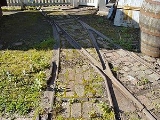
A plateway is an early kind of railway or tramway or wagonway
, with a cast iron
rail
. They were mainly used for about 50 years up to 1830, though some continued later.
Plateways were of two kinds, "L" shaped flangeways or smooth topped edgeways, depending on whether the guiding mechanism was on the flanged rail or on the flanged wheel. Either way, the guiding mechanism reduced the load on to a rail (plate) designed to support the weight of the vehicles.
Plateways were originally horsedrawn, but cable haulage and locomotives were sometimes used later on.
The plates of the plateway were made of cast iron, often cast by the ironworks that were their users. Ultimately, this system was replaced by rolled wrought iron (and later steel) "edge rails", of the kind almost universally used in modern railways. These were strong enough to support locomotive operation.
One edgeway-type plateway was the so-called Gloucester and Cheltenham Railway
, a tramway in modern parlance.
, which served to spread the load over the ground, and to maintain the gauge
(the distance between the rails or plates). The plates were usually made from cast iron and had differing cross sections
depending on the builder. They were often very short, often about 3 feet (914.4 mm) long, able to stretch only from one block to the next.
An early user of plate rails was Benjamin Outram
whose rail was 'L' shaped in section and the wagon wheels flangeless accordingly. The early plates were prone to break so different cross sections were employed, such as a second flange underneath.
His partner William Jessop
in 1789 favoured the edge rail cast in three foot lengths, with "fish-bellying" to give greater strength along the length of the plate.
Edgeways avoid the stone obstruction problem, but the flanges on the wheels tend to make those wheels unsuitable for ordinary roads.
Stone
block
s had an advantage over timber
sleepers
in that they left the middle of the track unhindered for the hooves
of horse
s.
Timber sleepers had an advantage over stone blocks in that they maintained the gauge more accurately
.
, to guide the wheels and to reduce friction.
s at frequent intervals. The single track sections were straight so that wagon drivers could see from one loop to the next, and wait for oncoming traffic if necessary.
Wagonway
Wagonways consisted of the horses, equipment and tracks used for hauling wagons, which preceded steam powered railways. The terms "plateway", "tramway" and in someplaces, "dramway" are also found.- Early developments :...
, with a cast iron
Cast iron
Cast iron is derived from pig iron, and while it usually refers to gray iron, it also identifies a large group of ferrous alloys which solidify with a eutectic. The color of a fractured surface can be used to identify an alloy. White cast iron is named after its white surface when fractured, due...
rail
Rail profile
The rail profile is the cross sectional shape of a railway rail, perpendicular to the length of the rail.In all but very early cast iron rails, a rail is hot rolled steel of a specific cross sectional profile designed for use as the fundamental component of railway track.Unlike some other uses of...
. They were mainly used for about 50 years up to 1830, though some continued later.
Plateways were of two kinds, "L" shaped flangeways or smooth topped edgeways, depending on whether the guiding mechanism was on the flanged rail or on the flanged wheel. Either way, the guiding mechanism reduced the load on to a rail (plate) designed to support the weight of the vehicles.
Plateways were originally horsedrawn, but cable haulage and locomotives were sometimes used later on.
The plates of the plateway were made of cast iron, often cast by the ironworks that were their users. Ultimately, this system was replaced by rolled wrought iron (and later steel) "edge rails", of the kind almost universally used in modern railways. These were strong enough to support locomotive operation.
One edgeway-type plateway was the so-called Gloucester and Cheltenham Railway
Gloucester and Cheltenham Tramroad
The Gloucester and Cheltenham Tramroad, also known as the Gloucester and Cheltenham Railway, connected Gloucester with Cheltenham with horse-drawn trams. Its primary economic purpose was the transport of coal from Gloucester's docks to the rapidly-developing spa town of Cheltenham, and onwards to...
, a tramway in modern parlance.
Plates and rails
The plates of a plateway generally rested on stone blocks or sleepersRailroad tie
A railroad tie/railway tie , or railway sleeper is a rectangular item used to support the rails in railroad tracks...
, which served to spread the load over the ground, and to maintain the gauge
Rail gauge
Track gauge or rail gauge is the distance between the inner sides of the heads of the two load bearing rails that make up a single railway line. Sixty percent of the world's railways use a standard gauge of . Wider gauges are called broad gauge; smaller gauges, narrow gauge. Break-of-gauge refers...
(the distance between the rails or plates). The plates were usually made from cast iron and had differing cross sections
Cross section (geometry)
In geometry, a cross-section is the intersection of a figure in 2-dimensional space with a line, or of a body in 3-dimensional space with a plane, etc...
depending on the builder. They were often very short, often about 3 feet (914.4 mm) long, able to stretch only from one block to the next.
An early user of plate rails was Benjamin Outram
Benjamin Outram
Benjamin Outram was an English civil engineer, surveyor and industrialist. He was a pioneer in the building of canals and tramways.-Personal life:...
whose rail was 'L' shaped in section and the wagon wheels flangeless accordingly. The early plates were prone to break so different cross sections were employed, such as a second flange underneath.
His partner William Jessop
William Jessop
William Jessop was an English civil engineer, best known for his work on canals, harbours and early railways in the late 18th and early 19th centuries.-Early life:...
in 1789 favoured the edge rail cast in three foot lengths, with "fish-bellying" to give greater strength along the length of the plate.
Advantages and disadvantages
Flangeways tend to get obstructed by loose stones, although the vehicles that run on them can run on ordinary roads.Edgeways avoid the stone obstruction problem, but the flanges on the wheels tend to make those wheels unsuitable for ordinary roads.
Stone
STONe
is a Japanese manga written and illustrated by Sin-Ichi Hiromoto. Kodansha released the two bound volumes of the manga on April 23, 2002 and August 23, 2002, respectively.The manga is licensed for an English-languague released in North America be Tokyopop...
block
Block
Block may refer to:-Administrative subdivisions:* A city block, the smallest area that is surrounded by streets* Block , term used in many South Asian countries-Objects:* A large concrete masonry unit...
s had an advantage over timber
Timber
Timber may refer to:* Timber, a term common in the United Kingdom and Australia for wood materials * Timber, Oregon, an unincorporated community in the U.S...
sleepers
Railroad tie
A railroad tie/railway tie , or railway sleeper is a rectangular item used to support the rails in railroad tracks...
in that they left the middle of the track unhindered for the hooves
Claw
A claw is a curved, pointed appendage, found at the end of a toe or finger in most mammals, birds, and some reptiles. However, the word "claw" is also often used in reference to an invertebrate. Somewhat similar fine hooked structures are found in arthropods such as beetles and spiders, at the end...
of horse
Horse
The horse is one of two extant subspecies of Equus ferus, or the wild horse. It is a single-hooved mammal belonging to the taxonomic family Equidae. The horse has evolved over the past 45 to 55 million years from a small multi-toed creature into the large, single-toed animal of today...
s.
Timber sleepers had an advantage over stone blocks in that they maintained the gauge more accurately
Accuracy and precision
In the fields of science, engineering, industry and statistics, the accuracy of a measurement system is the degree of closeness of measurements of a quantity to that quantity's actual value. The precision of a measurement system, also called reproducibility or repeatability, is the degree to which...
.
Antecedents
Even older than plateways were wagonways which used wooden rails, or (occasionally) grooves cut in stone blocks such as at the Haytor Granite TramwayHaytor Granite Tramway
The Haytor Granite Tramway was a unique granite-railed tramway running down from Haytor Down, Dartmoor, Devon. The tramway was built in 1820 to carry Haytor granite, which was of fine grain and high quality, down from the heights of Dartmoor for the construction of houses, bridges and other...
, to guide the wheels and to reduce friction.
Operations
The early plateways were usually operated on a toll basis, with any rolling stock owner able to operate their wagons on the tracks. Sometimes the plateway company was forbidden to operate its own wagons, so as to prevent a monopoly situation arising.Single Line
Plateways such as the Gloucester and Cheltenham Railway were single track with passing loopPassing loop
A passing loop is a place on a single line railway or tramway, often located at a station, where trains or trams in opposing directions can pass each other. Trains/trams in the same direction can also overtake, providing that the signalling arrangement allows it...
s at frequent intervals. The single track sections were straight so that wagon drivers could see from one loop to the next, and wait for oncoming traffic if necessary.
See also
- Rail tracksRail tracksThe track on a railway or railroad, also known as the permanent way, is the structure consisting of the rails, fasteners, sleepers and ballast , plus the underlying subgrade...
- Railway
- Tramway (industrial)
- Tramway trackTramway trackTramway track is used on tramways or light rail operations. Grooved rails are often used in order to make street running feasible...
- WagonwayWagonwayWagonways consisted of the horses, equipment and tracks used for hauling wagons, which preceded steam powered railways. The terms "plateway", "tramway" and in someplaces, "dramway" are also found.- Early developments :...