


Plastic shopping bag

Encyclopedia
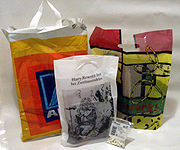
Shopping bag
Shopping bags are medium sized bags, typically around 10-20 litres in volume , that are often used by grocery shoppers to carry home their purchases...
made from various kinds of plastic
Plastic
A plastic material is any of a wide range of synthetic or semi-synthetic organic solids used in the manufacture of industrial products. Plastics are typically polymers of high molecular mass, and may contain other substances to improve performance and/or reduce production costs...
, and are common worldwide. These bags are sometimes called single-use bags, referring to carrying items from a store to a home. However, reuse for storage or trash is common, and modern plastic shopping bags are increasingly recyclable
Recycling
Recycling is processing used materials into new products to prevent waste of potentially useful materials, reduce the consumption of fresh raw materials, reduce energy usage, reduce air pollution and water pollution by reducing the need for "conventional" waste disposal, and lower greenhouse...
or biodegradable.
History
USUnited States
The United States of America is a federal constitutional republic comprising fifty states and a federal district...
and Europe
Europe
Europe is, by convention, one of the world's seven continents. Comprising the westernmost peninsula of Eurasia, Europe is generally 'divided' from Asia to its east by the watershed divides of the Ural and Caucasus Mountains, the Ural River, the Caspian and Black Seas, and the waterways connecting...
an patent applications relating to the production of plastic shopping bags can be found dating back to the early 1950s, but these refer to composite constructions with handles fixed to the bag in a secondary manufacturing process.
The modern lightweight shopping bag is the invention of Swedish
Sweden
Sweden , officially the Kingdom of Sweden , is a Nordic country on the Scandinavian Peninsula in Northern Europe. Sweden borders with Norway and Finland and is connected to Denmark by a bridge-tunnel across the Öresund....
engineer Sten Gustaf Thulin. In the early 1960s, Thulin developed the idea for forming a simple one-piece bag by folding, welding and die-cutting a flat tube of plastic in the early 1960s for packaging company Celloplast of Norrköping
Norrköping
Norrköping is a city in the province of Östergötland in eastern Sweden and the seat of Norrköping Municipality, Östergötland County. The city has a population of 87,247 inhabitants in 2010, out of a municipal total of 130,050, making it Sweden's tenth largest city and eighth largest...
, Sweden. Thulin's design produced a simple, strong bag with a high load-carrying capacity, and was patented worldwide by Celloplast in 1965.
Celloplast was a well-established producer of cellulose
Cellulose
Cellulose is an organic compound with the formula , a polysaccharide consisting of a linear chain of several hundred to over ten thousand β linked D-glucose units....
film and a pioneer in plastics processing. The company's patent position gave it a virtual monopoly on plastic shopping bag production, and the company set up manufacturing plants across Europe and in the US. However, other companies saw the attraction of the bag, too, and US petrochemicals group Mobil
Mobil
Mobil, previously known as the Socony-Vacuum Oil Company, was a major American oil company which merged with Exxon in 1999 to form ExxonMobil. Today Mobil continues as a major brand name within the combined company, as well as still being a gas station sometimes paired with their own store or On...
overturned the Celloplast US patent in 1977.
The Dixie Bag Company of College Park, Georgia
College Park, Georgia
College Park is a city located partly in Fulton County, Georgia and partially in Clayton County, Georgia, in the United States. As of the 2010 census, the city population was 13,942...
, owned and operated by Jack W. McBride, was one of the first companies to exploit this new opportunity to bring convenient products to all major shopping stores. The Dixie Bag Company, along with similar firms such as Houston Poly Bag and Capitol Poly, was instrumental in the manufacturing, marketing and perfecting of plastic bags in the early 1980s. Kroger
Kroger
The Kroger Co. is an American supermarket chain founded by Bernard Kroger in 1883 in Cincinnati, Ohio. It reported US$ 76.7 billion in sales during fiscal year 2009. It is the country's largest grocery store chain and its second-largest grocery retailer by volume and second-place general retailer...
, a Cincinnati-based grocery chain, began to replace its paper shopping bags with plastic bags in 1982, and was soon followed by its rival, Safeway
Safeway Inc.
Safeway Inc. , a Fortune 500 company, is North America's second largest supermarket chain after The Kroger Co., with, as of December 2010, 1,694 stores located throughout the western and central United States and western Canada. It also operates some stores in the Mid-Atlantic region of the Eastern...
.
Without its plastic bag monopoly, Celloplast's business went into decline, and the company was split up during the 1990s. The Norrköping site remains a plastics production site, however, and is now the headquarters of Miljösäck, Sweden’s largest producer of waste sacks manufactured from recycled polyethylene.
From the mid-1980s onwards, plastic bags became common for carrying daily groceries from the store to vehicles and homes throughout the developed world. As plastic bags increasingly replaced paper bags, and as other plastic materials and products replaced glass, metal, stone, timber and other materials, a packaging materials war erupted, with plastic shopping bags at the center of highly publicized disputes. Although few peer-reviewed studies or government surveys have provided estimates for global plastic bag use, environmental activists estimate that between 500 billion and 1 trillion plastic bags are used each year worldwide. In 2009, the United States International Trade Commission
United States International Trade Commission
The United States International Trade Commission is an independent, bi-partisan, quasi-judicial, federal agency of the United States that provides trade expertise to both the legislative and executive branches. Further, the agency determines the impact of imports on U.S...
reported that the number of bags used annually in the USA was 102 billion.
Manufacture and composition
Traditional plastic bags are usually made from polyethylenePolyethylene
Polyethylene or polythene is the most widely used plastic, with an annual production of approximately 80 million metric tons...
, which consists of long chains of ethylene
Ethylene
Ethylene is a gaseous organic compound with the formula . It is the simplest alkene . Because it contains a carbon-carbon double bond, ethylene is classified as an unsaturated hydrocarbon. Ethylene is widely used in industry and is also a plant hormone...
monomers. Ethylene is derived from natural gas
Natural gas
Natural gas is a naturally occurring gas mixture consisting primarily of methane, typically with 0–20% higher hydrocarbons . It is found associated with other hydrocarbon fuel, in coal beds, as methane clathrates, and is an important fuel source and a major feedstock for fertilizers.Most natural...
and petroleum
Petroleum
Petroleum or crude oil is a naturally occurring, flammable liquid consisting of a complex mixture of hydrocarbons of various molecular weights and other liquid organic compounds, that are found in geologic formations beneath the Earth's surface. Petroleum is recovered mostly through oil drilling...
. The polyethylene used in most plastic shopping bags is either low-density
Low density polyethylene
Low-density polyethylene is a thermoplastic made from petroleum. It was the first grade of polyethylene, produced in 1933 by Imperial Chemical Industries using a high pressure process via free radical polymerization. Its manufacture employs the same method today. LDPE is commonly recycled and has...
(resin identification code
Resin identification code
The SPI resin identification coding system is a set of symbols placed on plastics to identify the polymer type. It was developed by the Society of the Plastics Industry in 1988, and is used internationally....
4) or, more often, high-density
High density polyethylene
High-density polyethylene or polyethylene high-density is a polyethylene thermoplastic made from petroleum. It takes 1.75 kilograms of petroleum to make one kilogram of HDPE...
(resin identification code
Resin identification code
The SPI resin identification coding system is a set of symbols placed on plastics to identify the polymer type. It was developed by the Society of the Plastics Industry in 1988, and is used internationally....
2). Plastic shopping bags are commonly manufactured by blown film extrusion.
Biodegradable materials
Some modern bags are made of vegetable-based bioplasticBioplastic
Bioplastics are a form of plastics derived from renewable biomass sources, such as vegetable fats and oils, corn starch, pea starch, or microbiota, rather than fossil-fuel plastics which are derived from petroleum...
s, which can decay organically and prevent a build-up of toxic plastic bags in landfills and the natural environment. Bags can also be made from degradable polyethylene film. However, most degradable bags do not readily decompose in a sealed landfill and represent a possible contaminant to plastic recycling
Plastic recycling
Plastic recycling is the process of recovering scrap or waste plastics and reprocessing the material into useful products, sometimes completely different in form from their original state. For instance, this could mean melting down soft drink bottles and then casting them as plastic chairs and tables...
operations. Plastic shopping bags could be made from polylactic acid
Polylactic acid
Poly or polylactide is a thermoplastic aliphatic polyester derived from renewable resources, such as corn starch , tapioca products or sugarcanes...
(PLA), a biodegradable polymer derived from lactic acid
Lactic acid
Lactic acid, also known as milk acid, is a chemical compound that plays a role in various biochemical processes and was first isolated in 1780 by the Swedish chemist Carl Wilhelm Scheele. Lactic acid is a carboxylic acid with the chemical formula C3H6O3...
, although this is not widely used.
Environmental concerns
According to Vincent Cobb, a manufacturer of reusable bags, each year millions of discarded plastic shopping bags end up as litter in the environment when improperly disposed of. The same properties that have made plastic bags so commercially successful and ubiquitous—namely their low weight and resistance to degradation—have also contributed to their proliferation in the environment. Due to their durability, plastic bags can take up to 1000 years to decompose. As they slowly decompose, plastic bags break into tiny pieces and leach toxic chemicals into soils, lakes, rivers, and oceans.On land, plastic bags are one of the most prevalent types of litter in inhabited areas. At their worst, plastic bags can clog drainage systems and contribute to flooding, as occurred in Bangladesh
Bangladesh
Bangladesh , officially the People's Republic of Bangladesh is a sovereign state located in South Asia. It is bordered by India on all sides except for a small border with Burma to the far southeast and by the Bay of Bengal to the south...
in 1988 and 1998 and almost annually in Manila
Manila
Manila is the capital of the Philippines. It is one of the sixteen cities forming Metro Manila.Manila is located on the eastern shores of Manila Bay and is bordered by Navotas and Caloocan to the north, Quezon City to the northeast, San Juan and Mandaluyong to the east, Makati on the southeast,...
.
Plastic bags constitute a significant portion of the floating marine debris in the Earth's oceans. If washed out to sea, plastic bags can be carried long distances by ocean currents, and can strangle marine animals or, if ingested, cause them to starve to death. Numerous deaths among animals such as sea turtles and dolphins have been attributed to the ingestion of plastic bags and other plastic marine litter.
Littering is often a serious problem in developing countries, where trash collection infrastructure is less developed than in developed nations. The relatively limited adoption of modern biodegradable plastic bags means that many older landfills are filled with large, persistent deposits of non-degrading bags.
Reuse and recycling
Heavy-duty plastic shopping bags are suitable for reuse as reusable shopping bagReusable shopping bag
A reusable shopping bag, sometimes called bag for life is a type of shopping bag which can be reused several times: this is an alternative of single use paper or plastic bags...
s. Lighter weight bags are often reused as bin bag
Bin bag
A bin bag, swag sack or bin liner or garbage bag, trash bag, refuse sack, black sack, or can liner is a disposable bag used to contain rubbish. Such bags are useful to line the insides of waste containers to prevent the insides of the receptacle from becoming coated in waste material...
s (trash bags) or to pick up pet faeces. All types of plastic shopping bag can be recycled into new bags where effective collection schemes exist.
Since internet rumours started to claim that the Environmental Protection Agency had reported only 1% of plastic bags were recycled, significant attention resulted in a 700% growth in the recycling industry as new capacity led to a 7% rate. This resulted in more than 800 million lbs of bags and other film being recycled in 2007 alone Each ton of recycled plastic bags saves the energy equivalent of 11 barrels of oil, although most bags are produced from natural gas derived stock. In light of an Australia
Australia
Australia , officially the Commonwealth of Australia, is a country in the Southern Hemisphere comprising the mainland of the Australian continent, the island of Tasmania, and numerous smaller islands in the Indian and Pacific Oceans. It is the world's sixth-largest country by total area...
n study showing more than 60% of bags are reused as bin liners and for other purposes, the 7% recycling rate accounts for 17.5% of bags available for recycling.
According to the UK's Environment Agency
Environment Agency
The Environment Agency is a British non-departmental public body of the Department for Environment, Food and Rural Affairs and an Assembly Government Sponsored Body of the Welsh Assembly Government that serves England and Wales.-Purpose:...
, 76% of British carrier bags are reused. An estimated 90% of individuals reuse some plastic bags, and 56% of individuals reuse all plastic shopping bags. Heavier-duty plastic shopping bags are suitable for multiple uses as reusable shopping bag
Reusable shopping bag
A reusable shopping bag, sometimes called bag for life is a type of shopping bag which can be reused several times: this is an alternative of single use paper or plastic bags...
s.
Bans
Plastic bags are either restricted or completely banned in over a quarter of the world's countries. Belgium, Italy, Ireland and Hong Kong have legislation discouraging the use and encouraging the recycling of plastic bags by imposing a fixed or minimum levy for the supply of plastic bags or obliging retailers to recycle. Italy banned plastic bags entirely in January 2011. In other jurisdictions, including Bangladesh, South Africa, Thailand and three states/territories of Australia, plastic bags are banned.In the United States, bans have been imposed at the local level, starting with San Francisco
San Francisco Mandatory Recycling and Composting Ordinance
The San Francisco Mandatory Recycling and Composting Ordinance is a local municipal ordinance requiring all persons located in San Francisco to separate their recyclables, compostables and landfilled trash and to participate in recycling and composting programs...
in 2007. In 2008, Westport, Connecticut
Westport, Connecticut
-Neighborhoods:* Saugatuck – around the Westport railroad station near the southwestern corner of the town – a built-up area with some restaurants, stores and offices....
, banned plastic bags in grocery stores. In 2009, Edmonds, Washington
Edmonds, Washington
Edmonds is a city in Snohomish County, Washington, United States. Edmonds has a view of Puget Sound and both the Olympic Mountains and Cascade Range. The third most populous city in Snohomish County after Everett and Marysville, the population was 39,709 according to the 2010 census...
, banned plastic bags at retail stores. In 2010, Los Angeles County; Brownsville, Texas; and Bethel, Alaska, approved similar bans. In the first few months of 2011, bans went into effect in North Carolina
North Carolina
North Carolina is a state located in the southeastern United States. The state borders South Carolina and Georgia to the south, Tennessee to the west and Virginia to the north. North Carolina contains 100 counties. Its capital is Raleigh, and its largest city is Charlotte...
’s Outerbanks Region, banning all plastic bags at all retailers. On October 15, 2011, Portland, Oregon
Portland, Oregon
Portland is a city located in the Pacific Northwest, near the confluence of the Willamette and Columbia rivers in the U.S. state of Oregon. As of the 2010 Census, it had a population of 583,776, making it the 29th most populous city in the United States...
, instituted a ban on plastic bags, targeted at large volume supermarkets and retail outlets. Similar bans at the municipality level have been imposed in India, Mexico and the UK.
Taxes
A plastic bag levy introduced in IrelandIreland
Ireland is an island to the northwest of continental Europe. It is the third-largest island in Europe and the twentieth-largest island on Earth...
in 2002 resulted in a reduction of over 90% in the issuing of plastic shopping bags; the total reduction in plastic bag use was less than that due to increased use of commercial trash bin-liners in place of the free shopping bags previously used by many consumers. Sales of bin-liners have increased by 400% according to one industry source. The "ban on free plastic bags" in China introduced in 2008 resulted in a reduction by two thirds. In Taiwan
Taiwan
Taiwan , also known, especially in the past, as Formosa , is the largest island of the same-named island group of East Asia in the western Pacific Ocean and located off the southeastern coast of mainland China. The island forms over 99% of the current territory of the Republic of China following...
, plastic bags from supermarkets and other shops cost NT$
New Taiwan dollar
The New Taiwan dollar , or simply Taiwan dollar, is the official currency of the Taiwan Area of the Republic of China since 1949, when it replaced the Old Taiwan dollar...
2. In Wales
Wales
Wales is a country that is part of the United Kingdom and the island of Great Britain, bordered by England to its east and the Atlantic Ocean and Irish Sea to its west. It has a population of three million, and a total area of 20,779 km²...
, a 5-pence charge has been enforced on all plastic shopping bags since 1 October 2011.
In the United States, the California legislature rejected a 25-cent bag tax in June 2009. In August 2009, Seattle voters rejected a 20-cent bag tax previously approved by city leaders. A five-cent tax levied on plastic bags in Washington, DC in January 2010 resulted in a decrease in consumption from 22.5 million to 3 million bags in the first month alone. A study issued by the non-profit group American for Tax Reform found that the District of Columbia’s five-cent bag tax had a disproportionate impact on the city’s poor and cost the city over 100 jobs. In Virginia, various bills including a 20-cent and 5-cent bag tax failed to pass the state senate. A similar tax failed to move forward in nearby Prince George's County, Maryland, in April 2011, and opponents cited concerns about jobs and the economy. Neighboring Montgomery County, Maryland approved a five-cent tax in May 2011, but it has yet to take effect.
Recycling laws
Many cities and states in the United States - including California, New York, Chicago, Delaware and Baltimore - have addressed bag litter and landfill by enacting new recycling laws.Further reading
- Selke, Susan. Packaging and the Environment, 1994, ISBN 1566761042
- Selke, Susan. Plastics Packaging, 2004, ISBN 1569903727
- Stillwell, E. J. Packaging for the Environment, A. D. Little, 1991, ISBN 0814450741
- Scheirs, J. Polymer Recycling: Science, Technology and Applications, 1998, ISBN 0471970549
- Celloplast 1965 US Patent: Copy of US Patent 5669504