

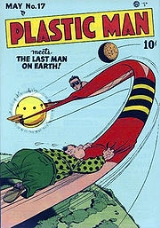
Plastic Man

Encyclopedia
Plastic Man is a fictional
comic-book superhero
originally published by Quality Comics
and later acquired by DC Comics
. Created by writer-artist Jack Cole
, he first appeared in Police Comics
#1 (August 1941).
One of Quality Comics' signature characters during the Golden Age of Comic Books
, Plastic Man can stretch his body into any imaginable form. His adventures were known for their quirky, offbeat structure and surreal slapstick
humor. When Quality Comics was shut down in 1956, DC Comics acquired many of its characters, integrating Plastic Man into the mainstream DC universe
. The character has starred in several short-lived DC series, as well as a Saturday morning cartoon
series in the early 1980s, and as a recurring character on Batman: The Brave and the Bold
.
Although the character's revival has never been a commercial hit, Plastic Man has been a favorite character of many modern
comic book creators, including writer Grant Morrison
, who included him in his 1990s revival of the Justice League
; Art Spiegelman
, who profiled Cole for The New Yorker
magazine; painter Alex Ross
, who has frequently included him in covers and stories depicting the Justice League; writer-artist Kyle Baker
, who wrote and illustrated an award winning Plastic Man series, and Frank Miller
, who included him in the Justice League in the comics All Star Batman and Robin the Boy Wonder and Batman: The Dark Knight Strikes Again
.
 Plastic Man was a crook named Patrick "Eel" O'Brian. Orphaned at age 10 and forced to live on the streets, he fell into a life of crime. As an adult, he became part of a burglary ring, specializing as a safecracker. During a late-night heist at the Crawford Chemical Works, he and his three fellow gang members were surprised by a night watchman. During the gang's escape, Eel was shot in the shoulder and doused with a large drum of unidentified acid. He escaped to the street only to discover that his gang had driven off without him.
Fleeing on foot and suffering increasing disorientation from the gunshot wound and the exposure to the acid, Eel eventually passed out on the foothills of a mountain near the city. He awoke to find himself in a bed in a mountain retreat, being tended to by a monk who had discovered him unconscious that morning. This monk, sensing a capacity for great good in O'Brian, turned away police officers who had trailed Eel to the monastery. This act of faith and kindness—combined with the realization that his gang had left him to be captured without a moment's hesitation—fanned Eel's longstanding dissatisfaction with his criminal life and his desire to reform.
During his short convalescence at the monastery, he discovered that the acid had entered his bloodstream and caused a radical physical change. His body now had all of the properties of rubber, allowing him to stretch, bounce, and mold himself into any shape. He immediately determined to use his new abilities on the side of law and order, donning a red, black and yellow (later red and yellow) rubber costume and capturing criminals as Plastic Man. He concealed his true identity with a pair of white goggles and by re-molding his face. As O'Brian, he maintained his career and connections with the underworld as a means of gathering information on criminal activity.
Plastic Man soon acquired comedic sidekick
Woozy Winks
, who was originally magically enchanted so that nature itself would protect him from harm. That eventually was forgotten and Woozy became simply a dumb but loyal friend of Plastic Man.
In his original Golden Age/Quality Comics incarnation, Plastic Man eventually became a member of the city police force and then the FBI. By the time he became a federal officer, he had nearly completely abandoned his Eel O'Brian identity.
The star of the 1966-1968 Silver Age run of Plastic Man, written by Arnold Drake
, was the son of the original Plastic Man, who as a toddler had accidentally drunk a souvenir bottle of the same acid that had given Eel O'Brian his powers. Other Silver and Bronze-age versions appear to carry the same identity and origin as the Golden Age original. The silver-age Plastic Man who took up the mantle from his father was later identified as residing on Earth-Twelve
, home of the Inferior Five
. A subsequent version appearing with Batman in The Brave and the Bold and Justice League of America was identified as residing on Earth-One. Afterwards, the original Quality Comics version was specified as being a member of the All-Star Squadron and Freedom Fighters
, originally of Earth-Two and later moving to Earth-X. This version died during an extended period of World War II
while on the latter world.
", a 1988-1989 four-issue Plastic Man miniseries by Phil Foglio
introduced a new version of Plastic Man: Eel O'Brian, abandoned by his criminal gang after being shot and exposed to the acid, wandered the streets as his new powers developed, frightening others and bringing the police and National Guard down on him as a dangerous monster. Eel was at first oblivious to the changes to his body, but after realizing that he was the monster everyone was going on about, he used his new abilities to escape his pursuers, but soon became so despondent over his new condition that he attempted suicide by jumping off a bridge.
Fortunately, he was interrupted by Woozy Winks, a former mental patient who was kicked out of an institution due to lack of funding (or as Woozy put it, "something called Reaganomics"), who desired nothing more than to return to the warm safety of a straitjacket and padded room. Eel and Woozy decided to work together and capitalize on Eel's new powers to make their fortunes (Eel wanting to get rich quick, Woozy just wanting his "old room" back), but couldn't decide whether there was more money in crime or crime-fighting, and resorted to flipping a coin to choose serving the law (though Woozy had his doubts early on). Eel, ending up with the name "Plastic Man" after a reporter misinterpreted his first choice, "Elastic Man", and Woozy set up a detective agency in New York City and had various misadventures.
The alteration that Plas was initially in the superhero business for the money has had an effect on his character development post-Crisis, notably in the 2000-2001 JLA storyline "Divided We Fall" by Mark Waid
where he, along with other Justice League members, was separated into two people, his normal "civilian" identity and his superhero persona, by the manipulative wish-granting Id. While Plastic Man devolved from a person with a sense of humor into a constantly wisecracking and almost ineffectual idiot, the now "normal" Eel O'Brian struggled with the criminal tendencies he had suppressed as he had become comfortable with his role as a superhero, and wondered if he had actually changed for the better or if it had all been part of the super-hero "act". Ultimately, Eel was the driving force behind the other transformed Leaguers banding together to re-join with their superheroic selves, noting that Bruce Wayne in particular was approaching a mental breakdown as he struggled with his rage over his parents' murder while lacking the ability to do anything about it as Batman
was the identity that had 'inherited' his skills.
Another memorable milestone in the life of Plastic man was in the late-Nineties/early Millenium incarnation of the Justice League in the story arc "The Obsidian Age" where many of the key members including Plastic Man were transported in time thousands of years earlier to the beginning days of Atlantis and during a battle with the antagonists, he was frozen and then shattered into hundreds of thousands of inanimate little pieces. Having no way to locate all the pieces, much less fix him, with the technology of the day, the JLA finally returned to their own time and were eventually successful in finding all of his pieces and returning Plas to his former complete self after laying near dormant and unable to move for thousands of years. Unfortunately, even though he had been practically destroyed and turned into scattered confetti of sorts, he was partially, if not completely, aware of the passage of time and his inherent helplessness which had a profoundly negative effect on his mind. Shortly after being reincorporated, he admitted he has lost his nerve and quit the JLA, hoping to live a regular life. Helping him come to grips with leaving his former life behind was the newly introduced information that he had a son, now a teenager, and felt the boy needed a father and a normal life. Eventually, Batman convinced Plas to return to his life as a super hero again.
" DC Comics crossover
storyline that followed the "Infinite Crisis
" crossover, a young man with similar appearance and powers as Plastic Man appears briefly in the superteam series Teen Titans Vol. 3, #34 written by R.J. Carter. The character wears a white costume with red goggles, similar to that of Offspring
, Plastic Man's son in the earlier 1999 DC miniseries
The Kingdom by Mark Waid. While the Teen Titans story itself does not identify the character, page two of a published script supposedly by writer Geoff Johns
' specifies it is "Plastic Man’s son, Offspring". Plastic Man's son is also shown in costume, and identified as Offspring, in the 2007 52
Week 35 (written by Geoff Johns, Grant Morrison, Greg Rucka
and Mark Waid) when he is injured while rescuing a number of the depowered Everyman heroes. Eventually, Plastic Man and Offspring come together as father and son and for a while, they had the idillic family set up until Plas was convinced that he couldn't deny his rubberized destiny as a super hero
In Countdown To Mystery #1 (2007) written by Matthew Sturges, Plastic Man is seduced by Eclipso
, being made to believe he is a joke among his fellow heroes, and the only way for him to get some respect is through Eclipso. He is later freed of this corruption by Bruce Gordon. Plastic Man makes his next appearance within the pages of Green Arrow/Black Canary
#8 by Judd Winick
, having been freed from a stasis tube by Green Arrow. His DNA is taken by Sivana and used to augment an amnesiac Connor Hawke
, in a bid to turn the young hero into a brainwashed slave with a strong healing factor
.
Plastic Man appeared for a brief period in the 2009 Justice League of America vol. 2 series written by Len Wein
. After joining up with the team following the events of Final Crisis
, Plastic Man has his effectiveness questioned by his teammtes Dr. Light
, which starts a fight between the two. Vixen
breaks them up. Vixen reassigns Plastic Man to team up with Dr. Light to stop the Royal Flush Gang
robbery, when they have some control issues. Later, after the Royal Flush Gang is defeated, Plastic Man and Dr. Light finally stop arguing.
During a massive battle at the Justice League Satellite
in Justice League: Cry for Justice
, Prometheus
injected Plastic Man with a chemical that badly damaged his plastic body. The chemicals caused Eel to suffer from a condition where it took great concentration to keep himself in his usual, semi-solid state and caused him pain, according to him, when he even thought about changing shape, leaving him in an infirm state.
In the Blackest Night crossover, while still suffering from his deteriorating state, Plastic Man had his heart torn out by the Black Lantern
, Vibe
, seemingly killing him. However, due to his powers, he was able to survive such an attack, albeit badly wounded. In the following issue, Vixen stated that Plastic Man was being taken care of at STAR Labs, and that he would be unable to return to the League.
He then appears in Justice League: Generation Lost
, helping a large coalition of heroes on an unsuccessful mission to trace Maxwell Lord
. He has seemingly been cured of his condition, and was shown retaining his normal shape without issue.
Later, he aids the JLA on their mission into Hell, where he helps Batman defeat Geryon
. The League learns Satanus
' plans to use the Dante
's mask to become powerful. Plastic Man grabs the mask, which possesses him. The Leagues combines forces to remove the mask, which is incinerated, apparently killing Plastic Man; however, it is discovered Zauriel
transported him into another dimension. Zauriel helps the League escape Hell.
, Plastic Man is considered as one of the candidates for the United Nations
-sponsored Justice League International
. He is denied a spot on the team for being too unpredictable.
Density Control: Plastic Man can change his density at will; becoming as dense as a rock or as flexible as a rubber band.
Malleability
(Elasticity/Plasticity): He can stretch his limbs and body to superhuman lengths and sizes. There is no known limit to how far he can stretch his body.
Size Alteration: He can shrink himself down to a few inches tall (posed as one of Batman's utility belt pockets) or become a titan (the size of skyscrapers).
Shape-Shifting: He can contort his body into various positions and sizes impossible for ordinary humans, such as being entirely flat so that he can slip under a door or using his fingers to pick conventional locks. He can also use it for disguise by changing the shape of his face and body. Thanks to his fluid state, Plastic Man can open holes in his body and turn himself into objects with mobile parts. In addition, he can alter his bodily mass and physical constitution at will; there is virtually no limit to the sizes and shapes he can contort himself into.
Superhuman Agility: These stretching powers grant Plastic Man heightened agility enabling him flexibility and coordination that is extraordinarily beyond the natural limits of the human body.
Color Change: The only limitation he has relates to color, which he cannot change without intense concentration. He generally does not use this ability and sticks to his red and yellow colored uniform.
Invulnerability: Plastic Man's powers extraordinarily augment his durability. Some stories, perhaps of anecdotal quality, have showed him susceptible to surprise attack by bullets, in one case oozing a substance similar to liquid plastic. In most stories, though, he is able to withstand corrosives, punctures and concussions without sustaining any injury (although he can be momentarily stunned). He is resistant to high velocity impacts that would kill an ordinary person, resistant to blasts from energy weapons (Batman once mentioned that he could presumably even withstand a nuclear detonation), and is bulletproof. His bodily mass can be dispersed, but for all intents and purposes it is invulnerable.
Regeneration: He is able to regenerate and/or assimilate lost or damaged tissue, although he needs to be reasonably intact for this process to begin; he was reduced to crumbs and scattered across the ocean for centuries, only returning to his usual form after the rest of the League were able to gather some of the crumbs and restore approximately 80% of his body mass, after which he began to regenerate what they hadn't salvaged.
Telepathic Immunity: As stated by Batman (in JLA #88, dec 2003), "Plastic Man's mind is no longer organic. It's untouchable by telepathy."
Immortality: Plastic Man does not appear to age; if he does, it is at a rate far slower than that of normal human beings. In the aftermath of the Justice League story Arc "Obsidian Age", Plastic Man was discovered to have survived for 3000 years as little more than crumbs on the bottom of the Atlantic Ocean. He is now over 3000 years old and is still active as a superhero.
Ultrasonic Detection: His body will start to "ripple" when an ultrasonic frequency is triggered.
, which melts and destabilizes his putty-like form, although he will eventually regenerate when the chemicals are gone. Another weakness is that the only colors Plastic Man can mimic are the colors of his body and costume (IE: red, black, yellow, and flesh tone), although he can use these colours in various ways, once even managing to exactly duplicate the appearance of the Flash
. Whether this is an inherent flaw in his powers or a mental block had never been explained, whereas, his son, Offspring, also gained his father's powers, but is able to mimic any color he chooses; Offspring's introduction revealed that Plastic Man could change colour, turning his nose blue to prove to Batman
that he could, but it apparently took a great deal of concentration just to accomplish that much. Also, for a long while it was not known if Plas could take off his costume, but when he rejoined civilian life, he was wearing normal clothing so it appeared that he is able to.
(2001—2002), Frank Miller
's miniseries now set on DC's new Earth-31, Plastic Man was betrayed and locked in Arkham Asylum
for years with his body forced into a perpetual egg-like shape (alluding to a container of Silly Putty
) by a pressurizing machine. The imprisonment and confinement drove him insane, and upon his release he lashed out at those around him. He fights Elongated Man
, having the upper hand until Batman brings Plastic Man to his senses with a punch to the face. Batman
declares that Plastic Man is the most powerful superhero in the room. Carrie Kelly (as Catgirl) describes him as being: "Immeasurably powerful. Absolutely nuts." In this continuity, he appears with silver hair and the occasional wrinkle. In All Star Batman and Robin
, also written by Miller. Plastic Man has only appeared in issue #5, where he is a founding member of a proto-Justice League
, along with Wonder Woman
, Superman
, and Green Lantern
Hal Jordan
. He constantly changes shape and cracks jokes, and other members repeatedly tell him to "shut up".
, harks back to the Jack Cole
version of Plastic Man featuring Eel O'Brian tended to by a monk in a mountain retreat, and inspired by the monks kindness, Eel resolves to use his powers for good, becoming the crime fighter Plastic Man, and works for the FBI. In this series, Plastic Man gets a girlfriend (FBI Special Agent Morgan, revealed as the surgically altered fiancee that Plas' alter ego had left in the 1940s) and adopts a Goth
teenage daughter, Edwina. The series won five Eisner Award
s for Best New Series, Best Title for Younger Readers, Best Writer/Artist: Humor and one Harvey Award
for Best New Series.
imprint
, set on the alternate universe
Earth-9, Plastic Man is a member of the Secret Six
. He is scientist Gunther Ganz, whose consciousness has been transferred to a "living polymer".
intercompany crossover
JLA/Avengers
, Plastic Man is a member of the JLA and teams with Martian Manhunter
in the Marvel locale of Wakanda
, where the two encounter the Marvel characters the Wasp and the Black Panther
. Plastic Man is replaced by DC Comics' Elongated Man
after the merging of worlds.
in Alan Moore
and Kevin O'Neill
's The League of Extraordinary Gentlemen: Black Dossier
.
event, Eel O'Brian is a villain. After Heat Wave
was sent to death row after killing Jason Rusch, O'Brian arrives to break him out in the flying fortress of the military Doom prison, having been hiding in the body of his cellmate Cluemaster
. During the prison break, O'Brian dislikes being called "Plastic Man", when inmate Sportsmaster
calls him by his name. While O'Brian helps him to retrieve his weapons, he discovers Heat Wave attacking the guards' control room and attempting to ram the flying prison at Cyborg
's home city of Detroit. O'Brian refuses to let him destroy the city, but Heat Wave turns on him, apparently killing him by using his flame gun to melt his body. After Heat Wave is defeated by Cyborg and imprisoned in Belle Reve
, O'Brian is revealed to have survived, and smuggles himself into the prison in Heat Wave's new cellmate's body and advances on him at the end of the page.
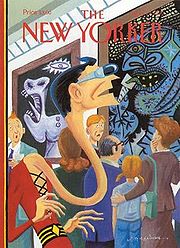 The April 19, 1999, issue of The New Yorker
features Plastic Man on the cover gawking at a Picasso
painting. This issue ran a biography of Jack Cole by Art Spiegelman
, which two years later would comprise much of the text in his and Chip Kidd
's book Jack Cole and Plastic Man: Forms Stretched to their Limits. In the 499th issue of Mad Magazine, Plastic Man can be seen in the magazine's Watchmen spoof during Funnyman's (spoof of Edward Blake/Comedian) funeral.
Elastic Superheroes line (which is highly sought after by collectors and extremely rare). He was a part of Kenner
's Super Powers action figure line in 1986. In 1998, Plastic Man was included in Hasbro
's line based on the JLA comic book. When DC Comics started its own toy company, DC Direct
, in 1999, Plastic Man was one of its first action figures made. A second figure, this time an interpretation of the character based on the art of Alex Ross
, was released by DC Direct in May 2006. In 2009, two versions of Plastic Man were released as part of the Batman: The Brave and the Bold tie-in toy line. Plastic Man was also released as a figure, in DCAU
style, in the Justice League Unlimited toyline in late 2009. A new, stretchable Plastic Man figure was recently released in the Batman: The Brave and the Bold toy line, in a multi-pack with Batman and Rubberneck. In 2010, Mattel released a Plastic Man figure as part of the DC Universe Classics line. This figure was exclusively sold at the San Diego Comic Con.
tabletop miniatures game, in his traditional red and yellow costume, in addition to having a regular Rookie/Experienced/Veteran figure in the inaugural DC Hypertime set. In 2003 a convention-exclusive figure was produced which featured the same powers and abilities but with a figure of Plastic Man as a mailbox (actually the mailbox 3-D object token repainted with his costume). Another version of Plastic Man, in the form of a hang glider was released in 2007. Meanwhile, in the VS System Trading Card Game, there was an alternate art version of Plastic Man's first card in VS System, in which his face takes up the entire card.
Fictional character
A character is the representation of a person in a narrative work of art . Derived from the ancient Greek word kharaktêr , the earliest use in English, in this sense, dates from the Restoration, although it became widely used after its appearance in Tom Jones in 1749. From this, the sense of...
comic-book superhero
Superhero
A superhero is a type of stock character, possessing "extraordinary or superhuman powers", dedicated to protecting the public. Since the debut of the prototypical superhero Superman in 1938, stories of superheroes — ranging from brief episodic adventures to continuing years-long sagas —...
originally published by Quality Comics
Quality Comics
Quality Comics was an American comic book publishing company that operated from 1939 to 1956 and was an influential creative force in what historians and fans call the Golden Age of comic books....
and later acquired by DC Comics
DC Comics
DC Comics, Inc. is one of the largest and most successful companies operating in the market for American comic books and related media. It is the publishing unit of DC Entertainment a company of Warner Bros. Entertainment, which itself is owned by Time Warner...
. Created by writer-artist Jack Cole
Jack Cole (artist)
Jack Ralph Cole was an American comic book artist and Playboy magazine cartoonist best known for creating the comedic superhero Plastic Man....
, he first appeared in Police Comics
Police Comics
Police Comics was a comic book anthology title published by Quality Comics from 1941 until 1953. It featured short stories in the superhero, crime and humor genres....
#1 (August 1941).
One of Quality Comics' signature characters during the Golden Age of Comic Books
Golden Age of Comic Books
The Golden Age of Comic Books was a period in the history of American comic books, generally thought of as lasting from the late 1930s until the late 1940s or early 1950s...
, Plastic Man can stretch his body into any imaginable form. His adventures were known for their quirky, offbeat structure and surreal slapstick
Slapstick
Slapstick is a type of comedy involving exaggerated violence and activities which may exceed the boundaries of common sense.- Origins :The phrase comes from the batacchio or bataccio — called the 'slap stick' in English — a club-like object composed of two wooden slats used in Commedia dell'arte...
humor. When Quality Comics was shut down in 1956, DC Comics acquired many of its characters, integrating Plastic Man into the mainstream DC universe
DC Universe
The DC Universe is the shared universe where most of the comic stories published by DC Comics take place. The fictional characters Superman, Batman and Wonder Woman are well-known superheroes from this universe. Note that in context, "DC Universe" is usually used to refer to the main DC continuity...
. The character has starred in several short-lived DC series, as well as a Saturday morning cartoon
Saturday morning cartoon
A Saturday morning cartoon is the colloquial term for the animated television programming that has typically been scheduled on Saturday mornings on the major American television networks from the 1960s to the present; the genre's peak in popularity mostly ended in the 1990s while the popularity of...
series in the early 1980s, and as a recurring character on Batman: The Brave and the Bold
Batman: The Brave and the Bold
Batman: The Brave and the Bold is an American animated television series based in part on the DC Comics series The Brave and the Bold which features two or more super heroes coming together to solve a crime or foil a super villain...
.
Although the character's revival has never been a commercial hit, Plastic Man has been a favorite character of many modern
Modern Age of Comic Books
The Modern Age of Comic Books is an informal name for the period in the history of mainstream American comic books generally considered to last from the mid-1980s until present day...
comic book creators, including writer Grant Morrison
Grant Morrison
Grant Morrison is a Scottish comic book writer, playwright and occultist. He is known for his nonlinear narratives and counter-cultural leanings, as well as his successful runs on titles like Animal Man, Doom Patrol, JLA, The Invisibles, New X-Men, Fantastic Four, All-Star Superman, and...
, who included him in his 1990s revival of the Justice League
Justice League
The Justice League, also called the Justice League of America or JLA, is a fictional superhero team that appears in comic books published by DC Comics....
; Art Spiegelman
Art Spiegelman
Art Spiegelman is an American comics artist, editor, and advocate for the medium of comics, best known for his Pulitzer Prize-winning comic book memoir, Maus. His works are published with his name in lowercase: art spiegelman.-Biography:Spiegelman was born in Stockholm, Sweden, to Polish Jews...
, who profiled Cole for The New Yorker
The New Yorker
The New Yorker is an American magazine of reportage, commentary, criticism, essays, fiction, satire, cartoons and poetry published by Condé Nast...
magazine; painter Alex Ross
Alex Ross
Nelson Alexander "Alex" Ross is an American comic book painter, illustrator, and plotter. He is praised for his realistic, human depictions of classic comic book characters. Since the 1990s he has done work for Marvel Comics and DC Comics Nelson Alexander "Alex" Ross (born January 22, 1970) is an...
, who has frequently included him in covers and stories depicting the Justice League; writer-artist Kyle Baker
Kyle Baker
Kyle John Baker is an American cartoonist, comic book writer-artist, and animator known for his graphic novels and for a 2000s revival of the series Plastic Man....
, who wrote and illustrated an award winning Plastic Man series, and Frank Miller
Frank Miller (comics)
Frank Miller is an American comic book artist, writer and film director best known for his dark, film noir-style comic book stories and graphic novels Ronin, Daredevil: Born Again, Batman: The Dark Knight Returns, Sin City and 300...
, who included him in the Justice League in the comics All Star Batman and Robin the Boy Wonder and Batman: The Dark Knight Strikes Again
Batman: The Dark Knight Strikes Again
Batman: The Dark Knight Strikes Again is a Batman mini-series by Frank Miller with Lynn Varley. It is a sequel to Miller's 1986 miniseries, Batman: The Dark Knight Returns.-Overview:...
.
Pre-Crisis Jack Cole version
Fleeing on foot and suffering increasing disorientation from the gunshot wound and the exposure to the acid, Eel eventually passed out on the foothills of a mountain near the city. He awoke to find himself in a bed in a mountain retreat, being tended to by a monk who had discovered him unconscious that morning. This monk, sensing a capacity for great good in O'Brian, turned away police officers who had trailed Eel to the monastery. This act of faith and kindness—combined with the realization that his gang had left him to be captured without a moment's hesitation—fanned Eel's longstanding dissatisfaction with his criminal life and his desire to reform.
During his short convalescence at the monastery, he discovered that the acid had entered his bloodstream and caused a radical physical change. His body now had all of the properties of rubber, allowing him to stretch, bounce, and mold himself into any shape. He immediately determined to use his new abilities on the side of law and order, donning a red, black and yellow (later red and yellow) rubber costume and capturing criminals as Plastic Man. He concealed his true identity with a pair of white goggles and by re-molding his face. As O'Brian, he maintained his career and connections with the underworld as a means of gathering information on criminal activity.
Plastic Man soon acquired comedic sidekick
Sidekick
A sidekick is a close companion who is generally regarded as subordinate to the one he accompanies. Some well-known fictional sidekicks are Don Quixote's Sancho Panza, Sherlock Holmes' Doctor Watson, The Lone Ranger's Tonto, The Green Hornet's Kato and Batman's Robin.-Origins:The origin of the...
Woozy Winks
Woozy Winks
Wolfgang "Woozy" Winks is a fictional supporting character in comic books published by Quality Comics, and later DC Comics. He is the comic relief sidekick to the superhero Plastic Man, and first appeared in Police Comics #13 ....
, who was originally magically enchanted so that nature itself would protect him from harm. That eventually was forgotten and Woozy became simply a dumb but loyal friend of Plastic Man.
In his original Golden Age/Quality Comics incarnation, Plastic Man eventually became a member of the city police force and then the FBI. By the time he became a federal officer, he had nearly completely abandoned his Eel O'Brian identity.
The star of the 1966-1968 Silver Age run of Plastic Man, written by Arnold Drake
Arnold Drake
Arnold Drake was an American comic book writer and screenwriter best known for co-creating the DC Comics characters Deadman and the Doom Patrol, and the Marvel Comics characters the Guardians of the Galaxy, among others....
, was the son of the original Plastic Man, who as a toddler had accidentally drunk a souvenir bottle of the same acid that had given Eel O'Brian his powers. Other Silver and Bronze-age versions appear to carry the same identity and origin as the Golden Age original. The silver-age Plastic Man who took up the mantle from his father was later identified as residing on Earth-Twelve
Multiverse (DC Comics)
The DC Multiverse is a fictional continuity construct that exists in stories published by comic book company DC Comics. The DC Multiverse consists of numerous worlds, most of them outside DC's main continuity, allowing writers the creative freedom to explore alternative versions of characters and...
, home of the Inferior Five
Inferior Five
The Inferior Five are a parody superhero team that premiered in the DC Comics title Showcase #62 . Created by E. Nelson Bridwell and Joe Orlando and Mike Esposito , the group was intended as a parody not only of the Fantastic Four, but of all the superhero teams whose members had such great...
. A subsequent version appearing with Batman in The Brave and the Bold and Justice League of America was identified as residing on Earth-One. Afterwards, the original Quality Comics version was specified as being a member of the All-Star Squadron and Freedom Fighters
Freedom Fighters (comics)
Freedom Fighters is a DC Comics comic book superhero team made up of characters acquired from the defunct company Quality Comics. Although the characters were created by Quality, they never were gathered in a group before acquired by DC...
, originally of Earth-Two and later moving to Earth-X. This version died during an extended period of World War II
World War II
World War II, or the Second World War , was a global conflict lasting from 1939 to 1945, involving most of the world's nations—including all of the great powers—eventually forming two opposing military alliances: the Allies and the Axis...
while on the latter world.
Post-Crisis Phil Foglio version
After the 1985 "Crisis on Infinite EarthsCrisis on Infinite Earths
Crisis on Infinite Earths is a 12-issue American comic book limited series and crossover event, produced by DC Comics in 1985 to simplify its then 50-year-old continuity...
", a 1988-1989 four-issue Plastic Man miniseries by Phil Foglio
Phil Foglio
Philip "Phil" Foglio is an American cartoonist and comic book artist best known for his humorous science fiction and fantasy work.-Early life and career:...
introduced a new version of Plastic Man: Eel O'Brian, abandoned by his criminal gang after being shot and exposed to the acid, wandered the streets as his new powers developed, frightening others and bringing the police and National Guard down on him as a dangerous monster. Eel was at first oblivious to the changes to his body, but after realizing that he was the monster everyone was going on about, he used his new abilities to escape his pursuers, but soon became so despondent over his new condition that he attempted suicide by jumping off a bridge.
Fortunately, he was interrupted by Woozy Winks, a former mental patient who was kicked out of an institution due to lack of funding (or as Woozy put it, "something called Reaganomics"), who desired nothing more than to return to the warm safety of a straitjacket and padded room. Eel and Woozy decided to work together and capitalize on Eel's new powers to make their fortunes (Eel wanting to get rich quick, Woozy just wanting his "old room" back), but couldn't decide whether there was more money in crime or crime-fighting, and resorted to flipping a coin to choose serving the law (though Woozy had his doubts early on). Eel, ending up with the name "Plastic Man" after a reporter misinterpreted his first choice, "Elastic Man", and Woozy set up a detective agency in New York City and had various misadventures.
The alteration that Plas was initially in the superhero business for the money has had an effect on his character development post-Crisis, notably in the 2000-2001 JLA storyline "Divided We Fall" by Mark Waid
Mark Waid
Mark Waid is an American comic book writer. He is well known for his eight-year run as writer of the DC Comics' title The Flash, as well as his scripting of the limited series Kingdom Come and Superman: Birthright, and his work on Marvel Comics' Captain America...
where he, along with other Justice League members, was separated into two people, his normal "civilian" identity and his superhero persona, by the manipulative wish-granting Id. While Plastic Man devolved from a person with a sense of humor into a constantly wisecracking and almost ineffectual idiot, the now "normal" Eel O'Brian struggled with the criminal tendencies he had suppressed as he had become comfortable with his role as a superhero, and wondered if he had actually changed for the better or if it had all been part of the super-hero "act". Ultimately, Eel was the driving force behind the other transformed Leaguers banding together to re-join with their superheroic selves, noting that Bruce Wayne in particular was approaching a mental breakdown as he struggled with his rage over his parents' murder while lacking the ability to do anything about it as Batman
Batman
Batman is a fictional character created by the artist Bob Kane and writer Bill Finger. A comic book superhero, Batman first appeared in Detective Comics #27 , and since then has appeared primarily in publications by DC Comics...
was the identity that had 'inherited' his skills.
Another memorable milestone in the life of Plastic man was in the late-Nineties/early Millenium incarnation of the Justice League in the story arc "The Obsidian Age" where many of the key members including Plastic Man were transported in time thousands of years earlier to the beginning days of Atlantis and during a battle with the antagonists, he was frozen and then shattered into hundreds of thousands of inanimate little pieces. Having no way to locate all the pieces, much less fix him, with the technology of the day, the JLA finally returned to their own time and were eventually successful in finding all of his pieces and returning Plas to his former complete self after laying near dormant and unable to move for thousands of years. Unfortunately, even though he had been practically destroyed and turned into scattered confetti of sorts, he was partially, if not completely, aware of the passage of time and his inherent helplessness which had a profoundly negative effect on his mind. Shortly after being reincorporated, he admitted he has lost his nerve and quit the JLA, hoping to live a regular life. Helping him come to grips with leaving his former life behind was the newly introduced information that he had a son, now a teenager, and felt the boy needed a father and a normal life. Eventually, Batman convinced Plas to return to his life as a super hero again.
One Year Later, Countdown and Blackest Night
In the 2006 "One Year LaterOne Year Later
"One Year Later" was a 2006 storyline event running through the DC Universe. As the title suggests, it involves a narrative jump exactly one year into the future of the DC Comics Universe following the events of the Infinite Crisis event, to explore major changes within the continuities of the many...
" DC Comics crossover
Fictional crossover
A fictional crossover is the placement of two or more otherwise discrete fictional characters, settings, or universes into the context of a single story. They can arise from legal agreements between the relevant copyright holders, or because of unauthorized efforts by fans, or even amid common...
storyline that followed the "Infinite Crisis
Infinite Crisis
Infinite Crisis is a 2005 - 2006 comic book storyline published by DC Comics, consisting of an eponymous, seven-issue comic book limited series written by Geoff Johns and illustrated by Phil Jimenez, George Pérez, Ivan Reis, and Jerry Ordway, and a number of tie-in books...
" crossover, a young man with similar appearance and powers as Plastic Man appears briefly in the superteam series Teen Titans Vol. 3, #34 written by R.J. Carter. The character wears a white costume with red goggles, similar to that of Offspring
Offspring (comics)
Offspring is a fictional comic book superhero in the DC universe. He is the son of Plastic Man, and has the same stretching powers as his father.-Kingdom Come:...
, Plastic Man's son in the earlier 1999 DC miniseries
Miniseries
A miniseries , in a serial storytelling medium, is a television show production which tells a story in a limited number of episodes. The exact number is open to interpretation; however, they are usually limited to fewer than a whole season. The term "miniseries" is generally a North American term...
The Kingdom by Mark Waid. While the Teen Titans story itself does not identify the character, page two of a published script supposedly by writer Geoff Johns
Geoff Johns
Geoff Johns is an American comic book writer, best known for his work for DC Comics, where he has been Chief Creative Officer since February 2010, in particular for characters such as Green Lantern, The Flash and Superman...
' specifies it is "Plastic Man’s son, Offspring". Plastic Man's son is also shown in costume, and identified as Offspring, in the 2007 52
52 (comic book)
52 was a weekly American comic book limited series published by DC Comics that debuted on May 10, 2006, one week after the conclusion of the seven-issue Infinite Crisis. The series was written by Geoff Johns, Grant Morrison, Greg Rucka, and Mark Waid with layouts by Keith Giffen...
Week 35 (written by Geoff Johns, Grant Morrison, Greg Rucka
Greg Rucka
Gregory "Greg" Rucka is an American comic book writer and novelist, known for his work on such comics as Action Comics, Batwoman: Detective Comics, and the miniseries Superman: World of New Krypton for DC Comics, and for novels such as his Queen & Country series.-Career:Rucka's writing career...
and Mark Waid) when he is injured while rescuing a number of the depowered Everyman heroes. Eventually, Plastic Man and Offspring come together as father and son and for a while, they had the idillic family set up until Plas was convinced that he couldn't deny his rubberized destiny as a super hero
In Countdown To Mystery #1 (2007) written by Matthew Sturges, Plastic Man is seduced by Eclipso
Eclipso
Eclipso is a fictional supervillain in the DC Comics Universe. The character is the incarnation of the Wrath of God and the Angel of Vengeance that turned evil and was replaced by the Spectre...
, being made to believe he is a joke among his fellow heroes, and the only way for him to get some respect is through Eclipso. He is later freed of this corruption by Bruce Gordon. Plastic Man makes his next appearance within the pages of Green Arrow/Black Canary
Green Arrow and Black Canary
Green Arrow and Black Canary is a comic book ongoing series published by DC Comics starring superheroes Green Arrow and Black Canary.-Publication history:...
#8 by Judd Winick
Judd Winick
Judd Winick is an American comic book, comic strip and television writer/artist and former reality television personality...
, having been freed from a stasis tube by Green Arrow. His DNA is taken by Sivana and used to augment an amnesiac Connor Hawke
Connor Hawke
Connor Hawke is a DC Comics superhero who operated as the second Green Arrow, created by Kelley Puckett and Jim Aparo. Connor is the son of Oliver Queen, the original Green Arrow, and his former girlfriend Moonday "Sandra" Hawke...
, in a bid to turn the young hero into a brainwashed slave with a strong healing factor
Healing factor
A healing factor is a term used to describe the ability of some characters in fiction to recover from bodily injuries or disease at a superhuman rate...
.
Plastic Man appeared for a brief period in the 2009 Justice League of America vol. 2 series written by Len Wein
Len Wein
Len Wein is an American comic book writer and editor best known for co-creating DC Comics' Swamp Thing and Marvel Comics' Wolverine, and for helping revive the Marvel superhero team the X-Men...
. After joining up with the team following the events of Final Crisis
Final Crisis
Final Crisis is a crossover storyline that appeared in comic books published by DC Comics in 2008, primarily the seven-issue miniseries of the same name written by Grant Morrison. Originally DC announced the project as being illustrated solely by J. G. Jones; artists Carlos Pacheco, Marco Rudy and...
, Plastic Man has his effectiveness questioned by his teammtes Dr. Light
Doctor Light (Kimiyo Hoshi)
Doctor Light is a fictional comic book superhero in the DC Comics universe.Kimiyo Hoshi is a distinct character from the DC villain of the same name...
, which starts a fight between the two. Vixen
Vixen (comics)
Vixen is a fictional character, a comic book superheroine published by DC Comics universe. She debuted in Action Comics #521 , and was created by Gerry Conway and Bob Oksner.-Publication history:...
breaks them up. Vixen reassigns Plastic Man to team up with Dr. Light to stop the Royal Flush Gang
Royal Flush Gang
The Royal Flush Gang or RFG are fictional characters in DC Comics. They first appeared in Justice League of America #43 in March 1966 under the leadership of Professor Amos Fortune.-History:...
robbery, when they have some control issues. Later, after the Royal Flush Gang is defeated, Plastic Man and Dr. Light finally stop arguing.
During a massive battle at the Justice League Satellite
Justice League Satellite
The Justice League Satellite is the name of two fictional locations, both of which were used as bases of operations for the DC Comics superhero team the Justice League of America.-First satellite:...
in Justice League: Cry for Justice
Justice League: Cry for Justice
Justice League: Cry for Justice is a seven-issue comic book limited series, written by James Robinson, drawn by Mauro Cascioli, and published by DC Comics in 2009...
, Prometheus
Prometheus (comics)
Prometheus is the name of three fictional characters appearing in comic books published by DC Comics.The first Prometheus debuted in New Teen Titans vol. 2, #24 and was created by Marv Wolfman and Eduardo Barreto . The second version debuted in New Year's Evil: Prometheus Prometheus is the name...
injected Plastic Man with a chemical that badly damaged his plastic body. The chemicals caused Eel to suffer from a condition where it took great concentration to keep himself in his usual, semi-solid state and caused him pain, according to him, when he even thought about changing shape, leaving him in an infirm state.
In the Blackest Night crossover, while still suffering from his deteriorating state, Plastic Man had his heart torn out by the Black Lantern
Black Lantern Corps
The Black Lantern Corps is a fictional organization of revenants appearing in comic books published by DC Comics. The group is composed of deceased fictional characters that seek to eliminate all life from the DC Universe.-Publication history:...
, Vibe
Vibe (comics)
Vibe is a fictional character, a comic book superhero published by DC Comics. He first appeared in Justice League of America Annual #2 , and was created by Gerry Conway and Chuck Patton.-Paco Ramone:...
, seemingly killing him. However, due to his powers, he was able to survive such an attack, albeit badly wounded. In the following issue, Vixen stated that Plastic Man was being taken care of at STAR Labs, and that he would be unable to return to the League.
He then appears in Justice League: Generation Lost
Justice League: Generation Lost
Justice League: Generation Lost was a year-long comic book limited series that premiered July 2010. It ran twice a month for 24 issues, alternating with Brightest Day written by Geoff Johns and Peter Tomasi.-Publication history:...
, helping a large coalition of heroes on an unsuccessful mission to trace Maxwell Lord
Maxwell Lord
Maxwell Lord IV is a fictional character appearing in comic books published by DC Comics. He is a shrewd and powerful businessman who was very influential in the formation of the Justice League International in DC Comics.-Before the League:...
. He has seemingly been cured of his condition, and was shown retaining his normal shape without issue.
Later, he aids the JLA on their mission into Hell, where he helps Batman defeat Geryon
Geryon
In Greek mythology, Geryon , son of Chrysaor and Callirrhoe and grandson of Medusa, was a fearsome giant who dwelt on the island Erytheia of the mythic Hesperides in the far west of the Mediterranean. A more literal-minded later generation of Greeks associated the region with Tartessos in southern...
. The League learns Satanus
Blaze and Satanus
Blaze and Satanus are fictional demonic siblings published by DC Comics. Blaze debuted in Action Comics #655 ; she was created by Roger Stern and Bob McLeod...
' plans to use the Dante
Dante Alighieri
Durante degli Alighieri, mononymously referred to as Dante , was an Italian poet, prose writer, literary theorist, moral philosopher, and political thinker. He is best known for the monumental epic poem La commedia, later named La divina commedia ...
's mask to become powerful. Plastic Man grabs the mask, which possesses him. The Leagues combines forces to remove the mask, which is incinerated, apparently killing Plastic Man; however, it is discovered Zauriel
Zauriel
Zauriel is a fictional character in the DC Universe. Originally a guardian angel who served Heaven for millions of years, he willingly fell to Earth and becomes a superhero, having been a member of DC's all-star Justice League. He first appeared in JLA #6...
transported him into another dimension. Zauriel helps the League escape Hell.
The New 52
Following the events of FlashpointFlashpoint (comics)
Flashpoint is an American comic book crossover story arc published by DC Comics. Consisting of an eponymous core limited series and a number of tie-in titles, the storyline premiered in May 2011...
, Plastic Man is considered as one of the candidates for the United Nations
United Nations
The United Nations is an international organization whose stated aims are facilitating cooperation in international law, international security, economic development, social progress, human rights, and achievement of world peace...
-sponsored Justice League International
Justice League International
Justice League International is a DC Comics superhero team written by Keith Giffen and J. M. DeMatteis, with art by Kevin Maguire, created in 1987.-Publication history:...
. He is denied a spot on the team for being too unpredictable.
Powers and abilities
Malleable Physiology: Plastic Man's powers are derived from an accident in which his body was bathed in an unknown industrial chemical mixture that also entered into his bloodstream through a gunshot wound. This caused a body-wide mutagenic process that transformed his physiology. Eel exists in a fluid state, neither entirely liquid or solid. Plastic Man has complete control over his structure.Density Control: Plastic Man can change his density at will; becoming as dense as a rock or as flexible as a rubber band.
Malleability
(Elasticity/Plasticity): He can stretch his limbs and body to superhuman lengths and sizes. There is no known limit to how far he can stretch his body.
Size Alteration: He can shrink himself down to a few inches tall (posed as one of Batman's utility belt pockets) or become a titan (the size of skyscrapers).
Shape-Shifting: He can contort his body into various positions and sizes impossible for ordinary humans, such as being entirely flat so that he can slip under a door or using his fingers to pick conventional locks. He can also use it for disguise by changing the shape of his face and body. Thanks to his fluid state, Plastic Man can open holes in his body and turn himself into objects with mobile parts. In addition, he can alter his bodily mass and physical constitution at will; there is virtually no limit to the sizes and shapes he can contort himself into.
Superhuman Agility: These stretching powers grant Plastic Man heightened agility enabling him flexibility and coordination that is extraordinarily beyond the natural limits of the human body.
Color Change: The only limitation he has relates to color, which he cannot change without intense concentration. He generally does not use this ability and sticks to his red and yellow colored uniform.
Invulnerability: Plastic Man's powers extraordinarily augment his durability. Some stories, perhaps of anecdotal quality, have showed him susceptible to surprise attack by bullets, in one case oozing a substance similar to liquid plastic. In most stories, though, he is able to withstand corrosives, punctures and concussions without sustaining any injury (although he can be momentarily stunned). He is resistant to high velocity impacts that would kill an ordinary person, resistant to blasts from energy weapons (Batman once mentioned that he could presumably even withstand a nuclear detonation), and is bulletproof. His bodily mass can be dispersed, but for all intents and purposes it is invulnerable.
Regeneration: He is able to regenerate and/or assimilate lost or damaged tissue, although he needs to be reasonably intact for this process to begin; he was reduced to crumbs and scattered across the ocean for centuries, only returning to his usual form after the rest of the League were able to gather some of the crumbs and restore approximately 80% of his body mass, after which he began to regenerate what they hadn't salvaged.
Telepathic Immunity: As stated by Batman (in JLA #88, dec 2003), "Plastic Man's mind is no longer organic. It's untouchable by telepathy."
Immortality: Plastic Man does not appear to age; if he does, it is at a rate far slower than that of normal human beings. In the aftermath of the Justice League story Arc "Obsidian Age", Plastic Man was discovered to have survived for 3000 years as little more than crumbs on the bottom of the Atlantic Ocean. He is now over 3000 years old and is still active as a superhero.
Ultrasonic Detection: His body will start to "ripple" when an ultrasonic frequency is triggered.
Weaknesses
His semi-liquid form remains stable at relatively high and low temperatures, provided that the temperature change is gradual. A sudden change induces a complete change of state, creating a truly solid or truly liquid form. Plastic Man was incapacitated in the JLA story arc "Tower of Babel" when mercenaries froze and shattered his body. Once thawed and reassembled, he was physically unharmed (though emotionally traumatized). In the JLA story arc "Divided We Fall", Plastic Man is shown to have some weakness to extreme heat (intense heat vision attack from a martian) and was temporarily melted. In some versions, Plastic Man is also vulnerable to chemicals such as acetoneAcetone
Acetone is the organic compound with the formula 2CO, a colorless, mobile, flammable liquid, the simplest example of the ketones.Acetone is miscible with water and serves as an important solvent in its own right, typically as the solvent of choice for cleaning purposes in the laboratory...
, which melts and destabilizes his putty-like form, although he will eventually regenerate when the chemicals are gone. Another weakness is that the only colors Plastic Man can mimic are the colors of his body and costume (IE: red, black, yellow, and flesh tone), although he can use these colours in various ways, once even managing to exactly duplicate the appearance of the Flash
Flash (comics)
The Flash is a name shared by several fictional comic book superheroes from the DC Comics universe. Created by writer Gardner Fox and artist Harry Lampert, the original Flash first appeared in Flash Comics #1 ....
. Whether this is an inherent flaw in his powers or a mental block had never been explained, whereas, his son, Offspring, also gained his father's powers, but is able to mimic any color he chooses; Offspring's introduction revealed that Plastic Man could change colour, turning his nose blue to prove to Batman
Batman
Batman is a fictional character created by the artist Bob Kane and writer Bill Finger. A comic book superhero, Batman first appeared in Detective Comics #27 , and since then has appeared primarily in publications by DC Comics...
that he could, but it apparently took a great deal of concentration just to accomplish that much. Also, for a long while it was not known if Plas could take off his costume, but when he rejoined civilian life, he was wearing normal clothing so it appeared that he is able to.
Enemies
Plastic Man has fought many enemies:- Acid Tongue - A criminal who can spit acid at a target from several yards away.
- Archie Type -
- Assassin -
- Blind Ali - A blind would-be assassin.
- Boss Annova -
- Brickface - A crime boss with a segmented face.
- Carrot-Man - A criminal that dresses up as a carrot.
- Chatterbox - A supervillain with a sonic weapon.
- Cheeseface -
- Doctor Dome - A supervillain in a dome-shaped helmet. He is the closest thing Plastic Man has to an arch-enemy.
- Lynx - Doctor Dome's sidekick.
- Doctor Forklift -
- Doctor Honctoff -
- Dollmaker -
- Even Steven - A balanced-obsessed criminal.
- Goldzinger - A gold-magnetizing crook.
- Granite Lady
- Killer Joe -
- King of Spades -
- Lowbrow - A short and insanely confident criminal who killed Cindy Bloch.
- Madame Merciless -
- Malleable Man
- Max the Knife -
- Meat By-Product - A monster spawned from a meat by-product.
- Ooze Brothers -
- Puttyface -
- Ramalama -
- Robby ReedDial H for HeroDial H for Hero is a comic book feature published by DC Comics about a mysterious dial that enables an ordinary person to become a superhero for a short time, by selecting the letters H-E-R-O in order. Each time it is used, the dial causes its possessor to become a superhero with a different name,...
- When Robby Reed's H-Dial was rusted, he ended up turning into evil versions of some of his hero forms. - Roxanne Roller - A roller-skating villain seeking vengeance against rock stars who supposedly spurned her.
- Rubberneck - A one-shot villain with super-strength. He appears in the Batman: The Brave and the BoldBatman: The Brave and the BoldBatman: The Brave and the Bold is an American animated television series based in part on the DC Comics series The Brave and the Bold which features two or more super heroes coming together to solve a crime or foil a super villain...
episode "Long Arm of the Law". In the episode, Kite ManKite ManKite Man is a fictional character, a supervillain in publications from DC Comics. The character first appeared in Batman vol. 1 #133 , and was created by Bill Finger and Dick Sprang...
plans revenge on Plastic Man from an earlier episode. With his sidekick Rubberneck, Kite Man threatens Plastic Man's loved ones and plans to remove his powers. He got his own action figure (based on his Batman: The Brave and the BoldBatman: The Brave and the BoldBatman: The Brave and the Bold is an American animated television series based in part on the DC Comics series The Brave and the Bold which features two or more super heroes coming together to solve a crime or foil a super villain...
appearance). - Ruby Ryder - A ruthless business woman and owner of Ruby Ryder Inc. who fought Plastic Man and Batman.
- Skunk - AKA the B.O. Bandit, he emanated an excruciatingly foul odor as a result of having never, in his entire life, bathed.
- Sludge - A monster spawned from sludge.
- Snuffer - A cyborg killer once hired by Boss Annova to assassinate Plastic Man.
- Sphinx - A super-strong crook that once tried to take over Doctor Dome's territory.
- Supreme Leader -
- Time TrapperTime TrapperThe Time Trapper is a fictional character, a supervillain in stories published by DC Comics. The Time Trapper's main enemies are the Legion of Super-Heroes...
- - Zircon -
The Dark Knight Strikes Again
In Batman: The Dark Knight Strikes AgainBatman: The Dark Knight Strikes Again
Batman: The Dark Knight Strikes Again is a Batman mini-series by Frank Miller with Lynn Varley. It is a sequel to Miller's 1986 miniseries, Batman: The Dark Knight Returns.-Overview:...
(2001—2002), Frank Miller
Frank Miller (comics)
Frank Miller is an American comic book artist, writer and film director best known for his dark, film noir-style comic book stories and graphic novels Ronin, Daredevil: Born Again, Batman: The Dark Knight Returns, Sin City and 300...
's miniseries now set on DC's new Earth-31, Plastic Man was betrayed and locked in Arkham Asylum
Arkham Asylum
The Elizabeth Arkham Asylum for the Criminally Insane, commonly referred to simply as Arkham Asylum, is a fictional psychiatric hospital in the DC Comics Universe, usually appearing in stories featuring Batman...
for years with his body forced into a perpetual egg-like shape (alluding to a container of Silly Putty
Silly Putty
Silly Putty , is the Crayola-owned trademark name for a class of silicone polymers. It is marketed today as a toy for children, but was originally created by accident during research into potential rubber substitutes for use by the United States in World War II...
) by a pressurizing machine. The imprisonment and confinement drove him insane, and upon his release he lashed out at those around him. He fights Elongated Man
Elongated Man
The Elongated Man is a fictional comic book superhero in the DC universe. He is a reserve member of the Justice League. His first appearance was in The Flash vol. 1, #112...
, having the upper hand until Batman brings Plastic Man to his senses with a punch to the face. Batman
Batman
Batman is a fictional character created by the artist Bob Kane and writer Bill Finger. A comic book superhero, Batman first appeared in Detective Comics #27 , and since then has appeared primarily in publications by DC Comics...
declares that Plastic Man is the most powerful superhero in the room. Carrie Kelly (as Catgirl) describes him as being: "Immeasurably powerful. Absolutely nuts." In this continuity, he appears with silver hair and the occasional wrinkle. In All Star Batman and Robin
All Star Batman and Robin
All Star Batman and Robin the Boy Wonder is an American comic book series written by Frank Miller and penciled by Jim Lee. It was published by DC Comics, with a sporadic schedule, between 2005 and 2008...
, also written by Miller. Plastic Man has only appeared in issue #5, where he is a founding member of a proto-Justice League
Justice League
The Justice League, also called the Justice League of America or JLA, is a fictional superhero team that appears in comic books published by DC Comics....
, along with Wonder Woman
Wonder Woman
Wonder Woman is a DC Comics superheroine created by William Moulton Marston. She first appeared in All Star Comics #8 . The Wonder Woman title has been published by DC Comics almost continuously except for a brief hiatus in 1986....
, Superman
Superman
Superman is a fictional comic book superhero appearing in publications by DC Comics, widely considered to be an American cultural icon. Created by American writer Jerry Siegel and Canadian-born American artist Joe Shuster in 1932 while both were living in Cleveland, Ohio, and sold to Detective...
, and Green Lantern
Green Lantern
The Green Lantern is the shared primary alias of several fictional characters, superheroes appearing in comic books published by DC Comics. The first Green Lantern was created by writer Bill Finger and artist Martin Nodell in All-American Comics #16 .Each Green Lantern possesses a power ring and...
Hal Jordan
Hal Jordan
Harold "Hal" Jordan is a DC Comics superhero known as Green Lantern, the first human shown to join the Green Lantern Corps and a founding member of the Justice League of America. Jordan is the second DC Comics character to adopt the Green Lantern moniker...
. He constantly changes shape and cracks jokes, and other members repeatedly tell him to "shut up".
Kyle Baker's Plastic Man
Plastic Man (2004–2006), written and illustrated by Kyle BakerKyle Baker
Kyle John Baker is an American cartoonist, comic book writer-artist, and animator known for his graphic novels and for a 2000s revival of the series Plastic Man....
, harks back to the Jack Cole
Jack Cole (artist)
Jack Ralph Cole was an American comic book artist and Playboy magazine cartoonist best known for creating the comedic superhero Plastic Man....
version of Plastic Man featuring Eel O'Brian tended to by a monk in a mountain retreat, and inspired by the monks kindness, Eel resolves to use his powers for good, becoming the crime fighter Plastic Man, and works for the FBI. In this series, Plastic Man gets a girlfriend (FBI Special Agent Morgan, revealed as the surgically altered fiancee that Plas' alter ego had left in the 1940s) and adopts a Goth
Goth subculture
The goth subculture is a contemporary subculture found in many countries. It began in England during the early 1980s in the gothic rock scene, an offshoot of the post-punk genre. The goth subculture has survived much longer than others of the same era, and has continued to diversify...
teenage daughter, Edwina. The series won five Eisner Award
Eisner Award
The Will Eisner Comic Industry Awards, commonly shortened to the Eisner Awards, and sometimes referred to as the Oscar Awards of the Comics Industry, are prizes given for creative achievement in American comic books. The Eisner Awards were first conferred in 1988, created in response to the...
s for Best New Series, Best Title for Younger Readers, Best Writer/Artist: Humor and one Harvey Award
Harvey Award
The Harvey Awards, named for writer-artist Harvey Kurtzman and founded by Gary Groth, President of the publisher Fantagraphics, are given for achievement in comic books. The Harveys were created as part of a successor to the Kirby Awards which were discontinued after 1987.The Harvey Awards are...
for Best New Series.
Tangent Comics
In the Tangent ComicsTangent Comics
Tangent Comics was a DC Comics imprint created in 1997–1998, developed from ideas created by Dan Jurgens. The line, formed from various one-shots, focused on creating all-new characters using established DC names, such as the Joker, Superman, and the Flash...
imprint
Imprint
In the publishing industry, an imprint can mean several different things:* As a piece of bibliographic information about a book, it refers to the name and address of the book's publisher and its date of publication as given at the foot or on the verso of its title page.* It can mean a trade name...
, set on the alternate universe
Parallel universe (fiction)
A parallel universe or alternative reality is a hypothetical self-contained separate reality coexisting with one's own. A specific group of parallel universes is called a "multiverse", although this term can also be used to describe the possible parallel universes that constitute reality...
Earth-9, Plastic Man is a member of the Secret Six
Secret Six (comics)
The Secret Six is the name of three different fictional comic book teams in the , plus an alternate universe's fourth team. Each team has had six members, led by a mysterious figure named Mockingbird, whom the characters assume to be one of the other five members.-Original Secret Six:The Secret Six...
. He is scientist Gunther Ganz, whose consciousness has been transferred to a "living polymer".
JLA/Avengers
In the DC Comics/Marvel ComicsMarvel Comics
Marvel Worldwide, Inc., commonly referred to as Marvel Comics and formerly Marvel Publishing, Inc. and Marvel Comics Group, is an American company that publishes comic books and related media...
intercompany crossover
Intercompany crossover
In comic books, an intercompany crossover is a comic or series of comics where characters published by one company meet those published by another...
JLA/Avengers
JLA/Avengers
JLA/Avengers is a comic book limited series and crossover published in prestige format by DC Comics and Marvel Comics from September 2003 to May 2004. The series was written by Kurt Busiek, with art by George Pérez...
, Plastic Man is a member of the JLA and teams with Martian Manhunter
Martian Manhunter
The Martian Manhunter is a fictional character, a superhero that appears in publications published by DC Comics. Created by writer Joseph Samachson and artist Joe Certa, the character first appeared in Detective Comics #225...
in the Marvel locale of Wakanda
Wakanda (comics)
Wakanda is a fictional nation in the Marvel Universe. It is the most prominent of several fictional African nations in the Marvel Universe. Wakanda is located in Northeastern Africa, although its exact location has varied throughout the nation's publication history: some sources place Wakanda in...
, where the two encounter the Marvel characters the Wasp and the Black Panther
Black Panther (comics)
The Black Panther is a fictional character in the Marvel Comics universe. Created by writer-editor Stan Lee and penciller-co-plotter Jack Kirby, he first appeared in Fantastic Four #52...
. Plastic Man is replaced by DC Comics' Elongated Man
Elongated Man
The Elongated Man is a fictional comic book superhero in the DC universe. He is a reserve member of the Justice League. His first appearance was in The Flash vol. 1, #112...
after the merging of worlds.
The League of Extraordinary Gentlemen: Black Dossier
Plastic Man is mentioned by Sal ParadyseSal Paradise
Salvatore “Sal” Paradise is the narrator and the protagonist in Jack Kerouac's novel On the Road. Sal, an Italian American youth living in New Jersey with his aunt, is an uninspired writer working on a book who follows and accompanies Dean Moriarty, a young and reckless Denver vagrant, on his...
in Alan Moore
Alan Moore
Alan Oswald Moore is an English writer primarily known for his work in comic books, a medium where he has produced a number of critically acclaimed and popular series, including Watchmen, V for Vendetta, and From Hell...
and Kevin O'Neill
Kevin O'Neill (comics)
Kevin O'Neill is an English comic book illustrator best known as the co-creator of Nemesis the Warlock, Marshal Law , and The League of Extraordinary Gentlemen .-Early career:...
's The League of Extraordinary Gentlemen: Black Dossier
The League of Extraordinary Gentlemen: Black Dossier
The League of Extraordinary Gentlemen: Black Dossier is an original graphic novel in the comic book series The League of Extraordinary Gentlemen, written by Alan Moore and illustrated by Kevin O'Neill. It was the last volume of the series to be published by DC Comics. Although the third book to be...
.
Flashpoint
In the alternate timeline of the FlashpointFlashpoint (comics)
Flashpoint is an American comic book crossover story arc published by DC Comics. Consisting of an eponymous core limited series and a number of tie-in titles, the storyline premiered in May 2011...
event, Eel O'Brian is a villain. After Heat Wave
Heat Wave (comics)
Heat Wave is a fictional villain in the DC Universe and a primary foe of the Flash.-Fictional character biography:Born on a farm outside Central City, Mick Rory became fascinated with fire, as a child. This fascination turned into an obsession and one night, he set his family's home ablaze...
was sent to death row after killing Jason Rusch, O'Brian arrives to break him out in the flying fortress of the military Doom prison, having been hiding in the body of his cellmate Cluemaster
Cluemaster
The Cluemaster is a fictional character, a DC Comics supervillain and enemy of Batman. A failed game show host, he became a criminal who left clues to his crimes, though unlike the Riddler's, they were not riddles....
. During the prison break, O'Brian dislikes being called "Plastic Man", when inmate Sportsmaster
Sportsmaster
The Sportsmaster is the name used by two DC Comics villains who used their sports skills for criminal purposes. The original Sportsmaster first appeared in All-American Comics #85 , and was created by writer John Broome and artist Irwin Hasen....
calls him by his name. While O'Brian helps him to retrieve his weapons, he discovers Heat Wave attacking the guards' control room and attempting to ram the flying prison at Cyborg
Cyborg (comics)
Cyborg is a fictional character, a superhero appearing in comic books published by DC Comics. The character was created by writer Marv Wolfman and artist George Pérez, and first appears in a special insert in DC Comics Presents #26...
's home city of Detroit. O'Brian refuses to let him destroy the city, but Heat Wave turns on him, apparently killing him by using his flame gun to melt his body. After Heat Wave is defeated by Cyborg and imprisoned in Belle Reve
Belle Reve
Belle Reve Penitentiary is a fictional prison and sanitorium in the DC Universe, first appearing in Suicide Squad #1 by John Ostrander and Luke McDonnell.-Fictional background:...
, O'Brian is revealed to have survived, and smuggles himself into the prison in Heat Wave's new cellmate's body and advances on him at the end of the page.
Television
- Plastic Man made his animated debut in a cameo appearance in the 1973 Super FriendsSuper FriendsSuper Friends is an American animated television series about a team of superheroes, which ran from 1973 to 1986 on ABC as part of its Saturday morning cartoon lineup...
episode "Professor Goodfellow’s G.E.E.C." voiced by Norman AldenNorman AldenNorman Alden is an American character actor who has performed in television programs and motion pictures since first appearing on The 20th Century Fox Hour in 1957. He provided the voice of Kay in The Sword in the Stone film in 1963 and received Oscar buzz for his role in I Never Promised You a...
. Superman calls him in to extract a mouse from a computer system.
- Plastic Man starred in the 1979-1981 spin-off series The Plastic Man Comedy/Adventure ShowThe Plastic Man Comedy/Adventure ShowThe Plastic Man Comedy/Adventure Show is an animated television series produced by Ruby-Spears Productions from 1979 to 1981; it was shown right after Super Friends on the ABC Network. It featured various adventures of the DC Comics superhero Plastic Man...
voiced by Michael Bell. He was given a bumbling Hawaiian sidekick named Hula-Hula and a blonde-bombshell girlfriend called Penny (whom he later married). While Plastic Man villains Carrotman, Doctor Dome, and Doctor Honctoff were featured, the other villains Plastic Man fought were exclusive to the TV series. Later, the cast was joined by their son Baby Plas. The show was released on DVD in a complete series set on October 20, 2009.
- In the Justice League UnlimitedJustice League UnlimitedJustice League Unlimited is an American animated television series that was produced by Warner Bros. Animation and aired on Cartoon Network. Featuring a wide array of superheroes from the DC Comics universe, and specifically based on the Justice League superhero team, it is a direct sequel to the...
episode "The Greatest Story Never Told," Plastic Man was briefly mentioned as a member of the Justice League by Elongated ManElongated ManThe Elongated Man is a fictional comic book superhero in the DC universe. He is a reserve member of the Justice League. His first appearance was in The Flash vol. 1, #112...
to Booster Gold and Green Lantern but did not appear on the show.
- Warner Bros. AnimationWarner Bros. AnimationWarner Bros. Animation is the animation division of Warner Bros., a subsidiary of Time Warner. The studio is closely associated with the Looney Tunes and Merrie Melodies characters, among others. The studio is the successor to Warner Bros...
and Cartoon NetworkCartoon NetworkCartoon Network is a name of television channels worldwide created by Turner Broadcasting which used to primarily show animated programming. The channel began broadcasting on October 1, 1992 in the United States....
commissioned a Plastic Man television pilotTelevision pilotA "television pilot" is a standalone episode of a television series that is used to sell the show to a television network. At the time of its inception, the pilot is meant to be the "testing ground" to see if a series will be possibly desired and successful and therefore a test episode of an...
episode "Puddle Trouble" in 2006. Produced by Andy Suriano and Tom KennyTom KennyThomas James "Tom" Kenny is an American actor, voice actor and comedian. He is especially known for his long-running-role as SpongeBob SquarePants in the television series of the same name, as well as the live-action character Patchy the Pirate, Gary the Snail and the French narrator based on...
, and designed and storyboarded by Stephen DeStefano. Tom Kenny also performed the voice of Plastic Man in the program. Cartoon Network decided not to pick up Plastic Man as a series and has never aired the episode. "Puddle Trouble" has been released on the Plastic Man: The Complete Collection DVD set.
- Tom Kenny reprised his role as the voice of Plastic Man on the series Batman: The Brave and the BoldBatman: The Brave and the BoldBatman: The Brave and the Bold is an American animated television series based in part on the DC Comics series The Brave and the Bold which features two or more super heroes coming together to solve a crime or foil a super villain...
. Plastic Man appears in "Terror on Dinosaur Island!". He reappears in the teaser for "Journey to the Center of the Bat!". He also appears in the episodes "Game Over for Owlman!", "The Fate of Equinox!", "Long Arm of the Law!", "Death Race to Oblivion!" and "Cry Freedom Fighters!". Plastic Man's real name is Edward O'Brian in this continuity, instead of Patrick. Batman is also involved in his origin story in this continuity, having caused his accident during the robbery and later helping him get back on his feet and become a superhero.
- Plastic Man makes a non-speaking cameo appearance in the Young JusticeYoung Justice (TV series)Young Justice is an American animated television series created by Greg Weisman and Brandon Vietti for Cartoon Network. Despite its title, it is not an adaptation of Todd Dezago and Todd Nauck's Young Justice comic series, but rather an adaptation of the entire DC Universe with a focus on young...
episode "Revelation". He is shown rescuing a police officer from a massive plant creature created by the Injustice LeagueInjustice LeagueThe Injustice League is the name of two fictional teams of supervillains in the .-Original League :The original Injustice League was the brainchild of the interplanetary conqueror Agamemno. Bored of his dominion, he set out to conquer Earth and their champions, the Justice League...
.
- Warner Brothers Gave the Plastic Man shorts and a few other shorts the green light for the Cartoon Network DC comics block DC NationDC Nation ShortsDC Nation Shorts is a upcoming number of shorts that will air on Cartoon Network in 2012. The shorts will be part of the DC Nation block, and will consist of Plastic Man, Super Best Friends Forever, Doom Patrol, Batman, Lego Batman, Amethyst, Princess of Gemworld, Teen Titans, Blue Beetle and...
.
Film
- Plastic Man made an appearance in Justice League: New FrontierJustice League: New FrontierJustice League: The New Frontier is a 2008 direct-to-video animated superhero film, adapted from the DC Comics limited series DC: The New Frontier...
during a John F. KennedyJohn F. KennedyJohn Fitzgerald "Jack" Kennedy , often referred to by his initials JFK, was the 35th President of the United States, serving from 1961 until his assassination in 1963....
speech.
- In the early 1990s, Warner Bros.Warner Bros.Warner Bros. Entertainment, Inc., also known as Warner Bros. Pictures or simply Warner Bros. , is an American producer of film and television entertainment.One of the major film studios, it is a subsidiary of Time Warner, with its headquarters in Burbank,...
and Amblin EntertainmentAmblin EntertainmentAmblin Entertainment is an American film and television production company founded by director and producer Steven Spielberg and film producers Kathleen Kennedy and Frank Marshall in 1981. Amblin is only a production company, and has never distributed its own movies, nor has it fully financed its...
began work on a Plastic Man movie. Bryan SpicerBryan SpicerBryan Spicer is an American director of film and television.As a television director some his credits include Castle, 24, Day Break, Bones, House, Heroes, Killer Instinct, Vanished, Prison Break, Invasion, CSI: Crime Scene Investigation, The X-Files, The Lone Gunmen, In Plain Sight, Eureka and...
was originally slated to direct. Filmmakers Andy and Larry WachowskiThe Wachowski brothersLarry Wachowski and Andrew Paul "Andy" Wachowski , siblings collectively known as The Wachowskis , are American film directors, writers and producers, most famous for creating The Matrix series...
wrote a Plastic Man screenplayScreenplayA screenplay or script is a written work that is made especially for a film or television program. Screenplays can be original works or adaptations from existing pieces of writing. In them, the movement, actions, expression, and dialogues of the characters are also narrated...
in 1995, read and reported on by script reader and Yahoo! MoviesYahoo! MoviesYahoo! Movies , provided by the Yahoo! network, is home to a large collection of information on movies, past and new releases, trailers and clips, box office information, and showtimes and movie theater information. Yahoo! Movies also includes red carpet photos, actor galleries, and production...
columnist Greg Dean SchmitzGreg Dean SchmitzGreg Dean Schmitz is an American online film critic known for his movie news website, Upcomingmovies.com , and its second version as Greg's Previews of Upcoming Movies as part of Yahoo! Movies...
in June 2003. The Wachowskis sought a Christmas 2009 release and were in talks with Keanu ReevesKeanu ReevesKeanu Charles Reeves is a Canadian actor. Reeves is perhaps best known for his roles in Bill & Ted's Excellent Adventure, Speed, Point Break and the science fiction-action trilogy The Matrix...
about starring.
Magazines
The New Yorker
The New Yorker is an American magazine of reportage, commentary, criticism, essays, fiction, satire, cartoons and poetry published by Condé Nast...
features Plastic Man on the cover gawking at a Picasso
Pablo Picasso
Pablo Diego José Francisco de Paula Juan Nepomuceno María de los Remedios Cipriano de la Santísima Trinidad Ruiz y Picasso known as Pablo Ruiz Picasso was a Spanish expatriate painter, sculptor, printmaker, ceramicist, and stage designer, one of the greatest and most influential artists of the...
painting. This issue ran a biography of Jack Cole by Art Spiegelman
Art Spiegelman
Art Spiegelman is an American comics artist, editor, and advocate for the medium of comics, best known for his Pulitzer Prize-winning comic book memoir, Maus. His works are published with his name in lowercase: art spiegelman.-Biography:Spiegelman was born in Stockholm, Sweden, to Polish Jews...
, which two years later would comprise much of the text in his and Chip Kidd
Chip Kidd
Chip Kidd is an American author, editor, and graphic designer, best known for his book covers.- Early life :Born in Reading, Pennsylvania, Kidd grew up in the Reading suburb of Shillington, strongly influenced by American popular culture...
's book Jack Cole and Plastic Man: Forms Stretched to their Limits. In the 499th issue of Mad Magazine, Plastic Man can be seen in the magazine's Watchmen spoof during Funnyman's (spoof of Edward Blake/Comedian) funeral.
Action figures
There have been several versions of Plastic Man immortalized in plastic. In 1979 he was made into a stretch figure for the Mego CorporationMego Corporation
The Mego Corporation was a toy company that dominated the action figure toy market during most of the 1970s. The Mego Corporation was founded in the early 1950s by David Abrams and was mostly known prior to 1971 as a producer of dime store toys.-Golden age:...
Elastic Superheroes line (which is highly sought after by collectors and extremely rare). He was a part of Kenner
Kenner
Kenner Products was a toy company founded in 1947 by three brothers, Albert, Phillip, and Joseph L. Steiner, in Cincinnati, Ohio, United States, and was named after the street where the original corporate offices were located, which is just north of Cincinnati's Union Terminal.Kenner introduced its...
's Super Powers action figure line in 1986. In 1998, Plastic Man was included in Hasbro
Hasbro
Hasbro is a multinational toy and boardgame company from the United States of America. It is one of the largest toy makers in the world. The corporate headquarters is located in Pawtucket, Rhode Island, United States...
's line based on the JLA comic book. When DC Comics started its own toy company, DC Direct
DC Direct
DC Direct is the collectibles division of DC Comics, the Time Warner subsidiary that publishes comic books and licenses characters such as Superman, Wonder Woman, Green Lantern, Flash, Batman, Batgirl and Hawkgirl. DC Direct produces statues, props, replicas and prints for the direct market, a...
, in 1999, Plastic Man was one of its first action figures made. A second figure, this time an interpretation of the character based on the art of Alex Ross
Alex Ross
Nelson Alexander "Alex" Ross is an American comic book painter, illustrator, and plotter. He is praised for his realistic, human depictions of classic comic book characters. Since the 1990s he has done work for Marvel Comics and DC Comics Nelson Alexander "Alex" Ross (born January 22, 1970) is an...
, was released by DC Direct in May 2006. In 2009, two versions of Plastic Man were released as part of the Batman: The Brave and the Bold tie-in toy line. Plastic Man was also released as a figure, in DCAU
DC animated universe
The DC Animated Universe is a fan term that refers to a series of popular animated television series and related spin-offs produced by Warner Bros. Animation which share the same continuity. Most of these series are adapted from DC Comics properties...
style, in the Justice League Unlimited toyline in late 2009. A new, stretchable Plastic Man figure was recently released in the Batman: The Brave and the Bold toy line, in a multi-pack with Batman and Rubberneck. In 2010, Mattel released a Plastic Man figure as part of the DC Universe Classics line. This figure was exclusively sold at the San Diego Comic Con.
Gaming
Plastic Man is featured in Wizkids' HeroclixHeroClix
HeroClix is a collectible miniatures game that uses the Clix system. Originally designed and produced by WizKids, it is now owned and marketed by NECA. Players construct teams of comic book heroes, villains, and other characters from popular video games such as Street Fighter, Gears of War, and Halo...
tabletop miniatures game, in his traditional red and yellow costume, in addition to having a regular Rookie/Experienced/Veteran figure in the inaugural DC Hypertime set. In 2003 a convention-exclusive figure was produced which featured the same powers and abilities but with a figure of Plastic Man as a mailbox (actually the mailbox 3-D object token repainted with his costume). Another version of Plastic Man, in the form of a hang glider was released in 2007. Meanwhile, in the VS System Trading Card Game, there was an alternate art version of Plastic Man's first card in VS System, in which his face takes up the entire card.
Video games
- In the video game Justice League HeroesJustice League HeroesJustice League Heroes is a console video game for the Xbox, PlayStation 2, Nintendo DS, and PlayStation Portable systems. It is based on DC Comics' premiere superhero team, the Justice League of America. It was developed by Snowblind Studios and published and distributed by Warner Bros...
, while fighting through the WatchtowerJustice League WatchtowerThe Watchtower is the name of various bases used by the Justice League of America in DC Comics and various other media. It has been portrayed in DC comics as a building on Earth's moon, and as a space-station in orbit in the Justice League Unlimited cartoon.The Watchtower debuted in JLA #4 during...
, a voice comes over the intercom saying there is a message from Plastic Man. His message (interpreted by the computer) is that he has forgotten his keys.
- Plastic Man is a playable in Batman: The Brave and the Bold – The VideogameBatman: The Brave and the Bold – The VideogameBatman: The Brave and the Bold – The Videogame is a video game based on the comic book character Batman and the television cartoon series Batman: The Brave and the Bold. It was developed by WayForward Technologies and distributed by Warner Bros. Interactive Entertainment...
, voiced by Tom KennyTom KennyThomas James "Tom" Kenny is an American actor, voice actor and comedian. He is especially known for his long-running-role as SpongeBob SquarePants in the television series of the same name, as well as the live-action character Patchy the Pirate, Gary the Snail and the French narrator based on...
.
Miscellaneous
- A pre-Plastic Man Eel O'Brian appears in The Batman AdventuresThe Batman AdventuresThe Batman Adventures was a DC Comics comic book series featuring Batman. It is different from other Batman titles in that it is set in the continuity of Batman: The Animated Series as opposed to the regular DC Universe.-Overview:...
#6 and 8 as a member of a crime gang led by the Black MaskBlack Mask (comics)Black Mask is a fictional character in the DC Comics universe. An enemy of Batman, he first appeared in Batman #386 . Black Mask was created by Doug Moench and Tom Mandrake.-Dark beginning:...
. He is also a source of information for Matches Malone.
Jack Cole reprints
DC Comics unless otherwise noted.- The Great Comic Book Heroes, by Jules FeifferJules FeifferJules Ralph Feiffer is an American syndicated cartoonist, most notable for his long-run comic strip titled Feiffer. He has created more than 35 books, plays and screenplays...
(Dial Press, 1965)
-
- "The Origin of Plastic Man" a.k.a. "Eeyow! It's Plastic Man!" – Police Comics #1 (August 1941)
- Comix: A History of Comic Books in America (Bonanza Books, 1971)
- "The Granite Lady" – Police Comics #51, February 1946
- DC Special #15 (December 1971)
- "The Origin of Plastic Man" a.k.a. "Eeyow! It's Plastic Man!" – Police Comics #1 (August 1941)
- "The Man Who Can't Be Harmed" – Police Comics #13 (November 1942)
- "Plastic Man Products" – Plastic Man #17 (May 1949)
- "The Private Detecitve" (Starring Woozy Winks) – Plastic Man #26 (November 1950)
- "The Magic Cup" – Plastic Man #25 (September 1950)
- BatmanBatmanBatman is a fictional character created by the artist Bob Kane and writer Bill Finger. A comic book superhero, Batman first appeared in Detective Comics #27 , and since then has appeared primarily in publications by DC Comics...
#238 (January 1972) - Superman's Pal, Jimmy OlsenJimmy OlsenJimmy Olsen is a fictional character who appears mainly in DC Comics’ Superman stories. Olsen is a young photojournalist working for the Daily Planet. He is close friends with Lois Lane, Clark Kent/Superman and Perry White...
#149-150 (May–June 1972) - Plastic Man #1-2 (Dynapubs, B&W reprints of golden age comics in the Flashback series, 1974 & 1976)
- A Smithsonian Book of Comic-Book Comics (Smithsonian Institution / Harry N. Abrams, 1981)
- Batman
- "The Origin of Plastic Man" a.k.a. "Eeyow! It's Plastic Man!" – Police Comics #1 (August 1941)
- "The Man Who Can't Be Harmed" – Police Comics #13 (November 1942) which has the First appearanceFirst appearanceIn comic books and other stories with a long history, first appearance refers to the first occurrence to feature a fictional character.-Monetary value of first appearance issues:...
of sidekick Woozy WinksWoozy WinksWolfgang "Woozy" Winks is a fictional supporting character in comic books published by Quality Comics, and later DC Comics. He is the comic relief sidekick to the superhero Plastic Man, and first appeared in Police Comics #13 ....
- Plastic Man 80-Page Giant #1 DC (January 2004)
- Plastic Man Archives
- Volume 1, ISBN 1-56389-468-8 – Police Comics #1–20
- Volume 2, ISBN 1-56389-621-4 – Police Comics #21–30 and Plastic Man #1
- Volume 3, ISBN 1-56389-847-0 – Police Comics #31–39 and Plastic Man #2
- Volume 4, ISBN 1-56389-835-7 – Police Comics #40–49 and Plastic Man #3
- Volume 5, ISBN 1-56389-986-8 – Police Comics #50–58 and Plastic Man #4
- Volume 6, ISBN 1-4012-0154-7 – Police Comics #59–65 and Plastic Man #5–6
- Volume 7, ISBN 1-4012-0410-4 – Police Comics #66–71 and Plastic Man #7–8
- Volume 8, ISBN 1-4012-0777-4 – Police Comics #72–77 and Plastic Man #9–10
- "The Origin of Plastic Man" a.k.a. "Eeyow! It's Plastic Man!" – Police Comics #1 (August 1941)
See also
- Elongated ManElongated ManThe Elongated Man is a fictional comic book superhero in the DC universe. He is a reserve member of the Justice League. His first appearance was in The Flash vol. 1, #112...
, a DC character with similar powers. - Mister FantasticMister FantasticMr. Fantastic is a fictional character, a Marvel Comics superhero and a member of the Fantastic Four. Created by writer Stan Lee and artist/co-plotter Jack Kirby, he first appeared in Fantastic Four #1 ....
, a Marvel ComicsMarvel ComicsMarvel Worldwide, Inc., commonly referred to as Marvel Comics and formerly Marvel Publishing, Inc. and Marvel Comics Group, is an American company that publishes comic books and related media...
superhero with abilities similar to Plastic Man. - Thin ManThin Man (comics)The Thin Man is a fictional, American comic book character in Marvel Comics' main shared universe. Created by artist Klaus Nordling and an unknown writer in Mystic Comics #4 , published by Marvel predecessor Timely Comics during the time fans and historians call the Golden Age of Comic Books, the...
, another elastic superhero from Marvel's predecessor, Timely ComicsTimely ComicsTimely Comics, an imprint of Timely Publications, was the earliest comic book arm of American publisher Martin Goodman, and the entity that would evolve by the 1960s to become Marvel Comics....
.