

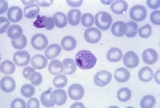
Plasmodium vivax

Encyclopedia
Plasmodium vivax is a protozoa
l parasite and a human pathogen
. The most frequent and widely distributed cause of recurring (tertian) malaria
, P. vivax is one of the four species of malarial parasite that commonly infect humans. It is less virulent than Plasmodium falciparum
, which is the deadliest of the four, and is seldom fatal. P. vivax is carried by the female Anopheles
mosquito, since it is the only sex of the species that bites.
(a pathologically enlarged spleen), but more often it causes debilitating – but non-fatal – symptoms. Overall it accounts for 65% of malaria cases in Asia
and South America
.
remains the treatment of choice for vivax malaria, except in Indonesia's Irian Jaya (Western New Guinea
) region and the geographically contiguous Papua New Guinea, where chloroquine resistance is common (up to 20% resistance). Chloroquine resistance is an increasing problem in other parts of the world, such as Korea,India.
When chloroquine resistance is common or when chloroquine is contraindicated, then artesunate
is the drug of choice, except in the U.S., where it is not approved for use. Where an artemisinin-based combination therapy has been adopted as the first-line treatment for P. falciparum malaria, it may also be used for P. vivax malaria in combination with primaquine for radical cure. An exception is artesunate plus sulfadoxine-pyrimethamine (AS+SP), which is not effective against P. vivax in many places. Mefloquine
is a good alternative and in some countries is more readily available. Atovaquone-proguanil is an effective alternative in patients unable to tolerate chloroquine. Quinine
may be used to treat vivax malaria but is associated with inferior outcomes.
Thirty-two to 100% of patients will relapse following successful treatment of P. vivax infection if a radical cure (eradication of liver stages) is not given. Eradication of the liver stages is achieved by giving primaquine
, after checking the patients G6PD status to reduce the risk of haemolysis. However, in severe G6PD deficiency, primaquine is contraindicated and should not be used. Recently, this point has taken particular importance for the increased incidence of vivax malaria among travelers. At least a 14-day course of primaquine is required for the radical treatment of P. vivax.
parasite on the Korean peninsula. In the years following the Korean War
(1950–53), malaria-eradication campaigns successfully reduced the number of new cases of the disease in North Korea
and South Korea
. In 1979, World Health Organization
declared the Korean peninsula vivax malaria-free, but the disease unexpectedly re-emerged in the late 1990s and still persists today. Several factors contributed to the re-emergence of the disease, including reduced emphasis on malaria control after 1979, floods and famine in North Korea
, emergence of drug resistance and possibly global warming
. Most cases are identified along the Korean Demilitarized Zone
. As such, vivax malaria offers the two Koreas a unique opportunity to work together on an important health problem that affects both countries.
Asexual forms:
Sexual forms: Gametocytes: Round. The gametocytes of P. vivax are commonly found in the peripheral blood at about the end of the first week of parasitemia.
It has been suggested that P. vivax has horizontally acquired
genetic material from humans.
for the infection usually ranges from ten to seventeen days and sometimes up to a year. Persistent liver stages allow relapse up to five years after elimination of red blood cell stages and clinical cure.
There are situations where some of the sporozoites do not immediately start to grow and divide after entering the hepatocyte, but remain in a dormant, hypnozoite stage for weeks or months. The duration of latency is variable from one hypnozoite to another and the factors that will eventually trigger growth are not known; this explains how a single infection can be responsible for a series of waves of parasitaemia or "relapses". Different strains of P. vivax have their own characteristic relapse pattern and timing.
The earlier stage is exo-erythrocytic generation.
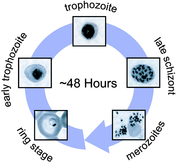 P. vivax preferentially penetrates young red blood cells (reticulocytes). In order to achieve this, merozoites have two proteins at their apical pole (PvRBP-1 and PvRBP-2). The parasite uses the Duffy blood group antigens
(Fy6) to penetrate red blood cells. This antigen does not occur in the majority of humans in West Africa [phenotype Fy (a-b-)]. As a result P. vivax occurs less frequently in West Africa.
The parasitised red blood cell
is up to twice as large as a normal red cell and Schüffner's dots
(also known as Schüffner's stippling or Schüffner's granules) is seen on the infected cell's surface, the spotted appearance of which varies in color from light pink, to red, to red-yellow, as coloured with Romanovsky stains. The parasite within it is often wildly irregular in shape (described as "amoeboid"). Schizonts of P. vivax have up to twenty merozoites within them. It is rare to see cells with more than one parasite within them. Merozoites will only attach to immature blood cell (reticulocytes) and therefore it is unusual to see more than 3% of all circulating erythrocytes parasitised.
Development of gametes from gametocytes is known as gametogony. When a female Anopheles mosquito bites an infected person, gametocytes and other stages of the parasite are transferred to the stomach where further development occur.
The microgametocytes becomes very active and its nucleus undergoes fission to give 6-8 daughter nuclei which becomes arranged at the periphery. The cytoplasm develops long thin flagella like projections, then a nucleus enter into each one of these extensions. These cytoplasmic extensions later break off as mature male gametes (microgametes). This process of formation of flagella like microgametes or male gametes is known as exflagellation.
Macrogametocytes show very little change. It develops a cone of reception at one side and becomes mature as female gamete / macrogameto cytes.
Male gametes move actively in the stomach of mosquito in search of female gamete. Male gamete then enters into female gamete through the cone of reception and the complete fusion of 2 gametes result in the formation of zygote. (synkaryon). Process of fusion of male and female gamete is called as syngamy. Fusion of 2 dissimilar gametes is known as anisogamy.
The zygote remains inactive for sometime but it soon elongates, becomes vermiform (worm-like) and motile. It is now known as ookinete. The pointed ends of ookinete penetrate the wall of stomach and comes to lie below its outer epithelial layer. Here it becomes spherical and develops a cyst wall around itself. The cyst wall is derived partly from the stomach tissues and partly produced by the zygote itself. At this stage, it is known as the oocyst. The oocyst absorbs nourishment and grow in size. These oocyst protrude (bulge) from the surface of stomach giving it a kind of blistered appearance. In a highly infected mosquito, as many as 1000 oocyst may be seen.
The nucleus of oocyst divides repeatedly to form large number of daughter nuclei. At the same time, the cytoplasm develops large vacuoles and forms numerous cytoplasmic masses. These cytoplasmic masses then elongate and a daughter nuclei migrates into each one of them. The resulting sickle-shaped bodies is known as sporozoites. This phase of asexual multiplication is known as sporogony and is completed in about 10-21 days. The oocyst then burst and sporozoites are relaesed into the body cavity of mosquito from where they eventually reach the salivary glands of mosquito through blood. The mosquito now becomes infectiv . Salivary glands of a single infected mosquito may contain as many as 200,000 sporozoites.
When the mosquito bites a healthy person, thousands of sporozoites are infected into the blood along with the saliva and the cycle starts again.
that has been sitting in EDTA
for more than half-an-hour before the blood film is made will look very similar in appearance to P. malariae
, which is an important reason to warn the laboratory immediately when the blood sample is drawn so they can process the sample as soon as it arrives. Blood films are preferably made within half-an-hour of the blood being drawn and must certainly be made within an hour of the blood being drawn.
Diagnosis can be done with the strip fast test of antibodies,
At present both types of P. vivax circulate in the Americas. The monkey parasite - Plasmodium simium - is related to the Old World strains rather than to the New World strains.
A specific name - Plasmodium collinsi - has been proposed for the New World strains but this suggestion has not been accepted to date.
Protozoa
Protozoa are a diverse group of single-cells eukaryotic organisms, many of which are motile. Throughout history, protozoa have been defined as single-cell protists with animal-like behavior, e.g., movement...
l parasite and a human pathogen
Pathogen
A pathogen gignomai "I give birth to") or infectious agent — colloquially, a germ — is a microbe or microorganism such as a virus, bacterium, prion, or fungus that causes disease in its animal or plant host...
. The most frequent and widely distributed cause of recurring (tertian) malaria
Malaria
Malaria is a mosquito-borne infectious disease of humans and other animals caused by eukaryotic protists of the genus Plasmodium. The disease results from the multiplication of Plasmodium parasites within red blood cells, causing symptoms that typically include fever and headache, in severe cases...
, P. vivax is one of the four species of malarial parasite that commonly infect humans. It is less virulent than Plasmodium falciparum
Plasmodium falciparum
Plasmodium falciparum is a protozoan parasite, one of the species of Plasmodium that cause malaria in humans. It is transmitted by the female Anopheles mosquito. Malaria caused by this species is the most dangerous form of malaria, with the highest rates of complications and mortality...
, which is the deadliest of the four, and is seldom fatal. P. vivax is carried by the female Anopheles
Anopheles
Anopheles is a genus of mosquito. There are approximately 460 recognized species: while over 100 can transmit human malaria, only 30–40 commonly transmit parasites of the genus Plasmodium, which cause malaria in humans in endemic areas...
mosquito, since it is the only sex of the species that bites.
Epidemiology
P. vivax is found mainly in the United States, Latin America, and in some parts of Africa. P. vivax can cause death due to splenomegalySplenomegaly
Splenomegaly is an enlargement of the spleen. The spleen usually lies in the left upper quadrant of the human abdomen. It is one of the four cardinal signs of hypersplenism, some reduction in the number of circulating blood cells affecting granulocytes, erythrocytes or platelets in any...
(a pathologically enlarged spleen), but more often it causes debilitating – but non-fatal – symptoms. Overall it accounts for 65% of malaria cases in Asia
Asia
Asia is the world's largest and most populous continent, located primarily in the eastern and northern hemispheres. It covers 8.7% of the Earth's total surface area and with approximately 3.879 billion people, it hosts 60% of the world's current human population...
and South America
South America
South America is a continent situated in the Western Hemisphere, mostly in the Southern Hemisphere, with a relatively small portion in the Northern Hemisphere. The continent is also considered a subcontinent of the Americas. It is bordered on the west by the Pacific Ocean and on the north and east...
.
Treatment
ChloroquineChloroquine
Chloroquine is a 4-aminoquinoline drug used in the treatment or prevention of malaria.-History:Chloroquine , N'--N,N-diethyl-pentane-1,4-diamine, was discovered in 1934 by Hans Andersag and co-workers at the Bayer laboratories who named it "Resochin". It was ignored for a decade because it was...
remains the treatment of choice for vivax malaria, except in Indonesia's Irian Jaya (Western New Guinea
Western New Guinea
West Papua informally refers to the Indonesian western half of the island of New Guinea and other smaller islands to its west. The region is officially administered as two provinces: Papua and West Papua. The eastern half of New Guinea is Papua New Guinea.The population of approximately 3 million...
) region and the geographically contiguous Papua New Guinea, where chloroquine resistance is common (up to 20% resistance). Chloroquine resistance is an increasing problem in other parts of the world, such as Korea,India.
When chloroquine resistance is common or when chloroquine is contraindicated, then artesunate
Artesunate
Artesunate is part of the artemisinin group of drugs that treat malaria. It is a semi-synthetic derivative of artemisinin that is water-soluble and may therefore be given by injection...
is the drug of choice, except in the U.S., where it is not approved for use. Where an artemisinin-based combination therapy has been adopted as the first-line treatment for P. falciparum malaria, it may also be used for P. vivax malaria in combination with primaquine for radical cure. An exception is artesunate plus sulfadoxine-pyrimethamine (AS+SP), which is not effective against P. vivax in many places. Mefloquine
Mefloquine
Mefloquine hydrochloride is an orally administered medication used in the prevention and treatment of malaria. Mefloquine was developed in the 1970s at the United States Department of Defense's Walter Reed Army Institute of Research as a synthetic analogue of quinine...
is a good alternative and in some countries is more readily available. Atovaquone-proguanil is an effective alternative in patients unable to tolerate chloroquine. Quinine
Quinine
Quinine is a natural white crystalline alkaloid having antipyretic , antimalarial, analgesic , anti-inflammatory properties and a bitter taste. It is a stereoisomer of quinidine which, unlike quinine, is an anti-arrhythmic...
may be used to treat vivax malaria but is associated with inferior outcomes.
Thirty-two to 100% of patients will relapse following successful treatment of P. vivax infection if a radical cure (eradication of liver stages) is not given. Eradication of the liver stages is achieved by giving primaquine
Primaquine
Primaquine is a medication used in the treatment of malaria and Pneumocystis pneumonia. It is a member of the 8-aminoquinoline group of drugs that includes tafenoquine and pamaquine.-Radical cure:...
, after checking the patients G6PD status to reduce the risk of haemolysis. However, in severe G6PD deficiency, primaquine is contraindicated and should not be used. Recently, this point has taken particular importance for the increased incidence of vivax malaria among travelers. At least a 14-day course of primaquine is required for the radical treatment of P. vivax.
Eradication efforts in Korea
P. vivax is the only indigenous malariaMalaria
Malaria is a mosquito-borne infectious disease of humans and other animals caused by eukaryotic protists of the genus Plasmodium. The disease results from the multiplication of Plasmodium parasites within red blood cells, causing symptoms that typically include fever and headache, in severe cases...
parasite on the Korean peninsula. In the years following the Korean War
Korean War
The Korean War was a conventional war between South Korea, supported by the United Nations, and North Korea, supported by the People's Republic of China , with military material aid from the Soviet Union...
(1950–53), malaria-eradication campaigns successfully reduced the number of new cases of the disease in North Korea
North Korea
The Democratic People’s Republic of Korea , , is a country in East Asia, occupying the northern half of the Korean Peninsula. Its capital and largest city is Pyongyang. The Korean Demilitarized Zone serves as the buffer zone between North Korea and South Korea...
and South Korea
South Korea
The Republic of Korea , , is a sovereign state in East Asia, located on the southern portion of the Korean Peninsula. It is neighbored by the People's Republic of China to the west, Japan to the east, North Korea to the north, and the East China Sea and Republic of China to the south...
. In 1979, World Health Organization
World Health Organization
The World Health Organization is a specialized agency of the United Nations that acts as a coordinating authority on international public health. Established on 7 April 1948, with headquarters in Geneva, Switzerland, the agency inherited the mandate and resources of its predecessor, the Health...
declared the Korean peninsula vivax malaria-free, but the disease unexpectedly re-emerged in the late 1990s and still persists today. Several factors contributed to the re-emergence of the disease, including reduced emphasis on malaria control after 1979, floods and famine in North Korea
North Korea
The Democratic People’s Republic of Korea , , is a country in East Asia, occupying the northern half of the Korean Peninsula. Its capital and largest city is Pyongyang. The Korean Demilitarized Zone serves as the buffer zone between North Korea and South Korea...
, emergence of drug resistance and possibly global warming
Global warming
Global warming refers to the rising average temperature of Earth's atmosphere and oceans and its projected continuation. In the last 100 years, Earth's average surface temperature increased by about with about two thirds of the increase occurring over just the last three decades...
. Most cases are identified along the Korean Demilitarized Zone
Korean Demilitarized Zone
The Korean Demilitarized Zone is a strip of land running across the Korean Peninsula that serves as a buffer zone between North and South Korea. The DMZ cuts the Korean Peninsula roughly in half, crossing the 38th parallel on an angle, with the west end of the DMZ lying south of the parallel and...
. As such, vivax malaria offers the two Koreas a unique opportunity to work together on an important health problem that affects both countries.
Biology
P. vivax can reproduce both asexually and sexually, depending on its life cycle stage.Asexual forms:
- Immature trophozoites (Ring or signet-ring shaped), about 1/3 of the diameter of a RBC.
- Mature trophozoites: Very irregular and delicate (described as amoeboid); many pseudopodial processes seen. Presence of fine grains of brown pigment (malarial pigment) or hematin probably derived from the haemoglobin of the infected red blood cell.
- Schizonts (also called meronts): As large as a normal red cell; thus the parasitized corpuscle becomes distended and larger than normal. There are about sixteen merozoites.
Sexual forms: Gametocytes: Round. The gametocytes of P. vivax are commonly found in the peripheral blood at about the end of the first week of parasitemia.
It has been suggested that P. vivax has horizontally acquired
Horizontal gene transfer
Horizontal gene transfer , also lateral gene transfer , is any process in which an organism incorporates genetic material from another organism without being the offspring of that organism...
genetic material from humans.
Life cycle
The incubation periodIncubation period
Incubation period is the time elapsed between exposure to a pathogenic organism, a chemical or radiation, and when symptoms and signs are first apparent...
for the infection usually ranges from ten to seventeen days and sometimes up to a year. Persistent liver stages allow relapse up to five years after elimination of red blood cell stages and clinical cure.
Human infection
The infection of Plasmodium vivax takes place in human when an infected female anopheles mosquito sucks blood from a healthy person. During feeding, the mosquito injects sporozoites to prevent blood clotting and saliva, thousands of sporozoites are inoculated into human blood; within a half-hour the sporozoites reach the liver. There they enter hepatic cells, transform into the tropozoite form and feed on hepatic cells, and reproduce asexually. This process gives rise to thousands of merozoites (plasmodium daughter cells) in the circulatory system and the liver.Liver stage
The P. vivax sporozoite enters a hepatocyte and begins its exoerythrocytic schizogony stage. This is characterized by multiple rounds of nuclear division without cellular segmentation. After a certain number of nuclear divisions, the parasite cell will segment and merozoites are formed.There are situations where some of the sporozoites do not immediately start to grow and divide after entering the hepatocyte, but remain in a dormant, hypnozoite stage for weeks or months. The duration of latency is variable from one hypnozoite to another and the factors that will eventually trigger growth are not known; this explains how a single infection can be responsible for a series of waves of parasitaemia or "relapses". Different strains of P. vivax have their own characteristic relapse pattern and timing.
The earlier stage is exo-erythrocytic generation.
Erythrocytic cycle
Duffy antigen
Duffy antigen/chemokine receptor also known as Fy glycoprotein or CD234 is a protein that in humans is encoded by the DARC gene....
(Fy6) to penetrate red blood cells. This antigen does not occur in the majority of humans in West Africa [phenotype Fy (a-b-)]. As a result P. vivax occurs less frequently in West Africa.
The parasitised red blood cell
Red blood cell
Red blood cells are the most common type of blood cell and the vertebrate organism's principal means of delivering oxygen to the body tissues via the blood flow through the circulatory system...
is up to twice as large as a normal red cell and Schüffner's dots
Schüffner's dots
Schüffner's dots refers to a hematological finding that is associated with malaria, exclusively found in Plasmodium ovale and Plasmodium vivax....
(also known as Schüffner's stippling or Schüffner's granules) is seen on the infected cell's surface, the spotted appearance of which varies in color from light pink, to red, to red-yellow, as coloured with Romanovsky stains. The parasite within it is often wildly irregular in shape (described as "amoeboid"). Schizonts of P. vivax have up to twenty merozoites within them. It is rare to see cells with more than one parasite within them. Merozoites will only attach to immature blood cell (reticulocytes) and therefore it is unusual to see more than 3% of all circulating erythrocytes parasitised.
Sexual stage
The sexual stage includes following processes by which P. vivax reproduces sexually:- Transfer to mosquito
- Gametogenesis
- Microgametes
- Macrogametes
- Fertilization
- Ookinite
- Oocyst
- Sporogony
Formation of gametes
Development of gametes from gametocytes is known as gametogony. When a female Anopheles mosquito bites an infected person, gametocytes and other stages of the parasite are transferred to the stomach where further development occur.
The microgametocytes becomes very active and its nucleus undergoes fission to give 6-8 daughter nuclei which becomes arranged at the periphery. The cytoplasm develops long thin flagella like projections, then a nucleus enter into each one of these extensions. These cytoplasmic extensions later break off as mature male gametes (microgametes). This process of formation of flagella like microgametes or male gametes is known as exflagellation.
Macrogametocytes show very little change. It develops a cone of reception at one side and becomes mature as female gamete / macrogameto cytes.
Fertilization
Male gametes move actively in the stomach of mosquito in search of female gamete. Male gamete then enters into female gamete through the cone of reception and the complete fusion of 2 gametes result in the formation of zygote. (synkaryon). Process of fusion of male and female gamete is called as syngamy. Fusion of 2 dissimilar gametes is known as anisogamy.
The zygote remains inactive for sometime but it soon elongates, becomes vermiform (worm-like) and motile. It is now known as ookinete. The pointed ends of ookinete penetrate the wall of stomach and comes to lie below its outer epithelial layer. Here it becomes spherical and develops a cyst wall around itself. The cyst wall is derived partly from the stomach tissues and partly produced by the zygote itself. At this stage, it is known as the oocyst. The oocyst absorbs nourishment and grow in size. These oocyst protrude (bulge) from the surface of stomach giving it a kind of blistered appearance. In a highly infected mosquito, as many as 1000 oocyst may be seen.
Sporogony
The nucleus of oocyst divides repeatedly to form large number of daughter nuclei. At the same time, the cytoplasm develops large vacuoles and forms numerous cytoplasmic masses. These cytoplasmic masses then elongate and a daughter nuclei migrates into each one of them. The resulting sickle-shaped bodies is known as sporozoites. This phase of asexual multiplication is known as sporogony and is completed in about 10-21 days. The oocyst then burst and sporozoites are relaesed into the body cavity of mosquito from where they eventually reach the salivary glands of mosquito through blood. The mosquito now becomes infectiv . Salivary glands of a single infected mosquito may contain as many as 200,000 sporozoites.
When the mosquito bites a healthy person, thousands of sporozoites are infected into the blood along with the saliva and the cycle starts again.
Laboratory considerations
P. vivax and P. ovalePlasmodium ovale
Plasmodium ovale is a species of parasitic protozoa that causes tertian malaria in humans. It is closely related to Plasmodium falciparum and Plasmodium vivax, which are responsible for most malaria. It is rare compared to these two parasites, and substantially less dangerous than P...
that has been sitting in EDTA
EDTA
Ethylenediaminetetraacetic acid, widely abbreviated as EDTA , is a polyamino carboxylic acid and a colourless, water-soluble solid. Its conjugate base is named ethylenediaminetetraacetate. It is widely used to dissolve limescale. Its usefulness arises because of its role as a hexadentate ligand...
for more than half-an-hour before the blood film is made will look very similar in appearance to P. malariae
Plasmodium malariae
Plasmodium malariae is a parasitic protozoa that causes malaria in humans. It is closely related to Plasmodium falciparum and Plasmodium vivax which are responsible for most malarial infection. While found worldwide, it is a so-called "benign malaria" and is not nearly as dangerous as that...
, which is an important reason to warn the laboratory immediately when the blood sample is drawn so they can process the sample as soon as it arrives. Blood films are preferably made within half-an-hour of the blood being drawn and must certainly be made within an hour of the blood being drawn.
Diagnosis can be done with the strip fast test of antibodies,
Taxonomy
P. vivax can be divided into two clades one that appears to have origins in the Old World and a second that originated in the New World. The distinction can be made on the basis of the structure of the A and S forms of the rRNA. A rearrangement of these genes appears to have occurred in the New World strains. It appears that a gene conversion occurred in an Old World strain and this strain gave rise to the New World strains. The timing of this event has yet to be established.At present both types of P. vivax circulate in the Americas. The monkey parasite - Plasmodium simium - is related to the Old World strains rather than to the New World strains.
A specific name - Plasmodium collinsi - has been proposed for the New World strains but this suggestion has not been accepted to date.