


Pit stop

Encyclopedia
In motorsport
s, a pit stop is where a racing vehicle
stops in the pits during a race for refuelling, new tire
s, repairs, mechanical adjustments, a driver change, or any combination of the above. Not all are allowed in all formulae.
The pits usually comprise a pit lane which runs parallel to the start/finish straight and is connected at each end to the main track, and a row of garage
s (usually one per team) outside which the work is done. Pit stop work is carried out by anywhere from five to twenty mechanic
s (also called a pit crew), depending on the series regulations, while the driver waits in the vehicle (except where a driver change is involved). In American racing series, a pit lane consists of a number of pit stalls and a concrete pit wall which separates the pit lane from the infield, with the garages on a separate road in the infield; European racing series typically have the individual garage stalls open directly onto the pit lane through the team's assigned pit stall. In American English
, it is common to drop the definite article
and just refer to "pit lane", whereas in British English
one would always refer to "the pit lane".
By making pit stops cars can carry less fuel, and therefore be lighter and faster, and use softer tires that wear faster but provide more grip. Teams usually plan for each of their cars to pit following a planned schedule, the number of stops determined by the fuel capacity of the car, tire lifespan, and tradeoff of time lost in the pits versus how much time may be gained on the race track through the benefits of pit stops. Choosing the optimum pit strategy of how many stops to make and when to make them is crucial in having a successful race. It is also important for teams to take competitors' strategies into account when planning pit stops, to avoid being "held up" behind other cars. An unscheduled or extended stop, such as for a repair, can be very costly for a driver's chance of success, because while the car is stopped for service, cars remaining on the track can rapidly gain distance on the stopped car.
However, the car that made the additional pit stop will run faster on the race track than cars that did not make the stop, both because it can carry a smaller amount (and thus lower weight) of fuel, and will also have less wear on its tires, providing more traction and allowing higher speeds in the corners. In racing series where teams have their choice of different compound tires, the lower tire wear may be enough to allow the team to choose to use a tire with a softer rubber compound that provides increased grip at the expense of faster wear; going longer between stops may even cause enough wear on the softer tire to cause the tires to fail.
Because of this, race teams plan a pit strategy prior to the start of every race. This is a schedule for each car's planned pit stops during the race, and takes into account factors such as rate of fuel consumption, weight of fuel, cornering speed with each available tire compound, rate of tire wear, the effect of tire wear on cornering speed, the length of pit road and the track's pit road speed limit
, and even expected changes in weather and lighting conditions. The pit strategy does not just include a schedule of when pit stops will happen; it also includes what service and adjustments are scheduled for each pit stop, particularly in endurance racing, where scheduled changes of wear-limited parts such as brake pads
may be planned for specific points during the race. The pit strategy is calculated carefully so that the amount of time to be "given away" to other competitors in pit stops is balanced out by the time gained while on the track, resulting, theoretically, in the shortest possible time to cover the scheduled distance.
However, a team's pit strategy is not a fixed, immutable thing; it is subject to change during the race to take into account the unpredictable events that happen in every race. In road racing
, for example, if the weather changes from dry to rain, teams will be forced to recalculate their pit strategy based on the unscheduled stop to change from dry-weather "slick" tires
to treaded wet-weather tires. Full-course caution periods often see mass pit stops by many teams, hoping to take advantage of the slowed pace to reduce the ground lost to other teams while making pit stops; this forces teams that do so to immediately recalculate their pit strategy to optimize it for the remaining race distance after the stop.
Even when a team chooses not to take advantage of the opportunity to stop during a full-course caution, it can still result in significant changes to pit strategy; under caution, the cars run at a reduced speed that results in greatly reduced tire wear and fuel burn for a distance traveled. Depending on the circumstances, this may be enough for a team to gain more by choosing not to pit, hoping that the reduced fuel burn and tire wear will allow them to make one pit stop fewer than the other teams, allowing them to gain distance and time on their opponents. At tracks noted for frequent full-course cautions, teams may even plan their entire race strategy around this, using a suspension and aerodynamic setup suited to short sprints instead of extended runs to gain positions in the short bursts of green-flag racing, and planning their pit strategy on the assumption that cautions will extend their fuel mileage and tire wear enough to make fewer stops than would otherwise be needed to complete the race distance.
Other services performed in routine pit stops include removing debris from radiator
air intakes; cleaning the windshield; and making adjustments to tire pressure, suspension settings
, and aerodynamic devices to optimize the car's performance for the current conditions. In endurance racing, scheduled driver changes and brake pad replacements are also considered "routine" service when done as part of a scheduled pit stop.
An unscheduled pit stop may see other service performed; because unscheduled stops are usually due to damage or mechanical problems, they frequently see emergency repairs performed on the car. These tend to have extremely long duration, due to the need to diagnose the car's problems prior to the time-consuming repairs.
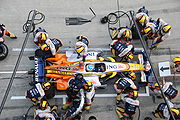 In Formula One
, mid race refueling is currently not permitted by the regulations, and cars make pit stops with the primary purpose of changing tyres. Teams sometimes also make adjustments to the front and rear wings and perform minor repairs, most commonly replacing the nose and front wing assembly. Pit strategies generally call for between one and three scheduled stops, depending on the circuit. The driving between pit stops are commonly known as 'stints'.
When the car is approximately one lap away from making its stop, the team's pit crew will set up fresh tires and all needed pit equipment. Because of the overhead pneumatic rig, the team may have all pit mechanics in position prior to the car's arrival, with the exception of the rear jack man.
Interestingly, unlike almost all other forms of racing that feature routine pit stops, Formula One rules limit teams to a single pit crew for the mandatory two cars entered. Therefore, teams must stagger their pit schedules so that only one of their two cars is in the pits at any given time. Most other racing series that feature routine pit stops permit each car its own pit stall and crew.
until the end of the 2009 season
. During this period, a pit stop involved about twenty mechanics, with the aim of completing the stop as quickly as possible. Stops generally lasted for six to twelve seconds depending on how much fuel is put into the car. However, if there is a problem, such as a fuel pump failing or the engine stalling, or repairs having to be made, it can take much longer. Cars were fueled at a rate of more than 12 liters per second. This is accomplished by a fairly complex closed system that pumps air out of the car's fuel tank as the fuel is being pumped in.
As refueling is a potentially hazardous situation, the mechanics wore fire-resistant multi-layer suits
& flame-resistant glove
s, long underwear, balaclava, sock
s and shoe
s, which have to meet the guidelines set by FIA Standard 8856-2000.http://www.fia.com/sport/Regulations/driverequipregs.html
is regarded as the first former professional athlete involved in a pit crew, as a jackman. Nonetheless, pit crew members work with the team in fabricating or designing the race cars during the week while training for their "pit job" on the weekends.
Teams will be penalized if the car is serviced outside of the designated pit stall, if the car drives over an air hose, or if any of the old tires are not on the pit wall side (usually left) of the vehicle's centerline before the car leaves. If a car stalls, the pit crew may provide a push start
, but the car cannot be pushed beyond three pit stalls ahead of its own, or beyond the paddle man at the end of pit road. A pit stop for four tires and fuel can last 12–16 seconds, and a stop for two tires and fuel may take 5–7 seconds. These times depend upon any suspension adjustments performed and the quality of the crew.
NASCAR Sprint Cup Series team pit strategies vary widely, depending on the track. Fuel is generally a more limiting factor than tire wear, and the phrase "fuel window" or "pit window" is used to indicate the maximum number of laps possible with a full load of fuel, assuming continuous green flag conditions and a small reserve. The window is used to calculate (or recalculate after a stop) the minimum number of pit stops required to complete the race. The road courses on the schedule may see as few as two scheduled stops; oval
race tracks generally see between four and six scheduled stops. Races at short tracks such as Bristol Motor Speedway
and Martinsville Speedway
are short enough to be completed with only two scheduled stops for fuel, but teams plan on more stops due to rapid tire wear and significant loss of cornering speed on worn tires.
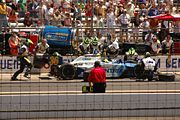 In the IndyCar Series
, a pit stop is a more complex operation than in NASCAR, but far less so than in Formula One. Rules permit six mechanics over the pit wall during a stop. The pit rules and procedures have origins in USAC
National Championship racing.
During a routine pit stop in either series, the tires are laid out and three of the four tire changers are pre-positioned before the car enters its pit stall; the fourth tire changer, whose responsibility is the rear tire on the far side of pit road from the pit wall, doesn't take his position until after the car arrives, due to a rule against having the car run over the feed hose for the impact wrench used to change the tires.
After the car arrives, the first step, taken while the fourth tire changer takes his position, is for a mechanic to insert the "vent hose" into its socket on the engine cowling. This hose vents the air out of the fuel tank, captures any overflow fuel, and also activates the car's built-in pneumatic
jacks. After the vent hose is in place, another mechanic attaches the refueling hose to its socket, allowing the ethanol
fuel to flow into the fuel tank. Simultaneously, the four tire changers remove the tires and install the new ones. After the tire changes are complete, the front tire changers may use manual adjusters to adjust the angle of the car's front wing.
After the tire changes are complete, the vent hose is removed, allowing the car to return to its wheels. However, the driver usually must wait until the fueling is finished and the fuel hose is removed from the car. The right front tire changer (who is usually also the crew chief) signals the driver when the stop is complete. Before the car departs its pit stall, a crew member must use a squirt of water to wash any excess fuel from the fuel hose and vent hose sockets; this is usually done with a pressurized hose by a crew member behind the pit wall.
Under normal conditions, a routine stop for an IndyCar team lasts between ten and fourteen seconds. IndyCar teams are permitted to set their own pit strategies.
endurance racing, pit stops are a more leisurely affair, but no less important than in other forms of racing. While stops take longer, much more routine maintenance is scheduled during such pit stops, needed to keep the car running for as long as twenty-four hours; this includes major aerodynamic changes to deal with the changing temperature in such a long race, and replacement of certain wear-limited parts, such as brake pads. Due to the fact that the race is scheduled to last a certain length of time rather than a specific distance, pit strategies are generally not designed to be synchronized with the race distance, but rather to happen on a schedule based on the car's requirements for routine service.
Under the rules of the Automobile Club de l'Ouest
(ACO) {used by the American Le Mans Series
and Le Mans Series
} only five mechanics are permitted to work on the car. One man is permitted to fuel the car; all fueling must be completed before any other service occurs. The other four mechanics on pit lane at any given time are typically two tire changers and two tire carriers, each of whom handles his task on only one side of the car. Automatic pneumatic jacks are used, integrated into the car itself.
The Grand American Road Racing Association
allows only four mechanics to service a car during a pit stop. One crew member will refuel the car while the other three are responsible for changing tires and operating the pneumatic jacks. A fifth crewmember must serve as the teams designated firefighter
and must stand ready in the pit stall with a fire extinguisher while the car is being refueled. A sixth crewmember may assist in a driver change. Neither the firefighter or driver's assistant may perform any additional service to the car itself.Unlike the ACO, Grand-Am does not force crews to wait for fueling to complete before changing tires.
In endurance racing, driver changes are mandatory; the shortest endurance races are scheduled for four hours, one hour longer than the longest nonstop time permitted behind the wheel. During a pit stop with a driver change, the new driver and a driver change assistant are permitted into the pit lane. The assistant, who may not do any mechanical work on the car, is tasked with helping the current driver out of the car, removing or swapping driver seat inserts, helping the new driver into the car, and helping the new driver tightly fasten his safety harness
and connect his various helmet connections to the car's systems, including the two-way team radio and the drink bottle used to stave off dehydration
.
A routine pit stop with no scheduled maintenance and no driver change generally lasts from thirty to forty seconds. With a driver change included, that time increases by about ten seconds. Should there be significant scheduled maintenance, such as changing brake pads, the stop can easily last well more than a minute.
Unlike most other forms of racing, the rules of endurance racing require that the car's engine
be shut off during the stop. Another difference from most forms of racing is found in the practice of "double-stinting" or even "triple-stinting" tires; tires hard enough to withstand the rigors of racing in the heat of the daytime may be so hard that they do not wear significantly during the nighttime hours. In a race where this is an issue, significant time can be gained by choosing to leave worn tires on the car during the first stop after they were put on the car; if the temperature drops low enough, teams may even be able to go two pit stops without changing tires.
Auto racing
Auto racing is a motorsport involving the racing of cars for competition. It is one of the world's most watched televised sports.-The beginning of racing:...
s, a pit stop is where a racing vehicle
Vehicle
A vehicle is a device that is designed or used to transport people or cargo. Most often vehicles are manufactured, such as bicycles, cars, motorcycles, trains, ships, boats, and aircraft....
stops in the pits during a race for refuelling, new tire
Tire
A tire or tyre is a ring-shaped covering that fits around a wheel rim to protect it and enable better vehicle performance by providing a flexible cushion that absorbs shock while keeping the wheel in close contact with the ground...
s, repairs, mechanical adjustments, a driver change, or any combination of the above. Not all are allowed in all formulae.
The pits usually comprise a pit lane which runs parallel to the start/finish straight and is connected at each end to the main track, and a row of garage
Automobile repair shop
An automobile repair shop is a place where automobiles are repaired by auto mechanics and electricians.- Types :The automotive garage can be divided in so many category....
s (usually one per team) outside which the work is done. Pit stop work is carried out by anywhere from five to twenty mechanic
Mechanic
A mechanic is a craftsman or technician who uses tools to build or repair machinery.Many mechanics are specialized in a particular field such as auto mechanics, bicycle mechanics, motorcycle mechanics, boiler mechanics, general mechanics, industrial maintenance mechanics , air conditioning and...
s (also called a pit crew), depending on the series regulations, while the driver waits in the vehicle (except where a driver change is involved). In American racing series, a pit lane consists of a number of pit stalls and a concrete pit wall which separates the pit lane from the infield, with the garages on a separate road in the infield; European racing series typically have the individual garage stalls open directly onto the pit lane through the team's assigned pit stall. In American English
American English
American English is a set of dialects of the English language used mostly in the United States. Approximately two-thirds of the world's native speakers of English live in the United States....
, it is common to drop the definite article
Definite Article
Definite Article is the title of British comedian Eddie Izzard's 1996 performance released on VHS. It was recorded on different nights at the Shaftesbury Theatre...
and just refer to "pit lane", whereas in British English
British English
British English, or English , is the broad term used to distinguish the forms of the English language used in the United Kingdom from forms used elsewhere...
one would always refer to "the pit lane".
By making pit stops cars can carry less fuel, and therefore be lighter and faster, and use softer tires that wear faster but provide more grip. Teams usually plan for each of their cars to pit following a planned schedule, the number of stops determined by the fuel capacity of the car, tire lifespan, and tradeoff of time lost in the pits versus how much time may be gained on the race track through the benefits of pit stops. Choosing the optimum pit strategy of how many stops to make and when to make them is crucial in having a successful race. It is also important for teams to take competitors' strategies into account when planning pit stops, to avoid being "held up" behind other cars. An unscheduled or extended stop, such as for a repair, can be very costly for a driver's chance of success, because while the car is stopped for service, cars remaining on the track can rapidly gain distance on the stopped car.
General strategy
In any racing series that permits scheduled pit stops, pit strategy becomes one of the most important features of the race; this is because a race car traveling at 100 miles per hour (160 kilometers per hour) will travel approximately 150 feet (45 meters) per second. During a ten-second pit stop, a car's competitors will gain approximately one-quarter mile (one-half kilometer) over the stopped car.However, the car that made the additional pit stop will run faster on the race track than cars that did not make the stop, both because it can carry a smaller amount (and thus lower weight) of fuel, and will also have less wear on its tires, providing more traction and allowing higher speeds in the corners. In racing series where teams have their choice of different compound tires, the lower tire wear may be enough to allow the team to choose to use a tire with a softer rubber compound that provides increased grip at the expense of faster wear; going longer between stops may even cause enough wear on the softer tire to cause the tires to fail.
Because of this, race teams plan a pit strategy prior to the start of every race. This is a schedule for each car's planned pit stops during the race, and takes into account factors such as rate of fuel consumption, weight of fuel, cornering speed with each available tire compound, rate of tire wear, the effect of tire wear on cornering speed, the length of pit road and the track's pit road speed limit
Speed limit
Road speed limits are used in most countries to regulate the speed of road vehicles. Speed limits may define maximum , minimum or no speed limit and are normally indicated using a traffic sign...
, and even expected changes in weather and lighting conditions. The pit strategy does not just include a schedule of when pit stops will happen; it also includes what service and adjustments are scheduled for each pit stop, particularly in endurance racing, where scheduled changes of wear-limited parts such as brake pads
Brake pads
Brake pads are a component of disk brakes used in automotive and other applications. Brake pads are steel backing plates with friction material bound to the surface that faces the disk brake rotor.- Function :...
may be planned for specific points during the race. The pit strategy is calculated carefully so that the amount of time to be "given away" to other competitors in pit stops is balanced out by the time gained while on the track, resulting, theoretically, in the shortest possible time to cover the scheduled distance.
However, a team's pit strategy is not a fixed, immutable thing; it is subject to change during the race to take into account the unpredictable events that happen in every race. In road racing
Road racing
Road racing is a general term for most forms of motor racing held on paved, purpose-built race tracks , as opposed to oval tracks and off-road racing...
, for example, if the weather changes from dry to rain, teams will be forced to recalculate their pit strategy based on the unscheduled stop to change from dry-weather "slick" tires
Slick tire
A slick tyre is a type of tyre that has no tread pattern, used mostly in auto racing. The first production "slick tyre" was developed by a company called M&H Tires in the early 1950s for use in drag racing...
to treaded wet-weather tires. Full-course caution periods often see mass pit stops by many teams, hoping to take advantage of the slowed pace to reduce the ground lost to other teams while making pit stops; this forces teams that do so to immediately recalculate their pit strategy to optimize it for the remaining race distance after the stop.
Even when a team chooses not to take advantage of the opportunity to stop during a full-course caution, it can still result in significant changes to pit strategy; under caution, the cars run at a reduced speed that results in greatly reduced tire wear and fuel burn for a distance traveled. Depending on the circumstances, this may be enough for a team to gain more by choosing not to pit, hoping that the reduced fuel burn and tire wear will allow them to make one pit stop fewer than the other teams, allowing them to gain distance and time on their opponents. At tracks noted for frequent full-course cautions, teams may even plan their entire race strategy around this, using a suspension and aerodynamic setup suited to short sprints instead of extended runs to gain positions in the short bursts of green-flag racing, and planning their pit strategy on the assumption that cautions will extend their fuel mileage and tire wear enough to make fewer stops than would otherwise be needed to complete the race distance.
Services performed
During a scheduled pit stop, the team's pit crew services the car as swiftly as possible, completing a number of different services. The most visible services performed are refueling the car and changing tires.Other services performed in routine pit stops include removing debris from radiator
Radiator
Radiators are heat exchangers used to transfer thermal energy from one medium to another for the purpose of cooling and heating. The majority of radiators are constructed to function in automobiles, buildings, and electronics...
air intakes; cleaning the windshield; and making adjustments to tire pressure, suspension settings
Suspension (vehicle)
Suspension is the term given to the system of springs, shock absorbers and linkages that connects a vehicle to its wheels. Suspension systems serve a dual purpose — contributing to the car's roadholding/handling and braking for good active safety and driving pleasure, and keeping vehicle occupants...
, and aerodynamic devices to optimize the car's performance for the current conditions. In endurance racing, scheduled driver changes and brake pad replacements are also considered "routine" service when done as part of a scheduled pit stop.
An unscheduled pit stop may see other service performed; because unscheduled stops are usually due to damage or mechanical problems, they frequently see emergency repairs performed on the car. These tend to have extremely long duration, due to the need to diagnose the car's problems prior to the time-consuming repairs.
Formula One
Formula One
Formula One, also known as Formula 1 or F1 and referred to officially as the FIA Formula One World Championship, is the highest class of single seater auto racing sanctioned by the Fédération Internationale de l'Automobile . The "formula" designation in the name refers to a set of rules with which...
, mid race refueling is currently not permitted by the regulations, and cars make pit stops with the primary purpose of changing tyres. Teams sometimes also make adjustments to the front and rear wings and perform minor repairs, most commonly replacing the nose and front wing assembly. Pit strategies generally call for between one and three scheduled stops, depending on the circuit. The driving between pit stops are commonly known as 'stints'.
When the car is approximately one lap away from making its stop, the team's pit crew will set up fresh tires and all needed pit equipment. Because of the overhead pneumatic rig, the team may have all pit mechanics in position prior to the car's arrival, with the exception of the rear jack man.
Interestingly, unlike almost all other forms of racing that feature routine pit stops, Formula One rules limit teams to a single pit crew for the mandatory two cars entered. Therefore, teams must stagger their pit schedules so that only one of their two cars is in the pits at any given time. Most other racing series that feature routine pit stops permit each car its own pit stall and crew.
Refueling
Refueling was permitted from the 1994 season1994 Formula One season
The 1994 Formula One season was the 45th season of FIA Formula One motor racing. It featured the 1994 FIA Formula One World Championship which commenced on March 27, 1994, and ended on November 13 after sixteen races. The season is remembered as one of the most tragic and controversial seasons in...
until the end of the 2009 season
2009 Formula One season
The 2009 Formula One season was the 60th FIA Formula One World Championship season. The season took place over 17 rounds, and started with the on 29 March 2009. It ended on 1 November 2009 with the inaugural ....
. During this period, a pit stop involved about twenty mechanics, with the aim of completing the stop as quickly as possible. Stops generally lasted for six to twelve seconds depending on how much fuel is put into the car. However, if there is a problem, such as a fuel pump failing or the engine stalling, or repairs having to be made, it can take much longer. Cars were fueled at a rate of more than 12 liters per second. This is accomplished by a fairly complex closed system that pumps air out of the car's fuel tank as the fuel is being pumped in.
As refueling is a potentially hazardous situation, the mechanics wore fire-resistant multi-layer suits
Nomex
Nomex is a registered trademark for flame resistant meta-aramid material developed in the early 1960s by DuPont and first marketed in 1967.- Properties:...
& flame-resistant glove
Glove
A glove is a garment covering the hand. Gloves have separate sheaths or openings for each finger and the thumb; if there is an opening but no covering sheath for each finger they are called "fingerless gloves". Fingerless gloves with one large opening rather than individual openings for each...
s, long underwear, balaclava, sock
Sock
A sock is an item of clothing worn on the feet. The foot is among the heaviest producers of sweat in the body, as it is able to produce over of perspiration per day. Socks help to absorb this sweat and draw it to areas where air can evaporate the perspiration. In cold environments, socks decrease...
s and shoe
Shoe
A shoe is an item of footwear intended to protect and comfort the human foot while doing various activities. Shoes are also used as an item of decoration. The design of shoes has varied enormously through time and from culture to culture, with appearance originally being tied to function...
s, which have to meet the guidelines set by FIA Standard 8856-2000.http://www.fia.com/sport/Regulations/driverequipregs.html
F1 pit crew roles
- The "Lollipop Man" holds the team's pit sign, helping the driver identify his pit stall on a possibly crowded pit road. During the stop, he holds the sign in position to remind the driver to keep his brakes on while tires are being changed, and then to remember to put the car in first gear once the jacks are lowered. He also gives the driver the sign to depart his pit stall by raising the sign from in front of the driver.
- In 20082008 Formula One seasonThe 2008 Formula One season was the 59th FIA Formula One World Championship season. It began on 16 March and ended on 2 November with eighteen Grand Prix races....
, FerrariScuderia FerrariScuderia Ferrari is the racing team division of the Ferrari automobile marque. The team currently only races in Formula One but has competed in numerous classes of motorsport since its formation in 1929, including sportscar racing....
used a traffic lightTraffic lightTraffic lights, which may also be known as stoplights, traffic lamps, traffic signals, signal lights, robots or semaphore, are signalling devices positioned at road intersections, pedestrian crossings and other locations to control competing flows of traffic...
system to replace the Lollipop Man. A red light signaled the driver to keep his brakes on, an amber light to put the car in first gear, and a green light to signal the driver to depart his pit stall. However, after human error caused Felipe MassaFelipe MassaFelipe Massa is a Brazilian Formula One racing driver. He finished second in the Drivers' World Championship, and is under contract to race for Scuderia Ferrari until the end of the season.-Early years:...
to drive off with his fuel hose still attached during the Singapore Grand Prix2008 Singapore Grand PrixThe 2008 Singapore Grand Prix, formally known as the 2008 Formula 1 SingTel Singapore Grand Prix, was a Formula One race held on 28 September 2008 at the newly built Marina Bay Street Circuit in Marina Bay, Singapore...
, Ferrari reverted back to the Lollipop Man system. However, in the 2010 and current 2011 season, Ferrari have once again reverted to a traffic light system, as have some other teams.
- In 2008
- The four tyre changers, one at each corner of the car, have the sole responsibility of using a pneumatic wrench to remove the car's single locking lug nutLug nutA lug nut is a fastener, specifically a nut, used to secure a wheel on a vehicle. Typically, lug nuts are found on automobiles, trucks , and other large vehicles utilizing rubber tires.-Design:...
from each tyre, then reinstall it on the new tyre. - Eight tyre carriers are used, two at each corner of the car, one assigned the task of removing the old tyre from the car, and one to install the new tyre on it. The front new tyre carriers also have the responsibility of adjusting the car's front wing during the stop.
- The front and rear jack men use simple leverLeverIn physics, a lever is a rigid object that is used with an appropriate fulcrum or pivot point to either multiply the mechanical force that can be applied to another object or resistance force , or multiply the distance and speed at which the opposite end of the rigid object travels.This leverage...
-type jacks to lift the car and permit the changing of tyres. The job of front jack man is considered the most hazardous, as it requires standing directly in front of the car as it enters its pit stall. By contrast, due to the location of his duties directly behind the car, the rear jack man is the only team member not in his working position before the car enters its pit stall. - The fire extinguisher man does not actually work on the car; instead, he stands ready with a hand-held fire extinguisherFire extinguisherA fire extinguisher or extinguisher, flame entinguisher is an active fire protection device used to extinguish or control small fires, often in emergency situations...
to try and stop any accidental fires that may occur during a stop, at least long enough for the pit crew and driver to evacuate. This job became standard following Jos VerstappenJos VerstappenJohannes Franciscus "Jos" Verstappen nicknamed "Jos the Boss" is a Dutch racing driver. He is the most successful Dutch Formula One driver, and has also won races in A1 Grand Prix and Le Mans Series LMP2 races...
's 1994 pit fire. - The starter man does not normally work on the car. His job is to stand ready with a starter tool to restart the car should the driver stall his engineStall (engine)A stall is the slowing or stopping of a process, and in the case of an engine, refers to a sudden stopping of the engine turning, usually brought about accidentally....
during the stop.
NASCAR Sprint Cup Series
Crew chiefs lead the pit crew during pit stops in addition to coaching the driver during the race. Pit crew members were once the mechanics on the racecar, but most teams feature individuals dedicated to pit stops only, and often former collegiate or professional athletes are used for pit stops. Former NFL player Tim GoadTim Goad
Tim Goad is a former American football defensive tackle who played for three teams in a 9-year National Football League career. He is regarded as the first former professional athlete involved in a pit crew, as a jackman....
is regarded as the first former professional athlete involved in a pit crew, as a jackman. Nonetheless, pit crew members work with the team in fabricating or designing the race cars during the week while training for their "pit job" on the weekends.
Teams will be penalized if the car is serviced outside of the designated pit stall, if the car drives over an air hose, or if any of the old tires are not on the pit wall side (usually left) of the vehicle's centerline before the car leaves. If a car stalls, the pit crew may provide a push start
Push start
Push starting, also known as bump starting, pop starting or crash starting is a method of starting a motor vehicle with an internal combustion engine by engaging the manual transmission through the motion of the vehicle...
, but the car cannot be pushed beyond three pit stalls ahead of its own, or beyond the paddle man at the end of pit road. A pit stop for four tires and fuel can last 12–16 seconds, and a stop for two tires and fuel may take 5–7 seconds. These times depend upon any suspension adjustments performed and the quality of the crew.
NASCAR Sprint Cup Series team pit strategies vary widely, depending on the track. Fuel is generally a more limiting factor than tire wear, and the phrase "fuel window" or "pit window" is used to indicate the maximum number of laps possible with a full load of fuel, assuming continuous green flag conditions and a small reserve. The window is used to calculate (or recalculate after a stop) the minimum number of pit stops required to complete the race. The road courses on the schedule may see as few as two scheduled stops; oval
Oval track
Oval track racing, also known as oval racing, is a form of closed-circuit automobile racing that is contested on an oval-shaped track. An oval track differs from a road course in that the layout resembles an oval with turns in only one direction, almost universally left...
race tracks generally see between four and six scheduled stops. Races at short tracks such as Bristol Motor Speedway
Bristol Motor Speedway
Bristol Motor Speedway, formerly known as Bristol International Raceway and Bristol Raceway is a NASCAR short track venue located in Bristol, Tennessee. Constructed in 1960, it held its first NASCAR race on July 30, 1961...
and Martinsville Speedway
Martinsville Speedway
Martinsville Speedway is an International Speedway Corporation-owned NASCAR stock car racing track located in Henry County, near Ridgeway, Virginia, just to the south of Martinsville. At in length, it is the shortest track in the NASCAR Sprint Cup Series. The track was also one of the first paved...
are short enough to be completed with only two scheduled stops for fuel, but teams plan on more stops due to rapid tire wear and significant loss of cornering speed on worn tires.
NASCAR pit crew roles
- The Crew chief is the leader of the pit crew and assigns a Pit Crew Coach to help coordinate the pit stops and train the pit crew members how to stay in good physical shape. NASCAR regulations dictate that only six individuals can go "over the wall" to service a racecar during a pit stop. The tool limits on the crew are two impact wrenches, one jack, and two cans of gasoline. Other tools may be used if needed, but major work must be performed in the garage area.
- The Car chief performs a majority of the scheduling and day-to-day preparations at the shop prior to the race weekend. This person is responsible for managing the crew throughout the weekend, ensuring that the car meets all of NASCAR’s inspection requirements, and overseeing changes to the car requested by the crew chief or the team engineer.This role is similar to that of a chief operating officer'sChief operating officerA Chief Operating Officer or Director of Operations can be one of the highest-ranking executives in an organization and comprises part of the "C-Suite"...
in general. - The jackman raises each side of the car so that the tires can be replaced. The jackman will, also, usually pull the old right rear tire from the car after the rear tire changer loosens the lug nuts. This is to help get the new right rear tire on faster. The jackman signals for the driver to leave the pits by lowering the car.
- The two tire changers remove the lug nuts and (if not done by the jackman) the old tire, and tighten the new tire's lug nuts. One tire changer is responsible solely for the front tires, while the other is responsible for the rears. NASCAR requires a wheel to have five traditional lug nuts, as opposed to the single locking lug nut seen in Formula One. Many jackmen watch the tire changers to make sure the lug nuts are tight.
- The gas man fills the car with gasoline with a special gas can. The gas man may, also, help pull old tires from the race car after lug nuts are loosened if the car does not need fuel or if the car needs little fuel and the gas man finishes his job before anyone else.
- The two tire carriers bring new tires over the pit wall and guide them onto the studs. They must stay in contact with the old tires when they are being taken to the wall. The front tire carrier is usually responsible for pulling the front fenders away from the tire if necessary. He may also be responsible for cleaning and adding or removing tape to/from the grilleGrilleA grille or grill is an opening of several slits side by side in a wall or metal sheet or other barrier, usually to let air or water enter and/or leave but keep larger objects including people and animals in or out.-Spelling:In the United States, "grille" is used to differentiate the automotive...
during a pit stop adjust front-end downforceDownforceDownforce is a downwards thrust created by the aerodynamic characteristics of a car. The purpose of downforce is to allow a car to travel faster through a corner by increasing the vertical force on the tires, thus creating more grip....
and engine temperatures. The rear tire carrier is usually responsible for making any necessary adjustments to the rear track bar and/or wedge. - The seventh man or utility is only permitted over the wall in the second half of the race (sometimes earlier if conditions and NASCAR dictate otherwise). He may clean the windshield and provide the driver with fresh drinking water and other necessities, but he may not make any other adjustments to the car.
IndyCar Series
IndyCar Series
The IZOD IndyCar Series is the premier level of American open wheel racing. The current championship, founded by Indianapolis Motor Speedway owner Tony George, began in 1996 as a competitor to CART known as the Indy Racing League . Citing CART's increasing reliance on expensive machinery and...
, a pit stop is a more complex operation than in NASCAR, but far less so than in Formula One. Rules permit six mechanics over the pit wall during a stop. The pit rules and procedures have origins in USAC
United States Automobile Club
The United States Auto Club is one of the sanctioning bodies of auto racing in the United States. From 1956 to 1979, the USAC sanctioned the United States National Championship, and from 1956 to 1997 the organization sanctioned the Indianapolis 500...
National Championship racing.
During a routine pit stop in either series, the tires are laid out and three of the four tire changers are pre-positioned before the car enters its pit stall; the fourth tire changer, whose responsibility is the rear tire on the far side of pit road from the pit wall, doesn't take his position until after the car arrives, due to a rule against having the car run over the feed hose for the impact wrench used to change the tires.
After the car arrives, the first step, taken while the fourth tire changer takes his position, is for a mechanic to insert the "vent hose" into its socket on the engine cowling. This hose vents the air out of the fuel tank, captures any overflow fuel, and also activates the car's built-in pneumatic
Pneumatics
Pneumatics is a branch of technology, which deals with the study and application of use of pressurized gas to effect mechanical motion.Pneumatic systems are extensively used in industry, where factories are commonly plumbed with compressed air or compressed inert gases...
jacks. After the vent hose is in place, another mechanic attaches the refueling hose to its socket, allowing the ethanol
Ethanol
Ethanol, also called ethyl alcohol, pure alcohol, grain alcohol, or drinking alcohol, is a volatile, flammable, colorless liquid. It is a psychoactive drug and one of the oldest recreational drugs. Best known as the type of alcohol found in alcoholic beverages, it is also used in thermometers, as a...
fuel to flow into the fuel tank. Simultaneously, the four tire changers remove the tires and install the new ones. After the tire changes are complete, the front tire changers may use manual adjusters to adjust the angle of the car's front wing.
After the tire changes are complete, the vent hose is removed, allowing the car to return to its wheels. However, the driver usually must wait until the fueling is finished and the fuel hose is removed from the car. The right front tire changer (who is usually also the crew chief) signals the driver when the stop is complete. Before the car departs its pit stall, a crew member must use a squirt of water to wash any excess fuel from the fuel hose and vent hose sockets; this is usually done with a pressurized hose by a crew member behind the pit wall.
Under normal conditions, a routine stop for an IndyCar team lasts between ten and fourteen seconds. IndyCar teams are permitted to set their own pit strategies.
Endurance racing
In the various forms of sports carSports car
A sports car is a small, usually two seat, two door automobile designed for high speed driving and maneuverability....
endurance racing, pit stops are a more leisurely affair, but no less important than in other forms of racing. While stops take longer, much more routine maintenance is scheduled during such pit stops, needed to keep the car running for as long as twenty-four hours; this includes major aerodynamic changes to deal with the changing temperature in such a long race, and replacement of certain wear-limited parts, such as brake pads. Due to the fact that the race is scheduled to last a certain length of time rather than a specific distance, pit strategies are generally not designed to be synchronized with the race distance, but rather to happen on a schedule based on the car's requirements for routine service.
Under the rules of the Automobile Club de l'Ouest
Automobile Club de l'Ouest
The Automobile Club de l'Ouest , sometimes abbreviated to ACO, is the largest automotive group in France. It was founded in 1906 by car building and racing enthusiasts, and is most famous for being the organising entity behind the annual Le Mans 24 Hours race...
(ACO) {used by the American Le Mans Series
American Le Mans Series
The American Le Mans Series presented by Tequila Patrón is a sports car racing series based in the United States and Canada. It consists of a series of endurance and sprint races, and was created in the spirit of the 24 Hours of Le Mans. Teams compete in one of five classes: LMP1, LMP2 and LMPC...
and Le Mans Series
Le Mans Series
The Le Mans Series is a European sports car racing endurance series based around the 24 Hours of Le Mans race and run by the Automobile Club de l'Ouest . The series was originally named the Le Mans Endurance Series, but changed its name prior to the 2006 season...
} only five mechanics are permitted to work on the car. One man is permitted to fuel the car; all fueling must be completed before any other service occurs. The other four mechanics on pit lane at any given time are typically two tire changers and two tire carriers, each of whom handles his task on only one side of the car. Automatic pneumatic jacks are used, integrated into the car itself.
The Grand American Road Racing Association
Grand American Road Racing Association
GRAND-AM Road Racing or GRAND-AM is an auto racing sanctioning body that was established in 1999 to organize road racing competitions in North America...
allows only four mechanics to service a car during a pit stop. One crew member will refuel the car while the other three are responsible for changing tires and operating the pneumatic jacks. A fifth crewmember must serve as the teams designated firefighter
Firefighter
Firefighters are rescuers extensively trained primarily to put out hazardous fires that threaten civilian populations and property, to rescue people from car incidents, collapsed and burning buildings and other such situations...
and must stand ready in the pit stall with a fire extinguisher while the car is being refueled. A sixth crewmember may assist in a driver change. Neither the firefighter or driver's assistant may perform any additional service to the car itself.Unlike the ACO, Grand-Am does not force crews to wait for fueling to complete before changing tires.
In endurance racing, driver changes are mandatory; the shortest endurance races are scheduled for four hours, one hour longer than the longest nonstop time permitted behind the wheel. During a pit stop with a driver change, the new driver and a driver change assistant are permitted into the pit lane. The assistant, who may not do any mechanical work on the car, is tasked with helping the current driver out of the car, removing or swapping driver seat inserts, helping the new driver into the car, and helping the new driver tightly fasten his safety harness
Seat belt
A seat belt or seatbelt, sometimes called a safety belt, is a safety harness designed to secure the occupant of a vehicle against harmful movement that may result from a collision or a sudden stop...
and connect his various helmet connections to the car's systems, including the two-way team radio and the drink bottle used to stave off dehydration
Dehydration
In physiology and medicine, dehydration is defined as the excessive loss of body fluid. It is literally the removal of water from an object; however, in physiological terms, it entails a deficiency of fluid within an organism...
.
A routine pit stop with no scheduled maintenance and no driver change generally lasts from thirty to forty seconds. With a driver change included, that time increases by about ten seconds. Should there be significant scheduled maintenance, such as changing brake pads, the stop can easily last well more than a minute.
Unlike most other forms of racing, the rules of endurance racing require that the car's engine
Engine
An engine or motor is a machine designed to convert energy into useful mechanical motion. Heat engines, including internal combustion engines and external combustion engines burn a fuel to create heat which is then used to create motion...
be shut off during the stop. Another difference from most forms of racing is found in the practice of "double-stinting" or even "triple-stinting" tires; tires hard enough to withstand the rigors of racing in the heat of the daytime may be so hard that they do not wear significantly during the nighttime hours. In a race where this is an issue, significant time can be gained by choosing to leave worn tires on the car during the first stop after they were put on the car; if the temperature drops low enough, teams may even be able to go two pit stops without changing tires.
Notable pit stops
- 1963 Daytona 5001963 Daytona 500The 1963 Daytona 500 was won by Tiny Lund driving a 1963 Ford. Lund drove his number 21 to victory in three hours and 17 minutes. There were 2 cautions flags which slowed the race for 10 laps. Lund filled in for an injured Marvin Panch, who suffered injuries after a crash in a Maserati was...
: Wood Brothers RacingWood Brothers RacingWood Brothers Racing is an American auto racing team that competes in the NASCAR Sprint Cup, Nationwide, and Camping World Truck Series. The team was formed in 1950 by the sons of Walter and Ada Wood, thus the Wood Brothers...
develops choreographed pit stops to reduce the amount of time spent on pit road. Driver Tiny LundTiny LundDeWayne Louis "Tiny" Lund was a NASCAR driver. He was ironically nicknamed "Tiny" due to his rather large and imposing size.-Background:...
spends so little time on pit road that he would go on to win the race with out changing his tires once. For this, Wood Brothers Racing is often credited with inventing the modern pit stop. - 1965 Indianapolis 5001965 Indianapolis 500Results of the 1965 Indianapolis 500 held at Indianapolis on Monday, May 31, 1965.-Trivia:* It was the first time that the Indianapolis 500 was nationally televised on ABC Sports, this race was shown as part of ABC's Wide World of Sports, anchored by Charlie Brockman....
: Wood Brothers Racing fielded a FordFord Motor CompanyFord Motor Company is an American multinational automaker based in Dearborn, Michigan, a suburb of Detroit. The automaker was founded by Henry Ford and incorporated on June 16, 1903. In addition to the Ford and Lincoln brands, Ford also owns a small stake in Mazda in Japan and Aston Martin in the UK...
powered LotusLotus CarsLotus Cars is a British manufacturer of sports and racing cars based at the former site of RAF Hethel, a World War II airfield in Norfolk. The company designs and builds race and production automobiles of light weight and fine handling characteristics...
driven by Scottish Formula One driver Jim ClarkJim ClarkJames "Jim" Clark, Jr OBE was a British Formula One racing driver from Scotland, who won two World Championships, in 1963 and 1965....
. This brought their new concept of fast pit stops into open-wheel racing. Clark won the race with an average speed of 150.686 (a new Indianapolis 500Indianapolis 500The Indianapolis 500-Mile Race, also known as the Indianapolis 500, the 500 Miles at Indianapolis, the Indy 500 or The 500, is an American automobile race, held annually, typically on the last weekend in May at the Indianapolis Motor Speedway in Speedway, Indiana...
record). This was Ford's first win at Indy. - 1976 Indianapolis 5001976 Indianapolis 500The 1976 Indianapolis 500 was held at Indianapolis on Sunday, May 30, 1976.Rain stopped the race on lap 102. Two hours later, the race was about to be restarted, but the rain fell again. Officials called the race at that point and Johnny Rutherford was declared the winner...
: A world record was set for time taken in a pit-stop when Bobby UnserBobby UnserRobert William "Bobby" Unser is a retired U.S. automobile racer. He is the brother of Al Unser, Jerry Unser and Louie Unser, the father of Robby Unser, and the uncle of Al Unser, Jr. and Johnny Unser...
pitted in four seconds. - 1981 Daytona 5001981 Daytona 500The 1981 event saw Richard Petty take an amazing gamble to win his 7th Daytona 500. With 24 laps to go, Petty came to the pits for his final scheduled pit stop, but instead of changing tires, only took on fuel. It worked well as Petty became the first driver to win the Daytona 500 in three...
: During the final round of pit stops, Richard PettyRichard PettyRichard Lee Petty is a former NASCAR driver who raced in the Strictly Stock/Grand National Era and the NASCAR Winston Cup Series...
's crew calls off a planned tire change, and services fuel only. The lightning-fast stop puts Petty back on the track in the lead, and he holds off a shocked Bobby AllisonBobby AllisonRobert Arthur Allison is a former NASCAR Winston Cup driver and was named one of NASCAR's 50 greatest drivers. His two sons, Clifford Allison and Davey Allison followed him into racing, and both died within a year of each other....
for a record 7th Daytona 500 victory. - 1982 Indianapolis 5001982 Indianapolis 500The 66th Indianapolis 500 was held at the Indianapolis Motor Speedway on Sunday, May 30, 1982. Gordon Johncock, who had previously won the rain-shortened 1973 race, was the winner...
: Gordon JohncockGordon JohncockGordon Johncock is a former racing driver, best known as a two-time winner of the Indianapolis 500 and the 1976 USAC Marlboro Championship Trail champion. Johncock was most often simply referred to as "Gordy."...
and Rick MearsRick MearsRick Ravon Mears is a retired American race car driver. He is one of three men to have won the Indianapolis 500-Mile Race four times , and the current record-holder for pole positions in the race with six...
are running together on the track as they approach their final pit stops. Johncock's crew saves time by giving him just enough fuel to finish the race, sending him out with an 11-second lead. The better-handling Mears closes the gap but runs out of laps as Johncock hangs on to win by 0.16 seconds. - 1989 Portuguese Grand Prix1989 Portuguese Grand PrixThe 1989 Portuguese Grand Prix was a Formula One race held at the Autódromo do Estoril on September 24, 1989. This race resulted in Onyx's only podium , the only lap ever led by a Minardi, and saw 10 different teams in the top 10....
: Nigel MansellNigel MansellNigel Ernest James Mansell OBE is a British racing driver who won both the Formula One World Championship and the CART Indy Car World Series...
came in too fast and missed his pit box. He then reversed back to take his spot, and mechanics changed the tyres. Due to reversing in pit lane, he was disqualified. He did not acknowledge the black flag, collided with Ayrton SennaAyrton SennaAyrton Senna da Silva was a Brazilian racing driver. A three-time Formula One world champion, he is widely regarded as one of the greatest F1 drivers of all time...
and was given one-race ban. - 1991 Portuguese Grand Prix1991 Portuguese Grand PrixThe 1991 Portuguese Grand Prix was a Formula One race held at the Autódromo do Estoril on September 22, 1991. It was the thirteenth round of the 1991 Formula One season.- Report :...
: Nigel Mansell lost a wheel instantly after making his stop. The mechanics put the wheel back on in the middle of pit road, and Mansell was disqualified for the second time in three years in the event. - 1993 Australian Grand Prix1993 Australian Grand PrixThe 1993 Australian Grand Prix was a Formula One motor race held at Adelaide on November 7, 1993. It was the final round of the 1993 Formula One season....
: McLaren's Ayrton SennaAyrton SennaAyrton Senna da Silva was a Brazilian racing driver. A three-time Formula One world champion, he is widely regarded as one of the greatest F1 drivers of all time...
came into the pit unexpectedly for new tires; the team serviced the car in under four seconds. - 1994 San Marino Grand Prix1994 San Marino Grand PrixThe 1994 San Marino Grand Prix was a Formula One motor race held on May 1, 1994 at the Autodromo Enzo e Dino Ferrari, Imola, Italy. It was the third race of the 1994 Formula One season...
: Michele AlboretoMichele AlboretoMichele Alboreto was an Italian racing driver. He is famous for finishing runner up to Alain Prost in the 1985 Formula One World Championship, as well as winning the 1997 24 Hours of Le Mans and 2001 12 Hours of Sebring sports car races...
lost a wheel after his pit stop. The wheel caused injuries to mechanics from Ferrari and Lotus. Following this and other tragic events during the weekend, the pit lane speed limit was introduced in Formula One. - 1994 German Grand Prix1994 German Grand PrixThe 1994 German Grand Prix was a Formula One motor race held on July 31, 1994 at the Hockenheimring, Hockenheim. It was the ninth race of the 1994 Formula One season....
: BenettonBenetton FormulaBenetton Formula Ltd., commonly referred to simply as Benetton, was a Formula One constructor that participated from to . The team was owned by the Benetton family who run a worldwide chain of clothing stores of the same name. In 2000 the team was purchased by Renault, but competed as Benetton for...
driver Jos VerstappenJos VerstappenJohannes Franciscus "Jos" Verstappen nicknamed "Jos the Boss" is a Dutch racing driver. He is the most successful Dutch Formula One driver, and has also won races in A1 Grand Prix and Le Mans Series LMP2 races...
came into the pits; while refuelling, some fuel was accidentally sprayed onto the hot bodywork of the car – a few seconds later the fuel ignited and Verstappen's car was engulfed in a ball of flames. Verstappen escaped the incident with burns around his eyes, as he had his visor up during the pit stop. - 1995 Spanish Grand Prix1995 Spanish Grand PrixThe 1995 Spanish Grand Prix was a Formula One motor race held on May 14, 1995 at the Circuit de Catalunya, Barcelona. It was the fourth race of the 1995 Formula One season. It proved to be the final race for former champion Nigel Mansell, who quit the McLaren team after the race...
: Johnny HerbertJohnny HerbertJohn Paul Herbert is a British racing driver from England. He competed in Formula One, winning three races, and also in sports cars winning the Le Mans 24 Hours in 1991 driving a Mazda 787B...
exited his pit box with the rear jack still attached to his car. It fell off harmlessly at the pit lane exit. - 1996 24 Hours of Daytona24 Hours of DaytonaThe 24 Hours of Daytona, currently known as the Rolex 24 Daytona for sponsorship reasons, is a 24-hour sports car endurance race held annually at Daytona International Speedway in Daytona Beach, Florida. It is run on a combined road course, utilizing portions of the NASCAR tri-oval and an infield...
: "Mad Max" PapisMax PapisMassimiliano "Max" Papis is a racing driver who has competed in several top-level motorsports events such as Le Mans 24 Hours, Formula One and Champ Car. He has three Champ Car victories. He is the son-in-law of Emerson Fittipaldi. His son's godfather is fellow Italian Alex Zanardi...
was charging around the track on the final stint of the race, trying to catch the leader. On his final pit stop, Papis entered the pit area at full speed (~200 mph). Despite still finishing second, the startling sight helped earn him the name "Mad Max." This is no longer possible, as almost all federations controlling motorsport have adopted pit lane speed limits because of crew safety. - 1998 British Grand Prix1998 British Grand PrixThe 1998 British Grand Prix was a Formula One race held at Silverstone on 12 July 1998. The race was won by Michael Schumacher in controversial circumstances.- Qualifying :...
: Two laps from the finish, FerrariScuderia FerrariScuderia Ferrari is the racing team division of the Ferrari automobile marque. The team currently only races in Formula One but has competed in numerous classes of motorsport since its formation in 1929, including sportscar racing....
driver Michael SchumacherMichael SchumacherMichael Schumacher is a German Formula One racing driver for the Mercedes GP team. Famous for his eleven-year spell with Ferrari, Schumacher is a seven-time World Champion and is widely regarded as the greatest F1 driver of all time...
was issued with a ten-second penalty, meaning he had to drive through the pit lane obeying the speed limit, stop at the penalty box (not the team's pit box), and remain stationary for ten seconds before leaving the pits and continuing with the race. On the final lap of the race, Schumacher came in to serve the penalty and in doing so crossed the finish line (which extends across the pit lane) before reaching his pit box and before Mika HäkkinenMika HäkkinenMika Pauli Häkkinen is a Finnish racing driver and two-time Formula One World Champion...
crossed the finish line on the race track. - 1999 Portland Grand PrixGrand Prix of PortlandThe Grand Prix of Portland was a Champ Car World Series race held at Portland International Raceway in Portland, Oregon. The race has not been highly considered as an addition to the Indy Car Series, but is a likely candidate should the league desire a Pacific Northwest venue.For nearly its entire...
: Gil de FerranGil de FerranGil de Ferran , is a professional racing driver and team owner. De Ferran was the 2000 and 2001 Champ Car champion driving for the Penske Honda Team and the winner of the 2003 Indianapolis 500.Inspired by the success of fellow Brazilian Emerson Fittipaldi, de Ferran began his career in kart racing...
leads but has insufficient fuel to make it to the finish. Rather than try to conserve fuel, de Ferran's Walker RacingWalker RacingWalker Racing is a racing team founded by Derrick Walker in 1991 racing originally in the CART Championship Car series. Presently the team competes in the Firestone Indy Lights series.-Early success:...
team instructs him to drive all-out to build enough of a margin to make an extra pit stop. The strategy is a gamble as a yellow flag will bunch the field and wipe out any margin de Ferran builds. The green flag stays out, de Ferran pits without losing the lead and he goes on to take the team's first win in four years. - 2000 Spanish Grand Prix2000 Spanish Grand PrixThe 2000 Spanish Grand Prix was a Formula One race held on May 7, 2000 at the Circuit de Catalunya.__FORCETOC__- Report :Qualifying had Michael Schumacher on pole position, with Mika Häkkinen second, Rubens Barrichello third, David Coulthard fourth, Ralf Schumacher in fifth and Jacques Villeneuve...
: Ferrari's Michael Schumacher was given the signal to go by the lollipop when the refuelling hose was still attached to his car, knocking mechanic Nigel StepneyNigel StepneyNigel Stepney is a British-born former Formula One mechanic. He started in Formula One as a mechanic at Shadow in 1977, then followed Elio de Angelis to Lotus before moving to Benetton for the late 1980s and early 90s and then to Ferrari with Michael Schumacher, Rory Byrne and Ross Brawn...
down and damaging his ankle ligaments. - 2001 24 Hours of Le Mans2001 24 Hours of Le MansThe 2001 24 Hours of Le Mans was the 69th Grand Prix of Endurance, and took place on June 16 and 17 2001.On recommendation of the FIA following the incidents involving the Mercedes-Benz CLRs in 1999, the large hill on the third section of the Mulsanne straight was lowered in order to decrease the...
: Joest RacingJoest RacingJoest Racing is a racing team that was established in 1978 by former Porsche works racer Reinhold Joest...
changes the transaxleTransaxleIn the automotive field, a transaxle is a major mechanical component that combines the functionality of the transmission, the differential, and associated components of the driven axle into one integrated assembly....
on their Audi R8 (a process that usually takes hours) in less than 5 minutes. They would go on to win the overall race. - 2002 UAW-Daimler Chrysler 400: Sterling MarlinSterling MarlinSterling Marlin is a retired NASCAR Sprint Cup Series driver. He is the son of late NASCAR driver Coo Coo Marlin. He is married to Paula and has a daughter, Sutherlin, and a son, Steadman, who sometimes races in the Nationwide Series....
of Chip Ganassi RacingChip Ganassi RacingChip Ganassi Racing with Felix Sabates is an automotive racing organization with teams competing in the IZOD IndyCar Series and the Rolex Sports Car Series. It is owned by businessmen Chip Ganassi and Felix Sabates. They have won 4 Champ Car, 3 Indy Racing League and 1 Grand-Am championships...
spun while attempting to make a late race pit stop, causing him to break the pit road speed limit. At the time, NASCAR's penalty for speeding while entering pit road was to hold the driver in his pit stall for an additional 15 seconds. The official in Marlin's pit was not informed of the penalty until after the crew released the car. NASCAR determined that they had no precedent for forcing Marlin to return to the pits as his early release was their mistake. Marlin would win the race by 1.163 seconds. Following the incident, NASCAR amended its rules so that all speeding violations are enforced with a drive through penalty (forcing the driver to travel the length of pit road at the speed limit). - Sprint All-Star Race XVIII (2002): Roush RacingRoush RacingRoush Fenway Racing is a racing team competing in NASCAR racing. As one of NASCAR's largest premier racing teams, Roush runs teams in the Sprint and Nationwide Series, and formerly in the Camping World Truck Series and ARCA RE/MAX Series.Roush first entered NASCAR competition in 1988, but had...
's Jeff BurtonJeff BurtonJeffrey Brian "Jeff" Burton , also referred to as JB or The Mayor, is a NASCAR Sprint Cup Series driver who drives the #31 Caterpillar Chevrolet Impala for Richard Childress Racing. Burton is the younger brother of Ward Burton, who is a former Sprint Cup driver...
made a pit stop on the final lap of the first 40-lap segment. A pit stop for tires was mandatory during the segment, but the rule did not stipulate when it had to be taken. By selecting a pit stall only 100 yards shy of the start/finish line, Burton did not have to spend the time all the other drivers took traveling the entire length of pit road. Since Sprint All-Star Race XIX, the rule was modified to mandate the stop within a specific number of laps in the race. - 2003 Austrian Grand Prix: Michael SchumacherMichael SchumacherMichael Schumacher is a German Formula One racing driver for the Mercedes GP team. Famous for his eleven-year spell with Ferrari, Schumacher is a seven-time World Champion and is widely regarded as the greatest F1 driver of all time...
's Ferrari F2003-GAFerrari F2003-GAThe Ferrari F2003-GA was the car used by Scuderia Ferrari in the 2003 Formula 1 season, designed by Rory Byrne and Ross Brawn. Its development was based on the previous Ferrari F2002, and featured bulbous sidepods and a lengthened wheelbase to aid aerodynamics. The engine and gearbox were developed...
caught on fire due to a leak from refuelling nozzle costing him to 15–20 seconds. The German still managed to win the race. - 2004 French Grand Prix2004 French Grand PrixThe 2004 French Grand Prix was a Formula One race held on July 4, 2004 at the Circuit de Nevers Magny-Cours. This race has become famous for a 4 stop strategy used by Michael Schumacher to beat Fernando Alonso's Renault.__FORCETOC__- Qualifying :-Race:...
: Scuderia FerrariScuderia FerrariScuderia Ferrari is the racing team division of the Ferrari automobile marque. The team currently only races in Formula One but has competed in numerous classes of motorsport since its formation in 1929, including sportscar racing....
's Michael SchumacherMichael SchumacherMichael Schumacher is a German Formula One racing driver for the Mercedes GP team. Famous for his eleven-year spell with Ferrari, Schumacher is a seven-time World Champion and is widely regarded as the greatest F1 driver of all time...
managed to beat Renault's Fernando AlonsoFernando AlonsoFernando Alonso Díaz is a Spanish Formula One racing driver and a two-time World Champion, who is currently racing for Ferrari....
by taking a four stops strategy. - 2007 French Grand Prix2007 French Grand PrixThe 2007 French Grand Prix was a Formula One motor race held on July 1, 2007 at the Circuit de Nevers Magny-Cours, Magny-Cours, France. It was the eighth race of the 2007 Formula One season. The race, contested over 70 laps, was won by Kimi Räikkönen for the Ferrari team after starting from...
: Spyker'sSpyker F1Spyker F1 Team was a Formula One team that competed in the 2007 Formula One World Championship, and was created by Spyker Cars after their buyout of the short-lived Midland F1 team...
Christijan AlbersChristijan AlbersChristijan Albers is a Dutch racing driver. After success in the DTM he drove in Formula One from until the 2007 British Grand Prix, shortly after which he was dropped by his Spyker F1 team...
ignored the lollipop which signaled to him not to leave, driving off with part of the fuel rig still attached. Albers expressed relief that nobody was hurt, but he received a €5,000 penalty for dangerous driving. Spyker technical director Mike GascoyneMike GascoyneMichael "Mike" Gascoyne is a designer of Formula One cars. He is currently the Chief Technical Officer of Team Lotus....
commented that he was mystified by the mistake, and Niki LaudaNiki LaudaAndreas Nikolaus "Niki" Lauda is an Austrian former Formula One racing driver and three-time F1 World Champion. More recently an aviation entrepreneur, he has founded and run two airlines and was manager of the Jaguar Formula One racing team for two years.- Early years in racing :Born in Vienna,...
described the incident as the most stupid thing he had ever seen in F1. - 2008 Canadian Grand Prix2008 Canadian Grand PrixThe 2008 Canadian Grand Prix was a Formula One motor race held on June 8, 2008 at the Circuit Gilles Villeneuve, Montreal, Canada. It was the 7th race of the 2008 Formula One season. The race, contested over 70 laps, was won by Robert Kubica for the BMW Sauber team after starting from...
: Ferrari's Kimi RäikkönenKimi RäikkönenKimi Matias Räikkönen , nicknamed Iceman, is a Finnish racing driver, who will drive in Formula One for Lotus in . After nine seasons racing in Formula One, in which he took the Formula One World Drivers' Championship, he competed in the World Rally Championship from 2009-2011.Räikkönen entered...
came to a stop at the end of the pit lane as the exit was closed, with the red indicator light on. Räikkönen was alongside BMW's Kubica at the end of the pit lane when Hamilton sped towards them not noticing the red light at first. Hamilton slid into the back of Räikkönen's car, with Nico Rosberg further hitting the back of Hamilton. Both Hamilton and Räikkönen retired from the race, each leaving their vehicles at the exit of the pitlane. Both Hamilton and Rosberg were penalised a 10 place grid penalty at the next Grand Prix in France. - 2008 Singapore Grand Prix2008 Singapore Grand PrixThe 2008 Singapore Grand Prix, formally known as the 2008 Formula 1 SingTel Singapore Grand Prix, was a Formula One race held on 28 September 2008 at the newly built Marina Bay Street Circuit in Marina Bay, Singapore...
: Ferrari's Felipe MassaFelipe MassaFelipe Massa is a Brazilian Formula One racing driver. He finished second in the Drivers' World Championship, and is under contract to race for Scuderia Ferrari until the end of the season.-Early years:...
drove off with the fuel hose still attached to the car knocking down a member of the pit crew while he attempted to head back to the track as he was mistakenly shown the green signal. The problem was later attributed to the failure of Ferrari's automated light system. This being the first night race in F1, the Ferrari team subsequently resumed the use of the traditional lollipop man for the remainder of the season. - 2009 Brazilian Grand Prix2009 Brazilian Grand PrixThe 2009 Brazilian Grand Prix was a Formula One motor race which was held on October 18, 2009 at the Autódromo José Carlos Pace, São Paulo, Brazil. It was the sixteenth race of the 2009 Formula One season...
: Heikki KovalainenHeikki KovalainenHeikki Johannes Kovalainen is a Finnish Formula One racing driver who spent the 2008 and 2009 seasons with British based team McLaren and the 2010 and 2011 seasons with Team Lotus....
left the pit stop with the fuel hose still attached, creating a small fire on the pit lane, but also spraying fuel onto Kimi RäikkönenKimi RäikkönenKimi Matias Räikkönen , nicknamed Iceman, is a Finnish racing driver, who will drive in Formula One for Lotus in . After nine seasons racing in Formula One, in which he took the Formula One World Drivers' Championship, he competed in the World Rally Championship from 2009-2011.Räikkönen entered...
who had just left the pits, temporarily blinding him and burning his eyes. - 2010 Hungarian Grand Prix2010 Hungarian Grand PrixThe 2010 Hungarian Grand Prix was the twelfth round of the 2010 Formula One season. It was held in Hungaroring, Hungary on August 1, 2010...
: Nico RosbergNico RosbergNico Erik Rosberg is a racing driver for the Mercedes GP Formula One team. He races under the German flag in Formula One, although he competed for Finland earlier in his career...
left the pitstop with a tire unattached and rolling down the pitlane. At the same time, the Renault F1Renault F1Lotus Renault GP, formerly the Renault F1 Team, is a British Formula One racing team. The Oxfordshire-based team can trace its roots back through the Benetton team of the late 1980s and 1990s to the Toleman team of the early 1980s. Renault had also competed in various forms since , before taking...
lollipop man gave the signal for Robert KubicaRobert KubicaRobert Józef Kubica is the first Polish racing driver to compete in Formula One. Between 2006 and 2009 he drove for the BMW Sauber F1 team, promoted from test driver to race driver during 2006...
to leave his box when Adrian SutilAdrian Sutil-Biography:Sutil is the son of professional musicians Monika, a German, and Jorge, a Uruguayan. He has two brothers named Daniel and Raphael. He weighs 165 pounds and is 6 feet tall. A talented pianist, Sutil started karting at 14 before moving up to Swiss Formula Ford 1800 in 2002...
was approaching. They both crashed out in an X shape (Sutil retired immediately, Kubica drove for a couple of laps and then retired) - 2011 Chinese Grand Prix2011 Chinese Grand PrixThe 2011 Chinese Grand Prix was a Formula One motor race held on 17 April 2011 at the Shanghai International Circuit in Shanghai, People's Republic of China. It was the third round of the 2011 Formula One season...
: Jenson ButtonJenson ButtonJenson Alexander Lyons Button MBE is a British Formula One driver currently signed to McLaren. He was the 2009 World Drivers' Champion.Button began karting at the age of eight and achieved early success, before progressing to car racing in the British Formula Ford Championship and the British...
mistakenly drove into the Red BullRed Bull RacingRed Bull Racing is a Formula One racing team based in Milton Keynes, England which currently holds an Austrian licence. It is, along with Scuderia Toro Rosso, one of two teams owned by beverage company Red Bull GmbH. The team have won two Constructors' Championship titles, in and , becoming the...
pit box while driving in for his pit stop before being waved past by Red Bull mechanics, costing him and Sebastian VettelSebastian VettelSebastian Vettel is a German Formula One racing driver, currently driving for Red Bull Racing. He is the current World Champion, having won the championship in and ....
, who was also pitting behind him, valuable time. - 2011 Abu Dhabi Grand Prix2011 Abu Dhabi Grand PrixThe 2011 Abu Dhabi Grand Prix was the eighteenth and penultimate round of the 2011 Formula One season. It was held on 13 November 2011 at the Yas Marina Circuit on Yas Island, a man-made island on the outskirts of Abu Dhabi in the United Arab Emirates. It was the third running of the Abu Dhabi...
: Lewis HamiltonLewis HamiltonLewis Carl Davidson Hamilton, MBE is a British Formula One racing driver from England, currently racing for the McLaren team. He was the Formula One World Champion.Hamilton was born in Stevenage, Hertfordshire...
entered the pit lane and had his service in 3.19 seconds followed seconds later by Jenson ButtonJenson ButtonJenson Alexander Lyons Button MBE is a British Formula One driver currently signed to McLaren. He was the 2009 World Drivers' Champion.Button began karting at the age of eight and achieved early success, before progressing to car racing in the British Formula Ford Championship and the British...
having a 4 second Pit stop with Hamilton having the possibly fastest pit stop in F1 and then the fastest double pit stop combined time