


Pioneer program

Encyclopedia
United States
The United States of America is a federal constitutional republic comprising fifty states and a federal district...
unmanned space missions that was designed for planetary exploration. There were a number of such missions in the program, but the most notable were Pioneer 10
Pioneer 10
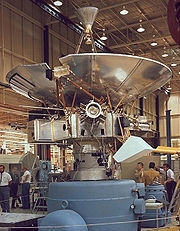
Pioneer 10 is a 258-kilogram robotic space probe that completed the first interplanetary mission to Jupiter, and became the first spacecraft to achieve escape velocity from the Solar System. The project was managed by the NASA Ames Research Center and the contract for the construction of the...
and Pioneer 11
Pioneer 11
Pioneer 11 is a 259-kilogram robotic space probe launched by NASA on April 6, 1973 to study the asteroid belt, the environment around Jupiter and Saturn, solar wind, cosmic rays, and eventually the far reaches of the solar system and heliosphere...
, which explored the outer planets and left the solar system
Solar System
The Solar System consists of the Sun and the astronomical objects gravitationally bound in orbit around it, all of which formed from the collapse of a giant molecular cloud approximately 4.6 billion years ago. The vast majority of the system's mass is in the Sun...
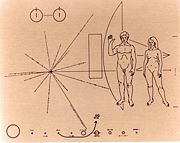
. Both carry a golden plaque
Pioneer plaque
The Pioneer plaques are a pair of gold-anodized aluminium plaques which were placed on board the 1972 Pioneer 10 and 1973 Pioneer 11 spacecraft, featuring a pictorial message, in case either Pioneer 10 or 11 are intercepted by extraterrestrial life...
, depicting a man and a woman and information about the origin and the creators of the probes, should any extraterrestrials
Extraterrestrial life
Extraterrestrial life is defined as life that does not originate from Earth...
find them someday.
Credit for naming the first probe has been attributed to Stephen A. Saliga, who had been assigned to the Air Force Orientation Group, Wright-Patterson AFB, as chief designer of Air Force exhibits. While he was at a briefing, the spacecraft was described to him as a "lunar-orbiting vehicle with an infrared scanning device." Saliga thought the title too long and lacked theme for an exhibit design. He suggested "Pioneer" as the name of the probe since "the Army had already launched and orbited the Explorer satellite and their Public Information Office was identifying the Army as 'Pioneers in Space,'" and by adopting the name the Air Force would "make a 'quantum jump' as to who really [were] the 'Pioneers in space.'"
Early Pioneer missions
The earliest missions were attempts to achieve Earth's escape velocityEscape velocity
In physics, escape velocity is the speed at which the kinetic energy plus the gravitational potential energy of an object is zero gravitational potential energy is negative since gravity is an attractive force and the potential is defined to be zero at infinity...
, simply to show it was feasible and study the Moon
Moon
The Moon is Earth's only known natural satellite,There are a number of near-Earth asteroids including 3753 Cruithne that are co-orbital with Earth: their orbits bring them close to Earth for periods of time but then alter in the long term . These are quasi-satellites and not true moons. For more...
. This included the first launch by NASA
NASA
The National Aeronautics and Space Administration is the agency of the United States government that is responsible for the nation's civilian space program and for aeronautics and aerospace research...
which was formed from the old NACA
National Advisory Committee for Aeronautics
The National Advisory Committee for Aeronautics was a U.S. federal agency founded on March 3, 1915 to undertake, promote, and institutionalize aeronautical research. On October 1, 1958 the agency was dissolved, and its assets and personnel transferred to the newly created National Aeronautics and...
. These missions were carried out by the US Air Force
United States Air Force
The United States Air Force is the aerial warfare service branch of the United States Armed Forces and one of the American uniformed services. Initially part of the United States Army, the USAF was formed as a separate branch of the military on September 18, 1947 under the National Security Act of...
and Army
United States Army
The United States Army is the main branch of the United States Armed Forces responsible for land-based military operations. It is the largest and oldest established branch of the U.S. military, and is one of seven U.S. uniformed services...
.
Able space probes (1958–1960)
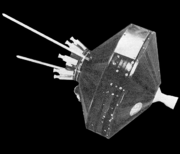
- Most missions here are listed with their most recognised name, and alternate names after in brackets.
- Pioneer 0Pioneer 0Pioneer 0 was a failed United States space probe that was designed to go into orbit around the Moon, carrying a television camera, a micrometeorite detector and a magnetometer, as part of the first International Geophysical Year science payload...
(Thor-Able 1, Pioneer) – LunarMoonThe Moon is Earth's only known natural satellite,There are a number of near-Earth asteroids including 3753 Cruithne that are co-orbital with Earth: their orbits bring them close to Earth for periods of time but then alter in the long term . These are quasi-satellites and not true moons. For more...
orbiter, destroyed (Thor failure 77 seconds after launch) August 17, 1958 - Pioneer 1Pioneer 1On October 11, 1958, Pioneer 1 became the first spacecraft launched by NASA, the newly formed space agency of the United States. The flight was the second and most successful of the three Thor-Able space probes.- Spacecraft design :...
(Thor-Able 2, Pioneer I) – Lunar orbiter, missed Moon (third stage partial failure) October 11, 1958 - Pioneer 2Pioneer 2Pioneer 2 was the last of the three project Able space probes designed to probe lunar and cislunar space. Shortly after launch at 07:30:00 UTC on November 8, 1958, the third stage of the launch vehicle separated but failed to ignite, and Pioneer 2 did not achieve its intended lunar orbit...
(Thor-Able 3, Pioneer II) – Lunar orbiter, reentry (third stage failure) November 8, 1958 - Pioneer P-1Pioneer P-1Pioneer P-1 was a failed mission in the Pioneer program. The spacecraft was a 1 meter diameter sphere, with a propulsion module. It was launched on September 24, 1959 on an Atlas-C Able launcher. It was to carry a TV camera and a magnetic field sensor. It was to be spin-stabilized, and was known as...
(Atlas-Able 4A, Pioneer W), probe lost September 24, 1959 - Pioneer P-3Pioneer P-3Pioneer P-3 was intended to be a lunar orbiter probe, but the mission failed shortly after launch. The objectives were to place a highly instrumented probe in lunar orbit, to investigate the environment between the Earth and Moon, and to develop technology for controlling and maneuvering...
(Atlas-Able 4, Atlas-Able 4B, Pioneer X) – Lunar probe, lost in launcher failure November 26, 1959 - Pioneer 5Pioneer 5Pioneer 5 was a spin-stabilized space probe in the NASA Pioneer program used to investigate interplanetary space between the orbits of Earth and Venus. It was launched on March 11, 1960 from Cape Canaveral Air Force Station Launch Complex 17a at 13:00:00 UTC with an on-orbit dry mass of 43 kg...
(Pioneer P-2, Thor-Able 4, Pioneer V) – interplanetary space between Earth and VenusVenusVenus is the second planet from the Sun, orbiting it every 224.7 Earth days. The planet is named after Venus, the Roman goddess of love and beauty. After the Moon, it is the brightest natural object in the night sky, reaching an apparent magnitude of −4.6, bright enough to cast shadows...
, launched March 11, 1960 - Pioneer P-30Pioneer P-30Pioneer P-30 was intended to be a lunar orbiter probe, but the mission failed shortly after launch on September 25, 1960. The objectives were to place a highly instrumented probe in lunar orbit, to investigate the environment between the Earth and Moon, and to develop technology for controlling...
(Atlas-Able 5A, Pioneer Y) – Lunar probe, failed to achieve lunar orbit September 25, 1960 - Pioneer P-31Pioneer P-31Pioneer P-31 was intended to be a lunar orbiter probe, but the mission failed shortly after launch. The objectives were to place a highly instrumented probe in lunar orbit, to investigate the environment between the Earth and Moon, and to develop technology for controlling and maneuvering...
(Atlas-Able 5B, Pioneer Z) – Lunar probe, lost in upper stage failure December 15, 1960
Juno II lunar probes (1958–1959)
- Pioneer 3Pioneer 3Pioneer 3 was a spin stabilized spacecraft launched at 05:45:12 UTC on 6 December 1958 by the U.S. Army Ballistic Missile Agency in conjunction with the National Aeronautics and Space Administration...
– Lunar flyby, missed Moon due to launcher failure December 6, 1958 - Pioneer 4Pioneer 4Pioneer 4 was a spin-stabilized spacecraft launched as part of the Pioneer program on a lunar flyby trajectory and into a heliocentric orbit making it the first U.S. probe to escape from the Earth's gravity. It carried a payload similar to Pioneer 3: a lunar radiation environment experiment using a...
– Lunar flyby, achieved Earth escape velocityEscape velocityIn physics, escape velocity is the speed at which the kinetic energy plus the gravitational potential energy of an object is zero gravitational potential energy is negative since gravity is an attractive force and the potential is defined to be zero at infinity...
, launched March 3, 1959
Later Pioneer missions (1965–1978)
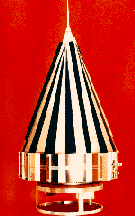
NASA Ames Research Center
The Ames Research Center , is one of the United States of America's National Aeronautics and Space Administration 10 major field centers.The centre is located in Moffett Field in California's Silicon Valley, near the high-tech companies, entrepreneurial ventures, universities, and other...
used the Pioneer name for a new series of missions, initially aimed at the inner solar system, before the bold flyby missions to Jupiter
Jupiter
Jupiter is the fifth planet from the Sun and the largest planet within the Solar System. It is a gas giant with mass one-thousandth that of the Sun but is two and a half times the mass of all the other planets in our Solar System combined. Jupiter is classified as a gas giant along with Saturn,...
and Saturn
Saturn
Saturn is the sixth planet from the Sun and the second largest planet in the Solar System, after Jupiter. Saturn is named after the Roman god Saturn, equated to the Greek Cronus , the Babylonian Ninurta and the Hindu Shani. Saturn's astronomical symbol represents the Roman god's sickle.Saturn,...
. While successful, the missions returned much poorer images than the Voyager's
Voyager program
The Voyager program is a U.S program that launched two unmanned space missions, scientific probes Voyager 1 and Voyager 2. They were launched in 1977 to take advantage of a favorable planetary alignment of the late 1970s...
five years later. In 1978, the end of the program saw a return to the inner solar system, with the Pioneer Venus Orbiter and Multiprobe, this time using orbital insertion rather than flyby missions.
The new missions were numbered from Pioneer 6 (alternate names in parentheses).
Pioneer 6, 7, 8, and 9 – interplanetary space "weather network"
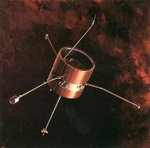
- Pioneer 6 (Pioneer A) – launched December 1965
- Pioneer 7 (Pioneer B) – launched August 1966
- Pioneer 8 (Pioneer C) – launched December 1967
- Pioneer 9 (Pioneer D) – launched November 1968 (defunct since 1983)
- Pioneer E – lost in launcher failure August 1969
Pioneer 6 and Pioneer 9 are in solar orbits with 0.8 AU
Astronomical unit
An astronomical unit is a unit of length equal to about or approximately the mean Earth–Sun distance....
s distance to the Sun. Their orbital periods are therefore slightly shorter than Earth's.
Pioneer 7 and Pioneer 8 are in solar orbits with 1.1 AUs distance to the Sun. Their orbital periods are therefore slightly longer than Earth's.
Because they orbit the Sun on either side of the Earth's orbital path, some of them are, from time to time, 180° away from Earth. They can sense parts of the Sun several days before the Sun's rotation reveals it to ground based/earth orbiting observatories. If a powerful solar magnetic storm is born, they can warn Earth in advance.
Outer solar system missions
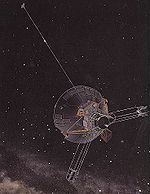
- Pioneer 10Pioneer 10Pioneer 10 is a 258-kilogram robotic space probe that completed the first interplanetary mission to Jupiter, and became the first spacecraft to achieve escape velocity from the Solar System. The project was managed by the NASA Ames Research Center and the contract for the construction of the...
(Pioneer F) – JupiterJupiterJupiter is the fifth planet from the Sun and the largest planet within the Solar System. It is a gas giant with mass one-thousandth that of the Sun but is two and a half times the mass of all the other planets in our Solar System combined. Jupiter is classified as a gas giant along with Saturn,...
, interstellar mediumInterstellar mediumIn astronomy, the interstellar medium is the matter that exists in the space between the star systems in a galaxy. This matter includes gas in ionic, atomic, and molecular form, dust, and cosmic rays. It fills interstellar space and blends smoothly into the surrounding intergalactic space...
, launched March 1972 - Pioneer 11Pioneer 11Pioneer 11 is a 259-kilogram robotic space probe launched by NASA on April 6, 1973 to study the asteroid belt, the environment around Jupiter and Saturn, solar wind, cosmic rays, and eventually the far reaches of the solar system and heliosphere...
(Pioneer G) – JupiterJupiterJupiter is the fifth planet from the Sun and the largest planet within the Solar System. It is a gas giant with mass one-thousandth that of the Sun but is two and a half times the mass of all the other planets in our Solar System combined. Jupiter is classified as a gas giant along with Saturn,...
, SaturnSaturnSaturn is the sixth planet from the Sun and the second largest planet in the Solar System, after Jupiter. Saturn is named after the Roman god Saturn, equated to the Greek Cronus , the Babylonian Ninurta and the Hindu Shani. Saturn's astronomical symbol represents the Roman god's sickle.Saturn,...
, interstellar mediumInterstellar mediumIn astronomy, the interstellar medium is the matter that exists in the space between the star systems in a galaxy. This matter includes gas in ionic, atomic, and molecular form, dust, and cosmic rays. It fills interstellar space and blends smoothly into the surrounding intergalactic space...
, launched April 1973 - Pioneer HPioneer HPioneer H is an unlaunched unmanned space mission that was part of the US Pioneer program for a planned 1974 launch. Had this mission and spacecraft been launched, it would have been designated Pioneer 12; that designation was later applied to the Pioneer Venus Orbiter.The probe would have been...
– identical to Pioneers 10 and 11, but never launched
Pioneer Venus project

- Pioneer Venus Orbiter (Pioneer Venus 1, Pioneer 12) – launched December 1978
- Pioneer Venus Multiprobe (Pioneer Venus 2, Pioneer 13) – launched August 1978
- Pioneer Venus Probe Bus – transport vehicle and upper atmosphere probe
- Pioneer Venus Large Probe – 300 kg parachuted probe
- Pioneer Venus North Probe – 75 kg impactor probe
- Pioneer Venus Night Probe – 75 kg impactor probe
- Pioneer Venus Day Probe – 75 kg impactor probe
See also
- Pioneer anomalyPioneer anomalyThe Pioneer anomaly or Pioneer effect is the observed deviation from predicted accelerations of the Pioneer 10 and Pioneer 11 spacecraft after they passed about on their trajectories out of the Solar System....
- Ranger programRanger programThe Ranger program was a series of unmanned space missions by the United States in the 1960s whose objective was to obtain the first close-up images of the surface of the Moon. The Ranger spacecraft were designed to take images of the lunar surface, returning those images until they were destroyed...
- Surveyor programSurveyor programThe Surveyor Program was a NASA program that, from 1966 through 1968, sent seven robotic spacecraft to the surface of the Moon. Its primary goal was to demonstrate the feasibility of soft landings on the Moon...
- Mariner programMariner programThe Mariner program was a program conducted by the American space agency NASA that launched a series of robotic interplanetary probes designed to investigate Mars, Venus and Mercury from 1963 to 1973...
- Voyager programVoyager programThe Voyager program is a U.S program that launched two unmanned space missions, scientific probes Voyager 1 and Voyager 2. They were launched in 1977 to take advantage of a favorable planetary alignment of the late 1970s...
- Timeline of Solar System explorationTimeline of solar system explorationThis is a timeline of Solar System exploration ordered by date of spacecraft launch. It includes:*All spacecraft that have left Earth orbit for the purposes of Solar System exploration , including lunar probes....