
Home      Discussion      Topics      Dictionary      Almanac
Signup       Login
Pio of Pietrelcina

Pio of Pietrelcina

Overview
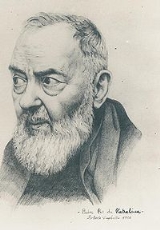
Saint Pio of Pietrelcina (25 May 188723 September 1968) was a Capuchin
Order of Friars Minor Capuchin
The Order of Friars Minor Capuchin is an Order of friars in the Catholic Church, among the chief offshoots of the Franciscans. The worldwide head of the Order, called the Minister General, is currently Father Mauro Jöhri.-Origins :...

 priest
Priest
A priest is a person authorized to perform the sacred rites of a religion, especially as a mediatory agent between humans and deities. They also have the authority or power to administer religious rites; in particular, rites of sacrifice to, and propitiation of, a deity or deities...

 from Italy
Italy
Italy , officially the Italian Republic languages]] under the European Charter for Regional or Minority Languages. In each of these, Italy's official name is as follows:;;;;;;;;), is a unitary parliamentary republic in South-Central Europe. To the north it borders France, Switzerland, Austria and...

 who is venerated as a saint
Saint
A saint is a holy person. In various religions, saints are people who are believed to have exceptional holiness.In Christian usage, "saint" refers to any believer who is "in Christ", and in whom Christ dwells, whether in heaven or in earth...

 in the Catholic Church. He was born Francesco Forgione, and given the name Pio when he joined the Capuchins; he was popularly known as Padre Pio after his ordination to the priesthood. He became famous for his stigmata
Stigmata
Stigmata are bodily marks, sores, or sensations of pain in locations corresponding to the crucifixion wounds of Jesus, such as the hands and feet...

. On 16 June 2002, he was canonized
Canonization
Canonization is the act by which a Christian church declares a deceased person to be a saint, upon which declaration the person is included in the canon, or list, of recognized saints. Originally, individuals were recognized as saints without any formal process...

 by Pope John Paul II
Pope John Paul II
Blessed Pope John Paul II , born Karol Józef Wojtyła , reigned as Pope of the Catholic Church and Sovereign of Vatican City from 16 October 1978 until his death on 2 April 2005, at of age. His was the second-longest documented pontificate, which lasted ; only Pope Pius IX ...

.
Discussion
Ask a question about 'Pio of Pietrelcina'
Start a new discussion about 'Pio of Pietrelcina'
Answer questions from other users
Full Discussion Forum
 
Unanswered Questions
Encyclopedia
Saint Pio of Pietrelcina (25 May 188723 September 1968) was a Capuchin
Order of Friars Minor Capuchin
The Order of Friars Minor Capuchin is an Order of friars in the Catholic Church, among the chief offshoots of the Franciscans. The worldwide head of the Order, called the Minister General, is currently Father Mauro Jöhri.-Origins :...

 priest
Priest
A priest is a person authorized to perform the sacred rites of a religion, especially as a mediatory agent between humans and deities. They also have the authority or power to administer religious rites; in particular, rites of sacrifice to, and propitiation of, a deity or deities...

 from Italy
Italy
Italy , officially the Italian Republic languages]] under the European Charter for Regional or Minority Languages. In each of these, Italy's official name is as follows:;;;;;;;;), is a unitary parliamentary republic in South-Central Europe. To the north it borders France, Switzerland, Austria and...

 who is venerated as a saint
Saint
A saint is a holy person. In various religions, saints are people who are believed to have exceptional holiness.In Christian usage, "saint" refers to any believer who is "in Christ", and in whom Christ dwells, whether in heaven or in earth...

 in the Catholic Church. He was born Francesco Forgione, and given the name Pio when he joined the Capuchins; he was popularly known as Padre Pio after his ordination to the priesthood. He became famous for his stigmata
Stigmata
Stigmata are bodily marks, sores, or sensations of pain in locations corresponding to the crucifixion wounds of Jesus, such as the hands and feet...

. On 16 June 2002, he was canonized
Canonization
Canonization is the act by which a Christian church declares a deceased person to be a saint, upon which declaration the person is included in the canon, or list, of recognized saints. Originally, individuals were recognized as saints without any formal process...

 by Pope John Paul II
Pope John Paul II
Blessed Pope John Paul II , born Karol Józef Wojtyła , reigned as Pope of the Catholic Church and Sovereign of Vatican City from 16 October 1978 until his death on 2 April 2005, at of age. His was the second-longest documented pontificate, which lasted ; only Pope Pius IX ...

.

Early life


Francesco Forgione was born to Grazio Mario Forgione (1860–1946) and Maria Giuseppa de Nunzio Forgione (1859–1929) on 25 May 1887, in Pietrelcina
Pietrelcina
Pietrelcina is a town and comune in the province of Benevento in the Campania region of southern Italy. It is the birthplace of Saint Pio of Pietrelcina .-Geography:Benevento, Paduli, Pago Veiano and Pesco Sannita are neighbouring towns....

, a farming town in the southern Italian region of Campania
Campania
Campania is a region in southern Italy. The region has a population of around 5.8 million people, making it the second-most-populous region of Italy; its total area of 13,590 km² makes it the most densely populated region in the country...

. His parents made a living as peasant farmers. He was baptized in the nearby Santa Anna Chapel, which stands upon the walls of a castle. He later served as an altar boy
Altar server
An altar server is a lay assistant to a member of the clergy during a Christian religious service. An altar server attends to supporting tasks at the altar such as fetching and carrying, ringing the altar bell and so on....

 in this same chapel. Restoration work on this chapel was later undertaken by the Padre Pio Foundation of America based in Cromwell, Connecticut. His siblings were an older brother, Michele, and three younger sisters, Felicita, Pellegrina, and Grazia (who was later to become a Bridgettine
Bridgettines
The Bridgettine or Birgittine Order is a monastic religious order of Augustinian nuns, Religious Sisters and monks founded by Saint Birgitta of Sweden in approximately 1350, and approved by Pope Urban V in 1370...

 nun). His parents had two other children who died in infancy. When he was baptized, he was given the name Francesco, which was the name of one of these two. He stated that by the time he was five years old he had already taken the decision to dedicate his entire life to God. He is also said to have begun inflicting penances on himself and to have been chided on one occasion by his mother for using a stone as a pillow and sleeping on the stone floor. He worked on the land up to the age of 10, looking after the small flock of sheep the family owned. This delayed his education to some extent.

Pietrelcina was a highly religious town (feast days of saints were celebrated throughout the year), and religion had a profound influence on the Forgione family. The members of the family attended daily Mass, prayed the Rosary
Rosary
The rosary or "garland of roses" is a traditional Catholic devotion. The term denotes the prayer beads used to count the series of prayers that make up the rosary...

 nightly, and abstained from meat three days a week in honor of Our Lady of Mount Carmel
Our Lady of Mount Carmel
Our Lady of Mount Carmel is the title given to the Blessed Virgin Mary in her role as patroness of the Carmelite Order. The first Carmelites were Christian hermits living on Mount Carmel in the Holy Land during the late 12th and early to mid 13th centuries...

. Although Francesco's parents and grandparents were illiterate, they memorised the Scriptures and narrated Bible stories to their children. It is asserted by his mother that Francesco was able to see and speak with Jesus
Jesus
Jesus of Nazareth , commonly referred to as Jesus Christ or simply as Jesus or Christ, is the central figure of Christianity...

, the Virgin Mary and his guardian angel
Guardian angel
A guardian angel is an angel assigned to protect and guide a particular person or group. Belief in guardian angels can be traced throughout all antiquity...

, and that as a child, he assumed that all people could do so.

As a youth Pio reported that he had experienced heavenly visions and ecstasies
Religious ecstasy
Religious ecstasy is an altered state of consciousness characterized by greatly reduced external awareness and expanded interior mental and spiritual awareness which is frequently accompanied by visions and emotional/intuitive euphoria...

. In 1897, after he had completed three years at the public school, Francesco was drawn to the life of a friar after listening to a young Capuchin
Order of Friars Minor Capuchin
The Order of Friars Minor Capuchin is an Order of friars in the Catholic Church, among the chief offshoots of the Franciscans. The worldwide head of the Order, called the Minister General, is currently Father Mauro Jöhri.-Origins :...

 friar who was, at that time, seeking donations in the countryside. When he expressed his desire to his parents, they made a trip to Morcone
Morcone
Morcone is a comune in the Province of Benevento in the Italian region Campania, located about 70 km northeast of Naples and about 25 km northwest of Benevento...

, a community 13 miles (20.9 km) north of Pietrelcina, to find out if their son was eligible to enter the Capuchin Order. The Friars there informed them that they were interested in accepting Francesco into their community, but he needed more educational qualifications.

Francesco's father went to the United States
United States
The United States of America is a federal constitutional republic comprising fifty states and a federal district...

 in search of work to pay for private tutoring for his son Francesco, so that he might meet the academic requirements to enter the Capuchin Order. It was in this period that Francesco received the sacrament of Confirmation on 27 September 1899. He underwent private tutoring and passed the stipulated academic requirements. On 6 January 1903, at the age of 15, he entered the novitiate
Novitiate
Novitiate, alt. noviciate, is the period of training and preparation that a novice monastic or member of a religious order undergoes prior to taking vows in order to discern whether they are called to the religious life....

 of the Capuchin Friars
Order of Friars Minor Capuchin
The Order of Friars Minor Capuchin is an Order of friars in the Catholic Church, among the chief offshoots of the Franciscans. The worldwide head of the Order, called the Minister General, is currently Father Mauro Jöhri.-Origins :...

 at Morcone where, on 22 January, he took the Franciscan
Franciscan
Most Franciscans are members of Roman Catholic religious orders founded by Saint Francis of Assisi. Besides Roman Catholic communities, there are also Old Catholic, Anglican, Lutheran, ecumenical and Non-denominational Franciscan communities....

 habit
Religious habit
A religious habit is a distinctive set of garments worn by members of a religious order. Traditionally some plain garb recognisable as a religious habit has also been worn by those leading the religious eremitic and anachoritic life, although in their case without conformity to a particular uniform...

 and the name of Fra (Brother) Pio in honor of Pope St Pius V
Pope Pius V
Pope Saint Pius V , born Antonio Ghislieri , was Pope from 1566 to 1572 and is a saint of the Catholic Church. He is chiefly notable for his role in the Council of Trent, the Counter-Reformation, and the standardization of the Roman liturgy within the Latin Church...

, the patron saint
Patron saint
A patron saint is a saint who is regarded as the intercessor and advocate in heaven of a nation, place, craft, activity, class, clan, family, or person...

 of Pietrelcina. He took the simple vow
Simple vow
In Roman Catholic canon law, a simple vow is any vow, public or private, individual or collective, concerned with an action or with abstaining from an action, if that vow has not been recognized by the Church as a solemn vow....

s of poverty, chastity and obedience.

Priesthood


To commence his six-year study for priesthood and to grow in community life, he travelled to the friary of St. Francis of Assisi by oxcart. Three years later on 27 January 1907, he made his solemn profession
Profession (religious)
The term religious profession is defined in the 1983 Code of Canon Law of the Roman Catholic Church in relation to members of religious institutes as follows:By religious profession members make a public vow to observe the three evangelical counsels...

. In 1910, Brother Pio was ordained
Ordination
In general religious use, ordination is the process by which individuals are consecrated, that is, set apart as clergy to perform various religious rites and ceremonies. The process and ceremonies of ordination itself varies by religion and denomination. One who is in preparation for, or who is...

 a priest
Priest
A priest is a person authorized to perform the sacred rites of a religion, especially as a mediatory agent between humans and deities. They also have the authority or power to administer religious rites; in particular, rites of sacrifice to, and propitiation of, a deity or deities...

 by Archbishop Paolo Schinosi at the Cathedral of Benevento
Benevento
Benevento is a town and comune of Campania, Italy, capital of the province of Benevento, 50 km northeast of Naples. It is situated on a hill 130 m above sea-level at the confluence of the Calore Irpino and Sabato...

. Four days later, he offered his first Mass
Tridentine Mass
The Tridentine Mass is the form of the Roman Rite Mass contained in the typical editions of the Roman Missal that were published from 1570 to 1962. It was the most widely celebrated Mass liturgy in the world until the introduction of the Mass of Paul VI in December 1969...

 at the parish church of Our Lady of the Angels. His health being precarious, he was permitted to remain with his family until early 1916 while still retaining the Capuchin habit.

On 4 September 1916, Padre Pio was ordered to return to his community life. Thus he was moved to an agricultural community, Our Lady of Grace
Our Lady of Grace
Our Lady of Grace is a title of the Blessed Virgin Mary. It may also refer to:England*A Roman Catholic church in Chiswick, London, England, in the Archdiocese of Westminster*Our Lady of Grace School , in Prestwich, Greater Manchester...

 Capuchin Friary
Monastery
Monastery denotes the building, or complex of buildings, that houses a room reserved for prayer as well as the domestic quarters and workplace of monastics, whether monks or nuns, and whether living in community or alone .Monasteries may vary greatly in size – a small dwelling accommodating only...

, located in the Gargano Mountains in San Giovanni Rotondo
San Giovanni Rotondo
San Giovanni Rotondo is the name of a city and comune in the province of Foggia, Puglia region, southern Italy. As of 2006 it had a population of 26,442....

. Along with Padre Pio, the community had seven friars. He stayed at San Giovanni Rotondo until his death, except for his military service.
When World War I
World War I
World War I , which was predominantly called the World War or the Great War from its occurrence until 1939, and the First World War or World War I thereafter, was a major war centred in Europe that began on 28 July 1914 and lasted until 11 November 1918...

 started, four friars from this community were selected for military service. At that time, Padre Pio was a teacher at the seminary and a spiritual director. When one more friar was called into service, Padre Pio was put in charge of the community. Then, in the month of August 1917 Padre Pio was also called to military service. Although not in good health, he was assigned to the 4th Platoon of the 100th Company of the Italian Medical Corps. Although hospitalized by mid-October, he was not discharged until March 1918, whereupon he returned to San Giovanni Rotondo and was assigned to work at Santa Maria degli Angeli (Our Lady of the Angels) in Pietrelcina. Later, in response to his growing reputation as a worker of miracle
Miracle
A miracle often denotes an event attributed to divine intervention. Alternatively, it may be an event attributed to a miracle worker, saint, or religious leader. A miracle is sometimes thought of as a perceptible interruption of the laws of nature. Others suggest that a god may work with the laws...

s, his superiors assigned him to the friar
Friar
A friar is a member of one of the mendicant orders.-Friars and monks:...

y of San Giovanni Rotondo
San Giovanni Rotondo
San Giovanni Rotondo is the name of a city and comune in the province of Foggia, Puglia region, southern Italy. As of 2006 it had a population of 26,442....

. In all, his military service lasted 182 days.

Padre Pio then became a spiritual director, guiding many spiritually, considering them his spiritual daughters and sons. He had five rules for spiritual growth, namely, weekly confession, daily Communion, spiritual reading, meditation, and examination of conscience.

He compared weekly confession to dusting a room weekly, and recommended the performance of meditation and self-examination twice daily: once in the morning, as preparation to face the day, and once again in the evening, as retrospection. His advice on the practical application of theology he often summed up in his now famous quote, "Pray, Hope and Don’t Worry". He directed Christians to recognize God in all things and to desire above all things to do the will of God.

Poor health


According to the diary of Father Agostino da San Marco, his spiritual director in San Marco in Lamis
San Marco in Lamis
San Marco in Lamis is a town and comune in the province of Foggia in the Apulia region of southeast Italy. It is located in the Gargano massif area.Apart from some tourism connected to pilgrimages at the local Catholic sanctuary of St...

, the young Francesco Forgione was afflicted with a number of illnesses. At six he suffered from a grave gastroenteritis, which kept him bedridden for a long time. At ten he caught typhoid fever. At 17, he suddenly fell ill, complaining of loss of appetite, insomnia, exhaustion, fainting spells, and terrible migraines. He vomited frequently and could absorb only milk and cheese.

The hagiographers say that it was during this time, together with his physical illness, that inexplicable phenomena began to occur. According to their stories, one could hear strange noises coming from his room at night – sometimes screams or roars. During prayer, brother Pio remained in a stupor, as if he were absent.

One of Pio's fellow brothers claims to have seen him in ecstasy, levitating above the ground.

In June 1905, Padre Pio's health was so weak that his superiors decided to send him to a mountain convent, in the hope that the change of air would do him some good. His health got worse however, and doctors advised that he return to his home town. But even there, his health continued to worsen.

In addition to his childhood illnesses, throughout his life Padre Pio suffered from "asthmatic bronchitis". He also had a large kidney stone, with frequent abdominal pains. He also suffered from a chronic gastritis, which later turned into an ulcer. He suffered from inflammations of the eye, of the nose, of the ear and of the throat, and eventually formed rhinitis
Rhinitis
Rhinitis , commonly known as a stuffy nose, is the medical term describing irritation and inflammation of some internal areas of the nose. The primary symptom of rhinitis is nasal dripping. It is caused by chronic or acute inflammation of the mucous membrane of the nose due to viruses, bacteria or...

 and chronic otitis
Otitis
Otitis is a general term for inflammation or infection of the ear, in both humans and other animals.It is subdivided into the following:*Otitis externa, external otitis, or "swimmer's ear" involves the outer ear and ear canal. In external otitis, the ear hurts when touched or pulled.*Otitis media...

.

In the summer of 1915, in spite of poor health, he was drafted into the army. But after 30 days he was sent home on leave due to bad health. He returned to military service, and was put on leave again, this time for six months at a convent in a mountain village, San Giovanni Rotondo, where the weather was relatively cool even in the summer. After six months in this convent he returned to military service, but was sent home again two months later. On his return he was declared fit for service, and sent to the Sales barracks in Naples, where he remained until March 1917, at which time he was diagnosed with pulmonary tuberculosis, certified by a radiological exam. He was then sent home on permanent leave.

In 1925, Padre Pio was operated on for an inguinal hernia, and shortly after this a large cyst formed on his neck which had to be surgically removed. Another surgery was required to remove a malignant tumor on his ear. After this operation Padre Pio was subjected to radiological treatment, which was successful, it seems, after only two treatments.

In 1956, he came down with a serious case of "exudative pleuritis". The diagnosis was certified by professor Cataldo Cassano, who personally extracted the serous liquid from the body of Padre Pio. He remained bedridden for four consecutive months.

In his old age Padre Pio was tormented by arthritis.

Spiritual suffering


Padre Pio stated that he believed the love of God is inseparable from suffering and that suffering all things for the sake of God is the way for the soul to reach God. He felt that his soul was lost in a chaotic maze, plunged into total desolation, as if he were in the deepest pit of hell. During his period of spiritual suffering, his followers believe that Padre Pio was attacked by the Devil, both physically and spiritually. His followers also believe that the Devil used diabolical tricks in order to increase Padre Pio's torments. These included apparitions as an "angel of light" and the alteration or destruction of letters to and from his spiritual directors. Padre Augustine confirmed this when he said:

The Devil appeared as young girls that danced naked without any clothes on, as Christ Crucified, as a young friend of the monks, as the Spiritual Father or as the Provincial Father; as Pope Pius X, a Guardian Angel, as St. Francis and as Our Lady.


Now, twenty-two days have passed, since Jesus allowed the devils to vent their anger on me. My Father, my whole body is bruised from the beatings that I have received to the present time by our enemies. Several times, they have even torn off my shirt so that they could strike my exposed flesh.


Fr. Gabriele Amorth
Gabriele Amorth
Gabriele Amorth is an Italian Roman Catholic priest and an exorcist of the Diocese of Rome who claims to have cleansed tens of thousands of people of evil spirits. Controversially, he believes that practising yoga is satanic and leads to evil just like reading JK Rowling’s Harry Potter...

, senior exorcist of Vatican City
Vatican City
Vatican City , or Vatican City State, in Italian officially Stato della Città del Vaticano , which translates literally as State of the City of the Vatican, is a landlocked sovereign city-state whose territory consists of a walled enclave within the city of Rome, Italy. It has an area of...

 stated in an interview that Padre Pio was able to distinguish between real apparitions of Jesus, Mary and the Saints and the illusions created by the Devil by carefully analysing the state of his mind and the feelings produced in him during the apparitions. In one of Padre Pio's letters, he states that he remained patient in the midst of his trials because of his firm belief that Jesus, Mary, his Guardian Angel, St. Joseph and St. Francis were always with him and helped him always.

Transverberation and visible stigmata


Based on Padre Pio's correspondence, even early in his priesthood he experienced less obvious indications of the visible stigmata
Stigmata
Stigmata are bodily marks, sores, or sensations of pain in locations corresponding to the crucifixion wounds of Jesus, such as the hands and feet...

 for which he would later become famous. In a 1911 letter, Padre Pio wrote to his spiritual advisor, Padre Benedetto from San Marco in Lamis
San Marco in Lamis
San Marco in Lamis is a town and comune in the province of Foggia in the Apulia region of southeast Italy. It is located in the Gargano massif area.Apart from some tourism connected to pilgrimages at the local Catholic sanctuary of St...

, describing something he had been experiencing for a year:

Then last night something happened which I can neither explain nor understand. In the middle of the palms of my hands a red mark appeared, about the size of a penny, accompanied by acute pain in the middle of the red marks. The pain was more pronounced in the middle of the left hand, so much so that I can still feel it. Also under my feet I can feel some pain.


His close friend Padre Agostino wrote to him in 1915, asking specific questions such as when he first experienced visions, whether he had been granted the stigmata, and whether he felt the pains of the Passion of Christ
Passion (Christianity)
The Passion is the Christian theological term used for the events and suffering – physical, spiritual, and mental – of Jesus in the hours before and including his trial and execution by crucifixion...

, namely the crowning of thorns and the scourging. Padre Pio replied that he had been favoured with visions since his novitiate period (1903 to 1904). He wrote that although he had been granted the stigmata, he had been so terrified by the phenomenon he begged the Lord to withdraw them. He did not wish the pain to be removed, only the visible wounds, since at the time he considered them to be an indescribable and almost unbearable humiliation. The visible wounds disappeared at that point, but reappeared in September 1918. He reported, however, that the pain remained and was more acute on specific days and under certain circumstances. He also said that he was indeed experiencing the pain of the crown of thorns and the scourging. He was not able to clearly indicate the frequency of this experience, but said that he had been suffering from them at least once weekly for some years.

These experiences are alleged to have caused his health to fail, for which reason he was permitted to stay at home. To maintain his religious life as a friar while away from the community, he said Mass daily and taught at school.

St. John of the Cross describes the phenomenon of transverberation as follows:

The soul being inflamed with the love of God which is interiorly attacked by a Seraph, who pierces it through with a fiery dart. This leaves the soul wounded, which causes it to suffer from the overflowing of divine love.


World War I was still going on, and in July 1918, Pope Benedict XV
Pope Benedict XV
Pope Benedict XV , born Giacomo Paolo Giovanni Battista della Chiesa, reigned as Pope from 3 September 1914 to 22 January 1922...

, who had termed the World War "the suicide of Europe," appealed to all Christians urging them to pray for an end to the World War. On 27 July of the same year, Padre Pio offered himself as a victim for the end of the war. Days passed and between 5 August and 7 August, Padre Pio had a vision in which Christ appeared and pierced his side.
As a result of this experience, Padre Pio had a physical wound in his side. This occurrence is considered as a "transverberation" or piercing of the heart indicating the union of love with God.

As a side-note, a first-class relic of Padre Pio, which consists of a large framed square of linen bearing a bloodstain from "the wound of the transverberation of the heart" in Padre Pio's side, is exposed for public veneration at the St. John Cantius Church in Chicago.

With his transverberation began another seven-week long period of spiritual unrest for Padre Pio. One of his Capuchin brothers said this of his state during that period:

During this time his entire appearance looked altered as if he had died. He was constantly weeping and sighing, saying that God had forsaken him.


In a letter from Padre Pio to Padre Benedetto, dated 21 August 1918, Padre Pio writes of his experiences during the transverberation:

While I was hearing the boys’ confessions on the evening of the 5th [August] I was suddenly terrorized by the sight of a celestial person who presented himself to my mind’s eye. He had in his hand a sort of weapon like a very long sharp-pointed steel blade which seemed to emit fire. At the very instant that I saw all this, I saw that person hurl the weapon into my soul with all his might. I cried out with difficulty and felt I was dying. I asked the boy to leave because I felt ill and no longer had the strength to continue. This agony lasted uninterruptedly until the morning of the 7th. I cannot tell you how much I suffered during this period of anguish. Even my entrails were torn and ruptured by the weapon, and nothing was spared. From that day on I have been mortally wounded. I feel in the depths of my soul a wound that is always open and which causes me continual agony.


On 20 September 1918, accounts state that the pains of the transverberation had ceased and Padre Pio was in "profound peace." On that day, as Padre Pio was engaged in prayer in the choir loft in the Church of Our Lady of Grace, the same Being who had appeared to him and given him the transverberation, and who is believed to be the Wounded Christ, appeared again and Padre Pio had another experience of religious ecstasy
Religious ecstasy
Religious ecstasy is an altered state of consciousness characterized by greatly reduced external awareness and expanded interior mental and spiritual awareness which is frequently accompanied by visions and emotional/intuitive euphoria...

. When the ecstasy ended, Padre Pio had received the Visible Stigmata, the five wounds of Christ. This time, however, the stigmata were permanent and would stay on him for the next fifty years of his life.

In a letter from St. Padre Pio to Padre Benedetto, his superior and spiritual advisor, Padre Benedetto from San Marco in Lamis
San Marco in Lamis
San Marco in Lamis is a town and comune in the province of Foggia in the Apulia region of southeast Italy. It is located in the Gargano massif area.Apart from some tourism connected to pilgrimages at the local Catholic sanctuary of St...

 dated 22 October 1918, Padre Pio describes his experience of receiving the Stigmata as follows:

On the morning of the 20th of last month, in the choir, after I had celebrated Mass I yielded to a drowsiness similar to a sweet sleep. [...] I saw before me a mysterious person similar to the one I had seen on the evening of 5 August. The only difference was that his hands and feet and side were dripping blood. This sight terrified me and what I felt at that moment is indescribable. I thought I should have died if the Lord had not intervened and strengthened my heart which was about to burst out of my chest. The vision disappeared and I became aware that my hands, feet and side were dripping blood. Imagine the agony I experienced and continue to experience almost every day. The heart wound bleeds continually, especially from Thursday evening until Saturday. Dear Father, I am dying of pain because of the wounds and the resulting embarrassment I feel deep in my soul. I am afraid I shall bleed to death if the Lord does not hear my heartfelt supplication to relieve me of this condition. Will Jesus, who is so good, grant me this grace? Will he at least free me from the embarrassment caused by these outward signs? I will raise my voice and will not stop imploring him until in his mercy he takes away, not the wound or the pain, which is impossible since I wish to be inebriated with pain, but these outward signs which cause me such embarrassment and unbearable humiliation.
He quoted, "the pain was so intense that I began to feel as if I were dying on the cross."

Though Padre Pio would have preferred to suffer in secret, by early 1919, news about the stigmatic friar began to spread in the secular world. Padre Pio’s wounds were examined by many people, including physicians. People who had started rebuilding their lives after World War I began to see in Padre Pio a symbol of hope. Those close to him attest that he began to manifest several spiritual gifts including the gifts of healing, bilocation
Bilocation
Bilocation, or sometimes multilocation, is a term used to describe the ability/instances in which an individual or object is said to be, or appears to be, located in two distinct places at the same instant in time...

, levitation, prophecy
Prophecy
Prophecy is a process in which one or more messages that have been communicated to a prophet are then communicated to others. Such messages typically involve divine inspiration, interpretation, or revelation of conditioned events to come as well as testimonies or repeated revelations that the...

, miracle
Miracle
A miracle often denotes an event attributed to divine intervention. Alternatively, it may be an event attributed to a miracle worker, saint, or religious leader. A miracle is sometimes thought of as a perceptible interruption of the laws of nature. Others suggest that a god may work with the laws...

s, extraordinary abstinence from both sleep and nourishment (one account states that Padre Agostino recorded one instance in which Padre Pio was able to subsist for at least 20 days at Verafeno on only the Eucharist
Eucharist
The Eucharist , also called Holy Communion, the Sacrament of the Altar, the Blessed Sacrament, the Lord's Supper, and other names, is a Christian sacrament or ordinance...

 without any other nourishment), the ability to read hearts, the gift of tongues, the gift of conversions, and the fragrance from his wounds.

Controversies


It is claimed that no more than Anecdotal evidence
Anecdotal evidence
The expression anecdotal evidence refers to evidence from anecdotes. Because of the small sample, there is a larger chance that it may be true but unreliable due to cherry-picked or otherwise unrepresentative of typical cases....

 supports Pio’s alleged mystical abilities, some of his bilocations are consistent with hallucinations and the supposed odor of sanctity was purported to be Eau de Cologne
Eau de Cologne
Eau de Cologne or simply Cologne is a toiletry, a perfume in a style that originated from Cologne, Germany. It is nowadays a generic term for scented formulations in typical concentration of 2-5% essential oils. However as of today cologne is a blend of extracts, alcohol, and water...

. He was never watched continuously to ensure that chemicals like carbolic acid or iodine
Iodine
Iodine is a chemical element with the symbol I and atomic number 53. The name is pronounced , , or . The name is from the , meaning violet or purple, due to the color of elemental iodine vapor....

 were not used to prevent wounds healing, as has been claimed. Pio over many years wore fingerless gloves which concealed his wounds or prevented him having to tend the wounds, yet near his death Pio avoided covering his hands and there was no sign of injury.

The founder of Milan's Catholic University of the Sacred Heart, friar, physician and psychologist Agostino Gemelli
Agostino Gemelli
Agostino Gemelli was an Italian physician, Franciscan friar and psychologist who was also the founder and chancellor of Università Cattolica del Sacro Cuore of Milan in 1921....

, concluded Padre Pio was "an ignorant and self-mutilating psychopath who exploited people's credulity." In short, he was accused of infractions against all three of his monastic vows: poverty, chastity and obedience. Agostino Gemelli also speculated that Padre Pio kept his wounds open with carbolic acid. As a result of the Gemelli assessment, the wounds were wrapped in cloth. Despite this, the bleeding continued for some 50 years until they closed within hours of his death.

On 29 July 1960, an Italian monsignore, Carlo Maccari, later to become the archbishop of Ancona, began yet another investigation on behalf of Pope John XXIII and the Holy Office. The 200-page report he compiled, though never published in full, is said to be devastatingly critical. Vatican gossip long had it that the “Maccari dossier” was an insuperable obstacle to Padre Pio’s sainthood. According to official Capuchin literature, however, Maccari later recanted and prayed to Padre Pio on his deathbed.

In 1940, Padre Pio began plans to open a hospital
Hospital
A hospital is a health care institution providing patient treatment by specialized staff and equipment. Hospitals often, but not always, provide for inpatient care or longer-term patient stays....

 in San Giovanni Rotondo, to be named the Casa Sollievo della Sofferenza
Casa Sollievo della Sofferenza
Casa Sollievo della Sofferenza is a private hospital in San Giovanni Rotondo, founded by Saint Pio of Pietrelcina....

 or "Home to Relieve Suffering"; the hospital opened in 1956. Barbara Ward
Barbara Ward
Barbara Mary Ward , in later life Baroness Jackson of Lodsworth, was a British economist and writer interested in the problems of developing countries. She urged Western governments to share their prosperity with the rest of the world and in the 1960s turned her attention to environmental...

, a British humanitarian and journalist on assignment in Italy, played a major role in obtaining for this project a grant of $325,000 from the United Nations Relief and Rehabilitation Administration
United Nations Relief and Rehabilitation Administration
The United Nations Relief and Rehabilitation Administration was an international relief agency, largely dominated by the United States but representing 44 nations. Founded in 1943, it became part of the United Nations in 1945, was especially active in 1945 and 1946, and largely shut down...

 (UNRRA). In order that Padre Pio might directly supervise this project, Pope Pius XII
Pope Pius XII
The Venerable Pope Pius XII , born Eugenio Maria Giuseppe Giovanni Pacelli , reigned as Pope, head of the Catholic Church and sovereign of Vatican City State, from 2 March 1939 until his death in 1958....

, in 1957 granted him dispensation from his vow of poverty. Padre Pio's detractors used this project as another weapon to attack him, charging him with misappropriation of funds.

Padre Pio was subject to numerous investigations. Fearing local riots, a plan to transfer Padre Pio to another friary was dropped and a second plan was aborted when a riot almost happened. In the period from 1924 to 1931 the Holy See made various statements denying that the happenings in the life of Padre Pio were due to any divine cause. At one point, he was prevented from publicly performing his priestly duties, such as hearing confessions and saying Mass.

By 1933, the tide began to turn, with Pope Pius XI
Pope Pius XI
Pope Pius XI , born Ambrogio Damiano Achille Ratti, was Pope from 6 February 1922, and sovereign of Vatican City from its creation as an independent state on 11 February 1929 until his death on 10 February 1939...

 ordering the Holy See to reverse its ban on Padre Pio’s public celebration of Mass. The Pope said, "I have not been badly disposed toward Padre Pio, but I have been badly informed." In 1934, he was again allowed to hear confessions. He was also given honorary permission to preach despite never having taken the exam for the preaching licence. Pope Pius XII
Pope Pius XII
The Venerable Pope Pius XII , born Eugenio Maria Giuseppe Giovanni Pacelli , reigned as Pope, head of the Catholic Church and sovereign of Vatican City State, from 2 March 1939 until his death in 1958....

, who assumed the papacy in 1939, encouraged devotees to visit Padre Pio. According to a recent book, Pope John XXIII
Pope John XXIII
-Papal election:Following the death of Pope Pius XII in 1958, Roncalli was elected Pope, to his great surprise. He had even arrived in the Vatican with a return train ticket to Venice. Many had considered Giovanni Battista Montini, Archbishop of Milan, a possible candidate, but, although archbishop...

 (1958–1963) apparently did not espouse the outlook of his predecessors, and wrote in 1960 of Padre Pio’s “immense deception." However, it was John XXIII's successor, Pope Paul VI
Pope Paul VI
Paul VI , born Giovanni Battista Enrico Antonio Maria Montini , reigned as Pope of the Catholic Church from 21 June 1963 until his death on 6 August 1978. Succeeding Pope John XXIII, who had convened the Second Vatican Council, he decided to continue it...

, who, in the mid-1960s, firmly dismissed all accusations against Padre Pio.

Death


The deterioration of Padre Pio's health started during the 1960s in spite of which he continued his spiritual works. On 21 September 1968, the day after the 50th anniversary of his receiving the Stigmata
Stigmata
Stigmata are bodily marks, sores, or sensations of pain in locations corresponding to the crucifixion wounds of Jesus, such as the hands and feet...

, Padre Pio experienced great tiredness. The next day, on 22 September 1968, Padre Pio was supposed to offer a Solemn High Mass
Solemn Mass
Solemn Mass , sometimes also referred to as Solemn High Mass or simply High Mass, is, when used not merely as a description, the full ceremonial form of the Tridentine Mass, celebrated by a priest with a deacon and a subdeacon, requiring most of the parts of the Mass to be sung, and the use of...

, but feeling weak and fearing that he might be too ill to complete the Mass, he asked his superior if he might say a Low Mass
Low Mass
Low Mass is a Tridentine Mass defined officially in the Code of Rubrics included in the 1962 edition of the Roman Missal as Mass in which the priest does not chant the parts that the rubrics assign to him...

 instead, just as he had done daily for years. Due to the large number of pilgrims present for the Mass, Padre Pio's superior decided the Solemn High Mass must proceed, and so Padre Pio, in the spirit of obedience to his superior, went on to celebrate the Solemn High Mass. While celebrating the Solemn High Mass, he appeared extremely weak and in a fragile state. His voice was weak when he said the Mass, and after the Mass had concluded, he was so weakened that he almost collapsed as he was descending the altar steps and needed help from a great many of his Capuchin
Order of Friars Minor Capuchin
The Order of Friars Minor Capuchin is an Order of friars in the Catholic Church, among the chief offshoots of the Franciscans. The worldwide head of the Order, called the Minister General, is currently Father Mauro Jöhri.-Origins :...

 confreres. This would be Padre Pio's last celebration of the Mass
Mass (liturgy)
"Mass" is one of the names by which the sacrament of the Eucharist is called in the Roman Catholic Church: others are "Eucharist", the "Lord's Supper", the "Breaking of Bread", the "Eucharistic assembly ", the "memorial of the Lord's Passion and Resurrection", the "Holy Sacrifice", the "Holy and...

.

Early in the morning of 23 September 1968, Padre Pio made his last confession and renewed his Franciscan vows. As was customary, he had his rosary
Rosary
The rosary or "garland of roses" is a traditional Catholic devotion. The term denotes the prayer beads used to count the series of prayers that make up the rosary...

 in his hands, though he did not have the strength to say the Hail Mary
Hail Mary
The Angelic Salutation, Hail Mary, or Ave Maria is a traditional biblical Catholic prayer asking for the intercession of the Virgin Mary, the mother of Jesus. The Hail Mary is used within the Catholic Church, and it forms the basis of the Rosary...

s aloud. Till the end, he repeated the words "Gesù, Maria" (Jesus, Mary). At around 2:30am, he said, "I see two mothers" (taken to mean his mother and Mary). At 2:30 a.m. he breathed his last in his cell in San Giovanni Rotondo with his last breath whispering, "Maria!"

His body was buried on 26 September in a crypt in the Church of Our Lady of Grace. His Requiem Mass was attended by over 100,000 people. He was often heard to say, "After my death I will do more. My real mission will begin after my death." The accounts of those who stayed with Padre Pio till the end state that the stigmata had completely disappeared without even leaving a scar. Only a red mark "as if drawn by a red pencil" remained on his side which then disappeared.

St. Pio of Pietrelcina is currently known as the patron saint of civil defense volunteers, after a group of 160 of them petitioned the Italian Bishops’ conference. The Bishops forwarded the request to the Vatican, which gave its approval to the designation. He is also “less officially” known as the patron saint of stress relief and the “January blues,” after the Catholic Enquiry Office in London proclaimed him as such. They designated the most depressing day of the year, identified as January 22, as Don’t Worry Be Happy day, in honor of Padre Pio’s famous advice: “Pray, hope, and don’t worry.”

Alleged supernatural phenomena


Even the Vatican was skeptical about supernatural claims but Padre Pio acquired fame as a worker. He was purported to have the gift of reading soul
Soul
A soul in certain spiritual, philosophical, and psychological traditions is the incorporeal essence of a person or living thing or object. Many philosophical and spiritual systems teach that humans have souls, and others teach that all living things and even inanimate objects have souls. The...

s, he is alleged to have been able to bilocate
Bilocation
Bilocation, or sometimes multilocation, is a term used to describe the ability/instances in which an individual or object is said to be, or appears to be, located in two distinct places at the same instant in time...

 according to eyewitness accounts.

In 1947, Father Karol Józef Wojtyła, a young Polish priest who would later go on to become Pope John Paul II
Pope John Paul II
Blessed Pope John Paul II , born Karol Józef Wojtyła , reigned as Pope of the Catholic Church and Sovereign of Vatican City from 16 October 1978 until his death on 2 April 2005, at of age. His was the second-longest documented pontificate, which lasted ; only Pope Pius IX ...

, visited Padre Pio, who heard his confession. Austrian Cardinal Alfons Stickler reported that Wojtyła confided to him that during this meeting Padre Pio told him he would one day ascend to "the highest post in the Church though further confirmation is needed." Cardinal Stickler further went on to say that Wojtyła believed that the prophecy was fulfilled when he became a Cardinal, not Pope, as has been reported in works of piety. (John Paul's secretary, Stanisław Dziwisz, denies the prediction, while George Weigel's
George Weigel
George Weigel is an American author, and political and social activist. He currently serves as a Distinguished Senior Fellow of the Ethics and Public Policy Center. Weigel was the Founding President of the James Madison Foundation...

 biography Witness to Hope, which contains an account of the same visit, does not mention it)

According to Oral tradition Bishop Wojtyła wrote to Padre Pio in 1962 to ask him to pray for Dr. Wanda Poltawska, a friend in Poland who was thought to be suffering from cancer. Later, what was thought to be Dr. Poltawska's cancer was found to be in Spontaneous remission
Spontaneous remission
Spontaneous healing, also called spontaneous remission or spontaneous regression, means an unexpected improvement or cure from a disease which usually is taking a different course. Both terms are mainly used for unexpected transient or final improvements in cancer. Spontaneous remissions concern...

; medical professionals were unable to offer an explanation for the phenomenon, see frequency of spontaneous remission.

Because of the unusual abilities Padre Pio possessed, the Holy See
Holy See
The Holy See is the episcopal jurisdiction of the Catholic Church in Rome, in which its Bishop is commonly known as the Pope. It is the preeminent episcopal see of the Catholic Church, forming the central government of the Church. As such, diplomatically, and in other spheres the Holy See acts and...

 twice instituted investigations of the stories surrounding him. However, the Church has since formally approved his veneration with his canonization
Canonization
Canonization is the act by which a Christian church declares a deceased person to be a saint, upon which declaration the person is included in the canon, or list, of recognized saints. Originally, individuals were recognized as saints without any formal process...

 by Pope John Paul II in 2002.

In the 1999 book, Padre Pio: The Wonder Worker, a segment by Irish priest Malachy Gerard Carroll describes the story of Gemma de Giorgi, a Sicilian girl whose alleged blindness some believe was corrected during a visit to the Capuchin priest. Gemma, who was brought to San Giovanni Rotondo in 1947 by her grandmother, was born without pupils. During her trip to see Padre Pio, the little girl reportedly began to see objects including a steamboat and the sea. Gemma's grandmother did not believe the child had been healed. After Gemma forgot to ask Padre Pio for Grace
Actual grace
Actual grace is, in Roman Catholic theology, a share in God's life. It is contrasted with sanctifying grace, which is a state of being that can be permanent, in that it consists only in a passing influence of God on the soul....

 during her Confession
Confession
This article is for the religious practice of confessing one's sins.Confession is the acknowledgment of sin or wrongs...

, her grandmother reportedly implored the priest to ask God to restore her sight. Padre Pio, according to Carroll, told her, "The child must not weep and neither must you for the child sees and you know she sees." The section goes on to say that oculist
Optometry
Optometry is a health care profession concerned with eyes and related structures, as well as vision, visual systems, and vision information processing in humans. Optometrists, or Doctors of Optometry, are state licensed medical professionals trained to prescribe and fit lenses to improve vision,...

s were unable to determine how she gained vision.
Padre Pio is alleged to have waged physical combat with Satan and his minions, similar to incidents described concerning St. John Vianney, from which he is said to have sustained extensive bruising. He is also said to communicate with angels and grant favors and healings prior to any written or verbal request.

On the day of his death, mystic and Servant of God
Servant of God
Servant of God is a title given to individuals by various religions, but in general the phrase is used to describe a person believed to be pious in his or her faith tradition. In the Catholic Church, it designates someone who is being investigated by the Church for possibly being recognized as a...

 Maria Esperanza de Bianchini
Maria Esperanza de Bianchini
Maria Esperanza de Bianchini , also known as Servant of God Maria Esperanza, was a Venezuelan mystic, born on the feast of Saint Cecilia in Barrancas in the State of Monagas near the Orinoco River...

 from Caracas, Venezuela reported that Padre Pio appeared to her in a vision and stated "I have come to say good-bye. My time has come. It is your turn." It is reported that her husband then watched as his wife's face transfigured into that of Padre Pio. On the following day, they heard of the death of Padre Pio. Witnesses claim to have seen Ms. Esperanza herself levitating during Mass and engaging in bilocation Padre Domenico da Cese
Domenico da Cese
Padre Domenico da Cese was a stigmatist monk of the Capuchin order.Padre Domenico was born Emilio Petrarca in Cese, Italy. At school, on January 12, 1915, when he was nine, he called out in class that there was going to be an earthquake that night and there was...

 a fellow Capuchin stigmatist reported that on Sunday, September 22, 1968 he saw Padre Pio kneeling in prayer before the Holy Face of Manoppello in Manoppello, although it was known that Padre Pio hadn't left his room.

Stigmata


On 20 September 1918, while hearing confessions, Padre Pio is said to have had his first occurrence of the stigmata
Stigmata
Stigmata are bodily marks, sores, or sensations of pain in locations corresponding to the crucifixion wounds of Jesus, such as the hands and feet...

—bodily marks, pain, and bleeding in locations corresponding to the crucifixion
Crucifixion
Crucifixion is an ancient method of painful execution in which the condemned person is tied or nailed to a large wooden cross and left to hang until dead...

 wounds of Jesus Christ. This phenomenon continued for fifty years, until the end of his life. The blood flowing from the stigmata is said to have smelled of perfume or flowers, a phenomenon mentioned in stories of the lives of several saint
Saint
A saint is a holy person. In various religions, saints are people who are believed to have exceptional holiness.In Christian usage, "saint" refers to any believer who is "in Christ", and in whom Christ dwells, whether in heaven or in earth...

s and often referred to as the odour of sanctity
Odour of Sanctity
The odour of sanctity or odor of sanctity, according to the Catholic Church, is commonly understood to mean a specific scent that emanates from the bodies of saints, especially from the wounds of stigmata.-Meanings:...

.

His stigmata, regarded by some as evidence of holiness, was studied by physicians whose independence from the Church is not known. The observations were reportedly unexplainable and the wounds never became infected. His wounds healed once, but reappeared. The wounds were examined by Luigi Romanelli, chief physician of the City Hospital of Barletta, for about one year. Dr. Giorgio Festa, a private practitioner also examined them in 1920 and 1925. Professor Giuseppe Bastianelli
Giuseppe Bastianelli
Giuseppe Bastianelli was an Italian physician and zoologist who worked on malaria.Born in Rome, Bastianelli was initially interested in chemistry, physiology and neurology; subsequently he became interested in the study of malaria...

, physician to Pope Benedict XV agreed that the wounds existed but made no other comment. Pathologist Dr. Amico Bignami
Amico Bignami
Amico Bignami was an Italian physician and entomologistHe was born in Bologna and graduated as a doctor in Rome in 1882. In 1883, he became extraordinary professor of pathology and in 1906, full-time professor at the University of Rome. In 1917, he became professor of medicine, a post he occupied...

 of the University of Rome also observed the wounds, but could make no diagnosis. Both Bignami and Dr. Giuseppe Sala commented on the unusually smooth edges of the wounds and lack of edema
Edema
Edema or oedema ; both words from the Greek , oídēma "swelling"), formerly known as dropsy or hydropsy, is an abnormal accumulation of fluid beneath the skin or in one or more cavities of the body that produces swelling...

. Dr. Alberto Caserta took X-ray
X-ray
X-radiation is a form of electromagnetic radiation. X-rays have a wavelength in the range of 0.01 to 10 nanometers, corresponding to frequencies in the range 30 petahertz to 30 exahertz and energies in the range 120 eV to 120 keV. They are shorter in wavelength than UV rays and longer than gamma...

s of the hands in 1954 and found no abnormality in the bone structure.

It was reputed, however, that his condition caused him great embarrassment, and most photographs show him with red mittens or black coverings on his hands and feet where the bleedings occurred. At Padre Pio's death in 1968, his body appeared unwounded, with no sign of scarring. Allegedly there was report that doctors who examined his body found it empty of all blood.

Historian Sergio Luzzatto and others, both religious and non-religious, have accused Padre Pio of faking his stigmata. Luzzatto's theory, namely that Padre Pio used carbolic acid to self-inflict the wounds, is based on a document found in the Vatican's archive — the testimony of a pharmacist at the San Giovanni Rotondo, Maria De Vito, from whom he ordered 4 grams of the acid. According to De Vito, Padre Pio asked her to keep the order secret, saying it was to sterilise needles. The document was examined but dismissed by the Catholic Church during Padre Pio's beatification
Beatification
Beatification is a recognition accorded by the Catholic Church of a dead person's entrance into Heaven and capacity to intercede on behalf of individuals who pray in his or her name . Beatification is the third of the four steps in the canonization process...

 process.

One commentator expressed the belief that the Church likely dismissed the claims based on witnesses that stated the acid was in fact used for sterilization: "The boys had needed injections to fight the Spanish Flu which was raging at that time. Due to a shortage of doctors, Padres Paolino and Pio administered the shots, using carbolic acid as a sterilizing agent.”

Sainthood and later recognition


In 1982, the Holy See authorized the Archbishop of Manfredonia to open an investigation to discover whether Padre Pio should be considered a saint. The investigation went on for seven years, and in 1990 Padre Pio was declared a Servant of God
Servant of God
Servant of God is a title given to individuals by various religions, but in general the phrase is used to describe a person believed to be pious in his or her faith tradition. In the Catholic Church, it designates someone who is being investigated by the Church for possibly being recognized as a...

, the first step in the progression to canonization
Canonization
Canonization is the act by which a Christian church declares a deceased person to be a saint, upon which declaration the person is included in the canon, or list, of recognized saints. Originally, individuals were recognized as saints without any formal process...

.

Beginning in 1990, the Congregation for the Causes of Saints
Congregation for the Causes of Saints
The Congregation for the Causes of Saints is the congregation of the Roman Curia which oversees the complex process that leads to the canonization of saints, passing through the steps of a declaration of "heroic virtues" and beatification...

 debated how heroically Padre Pio had lived his life, and in 1997 Pope John Paul II
Pope John Paul II
Blessed Pope John Paul II , born Karol Józef Wojtyła , reigned as Pope of the Catholic Church and Sovereign of Vatican City from 16 October 1978 until his death on 2 April 2005, at of age. His was the second-longest documented pontificate, which lasted ; only Pope Pius IX ...

 declared him venerable
Venerable
The Venerable is used as a style or epithet in several Christian churches. It is also the common English-language translation of a number of Buddhist titles.-Roman Catholic:...

. A discussion of the effects of his life on others followed, including the cure of an Italian woman, Consiglia de Martino, which had been associated with Padre Pio's intercession
Intercession
Intercession is the act of interceding between two parties. In both Christian and Islamic religious usage, it is a prayer to God on behalf of others....

. In 1999, on the advice of the Congregation, John Paul II declared Padre Pio blessed
Beatification
Beatification is a recognition accorded by the Catholic Church of a dead person's entrance into Heaven and capacity to intercede on behalf of individuals who pray in his or her name . Beatification is the third of the four steps in the canonization process...

.

After further consideration of Padre Pio's virtues and ability to do good even after his death, including discussion of another healing attributed to his intercession, the Pope declared Padre Pio a saint on 16 June 2002. Three hundred thousand people were estimated to have attended the canonization
Canonization
Canonization is the act by which a Christian church declares a deceased person to be a saint, upon which declaration the person is included in the canon, or list, of recognized saints. Originally, individuals were recognized as saints without any formal process...

 ceremony.

Padre Pio is one of only two saints who were priests living after the Second Vatican Council; the other being Saint Josemaria Escriva. Both priests had permission from the pope to offer the traditional Latin Mass
Tridentine Mass
The Tridentine Mass is the form of the Roman Rite Mass contained in the typical editions of the Roman Missal that were published from 1570 to 1962. It was the most widely celebrated Mass liturgy in the world until the introduction of the Mass of Paul VI in December 1969...

 without any of the liturgical reforms that stemmed from the Council.

On 1 July 2004, Pope John Paul II dedicated the Padre Pio Pilgrimage Church
Padre Pio Pilgrimage Church
The Padre Pio Pilgrimage Church is a church in San Giovanni Rotondo, Italy owned by the Ordine dei Frati Minori Cappuccini di Foggia. Built in devotion to Saint Pio of Pietrelcina, it can accommodate 6,500 people seated at worship, with standing room for 30,000 people outside. The Genoan architect...

 in San Giovanni Rotondo
San Giovanni Rotondo
San Giovanni Rotondo is the name of a city and comune in the province of Foggia, Puglia region, southern Italy. As of 2006 it had a population of 26,442....

 to the memory of Saint Pio of Pietrelcina. A statue of Saint Pio in Messina, Sicily
Sicily
Sicily is a region of Italy, and is the largest island in the Mediterranean Sea. Along with the surrounding minor islands, it constitutes an autonomous region of Italy, the Regione Autonoma Siciliana Sicily has a rich and unique culture, especially with regard to the arts, music, literature,...

 attracted attention in 2002 when it reportedly wept tears of blood. Padre Pio has become one of the world's most popular saints. There are more than 3,000 "Padre Pio Prayer Groups" worldwide, with three million members. There are parish
Parish
A parish is a territorial unit historically under the pastoral care and clerical jurisdiction of one parish priest, who might be assisted in his pastoral duties by a curate or curates - also priests but not the parish priest - from a more or less central parish church with its associated organization...

es dedicated to Padre Pio in and Sydney
Sydney
Sydney is the most populous city in Australia and the state capital of New South Wales. Sydney is located on Australia's south-east coast of the Tasman Sea. As of June 2010, the greater metropolitan area had an approximate population of 4.6 million people...

, Australia
Australia
Australia , officially the Commonwealth of Australia, is a country in the Southern Hemisphere comprising the mainland of the Australian continent, the island of Tasmania, and numerous smaller islands in the Indian and Pacific Oceans. It is the world's sixth-largest country by total area...

, and there is a St. Padre Pio Shrine
St. Padre Pio Shrine
The St. Padre Pio Shrine is an outdoor Roman Catholic shrine in Buena, New Jersey dedicated to the 20th century Italian saint Padre Pio. The shrine was erected in 2002 by Italian-American farmers in Buena, and consists of a four-story monument and three statutes on twelve acres of land...

 in Buena
Buena, New Jersey
Buena is a borough in Atlantic County, New Jersey, United States. As of the United States 2010 Census, the borough population was 4,603.Landisville and Minotola are unincorporated areas located within Buena Borough, both of which had postal facilities established with those names in 1871 and 1897,...

, New Jersey. A 2006 survey by the magazine Famiglia Cristiana
Famiglia Cristiana
Famiglia Cristiana is an Italian weekly magazine. It was founded in 1931, and is currently owned by Edizioni San Paolo, a Roman Catholic publishing group....

found that more Italian Catholics pray to Padre Pio than to any other figure. This prayer, more properly understood as a request, is not to be confused with worship which the Catholic Church teaches is due only to God himself.

A statue of Padre Pio will be built on a hill near the town of San Giovanni Rotondo
San Giovanni Rotondo
San Giovanni Rotondo is the name of a city and comune in the province of Foggia, Puglia region, southern Italy. As of 2006 it had a population of 26,442....

 in the southern province of Puglia, Italy, close to the town where he is commemorated. The project will cost several million pounds, with the money to be raised from his devotees around the world. The statue will be coated in a special photovoltaic paint which will enable it to trap the sun's heat and produce solar energy, making it an "ecological" religious icon.
On 3 March 2008, the body of Saint Pio was exhumed from his crypt, 40 years after his death, so that his remains could be prepared for display. A church statement described the body as being in "fair condition". Archbishop
Archbishop
An archbishop is a bishop of higher rank, but not of higher sacramental order above that of the three orders of deacon, priest , and bishop...

 Domenico D'Ambrosio, papal legate
Papal legate
A papal legate – from the Latin, authentic Roman title Legatus – is a personal representative of the pope to foreign nations, or to some part of the Catholic Church. He is empowered on matters of Catholic Faith and for the settlement of ecclesiastical matters....

 to the shrine in San Giovanni Rotondo
San Giovanni Rotondo
San Giovanni Rotondo is the name of a city and comune in the province of Foggia, Puglia region, southern Italy. As of 2006 it had a population of 26,442....

, stated "the top part of the skull is partly skeletal but the chin is perfect and the rest of the body is well preserved". Archbishop D’Ambrosio also confirmed in a communiqué that “the stigmata are not visible.” He went on to say that St. Pio's hands "looked like they had just undergone a manicure". It was hoped that morticians would be able to restore the face so that it will be recognizable. However, due to its deterioration, his face was covered with a life-like silicone
Silicone
Silicones are inert, synthetic compounds with a variety of forms and uses. Typically heat-resistant and rubber-like, they are used in sealants, adhesives, lubricants, medical applications , cookware, and insulation....

 mask.

Cardinal José Saraiva Martins, prefect for the Congregation for the Causes of the Saints, celebrated Mass
Mass (liturgy)
"Mass" is one of the names by which the sacrament of the Eucharist is called in the Roman Catholic Church: others are "Eucharist", the "Lord's Supper", the "Breaking of Bread", the "Eucharistic assembly ", the "memorial of the Lord's Passion and Resurrection", the "Holy Sacrifice", the "Holy and...

 for 15,000 devotees on 24 April at the Shrine of Holy Mary of Grace, San Giovanni Rotondo
San Giovanni Rotondo
San Giovanni Rotondo is the name of a city and comune in the province of Foggia, Puglia region, southern Italy. As of 2006 it had a population of 26,442....

, before the body went on display in a crystal, marble, and silver sepulcher in the crypt
Crypt
In architecture, a crypt is a stone chamber or vault beneath the floor of a burial vault possibly containing sarcophagi, coffins or relics....

 of the monastery. Padre Pio is wearing his brown Capuchin habit with a white silk stole embroidered with crystals and gold thread. His hands hold a large wooden cross. 800,000 pilgrims
Pilgrims
Pilgrims , or Pilgrim Fathers , is a name commonly applied to early settlers of the Plymouth Colony in present-day Plymouth, Massachusetts, United States...

 worldwide, mostly from Italy, made reservations to view the body up to December 2008, but only 7,200 people a day were able to file past the crystal coffin. Officials extended the display through September, 2009.

Saint Pio's remains were placed in the church of Saint Pio, which is beside San Giovanni Rotondo. In April 2010 they were moved to a special golden "Cripta".

In popular culture

  • Saint Pio and the validity of his claims are discussed in the novel The Shroud Codex by Jerome R. Corsi, ISBN 978-1-4391-9041-8, Threshold Editions, 2010.
  • In the 1998 film Stigmata
    Stigmata
    Stigmata are bodily marks, sores, or sensations of pain in locations corresponding to the crucifixion wounds of Jesus, such as the hands and feet...

    , one the main characters, a priest named Father Kiernan, while investigating a possible case of stigmata afflicting a woman played by Patricia Arquette
    Patricia Arquette
    Patricia T. Arquette is an American actress and director. She played the lead character in the supernatural drama series Medium for which she won the Primetime Emmy Award for Outstanding Lead Actress in a Drama Series....

    , mentions Padre Pio in a conversation with her, during which a photo of Padre Pio as a young man is shown on screen.

See also

  • Incorruptibility
    Incorruptibility
    Incorruptibility is a Roman Catholic and Eastern Orthodox belief that supernatural intervention allows some human bodies to avoid the normal process of decomposition after death as a sign of their holiness...

  • List of people on stamps of Ireland
  • Scientific skepticism
    Scientific skepticism
    Scientific skepticism is the practice of questioning the veracity of claims lacking empirical evidence or reproducibility, as part of a methodological norm pursuing "the extension of certified knowledge". For example, Robert K...

  • Visions of Jesus and Mary
    Visions of Jesus and Mary
    Since the Crucifixion of Jesus Christ on Calvary until today, a number of people have claimed to have had visions of Christ and personal conversations with him. Some people make similar claims regarding the Blessed Virgin Mary. Discussions about the authenticity of these visions have often invited...

  • Weeping statue
    Weeping statue
    A weeping statue is a statue which has been claimed to be shedding tears or weeping by supernatural means. Statues weeping tears of a substance which appears to be human blood, oil, and scented liquids have all been reported. Other claimed phenomena are sometimes associated with weeping statues...


Official websites


Unofficial biographies


Padre Pio organizations


Miscellaneous links