

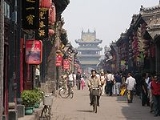
Pingyao

Encyclopedia
Pingyao is a Chinese city and county in central Shanxi
province, China
. It lies about 715 km from Beijing
and 80 km from the provincial capital, Taiyuan
. During the Qing Dynasty
, Pingyao was a financial center of China. It is now renowned for its well-preserved ancient city wall
, and is a UNESCO
World Heritage Site
.
and Qing
dynasties, conforming to a typical bagua pattern. More than 300 sites in or near the city have ancient ruins. Preserved Ming- and Qing-style residences number close to 4,000. The streets and storefronts still largely retain their historical appearance.
In the Spring and Autumn Period, the county belonged to the kingdom of Jin. It was part of the kingdom of Zhao
in the Warring States Period
. In the Qin Dynasty
, it was known as Pingtao. During the Han Dynasty
, it was known as Zhongdu county. In 1986, the People's Republic of China
designated Pingyao as one of the Chinese Historic and Cultural Cities. It became a World Heritage Site
in 1997, including the outlying Zhenguo Temple
and Shuanglin Temple
.
of Pingyao were constructed in the 3rd year of the Hongwu Emperor
(1370). The walls have six barbican
gates. The north and south sides have one gate each. The east and west sides have two gates each. This pattern is similar to that of a turtle (the head, tail, and four legs), earning Pingyao the moniker "Turtle City." The walls measure about 12 meters high, with a perimeter
of 6,000 meters. A 4-meter wide, 4-meter deep moat
can be found just outside the walls. Aside from the four structured towers at the four corners, there are also 72 watchtowers and more than 3,000 battlement
s.
In 2004, part of the southern walls collapsed but were reconstructed. However, the rest of the city walls are still largely intact and are considered among the best-preserved ancient city walls on this scale. This makes the city walls the centerpiece of the Heritage Site.
. During those times, there were as many as 20 financial institutions within the city, comprising more than half of total in the whole country. Among these is "Rishengchang
," considered the first bank
in China. Rishengchang
controlled almost 50% silver trade when its scale reached the top in the whole Qing Dynasty
. It continued to maintain its prosperity until going bankrupt in 1914 because lots of the modern banks were built up. The 2009 film Empire of Silver
depicted the tribulations of a Shanxi bank-owning family that lived in Pingyao during the early 20th century.
, and is in the southwestern edge of the Taiyuan
basin. It is adjacent to another Chinese Historic and Cultural City Qi County
. Pingyao's economy is largely agricultural and the region is famed for its beef
. Other products from the region include grains
, cotton
, and lacquerware
.
Since 2007, non-profit organization
Global Heritage Fund
(GHF) has been working with the Pingyao County Government to protect the city against problems of poverty, neglect, lack of resources, mass tourism, and uncontrolled development. GHF's stated goal for the project is to better preserve the cultural heritage of Pingyao ancient city in more comprehensive and systematic approaches as part of an integrated planning, conservation and development program. The Pingyao Cultural Heritage Development Program aims to preserve the vernacular architecture
, revitalize and stimulate the traditional arts and establish special historic areas.
Shanxi
' is a province in Northern China. Its one-character abbreviation is "晋" , after the state of Jin that existed here during the Spring and Autumn Period....
province, China
China
Chinese civilization may refer to:* China for more general discussion of the country.* Chinese culture* Greater China, the transnational community of ethnic Chinese.* History of China* Sinosphere, the area historically affected by Chinese culture...
. It lies about 715 km from Beijing
Beijing
Beijing , also known as Peking , is the capital of the People's Republic of China and one of the most populous cities in the world, with a population of 19,612,368 as of 2010. The city is the country's political, cultural, and educational center, and home to the headquarters for most of China's...
and 80 km from the provincial capital, Taiyuan
Taiyuan
Taiyuan is the capital and largest city of Shanxi province in North China. At the 2010 census, it had a total population of 4,201,591 inhabitants on 6959 km² whom 3,212,500 are urban on 1,460 km². The name of the city literally means "Great Plains", referring to the location where the Fen River...
. During the Qing Dynasty
Qing Dynasty
The Qing Dynasty was the last dynasty of China, ruling from 1644 to 1912 with a brief, abortive restoration in 1917. It was preceded by the Ming Dynasty and followed by the Republic of China....
, Pingyao was a financial center of China. It is now renowned for its well-preserved ancient city wall
Chinese city wall
Chinese city walls refer to civic defensive systems used to protect towns and cities in China in pre-modern times. The system consisted of walls, towers, and gates, which were often built to a uniform standard throughout the Empire....
, and is a UNESCO
UNESCO
The United Nations Educational, Scientific and Cultural Organization is a specialized agency of the United Nations...
World Heritage Site
World Heritage Site
A UNESCO World Heritage Site is a place that is listed by the UNESCO as of special cultural or physical significance...
.
Historical importance
Pingyao still retains its city layout from the MingMing Dynasty
The Ming Dynasty, also Empire of the Great Ming, was the ruling dynasty of China from 1368 to 1644, following the collapse of the Mongol-led Yuan Dynasty. The Ming, "one of the greatest eras of orderly government and social stability in human history", was the last dynasty in China ruled by ethnic...
and Qing
Qing Dynasty
The Qing Dynasty was the last dynasty of China, ruling from 1644 to 1912 with a brief, abortive restoration in 1917. It was preceded by the Ming Dynasty and followed by the Republic of China....
dynasties, conforming to a typical bagua pattern. More than 300 sites in or near the city have ancient ruins. Preserved Ming- and Qing-style residences number close to 4,000. The streets and storefronts still largely retain their historical appearance.
In the Spring and Autumn Period, the county belonged to the kingdom of Jin. It was part of the kingdom of Zhao
Zhao (state)
Zhao was a significant Chinese state during the Warring States Period, along with six others...
in the Warring States Period
Warring States Period
The Warring States Period , also known as the Era of Warring States, or the Warring Kingdoms period, covers the Iron Age period from about 475 BC to the reunification of China under the Qin Dynasty in 221 BC...
. In the Qin Dynasty
Qin Dynasty
The Qin Dynasty was the first imperial dynasty of China, lasting from 221 to 207 BC. The Qin state derived its name from its heartland of Qin, in modern-day Shaanxi. The strength of the Qin state was greatly increased by the legalist reforms of Shang Yang in the 4th century BC, during the Warring...
, it was known as Pingtao. During the Han Dynasty
Han Dynasty
The Han Dynasty was the second imperial dynasty of China, preceded by the Qin Dynasty and succeeded by the Three Kingdoms . It was founded by the rebel leader Liu Bang, known posthumously as Emperor Gaozu of Han. It was briefly interrupted by the Xin Dynasty of the former regent Wang Mang...
, it was known as Zhongdu county. In 1986, the People's Republic of China
People's Republic of China
China , officially the People's Republic of China , is the most populous country in the world, with over 1.3 billion citizens. Located in East Asia, the country covers approximately 9.6 million square kilometres...
designated Pingyao as one of the Chinese Historic and Cultural Cities. It became a World Heritage Site
World Heritage Site
A UNESCO World Heritage Site is a place that is listed by the UNESCO as of special cultural or physical significance...
in 1997, including the outlying Zhenguo Temple
Zhenguo Temple
Zhenguo Temple is a Buddhist temple located 10 km away from Pingyao in the village of Hadongcun, in Shanxi Province, China. The temple's oldest hall, the Wanfo Hall, was built in 963 during the Northern Han dynasty, and is notable for featuring very large brackets that hold up the roof and flying...
and Shuanglin Temple
Shuanglin Temple
The Shuanglin Temple , is a large Buddhist temple, part of the World Heritage Site of Pingyao, Shanxi province, China.-History:The temple is situated in the countryside about 7 kilometers southwest of the ancient city. It was originally founded in the 6th century during the Northern Wei period,...
.
City walls
The city wallsChinese city wall
Chinese city walls refer to civic defensive systems used to protect towns and cities in China in pre-modern times. The system consisted of walls, towers, and gates, which were often built to a uniform standard throughout the Empire....
of Pingyao were constructed in the 3rd year of the Hongwu Emperor
Hongwu Emperor
The Hongwu Emperor , known variably by his given name Zhu Yuanzhang and by his temple name Taizu of Ming , was the founder and first emperor of the Ming Dynasty of China...
(1370). The walls have six barbican
Barbican
A barbican, from medieval Latin barbecana, signifying the "outer fortification of a city or castle," with cognates in the Romance languages A barbican, from medieval Latin barbecana, signifying the "outer fortification of a city or castle," with cognates in the Romance languages A barbican, from...
gates. The north and south sides have one gate each. The east and west sides have two gates each. This pattern is similar to that of a turtle (the head, tail, and four legs), earning Pingyao the moniker "Turtle City." The walls measure about 12 meters high, with a perimeter
Perimeter
A perimeter is a path that surrounds an area. The word comes from the Greek peri and meter . The term may be used either for the path or its length - it can be thought of as the length of the outline of a shape. The perimeter of a circular area is called circumference.- Practical uses :Calculating...
of 6,000 meters. A 4-meter wide, 4-meter deep moat
Moat
A moat is a deep, broad ditch, either dry or filled with water, that surrounds a castle, other building or town, historically to provide it with a preliminary line of defence. In some places moats evolved into more extensive water defences, including natural or artificial lakes, dams and sluices...
can be found just outside the walls. Aside from the four structured towers at the four corners, there are also 72 watchtowers and more than 3,000 battlement
Battlement
A battlement in defensive architecture, such as that of city walls or castles, comprises a parapet , in which portions have been cut out at intervals to allow the discharge of arrows or other missiles. These cut-out portions form crenels...
s.
In 2004, part of the southern walls collapsed but were reconstructed. However, the rest of the city walls are still largely intact and are considered among the best-preserved ancient city walls on this scale. This makes the city walls the centerpiece of the Heritage Site.
Finance
Pingyao was the financial center of China in the late Qing DynastyQing Dynasty
The Qing Dynasty was the last dynasty of China, ruling from 1644 to 1912 with a brief, abortive restoration in 1917. It was preceded by the Ming Dynasty and followed by the Republic of China....
. During those times, there were as many as 20 financial institutions within the city, comprising more than half of total in the whole country. Among these is "Rishengchang
Rishengchang
The Rishengchang Exchange Shop , located in Pingyao, Shanxi province, China, is considered the first draft bank in China's history. It was founded in Qing Dynasty. In the nineteenth century, at its peak, it controlled almost half of the Chinese economy and its branches were widespread throughout...
," considered the first bank
Bank
A bank is a financial institution that serves as a financial intermediary. The term "bank" may refer to one of several related types of entities:...
in China. Rishengchang
Rishengchang
The Rishengchang Exchange Shop , located in Pingyao, Shanxi province, China, is considered the first draft bank in China's history. It was founded in Qing Dynasty. In the nineteenth century, at its peak, it controlled almost half of the Chinese economy and its branches were widespread throughout...
controlled almost 50% silver trade when its scale reached the top in the whole Qing Dynasty
Qing Dynasty
The Qing Dynasty was the last dynasty of China, ruling from 1644 to 1912 with a brief, abortive restoration in 1917. It was preceded by the Ming Dynasty and followed by the Republic of China....
. It continued to maintain its prosperity until going bankrupt in 1914 because lots of the modern banks were built up. The 2009 film Empire of Silver
Empire of Silver (film)
Empire of Silver is a 2009 film written and directed by Christina Yao. The historical epic concerns the turn-of-the-century Chinese economy and its relation to the Boxer Rebellion and stars Aaron Kwok and Jennifer Tilly.-Cast:* Third Master — Aaron Kwok...
depicted the tribulations of a Shanxi bank-owning family that lived in Pingyao during the early 20th century.
Geography and economy
Pingyao is located on the eastern banks of the Fen RiverFen River
The Fen River drains the center of Shanxi Province, China. It rises in the Guancen Mountains of Ningwu County in northeast Shanxi, flows southeast into the basin of Taiyuan, and then south through the central valley of Shanxi before turning west to join the Yellow River west of Hejin. The Fen and...
, and is in the southwestern edge of the Taiyuan
Taiyuan
Taiyuan is the capital and largest city of Shanxi province in North China. At the 2010 census, it had a total population of 4,201,591 inhabitants on 6959 km² whom 3,212,500 are urban on 1,460 km². The name of the city literally means "Great Plains", referring to the location where the Fen River...
basin. It is adjacent to another Chinese Historic and Cultural City Qi County
Qi County, Shanxi
Qi County, Shanxi is a county of Shanxi, China. It is under the administration of Jinzhong city.-References:*...
. Pingyao's economy is largely agricultural and the region is famed for its beef
Beef
Beef is the culinary name for meat from bovines, especially domestic cattle. Beef can be harvested from cows, bulls, heifers or steers. It is one of the principal meats used in the cuisine of the Middle East , Australia, Argentina, Brazil, Europe and the United States, and is also important in...
. Other products from the region include grains
Cereal
Cereals are grasses cultivated for the edible components of their grain , composed of the endosperm, germ, and bran...
, cotton
Cotton
Cotton is a soft, fluffy staple fiber that grows in a boll, or protective capsule, around the seeds of cotton plants of the genus Gossypium. The fiber is almost pure cellulose. The botanical purpose of cotton fiber is to aid in seed dispersal....
, and lacquerware
Lacquerware
Lacquerware are objects decoratively covered with lacquer. The lacquer is sometimes inlaid or carved. Lacquerware includes boxes, tableware, buttons and even coffins painted with lacquer in cultures mostly in the Eastern Hemisphere.-History:...
.
Threats
Increases in tourism have put pressure on the ancient walled city of Pingyao. During the tourist high-season, the amount of visitors to the city can reach up to 3 times its maximum capacity per day.Since 2007, non-profit organization
Non-profit organization
Nonprofit organization is neither a legal nor technical definition but generally refers to an organization that uses surplus revenues to achieve its goals, rather than distributing them as profit or dividends...
Global Heritage Fund
Global Heritage Fund
Global Heritage Fund is a non-profit organization that operates internationally. Its mission statement says that it exists to protect and preserve significant and endangered cultural heritage sites in the developing world, through scientific excellence and community development...
(GHF) has been working with the Pingyao County Government to protect the city against problems of poverty, neglect, lack of resources, mass tourism, and uncontrolled development. GHF's stated goal for the project is to better preserve the cultural heritage of Pingyao ancient city in more comprehensive and systematic approaches as part of an integrated planning, conservation and development program. The Pingyao Cultural Heritage Development Program aims to preserve the vernacular architecture
Vernacular architecture
Vernacular architecture is a term used to categorize methods of construction which use locally available resources and traditions to address local needs and circumstances. Vernacular architecture tends to evolve over time to reflect the environmental, cultural and historical context in which it...
, revitalize and stimulate the traditional arts and establish special historic areas.
External links
- Official website of Pingyao County Government
- Pingyao preservation project summary at Global Heritage FundGlobal Heritage FundGlobal Heritage Fund is a non-profit organization that operates internationally. Its mission statement says that it exists to protect and preserve significant and endangered cultural heritage sites in the developing world, through scientific excellence and community development...
- Explore Pingyao with Google Earth on Global Heritage NetworkGlobal Heritage NetworkGlobal Heritage Network , established by Global Heritage Fund , is an early warning and threats monitoring system for cultural heritage sites in developing countries...
- UN World Heritage - Pingyao