
All Topics  
Pinball

 
Pinball

   Email Print
   Bookmark   Link


Pinball


Pinball is a type of arcade game
Arcade game

An arcade game is a coin-operated entertainment machine, typically installed in businesses such as restaurants, public houses, video arcades, and Family Entertainment Centers....
, usually coin-operated, where a player attempts to score points by manipulating one or more metal
Metal

In chemistry, a metal is a chemical element whose atoms readily lose electrons to form positive ions , and form metallic bonds between other metal atoms and ionic bonds between nonmetal atoms....
 balls on a playfield inside a glass
Glass

Glass generally refers to a Hardness, brittle, transparency amorphous solid, such as that used for windows, many Glass Bottles, or eyewear, including, but not limited to, soda-lime glass, borosilicate glass, acrylic glass, sugar glass, Muscovite , or aluminium oxynitride....
-covered case called a pinball machine. The primary objective of the game is to score as many points as possible. Secondary objectives are to maximize the time spent playing (by earning extra balls and keeping the ball in play as long as possible) and to earn free games (known as replays).

origins of pinball are intertwined with the history of many other games.


Discussion
Ask a question about 'Pinball'
Start a new discussion about 'Pinball'
Answer questions from other users
Full Discussion Forum


Encyclopedia


Pinball is a type of arcade game
Arcade game

An arcade game is a coin-operated entertainment machine, typically installed in businesses such as restaurants, public houses, video arcades, and Family Entertainment Centers....
, usually coin-operated, where a player attempts to score points by manipulating one or more metal
Metal

In chemistry, a metal is a chemical element whose atoms readily lose electrons to form positive ions , and form metallic bonds between other metal atoms and ionic bonds between nonmetal atoms....
 balls on a playfield inside a glass
Glass

Glass generally refers to a Hardness, brittle, transparency amorphous solid, such as that used for windows, many Glass Bottles, or eyewear, including, but not limited to, soda-lime glass, borosilicate glass, acrylic glass, sugar glass, Muscovite , or aluminium oxynitride....
-covered case called a pinball machine. The primary objective of the game is to score as many points as possible. Secondary objectives are to maximize the time spent playing (by earning extra balls and keeping the ball in play as long as possible) and to earn free games (known as replays).

History of pinball


Evolution from outdoor games
The origins of pinball are intertwined with the history of many other games. Games played outdoors by rolling balls or stones on a grass course, such as Bocce
Bocce

Bocce , is a precision sport belonging to the boules sport family, closely related to bowls and p?tanque with a common ancestry from ancient games played in the Roman Empire....
 or Bowls
Bowls

Bowls is a sport in which the goal is to roll slightly asymmetric balls, called bowls, closest to a smaller—normally white—bowl called the "jack" or "kitty"....
, eventually evolved into games played by hitting the balls with sticks and propelling them at targets. Croquet
Croquet

Croquet is a game played both as a recreational pastime and as a competitive sport which involves hitting wooden or plastic balls with a mallet through hoops embedded into the grass playing arena....
 and Shuffleboard
Shuffleboard

Shuffleboard is a game in which players use broom-shaped paddles to push weighted pucks, sending them gliding down a narrow and elongated court, with the purpose of having them come to rest within a marked scoring area....
 are examples of these games.

These games led to indoor versions that could be played on a table, such as Billiards
Billiards

Cue sports are a wide variety of Game of skill generally played with a cue stick which is used to strike billiard balls, moving them around a Baize-covered billiards table bounded by rubber ....
 or Carrom
Carrom

Carrom or carroms is a family of tabletop games sharing a similarity in that their mechanics lie somewhere between billiards and table shuffleboard....
, or on the floor of a pub like Bowling
Bowling

Bowling is a game in which players attempt to score points by rolling a bowling ball along a flat surface either into objects called Bowling pin or to get close to a target ball....
. The tabletop versions of these games became the ancestor of the modern pinball machine.

Bagatelle
The existence of table-based games dates back to the 15th century. While some games took the wickets and balls of Croquet and turned them into the pockets of modern billiards, some tables became smaller and had the holes placed in strategic areas in the middle of the table.

In France
France

France , officially the French Republic , is a country whose Metropolitan France is located in Western Europe and that also comprises various Overseas departments and territories of France....
, during the reign of King Louis XIV, someone took a billiard table and narrowed it, placing pins at one end of the table while making the player shoot balls with a stick or cue from the other end. Pins took too long to reset when knocked down, so the pins eventually were fixed to the table and holes took the place of targets. Players could ricochet the ball off the pins to achieve the harder scoring holes.

In 1777, a party was thrown in honor of the King and his wife at the Château de Bagatelle
Château de Bagatelle

File:Paris Bagatelle 01.jpgThe Ch?teau de Bagatelle is a small neo-classical ch?teau in the Bois de Boulogne in the XVIe arrondissement of Paris....
, owned by the brother of the king. The highlight of the party was a new table game featuring the slender table and cue sticks, which players used to shoot ivory balls up an inclined playfield. The table game was dubbed Bagatelle
Bagatelle

Bagatelle is an indoor table game related to billiards, the object of which is to get a number of balls past pins into holes. It probably developed from the table made with raised sides for trou madame, which was also played with ivory balls and continued popular into the later nineteenth century....
 by the King's brother and shortly after swept through France. Some French soldiers carried their favorite bagatelle tables with them to America while helping to fight the British in the American Revolutionary War
American Revolutionary War

The American Revolutionary War , also known as the American War of Independence, began as a war between the Kingdom of Great Britain and Thirteen Colonies on the North America, and ended in a global war between several European great powers....
. Bagatelle spread and became so popular in America as well that a political cartoon from 1863 even depicts President Abraham Lincoln
Abraham Lincoln

Abraham Lincoln was the List of Presidents of the United States President of the United States. He successfully led the country through its greatest internal crisis, the American Civil War, preserving the Union and ending slavery....
 playing a tabletop bagatelle game.

The birth of pinball
In 1869, a British inventor named Montague Redgrave settled in America and manufactured bagatelle tables out of his factory in Cincinnati, Ohio
Cincinnati, Ohio

Cincinnati is a city in the U.S. state of Ohio and the county seat of Hamilton County, Ohio. The municipality is located in southwestern Ohio and is situated on the Ohio River at the Ohio-Kentucky border....
. In 1871 Redgrave was granted US Patent #115,357 for his "Improvements in Bagatelle", which replaced the cue at the player's end of the table with a coiled spring and a plunger. The player shot balls up the inclined playfield using this plunger, a device that remains in pinball to this day. This innovation made the game friendlier to players. The game also shrank in size and began to fit on top of a bar or counter. The balls became marbles and the wickets became small "pins". Redgrave's innovations in game design are acknowledged as the birth of pinball in its modern form.

Modern day pinball


Pinball and gambling
Pinball machines, like many other mechanical games, were sometimes used as gambling
Gambling

Gambling is the wikt:wager#Verb of money or something of material Value on an event with an uncertain outcome with the primary intent of winning additional money and/or material goods....
 devices. Some pinball machines, such as Bally's "bingos", featured a grid on the backglass scoring area with spaces corresponding to targets or holes on the playfield. Free games could be won if the player was able to get the balls to land in a winning pattern, however, doing this was nearly random, and a common use for such machines was for gambling. Other machines allowed a player to win and accumulate large numbers of "free games" which could then be cashed-out for money with the location owner. Later, this type of feature was discontinued in an effort to legitimize the machines, and to avoid legal problems in areas where awarding free games was considered illegal, some games — called Add-A-Ball games — did away with the free game feature, instead giving players extra balls to play (between 5 and 25 in most cases). These extra balls were indicated via lighted graphics in the backglass or by a ball count wheel, but in some areas even that was disallowed and so some games came with a sticker to cover over the counters.

One important and notable area where pinball games have been regulated or banned was in New York City
New York City

The City of New York is the List of United States cities by population in the United States, while the New York metropolitan area ranks among the List of urban areas by population....
, beginning in the 1940s and continuing until 1976. The ban ended when Roger Sharpe (a star witness for the AMOA - Amusement and Music Operators Association) testified in April 1976 before a committee in a Manhattan
Manhattan

Manhattan is one of the five borough of New York City, located primarily on Manhattan Island at the mouth of the Hudson River.With a United States Census of 1,620,867 living in a land area of 22.96 square miles , Manhattan, coextensive with New York County, is the most population density county in the United States, w...
 courtroom that pinball games had become games of skill and were no longer games of chance (i.e. gambling). He began to play one of two games set up in the courtroom, and — in a move he compares to Babe Ruth
Babe Ruth

George Herman Ruth, Jr. , also popularly known as "Babe", "The Bambino", and "The Sultan of Swat", was an United States Major League Baseball baseball player from –....
's home run in the 1932 World Series
World Series

The World Series is the championship series of Major League Baseball, the culmination of the sport's playoff each October. Since the Series takes place in mid-autumn, sportswriters many years ago dubbed the event the Fall Classic, a usage reflected in the logo for the 2008 World Series; it is also sometimes known as the October Clas...
 — called out precisely what he was going to shoot for, and then proceeded to do exactly so. Astonished committee members reportedly then voted to remove the ban, a result which was then followed in many other cities.

Like New York, Los Angeles banned pinball machines in 1939. The ban was overturned by the Supreme Court of California
Supreme Court of California

The Supreme Court of California is the state supreme court of California. It is headquartered in San Francisco, California, and regularly holds sessions at its branch offices in Los Angeles, California and Sacramento, California....
 in 1974 because (1) if pinball machines were games of chance, the ordinance was preempted by state law governing games of chance in general, and (2) if they were games of skill, the ordinance was unconstitutional as a denial of the equal protection of the laws
Equal Protection Clause

The Equal Protection Clause, part of the Fourteenth Amendment to the United States Constitution to the United States Constitution, provides that "no state shall ......
.

Regardless of these events, some towns in America still have such bans on the law books over fifty years later, and several countries still ban the games and their rewards. (Sharpe reportedly acknowledges his courtroom shot was lucky.)

More recent games are clearly labeled "FOR AMUSEMENT ONLY" in an attempt to emphasize their legitimate, legal nature.

Another close but distinct relative of pinball is Pachinko
Pachinko

File:Pachinko parlour.jpg is a Japanese Gambling device used for amusement and prizes. Although pachinko machines were originally strictly mechanical, modern pachinko machines are a cross between a pinball machine and a video slot machine....
, a gambling game played in Japan
Japan

Japan is an island country in East Asia. Located in the Pacific Ocean, it lies to the east of the Sea of Japan, People's Republic of China, North Korea, South Korea and Russia, stretching from the Sea of Okhotsk in the north to the East China Sea and Taiwan in the south....
. Although they share a common ancestry, the games are very different, in that pachinko simply involves shooting many small balls one after the other into a nearly-vertical playfield, while pinball is about the manipulation of the small number of balls currently in play.

Depression era
By the 1930s, manufacturers were producing coin-operated versions of bagatelles, now known as "marble games" or "pin games". The table was under glass and used Redgrave's plunger device to propel the ball into the upper playfield. In 1931 David Gottlieb's Baffle Ball became the first overnight hit of the coin-operated era. Selling for $17.50, the game dispensed five balls for a penny. The game struck a chord with a public eager for cheap entertainment in a depression-era economy. Most drugstores and taverns in America operated pinball machines, with many locations making back the cost of the game in a matter of days. Baffle Ball sold over 50,000 units and established Gottlieb
Gottlieb

Gottlieb was an arcade game corporation based in Chicago, Illinois. The company was established by David Gottlieb in 1927, initially producing pinball machines while later expanding into various other games including pitch-and-bats, bowling games, and eventually video arcade games ....
 as the first major manufacturer of pinball machines.

In 1932, Gottlieb distributor Ray Moloney found it hard to obtain more Baffle Ball units to sell. In his frustration he founded Lion Manufacturing to produce a game of his own design, Ballyhoo, named after a popular magazine of the day. The game became a smash hit as well, its larger playfield and ten pockets making it more of a challenge than Baffle Ball, selling 50,000 units in 7 months. Moloney eventually changed the name of his company to Bally to reflect the success of this game. These early machines were relatively small, mechanically simple and originally designed to sit on a counter or bar top.

The 1930s saw a leap forward in innovation in pinball design and devices with the introduction of electrification. A company called Pacific Amusements in Los Angeles, California
Los Angeles, California

Los Angeles is the largest city in the U.S. state of California and the List of United States cities by population in the United States. Often abbreviated as L.A. and nicknamed The City of Angels, Los Angeles is rated as a beta global city, has an estimated population of 3.8 million and spans over in Southern California....
, USA produced a game called Contact in 1933. Contact had an electrically powered solenoid
Solenoid

A solenoid is a three-dimensional coil. In physics, the term solenoid refers to a loop of wire, often wrapped around a metallic core, which produces a magnetic field when an electric current is passed through it....
 to propel the ball out of a bonus hole in the middle of the playfield. Another solenoid rang a bell to reward the player. The designer of Contact, Harry Williams, would eventually form his own company, Williams Manufacturing
Williams (gaming company)

WMS Industries, Inc. is a long-standing United States electronic gaming and amusement company based in Waukegan, Illinois. WMS traces its roots far back as 1943 as the Williams Manufacturing Company founded by Harry E....
, in 1944. Other manufacturers quickly followed suit with similar features. In addition, electric lights soon became a standard feature of all subsequent pinball games, designed to attract people to the game.

By the end of 1932 there were approximately 150 companies manufacturing pinball machines, most of them in the city of Chicago
Chicago

Chicago is the largest city in the U.S. state of Illinois and the Midwestern United States, as well as the List of United States cities by population city in the United States with more than 2.8 million residents....
. Chicago has been the center of pinball manufacturing ever since. Competition between the companies was brutal, however, and by 1934 there were only 14 companies left.

Post-war boom
During World War II all of the major manufacturing companies in coin-operated games were put into use manufacturing equipment for the American war effort. Some companies like Williams bought old games from operators and refurbished them, adding new artwork with a patriotic theme.

By the end of the war, a generation of Americans looked for amusement in their bars and malt shops. Pinball saw another golden age of growth. Innovations such as the tilt mechanism and free games (known as replays) appeared.

The post-war era was dominated by Gottlieb
Gottlieb

Gottlieb was an arcade game corporation based in Chicago, Illinois. The company was established by David Gottlieb in 1927, initially producing pinball machines while later expanding into various other games including pitch-and-bats, bowling games, and eventually video arcade games ....
. Game designer Wayne Neyens along with artist Leroy Parker turned out game after game that collectors consider some of the most classic pinball machines ever designed. The most famous were designed by James Rider, the man behind the epitomized catchphrase "I've got it", amongst others.

Gottlieb's Humpty Dumpty, introduced in 1947, was the first game to add player-controlled flippers to keep the ball in play longer and added a skill factor to the game. The low power of the Humpty Dumpty flippers necessitated that three pairs be placed around the playfield in order to get the ball to the top. But the addition of a DC power supply enabled the flippers on Humpty Dumpty to become only two, more powerful ones at the bottom of the Triple Action playfield -- one of many innovations by designer Steve Kordek, who is also credited with introducing the very first "drop target" (1962 on Vagabond) and "multiball" (1963 on Beat the Clock) concepts to the game.

Solid-state era
The advent of the microprocessor
Microprocessor

A microprocessor incorporates most or all of the functions of a central processing unit on a single integrated circuit . The first microprocessors emerged in the early 1970s and were used for electronic calculators, using Binary-coded decimal arithmetic on 4-bit Word ....
 brought another new age for pinball as it entered into the realm of electronic gaming
Electronic game

An electronic game is a game that employs electronics to create an interactive system with which a player can Play . The most common form of electronic game today is the video game, and for this reason the terms are often mistakenly used synonymously....
. The electromechanical relays and scoring reels that drove games in the 1950s and 1960s were replaced in the 1970s with circuit boards and digital displays. Williams introduced their first solid-state electronic game
Electronic game

An electronic game is a game that employs electronics to create an interactive system with which a player can Play . The most common form of electronic game today is the video game, and for this reason the terms are often mistakenly used synonymously....
, Hot Tip, in 1977, and because of this new technology, they and Bally thrived in this era as they both sold large amounts of games with fancy sound effects, speech, and game features that only a computer could make possible.

The video game boom of the 1980s, however, signaled the end of the boom for pinball. Arcades quickly replaced rows of pinball machines with games like Asteroids and Pac-Man
Pac-Man

is an arcade game developed by Namco and licensed for distribution in the United States by Midway Games, first released in Japan on May 22, 1980. Immensely popular in the United States from its original release to the present day, Pac-Man is universally considered as one of the classics of the medium, virtually synonymous with video games, and...
, which earned incredible amounts of money compared to the pinballs of the day. Bally, Williams, and Gottlieb continued to quietly make pinballs while they also manufactured video games in much higher numbers. Many of the larger companies were acquired by corporations or merged with other companies. Chicago Coin
Chicago Coin

File:Chicago Coin logo.svgChicago Coin was one of the early major manufacturers of pinball tables. Chicago Coin, founded in 1931, would make pingames and modern pinball machines for over 45 years before being sold to the Stern family in 1977 and becoming Stern ...
 was purchased by the Stern family who brought the company into the digital era as Stern Enterprises, which closed its doors in the mid-1980s. Bally exited the pinball business in 1988 and sold their assets to Williams, who subsequently used the Bally trademark on about half of their pinball releases from then on.

Pinball in the digital age
After the collapse of the coin-operated video game industry, pinball saw another comeback in the 1990s. Some new manufacturers entered the field such as Capcom Pinball and Alvin G. and Company, founded by Alvin Gottlieb, son of David Gottlieb. Gary Stern, the son of Williams co-founder Sam Stern, founded Data East
Data East

also abbreviated as DECO, was a Japanese video game company. Their main headquarters were located in Tokyo, while their American subsidiary, Data East USA, was headquartered in San Jose, California....
 Pinball with funding from Data East Japan.

The games from Williams now dominated the industry, with complicated mechanical devices and more elaborate display and sound systems attracting new players to the game. Licensing popular movies and icons of the day became a staple for pinball, with Bally/Williams' The Addams Family
The Addams Family (pinball)

The Addams Family is the best selling pinball machine of all time, having sold 20,270 units. Manufactured by Midway Games , it is a Solid state game....
 hitting an all-time modern sales record of 20,270 machines. Two years later, Williams commemorated this benchmark with a limited edition of 1,000 Addams Family Gold pinball machines, featuring gold-colored trim and updated software with new game features. Other notable popular licenses included Indiana Jones: The Pinball Adventure
Indiana Jones: The Pinball Adventure

Indiana Jones: The Pinball Adventure is a 1993 widebody pinball game designed by Mark Ritchie and released by Williams . It was based on the Indiana Jones movies....
 and Star Trek: The Next Generation
Star Trek: The Next Generation (pinball)

Star Trek: The Next Generation is a widebody pinball game, designed by Steve Ritchie and released in November 1993 by Williams . It was part of WMS' SuperPin series , and was based on the Star Trek: The Next Generation....
. Expanding markets in Europe and Asia helped fuel the boom. Pat Lawlor
Pat Lawlor

Patrick M. Lawlor is a pinball machine designer who has designed some of history's most commercially-successful pinball games....
 was a designer, working for Williams up until their closure in 1999. About a year after, Lawlor announced a return to the industry, starting his own company working in conjunction with Stern Pinball to produce new games into the new millennium.

The end of the 1990s saw another downturn in the industry, with Gottlieb, Capcom, and Alvin G. all closing their doors by the end of 1996. Data East was acquired by Sega
Sega

is a Multinational corporation video game software and hardware development company, and a home computer and console manufacturer headquartered in Ota, Tokyo, Tokyo, Japan....
 and became Sega Pinball for a few years. By 1997 there were only two companies left: Sega Pinball and Williams. In 1999 Sega sold their pinball division to Gary Stern (President of Sega Pinball at the time) who called his company Stern Pinball
Stern (gaming company)

Stern is the name of two different but related arcade game companies: Stern Electronics, Inc. and Stern Pinball, Inc....
. By this time, Williams had shrunk its production runs significantly and reduced the manufacturing cost of their machines by incorporating fewer playfield toys than in earlier games. In 1999 Williams attempted to revive sales with the Pinball 2000
Pinball 2000

Pinball 2000 is the last pinball hardware and software platform developed by major pinball manufacturer Williams , and was used in the machines Revenge From Mars and Star Wars Episode I before Williams exited the pinball business on October 25th, 1999....
 line of games, merging a video display into the pinball playfield. The reception was lukewarm and Williams exited the pinball business to focus on making gaming equipment for casinos, licensing the rights to Bally/Williams parts to Illinois Pinball and names to The Pinball Factory. Stern Pinball is the only current manufacturer of original pinball machines. Almost all members of the design teams for Stern Pinball are former employees of Williams.

In November 2005 The Pinball Factory (TPF), based in Melbourne
Melbourne

Melbourne is the more common name for the geographic region and Census in Australia of the Greater Melbourne metropolitan area. It is the second List of cities in Australia by population in Australia, with a population of approximately 3.8 million and serves as the List of Australian capital cities of Victoria ....
, Australia
Australia

Australia, officially the Commonwealth of Australia, is a country in the southern hemisphere comprising the Australia of the world's smallest continent, the major island of Tasmania, and numerous list of islands of Australia in the Indian Ocean and Pacific Oceans....
, announced that they would be producing a new Crocodile Hunter
Crocodile Hunter

Crocodile Hunter may represent:* The Crocodile Hunter, TV nature program** Steve Irwin, star of The Crocodile Hunter**...
-themed pinball machine under the Bally label. However, with the death of Steve Irwin
Steve Irwin

Stephen Robert Irwin , known simply as Steve Irwin and nicknamed "The Crocodile Hunter", was an iconic Australian television personality, wildlife expert, and conservationist....
, it was announced that the future of this game has become uncertain. In 2006 TPF announced that they would be reproducing two popular 90's era Williams machines, Medieval Madness
Medieval Madness

Medieval Madness is a Williams pinball machine released in June 1997. Designed by Brian Eddy and programmed by Lyman Sheats, Medieval Madness had a production run of 4,016 units....
 and Cactus Canyon. To date The Pinball Factory has produced no machines. Illinois pinball company PinBall Manufacturing Inc. has produced several reproductions of Capcom's Big Bang Bar for the European market and continues to build machines for the U.S.

Competition


In 1974, students at Jersey City State College wanted to make pinball playing a varsity school sport, like football
American football

American football, known in the United States and Canada simply as football, is a competitive team sport known for mixing strategy with physical play....
 was, so they started a Pinball Club Team to compete against clubs at other schools. Of the two schools that were asked to participate, only St. Peter's College
St. Peter's College

St Peter's College or St. Peter's College may refer to:...
 took up the challenge.

Many pinball leagues have formed, with varying levels of competitiveness, formality and structure. These leagues exist everywhere from the in the Washington, DC area to the in Japan. In the late 1990's, game manufacturers added messages to some games encouraging players to join a local league, providing website addresses for prospective league players to investigate.

Competitive pinball has become increasingly popular in recent years, with the relaunch of both PAPA
Papa

Papa can refer to: is just one example. A discussion of this phenomenon can be found in the article Mama and papa.**some people also refer to their grandfathers as "papa"....
 (Professional-Amateur Pinball Association) and the . The IFPA is run by Roger Sharpe and Steve Epstein.

Two different systems for ranking pinball players exist. The is affiliated with the IFPA and is run by Roger Sharpe's son, Josh, who assigns point values to results in various tournaments. PAPA manages a ranking system known as the , which uses the Glicko rating system
Glicko rating system

The Glicko rating system and the Glicko-2 rating system are similar to the Elo rating system: a method for assessing a player's strength in games of skill such as chess....
 to mathematically analyze the results of more than 100,000 competitive matches.

PAPA also designates the winner of the A Division in the annual PAPA World Pinball Championships as the World Pinball Champion; the current holder of this title is Keith Elwin from the USA. Current Junior (16 and under) and Senior (50 and over) World Champions are Ethan Blonder and Ed Hershey, respectively.

Pinball in popular culture

Pinball games have frequently been featured in popular culture
Popular culture

Popular culture is the totality of Distinction memes, ideas, Perspective s and Attitude s that are deemed preferred per an informal consensus within the mainstream of a given culture....
, often as a symbol of rebellion or toughness. Perhaps the most famous instance is the rock opera
Rock opera

A rock opera is a musical work that presents a storyline told over multiple parts, songs or sections. A rock opera differs from a conventional rock album, which usually includes songs that are unrelated to each other in terms of storyline....
 album Tommy
Tommy (rock opera)

Tommy is the fourth album by the English Rock music band The Who. A double album telling a loose story about a "deaf, dumb, and blind boy" who becomes the leader of a messianic movement, Tommy was the first musical work to be billed overtly as a rock opera....
 (1969) by British
United Kingdom

The United Kingdom of Great Britain and Northern Ireland, commonly known as the United Kingdom , the UK or Britain,is a sovereign state located off the northwestern coast of continental Europe....
 band The Who
The Who

The Who are an England Rock music band formed in 1964. The primary lineup was guitarist Pete Townshend, vocalist Roger Daltrey, bassist John Entwistle and drummer Keith Moon....
, which centers on the title character, a "deaf, dumb, and blind kid", who nevertheless becomes a "Pinball Wizard
Pinball Wizard

"Pinball Wizard" is a song written by Pete Townshend and performed by the England rock music band The Who, and featured on their 1969 rock opera album Tommy ....
" and who later uses pinball as a symbol and tool for his messianic mission. (The album was subsequently made into a movie
Tommy (film)

Tommy is a 1975 in film musical film, based on The Who 1969 in music rock opera album musical Tommy . It was directed by Ken Russell and featured a star-studded cast, including the band members themselves....
 and stage musical.) Wizard has since moved into popular usage as a term for an expert pinball player. Things came full circle when Bally created the Wizard pinball game featuring Ann-Margret
Ann-Margret

Ann-Margret is a Sweden-born American actress, singer and dancer. She has won the Golden Globe Award five times, and has been nominated for the Academy Award, Emmy Award and Grammy....
 and The Who's Roger Daltrey
Roger Daltrey

Roger Harry Daltrey Order of the British Empire is an England singer-songwriter and actor, best known as the founder and lead singer of English rock music band The Who....
 on the backglass. In the movie version, Tommy plays a Gottlieb machine, while The Champ plays a Gottlieb machine.

Other examples of pinball in pop culture include:
  • In the 1948 movie "The Time of Your Life" one of the characters was called "Willie, the Marbler Game Maniac". After repeated attempts he eventually wins. With a fanfare, the backglass descends to reveal a winning screen, American flags pop out from the side of the machine, and fireworks erupted from the back. He is award six nickels by the bartender, and says, "With a little skill a man can make an honest living beating the marble games."
  • Singer/Songwriter Lonnie Irving's song "Pinball Machine" made the Top 100 Singles Chart in March 1960 on the Starday label. The lyrics are the lament of a victim of an addiction to truck driving and pinball machines.
  • "Pinball Blues", performed by Charlie Moore & Bill Napier.
  • The band Cook County merged composer Cy Coleman's
    Cy Coleman

    For the fictional principal Seymour Kaufman, see Room 222.Cy Coleman was an American composer, songwriter, and jazz pianist....
     "Playboy's Theme" with the electronic sounds of the Bally "Playboy
    Playboy

    Playboy is an American men's magazine, founded in Chicago, Illinois, by Hugh Hefner and his associates, which has grown into Playboy Enterprises, with a presence in nearly every medium....
    " pinball machine to create the song "Pinball Playboy" in 1979.
  • The 1973 movie Heavy Traffic
    Heavy Traffic

    Heavy Traffic is a 1973 in film American animated film written and directed by Ralph Bakshi. The film, which begins, ends, and occasionally combines with live-action, explores the often surreal fantasy of a young New York City cartoonist named Michael Corleone, using pinball imagery as a metaphor for Inner city life....
    ,
    directed by Ralph Bakshi
    Ralph Bakshi

    Ralph Bakshi is an American director of animation and live-action films. As the American animation industry fell into decline during the 1960s and 1970s, Bakshi tried to establish an alternative to mainstream animation through independent animation and adult animation-oriented productions....
    , uses pinball imagery as a metaphor for inner-city life.
  • The British 1973 movie The Final Programme
    The Final Programme

    The Final Programme was a 1973 British comedy-thriller film directed by Robert Fuest, and starring Jon Finch and Jenny Runacre. It was based on the first Jerry Cornelius novel by Michael Moorcock....
    ,
    has a club in which couples enter transparent balls and roll them around on a playing field the size of a dance hall.
  • The 1979 movie Tilt
    Tilt (film)

    Tilt is a movie that was released in 1979 and is rated PG. It stars a young Brooke Shields as a pinball wizard. Pinball sound effects by Bill Wray , Jim Wray, George Enete and Rudy Durand....
     starring Brooke Shields
    Brooke Shields

    Brooke Christa Camille Shields is an American actor and supermodel. Some of her better-known movies include Pretty Baby and The Blue Lagoon as well as tv shows such as Suddenly Susan and Lipstick Jungle ....
     as a young pinball wizard.
  • The 1970s TV game show The Magnificent Marble Machine
    The Magnificent Marble Machine

    The Magnificent Marble Machine was an United States television game show hosted by Art James and based on pinball. The show ran on National Broadcasting Company from July 7, 1975 to June 11, 1976, but was interrupted for about two weeks in January, due to scheduling changes on the network....
     featured a giant pinball machine.
  • Happy Days
    Happy Days

    Happy Days is an Television in the United States television sitcom that originally aired from 1974 in television to 1984 in television on American Broadcasting Company....
    ' Arthur "Fonzie
    Fonzie

    Arthur Herbert Fonzarelli is a fictional character played by Henry Winkler in the United States situation comedy Happy Days . He was originally a secondary character but became the lead....
    " Fonzarelli often played a "Nip-It" pinball at Arnold's Drive-In. This is notable only as the show was set in the 1950s while Nip-It was created in the 1970s.
  • The 1982 movie The Verdict
    The Verdict

    The Verdict is a 1982 in film feature film which tells the story of a down-on-his-luck alcoholism lawyer who pushes a medical malpractice case in order to improve his own situation, but discovers along the way that he is doing the "right" thing....
     portrays pinball as the quintessential barfly
    Barfly

    A barfly is a person who spends a significant amount of time at a Bar .Barfly may also mean:* Barfly , a 1987 American film starring Mickey Rourke and Faye Dunaway...
     game.
  • In the Three Stooges short film "Three Little Pirates" there is a scene where the boys happen upon a pinball machine and Larry says, "A game of skill", possibly alluding to the then common allegations that pinball was a game of chance.
  • Episode 13 (Season 1) of the 1990s kids' show Are You Afraid of the Dark? titled 'The Tale of the Pinball Wizard' dealt with a boy with a penchant for pinball games becoming trapped in a pinball game made real.
  • Sesame Street
    Sesame Street

    Sesame Street is an Television in the United States educational children's television series and a pioneer of the contemporary educational television standard, combining both edutainment....
     had a segment called Pinball Number Count
    Pinball Number Count

    Pinball Number Count is a collective title referring to 11 one-minute animated segments on the popular PBS children's series Sesame Street that teach children to count to 12 by following the journey of a pinball through a rather fanciful pinball machine....
     where a pinball goes through many different places. The song was sung by the Pointer Sisters
    Pointer Sisters

    The Pointer Sisters are an United States Grammy Award-winning Pop music/R&B recording act from Oakland, California, California that achieved mainstream success during the 1970s and 1980s....
    .
  • British singer/songwriter Brian Protheroe had a 1979 chart hit with his song "Pinball".
  • Monday Night Football introduction played a computer generated pinball with their theme song.
  • On The Simpsons
    The Simpsons

    The Simpsons is an Television in the United States animated cartoon Situation comedy created by Matt Groening for the Fox Broadcasting Company....
    , Sideshow Bob
    Sideshow Bob

    Robert Underdunk Terwilliger, better known by his stage name Sideshow Bob, is a recurring fictional character in the animated television series The Simpsons....
     said that his former medium of TV "destroyed more young minds than syphilis and pinball combined."
  • Blernsball, the futuristic version of baseball
    Baseball

    Baseball is a bat-and-ball sport played between two team sport of nine players each. The goal of baseball is to score run by hitting a thrown Baseball with a baseball bat and touching a series of four markers called base arranged at the corners of a ninety-foot square, or diamond. Players on one team take turns hitting against...
     in Futurama
    Futurama

    Futurama is an Animated cartoon United States Situation comedy created by Matt Groening, and developed by Groening and David X. Cohen for the Fox Broadcasting Company....
    , features pinball game elements, including captive balls and multiball.
  • Pinball-themed zones made numerous appearances in the early Sonic the Hedgehog series of video games, including an entire game based on the Pinball theme, Sonic Spinball.
  • A Pinball-themed courtship is featured in Bad Santa
    Bad Santa

    Bad Santa is a Golden Globe-nominated 2003 in film comedy film film director by Terry Zwigoff, produced by Coen Brothers, and starring Billy Bob Thornton as the title character and Tony Cox as his partner in crime....
     when Billy Bob Thornton
    Billy Bob Thornton

    Billy Bob Thornton is an American screenwriter, actor and occasional Film director, playwright and singer. His rise to fame began in the mid-1990s, after writing, directing, and starring in the film Sling Blade, for which he won an Academy Awards for Best Adapted Screenplay; he has since established a successful career as a film actor in...
     shows the mechanics of the "tilt mechanism."
  • In the movie West Side Story
    West Side Story

    West Side Story is a musical with a book by Arthur Laurents, music by Leonard Bernstein, and lyrics by Stephen Sondheim. The musical is based on William Shakespeare's Romeo and Juliet....
     one of the gangmembers is playing a pinball machine when the Sharks and Jets meet in the store.
  • In the Disney movie The Game Plan
    The Game Plan

    The Game Plan can refer to:*The Game Plan *The Game Plan : 2007 comedy film starring Dwayne Johnson...
    , Peyton plays a pinball machine when she goes into Joe's house while Joe reads Peyton's birth certificate
    Birth certificate

    A birth certificate is a vital record that documents the birth of a child. Outside the United States, the term "birth certificate" refers to a certification of the original birth record....
     or letter.
  • In a 2008 episode of South Park
    South Park

    South Park is an United Statesn animation situation comedy, notorious for its toilet humour, surrealism, and often black comedy, which satirizes Subject matter in South Park including religion, politics, violence, abuse, sexuality, and mental disorder....
    , Indiana Jones
    Indiana Jones

    Dr. Henry Walton "Indiana" Jones, Jr. is a fictional character adventurer, soldier, professor of archaeology, and the main protagonist of the Indiana Jones franchise....
     is seen playing a Howard the Duck
    Howard the Duck (film)

    Howard the Duck , is a 1986 live-action film produced by Lucasfilm and Universal Pictures, directed by Willard Huyck from a script by Huyck and his wife, Gloria Katz....
     pinball machine.


Features of a pinball game


Playfield

The playfield is a planar
Planar

In computer graphics, planar is the method of representing pixel colours with several bitplanes of Random Access Memory. Each bit in a bitplane is related to one pixel on the screen....
 surface inclined upward from three to seven degrees
Degree (angle)

A degree , usually denoted by ? , is a measurement of plane angle, representing 1/360 of a Turn ; one degree is equivalent to p/180 radians....
 (current convention is six and a half degrees), away from the player, and includes multiple targets and scoring objectives. Some operators intentionally extend (to raise) threaded levelers on the rear legs and/or shorten or remove the levelers on the front legs to create additional incline in the playfield, making the ball move faster and harder to play. It is important that the playfield be level left-to-right; a quick visual test compares the top of the back cabinet against a brick or block wall behind it. Or, roll a marble down the center of the playfield glass. If it clearly rolls off to one side, a player may be inclined to stuff folded paper beneath the legs on the lower side to level the playfield. Additionally, leg levelers that are all extended fully make the game easier to nudge; when collapsed low, the entire game is more stable, and nudging becomes harder. A game that's fun to play makes more money for the owner; a game that is faulty does not get repeat customers. The ball is put into play by use of the plunger, a spring
Spring (device)

A spring is an Elasticity object used to store mechanical energy. Springs are usually made out of hardened steel. Small springs can be wound from pre-hardened stock, while larger ones are made from annealing steel and hardened after fabrication....
-loaded rod that strikes the ball as it rests in an entry lane, or as in some newer games, by a button that signals the game logic to fire a solenoid
Solenoid

A solenoid is a three-dimensional coil. In physics, the term solenoid refers to a loop of wire, often wrapped around a metallic core, which produces a magnetic field when an electric current is passed through it....
 that strikes the ball. With both devices the result is the same: The ball is propelled upwards onto the playfield. Once a ball is in play, it tends to move downward towards the player, although the ball can move in any direction, sometimes unpredictably, as the result of contact with objects on the playfield or by the player's own actions. To return the ball to the upper part of the playfield, the player makes use of one or more flippers. Manipulation of the ball may also be accomplished by nudging (physically pushing the cabinet). However, excessive nudging is generally penalized by the loss of the current player's turn (known as tilting) or ending of the entire game when the nudging is particularly violent (known as slam tilting). Many games also have a slam tilt in the bottom of the lower cabinet to end the game if the cabinet is raised and dropped to the floor in an attempt to falsely trigger the coin counting switch.

Plunger

The plunger is a spring
Spring (device)

A spring is an Elasticity object used to store mechanical energy. Springs are usually made out of hardened steel. Small springs can be wound from pre-hardened stock, while larger ones are made from annealing steel and hardened after fabrication....
-loaded rod with a small handle, used to propel the ball into the playfield. The player can control the amount of force
Force

In physics, a force is that which can cause an object with mass to change its velocity. Force has both Euclidean_vector#Length of a vector and Direction , making it a Vector quantity....
 used for launching by pulling the plunger a certain distance (thus changing the spring compression
Physical compression

Physical compression is the result of the subjection of a material to compressive stress, resulting in reduction of volume. The opposite of compression is tension ....
). This is often used for a "skill shot", in which a player attempts to launch a ball so that it exactly hits a specified target. Once the ball is in motion in the main area of the playfield, the plunger is not used again until another ball must be brought onto the playfield. In modern machines, an electronically-controlled
Electronics

Electronics refers to the flow of charge through nonmetal electrical conductor , whereas electrical refers to the flow of charge through metal electrical conductor....
 launcher is sometimes substituted for the plunger.

Flippers

The flippers are one or more small mechanically or electromechanically-controlled levers, roughly 3 to 7 cm in length, used for redirecting the ball up the playfield. They are the main control that the player has over the ball. Careful timing and positional control allows the player to intentionally direct the ball in a range of directions with various levels of velocity. With the flippers, the player attempts to move the ball to hit various types of scoring targets, and to keep the ball from disappearing off the bottom of the playfield. The very first pinball games appeared in the early 1930s and did not have flippers; after launch the ball simply proceeded down the playfield, directed by static nails (or "pins") to one of several scoring areas. (These pins gave the game its name). In 1947, the first mechanical flippers appeared on Gottlieb's and by the early 1950s, the familiar two-flipper configuration, with the flippers at the bottom of the playfield above the center drain, had become standard.

The new flipper ushered in the "golden age" of pinball, where the fierce competition between the various pinball manufacturers led to constant innovation in the field. Various types of stationary and moving targets were added, spinning scoring reels replaced games featuring static scores lit from behind. Multiplayer scores were added soon after, and then bells and other noise-makers, all of which began to make pinball less a game and more of an experience.

The flippers have loaned pinball its common name in many languages, where the game is known mainly as "flipper".

Backglass

The backglass is a vertical graphic panel mounted on the front of the backbox, which is the upright box at the top back of the machine. The backglass contains the name of the machine, eye-catching graphics
Graphics

Graphics are visual presentations on some surface, such as a wall, canvas, computer screen, paper, or stone to brand, inform, illustrate, or entertain....
, (usually) the score displays (lights, mechanical wheels, digital displays, or a dot matrix display depending on the era), and sometimes a mechanical device tied to game play, for example, elevator doors that opened on an image or a woman swatting a cat with a broom such as on . For older games, the backglass image is painted in layers on the reverse side of a piece of glass; in more recent games, the image is imprinted into a translucent piece of plastic-like material called a translite which is mounted behind a piece of glass and which is easily removable. The earliest games did not have backglasses or backboxes and were little more than playfields in boxes. Games are generally built around a particular theme, such as a sport
Sport

Sport is an activity that is governed by a set of regulation of sport or traditions and often engaged in competitively. Sports commonly refer to activities where the physical capabilities of the competitor are the sole or primary determinant of the outcome , but the term is also used to include activities such as mind sports and motor...
 or character and the backglass art reflects this theme to attempt the attention of players. Recent machines are typically "tied-in" to other enterprises such as a popular film series, toy
Toy

A toy is an object used in Play . Toys are usually associated with children and pets, but it is not unusual for adult humans and some non-Domesticationated animals to play with toys....
, or brand name. The entire machine is designed to be as eye-catching as possible to attract players and their quarters; every possible space is filled with colorful graphics, blinking lights, and themed objects, and the backglass is usually the first artwork the players see from a distance. Since the artistic value of the backglass may be quite impressive, it is not uncommon for enthusiasts to use a deep frame around a backglass (with a light behind it) and hang it on a wall after the rest of the game is discarded.

Scoring points

Contact with or manipulation of scoring elements (such as targets or ramps) scores points for the player. Electrical switches embedded in the scoring elements detect contact and relay this information to the scoring mechanism. Older pinball machines used an electromechanical
Electromechanics

In engineering, electromechanics combines the sciences of electromagnetism of electrical engineering and mechanical engineering. Mechanical engineering in this context refers to the larger discipline which includes chemical engineering, physics, and othe related disciplines....
 system for scoring wherein a pulse from a switch would cause a complex mechanism composed of relays to ratchet up the score. In later games these tasks have been taken over by semiconductor
Semiconductor

A semiconductor is a material that has electrical conductivity between those of a Electrical conductor and an electrical insulation; it can vary over that wide range either permanently or dynamically....
 chips and displays are made on electronic segmented or dot matrix displays
Dot matrix display

A dot matrix display is a display device used to display information on machines, clocks, railway departure indicators and many and other devices requiring a simple display device of limited resolution....
.

Pinball scoring can be peculiar and varies greatly from machine to machine. During the 1930s and the 1940s, lights mounted behind the painted backglasses were used for scoring purposes, making the scoring somewhat arbitrary. (Frequently the lights represented scores in the hundreds of thousands.) Then later, during the 1950s and 1960s when the scoring mechanism was limited to mechanical wheels, high scores were frequently only in the hundreds or thousands. (Although, in an effort to keep with the traditional high scores attained with the painted backglass games, the first pinball machines to use mechanical wheels for scoring, such as , allowed the score to reach into the millions by adding a number of permanent zeros to the end of the score.) The average score changed again in the 1970s with the advent of electronic displays. Average scores soon began to commonly increase back into tens or hundreds of thousands. Since then, there has been a trend of scoring inflation, with modern machines often requiring scores of over a billion points to win a free game. At the peak of this trend, two machines, Johnny Mnemonic and Attack From Mars, have been played into the trillions. In 1990, the Bally pinball machine made fun of this trend, offering the player a chance to score a "Gazillion" point jackpot. Another recent curiosity is the 1997 Bally game which, true to its theme, awards points in terms of a real basketball
Basketball

Basketball is a team sport in which two teams of five active players each try to score points against one another by propelling a basketball through a 10 feet  high hoop under organized rules....
 score: Each successful shot can give from one to three points. Getting a hundred points by the end of a game is considered respectable, which makes it one of the lowest scoring pinball machines of all time. The "scoring inflation" trend continued until the 1996 release of Tales of the Arabian Nights, where all points would shrink over 100-fold. For example, replay scores that used to be in the billions have now shrunk to usually no more than 30 million. The inflated scores are the source of one of the Spanish-language names of pinball machines, máquina del millón ("million machine").

Manufacturing Process of a Pinball Machine

The pinball machine is first constructed with the wiring for the game’s electronic system. It starts off with a color-coded wiring arrangement that is wrapped around pins and connectors on the circuit board. On average one machine caries almost a half of mile of wire. It is then up to technicians to follow a meticulous set of instructions from a diagrams that has been engineered to keep things from getting confused. During this time the playing field is set onto foam strips and a bed of nails. The nails are then pressed in the playing board as the bed raises and compress them against the header. Following come the anchors that is then hammered into place. The anchors help secure a metal railing that keeps the balls from exiting the playing field.

After the main construction is processed, it then comes down to fitting a few lampposts, some plastic bumpers, and one hundred and fifteen flashing lights. All of the wiring is permanently fasten and speakers are bolted into the cabinet. Along with this comes the most crucial tool, the spring power plunger, which is set into place. Finally, a few other toys and gimmick are added, such as toy villains and other small themed characters. Once everything is tested a sees to be running alright the play field is inserted into its conceal. To protect the main body of the game a shattered proof window is included, along with a metal bar that is locked into place.

Machine layout

The key attribute of a successful pinball game is an interesting and challenging layout of scoring opportunities. Many types of targets and features have been developed over the years.

Common scoring targets and other playfield features include:

Solenoids

  • Solenoids or coils: These are found in every modern pinball machine since the flipper age. They are usually hidden under the playfield, or covered by playfield components. By applying power to the coil, the magnetic field created by electromagnetism causes a metal object (usually called a plunger) to move. The plunger is then connected to a feature or accessory on the playfield. Flipper solenoids contain two coil windings in one package; a power-winding to give the flipper its initial thrust up, and a hold winding that uses lower power and essentially just holds the flipper up allowing the player to capture the ball in the inlane for more precise aiming. As the flipper nears the end of its upward travel, a switch under the flipper disconnects the power-winding and leaves only the second lower-power winding to hold the flipper up in place. In older machines this is mechanically controlled using switches mounted next to the flipper hardware. Modern machines use computers to control the coil power, making the switch almost unnecessary as the computer can change the power based on timing; however, machines still include the switches. Solenoids also control pop-bumpers, kickbacks, droptargets, and many other features on the machine. These solenoid coils contain a single coil winding.


Bumpers

  • Bumpers: These are round knobs that, when hit, will actively push the ball away. There is also an earlier variety of bumper (known as a dead bumper or passive bumper) that doesn't propel the ball away; most bumpers on machines built since the 1960s are active bumpers, variously called "pop bumpers", "thumper bumpers", "jet bumpers", or "turbo bumpers". Most recent games include a set of pop bumpers, usually three, sometimes more or less depending on the designer's goals. Bumpers predate flippers, and active bumpers added a great deal of spice to older games.


Slingshots

  • Kickers and slingshots: These are targets which propel the ball away upon impact, like bumpers, but are usually a horizontal side of a wall. Every recent pinball machine includes slingshots to the upper left and upper right of the lowest set of flippers; older games used more experimental arrangements.


Ramps

  • Ramps: Ramps are, as the name may imply, inclined planes, with a gentle enough slope that the ball may travel along it. The player attempts to direct the ball with enough force to make it to the top of the ramp and down the other side. If the player succeeds, he has made a "ramp shot". Ramps frequently end in such a way that the ball goes to a flipper so one can make several ramp shots in a row. Often, the number of ramp shots scored in a game is tallied, and reaching certain numbers may lead to various game features. At other times, the ramps will go to smaller "mini-playfields" (small playfields, usually raised above the main game surface, with special goals or scoring).


Targets

  • Stationary Targets: These are static targets that simply record when a ball strikes them. These are generally the simplest playfield elements.
  • Bullseye Targets: These are static targets that have two concentric elements, similar to a stationary target. Hitting the outer ring usually scores lower than hitting the center bull's eye. Found mostly on older electro-mechanical games.
  • Drop targets: These are targets that drop below the playfield when hit. Eliminating an entire row in this manner may lead to any of various features. Once an entire bank of drop targets is hit, the bank may reset or pop back up. Alternately, the drop targets can be placed in front of other targets, requiring the drop target to be knocked down before the targets behind can be hit, or the drop target may only pop up at specific times to deny the player the ability to shoot the ball into whatever is behind it. If used in the latter way, the target is usually blocking a lane or ramp.
  • Kicking Target: Used only by Gottlieb, these targets look like stationary targets, but when hit they kick the ball away in the opposite direction much like a slingshot or bumper.
  • Vari-Target: These targets reward a different amount of points depending on how hard the target was hit. It is a metal arm that pivots under the playfield. When a ball hits it, it ratchets back sometimes, resetting immediately or resetting only after it is hit all the way back. A large sum of points is usually rewarded when the target is hit back all the way with one strike of the ball.


Holes and saucers

  • Holes: The player directs the ball into a hole. On modern games, there are both vertical and horizontal holes (also called scoops), and the game may include mechanisms to move the ball between them. On older games, there is a peculiar thing called a "gobble hole": this takes the ball, awards a large number of points or a free game, but doesn't give the ball back.
  • Saucers: A type of shallow hole that still keeps the ball visible above the table. Once the ball is directed into the recess, it will be ejected back towards the direction it came from, or sometimes at a right angle to its entry point instead. On recent tables, a saucer shot usually awards a random prize or a "video mode" on dot-matrix display machines.


Spinners and rollovers

  • Spinners: a ball can push through a flat surface that is hinged in the middle, causing it to spin; each rotation adds points.
  • Rollovers: these are targets activated when a ball rolls over them. Often a series of rollover targets are placed side-by-side and with dividers between them forming "lanes"; the player must guide the ball to particular lanes (or to all lanes) in order to complete an objective. Such lanes are frequently placed at the bottom sides of the table: "inlanes" feed the ball back to the flippers, "outlanes" cause the ball to immediately drain. On many tables, outlanes can have extra balls or "specials" lit to act in the same role as the older gobble holes.
  • Whirlwind Spinner(s): Used in many games, a whirlwind spinner is a rotating disk on the playfield that momentarily "grabs" the ball and throws it off into a random direction. Some games couple a whirlwind spinner with a magnet placed in the center, although DataEast seems to be the only manufacturer to do so.


Switches and one way doors

  • Switches: an area that is blocked off after the ball passes through it once. An example of this is the initial firing lane: as a ball passes through the firing lane, it hits a switch and cannot reenter that chute.
  • One Way Door: This is a block that will allow balls to come through one way but will block the ball if it is going the other way.


Toys, magnets and captive balls

  • Toys: various items on, above, or beneath the playfield (items beneath the playfield visible through windows) or attached to the cabinet (usually to the backbox). Usually, each toy is unique to the machine it was made for, and reflects the theme of the game. They may be visual only, and have no effect on game play; they may be alternate ways of performing common game functions (for example, instead of using a drop hole to hold the ball, a hand or dinosaur might reach out, grab the ball, and capture it that way); or they may be an integral part of the game rules and play (for instance, having a smaller playfield over the main playfield that can be tilted right and left by the player, using the flipper buttons).
  • Electromagnets: some tables feature electrically operated magnets below the playfield to affect the ball's speed and/or trajectory according to the current state of game play. This may be done to make the ball's movement unpredictable, to temporarily halt the ball (as a "ball saver", for example), or to otherwise control the ball by non-mechanical means. Electromagnets may also be used in above-playfield elements (often as part of the playfield "toys") to grab the ball and move it elsewhere (up onto a mini-playfield, for example). The Williams machine The Twilight Zone, featured a mini-playfield that used electromagnets controlled by the flipper buttons, allowing the player to "flip" the ball on the mini-playfield, essentially working as invisible flippers. Contrary to popular myth, there are no professionally produced pinball machines known to contain permanent magnets under the playfield with the intent of making game play harder or to increase ball losses.
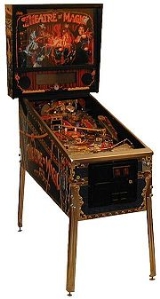
  • Captive Balls: a ball that remains on the playfield and is allowed to move around only within a confined area. A typical application of this is having a short lane on the playfield with a narrow opening, inside which a captive ball is held. The player can strike this captive ball with the ball in play, pushing it along the lane to activate a rollover switch or target. In games such as "Theatre of Magic" captive balls sometimes have whats called a "Newton Ball," which is a stationary ball adjacent to a free ball in a small lane. The ball being played strikes the Newton ball which, in turn, transfers its momentum to the adjacent ball, which causes it to move.


Features

There are other idiosyncratic features on many pinball playfields. Pinball games have become increasingly complex and multiple play modes, multi-level playfields, and even progression through a rudimentary "plot" have become common features on recent games. Pinball scoring objectives can be quite complex and require a series of targets to be hit in a particular order. Recent pinball games are distinguished by increasingly complex rule sets that require a measure of strategy and planning by the player for maximum scoring. Players seeking highest scores would be well-advised to study the placard (usually found in the lower-left corner of the playfield) to learn each game's specific patterns required for these advanced features and scoring.

Common features in modern pinball games include the following:
  • Ball lock: Try to get two (or three or however many) balls into a specific hole or target. Each time a ball goes in there, it is "locked" and a new ball appears at the plunger. When you have locked the required number of balls, a multiball starts. On some games, the balls are physically locked in place by solenoid-actuated gates, but many newer machines use "virtual" ball locks instead, in which the game merely keeps count of the number of locked balls and then auto-launches them from the main ball trough when it is time for them to be released.
  • Multiball: More than one ball in play at a time. Usually includes some kind of "jackpot" scoring. Multiball ends when all but one ball is lost down the bottom of the playfield, when regular play resumes.
  • Jackpot: Some targets on the playfield increase the scoring value of something else. This "something else" could be as simple as hitting a ramp, or it could be a complicated sequence of targets. Upon their inception, the Jackpot was the main goal of most pinballs in the 80s. Jackpots would often range from 1-4 million (back when it was a significant addition to the score), and their value would accrue between games until it was scored. Scoring it was usually a complicated task. Modern games often dilute the meaning of a jackpot. Modern games give off several "Jackpots" in each multiball mode, which is usually quite easy to attain, and the value of today's "Jackpots" is far less significant.
  • End-of-ball bonus: After each ball is played, the player scores bonus points depending on how many times certain features have been activated, or the amounts of items that the player may obtain. Some games award a seemingly arbitrary amount of points that depend on the number of times any switch has been hit. Virtually all games have the ability to assign a multiplier to the bonus. Most games cap the bonus multiplier at 5x or 10x, although more modern games apparently have no limit.
  • Extra ball: If a player has earned this, when they lose a ball, they get another one to play immediately afterward, and the machine does not count the lost ball towards the limit of balls for that game. For example, if you were on Ball 2, and you have an extra ball, the next ball (the extra one) will also be Ball 2 (it will not be Ball 3).
When a machine says "SHOOT AGAIN" on the scoreboard, it means that you have an extra ball to shoot. In a multiplayer game, the player who just lost his ball is the same one to shoot again.
  • Various timed rounds (modes): For example, if you hit a specific target three times within the next 20 seconds, you might score several tens of millions of points for it. There are many and various time-related features in pinball. Progression through each mode is frequently accompanied by DMD animations and sound.
  • Stackability: To "stack" means that you can run one play mode while another mode is in progress. This strategy usually yields higher scores. A noted example of this is Williams' , with its Multi-Multiball feature.
  • Wizard Mode: A special scoring mode, which is reached after meeting certain prerequisites to access this mode (e.g., finishing all modes). This is the pinball equivalent of the final boss fight
    Boss (video games)

    A boss is a computer-controlled opponent which is found in video games. Their purpose is to test the skills that the player has accumulated over the course of a game....
     in video games. Classic examples of this include Williams' Black Knight 2000
    Black Knight (pinball)

    Black Knight is a 1980 pinball game designed by Steve Ritchie and released by Williams .This game is known for its two-level playfield , and introduced the patented "Magna-Save", in which a player-controlled magnet is used to prevent outlane drains....
     (The King's Ransom) and Midway's Twilight Zone (Lost in the Zone). Named after The Who's song Pinball Wizard
    Pinball Wizard

    "Pinball Wizard" is a song written by Pete Townshend and performed by the England rock music band The Who, and featured on their 1969 rock opera album Tommy ....
    . Wizard modes come in two varieties: goal-oriented types where the player receives a huge amount of points after completing a specific task, or multiball modes with 4-6 balls in play, and virtually every feature active. Some games offer both and award the latter as a condition for completing the former.
  • Ball Index: Many modern games include a feature that prevents a player from being disappointed if a ball sent into play quickly drains before substantial points have been added. This player will immediately be given another (free) ball to compensate. Electromechanical games made during the 1970's had a similar Ball Index switch system that returned a drained ball if no points were made.
  • Slam Tilt: There are special tilt switches placed on the underside of the playfield, on the coin door, and (on electromechanical games) in the lower cabinet and upper cabinet. Designed to prevent cheating. If a player lifts and drops, pounds, or kicks the machine and activates any slam tilt, the entire game ends immediately for all players and may go into a reset/reboot mode. These are also used on video games. A similar Incline Tilt prevents a player from lifting the front of the cabinet to tip the ball back up the playfield by ending his turn.

Special scores

  • High score lists: if a player attains one of the highest scores ever (or the highest score on a given day) he is invited to add his initials to a displayed list of high-scorers on that particular machine. "Bragging rights" associated with being on the high-score list are a powerful incentive for experienced players to master a new machine.
Pinball designers also entice players with the chance to win an extra game or replay. Ways to get a replay might include:
  • Replay Score: Beat a specified score to get an extra game. Some machines allow the operator to set this score to increase with each consecutive game in which the replay score is achieved, in order to prevent a skilled player from gaining virtually unlimited play on one credit by simply achieving the same replay score in every game.
  • Special: A mechanism to get an extra game during play is usually called a "special". Typically, some hard-to-get feature of the game will light the outlanes (the areas to the extreme left and right of the flippers) for special. Since the outlanes always lose the ball, having "special" there makes it worth shooting for them (and is pretty much the only time this is the case).
  • Match: At the end of the game, if the last two digits of your score match a random digit followed by zero, you get an extra game. As pinball scores on modern machines nearly always end in zero, the chances of this happening appear to be 1 in 10, but the operator can alter this probability -- it is usually around 7%. Other non-numeric methods are sometimes used to award a match. In earlier machines, before a phenomenon often referred to as score inflation, had happened (causing almost all scores to end in 0) and scores could end in any integer, the match function was often a random integer from 0 to 9 that had to match the last digit in the score.
  • High Score: Most machines award 1-3 free games if a player gets on the high score list. Typically, one or two credits are awarded for a 1st-4th place listing, and three for the Grand Champion.


When an extra game is won, the machine typically makes a single loud bang, most often with a solenoid
Solenoid

A solenoid is a three-dimensional coil. In physics, the term solenoid refers to a loop of wire, often wrapped around a metallic core, which produces a magnetic field when an electric current is passed through it....
 that strikes a piece of metal, or the side of the cabinet, with a rod, known as a knocker, or less commonly with loudspeaker
Loudspeaker

A loudspeaker, speaker, or speaker system is an electroacoustical transducer that converts an electricity signal processing to sound....
s.

Playing techniques

The primary skill of pinball involves application of the proper timing and technique to the operation of the flippers, nudging the playfield when appropriate without tilting, and choosing targets for scores or features. A skilled player can quickly "learn the angles" and gain a high level of control of ball motion, even on a table they've never played.

A placard is usually placed in a lower corner of the playfield. It may simply show pricing information, but should also show critical details about special scoring techniques. This information is vital to achieving higher scores; it typically describes a series of events that must take place (e.g., shoot right ramp and left drop targets to light 'extra ball' rollover). Learning these details makes the game more fun and challenging. With practice -- and a table in good operating condition -- a player can often achieve specific targets and higher scores as well as trigger exciting events.

Nudging

Skillful players can influence the movement of the ball by nudging or bumping the pinball machine, a technique known as "nudging." There are tilt mechanisms which guard against excessive manipulation of this sort. The mechanisms generally include:
  • a grounded plumb bob centered in an electrified steel
    Steel

    Steel is an alloy consisting mostly of iron, with a carbon content between 0.2% and 2.14% by weight , depending on grade. Carbon is the most cost-effective alloying material for iron, but various other alloying elements are used such as manganese, chromium, vanadium, and tungsten....
     ring - when the machine is jostled too far or too hard, the bob bumps up against the ring, completing a circuit. The bob is usually cone-shaped allowing the operator to slide it up or down, controlling the sensitivity of the bob;
  • an electrified ball on a slight ramp with a grounded post at the top of the ramp - when the front of the machine is lifted (literally, tilted) too high, the ball rolls to the top of the ramp and completes the circuit; and
  • an impact sensor – usually located on the coin door, the playfield and/or the cabinet itself.


When one of these sensors is activated, the game registers a "tilt" and locks out, disabling solenoids for the flippers and other playfield systems so that the ball can do nothing other than roll all the way down the playfield to the drain. A tilt will usually also result in the loss of any bonus points earned by the player during that ball. Older games would immediately end the ball in play on a tilt. Modern games give tilt warnings before sacrificing the ball in play. The number of tilt warnings can be adjusted by the operator/owner of the machine. Until recently most games also had a "slam tilt" switch which guarded against kicking or slamming the coin mechanism (or for overly agressive behavior with the machine), which could give a false indication that a coin had been inserted, thereby giving a free game or credit. Apparently, this feature was recently taken out by default in new Stern
Stern (gaming company)

Stern is the name of two different but related arcade game companies: Stern Electronics, Inc. and Stern Pinball, Inc....
 S.A.M System games. However, it can be added as an option. A slam tilt will typically end the current game for all players.

Trapping

Skilled players can also hold a ball in place with the flipper, giving them more control over where they want to place the ball when they shoot it forward. This is known as "trapping". This technique involves catching the ball in the corner between the base of the flipper and the wall to its side, just as the ball falls towards the flipper; the flipper is then released, which allows the ball to roll slowly downward against the flipper. The player then chooses the moment to hit the flipper again, timing the shot as the ball slides slowly against the flipper. Multi-ball games, in particular, reward trapping techniques. Usually this is done by trapping one or more balls out of play with one flipper, then using the other flipper to score points with the remaining ball or balls.

Once a player has successfully trapped a ball, they may then attempt to "juggle" the ball to the other flipper. This is done by tapping the flipper button quickly enough so that the trapped ball is knocked back at an angle of less than 90 degrees into the bottom of the nearest slingshot. The ball will then often bounce across the table to the other flipper, where the ball may then be hit (or trapped) by the opposite flipper.

Occasionally a pinball machine will have a pin or post placed directly between the two bottom flippers. When this feature is present, the advanced player may then attempt to perform a "chill maneuver" when the ball is heading directly toward the pin by opting not to hit a flipper. If successful, this will cause the ball to bounce up and back into play.

A related move, the "dead flipper pass," is performed by not flipping when a ball is heading toward a flipper. If done properly, the ball will bounce off the "dead" flipper, across to the other flipper, where it may be trapped and controlled.

One controversial technique for saving the ball is called a "death save" or "bangback". Very few pinball players can successfully perform this advanced technique. The death save may only be performed when a ball has dropped through an outlane and is heading down toward the drain. If the timing is exactly correct, a player may hold a flipper up and then nudge the machine hard enough (but not so hard as to tilt the machine) to pop the ball back up into play on to the opposite flipper. Usually the death save is performed by kicking one of the legs of the machine with great force, which is why the move is unpopular with many players, and is often strongly frowned upon by less-experienced arcade operators. More recent machines have recognized this maneuver as a legitimate one though, even going so far as to grant the player a point reward for a successful death save.

Skilled players can often play on a machine for long periods of time on a single coin. By earning extra balls, a single game can be stretched out for a long period, and if the player is playing well he or she can earn replays by points and possibly also free games, known as "specials".

Cheating

Occasionally, a player may try to obtain free games by attaching a piece of string to a coin and lowering it to the counter switch, then raise and lower it to obtain free credits. This is actually quite difficult to do, since a coin acceptor mechanism is designed to reject anything other than a true coin, and uses thickness, diameter, weight and inertia as tests. A slow-moving coin on a string is simply treated as a slug
Counterfeit

A counterfeit is an imitation made usually with the intent to deceptively represent its content or origins, thus increasing sales appeal due to the reputation of the imitated product....
 and rejected. Even if it works, a savvy operator will compare the coins to the credits counter and install an inexpensive 'string cutter' razor, so the cheater's victory is short-lived. If discovered in an attempt, the offender will likely be banned from the establishment.

Slugs made from hammered metal pieces or foreign coins are sometimes tried. As soon as the operator finds them in the coin box, multiple adjustments on the acceptor mechanism will be fine-tuned to be less forgiving, stopping that activity.

Electromechanical pinball machines manufactured by Williams (until approximately 1973) had a wiring anomaly which could be exploited with one or more credits remaining on the game reel. By depositing a single coin and pressing the reset button one-quarter to one-half second later, up to five games could be obtained.

Some early (late '70s) computerized games could be fooled into giving free credits by switching the power off and on quickly, or applying a static shock to the coin door. These issues were quickly fixed, and today, may cause existing credits to be removed.

Sometimes, a faulty playfield item will bounce or switch to rack up extra points that are not earned. While initially exciting to get something for nothing, the result is that a solenoid may be destroyed in the process of constant triggering, taking the game out of service.

Unique pinball features

  • Easter Eggs
    Easter egg (media)

    A virtual Easter egg is an intentional hidden message, in-joke or feature in an object such as a film, book, Compact disc, DVD, computer program, web page or video game....
    : In the '90s, game designers often put hidden, recurring images or references in their games, similar to how easter eggs are placed in video games and other PC software. For example, Williams' designers hid cows in the video displays of the games, and Pat Lawlor would place a red button in the artwork of games he developed. The methods used to find the hidden items usually involved pressing the flipper buttons in a certain order or during specific events. Designers also included hidden messages or in-jokes; one example of this is the phrase "DOHO" sometimes seen quickly displayed on the dot matrix displays, a reference to Dorris Ho, the wife of then-Williams display artist Scott Slomiany [AKA Scott Matrix]. (DOHO has also taken on the meaning of a Documented Occurance of a Hidden Object due to the history of the Dorris Ho explanation not being generally known until recently.) The game went so far as to embed a hidden Breakout-like game available only after a complex sequence of events was accomplished during the game.


Computer pinball simulation


Pinball on a personal computer
Simulating a pinball machine has also been a popular theme of computer games, most famously when Bill Budge
Bill Budge

Bill Budge is a computer game game programmer and game designer. His two main claims to fame are 1981's Raster Blaster and 1983's Pinball Construction Set....
 wrote Pinball Construction Set
Pinball Construction Set

Pinball Construction Set is a computer game by Bill Budge published by Electronic Arts. It was released for the Apple II family and Atari 8-bit family in 1983 and was later ported to other platforms, such as the Commodore 64 and DOS ....
 for the Apple II in 1983. While there had been earlier pinball video games, such as Video Pinball for the Atari 2600
Atari 2600

The Atari 2600 is a video game console released in October 1977. It is credited with popularizing the use of microprocessor-based hardware and cartridge containing game code, instead of having non-microprocessor dedicated console hardware with all games built in....
, Pinball Construction Set was the first program that allowed the user to create his own simulated pinball machine and then play it.

Most early simulations were top-down 2D
2D computer graphics

2D computer graphics is the computer-based generation of digital images—mostly from two-dimensional models and by techniques specific to them....
. As processor
Central processing unit

A central processing unit is an electronic circuit that can execute computer programs. This broad definition can easily be applied to many early computers that existed long before the term "CPU" ever came into widespread usage....
 and graphics capabilities have improved, more accurate ball physics and 3D
Dimension

In mathematics, the dimension of a space is roughly defined as the minimum number of coordinates needed to specify every point within it. For example: a point on the unit circle in the plane can be specified by two Cartesian coordinates but one can make do with a single coordinate , so the circle is 1-dimensional even though it exists in...
 pinball simulations have become possible (though a truly convincing model of pinball physics
Physics

Physics is the natural science which examines basic concepts such as energy, force, and spacetime and all that derives from these, such as mass, charge, matter and its Motion ....
 and control has remained elusive). Tilting has also been simulated, which can be activated using one or more keys (sometimes the space bar) for "moving" the table. Flipper button computer peripherals were also released, allowing pinball fans to add an accurate feel to their game play instead of using the keyboard or mouse
Mouse (computing)

In computing, a mouse is a pointing device that functions by detecting dimension motion relative to its supporting surface. Physically, a mouse consists of an object held under one of the user's hands, with one or more buttons....
.

Today, video game players and computer users can find pinball simulators for practically every platform and operating system.

Pinball simulators
There have been pinball programs released for all major home video game and computer systems. While not every simulator made will be listed here, the following simulators are notable:
  • 1982's David's Midnight Magic
    David's Midnight Magic

    David's Midnight Magic is an early computer pinball simulation written by David Snider and released by Br?derbund in 1982. . The game was originally released for the Apple II family computer platform and was later released for the Commodore 64 and Atari 8-bit family platforms....
     for the Apple II, Commodore 64
    Commodore 64

    The Commodore 64 is an 8-bit home computer released by Commodore International in August, 1982, at a price of United States dollar595. Preceded by the Commodore VIC-20 and Commodore MAX Machine, the C64 features 64 kilobytes of Random-access memory with sound and graphics performance that were superior to IBM-compatible computers of tha...
    , and Atari 8-bit computer series was notable as being the first commercial simulation of an existing pinball machine, namely Williams' Black Knight.
  • Microsoft Windows
    Microsoft Windows

    Microsoft Windows is a series of software operating systems and graphical user interfaces produced by Microsoft. Microsoft first introduced an operating environment named Windows in November 1985 as an add-on to MS-DOS in response to the growing interest in graphical user interfaces ....
     NT 4.0
    brought the computerized pinball game into the workplace, by including 3D Pinball: Space Cadet
    Full Tilt! Pinball

    Full Tilt! Pinball is a pinball video game developed by Cinematronics and published by Maxis in 1995. It featured prerendered 3-D computer graphics...
     with the operating system alongside the popular Solitaire card game. Space Cadet was licensed to Microsoft from Maxis
    Maxis

    Maxis Software was an United States company that was founded as a video game developer and is now a brand name of Electronic Arts . Maxis' second software title was the seminal SimCity, a city simulation and planning Video game....
    ' pinball software collection Full Tilt! Pinball.
  • While most pinball simulators feature tables created specifically for the computer, fans of real tables were rewarded for their patience when Microsoft released a collection of simulated Gottlieb tables for the PC. A different collection of simulated Gottlieb games was released for the PlayStation 2
    PlayStation 2

    The PlayStation 2 is a History of video game consoles video game console manufactured by Sony. The successor to the PlayStation, and the predecessor to the PlayStation 3, the PlayStation 2 forms part of the PlayStation of video game consoles....
    , Xbox
    Xbox

    The Xbox is a History of video games video game console produced by Microsoft. It was Microsoft's first foray into the gaming console market, and competed with Sony's PlayStation 2 and Nintendo's GameCube....
     (both in 2004), the PSP
    PlayStation Portable

    The PlayStation Portable is a handheld game console manufactured and marketed by Sony Computer Entertainment. Development of the console was first announced during History of E3#During the Rise of Online Gaming , and it was unveiled on May 11, 2004 at a Sony press conference before E3 2004....
     in 2006 and the Nintendo Wii
    Wii

    The Wii is a home video game console released by Nintendo. As a History of video game consoles console, the Wii primarily competes with Microsoft's Xbox 360 and Sony's PlayStation 3....
     in 2007. Both the PC and video game compilations had tables representing various time periods in Gottlieb's history.
  • Visual Pinball
    Visual Pinball

    Visual Pinball is software application for Microsoft Windows comprising an emulator, simulator and level editor that allows users to create and play recreations of pinball machines and self designed tables....
    , released by Randy Davis in 2001, is a simulation tool that not only allows a user to play simulations of popular real-world machines, but also allows them to create new tables (playfields). Visual PinMAME is an ongoing project that combines the Visual Pinball program with an emulator that uses ROM image
    ROM image

    A ROM image, or simply ROM, is a computer file which contains a copy of the data from a read-only memory chip, often from a ROM cartridge, a computer's firmware, or from an arcade game's arcade system board....
    s from electronic pinball machines to both control the behavior of the simulation in Visual Pinball and to reproduce the sounds and score displays of the actual tables.


Pinball firsts


Title Manufacturer Year Notable For
Baffle Ball
Baffle Ball

Baffle Ball is a pinball game machine and was created in 1931 by Gottlieb. It was the first pinball machine, and was designed by David Gottlieb....
 
Gottlieb 1931 First commercially successful pinball machine
Broker's Tip Gottlieb 1933 First mechanical tilt mechanism
Autocount ABT Manufacturing 1933 First electrical tilt mechanism
Bumper Bally 1936 First bumper
Dux 1937 First full-sized backglass
Humpty Dumpty 1947 First table to use flippers
Rainbow Williams 1948 First use of active bumpers
Army Navy Williams 1953 First use of score wheels
Nine Sisters Williams 1953 First ramp on playfield
Super Jumbo Gottlieb 1954 First machine to keep score for four players
Balls-a-Poppin' Gottlieb 1956 First multiball
Magic Clock Williams 1960 First moving target
Flipper Gottlieb 1960 First machine to award an extra ball
Vagabond Williams 1962 First drop targets
Cabaret Williams 1968 First up post
WIZARD Bally 1975 First machine theme to be licensed from a movie
Spirit of '76 Mirco Games 1975 First machine to use a microprocessor
The Magnificent Marble Machine

The Magnificent Marble Machine was an United States television game show hosted by Art James and based on pinball. The show ran on National Broadcasting Company from July 7, 1975 to June 11, 1976, but was interrupted for about two weeks in January, due to scheduling changes on the network....
 
1975 Only pinball machine to be the basis of a game show. TMMM was a custom-built, non-commercial machine and is the largest pinball machine in history, at 20 feet high and 12 feet long.
Gorgar Williams 1979 First machine to provide synthesized speech (7 words)
Hercules Atari 1979 Largest commercial pinball machine (83 in tall, 39 in wide, 93 in deep)
Firepower Williams 1980 First use of "lane advance" (player control of top rollover lane lights)
Black Knight Williams 1980 First multi-level playfield
First Magna-Save (player-controlled magnet to prevent outlane drains)
Caveman Gottlieb 1982 First combination of mechanical pinball with a video game
Chicago Cubs: Triple Play Gottlieb 1985 First alpha-numeric display
High Speed Williams 1986 First machine to auto-adjust replay scores based on game history
First use of a complete song/soundtrack
First jackpot to carry over between games
F-14 Tomcat Williams 1987 First automatic ball save
Dakar Mr. Game 1988 First video monitor scoring display
Black Knight 2000 Williams 1989 First "Wizard Mode"
Elvira and the Party Monsters Bally 1989 First known use of a celebrity voice recorded especially for the game (Cassandra Peterson
Cassandra Peterson

Cassandra Peterson is an United States actor best known for her on-screen horror hostess character "Elvira, Mistress of the Dark." She gained fame on Los Angeles, California television station KCAL-TV wearing a black, Gothic fashion, cleavage -enhancing gown as host of Movie Macabre, a weekly Horror film presentation....
 as Elvira)
Checkpoint Data East 1991 First dot-matrix scoring display
First machine to feature a choice of alternate soundtracks (selected by the player)
Terminator 2: Judgment Day Williams 1991 First cannon launcher (player "shoots" captured pinball at targets)
First "Video Mode"
Twilight Zone Bally 1993 First use of a non-magnetic, ceramic pinball (the "Powerball")
Indiana Jones: The Pinball Adventure Williams 1993 First use of a player-controlled mini-playfield
First machine with high-fidelity digitized and compressed sound (using the DCS sound system)


Footnotes

Bally's 1981 also had three playfields, and predated Haunted House. However, Elektra's lower playfield was a self-contained area that used its own captive ball for scoring. Haunted House's lower playfield was accessible during regular gameplay from both the main and upper play areas.

See also

  • List of pinball machines
    List of pinball machines

    This is a partial list of pinballs organized alphabetically by name.#External links...
  • Pinball Hall of Fame
    Pinball Hall of Fame

    The Pinball Hall of Fame opened in the Las Vegas, Nevada area, in January 2006. It is a project of the Las Vegas Pinball Collectors Club, and it features pinball machines from all eras, including some very rare machines such as Williams' Black Gold, Bally's Pinball Circus and Recreativos Franco's Impacto....
     - Pinball museum located in Las Vegas, Nevada.


External links

  • World's largest online searchable database of pinball machines covering over 100 years of manufacturing, with over 30,000 images of games, game related documents, ratings, comments, and links to additional resources.
  • Pinball restoration and repair guides.
  • Rule sheets for most modern titles
  • Hosting the World Pinball Top 100, an extensive system that lets players rate games on many different aspects (design, sounds, flow, etc..). Also home of the Solid State Pinball Archive, a place to manage and showcase your collection and put your self on the World Pinball Map.