


Pilbara craton

Encyclopedia
The Pilbara craton along with the Kaapvaal craton
(the Kaapvaal province of South Africa
) are the only remaining areas of pristine Archaean 3.6-2.7 Ga crust on Earth
. Similarities of their rock records, especially the similarities in the overlying Late Archean sequences of both these cratons, suggest that they were once part of the Vaalbara
supercontinent
, and then believed to have belonged to Ur
continent.
The Pilbara Craton comprises a mid-Archaean granite
-greenstone
terrane
and an overlying late-Archaean volcano
-sedimentary sequence
called the Hamersley Basin
. The Tabba Tabba Shear Zone
is the major division between the East and West Pilbara craton
. The Tabba Tabba Shear Zone is a granodioritic
suite that forms the eastern boundary fault
of the Mallina Basin
.
geochronology
indicates that the bulk of the intermediate to silicic
igneous rocks in the Pilbara formed during seven periods of paired volcanic and plutonic activity. The extent of pre-3.5 Ga rocks is uncertain, but appears limited to the greenstone belt
s and batholith
s in the eastern Pilbara. This period was the major episode of crustal growth in the eastern Pilbara domains with calc-alkaline
basalts, andesites and dacite
s with intrusive anorthosite
s in most greenstone belts, and tonalite-trondhjemite-granodiorite
(TTG) suite granitoids in most batholith
s. The compositions of calc-alkaline volcanic rocks resemble those from modern supra-subduction
environments with TTG magmas derived via melting of underplated or subducted mafic crust.
According to Bagas (2002), other major magmatic events occurred at 3.47–3.41, 3.33–3.10, 3.00–2.93 and 2.85–2.83 Ga. with calc-alkaline basalt
s, andesite
s and dacite
s that formed in most greenstone belts, and TTG suite granitoids in most batholiths. Some of the granitoids are as old as 3.4 Ga. The compositions of the calc-alkaline volcanic rocks resemble those of modern supra-subduction environments with TTG magmas derived via melting of underplated or subducted mafic crust.
monzogranite. The Archaean granite–greenstones are dominated by TTG formed by melting of hydrous mafic crust at high pressure, but a much greater degree of crustal reworking has occurred in the Pilbara Craton than is required by TTG-dominated crust.
s and I-type granitoids derived via extensive melting of older silicic
crust. After this time the magmatism shifted to domains in the western and central Pilbara with tonalite-trondhjemite-granodiorite (TTG) magmatism in the western Pilbara and calc-alkaline magmatism in the central Pilbara between 3.27 and 3.23 Ga. The bulk of west Pilbara greenstone belts and granite batholiths were generated in magmatic episodes at ~3.11 and 3.00 to 2.98 Ga with both episodes including calc-alkaline and TTG magmas. Late magmatism in the western Pilbara resulted from crustal melting by plume-derived mafic magmas at ~2.93 Ga. Western Pilbara domains were probably accreted to eastern Pilbara domains by 2.88 Ga with localized crustal melting in the eastern Pilbara producing fractionated Sn- and Ta-bearing granites and pegmatite
s.
the area at ~3.25 Ga, followed by gabbro
ic suite at 3.235 Ga. The area was then affected by an early dextral compressive
event that incorporated granodiorites and gabbro
s that formed the Tabba Tabba Shear Zone. A granitoid suite intruded the shear zone at 2.94 Ga. with xenocrystic populations of 3.115-3.015 Ga and 3015 Ma.
and the smaller Opthalmia Range, bordered on the south by the Ashburton Trough and the Bangemall basin. Much of the region is marked by hills of low relief; the highest area is Mount Meharry (1235 m; 4013 ft) which is also located in the Hamersley Ranges.
-facies
volcanic rocks of the Warrawoona Group
, which is dated between 3.517 and 3.325 Ga, and lesser amounts of metamorphic sedimentary rocks, and ultramafic, mafic, felsic, and intrusive rocks. This succession is unconformably
overlain by the ca. 3.31 Ga Budjan Creek Formation, which in turn is unconformably overlain by the dominantly clastic rocks of the Gorge Creek Group dated at younger than 3.235 Ga. The entire volcano-sedimentary succession dips and youngs away from the CDGC, and all granite–greenstone contacts are intrusive. Several generations of granitic magmatism have been documented from granitoid complexes of the EPGGT. None of the rocks of the CDGC conform to a classic Archaean TTG suite. This suggests that the majority of true TTGs in the Pilbara Craton are restricted to the older (>3.44 Ga) rocks of the granitic complexes of the East Pilbara Granite–Greenstone Terrane, and that extensive recycling of old TTG to produce voluminous high-K magmatism was not restricted to the late Archaean.
From the above analysis, a two-step process for the formation of the CDGC can be inferred. First, high-pressure melting of young mafic lower crust produced TTG magmas, such as those presently exposed in the Shaw Granitoid Complex. The thermal anomaly was also associated with basaltic magmatism that formed a mid-crustal intraplate. A second thermal event at c. 3.3 Ga then caused widespread crustal melting at a depth of 35–40 km. This event involved the re-melting of the older TTG to produce the monzogranites of the CDGC, whereas re-melting of the mafic intraplate produced the tonalitic
to granodioritic rocks of the complex.
Volcanic rocks in the lower Warrawoona Group vary in preservation from virtually undeformed lower greenschist
to severely altered meta-amphibolite
s. U/Pb
zircon
dating of felsic formations indicates that emplacement of the lower Warrawoona group volcanics occurred before ca. 3.47 Ga. The mafic rocks of the Warrawoona Group have overlying komatiitic
basalts with thin sections of bedded chert
. Geochemical signatures in these thin sections of bedded chert (3–6 meters thick) suggest that they were most likely formed by weak hydrothermal activity associated with hot-spot volcanism.
The Apex cherts are a series of silicic deposits within pillow lava
s of the Apex Basalt, dated at 3.465-3.458 Ga, and some researchers have believed a number of taxa of prokaryotes are preserved there, although this finding has been recently disputed by further research at this location. However, the additional researchers confirm evidence for early Archean microbial life based on carbonaceous material found here and in other locations. Siliceous mudstone
s and sandstones of the uppermost clastic rocks have geochemical signatures analogous to those of felsic plutonic/volcanic rocks. Some of the siliceous mudstones have differentiated granitoids that were exposed in the Early Archean. Studies show that the Warrawoona Group cherts were deposited in a variety of environments ranging from mid-oceanic spreading to converging tectonic plate boundaries via a hotspot. It is thought that the depositional variations here were caused by horizontal plate motions in the Early Archean.
"Geological and geochemical evidence shows that the Warrawoona Group was erupted onto a continental basement, and that these basalts assimilated small amounts of Carlindi granitoid. As the Coonterunah basalts have similar compositions, they probably formed likewise, although they were deposited >60 myr before....An older continental basement was probably critical for the early Pilbara craton evolution. The geochemical geological and geophysical characteristics of the Pilbara greenstone successions can be best explained as flood basalt
successions deposited onto thin, submerged continental basement. This magmatism was induced by thermal upwelling in the mantle, although the basalts themselves do not have compositions which reflect derivation from an anomalously hot mantle. The Carlindi granitoids probably formed by fusion of young garnet
-hornblende
-rich sialic crust induced by basaltic volcanism. Early Archaean rocks have Nd-Hf isotope
compositions which indicate that the young mantle had differentiated into distinct isotopic
domains before 4.0 Ga. Such ancient depletion was associated with an increase of mantle Nb/U ratios to modern values, and hence this event probably reflects the extraction of an amount of continental crust equivalent to its modern mass from the primitive mantle before 3.5 Ga. Thus, a steady-state model of crustal growth is favoured whereby post ~4.0 Ga continental additions have been balanced by recycling back into the mantle, with no net global flux of continental crust at modern subduction zones. It is also proposed that the decoupling
of initial e(Nd) and e(Hf) from its typical covariant behaviour was related to the formation of continental crust, perhaps by widespread formation of TTG magmas."
A new informative study by Green (2006): The uppermost units of the regionally extensive In the Pilgangoora Belt the 3.517 Ga Coonterunah Group was intruded by 3.484-3.468 Ga Carlindi granitoid
s that underlie the 3.458 Ga Warrawoona Group. The combined terrain was uplifted and eroded to form an erosional unconformity. The uppermost units of the regionally extensive 3.458 Ga Warrawoona Group were deposited onto the unconformity. This is the oldest-known evidence for emergent continental crust. The basalts on either side of the unconformity are remarkably similar, with N-MORB-normalised enrichment factors for LILE
, Th
, U
and LREE
(low rare earth elements) greater than those for Ta
, Nb
, P
, Zr
, Ti
, Y
and M-HREE (high rare earth elements), and initial e(Nd
, Hf
) compositions which systematically vary with Sm
/Nd, Nb/U and Nb/La
ratios. Geological and geochemical evidence shows that the Warrawoona Group was erupted onto continental basement, and that these basalts assimilated small amounts of Carlindi granitoid. As the Coonterunah basalts have similar compositions, they probably formed likewise, although they were deposited 60 million years before. Such a model is applicable to the other early Pilbara greenstone successions, and so an older continental basement was probably critical for early Pilbara evolution. The geochemical, geological and geophysical characteristics of the Pilbara greenstone successions can be best explained as flood basalt
successions deposited onto thin, submerged continental basement. This magmatism was induced by thermal upwelling in the mantle, although the basalts themselves do not have compositions which reflect derivation from an anomalously hot mantle. The Carlindi granitoids probably formed by fusion of young garnet
-hornblende
-rich sialic crust induced by basaltic volcanism. Early Archaean rocks have Nd-Hf isotope compositions which indicate that the young mantle had differentiated into distinct isotopic domains before 4.0 Ga. Such ancient depletion was associated with an increase of mantle Nb/U ratios to modern values, and hence this event probably reflects the extraction of an amount of continental crust equivalent to its modern mass from the primitive mantle before 3.5 Ga. Thus, a steady-state model of crustal growth is favoured whereby post ~4.0 Ga continental additions have been balanced by recycling back into the mantle, with no net global flux of continental crust at modern subduction zones. It is also proposed that the decoupling of initial e(Nd) and e(Hf) from its typical covariant behaviour was related to the formation of continental crust, perhaps by widespread formation of TTG magmas.
The lower part of the North Pole succession (see below) must have been deposited while the Coonterunah-Carlindi terrain Pilgangoora Belt was emergent. "These two successions provide critical constraints for determining the tectonic setting of the Pilbara greenstone belts. Evidence from both greenstone belts can be used to define some criteria which must be satisfied by proposed tectonic setting models. These include:
Some derived constraints are that the potential mantle temperature was 1400 °C, partial melting was shallow and did not involve garnet, and that the pre-Warrawoona basement must have been significantly extended and thinned during deposition of the Warrawoona succession to maintain shallow subaqueous to subaerial conditions. These criteria preclude many of thepossible tectonic settings for greenstone development. The favoured model for the Pilbara is a setting similar to Phanerozoic continental flood basalt provinces, but differing from recent analogues in that it was deposited onto submerged basement. The base-level of deposition was most likely controlled by the thickness of the continental basement and the rates of extension and eruption."
and geochemical
ly with the Warrawoona Group in the Pilgangoora Belt. Therefore, the lower part of the North Pole succession must have been deposited while the Coonterunah-Carlindi terrain was emergent. These two successions provide critical constraints for determining the tectonic setting of the Pilbara greenstone belts.
The NPD is a relatively high-level dome that has a flanking syncline
preserving some of the youngest rocks of the Fortescue Group of the craton
. Basaltic greenstones range in age from 3.5 to 2.7 Ga. The greenstone belts in the North Pole Dome (NPD) have undergone metamorphism from prehnite-pumpellyite facies
to greenschist-amphibolite facies. The southern North Pole area is outside the metamorphic aureole. Metamorphism of the North Pole greenstone belts are comparable to ocean-floor metamorphism.
The approximately 3.46 Ga North Pole Monzogranite, a volumetrically insignificant intrusive granite body, intrudes the greenstones in the apex of the dome. At the apex of the NPD is a small intrusive granite that is thought to have been the top of a large underlying domal granite batholith, but no marginal shear zones occur around the intrusion. A new study/model done by Blewett et al. (2004) suggests that the granite intrusion is plug-like, up to 1.5 km thick and does not represent the exposed top of a larger underlying domal batholith. "Results from potential field modelling show that the dome is relatively flat bottomed, with a base around 5.5–6.5 km deep. The NPD has no significant granitic material within the dome, but like all greenstones, is underlain by felsic crust (granite) below its base. The development of the NPD (and flanking syncline) was a multistage process. The first stage of doming involved relatively minor doming/tilting, possibly associated with the emplacement of the monzogranite, because palaeocurrents of synchronous volcanic rocks flowed radially outward from the dome. It is likely that this doming was minor as there are no recorded unconformities in the Warrawoona Group (in the NPD) above these volcanic rocks. A major dome-forming event (tilting >20°) occurred in the period between 3.24 and 2.772 Ga, and was unrelated to the emplacement of the small granite plug (diapir
ism). Regional folding and refolding from horizontal compression deformed the area into a domal shape. Uplift and erosion of the dome was superseded by extension and deposition of flood basalts in the Fortescue Group that flowed towards the dome. Three further stages of shortening folded the regional unconformity and the underlying and overlying units, further amplified the underlying dome, developed the flanking Marble Bar Syncline
, as well as fold interference patterns in the Fortescue Group. The NPD was developed over a 800 Ma time frame, ostensibly by a process of fold interference due to multiple stages of horizontal compression. This work shows that diapirism was not the cause of the development of the domal geometry of the NPD, and its flanking syncline, rather folding and refolding due to horizontal compression was the principal controlling factor."
s and hydrothermal faults are well exposed in the Marble Bar cherts. Studies of the downward facing pillow basalts, the geometry of the breccias, and oxygen isotope data for rocks and the breccia matrix, suggest the rocks were steeply overturned on the flank of the Mount Edgar Dome prior to brecciation. The breccias are thought to represent steep conjugate fault zones developed by local trans-tension. Studies show that the overturning and brecciation occurred before the formation of dome foliation and metamorphism. The deposition of the underlying Duffer Formation occurred at 3.46 Ga and the intrusion of the Mount Edgar Batholith occurred at 3.32 Ga. The overturning of the Marble Bar sequence prior to brecciation suggests that the main phase of the dome formation was very protracted.
According to a study by Nelson et al. (1999): "The Mt. Edgar Batholith near Marble Bar is a NE-SW granitoid complex of magma genesis with a sequence of pre-, syn- and post-tectonic intrusive phases, containing an originally subhorizontal mid-crustal detachment zone. Along the southwestern margin, the structure indicates this zone was tilted partly actively and partly passively during deformation to form the 70 km long, now steeply dipping, 2-3 km wide, Southern Edgar Marginal Shear Zone (SEMSZ). Early movement on this zone juxtaposed magmatitic gneiss
es adjacent to greenschist
and lower greenschist facies
supracrustals. Kinematic analyses consistently give a greenstone belt up movement. Zircon SHRIMP
U-Pb crystallization ages for granitoid sheets range between 3.312 and 3.465 Ga....Evidence for an early deformation phase in the SEMSZ comes from a gabbro
/diorite
complex (U/Pb age 3.465 Ga) with syn-tectonic dolerite sills. A related swarm of dolerite dykes (Ar age >3.4 Ga) exploited a conjugate set of NE-SW extensional fault
s in a felsic extrusive unit. The dykes are feeders for the overlying basaltic units, which are now, as are the felsics, part of a thrust sheet. Part of the SEMSZ footwall is formed by ~3.315 Ga TTG sheets and plutons. Less deformed plutons of similar age have intruded into the hanging wall of the SEMSZ....This study indicates that a mid-crustal detachment played a major role in the emplacement of the circa 3.315 Ga Mount Edgar granitoid suites and that this occurred during a uni-directional tectonic transport to the NE. Structures within the magmatitic gneisses and the thermal gradients across the detachment at this time are consistent with an extensional tectonic regime, the same regime proposed for the earlier phase of granitoid emplacement at circa 3.46 Ga in the Eastern Pilbara."
According to a study by Kloppenburg et al.(1999): The excellent preservation of the 3.49 Ga greenschist amphiboles from the North Star basalt in the Talga Talga section suggests that metamorphism occurred soon after extrusion. "Similar lithologies have been recognised throughout the area in the Marble Bar Belt, the Kelly Belt, the Gorge Ranges and are remnants of a formerly wide spread upper plate. Granodiorites of 3.46 Ga (U/Pb zircon ages) have intruded into this upper plate sequence in the north Shaw and in the Mount Edgar Batholith near Marble Bar. The upper plate sequence consists of an imbricated stack of thrust sheets with contrasting degrees of metamorphic overprinting, and is separated from lower plate gneisses by prominent mid crustal detachments. This configuration has been recognised in the northern and eastern Shaw Batholith, the southern Mount Edgar Batholith, and in the northern margin of the Kurrana Batholith. The lower plate typically consists of banded grey gneisses that show evidence for a complex thermal history. The detachments have typically been the focus of late intrusion ranging in composition from gabbroic to muscovite
bearing granitic sheets. Although similar in setting, a combination of kinematic and geochronological arguments suggests that the three identified detachments are not connected: the Split Rock Shear Zone in the Shaw Batholith is 3.46 Ga old although reactivation as young as 3.2 Ga cannot be ruled out. The South Edgar Marginal Shear is 3.31 Ga old although 3.47 Ga old gabbro sheets may point to an earlier component in this shear zone. The Kurrana Shear Zone predates 3.2 Ga as measured from the cooling age of metamorphic hornblende from the Middle Creek basement complex. The deposition age of the Mosquito Creek metasediments, which tectonically overly the Kurrana Shear Zone, is bracketed between 3.2 Ga, the age of high grade metamorphism in the Kurrana basement, and 2.9 Ga, the age of mafic sill
s in the eastern sector of the Mosquito Creek domain. The mid crustal detachments consistently yield kinematic data indicative of large scale horizontal motions at different periods in the Mid Archean tectonic evolution of the eastern Pilbara Craton. These we relate to cycles of extensional and compressional tectonics, which pre-date the final amalgamation of the East and West Pilbara Terranes at ca 2.9 Ga.
Mount Bruce Supergroup of the Pilbara Craton is overlain by the Wyloo Group with a maximum thickness of 10 km. and maximum age of Archaean. Neoarchaean comprises the Fortescue Group, Carawine Dolomite (Hammersley Group/Hamersley Basin). A layer of probable impact melt spherule
s occurred in the Late Archaean Jeerinah Formation, Fortescue Group. Magmatism caused doming of the Archaean Shaw Granitoid Complex, Pilbara Craton.
division.
Kaapvaal craton
The Kaapvaal craton , along with the Pilbara craton of Western Australia, are the only remaining areas of pristine 3.6-2.5 Ga crust on Earth...
(the Kaapvaal province of South Africa
South Africa
The Republic of South Africa is a country in southern Africa. Located at the southern tip of Africa, it is divided into nine provinces, with of coastline on the Atlantic and Indian oceans...
) are the only remaining areas of pristine Archaean 3.6-2.7 Ga crust on Earth
Earth
Earth is the third planet from the Sun, and the densest and fifth-largest of the eight planets in the Solar System. It is also the largest of the Solar System's four terrestrial planets...
. Similarities of their rock records, especially the similarities in the overlying Late Archean sequences of both these cratons, suggest that they were once part of the Vaalbara
Vaalbara
Vaalbara is theorized to be Earth's first supercontinent, beginning its formation about , completing its formation by about and breaking up by . The name Vaalbara is derived from the South African Kaapvaal craton and the West Australian Pilbara craton...
supercontinent
Supercontinent
In geology, a supercontinent is a landmass comprising more than one continental core, or craton. The assembly of cratons and accreted terranes that form Eurasia qualifies as a supercontinent today.-History:...
, and then believed to have belonged to Ur
Ur (continent)
Ur was a supercontinent that formed in the early Archean eon; the oldest continent on Earth, half a billion years older than Arctica. Ur joined with the continents Nena and Atlantica about to form the supercontinent Rodinia...
continent.
The Pilbara Craton comprises a mid-Archaean granite
Granite
Granite is a common and widely occurring type of intrusive, felsic, igneous rock. Granite usually has a medium- to coarse-grained texture. Occasionally some individual crystals are larger than the groundmass, in which case the texture is known as porphyritic. A granitic rock with a porphyritic...
-greenstone
Greenschist
Greenschist is a general field petrologic term applied to metamorphic or altered mafic volcanic rock. The term greenstone is sometimes used to refer to greenschist but can refer to other rock types too. The green is due to abundant green chlorite, actinolite and epidote minerals that dominate the...
terrane
Terrane
A terrane in geology is short-hand term for a tectonostratigraphic terrane, which is a fragment of crustal material formed on, or broken off from, one tectonic plate and accreted or "sutured" to crust lying on another plate...
and an overlying late-Archaean volcano
Volcano
2. Bedrock3. Conduit 4. Base5. Sill6. Dike7. Layers of ash emitted by the volcano8. Flank| 9. Layers of lava emitted by the volcano10. Throat11. Parasitic cone12. Lava flow13. Vent14. Crater15...
-sedimentary sequence
Sequence (geology)
A sequence in geology refers to a sequence of geological events, processes, or rocks, arranged in chronological order.A rock stratigraphical sequence is a geographical, or lithostratigraphic, discrete unit greater than a group or supergroup rank, and traceable over large areas of a continent...
called the Hamersley Basin
Depression (geology)
A depression in geology is a landform sunken or depressed below the surrounding area. Depressions may be formed by various mechanisms.Structural or tectonic related:...
. The Tabba Tabba Shear Zone
Shear zone
A shear zone is a very important structural discontinuity surface in the Earth's crust and upper mantle. It forms as a response to inhomogeneous deformation partitioning strain into planar or curviplanar high-strain zones. Intervening blocks stay relatively unaffected by the deformation...
is the major division between the East and West Pilbara craton
Craton
A craton is an old and stable part of the continental lithosphere. Having often survived cycles of merging and rifting of continents, cratons are generally found in the interiors of tectonic plates. They are characteristically composed of ancient crystalline basement rock, which may be covered by...
. The Tabba Tabba Shear Zone is a granodioritic
Granodiorite
Granodiorite is an intrusive igneous rock similar to granite, but containing more plagioclase than orthoclase-type feldspar. Officially, it is defined as a phaneritic igneous rock with greater than 20% quartz by volume where at least 65% of the feldspar is plagioclase. It usually contains abundant...
suite that forms the eastern boundary fault
Geologic fault
In geology, a fault is a planar fracture or discontinuity in a volume of rock, across which there has been significant displacement along the fractures as a result of earth movement. Large faults within the Earth's crust result from the action of tectonic forces...
of the Mallina Basin
Depression (geology)
A depression in geology is a landform sunken or depressed below the surrounding area. Depressions may be formed by various mechanisms.Structural or tectonic related:...
.
Ca. 3.6 Ga First Major Tectonic Cycle
The Pilbara craton evolved over two approximately 360 Ma tectonic cycles. ZirconZircon
Zircon is a mineral belonging to the group of nesosilicates. Its chemical name is zirconium silicate and its corresponding chemical formula is ZrSiO4. A common empirical formula showing some of the range of substitution in zircon is 1–x4x–y...
geochronology
Geochronology
Geochronology is the science of determining the age of rocks, fossils, and sediments, within a certain degree of uncertainty inherent to the method used. A variety of dating methods are used by geologists to achieve this, and schemes of classification and terminology have been proposed...
indicates that the bulk of the intermediate to silicic
Silicic
Silicic is a term used to describe magma or igneous rock rich in silica. The amount of silica that constitutes a silicic rock is usually put at at least 65 percent. Granite and rhyolite are typical silicic rocks....
igneous rocks in the Pilbara formed during seven periods of paired volcanic and plutonic activity. The extent of pre-3.5 Ga rocks is uncertain, but appears limited to the greenstone belt
Greenstone belt
Greenstone belts are zones of variably metamorphosed mafic to ultramafic volcanic sequences with associated sedimentary rocks that occur within Archaean and Proterozoic cratons between granite and gneiss bodies....
s and batholith
Batholith
A batholith is a large emplacement of igneous intrusive rock that forms from cooled magma deep in the Earth's crust...
s in the eastern Pilbara. This period was the major episode of crustal growth in the eastern Pilbara domains with calc-alkaline
Calc-alkaline
The calc-alkaline magma series is one of two main magma series in igneous rocks, the other magma series being the tholeiitic. A magma series is a series of compositions that describes the evolution of a mafic magma, which is high in magnesium and iron and produces basalt or gabbro, as it...
basalts, andesites and dacite
Dacite
Dacite is an igneous, volcanic rock. It has an aphanitic to porphyritic texture and is intermediate in composition between andesite and rhyolite. The relative proportions of feldspars and quartz in dacite, and in many other volcanic rocks, are illustrated in the QAPF diagram...
s with intrusive anorthosite
Anorthosite
Anorthosite is a phaneritic, intrusive igneous rock characterized by a predominance of plagioclase feldspar , and a minimal mafic component...
s in most greenstone belts, and tonalite-trondhjemite-granodiorite
Tonalite-Trondhjemite-Granodiorite
Tonalite–trondhjemite–granodiorite series are an aggregation of rocks that are formed by melting of hydrous mafic crust at high pressure. It is widely accepted that most Archaean granite–greenstones are dominated by TTG, although Late Archaean terranes, such as in the Yilgarn Craton, are dominated...
(TTG) suite granitoids in most batholith
Batholith
A batholith is a large emplacement of igneous intrusive rock that forms from cooled magma deep in the Earth's crust...
s. The compositions of calc-alkaline volcanic rocks resemble those from modern supra-subduction
Subduction
In geology, subduction is the process that takes place at convergent boundaries by which one tectonic plate moves under another tectonic plate, sinking into the Earth's mantle, as the plates converge. These 3D regions of mantle downwellings are known as "Subduction Zones"...
environments with TTG magmas derived via melting of underplated or subducted mafic crust.
According to Bagas (2002), other major magmatic events occurred at 3.47–3.41, 3.33–3.10, 3.00–2.93 and 2.85–2.83 Ga. with calc-alkaline basalt
Basalt
Basalt is a common extrusive volcanic rock. It is usually grey to black and fine-grained due to rapid cooling of lava at the surface of a planet. It may be porphyritic containing larger crystals in a fine matrix, or vesicular, or frothy scoria. Unweathered basalt is black or grey...
s, andesite
Andesite
Andesite is an extrusive igneous, volcanic rock, of intermediate composition, with aphanitic to porphyritic texture. In a general sense, it is the intermediate type between basalt and dacite. The mineral assemblage is typically dominated by plagioclase plus pyroxene and/or hornblende. Magnetite,...
s and dacite
Dacite
Dacite is an igneous, volcanic rock. It has an aphanitic to porphyritic texture and is intermediate in composition between andesite and rhyolite. The relative proportions of feldspars and quartz in dacite, and in many other volcanic rocks, are illustrated in the QAPF diagram...
s that formed in most greenstone belts, and TTG suite granitoids in most batholiths. Some of the granitoids are as old as 3.4 Ga. The compositions of the calc-alkaline volcanic rocks resemble those of modern supra-subduction environments with TTG magmas derived via melting of underplated or subducted mafic crust.
3.49-3.41 Ga Eastern Pilbara Domain
The period 3.49 to 3.41 Ga was a major episode of crustal growth in the Eastern Pilbara Domain. The 3.47–3.41 Ga period included significant Tonalite-Trondhjemite-Granodiorite (TTG) magmatism representing high-pressure melting of a mafic source. Most magmatism after ca. 3.4 Ga represents remelting of older crust, including the TTG older than 3.4 Ga, to produce moderate- to high-potassiumPotassium
Potassium is the chemical element with the symbol K and atomic number 19. Elemental potassium is a soft silvery-white alkali metal that oxidizes rapidly in air and is very reactive with water, generating sufficient heat to ignite the hydrogen emitted in the reaction.Potassium and sodium are...
monzogranite. The Archaean granite–greenstones are dominated by TTG formed by melting of hydrous mafic crust at high pressure, but a much greater degree of crustal reworking has occurred in the Pilbara Craton than is required by TTG-dominated crust.
Ca. 3.3 Ga Second Major Tectonic Cycle
A second major magmatic episode at ~3.33 Ga in the eastern Pilbara involved rhyoliteRhyolite
This page is about a volcanic rock. For the ghost town see Rhyolite, Nevada, and for the satellite system, see Rhyolite/Aquacade.Rhyolite is an igneous, volcanic rock, of felsic composition . It may have any texture from glassy to aphanitic to porphyritic...
s and I-type granitoids derived via extensive melting of older silicic
Silicic
Silicic is a term used to describe magma or igneous rock rich in silica. The amount of silica that constitutes a silicic rock is usually put at at least 65 percent. Granite and rhyolite are typical silicic rocks....
crust. After this time the magmatism shifted to domains in the western and central Pilbara with tonalite-trondhjemite-granodiorite (TTG) magmatism in the western Pilbara and calc-alkaline magmatism in the central Pilbara between 3.27 and 3.23 Ga. The bulk of west Pilbara greenstone belts and granite batholiths were generated in magmatic episodes at ~3.11 and 3.00 to 2.98 Ga with both episodes including calc-alkaline and TTG magmas. Late magmatism in the western Pilbara resulted from crustal melting by plume-derived mafic magmas at ~2.93 Ga. Western Pilbara domains were probably accreted to eastern Pilbara domains by 2.88 Ga with localized crustal melting in the eastern Pilbara producing fractionated Sn- and Ta-bearing granites and pegmatite
Pegmatite
A pegmatite is a very crystalline, intrusive igneous rock composed of interlocking crystals usually larger than 2.5 cm in size; such rocks are referred to as pegmatitic....
s.
3.315 Ga Corunna Downs Granitoid Complex
The Archaean Corunna Downs Granitoid Complex (CDGC) in the southeastern part of the East Pilbara Granite–Greenstone Terrain (EPGGT) consists of 80% ca. 3.315 Ga highly fractionated monzogranites, with trace elements consistent with remelting of an older TTG crust at a mid-crustal level. The remaining 20% is TTG formed through high-pressure melting of hydrated mafic crust. It is thought that as the mid-crustal melting of TTG occurred to form the monzogranites, melting of an associated mafic intraplate formed the TTG.3.25 Ga Tabba Tabba Shear Zone
The Tabba Tabba Shear Zone intrudedIntrusion
An intrusion is liquid rock that forms under Earth's surface. Magma from under the surface is slowly pushed up from deep within the earth into any cracks or spaces it can find, sometimes pushing existing country rock out of the way, a process that can take millions of years. As the rock slowly...
the area at ~3.25 Ga, followed by gabbro
Gabbro
Gabbro refers to a large group of dark, coarse-grained, intrusive mafic igneous rocks chemically equivalent to basalt. The rocks are plutonic, formed when molten magma is trapped beneath the Earth's surface and cools into a crystalline mass....
ic suite at 3.235 Ga. The area was then affected by an early dextral compressive
Compression (geology)
In geology the term compression refers to a set of stresses directed toward the center of a rock mass. Compressive strength refers to the maximum compressive stress that can be applied to a material before failure occurs. When the maximum compressive stress is in a horizontal orientation, thrust...
event that incorporated granodiorites and gabbro
Gabbro
Gabbro refers to a large group of dark, coarse-grained, intrusive mafic igneous rocks chemically equivalent to basalt. The rocks are plutonic, formed when molten magma is trapped beneath the Earth's surface and cools into a crystalline mass....
s that formed the Tabba Tabba Shear Zone. A granitoid suite intruded the shear zone at 2.94 Ga. with xenocrystic populations of 3.115-3.015 Ga and 3015 Ma.
Northern Pilbara, Hamersley Basin and Hamersley Range
The Hamersley basin covers the Pilbara archean craton in the north. Granite is exposed in the Hamersley basin as batholiths up to a 100 km (62.1 mi) in length; these light rocks are diapiric intrusions into the dark greenstones (metamorphosed basalt). There are also banded iron formations. To the south is the Hamersley RangeHamersley Range
The Hamersley Ranges is a mountainous region of the Pilbara, Western Australia. The range runs from the Fortescue River in the northeast, 460 km south. The range contains Western Australia's highest point, Mount Meharry, which reaches approximately AHD. There are many extensively-eroded...
and the smaller Opthalmia Range, bordered on the south by the Ashburton Trough and the Bangemall basin. Much of the region is marked by hills of low relief; the highest area is Mount Meharry (1235 m; 4013 ft) which is also located in the Hamersley Ranges.
Eastern Pilbara, Warrawoona Group
The greenstones in Eastern Pilbara comprise dominantly greenschistGreenschist
Greenschist is a general field petrologic term applied to metamorphic or altered mafic volcanic rock. The term greenstone is sometimes used to refer to greenschist but can refer to other rock types too. The green is due to abundant green chlorite, actinolite and epidote minerals that dominate the...
-facies
Facies
In geology, facies are a body of rock with specified characteristics. Ideally, a facies is a distinctive rock unit that forms under certain conditions of sedimentation, reflecting a particular process or environment....
volcanic rocks of the Warrawoona Group
Warrawoona Group
The Warrawoona Group is a geological unit in Western Australia containing putative fossils of cyanobacteria cells. Dated 3.465 Ga, these microstructures, found in archean chert, are considered to be the oldest known geological record of life on earth....
, which is dated between 3.517 and 3.325 Ga, and lesser amounts of metamorphic sedimentary rocks, and ultramafic, mafic, felsic, and intrusive rocks. This succession is unconformably
Unconformity
An unconformity is a buried erosion surface separating two rock masses or strata of different ages, indicating that sediment deposition was not continuous. In general, the older layer was exposed to erosion for an interval of time before deposition of the younger, but the term is used to describe...
overlain by the ca. 3.31 Ga Budjan Creek Formation, which in turn is unconformably overlain by the dominantly clastic rocks of the Gorge Creek Group dated at younger than 3.235 Ga. The entire volcano-sedimentary succession dips and youngs away from the CDGC, and all granite–greenstone contacts are intrusive. Several generations of granitic magmatism have been documented from granitoid complexes of the EPGGT. None of the rocks of the CDGC conform to a classic Archaean TTG suite. This suggests that the majority of true TTGs in the Pilbara Craton are restricted to the older (>3.44 Ga) rocks of the granitic complexes of the East Pilbara Granite–Greenstone Terrane, and that extensive recycling of old TTG to produce voluminous high-K magmatism was not restricted to the late Archaean.
From the above analysis, a two-step process for the formation of the CDGC can be inferred. First, high-pressure melting of young mafic lower crust produced TTG magmas, such as those presently exposed in the Shaw Granitoid Complex. The thermal anomaly was also associated with basaltic magmatism that formed a mid-crustal intraplate. A second thermal event at c. 3.3 Ga then caused widespread crustal melting at a depth of 35–40 km. This event involved the re-melting of the older TTG to produce the monzogranites of the CDGC, whereas re-melting of the mafic intraplate produced the tonalitic
Tonalite
Tonalite is an igneous, plutonic rock, of felsic composition, with phaneritic texture. Feldspar is present as plagioclase with 10% or less alkali feldspar. Quartz is present as more than 20% of the rock. Amphiboles and pyroxenes are common accessory minerals.In older references tonalite is...
to granodioritic rocks of the complex.
Volcanic rocks in the lower Warrawoona Group vary in preservation from virtually undeformed lower greenschist
Greenschist
Greenschist is a general field petrologic term applied to metamorphic or altered mafic volcanic rock. The term greenstone is sometimes used to refer to greenschist but can refer to other rock types too. The green is due to abundant green chlorite, actinolite and epidote minerals that dominate the...
to severely altered meta-amphibolite
Amphibolite
Amphibolite is the name given to a rock consisting mainly of hornblende amphibole, the use of the term being restricted, however, to metamorphic rocks. The modern terminology for a holocrystalline plutonic igneous rocks composed primarily of hornblende amphibole is a hornblendite, which are...
s. U/Pb
Uranium-lead dating
Uranium-lead is one of the oldest and most refined of the radiometric dating schemes, with a routine age range of about 1 million years to over 4.5 billion years, and with routine precisions in the 0.1-1 percent range...
zircon
Zircon
Zircon is a mineral belonging to the group of nesosilicates. Its chemical name is zirconium silicate and its corresponding chemical formula is ZrSiO4. A common empirical formula showing some of the range of substitution in zircon is 1–x4x–y...
dating of felsic formations indicates that emplacement of the lower Warrawoona group volcanics occurred before ca. 3.47 Ga. The mafic rocks of the Warrawoona Group have overlying komatiitic
Komatiite
Komatiite is a type of ultramafic mantle-derived volcanic rock. Komatiites have low silicon, potassium and aluminium, and high to extremely high magnesium content...
basalts with thin sections of bedded chert
Chert
Chert is a fine-grained silica-rich microcrystalline, cryptocrystalline or microfibrous sedimentary rock that may contain small fossils. It varies greatly in color , but most often manifests as gray, brown, grayish brown and light green to rusty red; its color is an expression of trace elements...
. Geochemical signatures in these thin sections of bedded chert (3–6 meters thick) suggest that they were most likely formed by weak hydrothermal activity associated with hot-spot volcanism.
The Apex cherts are a series of silicic deposits within pillow lava
Pillow lava
Pillow lavas are lavas that contain characteristic pillow-shaped structures that are attributed to the extrusion of the lava under water, or subaqueous extrusion. Pillow lavas in volcanic rock are characterized by thick sequences of discontinuous pillow-shaped masses, commonly up to one metre in...
s of the Apex Basalt, dated at 3.465-3.458 Ga, and some researchers have believed a number of taxa of prokaryotes are preserved there, although this finding has been recently disputed by further research at this location. However, the additional researchers confirm evidence for early Archean microbial life based on carbonaceous material found here and in other locations. Siliceous mudstone
Mudstone
Mudstone is a fine grained sedimentary rock whose original constituents were clays or muds. Grain size is up to 0.0625 mm with individual grains too small to be distinguished without a microscope. With increased pressure over time the platey clay minerals may become aligned, with the...
s and sandstones of the uppermost clastic rocks have geochemical signatures analogous to those of felsic plutonic/volcanic rocks. Some of the siliceous mudstones have differentiated granitoids that were exposed in the Early Archean. Studies show that the Warrawoona Group cherts were deposited in a variety of environments ranging from mid-oceanic spreading to converging tectonic plate boundaries via a hotspot. It is thought that the depositional variations here were caused by horizontal plate motions in the Early Archean.
"Geological and geochemical evidence shows that the Warrawoona Group was erupted onto a continental basement, and that these basalts assimilated small amounts of Carlindi granitoid. As the Coonterunah basalts have similar compositions, they probably formed likewise, although they were deposited >60 myr before....An older continental basement was probably critical for the early Pilbara craton evolution. The geochemical geological and geophysical characteristics of the Pilbara greenstone successions can be best explained as flood basalt
Flood basalt
A flood basalt or trap basalt is the result of a giant volcanic eruption or series of eruptions that coats large stretches of land or the ocean floor with basalt lava. Flood basalts have occurred on continental scales in prehistory, creating great plateaus and mountain ranges...
successions deposited onto thin, submerged continental basement. This magmatism was induced by thermal upwelling in the mantle, although the basalts themselves do not have compositions which reflect derivation from an anomalously hot mantle. The Carlindi granitoids probably formed by fusion of young garnet
Garnet
The garnet group includes a group of minerals that have been used since the Bronze Age as gemstones and abrasives. The name "garnet" may come from either the Middle English word gernet meaning 'dark red', or the Latin granatus , possibly a reference to the Punica granatum , a plant with red seeds...
-hornblende
Hornblende
Hornblende is a complex inosilicate series of minerals .It is not a recognized mineral in its own right, but the name is used as a general or field term, to refer to a dark amphibole....
-rich sialic crust induced by basaltic volcanism. Early Archaean rocks have Nd-Hf isotope
Isotope
Isotopes are variants of atoms of a particular chemical element, which have differing numbers of neutrons. Atoms of a particular element by definition must contain the same number of protons but may have a distinct number of neutrons which differs from atom to atom, without changing the designation...
compositions which indicate that the young mantle had differentiated into distinct isotopic
Isotope
Isotopes are variants of atoms of a particular chemical element, which have differing numbers of neutrons. Atoms of a particular element by definition must contain the same number of protons but may have a distinct number of neutrons which differs from atom to atom, without changing the designation...
domains before 4.0 Ga. Such ancient depletion was associated with an increase of mantle Nb/U ratios to modern values, and hence this event probably reflects the extraction of an amount of continental crust equivalent to its modern mass from the primitive mantle before 3.5 Ga. Thus, a steady-state model of crustal growth is favoured whereby post ~4.0 Ga continental additions have been balanced by recycling back into the mantle, with no net global flux of continental crust at modern subduction zones. It is also proposed that the decoupling
Decoupling
The term "decoupling" is used in many different contexts.-Economic growth without environmental damage:In economic and environmental fields, decoupling is becoming increasingly used in the context of economic production and environmental quality. When used in this way, it refers to the ability of...
of initial e(Nd) and e(Hf) from its typical covariant behaviour was related to the formation of continental crust, perhaps by widespread formation of TTG magmas."
Pilganoora Belt
In the Pilgangoora Belt the 3.517 Ga Coonterunah Group and 3.484-3.468 Ga Carlindi granitoids underlie the 3.458 Ga Warrawoona Group beneath an erosional unconformity, thus providing evidence for ancient emergent continental crust.A new informative study by Green (2006): The uppermost units of the regionally extensive In the Pilgangoora Belt the 3.517 Ga Coonterunah Group was intruded by 3.484-3.468 Ga Carlindi granitoid
Granitoid
A granitoid or granitic rock is a variety of coarse grained plutonic rock similar to granite which mineralogically are composed predominately of feldspar and quartz. Examples of granitoid rocks include granite, quartz monzonite, quartz diorite, syenite, granodiorite and trondhjemite. Many are...
s that underlie the 3.458 Ga Warrawoona Group. The combined terrain was uplifted and eroded to form an erosional unconformity. The uppermost units of the regionally extensive 3.458 Ga Warrawoona Group were deposited onto the unconformity. This is the oldest-known evidence for emergent continental crust. The basalts on either side of the unconformity are remarkably similar, with N-MORB-normalised enrichment factors for LILE
ILE
ILE can refer to:*ILE , Intermittent Layer Extrusion, a process which allows the extrusion of a variable layer thickness tube*Isolagen Inc...
, Th
Thorium
Thorium is a natural radioactive chemical element with the symbol Th and atomic number 90. It was discovered in 1828 and named after Thor, the Norse god of thunder....
, U
Uranium
Uranium is a silvery-white metallic chemical element in the actinide series of the periodic table, with atomic number 92. It is assigned the chemical symbol U. A uranium atom has 92 protons and 92 electrons, of which 6 are valence electrons...
and LREE
Rare earth element
As defined by IUPAC, rare earth elements or rare earth metals are a set of seventeen chemical elements in the periodic table, specifically the fifteen lanthanides plus scandium and yttrium...
(low rare earth elements) greater than those for Ta
Tantalum
Tantalum is a chemical element with the symbol Ta and atomic number 73. Previously known as tantalium, the name comes from Tantalus, a character in Greek mythology. Tantalum is a rare, hard, blue-gray, lustrous transition metal that is highly corrosion resistant. It is part of the refractory...
, Nb
Niobium
Niobium or columbium , is a chemical element with the symbol Nb and atomic number 41. It's a soft, grey, ductile transition metal, which is often found in the pyrochlore mineral, the main commercial source for niobium, and columbite...
, P
Phosphorus
Phosphorus is the chemical element that has the symbol P and atomic number 15. A multivalent nonmetal of the nitrogen group, phosphorus as a mineral is almost always present in its maximally oxidized state, as inorganic phosphate rocks...
, Zr
Zirconium
Zirconium is a chemical element with the symbol Zr and atomic number 40. The name of zirconium is taken from the mineral zircon. Its atomic mass is 91.224. It is a lustrous, grey-white, strong transition metal that resembles titanium...
, Ti
Titanium
Titanium is a chemical element with the symbol Ti and atomic number 22. It has a low density and is a strong, lustrous, corrosion-resistant transition metal with a silver color....
, Y
Yttrium
Yttrium is a chemical element with symbol Y and atomic number 39. It is a silvery-metallic transition metal chemically similar to the lanthanides and it has often been classified as a "rare earth element". Yttrium is almost always found combined with the lanthanides in rare earth minerals and is...
and M-HREE (high rare earth elements), and initial e(Nd
Neodymium
Neodymium is a chemical element with the symbol Nd and atomic number 60. It is a soft silvery metal that tarnishes in air. Neodymium was discovered in 1885 by the Austrian chemist Carl Auer von Welsbach. It is present in significant quantities in the ore minerals monazite and bastnäsite...
, Hf
Hafnium
Hafnium is a chemical element with the symbol Hf and atomic number 72. A lustrous, silvery gray, tetravalent transition metal, hafnium chemically resembles zirconium and is found in zirconium minerals. Its existence was predicted by Dmitri Mendeleev in 1869. Hafnium was the penultimate stable...
) compositions which systematically vary with Sm
Samarium
Samarium is a chemical element with the symbol Sm, atomic number 62 and atomic weight 150.36. It is a moderately hard silvery metal which readily oxidizes in air. Being a typical member of the lanthanide series, samarium usually assumes the oxidation state +3...
/Nd, Nb/U and Nb/La
Lanthanum
Lanthanum is a chemical element with the symbol La and atomic number 57.Lanthanum is a silvery white metallic element that belongs to group 3 of the periodic table and is the first element of the lanthanide series. It is found in some rare-earth minerals, usually in combination with cerium and...
ratios. Geological and geochemical evidence shows that the Warrawoona Group was erupted onto continental basement, and that these basalts assimilated small amounts of Carlindi granitoid. As the Coonterunah basalts have similar compositions, they probably formed likewise, although they were deposited 60 million years before. Such a model is applicable to the other early Pilbara greenstone successions, and so an older continental basement was probably critical for early Pilbara evolution. The geochemical, geological and geophysical characteristics of the Pilbara greenstone successions can be best explained as flood basalt
Flood basalt
A flood basalt or trap basalt is the result of a giant volcanic eruption or series of eruptions that coats large stretches of land or the ocean floor with basalt lava. Flood basalts have occurred on continental scales in prehistory, creating great plateaus and mountain ranges...
successions deposited onto thin, submerged continental basement. This magmatism was induced by thermal upwelling in the mantle, although the basalts themselves do not have compositions which reflect derivation from an anomalously hot mantle. The Carlindi granitoids probably formed by fusion of young garnet
Garnet
The garnet group includes a group of minerals that have been used since the Bronze Age as gemstones and abrasives. The name "garnet" may come from either the Middle English word gernet meaning 'dark red', or the Latin granatus , possibly a reference to the Punica granatum , a plant with red seeds...
-hornblende
Hornblende
Hornblende is a complex inosilicate series of minerals .It is not a recognized mineral in its own right, but the name is used as a general or field term, to refer to a dark amphibole....
-rich sialic crust induced by basaltic volcanism. Early Archaean rocks have Nd-Hf isotope compositions which indicate that the young mantle had differentiated into distinct isotopic domains before 4.0 Ga. Such ancient depletion was associated with an increase of mantle Nb/U ratios to modern values, and hence this event probably reflects the extraction of an amount of continental crust equivalent to its modern mass from the primitive mantle before 3.5 Ga. Thus, a steady-state model of crustal growth is favoured whereby post ~4.0 Ga continental additions have been balanced by recycling back into the mantle, with no net global flux of continental crust at modern subduction zones. It is also proposed that the decoupling of initial e(Nd) and e(Hf) from its typical covariant behaviour was related to the formation of continental crust, perhaps by widespread formation of TTG magmas.
The lower part of the North Pole succession (see below) must have been deposited while the Coonterunah-Carlindi terrain Pilgangoora Belt was emergent. "These two successions provide critical constraints for determining the tectonic setting of the Pilbara greenstone belts. Evidence from both greenstone belts can be used to define some criteria which must be satisfied by proposed tectonic setting models. These include:
- Eruption onto continental basement.
- Derivation from a mantle with a generally uniform (depleted) composition.
- Eruption of thick basaltic successions with only minor komatiitic and felsic volcanism.
- No stratigraphic trends of basalt composition.
- Coeval granitoid emplacement.
- Emergence of the Coonterunah-Carlindi terrain.
- Persistent shallow subaqueous to subaerial eruptionSubaerial eruptionA subaerial eruption is a volcanic eruption that has occurred on the surface. They generally produce pyroclastic flows, lava fountains, and lava flows, which are commonly classified in different subearial eruption types, including Plinian, Peléan, and Hawaiian eruptions. Subaerial eruptions...
of the Warrawoona Group - Extensional setting for the Warrawoona Group
- Very low-grade metamorphismMetamorphismMetamorphism is the solid-state recrystallization of pre-existing rocks due to changes in physical and chemical conditions, primarily heat, pressure, and the introduction of chemically active fluids. Mineralogical, chemical and crystallographic changes can occur during this process...
throughout the Warrawoona volcanic pile. - Minor regional deformation.
Some derived constraints are that the potential mantle temperature was 1400 °C, partial melting was shallow and did not involve garnet, and that the pre-Warrawoona basement must have been significantly extended and thinned during deposition of the Warrawoona succession to maintain shallow subaqueous to subaerial conditions. These criteria preclude many of thepossible tectonic settings for greenstone development. The favoured model for the Pilbara is a setting similar to Phanerozoic continental flood basalt provinces, but differing from recent analogues in that it was deposited onto submerged basement. The base-level of deposition was most likely controlled by the thickness of the continental basement and the rates of extension and eruption."
North Pole Dome
The North Pole Dome (NPD), 10 km of the Warrawoona Group are exposed. The upper 3 km correlates lithologicallyLithology
The lithology of a rock unit is a description of its physical characteristics visible at outcrop, in hand or core samples or with low magnification microscopy, such as colour, texture, grain size, or composition. It may be either a detailed description of these characteristics or be a summary of...
and geochemical
Geochemistry
The field of geochemistry involves study of the chemical composition of the Earth and other planets, chemical processes and reactions that govern the composition of rocks, water, and soils, and the cycles of matter and energy that transport the Earth's chemical components in time and space, and...
ly with the Warrawoona Group in the Pilgangoora Belt. Therefore, the lower part of the North Pole succession must have been deposited while the Coonterunah-Carlindi terrain was emergent. These two successions provide critical constraints for determining the tectonic setting of the Pilbara greenstone belts.
The NPD is a relatively high-level dome that has a flanking syncline
Syncline
In structural geology, a syncline is a fold, with younger layers closer to the center of the structure. A synclinorium is a large syncline with superimposed smaller folds. Synclines are typically a downward fold, termed a synformal syncline In structural geology, a syncline is a fold, with younger...
preserving some of the youngest rocks of the Fortescue Group of the craton
Craton
A craton is an old and stable part of the continental lithosphere. Having often survived cycles of merging and rifting of continents, cratons are generally found in the interiors of tectonic plates. They are characteristically composed of ancient crystalline basement rock, which may be covered by...
. Basaltic greenstones range in age from 3.5 to 2.7 Ga. The greenstone belts in the North Pole Dome (NPD) have undergone metamorphism from prehnite-pumpellyite facies
Prehnite-pumpellyite facies
The prehnite-pumpellyite facies is a metamorphic facies typical of subseafloor alteration of the oceanic crust around mid-ocean ridge spreading centres....
to greenschist-amphibolite facies. The southern North Pole area is outside the metamorphic aureole. Metamorphism of the North Pole greenstone belts are comparable to ocean-floor metamorphism.
The approximately 3.46 Ga North Pole Monzogranite, a volumetrically insignificant intrusive granite body, intrudes the greenstones in the apex of the dome. At the apex of the NPD is a small intrusive granite that is thought to have been the top of a large underlying domal granite batholith, but no marginal shear zones occur around the intrusion. A new study/model done by Blewett et al. (2004) suggests that the granite intrusion is plug-like, up to 1.5 km thick and does not represent the exposed top of a larger underlying domal batholith. "Results from potential field modelling show that the dome is relatively flat bottomed, with a base around 5.5–6.5 km deep. The NPD has no significant granitic material within the dome, but like all greenstones, is underlain by felsic crust (granite) below its base. The development of the NPD (and flanking syncline) was a multistage process. The first stage of doming involved relatively minor doming/tilting, possibly associated with the emplacement of the monzogranite, because palaeocurrents of synchronous volcanic rocks flowed radially outward from the dome. It is likely that this doming was minor as there are no recorded unconformities in the Warrawoona Group (in the NPD) above these volcanic rocks. A major dome-forming event (tilting >20°) occurred in the period between 3.24 and 2.772 Ga, and was unrelated to the emplacement of the small granite plug (diapir
Diapir
A diapir is a type of intrusion in which a more mobile and ductily-deformable material is forced into brittle overlying rocks. Depending on the tectonic environment, diapirs can range from idealized mushroom-shaped Rayleigh-Taylor instability-type structures in regions with low tectonic stress...
ism). Regional folding and refolding from horizontal compression deformed the area into a domal shape. Uplift and erosion of the dome was superseded by extension and deposition of flood basalts in the Fortescue Group that flowed towards the dome. Three further stages of shortening folded the regional unconformity and the underlying and overlying units, further amplified the underlying dome, developed the flanking Marble Bar Syncline
Syncline
In structural geology, a syncline is a fold, with younger layers closer to the center of the structure. A synclinorium is a large syncline with superimposed smaller folds. Synclines are typically a downward fold, termed a synformal syncline In structural geology, a syncline is a fold, with younger...
, as well as fold interference patterns in the Fortescue Group. The NPD was developed over a 800 Ma time frame, ostensibly by a process of fold interference due to multiple stages of horizontal compression. This work shows that diapirism was not the cause of the development of the domal geometry of the NPD, and its flanking syncline, rather folding and refolding due to horizontal compression was the principal controlling factor."
Talga Talga Section, Marble Bar Belt
Cataclastic brecciaFault breccia
Fault breccia, or tectonic breccia, is a breccia that was formed by tectonic forces....
s and hydrothermal faults are well exposed in the Marble Bar cherts. Studies of the downward facing pillow basalts, the geometry of the breccias, and oxygen isotope data for rocks and the breccia matrix, suggest the rocks were steeply overturned on the flank of the Mount Edgar Dome prior to brecciation. The breccias are thought to represent steep conjugate fault zones developed by local trans-tension. Studies show that the overturning and brecciation occurred before the formation of dome foliation and metamorphism. The deposition of the underlying Duffer Formation occurred at 3.46 Ga and the intrusion of the Mount Edgar Batholith occurred at 3.32 Ga. The overturning of the Marble Bar sequence prior to brecciation suggests that the main phase of the dome formation was very protracted.
According to a study by Nelson et al. (1999): "The Mt. Edgar Batholith near Marble Bar is a NE-SW granitoid complex of magma genesis with a sequence of pre-, syn- and post-tectonic intrusive phases, containing an originally subhorizontal mid-crustal detachment zone. Along the southwestern margin, the structure indicates this zone was tilted partly actively and partly passively during deformation to form the 70 km long, now steeply dipping, 2-3 km wide, Southern Edgar Marginal Shear Zone (SEMSZ). Early movement on this zone juxtaposed magmatitic gneiss
Gneiss
Gneiss is a common and widely distributed type of rock formed by high-grade regional metamorphic processes from pre-existing formations that were originally either igneous or sedimentary rocks.-Etymology:...
es adjacent to greenschist
Greenschist
Greenschist is a general field petrologic term applied to metamorphic or altered mafic volcanic rock. The term greenstone is sometimes used to refer to greenschist but can refer to other rock types too. The green is due to abundant green chlorite, actinolite and epidote minerals that dominate the...
and lower greenschist facies
Facies
In geology, facies are a body of rock with specified characteristics. Ideally, a facies is a distinctive rock unit that forms under certain conditions of sedimentation, reflecting a particular process or environment....
supracrustals. Kinematic analyses consistently give a greenstone belt up movement. Zircon SHRIMP
SHRIMP
The sensitive high resolution ion microprobe is a large-diameter, double-focusing secondary ion mass spectrometer sector instrument produced by Australian Scientific Instruments in Canberra, Australia...
U-Pb crystallization ages for granitoid sheets range between 3.312 and 3.465 Ga....Evidence for an early deformation phase in the SEMSZ comes from a gabbro
Gabbro
Gabbro refers to a large group of dark, coarse-grained, intrusive mafic igneous rocks chemically equivalent to basalt. The rocks are plutonic, formed when molten magma is trapped beneath the Earth's surface and cools into a crystalline mass....
/diorite
Diorite
Diorite is a grey to dark grey intermediate intrusive igneous rock composed principally of plagioclase feldspar , biotite, hornblende, and/or pyroxene. It may contain small amounts of quartz, microcline and olivine. Zircon, apatite, sphene, magnetite, ilmenite and sulfides occur as accessory...
complex (U/Pb age 3.465 Ga) with syn-tectonic dolerite sills. A related swarm of dolerite dykes (Ar age >3.4 Ga) exploited a conjugate set of NE-SW extensional fault
Extensional fault
An extensional fault is a fault that vertically thins and horizontally extends portions of the Earth's crust and/or lithosphere. In most cases such a fault is also a normal fault, but may be rotated to have a shallower geometry normally associated with a thrust fault...
s in a felsic extrusive unit. The dykes are feeders for the overlying basaltic units, which are now, as are the felsics, part of a thrust sheet. Part of the SEMSZ footwall is formed by ~3.315 Ga TTG sheets and plutons. Less deformed plutons of similar age have intruded into the hanging wall of the SEMSZ....This study indicates that a mid-crustal detachment played a major role in the emplacement of the circa 3.315 Ga Mount Edgar granitoid suites and that this occurred during a uni-directional tectonic transport to the NE. Structures within the magmatitic gneisses and the thermal gradients across the detachment at this time are consistent with an extensional tectonic regime, the same regime proposed for the earlier phase of granitoid emplacement at circa 3.46 Ga in the Eastern Pilbara."
North Star Basalt
The North Star Basalt in the Marble Bar Belt is the lowermost formation of the Warrawoona Group and one of the oldest greenstones sequences in the Archaean Pilbara Craton. In a thesis written by Beintema (2003): "It consists mainly of pillowed and massive basalts, minor gabbro, and comprises a large number of mafic and ultramafic dykes. Geochemical studies have shown that the upper part of the North Star Basalt comprises enriched tholeiitic basalts, probably due to contamination of the magmas by assimilation of crustal material. They do not resemble modern mid-oceanic ridge basalts (MORB). The lower, ultramafic part of the stratigraphy may not be part of the North Star Basalt, as indicated by its different trace element geochemistry. A 40Ar/39Ar cooling age of about 3.47 Ga indicates that these rocks may be the same age as the Talga Talga Subgroup of the Warrawoona Group, to which the North Star Basalt belongs. Only a small fraction of the dykes that occur in the area, is genetically related to the extrusive pile; the majority has been emplaced later, probably during regional extension at ca 3.3 Ga. Granite intrusions at ca 3.3 Ga post-date emplacement of all of the dyke suites, and have destroyed the lower section of the greenstone sequence. There is no firm evidence for large displacements on any of the structures within the unit. Therefore the Talga Talga anticline may still be a suitable type area for the North Star Basalt, but the presence of low angle unconformities should not be disregarded."According to a study by Kloppenburg et al.(1999): The excellent preservation of the 3.49 Ga greenschist amphiboles from the North Star basalt in the Talga Talga section suggests that metamorphism occurred soon after extrusion. "Similar lithologies have been recognised throughout the area in the Marble Bar Belt, the Kelly Belt, the Gorge Ranges and are remnants of a formerly wide spread upper plate. Granodiorites of 3.46 Ga (U/Pb zircon ages) have intruded into this upper plate sequence in the north Shaw and in the Mount Edgar Batholith near Marble Bar. The upper plate sequence consists of an imbricated stack of thrust sheets with contrasting degrees of metamorphic overprinting, and is separated from lower plate gneisses by prominent mid crustal detachments. This configuration has been recognised in the northern and eastern Shaw Batholith, the southern Mount Edgar Batholith, and in the northern margin of the Kurrana Batholith. The lower plate typically consists of banded grey gneisses that show evidence for a complex thermal history. The detachments have typically been the focus of late intrusion ranging in composition from gabbroic to muscovite
Muscovite
Muscovite is a phyllosilicate mineral of aluminium and potassium with formula KAl22, or 236. It has a highly-perfect basal cleavage yielding remarkably-thin laminæ which are often highly elastic...
bearing granitic sheets. Although similar in setting, a combination of kinematic and geochronological arguments suggests that the three identified detachments are not connected: the Split Rock Shear Zone in the Shaw Batholith is 3.46 Ga old although reactivation as young as 3.2 Ga cannot be ruled out. The South Edgar Marginal Shear is 3.31 Ga old although 3.47 Ga old gabbro sheets may point to an earlier component in this shear zone. The Kurrana Shear Zone predates 3.2 Ga as measured from the cooling age of metamorphic hornblende from the Middle Creek basement complex. The deposition age of the Mosquito Creek metasediments, which tectonically overly the Kurrana Shear Zone, is bracketed between 3.2 Ga, the age of high grade metamorphism in the Kurrana basement, and 2.9 Ga, the age of mafic sill
Sill (geology)
In geology, a sill is a tabular sheet intrusion that has intruded between older layers of sedimentary rock, beds of volcanic lava or tuff, or even along the direction of foliation in metamorphic rock. The term sill is synonymous with concordant intrusive sheet...
s in the eastern sector of the Mosquito Creek domain. The mid crustal detachments consistently yield kinematic data indicative of large scale horizontal motions at different periods in the Mid Archean tectonic evolution of the eastern Pilbara Craton. These we relate to cycles of extensional and compressional tectonics, which pre-date the final amalgamation of the East and West Pilbara Terranes at ca 2.9 Ga.
West and Central Domains
Younger TTG-type rocks are present in the West Pilbara Granite–Greenstone Terrane and Central Pilbara Tectonic Zone.Mount Bruce Supergroup, Wyloo Group, Fortescue Group, Hamersley Group
The PaleoproterozoicPaleoproterozoic
The Paleoproterozoic is the first of the three sub-divisions of the Proterozoic occurring between . This is when the continents first stabilized...
Mount Bruce Supergroup of the Pilbara Craton is overlain by the Wyloo Group with a maximum thickness of 10 km. and maximum age of Archaean. Neoarchaean comprises the Fortescue Group, Carawine Dolomite (Hammersley Group/Hamersley Basin). A layer of probable impact melt spherule
Spherulite
In petrology, spherulites are small, rounded bodies that commonly occur in vitreous igneous rocks. They are often visible in specimens of obsidian, pitchstone and rhyolite as globules about the size of millet seed or rice grain, with a duller luster than the surrounding glassy base of the rock,...
s occurred in the Late Archaean Jeerinah Formation, Fortescue Group. Magmatism caused doming of the Archaean Shaw Granitoid Complex, Pilbara Craton.
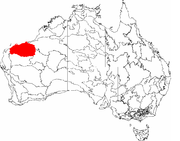
Physiography
The Pilbara craton (or Pilbara block), is distinct physiographic section of the larger Nullagine Platform province, which in turn is part of the larger West Australian ShieldAustralian Shield
The Australian Shield, also called the Western Australian Shield or Western Plateau, occupies more than half of the continent of Australia. It occupies the portion of Australia west of a line running north-south roughly from the eastern shore of Arnhem Land on the Bay or Gulf of Carpentaria to the...
division.
See also
- Geology of AustraliaGeology of AustraliaAustralia is a continent situated on the Indo-Australian Plate.The geology of Australia includes virtually all known rock types and from all geological time periods spanning over 3.8 billion years of the Earth's history.-Components:...
- Australian ShieldAustralian ShieldThe Australian Shield, also called the Western Australian Shield or Western Plateau, occupies more than half of the continent of Australia. It occupies the portion of Australia west of a line running north-south roughly from the eastern shore of Arnhem Land on the Bay or Gulf of Carpentaria to the...
- Western PlateauWestern PlateauThe Western Plateau is Australia's largest drainage division and is composed predominantly of the remains of the ancient rock shield of Gondwanaland. It incorporates two thirds of the continent; 2,700,000 square kilometres of arid land including large parts of Western Australia, South Australia,...
- Kaapvaal cratonKaapvaal cratonThe Kaapvaal craton , along with the Pilbara craton of Western Australia, are the only remaining areas of pristine 3.6-2.5 Ga crust on Earth...
- Yilgarn cratonYilgarn cratonThe Yilgarn Craton is a large craton which constitutes the bulk of the Western Australian land mass. It is bounded by a mixture of sedimentary basins and Proterozoic fold and thrust belts...
- Gawler cratonGawler cratonThe Gawler Craton covers approximately 440,000 square kilometres of central South Australia. Its Precambrian crystalline basement crustal block was cratonised ca. 1550-1450 Ma...
- VaalbaraVaalbaraVaalbara is theorized to be Earth's first supercontinent, beginning its formation about , completing its formation by about and breaking up by . The name Vaalbara is derived from the South African Kaapvaal craton and the West Australian Pilbara craton...