

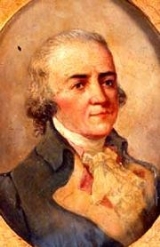
Pierre Samuel du Pont de Nemours

Encyclopedia
Pierre Samuel du Pont de Nemours (December 14, 1739 – August 7, 1817) was a French
nobleman, writer
, economist
, and government official, who was the father of Eleuthère Irénée du Pont
, the founder of E.I. duPont de Nemours and Company
, patriarch and progenitor of one of America's richest business dynasties of the 19th and 20th centuries.
Protestant or Huguenot
. His mother was a member of an impoverished noble family from Burgundy. He married Nicole Charlotte Marie Louise le Dée de Rencourt in 1766, also of a minor noble family. They had two grown children, including Eleuthère Irénée du Pont
, the founder of E.I. duPont de Nemours and Company
in the United States
.
1784. Eventually he became the protege of Dr. François Quesnay
, the personal physician of Louis XV
's mistress, Madame de Pompadour
. Quesnay was the leader of a faction known as the économistes, a group of liberals
at the court dedicated to economic and agricultural reforms. By the early 1760s Pierre Samuel’s writings on the national economy had drawn the attention of intellectuals like Voltaire
and Turgot
. His book Physiocracy, which advocated low tariffs and free trade
among nations, deeply influenced Adam Smith
.
In 1768 he took over from Nicolas Baudeau
editor of Ephémérides du citoyen ou Bibliothèque raisonnée des sciences morales et politiques wherein published Observations sur l'Esclavage des Negresin Volume 6.
In 1774 he was invited by King Stanisław August Poniatowski of the Polish-Lithuanian Commonwealth
to help organize that country’s educational system. The appointment to the Commission of National Education, with which he worked for several months, helped push his career forward, bringing him an appointment within the French government.
He served as Inspector General of Commerce under Louis XVI, helped negotiate the treaty of 1783
, by which Great Britain formally recognized the independence of the United States, and arranged the terms of a commercial signed by France and England in 1786.
and served as president of the National Constituent Assembly
. At this time, he added the name of the Nemours
district south of Paris to his name to distinguish himself from other du Ponts in the Assembly.
He and his son Eleuthère Irénée du Pont
were among those who physically defended Louis XVI
and Marie Antoinette
from a mob besieging the Tuileries Palace in Paris
during the insurrection
of August 10, 1792. He was condemned to the guillotine
during the Reign of Terror
, but his execution was still pending when Robespierre fell on 9 thermidor an IV (27 July 1794), and he was spared. He married Françoise Robin on 5 vendémiaire an IV (27 September 1795). (Robin was the daughter of Antoine Robin de Livet, a French aristocrat who lived in Lyon, and the widow of Pierre Poivre, the noted French administrator.) After his house was sacked by a mob during the events of 18 fructidor an V (4 September 1797), he and his entire family left for the United States
in 1799. They hoped (but failed) to found a model community of French exiles.
In the United States, he developed strong ties with industry and government, in particular with Thomas Jefferson
. Pierre engaged in informal diplomacy
between the United States and France during the reign of Napoleon. He was the originator of an idea that eventually became the Louisiana Purchase
, as a way to avoid French troops landing in New Orleans, and possibly sparking armed conflict with U.S. forces. Eventually, he would settle in the U.S. permanently; he died there in 1817.
His son, Eleuthère Irénée
, founded what would become one of the largest and most successful American corporations: E. I. du Pont de Nemours and Company
.
France
The French Republic , The French Republic , The French Republic , (commonly known as France , is a unitary semi-presidential republic in Western Europe with several overseas territories and islands located on other continents and in the Indian, Pacific, and Atlantic oceans. Metropolitan France...
nobleman, writer
Writer
A writer is a person who produces literature, such as novels, short stories, plays, screenplays, poetry, or other literary art. Skilled writers are able to use language to portray ideas and images....
, economist
Economist
An economist is a professional in the social science discipline of economics. The individual may also study, develop, and apply theories and concepts from economics and write about economic policy...
, and government official, who was the father of Eleuthère Irénée du Pont
Eleuthère Irénée du Pont
Éleuthère Irénée du Pont de Nemours , known as Irénée du Pont, or E.I. du Pont, was a French-born Huguenot chemist and industrialist who immigrated to the United States in 1799 and founded the gunpowder manufacturer, E. I. du Pont de Nemours and Company...
, the founder of E.I. duPont de Nemours and Company
DuPont
E. I. du Pont de Nemours and Company , commonly referred to as DuPont, is an American chemical company that was founded in July 1802 as a gunpowder mill by Eleuthère Irénée du Pont. DuPont was the world's third largest chemical company based on market capitalization and ninth based on revenue in 2009...
, patriarch and progenitor of one of America's richest business dynasties of the 19th and 20th centuries.
Early life and family
Pierre du Pont was born December 14, 1739, the son of Samuel Dupont and Anne Alexandrine de Montchanin. His father was a watchmaker and FrenchFrance
The French Republic , The French Republic , The French Republic , (commonly known as France , is a unitary semi-presidential republic in Western Europe with several overseas territories and islands located on other continents and in the Indian, Pacific, and Atlantic oceans. Metropolitan France...
Protestant or Huguenot
Huguenot
The Huguenots were members of the Protestant Reformed Church of France during the 16th and 17th centuries. Since the 17th century, people who formerly would have been called Huguenots have instead simply been called French Protestants, a title suggested by their German co-religionists, the...
. His mother was a member of an impoverished noble family from Burgundy. He married Nicole Charlotte Marie Louise le Dée de Rencourt in 1766, also of a minor noble family. They had two grown children, including Eleuthère Irénée du Pont
Eleuthère Irénée du Pont
Éleuthère Irénée du Pont de Nemours , known as Irénée du Pont, or E.I. du Pont, was a French-born Huguenot chemist and industrialist who immigrated to the United States in 1799 and founded the gunpowder manufacturer, E. I. du Pont de Nemours and Company...
, the founder of E.I. duPont de Nemours and Company
DuPont
E. I. du Pont de Nemours and Company , commonly referred to as DuPont, is an American chemical company that was founded in July 1802 as a gunpowder mill by Eleuthère Irénée du Pont. DuPont was the world's third largest chemical company based on market capitalization and ninth based on revenue in 2009...
in the United States
United States
The United States of America is a federal constitutional republic comprising fifty states and a federal district...
.
Ancient Régime
With a lively intelligence and high ambition, du Pont became estranged from his father, who wanted him to be a watchmaker, and developed a wide range of acquaintances with access to the French court. Noblesse de lettres: Pierre Samuel du Pont de Nemours made noble by "lettres patentes" (letters patent) from the king Louis XVILouis XVI of France
Louis XVI was a Bourbon monarch who ruled as King of France and Navarre until 1791, and then as King of the French from 1791 to 1792, before being executed in 1793....
1784. Eventually he became the protege of Dr. François Quesnay
François Quesnay
François Quesnay was a French economist of the Physiocratic school. He is known for publishing the "Tableau économique" in 1758, which provided the foundations of the ideas of the Physiocrats...
, the personal physician of Louis XV
Louis XV of France
Louis XV was a Bourbon monarch who ruled as King of France and of Navarre from 1 September 1715 until his death. He succeeded his great-grandfather at the age of five, his first cousin Philippe II, Duke of Orléans, served as Regent of the kingdom until Louis's majority in 1723...
's mistress, Madame de Pompadour
Madame de Pompadour
Jeanne Antoinette Poisson, Marquise de Pompadour, also known as Madame de Pompadour was a member of the French court, and was the official chief mistress of Louis XV from 1745 to her death.-Biography:...
. Quesnay was the leader of a faction known as the économistes, a group of liberals
Liberalism
Liberalism is the belief in the importance of liberty and equal rights. Liberals espouse a wide array of views depending on their understanding of these principles, but generally, liberals support ideas such as constitutionalism, liberal democracy, free and fair elections, human rights,...
at the court dedicated to economic and agricultural reforms. By the early 1760s Pierre Samuel’s writings on the national economy had drawn the attention of intellectuals like Voltaire
Voltaire
François-Marie Arouet , better known by the pen name Voltaire , was a French Enlightenment writer, historian and philosopher famous for his wit and for his advocacy of civil liberties, including freedom of religion, free trade and separation of church and state...
and Turgot
Anne Robert Jacques Turgot, Baron de Laune
Anne-Robert-Jacques Turgot, Baron de Laune , often referred to as Turgot, was a French economist and statesman. Turgot was a student of Francois Quesnay and as such belonged to the Physiocratic school of economic thought...
. His book Physiocracy, which advocated low tariffs and free trade
Free trade
Under a free trade policy, prices emerge from supply and demand, and are the sole determinant of resource allocation. 'Free' trade differs from other forms of trade policy where the allocation of goods and services among trading countries are determined by price strategies that may differ from...
among nations, deeply influenced Adam Smith
Adam Smith
Adam Smith was a Scottish social philosopher and a pioneer of political economy. One of the key figures of the Scottish Enlightenment, Smith is the author of The Theory of Moral Sentiments and An Inquiry into the Nature and Causes of the Wealth of Nations...
.
In 1768 he took over from Nicolas Baudeau
Nicolas Baudeau
Nicolas Baudeau was a Catholic cleric, theologian and economist, who was born in Amboise, France, on 25 April 1730. In 1765 he founded the first economics periodical to be published in France, Éphémérides du citoyen, and was at first an opponent of the physiocrats. Later on however he became a...
editor of Ephémérides du citoyen ou Bibliothèque raisonnée des sciences morales et politiques wherein published Observations sur l'Esclavage des Negresin Volume 6.
In 1774 he was invited by King Stanisław August Poniatowski of the Polish-Lithuanian Commonwealth
Polish-Lithuanian Commonwealth
The Polish–Lithuanian Commonwealth was a dualistic state of Poland and Lithuania ruled by a common monarch. It was the largest and one of the most populous countries of 16th- and 17th‑century Europe with some and a multi-ethnic population of 11 million at its peak in the early 17th century...
to help organize that country’s educational system. The appointment to the Commission of National Education, with which he worked for several months, helped push his career forward, bringing him an appointment within the French government.
He served as Inspector General of Commerce under Louis XVI, helped negotiate the treaty of 1783
Treaty of Paris (1783)
The Treaty of Paris, signed on September 3, 1783, ended the American Revolutionary War between Great Britain on the one hand and the United States of America and its allies on the other. The other combatant nations, France, Spain and the Dutch Republic had separate agreements; for details of...
, by which Great Britain formally recognized the independence of the United States, and arranged the terms of a commercial signed by France and England in 1786.
French Revolution
He was initially a supporter of the French RevolutionFrench Revolution
The French Revolution , sometimes distinguished as the 'Great French Revolution' , was a period of radical social and political upheaval in France and Europe. The absolute monarchy that had ruled France for centuries collapsed in three years...
and served as president of the National Constituent Assembly
National Constituent Assembly
The National Constituent Assembly was formed from the National Assembly on 9 July 1789, during the first stages of the French Revolution. It dissolved on 30 September 1791 and was succeeded by the Legislative Assembly.-Background:...
. At this time, he added the name of the Nemours
Nemours
Nemours is a commune in the Seine-et-Marne department in the Île-de-France region in north-central France.-Geography:Nemours is located on the Loing and its canal, c...
district south of Paris to his name to distinguish himself from other du Ponts in the Assembly.
He and his son Eleuthère Irénée du Pont
Eleuthère Irénée du Pont
Éleuthère Irénée du Pont de Nemours , known as Irénée du Pont, or E.I. du Pont, was a French-born Huguenot chemist and industrialist who immigrated to the United States in 1799 and founded the gunpowder manufacturer, E. I. du Pont de Nemours and Company...
were among those who physically defended Louis XVI
Louis XVI of France
Louis XVI was a Bourbon monarch who ruled as King of France and Navarre until 1791, and then as King of the French from 1791 to 1792, before being executed in 1793....
and Marie Antoinette
Marie Antoinette
Marie Antoinette ; 2 November 1755 – 16 October 1793) was an Archduchess of Austria and the Queen of France and of Navarre. She was the fifteenth and penultimate child of Holy Roman Empress Maria Theresa and Holy Roman Emperor Francis I....
from a mob besieging the Tuileries Palace in Paris
Paris
Paris is the capital and largest city in France, situated on the river Seine, in northern France, at the heart of the Île-de-France region...
during the insurrection
10th of August (French Revolution)
On 10 August 1792, during the French Revolution, revolutionary Fédéré militias — with the backing of a new municipal government of Paris that came to be known as the "insurrectionary" Paris Commune and ultimately supported by the National Guard — besieged the Tuileries palace. King Louis XVI and...
of August 10, 1792. He was condemned to the guillotine
Guillotine
The guillotine is a device used for carrying out :executions by decapitation. It consists of a tall upright frame from which an angled blade is suspended. This blade is raised with a rope and then allowed to drop, severing the head from the body...
during the Reign of Terror
Reign of Terror
The Reign of Terror , also known simply as The Terror , was a period of violence that occurred after the onset of the French Revolution, incited by conflict between rival political factions, the Girondins and the Jacobins, and marked by mass executions of "enemies of...
, but his execution was still pending when Robespierre fell on 9 thermidor an IV (27 July 1794), and he was spared. He married Françoise Robin on 5 vendémiaire an IV (27 September 1795). (Robin was the daughter of Antoine Robin de Livet, a French aristocrat who lived in Lyon, and the widow of Pierre Poivre, the noted French administrator.) After his house was sacked by a mob during the events of 18 fructidor an V (4 September 1797), he and his entire family left for the United States
United States
The United States of America is a federal constitutional republic comprising fifty states and a federal district...
in 1799. They hoped (but failed) to found a model community of French exiles.
In the United States, he developed strong ties with industry and government, in particular with Thomas Jefferson
Thomas Jefferson
Thomas Jefferson was the principal author of the United States Declaration of Independence and the Statute of Virginia for Religious Freedom , the third President of the United States and founder of the University of Virginia...
. Pierre engaged in informal diplomacy
Diplomacy
Diplomacy is the art and practice of conducting negotiations between representatives of groups or states...
between the United States and France during the reign of Napoleon. He was the originator of an idea that eventually became the Louisiana Purchase
Louisiana Purchase
The Louisiana Purchase was the acquisition by the United States of America of of France's claim to the territory of Louisiana in 1803. The U.S...
, as a way to avoid French troops landing in New Orleans, and possibly sparking armed conflict with U.S. forces. Eventually, he would settle in the U.S. permanently; he died there in 1817.
His son, Eleuthère Irénée
Eleuthère Irénée du Pont
Éleuthère Irénée du Pont de Nemours , known as Irénée du Pont, or E.I. du Pont, was a French-born Huguenot chemist and industrialist who immigrated to the United States in 1799 and founded the gunpowder manufacturer, E. I. du Pont de Nemours and Company...
, founded what would become one of the largest and most successful American corporations: E. I. du Pont de Nemours and Company
DuPont
E. I. du Pont de Nemours and Company , commonly referred to as DuPont, is an American chemical company that was founded in July 1802 as a gunpowder mill by Eleuthère Irénée du Pont. DuPont was the world's third largest chemical company based on market capitalization and ninth based on revenue in 2009...
.
See also
- Du Pont familyDu Pont familyThe Du Pont family is an American family descended from Pierre Samuel du Pont de Nemours . The son of a Paris watchmaker and a member of a Burgundian noble family, he and his sons, Victor Marie du Pont and Eleuthère Irénée du Pont, emigrated to the United States in 1800 and used the resources of...
for other family members and relationships. - Commission of National EducationKomisja Edukacji NarodowejThe Commission of National Education was the central educational authority in the Polish-Lithuanian Commonwealth, created by the Sejm and king Stanisław August Poniatowski on October 14, 1773...
External links
- DuPont Company DuPont Heritage