

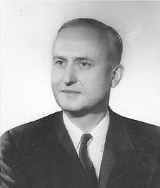
Pierre Pflimlin

Encyclopedia
Pierre Eugène Jean Pflimlin (pjɛʁ flimlɛ̃; 5 February 1907 – 27 June 2000) was a French Christian democratic politician who served as the penultimate Prime Minister of the Fourth Republic
for a few weeks in 1958, before being replaced by Charles de Gaulle
during the crisis of that year
.
in the département Nord.
A lawyer and a member of the Christian democratic Popular Republican Movement
(MRP), he was elected deputy of département Bas Rhin in 1945. With his personal roots in Alsace
, Pflimlin numbered among his MRP party colleagues the Luxembourg
-born Robert Schuman
; for both, relations with Germany played an important role in their political thinking.
He held some governmental offices during the Fourth Republic, notably as Minister of Agriculture (1947–1949 and 1950–1951) and as Minister of Economy and Finance (1955–1956 and 1957–1958).
In 13 May 1958, the French National Assembly
approved his nomination as Prime Minister. But the same day, riots took place in Algiers
. The French generals in Algeria
expected him to search for a negotiated solution with the Algerian nationalists and refused to recognize his cabinet. The crisis brought Charles de Gaulle to the head of the cabinet on 1 June.
Minister of State until 1959, Minister of Cooperation in 1962, he resigned with the other MRP ministers in order to protest against the euro-scepticism of de Gaulle.
Pflimlin served as mayor of Strasbourg
from 1959 to 1983.
He also was the President of the Parliamentary Assembly of the Council of Europe
from 1963 to 1966 and President of the European Parliament
from 1984 to 1987.
over the Rhine south of Strasbourg, connecting France to Germany, is named after him and was opened in 2002.
Changes:
French Fourth Republic
The French Fourth Republic was the republican government of France between 1946 and 1958, governed by the fourth republican constitution. It was in many ways a revival of the Third Republic, which was in place before World War II, and suffered many of the same problems...
for a few weeks in 1958, before being replaced by Charles de Gaulle
Charles de Gaulle
Charles André Joseph Marie de Gaulle was a French general and statesman who led the Free French Forces during World War II. He later founded the French Fifth Republic in 1958 and served as its first President from 1959 to 1969....
during the crisis of that year
May 1958 crisis
The May 1958 crisis was a political crisis in France during the turmoil of the Algerian War of Independence which led to the return of Charles de Gaulle to political responsibilities after a ten year absence...
.
Life
Pfilimlin was born in RoubaixRoubaix
Roubaix is a commune in the Nord department in northern France. It is located between the cities of Lille and Tourcoing.The Gare de Roubaix railway station offers connections to Lille, Tourcoing, Antwerp, Ostend and Paris.-Culture:...
in the département Nord.
A lawyer and a member of the Christian democratic Popular Republican Movement
Popular Republican Movement
The Popular Republican Movement was a French Christian democratic party of the Fourth Republic...
(MRP), he was elected deputy of département Bas Rhin in 1945. With his personal roots in Alsace
Alsace
Alsace is the fifth-smallest of the 27 regions of France in land area , and the smallest in metropolitan France. It is also the seventh-most densely populated region in France and third most densely populated region in metropolitan France, with ca. 220 inhabitants per km²...
, Pflimlin numbered among his MRP party colleagues the Luxembourg
Luxembourg
Luxembourg , officially the Grand Duchy of Luxembourg , is a landlocked country in western Europe, bordered by Belgium, France, and Germany. It has two principal regions: the Oesling in the North as part of the Ardennes massif, and the Gutland in the south...
-born Robert Schuman
Robert Schuman
Robert Schuman was a noted Luxembourgish-born French statesman. Schuman was a Christian Democrat and an independent political thinker and activist...
; for both, relations with Germany played an important role in their political thinking.
He held some governmental offices during the Fourth Republic, notably as Minister of Agriculture (1947–1949 and 1950–1951) and as Minister of Economy and Finance (1955–1956 and 1957–1958).
In 13 May 1958, the French National Assembly
French National Assembly
The French National Assembly is the lower house of the bicameral Parliament of France under the Fifth Republic. The upper house is the Senate ....
approved his nomination as Prime Minister. But the same day, riots took place in Algiers
Algiers
' is the capital and largest city of Algeria. According to the 1998 census, the population of the city proper was 1,519,570 and that of the urban agglomeration was 2,135,630. In 2009, the population was about 3,500,000...
. The French generals in Algeria
Algeria
Algeria , officially the People's Democratic Republic of Algeria , also formally referred to as the Democratic and Popular Republic of Algeria, is a country in the Maghreb region of Northwest Africa with Algiers as its capital.In terms of land area, it is the largest country in Africa and the Arab...
expected him to search for a negotiated solution with the Algerian nationalists and refused to recognize his cabinet. The crisis brought Charles de Gaulle to the head of the cabinet on 1 June.
Minister of State until 1959, Minister of Cooperation in 1962, he resigned with the other MRP ministers in order to protest against the euro-scepticism of de Gaulle.
Pflimlin served as mayor of Strasbourg
Strasbourg
Strasbourg is the capital and principal city of the Alsace region in eastern France and is the official seat of the European Parliament. Located close to the border with Germany, it is the capital of the Bas-Rhin département. The city and the region of Alsace are historically German-speaking,...
from 1959 to 1983.
He also was the President of the Parliamentary Assembly of the Council of Europe
Parliamentary Assembly of the Council of Europe
The Parliamentary Assembly of the Council of Europe , which held its first session in Strasbourg on 10 August 1949, can be considered the oldest international parliamentary assembly with a pluralistic composition of democratically elected members of parliament established on the basis of an...
from 1963 to 1966 and President of the European Parliament
European Parliament
The European Parliament is the directly elected parliamentary institution of the European Union . Together with the Council of the European Union and the Commission, it exercises the legislative function of the EU and it has been described as one of the most powerful legislatures in the world...
from 1984 to 1987.
Honors
The Pierre Pflimlin bridgePierre Pflimlin bridge
The Pierre Pflimlin Bridge is a 957 m long motorway bridge over the river Rhine between Germany and France, south of Strasbourg / Kehl. It is named after Pierre Pflimlin, a former French prime minister, and was opened in 2002...
over the Rhine south of Strasbourg, connecting France to Germany, is named after him and was opened in 2002.
Government (14 May – 1 June 1958)
- Pierre Pflimlin – President of the Council
- Guy MolletGuy MolletGuy Mollet was a French Socialist politician. He led the French Section of the Workers' International party from 1946 to 1969 and was Prime Minister in 1956–1957.-Early life and World War II:...
– Vice President of the Council - René PlevenRené PlevenRené Pléven was a notable French politician of the Fourth Republic. A member of the Free French, he helped found the Democratic and Socialist Union of the Resistance , a political party that was meant to be a successor to the wartime Resistance movement...
– Minister of Foreign Affairs - Maurice FaureMaurice FaureMaurice Faure at Azerat, Dordogne is a former member of the French Resistance and a former minister in several French governments....
– Minister of the Interior - Pierre de ChevignéPierre de ChevignéPierre de Chevigné was a French politician, who was the Minister of Defence for the French 5th Republic between May 14 and June 1, 1958....
– Minister of Armed Forces - Edgar FaureEdgar FaureEdgar Faure was a French politician, essayist, historian, and memoirist.-Career:Faure was born in Béziers, Languedoc-Roussillon. He trained as a lawyer in Paris and became a member of the Bar at 27, the youngest lawyer in France to do so at the time...
– Minister of Finance, Economic Affairs, and Planning - Paul Ribeyre – Minister of Commerce and Industry
- Paul BaconPaul BaconPaul Bacon was a French politician.During World War 2, Bacon was active in the French Resistance. He was a member of Georges Bidault's National Liberation Movement, and distributed a manifesto about trade unionism in December 1940. Bacon was arrested by the Gestapo in 1943.After the war, Bacon...
– Minister of Labour and Social Security - Robert LecourtRobert LecourtRobert Lecourt was a French politician and lawyer, judge and the fourth President of the European Court of Justice.Lecourt was born in Pavilly, Seine-Maritime...
– Minister of Justice - Jacques BordeneuveJacques BordeneuveJacques Bordeneuve was a French politician....
– Minister of National Education - Vincent BadieVincent BadieVincent Badie was a French lawyer and politician.Vincent Henri Badie was born in Béziers and practised as a lawyer at Montpellier. He was elected as Radical Party candidate to the Chamber of Deputies in 1936 representing Hérault...
– Minister of Veterans and War Victims - Roland Boscary-Monsservin – Minister of Agriculture
- André Colin – Minister of Overseas France
- Édouard Bonnefous – Minister of Public Works, Transport, and Tourism
- André Maroselli – Minister of Public Health and Population
- Pierre Garet – Minister of Reconstruction and Housing
- Édouard Corniglion-MolinierEdouard Corniglion-MolinierGeneral Edouard Corniglion-Molinier aviator and member of the French Resistance, member of the French government during the French Fourth Republic, in the 1950s, movie producer , friend of Marcel Dassault and cousin of Fred Vidal....
– Minister for the Sahara - Félix Houphouët-BoignyFélix Houphouët-BoignyFélix Houphouët-Boigny , affectionately called Papa Houphouët or Le Vieux, was the first President of Côte d'Ivoire. Originally a village chief, he worked as a doctor, an administrator of a plantation, and a union leader, before being elected to the French Parliament and serving in a number of...
– Minister of State
Changes:
- 17 May 1958 – Maurice FaureMaurice FaureMaurice Faure at Azerat, Dordogne is a former member of the French Resistance and a former minister in several French governments....
becomes Minister of European Institutions. Jules MochJules MochJules Salvador Moch was a French politician.-Biography:...
succeeds Faure as Minister of the Interior. Albert Gazier enters the ministry as Minister of Information. Max Lejeune succeeds Houphouët-Boigny as Minister of State.