

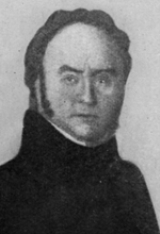
Pierre Louis Jean Casimir de Blacas

Encyclopedia
Avignon
Avignon is a French commune in southeastern France in the départment of the Vaucluse bordered by the left bank of the Rhône river. Of the 94,787 inhabitants of the city on 1 January 2010, 12 000 live in the ancient town centre surrounded by its medieval ramparts.Often referred to as the...
, Vaucluse
Vaucluse
The Vaucluse is a department in the southeast of France, named after the famous spring, the Fontaine-de-Vaucluse.- History :Vaucluse was created on 12 August 1793 out of parts of the departments of Bouches-du-Rhône, Drôme, and Basses-Alpes...
, France
France
The French Republic , The French Republic , The French Republic , (commonly known as France , is a unitary semi-presidential republic in Western Europe with several overseas territories and islands located on other continents and in the Indian, Pacific, and Atlantic oceans. Metropolitan France...
– 17 November 1839, Vienna
Vienna
Vienna is the capital and largest city of the Republic of Austria and one of the nine states of Austria. Vienna is Austria's primary city, with a population of about 1.723 million , and is by far the largest city in Austria, as well as its cultural, economic, and political centre...
, Austria
Austria
Austria , officially the Republic of Austria , is a landlocked country of roughly 8.4 million people in Central Europe. It is bordered by the Czech Republic and Germany to the north, Slovakia and Hungary to the east, Slovenia and Italy to the south, and Switzerland and Liechtenstein to the...
) was a French
France
The French Republic , The French Republic , The French Republic , (commonly known as France , is a unitary semi-presidential republic in Western Europe with several overseas territories and islands located on other continents and in the Indian, Pacific, and Atlantic oceans. Metropolitan France...
antiquarian, nobleman and diplomat during the Bourbon Restoration
Bourbon Restoration
The Bourbon Restoration is the name given to the period following the successive events of the French Revolution , the end of the First Republic , and then the forcible end of the First French Empire under Napoleon – when a coalition of European powers restored by arms the monarchy to the...
.
Youth
He was baptized at AvignonAvignon
Avignon is a French commune in southeastern France in the départment of the Vaucluse bordered by the left bank of the Rhône river. Of the 94,787 inhabitants of the city on 1 January 2010, 12 000 live in the ancient town centre surrounded by its medieval ramparts.Often referred to as the...
on 11 January 1771. He was the son of an aristocrat from Provence and took an opposing view of the French Revolution
French Revolution
The French Revolution , sometimes distinguished as the 'Great French Revolution' , was a period of radical social and political upheaval in France and Europe. The absolute monarchy that had ruled France for centuries collapsed in three years...
. In 1790, while a sous-lieutenant in the Noailles
Noailles
Noailles is the name of several communes in France:* Noailles, Corrèze, in the Corrèze département* Noailles, Oise, in the Oise département* Noailles, Tarn, in the Tarn département* Noailles, a neighborhood of Marseilles and its metro station...
dragoon
Dragoon
The word dragoon originally meant mounted infantry, who were trained in horse riding as well as infantry fighting skills. However, usage altered over time and during the 18th century, dragoons evolved into conventional light cavalry units and personnel...
s from Tarn, he fled across the Var to Nice
Nice
Nice is the fifth most populous city in France, after Paris, Marseille, Lyon and Toulouse, with a population of 348,721 within its administrative limits on a land area of . The urban area of Nice extends beyond the administrative city limits with a population of more than 955,000 on an area of...
in the Kingdom of Sardinia
Kingdom of Sardinia
The Kingdom of Sardinia consisted of the island of Sardinia first as a part of the Crown of Aragon and subsequently the Spanish Empire , and second as a part of the composite state of the House of Savoy . Its capital was originally Cagliari, in the south of the island, and later Turin, on the...
. From there, he went to the German frontier town of Coblenz and joined the counter-revolutionary émigré army
Army of Condé
The Army of Condé was a French field army during the French Revolutionary Wars. One of several émigré field armies, it was the only one to survive the War of the First Coalition; others had been formed by the Comte d'Artois and Mirabeau-Tonneau...
of Louis XVI
Louis XVI of France
Louis XVI was a Bourbon monarch who ruled as King of France and Navarre until 1791, and then as King of the French from 1791 to 1792, before being executed in 1793....
's cousin, the Prince de Condé
Louis Joseph de Bourbon, prince de Condé
Louis Joseph de Bourbon was Prince of Condé from 1740 to his death. A member of the House of Bourbon, he held the prestigious rank of Prince du Sang.-Biography:...
. Later, he went through Italy before entering the service of Russia
Russian Empire
The Russian Empire was a state that existed from 1721 until the Russian Revolution of 1917. It was the successor to the Tsardom of Russia and the predecessor of the Soviet Union...
and fighting the French Republic
French First Republic
The French First Republic was founded on 22 September 1792, by the newly established National Convention. The First Republic lasted until the declaration of the First French Empire in 1804 under Napoleon I...
in Switzerland under Alexander Suvorov
Alexander Suvorov
Alexander Vasilyevich Suvorov , Count Suvorov of Rymnik, Prince in Italy, Count of the Holy Roman Empire , was the fourth and last generalissimo of the Russian Empire.One of the few great generals in history who never lost a battle along with the likes of Alexander...
.
Entry into royal service
While in the pay of Austria, he then travelled to WarsawWarsaw
Warsaw is the capital and largest city of Poland. It is located on the Vistula River, roughly from the Baltic Sea and from the Carpathian Mountains. Its population in 2010 was estimated at 1,716,855 residents with a greater metropolitan area of 2,631,902 residents, making Warsaw the 10th most...
and rejoined the court-in-exile of the pretender to the throne of France, King Louis XVI
Louis XVI of France
Louis XVI was a Bourbon monarch who ruled as King of France and Navarre until 1791, and then as King of the French from 1791 to 1792, before being executed in 1793....
's younger brother, the Comte de Provence
Louis XVIII of France
Louis XVIII , known as "the Unavoidable", was King of France and of Navarre from 1814 to 1824, omitting the Hundred Days in 1815...
, who charged him with various missions, including one to Saint Petersburg
Saint Petersburg
Saint Petersburg is a city and a federal subject of Russia located on the Neva River at the head of the Gulf of Finland on the Baltic Sea...
. Despite the help of Joseph de Maistre
Joseph de Maistre
Joseph-Marie, comte de Maistre was a French-speaking Savoyard philosopher, writer, lawyer, and diplomat. He defended hierarchical societies and a monarchical State in the period immediately following the French Revolution...
, the King of Sardinia's diplomatic envoy to the court of the Russian tsar Alexander I
Alexander I of Russia
Alexander I of Russia , served as Emperor of Russia from 23 March 1801 to 1 December 1825 and the first Russian King of Poland from 1815 to 1825. He was also the first Russian Grand Duke of Finland and Lithuania....
, he was only able to gain small advantages for the future king. However, his willingness to do anything for the exiled prince, quickly gained Blacas the trust and confidence of his royal master. In 1809, Blacas was made the pretender's grandmaster of the wardrobe (grand-maître de la Garde-Robe du Roi). After the death of the Comte d'Avaray
Avaray
Avaray is a commune in the Loir-et-Cher department in central France.-History:Avaray is a French territorial title belonging to a family some of whose members have been conspicuous in history. The Béarnaise family named Besiade moved into the province of Orléanais in the 17th century, and there...
in 1811, he became Provence's closest advisor and favorite.
On 22 April 1814, he married a fellow exile, Henriette Marie Félicité du Bouchet de Sourches de Montsoreau, in London
London
London is the capital city of :England and the :United Kingdom, the largest metropolitan area in the United Kingdom, and the largest urban zone in the European Union by most measures. Located on the River Thames, London has been a major settlement for two millennia, its history going back to its...
. She had been born in Paris
Paris
Paris is the capital and largest city in France, situated on the river Seine, in northern France, at the heart of the Île-de-France region...
on 20 February 1780 to Yves Marie du Bouchet de Sourches, Comte de Montsoreau, a maréchal de camp
Field Marshal (France)
Maréchal de camp was a general officer rank used by the French Army until 1848.The rank originated from the older rank of sergeant major general . Sergeant Major General was third in command in an army, after the General and the Lieutenant General. One of his tasks was to dispose the troops on the...
and lieutenant général
Lieutenant General
Lieutenant General is a military rank used in many countries. The rank traces its origins to the Middle Ages where the title of Lieutenant General was held by the second in command on the battlefield, who was normally subordinate to a Captain General....
during the Ancien Régime, and his wife Marie Charlotte Lallemand de Nantouillet. The Comte de Montsoreau was the nephew of the Marquise de Tourzel
Louise-Elisabeth, Marquise de Tourzel
Louise Élisabeth de Croÿ, Marquise of Tourzel was a French memoir-writer, noble and courtier...
, the royal governess
Governess
A governess is a girl or woman employed to teach and train children in a private household. In contrast to a nanny or a babysitter, she concentrates on teaching children, not on meeting their physical needs...
to the children of King Louis XVI of France
Louis XVI of France
Louis XVI was a Bourbon monarch who ruled as King of France and Navarre until 1791, and then as King of the French from 1791 to 1792, before being executed in 1793....
and his wife, Queen Marie-Antoinette, during the French Revolution
French Revolution
The French Revolution , sometimes distinguished as the 'Great French Revolution' , was a period of radical social and political upheaval in France and Europe. The absolute monarchy that had ruled France for centuries collapsed in three years...
.
Service under Louis XVIII
When the Comte de Provence became the actual king of France after the defeat and abdication of Napoleon INapoleon I
Napoleon Bonaparte was a French military and political leader during the latter stages of the French Revolution.As Napoleon I, he was Emperor of the French from 1804 to 1815...
in 1814, Blacas was appointed to the position of minister in charge of the royal household (ministre de la Maison du Roi
Minister for the Maison du Roi
The Minister for the Maison du Roi was a cabinet role under the French monarchy, conferring leadership of the Maison du Roi.- Ancien Régime :...
) in the new ministry
Pierre Louis de Blacas d'Aulps ministry
The Pierre Louis de Blacas d'Aulps ministry was a de facto cabinet ministry of France that lasted from 13 May 1814 to 19 March 1815, during the First Restoration of Louis XVIII as king.-Officials:...
and given the rank of maréchal de camp
Field Marshal (France)
Maréchal de camp was a general officer rank used by the French Army until 1848.The rank originated from the older rank of sergeant major general . Sergeant Major General was third in command in an army, after the General and the Lieutenant General. One of his tasks was to dispose the troops on the...
. He assumed a dominant role in the new king's Conseil du Roi
Conseil du Roi
The Conseil du Roi or King's Council is a general term for the administrative and governmental apparatus around the king of France during the Ancien Régime designed to prepare his decisions and give him advice...
, essentially acting as prime minister
Prime Minister of France
The Prime Minister of France in the Fifth Republic is the head of government and of the Council of Ministers of France. The head of state is the President of the French Republic...
. But, unskilled, he made an assortment of errors, favoring members of the Ancien Régime too often. In addition, his cool and aloof behavior alienated many.
On Napoleon's return from Elba
Elba
Elba is a Mediterranean island in Tuscany, Italy, from the coastal town of Piombino. The largest island of the Tuscan Archipelago, Elba is also part of the National Park of the Tuscan Archipelago and the third largest island in Italy after Sicily and Sardinia...
, Blacas accompanied the new king on his flight to Ghent
Ghent
Ghent is a city and a municipality located in the Flemish region of Belgium. It is the capital and biggest city of the East Flanders province. The city started as a settlement at the confluence of the Rivers Scheldt and Lys and in the Middle Ages became one of the largest and richest cities of...
. Upon the king's return to Paris after the Battle of Waterloo
Battle of Waterloo
The Battle of Waterloo was fought on Sunday 18 June 1815 near Waterloo in present-day Belgium, then part of the United Kingdom of the Netherlands...
, though, Blacas' unpopularity led to his dismissal. In compensation, he was named a peer of France
Peerage of France
The Peerage of France was a distinction within the French nobility which appeared in the Middle Ages. It was abolished in 1789 during the French Revolution, but it reappeared in 1814 at the time of the Bourbon Restoration which followed the fall of the First French Empire...
with the title of Comte de Blacas d'Aulps. Soon, however, his place as royal advisor was taken over by the more moderate Élie Decazes
Élie, duc Decazes
Élie Decazes, 1st duc Decazes and 1st Duke of Glücksbierg , was a French statesman, known from 1815 to 1820 as 1st comte Decazes in France, 1st Duke of Glücksbierg in Denmark in 1818, and 1st duc Decazes in France in 1820 .-Early life:Élie Decazes was born at Saint-Martin-de-Laye, Gironde, son of...
.
Stay in Italy
A scapegoat for the royalist excesses of 1814, Blacas was unofficially exiled as the French ambassador to the court of the Kingdom of Two Sicilies, whose capital was located in NaplesNaples
Naples is a city in Southern Italy, situated on the country's west coast by the Gulf of Naples. Lying between two notable volcanic regions, Mount Vesuvius and the Phlegraean Fields, it is the capital of the region of Campania and of the province of Naples...
. There, he negotiated the 1816 marriage of the Louis XVIII's nephew, the Duc de Berry, to Francis I of the Two Sicilies
Francis I of the Two Sicilies
-Biography:Francis was born in Naples, the son of Ferdinand I of the Two Sicilies and his wife Archduchess Maria Carolina of Austria. He was also the nephew of Marie Antoinette and Louis XVI the last King and Queen of France before the first French Republic....
's daughter Caroline. Also in 1816, Blacas became a member of both the Académie des Inscriptions et Belles-Lettres
Académie des Inscriptions et Belles-Lettres
The Académie des Inscriptions et Belles-Lettres is a French learned society devoted to the humanities, founded in February 1663 as one of the five academies of the Institut de France.-History:...
and the Académie des Beaux-Arts
Académie des beaux-arts
The Académie des Beaux-Arts is a French learned society. It is one of the five academies of the Institut de France.It was created in 1795 as the merger of the:* Académie de peinture et de sculpture...
. Afterwards, he was appointed to be the French ambassador to the Holy See
Holy See
The Holy See is the episcopal jurisdiction of the Catholic Church in Rome, in which its Bishop is commonly known as the Pope. It is the preeminent episcopal see of the Catholic Church, forming the central government of the Church. As such, diplomatically, and in other spheres the Holy See acts and...
in Rome
Rome
Rome is the capital of Italy and the country's largest and most populated city and comune, with over 2.7 million residents in . The city is located in the central-western portion of the Italian Peninsula, on the Tiber River within the Lazio region of Italy.Rome's history spans two and a half...
. He signed a concordat
Concordat
A concordat is an agreement between the Holy See of the Catholic Church and a sovereign state on religious matters. Legally, they are international treaties. They often includes both recognition and privileges for the Catholic Church in a particular country...
between Bourbon France
Bourbon Restoration
The Bourbon Restoration is the name given to the period following the successive events of the French Revolution , the end of the First Republic , and then the forcible end of the First French Empire under Napoleon – when a coalition of European powers restored by arms the monarchy to the...
and Pope Pius VII
Pope Pius VII
Pope Pius VII , born Barnaba Niccolò Maria Luigi Chiaramonti, was a monk, theologian and bishop, who reigned as Pope from 14 March 1800 to 20 August 1823.-Early life:...
on 11 June 1817. In 1820, he received the Ordre du Saint-Esprit
Order of the Holy Spirit
The Order of the Holy Spirit, also known as the Order of the Knights of the Holy Spirit, was an Order of Chivalry under the French Monarchy. It should not be confused with the Congregation of the Holy Ghost or with the Order of the Holy Ghost...
. While still ambassador in Rome, he was one of three French representatives to the Congress of Laibach
Congress of Laibach
The Congress of Laibach was a conference of the allied sovereigns or their representatives, held in 1821 as part of the so-called Concert of Europe, which was the decided attempt of the Great Powers to settle international problems after the Napoleonic Wars through discussion and collective weight...
in 1821.
Remaining in Rome for many years, he provided the French artist Jean Auguste Dominique Ingres
Jean Auguste Dominique Ingres
Jean-Auguste-Dominique Ingres was a French Neoclassical painter. Although he considered himself to be a painter of history in the tradition of Nicolas Poussin and Jacques-Louis David, by the end of his life it was Ingres's portraits, both painted and drawn, that were recognized as his greatest...
in 1817 with his first official commission since 1814 and became a patron to the German classicist Theodor Panofka
Theodor Panofka
Theodor Sigismund Panofka was one of the first scholars to make a systemic study of the pottery of Ancient Greece, and one of the founders of the institution later to become the German Archaeological Institute .-Life:Panofka studied classical philology at Berlin University from 1819...
, who returned with him to Paris in 1828. In addition, he worked closely with Italian archaeologist Carlo Fea
Carlo Fea
Carlo Fea was an Italian archaeologist.Born at Pigna, in what is now Liguria, Fea studied law in Rome, receiving the degree of doctor of laws from the university of La Sapienza, but archaeology gradually attracted his attention, and with the view of obtaining better opportunities for his research...
in the excavation of the Roman Forum
Roman Forum
The Roman Forum is a rectangular forum surrounded by the ruins of several important ancient government buildings at the center of the city of Rome. Citizens of the ancient city referred to this space, originally a marketplace, as the Forum Magnum, or simply the Forum...
. Together, they correctly identified the Temple of Castor and Pollux
Temple of Castor and Pollux
The Temple of Castor and Pollux is an ancient edifice in the Roman Forum, Rome, central Italy. It was originally built in gratitude for victory at the Battle of Lake Regillus . Castor and Pollux were the Dioscuri, the "twins" of Gemini, the twin sons of Zeus and Leda...
in 1816.
Service under Charles X
Louis XVIII raised his title of Comte (Earl) to that of Duc de Blacas (Duke of Blacas) on 30 April 1821. After his death, the new king, Charles XCharles X of France
Charles X was known for most of his life as the Comte d'Artois before he reigned as King of France and of Navarre from 16 September 1824 until 2 August 1830. A younger brother to Kings Louis XVI and Louis XVIII, he supported the latter in exile and eventually succeeded him...
, chose him to be one of his premier gentilhommes de la chambre. Blacas was also appointed superintendent to the Crown properties (intendant général des Bâtiments de la Couronne). During his administration, he supported orientalist Jean-François Champollion
Jean-François Champollion
Jean-François Champollion was a French classical scholar, philologist and orientalist, decipherer of the Egyptian hieroglyphs....
and created the "Musée Egyptien" within the Louvre
Louvre
The Musée du Louvre – in English, the Louvre Museum or simply the Louvre – is one of the world's largest museums, the most visited art museum in the world and a historic monument. A central landmark of Paris, it is located on the Right Bank of the Seine in the 1st arrondissement...
. In his lifetime, Blacas amassed a rich antiquities collection that Joseph Toussaint Reinaud
Joseph Toussaint Reinaud
Joseph Toussaint Reinaud was a French orientalist.- Life :Joseph Toussaint Reinaud was born at Lambesc, Bouches-du-Rhône. He came to Paris in 1815, and became a pupil of Silvestre de Sacy...
described in part under the title "Description des monuments musulmans du cabinet du duc de Blacas" (Description of the Muslim objects in the cabinet
Cabinet of curiosities
A cabinet of curiosities was an encyclopedic collection in Renaissance Europe of types of objects whose categorical boundaries were yet to be defined. They were also known by various names such as Cabinet of Wonder, and in German Kunstkammer or Wunderkammer...
of the Duc de Blacas) in 1828. In 1866, his descendents sold most of his collection to the British Museum
British Museum
The British Museum is a museum of human history and culture in London. Its collections, which number more than seven million objects, are amongst the largest and most comprehensive in the world and originate from all continents, illustrating and documenting the story of human culture from its...
, where it is still today.
In 1830, Blacas followed the Bourbons into exile. Later, he was instrumental in the dismissal of the Duchesse de Gontaut
Marie Josephine Louise, Duchesse de Gontaut
Marie Joséphine Louise, duchesse de Gontaut was born in Paris on the 3rd of August 1773, daughter of Augustin François, comte de Montaut-Navailles, who had been governor of Louis XVI and his two brothers when children...
as the governess to the king's grandchildren in fear of her relatively liberal political views. In 1838, he was created Fürst von Blacas d'Aulps (Prince of Blacas and Aulps) by the Emperor of Austria
Austria
Austria , officially the Republic of Austria , is a landlocked country of roughly 8.4 million people in Central Europe. It is bordered by the Czech Republic and Germany to the north, Slovakia and Hungary to the east, Slovenia and Italy to the south, and Switzerland and Liechtenstein to the...
on 16 May 1837. He died on 17 November 1839 and was buried next to the Bourbon crypt of the Kostanjevica Monastery
Kostanjevica Monastery
Kostanjevica Monastery is a Franciscan monastery in Pristava near Nova Gorica, Slovenia. The locals frequently refer to it simply as Kapela ....
in Görz, Austria
Austria
Austria , officially the Republic of Austria , is a landlocked country of roughly 8.4 million people in Central Europe. It is bordered by the Czech Republic and Germany to the north, Slovakia and Hungary to the east, Slovenia and Italy to the south, and Switzerland and Liechtenstein to the...
, now on the Slovenia
Slovenia
Slovenia , officially the Republic of Slovenia , is a country in Central and Southeastern Europe touching the Alps and bordering the Mediterranean. Slovenia borders Italy to the west, Croatia to the south and east, Hungary to the northeast, and Austria to the north, and also has a small portion of...
n side of the border in Nova Gorica
Nova Gorica
Nova Gorica ; 21,082 ; 31,000 ) is a town and a municipality in western Slovenia, on the border with Italy...
. His wife died in Paris on 10 October 1856.
He was succeeded as Duke of Blacas by his son Louis
Louis, Duke of Blacas
Louis Charles Pierre Casimir de Blacas d'Aulps, 2nd Duke of Blacas, 2nd Prince of Blacas was a French nobleman and antiquarian. He was the son of Pierre-Louis de Blacas d'Aulps, 1st Duke of Blacas and of his wife Henriette-Marie-Félicité du Bouchet de Sourches de Montsoreau...
, who was also both an antiquarian and a Legitimist.