


Piano Sonata No. 28 (Beethoven)

Encyclopedia
Ludwig van Beethoven
's Piano Sonata No. 28 in A major, Op.
101, was written in 1816 and was dedicated to the pianist
Baron
ess Dorothea Ertmann. This piano sonata
runs for about 20 minutes and consists of four movement
s:
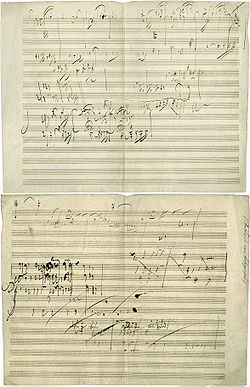 The Piano Sonata No. 28, Op. 101 is the first of the series of Beethoven's "Late Period" sonata
s, when his music moved in a new direction toward a more personal, more intimate, sometimes even an introspective, realm of freedom and fantasy. In this period he had achieved a complete mastery of form, texture and tonality and was subverting the very conventions he had mastered to create works of remarkable profundity and beauty. It is also characteristic of these late works to incorporate contrapuntal techniques (e.g. canon
and fugue
) into the sonata form
.
Beethoven himself described this sonata, composed in the town of Baden
, just south of Vienna
, during the summer of 1816, as "a series of impressions and reveries." The more intimate nature of the late sonatas probably has some connection with his deafness, which by this stage was almost total, isolating him from society so completely that his only means of communicating with friends and visitors was by means of a notebook.
For the first time Beethoven used the German term Hammerklavier to refer to the piano (although it was the next of his sonatas, Op. 106
, that became widely known as the Hammerklavier sonata).
This was the only one of his 32 sonatas that Beethoven ever saw played publicly; this was in 1816, and the performer was a bank official and musical dilettante.
marking for the opening movement, Etwas Lebhaft und mit innigsten Empfindung is roughly translated as "rather lively and with the warmest feeling," a marking which seeks to convey something of the romantic, elegiac aura of this opening movement. The adoption of this more subjective, personalised marking breaks away from the conventional tempo markings and demands a more intuitive engagement between the performer and the music, which would have been especially important to Beethoven as the interpretation of his music was left in the hands of the performers of the day because of his deafness.
Though the sonata is marked as being in A major, Beethoven does not write any satisfying cadences on the tonic key; the exposition and development do not include a single root position A major chord. The first tonic chord appears at the end of the recapitulation, and even then is blunted by the omission of the fifth scale degree.
The coda
draws to an end with the beautiful, meditative melodies in the middle register supported by an embellishment of the E major
chord (in the higher register) which creates a delicate, ponderous resonance.
s and harmonic dislocation. The effect can be disconcerting, alternating between static and accelerando and fusing seemingly distant and irrational musical motives. Erratic dynamics reinforce the eccentric rhythmic and contrapuntal forces. The opening voice-leading, tonal progressions and hypermetric patterns provide the model for the duration of the A-section.
" middle movement of the Waldstein, Sonata No. 21
. Strikingly, the opening melody of the first movement is recalled just as the third movement nears its conclusion. Downward arpeggio
s accelerate upward, then trills move upward. The concluding fugue
of the fourth movement leaps forth mit Entschlossenheit.
Ludwig van Beethoven
Ludwig van Beethoven was a German composer and pianist. A crucial figure in the transition between the Classical and Romantic eras in Western art music, he remains one of the most famous and influential composers of all time.Born in Bonn, then the capital of the Electorate of Cologne and part of...
's Piano Sonata No. 28 in A major, Op.
Opus number
An Opus number , pl. opera and opuses, abbreviated, sing. Op. and pl. Opp. refers to a number generally assigned by composers to an individual composition or set of compositions on publication, to help identify their works...
101, was written in 1816 and was dedicated to the pianist
Pianist
A pianist is a musician who plays the piano. A professional pianist can perform solo pieces, play with an ensemble or orchestra, or accompany one or more singers, solo instrumentalists, or other performers.-Choice of genres:...
Baron
Baron
Baron is a title of nobility. The word baron comes from Old French baron, itself from Old High German and Latin baro meaning " man, warrior"; it merged with cognate Old English beorn meaning "nobleman"...
ess Dorothea Ertmann. This piano sonata
Piano sonata
A piano sonata is a sonata written for a solo piano. Piano sonatas are usually written in three or four movements, although some piano sonatas have been written with a single movement , two movements , five or even more movements...
runs for about 20 minutes and consists of four movement
Movement (music)
A movement is a self-contained part of a musical composition or musical form. While individual or selected movements from a composition are sometimes performed separately, a performance of the complete work requires all the movements to be performed in succession...
s:
- Etwas lebhaft, und mit der innigsten Empfindung. (Somewhat lively, and with innermost sensitivity.) Allegretto, ma non troppo
- Lebhaft. Marschmäßig. (Lively. Moderate march.) Vivace alla marcia
- Langsam und sehnsuchtsvoll. (Slow and longingly) Adagio, ma non troppo, con affetto
- Geschwind, doch nicht zu sehr und mit Entschlossenheit. (Swiftly, but not too much, and with determination) Allegro
Composition
Sonata
Sonata , in music, literally means a piece played as opposed to a cantata , a piece sung. The term, being vague, naturally evolved through the history of music, designating a variety of forms prior to the Classical era...
s, when his music moved in a new direction toward a more personal, more intimate, sometimes even an introspective, realm of freedom and fantasy. In this period he had achieved a complete mastery of form, texture and tonality and was subverting the very conventions he had mastered to create works of remarkable profundity and beauty. It is also characteristic of these late works to incorporate contrapuntal techniques (e.g. canon
Canon (music)
In music, a canon is a contrapuntal composition that employs a melody with one or more imitations of the melody played after a given duration . The initial melody is called the leader , while the imitative melody, which is played in a different voice, is called the follower...
and fugue
Fugue
In music, a fugue is a compositional technique in two or more voices, built on a subject that is introduced at the beginning in imitation and recurs frequently in the course of the composition....
) into the sonata form
Sonata form
Sonata form is a large-scale musical structure used widely since the middle of the 18th century . While it is typically used in the first movement of multi-movement pieces, it is sometimes used in subsequent movements as well—particularly the final movement...
.
Beethoven himself described this sonata, composed in the town of Baden
Baden
Baden is a historical state on the east bank of the Rhine in the southwest of Germany, now the western part of the Baden-Württemberg of Germany....
, just south of Vienna
Vienna
Vienna is the capital and largest city of the Republic of Austria and one of the nine states of Austria. Vienna is Austria's primary city, with a population of about 1.723 million , and is by far the largest city in Austria, as well as its cultural, economic, and political centre...
, during the summer of 1816, as "a series of impressions and reveries." The more intimate nature of the late sonatas probably has some connection with his deafness, which by this stage was almost total, isolating him from society so completely that his only means of communicating with friends and visitors was by means of a notebook.
For the first time Beethoven used the German term Hammerklavier to refer to the piano (although it was the next of his sonatas, Op. 106
Piano Sonata No. 29 (Beethoven)
Ludwig van Beethoven's Piano Sonata No. 29 in B flat major, Op. 106 is a piano sonata widely considered to be one of the most important works of the composer's third period and among one of the great piano sonatas...
, that became widely known as the Hammerklavier sonata).
This was the only one of his 32 sonatas that Beethoven ever saw played publicly; this was in 1816, and the performer was a bank official and musical dilettante.
First movement
The tempoTempo
In musical terminology, tempo is the speed or pace of a given piece. Tempo is a crucial element of any musical composition, as it can affect the mood and difficulty of a piece.-Measuring tempo:...
marking for the opening movement, Etwas Lebhaft und mit innigsten Empfindung is roughly translated as "rather lively and with the warmest feeling," a marking which seeks to convey something of the romantic, elegiac aura of this opening movement. The adoption of this more subjective, personalised marking breaks away from the conventional tempo markings and demands a more intuitive engagement between the performer and the music, which would have been especially important to Beethoven as the interpretation of his music was left in the hands of the performers of the day because of his deafness.
Though the sonata is marked as being in A major, Beethoven does not write any satisfying cadences on the tonic key; the exposition and development do not include a single root position A major chord. The first tonic chord appears at the end of the recapitulation, and even then is blunted by the omission of the fifth scale degree.
The coda
Coda (music)
Coda is a term used in music in a number of different senses, primarily to designate a passage that brings a piece to an end. Technically, it is an expanded cadence...
draws to an end with the beautiful, meditative melodies in the middle register supported by an embellishment of the E major
E major
E major is a major scale based on E, with the pitches E, F, G, A, B, C, and D. Its key signature has four sharps .Its relative minor is C-sharp minor, and its parallel minor is E minor....
chord (in the higher register) which creates a delicate, ponderous resonance.
Second movement
The second movement takes the form of a vigorous romantic march characterized by a daring, formidable and clamorous network of dotted rhythmRhythm
Rhythm may be generally defined as a "movement marked by the regulated succession of strong and weak elements, or of opposite or different conditions." This general meaning of regular recurrence or pattern in time may be applied to a wide variety of cyclical natural phenomena having a periodicity or...
s and harmonic dislocation. The effect can be disconcerting, alternating between static and accelerando and fusing seemingly distant and irrational musical motives. Erratic dynamics reinforce the eccentric rhythmic and contrapuntal forces. The opening voice-leading, tonal progressions and hypermetric patterns provide the model for the duration of the A-section.
Third and fourth movements
The third movement acts somewhat like an introduction to the fourth movement, perhaps akin to the nearly static "IntroduzioneIntroduction (music)
In music, the introduction is a passage or section which opens a movement or a separate piece. In popular music this is often abbreviated as intro...
" middle movement of the Waldstein, Sonata No. 21
Piano Sonata No. 21 (Beethoven)
The Piano Sonata No. 21 in C major, Op. 53, also known as the Waldstein, is considered to be one of Beethoven's greatest piano sonatas, as well as one of the three particularly notable sonatas of his middle period . The sonata was completed in the summer of 1804...
. Strikingly, the opening melody of the first movement is recalled just as the third movement nears its conclusion. Downward arpeggio
Arpeggio
An arpeggio is a musical technique where notes in a chord are played or sung in sequence, one after the other, rather than ringing out simultaneously...
s accelerate upward, then trills move upward. The concluding fugue
Fugue
In music, a fugue is a compositional technique in two or more voices, built on a subject that is introduced at the beginning in imitation and recurs frequently in the course of the composition....
of the fourth movement leaps forth mit Entschlossenheit.
See also
- Piano history and musical performancePiano history and musical performanceThe piano has evolved technologically more than any other musical instrument, giving rise to difficult issues involving the performance of music written for earlier pianos.-Background:The earliest pianos by Cristofori The piano has evolved technologically more than any other musical instrument,...
- Beethoven's unusual pedal direction in the third movement.
External links
- A lecture by András SchiffAndrás SchiffAndrás Schiff is a Hungarian-born British classical pianist, who has won a number of awards including the Grammy and made numerous recordings.- Biography :...
on Beethoven's piano sonata op. 101 - Beethoven Piano Sonata No. 28, Op. 101, Creation history and discussion of musical content at Raptus Association
- Discussion and performance of Op. 101 by Mark Salman.
- For a public domain recording of this sonata visit Musopen
- concert performance (pt 1) by Vladimir HorowitzVladimir HorowitzVladimir Samoylovich Horowitz was a Russian-American classical virtuoso pianist and minor composer. His technique and use of tone color and the excitement of his playing were legendary. He is widely considered one of the greatest pianists of the 20th century.-Life and early...
- concert performance (pt 2) by Vladimir HorowitzVladimir HorowitzVladimir Samoylovich Horowitz was a Russian-American classical virtuoso pianist and minor composer. His technique and use of tone color and the excitement of his playing were legendary. He is widely considered one of the greatest pianists of the 20th century.-Life and early...