
All Topics  
Photorespiration


   Email Print
   Bookmark   Link


Photorespiration


Photorespiration (or "photo-respiration") is the alternate pathway for production of glyceraldehyde 3-phosphate
Glyceraldehyde 3-phosphate

Glyceraldehyde 3-phosphate, also known as triose phosphate or 3-phosphoglyceraldehyde and abbreviated as G3P, GADP, GAP, TP, GALP or PGAL, is a chemical compound that occurs as an intermediate in several central metabolic pathways of all organisms....
 (G3P) by RuBisCO
RuBisCO

Ribulose-1,5-bisphosphate carboxylase/oxygenase, most commonly known by the shorter name RuBisCO, is an enzyme that is used in the Calvin cycle to catalyze the first major step of carbon fixation, a process by which the atoms of atmospheric carbon dioxide are made available to organisms in the form of fuel molecules such as sucrose....
, the main enzyme of the light-independent reactions of photosynthesis
Photosynthesis

File:Seawifs global biosphere.jpgPhotosynthesis is a metabolic pathway that converts carbon dioxide into organic compounds, especially sugars, using the energy from sunlight....
 (also known as the Calvin cycle
Calvin cycle

The Calvin cycle is a series of biochemistry reactions that take place in the Stroma of chloroplasts in photosynthesis organisms. It was discovered by Melvin Calvin, James Bassham and Andrew Benson at the University of California, Berkeley ....
 or the Primary Carbon Reduction (PCR) cycle). Although RuBisCO favors carbon dioxide
Carbon dioxide

Carbon dioxide is a chemical compound composed of two oxygen atoms covalent bond to a single carbon atom. It is a gas at standard temperature and pressure and exists in Earth's atmosphere in this state....
 to oxygen
Oxygen

Oxygen no O2 produced; 2) O2 produced, but absorbed in oceans & seabed rock; 3) O2 starts to gas out of the oceans, but is absorbed by land surfaces and formation of ozone layer; 4-5) O2 sinks filled and the gas accumulates]]...
, (approximately 3 carboxylations per oxygenation), oxygenation of RuBisCO
RuBisCO

Ribulose-1,5-bisphosphate carboxylase/oxygenase, most commonly known by the shorter name RuBisCO, is an enzyme that is used in the Calvin cycle to catalyze the first major step of carbon fixation, a process by which the atoms of atmospheric carbon dioxide are made available to organisms in the form of fuel molecules such as sucrose....
 occurs frequently, producing a glycolate and a glycerate.


Discussion
Ask a question about 'Photorespiration'
Start a new discussion about 'Photorespiration'
Answer questions from other users
Full Discussion Forum


Encyclopedia


Photorespiration (or "photo-respiration") is the alternate pathway for production of glyceraldehyde 3-phosphate
Glyceraldehyde 3-phosphate

Glyceraldehyde 3-phosphate, also known as triose phosphate or 3-phosphoglyceraldehyde and abbreviated as G3P, GADP, GAP, TP, GALP or PGAL, is a chemical compound that occurs as an intermediate in several central metabolic pathways of all organisms....
 (G3P) by RuBisCO
RuBisCO

Ribulose-1,5-bisphosphate carboxylase/oxygenase, most commonly known by the shorter name RuBisCO, is an enzyme that is used in the Calvin cycle to catalyze the first major step of carbon fixation, a process by which the atoms of atmospheric carbon dioxide are made available to organisms in the form of fuel molecules such as sucrose....
, the main enzyme of the light-independent reactions of photosynthesis
Photosynthesis

File:Seawifs global biosphere.jpgPhotosynthesis is a metabolic pathway that converts carbon dioxide into organic compounds, especially sugars, using the energy from sunlight....
 (also known as the Calvin cycle
Calvin cycle

The Calvin cycle is a series of biochemistry reactions that take place in the Stroma of chloroplasts in photosynthesis organisms. It was discovered by Melvin Calvin, James Bassham and Andrew Benson at the University of California, Berkeley ....
 or the Primary Carbon Reduction (PCR) cycle). Although RuBisCO favors carbon dioxide
Carbon dioxide

Carbon dioxide is a chemical compound composed of two oxygen atoms covalent bond to a single carbon atom. It is a gas at standard temperature and pressure and exists in Earth's atmosphere in this state....
 to oxygen
Oxygen

Oxygen no O2 produced; 2) O2 produced, but absorbed in oceans & seabed rock; 3) O2 starts to gas out of the oceans, but is absorbed by land surfaces and formation of ozone layer; 4-5) O2 sinks filled and the gas accumulates]]...
, (approximately 3 carboxylations per oxygenation), oxygenation of RuBisCO
RuBisCO

Ribulose-1,5-bisphosphate carboxylase/oxygenase, most commonly known by the shorter name RuBisCO, is an enzyme that is used in the Calvin cycle to catalyze the first major step of carbon fixation, a process by which the atoms of atmospheric carbon dioxide are made available to organisms in the form of fuel molecules such as sucrose....
 occurs frequently, producing a glycolate and a glycerate. This usually occurs when oxygen levels are high; for example, when the stomata (tiny pores on the leaf
Leaf

In botany, a leaf is an above-ground plant Organ specialized for photosynthesis. For this purpose, a leaf is typically flat and thin, to expose the cells containing chloroplast to light over a broad area, and to allow light to penetrate fully into the tissues....
) are closed to prevent water loss on dry days. It involves three cellular organelles: chloroplasts, peroxisomes, and mitochondria. Photorespiration produces no ATP.

Biochemistry of photorespiration


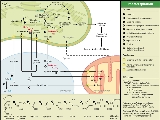
The oxidative photosynthetic carbon cycle reaction is catalyzed by RuBP oxygenase
RuBisCO

Ribulose-1,5-bisphosphate carboxylase/oxygenase, most commonly known by the shorter name RuBisCO, is an enzyme that is used in the Calvin cycle to catalyze the first major step of carbon fixation, a process by which the atoms of atmospheric carbon dioxide are made available to organisms in the form of fuel molecules such as sucrose....
 activity:

RuBP + O2 → Phosphoglycolate + 3-phosphoglycerate
Glycerate 3-phosphate

3-Phosphoglyceric acid , or glycerate 3-phosphate , is a biochemistry significant 3-carbon molecule that is a metabolic intermediate in both glycolysis and the Calvin cycle....


The phosphoglycolate is salvaged by a series of reactions in the peroxisome
Peroxisome

Peroxisomes are organelles from the Microbody family and are present in almost any eukaryote cell. They participate in the metabolism of fatty acids and many other metabolites....
, mitochondria, and again in the peroxisome
Peroxisome

Peroxisomes are organelles from the Microbody family and are present in almost any eukaryote cell. They participate in the metabolism of fatty acids and many other metabolites....
 where it is converted into serine
Serine

Serine is an organic compound with the chemical formula hydrogenoxygen2carbonCHCH2OH....
 and later glycerate. Glycerate reenters the chloroplast and subsequently the Calvin cycle
Calvin cycle

The Calvin cycle is a series of biochemistry reactions that take place in the Stroma of chloroplasts in photosynthesis organisms. It was discovered by Melvin Calvin, James Bassham and Andrew Benson at the University of California, Berkeley ....
 by the same transporter that exports glycolate. A cost of 1 ATP
Adenosine triphosphate

This article is about the chemical used by cells as an energy carrier. For other uses, see ATP .Adenosine-5'-triphosphate is a multifunctional nucleotide, and plays an important role in cell biology as a coenzyme that is the "molecule unit of currency" of intracellular energy transfer....
 is associated with conversion to 3-phosphoglycerate (PGA) (Phosphorylation
Phosphorylation

Phosphorylation is the addition of a phosphate group to a protein or other organic molecule. Protein phosphorylation in particular plays a significant role in a wide range of cellular processes....
), within the chloroplast
Chloroplast

Chloroplasts are organelles found in plant cells and other eukaryote organisms that conduct photosynthesis. Chloroplasts capture light energy to conserve Thermodynamic free energy in the form of Adenosine triphosphate and reduce NADP to NADPH through a complex set of processes called photosynthesis....
, which is then free to reenter the PCR cycle. One carbon dioxide molecule is produced for every 2 molecules of O2 that are taken up by RuBisCO.

Photorespiration is a wasteful process because G3P is created at a reduced rate and higher metabolic cost (2ATP and one NAD(P)H) compared with RuBP carboxylase activity
Calvin cycle

The Calvin cycle is a series of biochemistry reactions that take place in the Stroma of chloroplasts in photosynthesis organisms. It was discovered by Melvin Calvin, James Bassham and Andrew Benson at the University of California, Berkeley ....
. G3P produced in the chloroplast is used to create "nearly all" of the food and structures in the plant. While photorespiratory carbon cycling results in G3P eventually, it also produces waste ammonia
Ammonia

Ammonia is a chemical compound with the chemical formula nitrogenhydrogen. It is normally encountered as a gas with a characteristic pungent odor....
 that must be detoxified at a substantial cost to the cell in ATP and reducing equivalents.

Role of photorespiration


Photorespiration is said to be an evolutionary relic
Vestigial structure

Vestigiality describes homology character of organisms which have seemingly lost all or most of their original function in a species through evolution....
. Photorespiration lowers the efficiency of photosynthesis
Photosynthesis

File:Seawifs global biosphere.jpgPhotosynthesis is a metabolic pathway that converts carbon dioxide into organic compounds, especially sugars, using the energy from sunlight....
 by removing carbon molecules from the Calvin Cycle
Calvin cycle

The Calvin cycle is a series of biochemistry reactions that take place in the Stroma of chloroplasts in photosynthesis organisms. It was discovered by Melvin Calvin, James Bassham and Andrew Benson at the University of California, Berkeley ....
. The early atmosphere in which primitive plants originated contained very little oxygen, so it is hypothesized that the early evolution of RuBisCO
RuBisCO

Ribulose-1,5-bisphosphate carboxylase/oxygenase, most commonly known by the shorter name RuBisCO, is an enzyme that is used in the Calvin cycle to catalyze the first major step of carbon fixation, a process by which the atoms of atmospheric carbon dioxide are made available to organisms in the form of fuel molecules such as sucrose....
 was not influenced by its lack of discrimination between O2 and carbon dioxide. Although the functions of photorespiration remain controversial, it is widely accepted that this pathway influences a wide range of processes from bioenergetics, photosystem II function, and carbon metabolism to nitrogen assimilation and respiration. Crucially, the photorespiratory pathway is a major source of H2O2 in photosynthetic cells. Through H2O2 production and pyridine nucleotide interactions, photorespiration makes a key contribution to cellular redox homeostasis. In so doing, it influences multiple signaling pathways, particularly those that govern plant hormonal responses controlling growth, environmental and defense responses, and programmed cell death.

Another theory postulates that it may function as a "safety valve", preventing excess NADPH and ATP
Adenosine triphosphate

This article is about the chemical used by cells as an energy carrier. For other uses, see ATP .Adenosine-5'-triphosphate is a multifunctional nucleotide, and plays an important role in cell biology as a coenzyme that is the "molecule unit of currency" of intracellular energy transfer....
 from reacting with oxygen and producing free radicals
Radical (chemistry)

In chemistry, radicals are atoms, molecules or ions with unpaired electrons on an otherwise open shell configuration. These unpaired electrons are usually highly chemical reaction, so radicals are likely to take part in chemical reactions....
, as these can damage the metabolic functions of the cell by subsequent reactions with lipids or metabolites of alternate pathways.

Minimization of photorespiration (C4 and CAM plants)

Field, Corn, Liechtenstein, Mountains, Alps, Vaduz, Sky, Clouds, Landscape
Since photorespiration requires additional energy from the light reactions of photosynthesis, some plants have mechanisms to reduce uptake of molecular oxygen by RuBisCO
RuBisCO

Ribulose-1,5-bisphosphate carboxylase/oxygenase, most commonly known by the shorter name RuBisCO, is an enzyme that is used in the Calvin cycle to catalyze the first major step of carbon fixation, a process by which the atoms of atmospheric carbon dioxide are made available to organisms in the form of fuel molecules such as sucrose....
. They increase the concentration of CO2 in the leaves so that Rubisco
RuBisCO

Ribulose-1,5-bisphosphate carboxylase/oxygenase, most commonly known by the shorter name RuBisCO, is an enzyme that is used in the Calvin cycle to catalyze the first major step of carbon fixation, a process by which the atoms of atmospheric carbon dioxide are made available to organisms in the form of fuel molecules such as sucrose....
 is less likely to produce glycolate through reaction with O2.

C4
C4 carbon fixation

C4 carbon fixation is one of three biochemical mechanisms, along with C3 carbon fixation and CAM photosynthesis, functioning in land plants to "fix" carbon dioxide for sugar production through photosynthesis....
 plants capture carbon dioxide in cells of their mesophyll (using an enzyme called PEP carboxylase), and oxaloacetate is formed. This oxaloacetate is then converted to malate and is released into the bundle sheath cells (site of carbon dioxide fixation by RuBisCO
RuBisCO

Ribulose-1,5-bisphosphate carboxylase/oxygenase, most commonly known by the shorter name RuBisCO, is an enzyme that is used in the Calvin cycle to catalyze the first major step of carbon fixation, a process by which the atoms of atmospheric carbon dioxide are made available to organisms in the form of fuel molecules such as sucrose....
) where oxygen
Oxygen

Oxygen no O2 produced; 2) O2 produced, but absorbed in oceans & seabed rock; 3) O2 starts to gas out of the oceans, but is absorbed by land surfaces and formation of ozone layer; 4-5) O2 sinks filled and the gas accumulates]]...
 concentration is low to avoid photorespiration. Here Carbon dioxide is removed from the malate and combined with RuBP in the usual way. The Calvin cycle then proceeds as normal.

The enzyme PEP carboxylase (which catalyzes the combination of carbon dioxide with a compound called Phosphoenolpyruvate or PEP) is also found in other plants such as cacti and succulents who use a mechanism called Crassulacean acid metabolism or CAM in which PEP carboxylase sequesters carbon at night and releases it to the photosynthesizing cells during the day. This provides a mechanism for reducing high rates of water loss (transpiration
Transpiration

Transpiration is the evaporation of water from the aerial parts of plants, especially leaf but also Plant stems, flowers and roots. Leaf surfaces are dotted with openings called stoma that are bordered by guard cells....
) by stomata during the day.

This ability to avoid photorespiration makes these plants more hardy than other plants in dry conditions where stomata are closed and oxygen concentrations rise. C4 plants include sugar cane, corn (maize)
Maize

Maize , known as corn in some countries, is a cereal domesticated in Mesoamerica and subsequently spread throughout the American continents....
, and sorghum
Sorghum

Sorghum is a genus of numerous species of Poaceae, some of which are raised for grain and many of which are used as fodder plants either cultivated or as part of pasture....
.