

Phoronid

Encyclopedia
Phoronids are a phylum
of marine animals that filter-feed
with a lophophore
(a "crown" of tentacles), and build upright tubes of chitin
to support and protect their soft bodies. They live in all the oceans and seas including the Arctic Ocean but excluding the Antarctic Ocean, and between the intertidal zone and about 400 meters down. Most adult phoronids are 2 cm long and about 1.5 mm wide, although the largest are 50 cm long.
The bottom end of the body is an ampulla (a flask-like swelling), which anchors the animal in the tube and enables it to retract its body very quickly when threatened. When the lophophore is extended at the top of the body, cilia (little hairs) on the sides of the tentacles draw food particles to the mouth, which is inside and slightly to one side of the base of the lophophore. Unwanted material can be excluded by closing a lid above the mouth or be rejected by the tentacles, whose cilia can switch into reverse. The food then moves down to the stomach, which is in the ampulla. Solid wastes are moved up the intestine and out through the anus
, which is outside and slightly below the lophophore.
A blood vessel leads up the middle of the body from the stomach to a circular vessel at the base of the lophophore, and from there a single blind vessel runs up each tentacle. A pair of blood vessels near the body wall lead downward from the lophophore ring to the stomach and also to blind branches throughout the body. There is no heart, but the major vessels can contract in waves to move the blood. Phoronids do not ventilate their trunks with oxygenated water, but rely on respiration
through the lophophore. The blood contains hemoglobin
, which is unusual in such small animals and seems to be an adaptation to anoxic and hypoxic
environments. The blood of Phoronis architecta carries twice as much oxygen
as a human of the same weight. Two metanephridia filter the body fluid, returning any useful products and dumping the remaining soluble wastes through a pair of pores beside the anus.
One species builds colonies by budding
or by splitting into top and bottom sections, and all phoronids reproduce sexually
from spring to autumn. The eggs of most species form free-swimming actinotroch larvae, which feed on plankton. An actinotroch settles to the seabed after about 20 days and then undergoes a radical change in 30 minutes: the larval tentacles are replaced by the adult lophophore; the anus moves from the bottom to just outside the lophophore; and this changes the gut from upright to a U-bend, with the stomach at the bottom of the body. One species forms a "slug-like" larva, and the larvae of a few species are not known. Phoronids live for about one year.
Some species live separately, in vertical tubes embedded in soft sediment
, while others form tangled masses buried in or encrusting rocks and shells. In some habitats populations of phoronids reach tens of thousand of individuals per square meter. The actinotroch larvae are familiar among plankton
, and sometimes account for a significant proportion of the zooplankton biomass. Predators include fish, gastropods (snails), and nematode
s (tiny roundworms). One phoronid species is unpalatable to many epibenthic predators. Various parasites infest phoronids' body cavities, digestive tract and tentacles. It is unknown whether phoronids have any significance for humans. The International Union for Conservation of Nature (IUCN) has not listed any phoronid species as endangered.
As of 2010 there are no indisputable body fossils of phoronids. There is good evidence that phoronids created trace fossil
s found in the Silurian
, Devonian
, Permian
, Jurassic
and Cretaceous
periods, and possibly in the Ordovician
and Triassic
. Phoronids, brachiopod
s and bryozoa
ns (ectoprocts) have collectively been called lophophorates, because all use lophophores to feed. From about the 1940s to the 1990s, family trees based on embryological
and morphological
features placed lophophorates among or as a sister group to the deuterostome
s, a super-phylum which includes chordate
s and echinoderm
s. While a minority adhere to this view, most researchers now regard phoronids as members of the protosome super-phylum Lophotrochozoa
. Although analysts using molecular phylogeny
are confident that members of Lophotrochozoa are more closely related to each other than of non-members, the relationships between members are mostly unclear. Some analyses regard phoronids and brachiopods as sister-groups, while others place phoronids as a sub-group within brachiopoda.
. Phoronis is also the name of one of the two genera
of Phoronids.
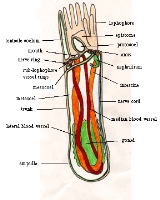
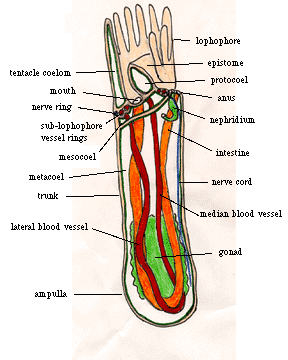 Most adult phoronids are 2 to 20 cm long and about 1.5 mm wide,
although the largest are 50 cm long. Their skins have no cuticle
but secrete rigid tubes of chitin
, similar to the material used in arthropod
s' exoskeleton
s, and sometimes reinforced with sediment
particles and other debris. Most species' tubes are erect, but those of Phoronis vancouverensis are horizontal and tangled. Phoronids can move within their tubes but never leave them. The bottom end of the body is an ampulla (a flask-like swelling in a tube-like structure), which anchors the animal in the tube and enables it to retract its body when threatened, reducing the body to 20 percent of its maximum length. Longitudinal muscles retract the body very quickly, while circular muscles slowly extend the body by compressing the internal fluid.
For feeding and respiration
each phoronid has at the top end a lophophore
, a "crown" of tentacles with which the animal filter-feeds. In small species the "crown" is a simple circle, in medium-size species it is bent into the shape of a horseshoe
with tentacles on the outer and inner sides, and in the largest species the ends of the horseshoe wind into complex spirals. These more elaborate shapes increase the area available for feeding and respiration
. The tentacles are hollow, held upright by fluid pressure, and can be moved individually by muscles.
The mouth is inside the base of the crown of tentacles but to one side. The gut runs from the mouth to one side of the stomach
, in the bottom of the ampulla. The intestine runs from the stomach, up the other side the body, and exits at the anus, outside and a little below the crown of tentacles. The gut and intestine are both supported by two mesenteries
(partitions that run the length of the body) connected to the body wall, and another mesentery connects the gut to the intestine.
The body is divided into coelom
s, compartments lined with mesothelium
. The main body cavity, under the crown of tentacles, is called the metacoelom, and the tentacles and their base share the mesocoelom. Above the mouth is the epistome, a hollow lid which can close the mouth. The cavity in the epistome is sometimes called the protocoelom, although other authors disagree that it is a coelom and Ruppert, Fox and Barnes think it is built by a different process.
, diatom
s, flagellate
s, peridinians, small invertebrate larvae, and detritus. Unwanted material can be excluded by closing the epistome (lid above the mouth) or be rejected by the tentacles, whose cilia can switch into reverse. The gut uses cilia and muscles to move food towards the stomach and secretes enzyme
s that digest some of the food, but the stomach digests the majority of the food. Phoronids also absorb amino acid
s (the building blocks of protein
s) through their skins, mainly in summer. Solid wastes are moved up the intestine and out through the anus
, which is outside and slightly below the lophophore.
A blood vessel starts from the peritoneum
(the membrane
that loosely encloses the stomach), with blind capillaries supplying the stomach. The blood vessel leads up the middle of the body to a circular vessel at the base of the lophophore, and from there a single blind vessel runs up each tentacle. A pair of blood vessels near the body wall lead downward from the lophophore ring, and in most species these are combined into one a little below the lophophore ring. The downward vessel(s) leads back to the peritoneum, and also to blind branches throughout the body. There is no heart, but muscles the major vessels contract in waves to move the blood. Unlike many animals that live in tubes, phoronids do not ventilate their trunks with oxygenated water, but rely on respiration
by the lophophore, which extends above hypoxic
sediments. The blood has hemocytes containing hemoglobin
, which unusual in such small animals and seems to be an adaptation to anoxic and hypoxic
environments. The blood of Phoronis architecta carries as much oxygen per cm3 as that of most vertebrate
s; the blood's volume in cm3 per gm of body weight is twice that of a human.
Podocyte
s on the walls of the blood vessels perform first-stage filtration of soluble wastes into the main coelom's fluid. Two metanephridia, each with a funnel-like intake, filter the fluid a second time, returning any useful products to the coelom and dumping the remaining wastes through a pair of nephridiopore
s beside the anus.
s (nerves that transmit signals very fast) which co-ordinate the retraction of the body when danger threatens.
Except for retracting the body into the tube, phoronids have limited and slow movement: partial emerging from the tube; bending the body when extended; and the lophophore's flicking of food into the mouth.
or by splitting into top and bottom sections which then grow into full bodies. In experiments, other species have spilt successfully, but only when both parts have enough gonad
al (reproductive) tissue. All phoronids breed sexually
from spring to autumn. Some species are hermaphroditic (have both male and female reproductive organs) but cross-fertilize
(fertilize the eggs of other members), while others are dioecious
(have separate sexes). The gamete
s (sperm
s and ova
) are produced in the swollen gonads, around the stomach. The gametes swim through the metacoelom to the metanephridia. Sperm exit by the nephridiopores and some are captured by the lophophores of individuals of the same species. Species that lay small fertilized eggs release them into the water as plankton, while species with larger eggs brood them either in the body's tube or stuck in the center of the lophophore by adhesive. The brooded eggs are released to feed on plankton when they develop into larvae.
Development of the eggs is a mixture of deuterostome
and protostome
characteristics. Early divisions
of the egg are holoblastic (the cells divide completely) and radial (they gradually form a stack of circles). The process is regulative (the fate of each cell depends on interaction with other cells, not on a rigid program in each cell), and experiments that divided early embryos produced complete larvae. Mesoderm
is formed from mesenchyme
originating from the archenteron
.
The coelom is formed by schizocoely, and the blastopore
(a dent in the embryo) becomes the mouth.
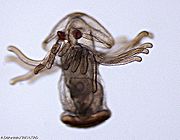 The slug-like larva of Phoronis ovalis swims for about 4 days, creeps on the sea-bed for 3 to 4 days, then bores into a carbonate floor. Nothing is known about three species. The remaining species develop free-swimming actinotroch larvae, which feed on plankton. The actinotroch is an upright cylinder with the anus at the bottom and fringed with cilia. At the top is a lobe or hood, under which are: a ganglion, connected to a patch of cilia outside the apex of the hood; a pair of protonephridia (smaller and simpler than the metanephridia in the adult); the mouth; and feeding tentacles that encircle the mouth. After swimming for about 20 days, the actinotroch settles on the seabed and undergoes a catastrophic metamorphosis (radical change) in 30 minutes: the hood and larval tentacles are absorbed and the adult lophophore is created round the mouth, and both now points upward; the gut develops a U-bend so that the anus is just under and outside the lophophore. Finally the adult phoronid builds a tube.
Phoronids live for about one year.
and excepting the Antarctic Ocean, and appear between the intertidal zone and about 400 meters down. Some occur separately, in vertical tubes embedded in soft sediment such as sand, mud, or fine gravel. Others form tangled masses of many individuals buried in or encrusting rocks and shells. In some habitats populations of phoronids reach tens of thousand of individuals per square meter. The actinotroch larvae are familiar among plankton
, and sometimes account for a significant proportion of the zooplankton biomass.
Phoronis australis bores into the wall of the tube of a cerianthid anemone
, Ceriantheomorphe brasiliensis, and uses this as a foundation for building its own tube. One cerianthid can house up to 100 phoronids. In this unequal relationship, the anemone experiences no significant benefits nor harm, while the phoronid benefits from: a foundation for its tube; food (both animals are filter-feeders); and protection, as the cerianthid withdraws into its tube when danger threatens, and this alerts the phoronid to retract into its own tube.
Although predators of phoronids are not well known, they include fish, gastropods (snails), and nematode
s (tiny roundworms). Phoronopsis viridis, which reaches densities of 26,500 per square meter on tidal flats in California
(USA), is unpalatable to many epibenthic predators, including fish and crabs. The unpalatability is strongest in the top section, including the lophophore, which is exposed to predators when phoronids feed. When the lophophores were removed in an experiment, the phoronids were more palatable, but this effect reduced over 12 days as the lophophores regenerated. These broadly effective defenses, which appear unusual among invertebrates inhabiting soft sediment, may be important in allowing Phoronopsis viridis to reach high densities. Some parasites infest phoronids: progenetic metacercariae and cysts of trematodes in phoronids' coelom
ic cavities; unidentified gregarines in phoronids' digestive tract; and an ancistrocomid ciliate
parasite, Heterocineta, in the tentacles.
It is unknown whether phoronids have any significance for humans. The International Union for Conservation of Nature (IUCN) has not listed any phoronid species as endangered.
Chengjiang fossils, in 1997 Chen and Zhou interpreted Iotuba chengjiangensis as a phoronid since it had tentacles and a U-shaped gut, and in 2004 Chen interpreted Eophoronis as a phoronid. However, in 2006 Conway Morris
regarded Iotuba and Eophoronis as synonyms for the same genus, which in his opinion looked like the priapulid Louisella
. In 2009 Balthasar and Butterfield found in western Canada two specimens from about 505 million years ago of a new fossil, Lingulosacculus nuda, which had two shells like those of brachiopod
s but not mineralized. In the authors' opinion, the U-shaped gut extended beyond the hinge line and outside the smaller shell. This would have precluded the attachment of muscles to close and open the shells, and the 50% of the animal's length beyond the hinge line would have needed longitudinal muscles and also a cuticle
for protection. Hence they suggest that Lingulosacculus may have been a member of a phoronid stem group within the linguliform
brachiopods.
There is good evidence that species of Phoronis created the trace fossil
s of the ichnogenus Talpina, which have been found in the Devonian
, Jurassic
and Cretaceous
periods. The Talpina animal bored into calcareous
algae
, coral
s, echinoid tests
(shells), mollusc shells and the rostra
of belemnites. Hederellid
s or Hederelloids are fossilized tubes, usually curved and between 0.1 and 1.8 mm wide, found from the Silurian
to the Permian
, and possibly in the Ordovician
and Triassic
. Their branching colonies may have been made by phoronids.
s and bryozoa
ns (ectoprocts) are collectively called lophophorates, because all feed using lophophores. From about the 1940s to the 1990s, family trees based on embryological
and morphological
features placed lophophorates among or as a sister group to the deuterostome
s, a super-phylum that includes chordate
s and echinoderm
s. In the early development of their embryos, deuterostomes form the anus
before the mouth, while protostome
s form the mouth first.
Nielsen (2002) views the phoronids and brachiopods as affiliated with the deuterostome pterobranchs, which also filter-feed by tentacles, because the current-driving cells of the lophophores of all three have one cilium per cell, while lophophores of bryozoans, which he regards as protosomes, have multiple cilia per cell. Helmkampf, Bruchhaus and Hausdorf (2008) summarise several authors' embryological and morphological analyses which doubt or disagree that phoronids and brachiopods are deuterostomes:
From 1988 onwards analyses based on molecular phylogeny
, which compares biochemical
features such as similarities in DNA
, have placed phoronids and brachiopods among the Lophotrochozoa
, a protostome super-phylum that includes molluscs, annelid
s and flatworm
s but excludes the other main protostome super-phylum Ecdysozoa
, whose members include arthropod
s. Cohen wrote, "This inference, if true, undermines virtually all morphology–based reconstructions of phylogeny made during the past century or more."
While analyses by molecular phylogeny are confident that members of Lophotrochozoa are more closely related to each other than of non-members, the relationships between members are mostly unclear. The Lophotrochozoa
are generally divided into: Lophophorata (animals that have lophophores), including Phoronida and Brachiopoda; Trochozoa (animals many of which have trochophore
larvae), including molluscs, annelid
s, echiura
ns, sipuncula
ns and nemertea
ns; and some other phyla (such as Platyhelminthes, Sipuncula
, Nemertea
, Gastrotricha, Gnathostomulida, Micrognathozoa, Nemertea
, Platyhelminthes and Rotifera).
Molecular phylogeny indicates that Phoronida are closely related to Brachiopoda, but Bryozoa
(Ectoprocta) are not closely related to this group, despite using a similar lophophore for feeding and respiration. This implies that the traditional definition "Lophophorata" is not monophyletic. Recently the term "Lophophorata" has been applied only to the Phoronida and Brachiopoda, and Halanych thinks this change will cause confusion. Some analyses regard Phoronida and Brachiopoda as sister-groups, while others place Phoronida as a sub-group within Brachiopoda, implying that Brachiopoda is paraphyletic. Cohen and Weydman's analysis (2005) concludes that phoronids are a sub-group of inarticulate brachiopods (those in which the hinge between the two valves have no teeth and sockets) and sister-group of the other inarticulate sub-groups. The authors also suggest that the ancestors of molluscs and the brachiopod+phoronid clade diverged between 900 Ma and 560 Ma, most probably about 685 Ma.
The phylum has two genera
, with no class
or order
names. Zoologists have given the larvae, usually called an actinotroch, a separate genus name from the adults.
In 1999 Temereva and Malakhov described Phoronis svetlanae. In 2000 Temereva described a new species, Phoronopsis malakhovi, while Emig regards it as a synonym for Phoronopsis harmeri. Santagata thinks Phoronis architecta is a different species from both Phoronis psammophila and Phoronis muelleri, and that "[the phoronids'] species diversity is currently underestimated". In 2009 Temereva described what may be larvae of Phoronopsis albomaculata and Phoronopsis californica. She wrote that, while there are 12 undisputed adult phoronid species, 25 morphological types of larvae have been identified.
Phylum
In biology, a phylum The term was coined by Georges Cuvier from Greek φῦλον phylon, "race, stock," related to φυλή phyle, "tribe, clan." is a taxonomic rank below kingdom and above class. "Phylum" is equivalent to the botanical term division....
of marine animals that filter-feed
Filter feeder
Filter feeders are animals that feed by straining suspended matter and food particles from water, typically by passing the water over a specialized filtering structure. Some animals that use this method of feeding are clams, krill, sponges, baleen whales, and many fish and some sharks. Some birds,...
with a lophophore
Lophophore
The lophophore is a characteristic feeding organ possessed by four major groups of animals: the Brachiopoda, Bryozoa, Entoprocta, and Phoronida. All lophophores are found in aquatic organisms.-Characteristics:...
(a "crown" of tentacles), and build upright tubes of chitin
Chitin
Chitin n is a long-chain polymer of a N-acetylglucosamine, a derivative of glucose, and is found in many places throughout the natural world...
to support and protect their soft bodies. They live in all the oceans and seas including the Arctic Ocean but excluding the Antarctic Ocean, and between the intertidal zone and about 400 meters down. Most adult phoronids are 2 cm long and about 1.5 mm wide, although the largest are 50 cm long.
The bottom end of the body is an ampulla (a flask-like swelling), which anchors the animal in the tube and enables it to retract its body very quickly when threatened. When the lophophore is extended at the top of the body, cilia (little hairs) on the sides of the tentacles draw food particles to the mouth, which is inside and slightly to one side of the base of the lophophore. Unwanted material can be excluded by closing a lid above the mouth or be rejected by the tentacles, whose cilia can switch into reverse. The food then moves down to the stomach, which is in the ampulla. Solid wastes are moved up the intestine and out through the anus
Anus
The anus is an opening at the opposite end of an animal's digestive tract from the mouth. Its function is to control the expulsion of feces, unwanted semi-solid matter produced during digestion, which, depending on the type of animal, may be one or more of: matter which the animal cannot digest,...
, which is outside and slightly below the lophophore.
A blood vessel leads up the middle of the body from the stomach to a circular vessel at the base of the lophophore, and from there a single blind vessel runs up each tentacle. A pair of blood vessels near the body wall lead downward from the lophophore ring to the stomach and also to blind branches throughout the body. There is no heart, but the major vessels can contract in waves to move the blood. Phoronids do not ventilate their trunks with oxygenated water, but rely on respiration
Aquatic respiration
Aquatic respiration is the process whereby an aquatic animal obtains oxygen from water.-Fish:In most fish respiration takes place through gills. Lungfish, however, possess one or two lungs...
through the lophophore. The blood contains hemoglobin
Hemoglobin
Hemoglobin is the iron-containing oxygen-transport metalloprotein in the red blood cells of all vertebrates, with the exception of the fish family Channichthyidae, as well as the tissues of some invertebrates...
, which is unusual in such small animals and seems to be an adaptation to anoxic and hypoxic
Hypoxia (environmental)
Hypoxia, or oxygen depletion, is a phenomenon that occurs in aquatic environments as dissolved oxygen becomes reduced in concentration to a point where it becomes detrimental to aquatic organisms living in the system...
environments. The blood of Phoronis architecta carries twice as much oxygen
Oxygen
Oxygen is the element with atomic number 8 and represented by the symbol O. Its name derives from the Greek roots ὀξύς and -γενής , because at the time of naming, it was mistakenly thought that all acids required oxygen in their composition...
as a human of the same weight. Two metanephridia filter the body fluid, returning any useful products and dumping the remaining soluble wastes through a pair of pores beside the anus.
One species builds colonies by budding
Budding
Budding is a form of asexual reproduction in which a new organism grows on another one. The new organism remains attached as it grows, separating from the parent organism only when it is mature. Since the reproduction is asexual, the newly created organism is a clone and is genetically identical...
or by splitting into top and bottom sections, and all phoronids reproduce sexually
Sexual reproduction
Sexual reproduction is the creation of a new organism by combining the genetic material of two organisms. There are two main processes during sexual reproduction; they are: meiosis, involving the halving of the number of chromosomes; and fertilization, involving the fusion of two gametes and the...
from spring to autumn. The eggs of most species form free-swimming actinotroch larvae, which feed on plankton. An actinotroch settles to the seabed after about 20 days and then undergoes a radical change in 30 minutes: the larval tentacles are replaced by the adult lophophore; the anus moves from the bottom to just outside the lophophore; and this changes the gut from upright to a U-bend, with the stomach at the bottom of the body. One species forms a "slug-like" larva, and the larvae of a few species are not known. Phoronids live for about one year.
Some species live separately, in vertical tubes embedded in soft sediment
Sediment
Sediment is naturally occurring material that is broken down by processes of weathering and erosion, and is subsequently transported by the action of fluids such as wind, water, or ice, and/or by the force of gravity acting on the particle itself....
, while others form tangled masses buried in or encrusting rocks and shells. In some habitats populations of phoronids reach tens of thousand of individuals per square meter. The actinotroch larvae are familiar among plankton
Plankton
Plankton are any drifting organisms that inhabit the pelagic zone of oceans, seas, or bodies of fresh water. That is, plankton are defined by their ecological niche rather than phylogenetic or taxonomic classification...
, and sometimes account for a significant proportion of the zooplankton biomass. Predators include fish, gastropods (snails), and nematode
Nematode
The nematodes or roundworms are the most diverse phylum of pseudocoelomates, and one of the most diverse of all animals. Nematode species are very difficult to distinguish; over 28,000 have been described, of which over 16,000 are parasitic. It has been estimated that the total number of nematode...
s (tiny roundworms). One phoronid species is unpalatable to many epibenthic predators. Various parasites infest phoronids' body cavities, digestive tract and tentacles. It is unknown whether phoronids have any significance for humans. The International Union for Conservation of Nature (IUCN) has not listed any phoronid species as endangered.
As of 2010 there are no indisputable body fossils of phoronids. There is good evidence that phoronids created trace fossil
Trace fossil
Trace fossils, also called ichnofossils , are geological records of biological activity. Trace fossils may be impressions made on the substrate by an organism: for example, burrows, borings , urolites , footprints and feeding marks, and root cavities...
s found in the Silurian
Silurian
The Silurian is a geologic period and system that extends from the end of the Ordovician Period, about 443.7 ± 1.5 Mya , to the beginning of the Devonian Period, about 416.0 ± 2.8 Mya . As with other geologic periods, the rock beds that define the period's start and end are well identified, but the...
, Devonian
Devonian
The Devonian is a geologic period and system of the Paleozoic Era spanning from the end of the Silurian Period, about 416.0 ± 2.8 Mya , to the beginning of the Carboniferous Period, about 359.2 ± 2.5 Mya...
, Permian
Permian
The PermianThe term "Permian" was introduced into geology in 1841 by Sir Sir R. I. Murchison, president of the Geological Society of London, who identified typical strata in extensive Russian explorations undertaken with Edouard de Verneuil; Murchison asserted in 1841 that he named his "Permian...
, Jurassic
Jurassic
The Jurassic is a geologic period and system that extends from about Mya to Mya, that is, from the end of the Triassic to the beginning of the Cretaceous. The Jurassic constitutes the middle period of the Mesozoic era, also known as the age of reptiles. The start of the period is marked by...
and Cretaceous
Cretaceous
The Cretaceous , derived from the Latin "creta" , usually abbreviated K for its German translation Kreide , is a geologic period and system from circa to million years ago. In the geologic timescale, the Cretaceous follows the Jurassic period and is followed by the Paleogene period of the...
periods, and possibly in the Ordovician
Ordovician
The Ordovician is a geologic period and system, the second of six of the Paleozoic Era, and covers the time between 488.3±1.7 to 443.7±1.5 million years ago . It follows the Cambrian Period and is followed by the Silurian Period...
and Triassic
Triassic
The Triassic is a geologic period and system that extends from about 250 to 200 Mya . As the first period of the Mesozoic Era, the Triassic follows the Permian and is followed by the Jurassic. Both the start and end of the Triassic are marked by major extinction events...
. Phoronids, brachiopod
Brachiopod
Brachiopods are a phylum of marine animals that have hard "valves" on the upper and lower surfaces, unlike the left and right arrangement in bivalve molluscs. Brachiopod valves are hinged at the rear end, while the front can be opened for feeding or closed for protection...
s and bryozoa
Bryozoa
The Bryozoa, also known as Ectoprocta or commonly as moss animals, are a phylum of aquatic invertebrate animals. Typically about long, they are filter feeders that sieve food particles out of the water using a retractable lophophore, a "crown" of tentacles lined with cilia...
ns (ectoprocts) have collectively been called lophophorates, because all use lophophores to feed. From about the 1940s to the 1990s, family trees based on embryological
Embryology
Embryology is a science which is about the development of an embryo from the fertilization of the ovum to the fetus stage...
and morphological
Morphology (biology)
In biology, morphology is a branch of bioscience dealing with the study of the form and structure of organisms and their specific structural features....
features placed lophophorates among or as a sister group to the deuterostome
Deuterostome
Deuterostomes are a superphylum of animals. They are a subtaxon of the Bilateria branch of the subregnum Eumetazoa, and are opposed to the protostomes...
s, a super-phylum which includes chordate
Chordate
Chordates are animals which are either vertebrates or one of several closely related invertebrates. They are united by having, for at least some period of their life cycle, a notochord, a hollow dorsal nerve cord, pharyngeal slits, an endostyle, and a post-anal tail...
s and echinoderm
Echinoderm
Echinoderms are a phylum of marine animals. Echinoderms are found at every ocean depth, from the intertidal zone to the abyssal zone....
s. While a minority adhere to this view, most researchers now regard phoronids as members of the protosome super-phylum Lophotrochozoa
Lophotrochozoa
The Lophotrochozoa are a major grouping of protostome animals. The taxon was discovered based on molecular data. Molecular evidence such as a result of studies of the evolution of small-subunit ribosomal RNA supports the monophyly of the phyla listed in the infobox shown at right.-Terminology:The...
. Although analysts using molecular phylogeny
Molecular phylogeny
Molecular phylogenetics is the analysis of hereditary molecular differences, mainly in DNA sequences, to gain information on an organism's evolutionary relationships. The result of a molecular phylogenetic analysis is expressed in a phylogenetic tree...
are confident that members of Lophotrochozoa are more closely related to each other than of non-members, the relationships between members are mostly unclear. Some analyses regard phoronids and brachiopods as sister-groups, while others place phoronids as a sub-group within brachiopoda.
Name
The name of the phylum comes from Phoronis, one of the many names of the Ancient Egyptian goddess IsisIsis
Isis or in original more likely Aset is a goddess in Ancient Egyptian religious beliefs, whose worship spread throughout the Greco-Roman world. She was worshipped as the ideal mother and wife as well as the matron of nature and magic...
. Phoronis is also the name of one of the two genera
Genera
Genera is a commercial operating system and development environment for Lisp machines developed by Symbolics. It is essentially a fork of an earlier operating system originating on the MIT AI Lab's Lisp machines which Symbolics had used in common with LMI and Texas Instruments...
of Phoronids.
Comparison of similar phyla
| Feature | Phoronids | Brachiopods | Bryozoans | Entoprocts |
|---|---|---|---|---|
| Tentacles hollow | Yes | Yes | Yes | no |
| Protection and support | Erect tube of chitin Chitin Chitin n is a long-chain polymer of a N-acetylglucosamine, a derivative of glucose, and is found in many places throughout the natural world... |
Shell with two valves | Various, including chitin, mineralized skeletons, plant-like shapes, and a mass of gelatinous material | none |
| Feeding flow | Top to bottom | In through sides of shell, out through front | Top to bottom | Bottom to top |
| Anus Anus The anus is an opening at the opposite end of an animal's digestive tract from the mouth. Its function is to control the expulsion of feces, unwanted semi-solid matter produced during digestion, which, depending on the type of animal, may be one or more of: matter which the animal cannot digest,... |
Outside ring of tentacles | In the mantle, or none and solid waste is ejected out of the mouth | none | Inside ring of tentacles |
Body structure
although the largest are 50 cm long. Their skins have no cuticle
Cuticle
A cuticle , or cuticula, is a term used for any of a variety of tough but flexible, non-mineral outer coverings of an organism, or parts of an organism, that provide protection. Various types of "cuticles" are non-homologous; differing in their origin, structure, function, and chemical composition...
but secrete rigid tubes of chitin
Chitin
Chitin n is a long-chain polymer of a N-acetylglucosamine, a derivative of glucose, and is found in many places throughout the natural world...
, similar to the material used in arthropod
Arthropod
An arthropod is an invertebrate animal having an exoskeleton , a segmented body, and jointed appendages. Arthropods are members of the phylum Arthropoda , and include the insects, arachnids, crustaceans, and others...
s' exoskeleton
Exoskeleton
An exoskeleton is the external skeleton that supports and protects an animal's body, in contrast to the internal skeleton of, for example, a human. In popular usage, some of the larger kinds of exoskeletons are known as "shells". Examples of exoskeleton animals include insects such as grasshoppers...
s, and sometimes reinforced with sediment
Sediment
Sediment is naturally occurring material that is broken down by processes of weathering and erosion, and is subsequently transported by the action of fluids such as wind, water, or ice, and/or by the force of gravity acting on the particle itself....
particles and other debris. Most species' tubes are erect, but those of Phoronis vancouverensis are horizontal and tangled. Phoronids can move within their tubes but never leave them. The bottom end of the body is an ampulla (a flask-like swelling in a tube-like structure), which anchors the animal in the tube and enables it to retract its body when threatened, reducing the body to 20 percent of its maximum length. Longitudinal muscles retract the body very quickly, while circular muscles slowly extend the body by compressing the internal fluid.
For feeding and respiration
Aquatic respiration
Aquatic respiration is the process whereby an aquatic animal obtains oxygen from water.-Fish:In most fish respiration takes place through gills. Lungfish, however, possess one or two lungs...
each phoronid has at the top end a lophophore
Lophophore
The lophophore is a characteristic feeding organ possessed by four major groups of animals: the Brachiopoda, Bryozoa, Entoprocta, and Phoronida. All lophophores are found in aquatic organisms.-Characteristics:...
, a "crown" of tentacles with which the animal filter-feeds. In small species the "crown" is a simple circle, in medium-size species it is bent into the shape of a horseshoe
Horseshoe
A horseshoe, is a fabricated product, normally made of metal, although sometimes made partially or wholly of modern synthetic materials, designed to protect a horse's hoof from wear and tear. Shoes are attached on the palmar surface of the hooves, usually nailed through the insensitive hoof wall...
with tentacles on the outer and inner sides, and in the largest species the ends of the horseshoe wind into complex spirals. These more elaborate shapes increase the area available for feeding and respiration
Respiration (physiology)
'In physiology, respiration is defined as the transport of oxygen from the outside air to the cells within tissues, and the transport of carbon dioxide in the opposite direction...
. The tentacles are hollow, held upright by fluid pressure, and can be moved individually by muscles.
The mouth is inside the base of the crown of tentacles but to one side. The gut runs from the mouth to one side of the stomach
Stomach
The stomach is a muscular, hollow, dilated part of the alimentary canal which functions as an important organ of the digestive tract in some animals, including vertebrates, echinoderms, insects , and molluscs. It is involved in the second phase of digestion, following mastication .The stomach is...
, in the bottom of the ampulla. The intestine runs from the stomach, up the other side the body, and exits at the anus, outside and a little below the crown of tentacles. The gut and intestine are both supported by two mesenteries
Mesentery
In anatomy, the mesentery is the double layer of peritoneum that suspends the jejunum and ileum from the posterior wall of the abdomen. Its meaning, however, is frequently extended to include double layers of peritoneum connecting various components of the abdominal cavity.-Mesentery :The...
(partitions that run the length of the body) connected to the body wall, and another mesentery connects the gut to the intestine.
The body is divided into coelom
Coelom
The coelom is a fluid-filled cavity formed within the mesoderm. Coeloms developed in triploblasts but were subsequently lost in several lineages. Loss of coelom is correlated with reduction in body size...
s, compartments lined with mesothelium
Mesothelium
The mesothelium is a membrane that forms the lining of several body cavities: the pleura , peritoneum and pericardium . Mesothelial tissue also surrounds the male internal reproductive organs and covers the internal reproductive organs of women...
. The main body cavity, under the crown of tentacles, is called the metacoelom, and the tentacles and their base share the mesocoelom. Above the mouth is the epistome, a hollow lid which can close the mouth. The cavity in the epistome is sometimes called the protocoelom, although other authors disagree that it is a coelom and Ruppert, Fox and Barnes think it is built by a different process.
Feeding, circulation and excretion
When the lophophore is extended, cilia (little hairs) on the sides of the tentacles draw water down between the tentacles and out at the base of the lophophore. Shorter cilia on the inner sides of the tentacles flick food particles into a groove in a circle under and just inside the tentacles, and cilia in the groove push the particles into the mouth. Phoronids direct their lophophores into the water current, and quickly reorient to maximize the food-catching area when currents change. Their diet includes algaeAlgae
Algae are a large and diverse group of simple, typically autotrophic organisms, ranging from unicellular to multicellular forms, such as the giant kelps that grow to 65 meters in length. They are photosynthetic like plants, and "simple" because their tissues are not organized into the many...
, diatom
Diatom
Diatoms are a major group of algae, and are one of the most common types of phytoplankton. Most diatoms are unicellular, although they can exist as colonies in the shape of filaments or ribbons , fans , zigzags , or stellate colonies . Diatoms are producers within the food chain...
s, flagellate
Flagellate
Flagellates are organisms with one or more whip-like organelles called flagella. Some cells in animals may be flagellate, for instance the spermatozoa of most phyla. Flowering plants do not produce flagellate cells, but ferns, mosses, green algae, some gymnosperms and other closely related plants...
s, peridinians, small invertebrate larvae, and detritus. Unwanted material can be excluded by closing the epistome (lid above the mouth) or be rejected by the tentacles, whose cilia can switch into reverse. The gut uses cilia and muscles to move food towards the stomach and secretes enzyme
Enzyme
Enzymes are proteins that catalyze chemical reactions. In enzymatic reactions, the molecules at the beginning of the process, called substrates, are converted into different molecules, called products. Almost all chemical reactions in a biological cell need enzymes in order to occur at rates...
s that digest some of the food, but the stomach digests the majority of the food. Phoronids also absorb amino acid
Amino acid
Amino acids are molecules containing an amine group, a carboxylic acid group and a side-chain that varies between different amino acids. The key elements of an amino acid are carbon, hydrogen, oxygen, and nitrogen...
s (the building blocks of protein
Protein
Proteins are biochemical compounds consisting of one or more polypeptides typically folded into a globular or fibrous form, facilitating a biological function. A polypeptide is a single linear polymer chain of amino acids bonded together by peptide bonds between the carboxyl and amino groups of...
s) through their skins, mainly in summer. Solid wastes are moved up the intestine and out through the anus
Anus
The anus is an opening at the opposite end of an animal's digestive tract from the mouth. Its function is to control the expulsion of feces, unwanted semi-solid matter produced during digestion, which, depending on the type of animal, may be one or more of: matter which the animal cannot digest,...
, which is outside and slightly below the lophophore.
A blood vessel starts from the peritoneum
Peritoneum
The peritoneum is the serous membrane that forms the lining of the abdominal cavity or the coelom — it covers most of the intra-abdominal organs — in amniotes and some invertebrates...
(the membrane
Biological membrane
A biological membrane or biomembrane is an enclosing or separatingmembrane that acts as a selective barrier, within or around a cell. It consists of a lipid bilayer with embedded proteins that may constitute close to 50% of membrane content...
that loosely encloses the stomach), with blind capillaries supplying the stomach. The blood vessel leads up the middle of the body to a circular vessel at the base of the lophophore, and from there a single blind vessel runs up each tentacle. A pair of blood vessels near the body wall lead downward from the lophophore ring, and in most species these are combined into one a little below the lophophore ring. The downward vessel(s) leads back to the peritoneum, and also to blind branches throughout the body. There is no heart, but muscles the major vessels contract in waves to move the blood. Unlike many animals that live in tubes, phoronids do not ventilate their trunks with oxygenated water, but rely on respiration
Aquatic respiration
Aquatic respiration is the process whereby an aquatic animal obtains oxygen from water.-Fish:In most fish respiration takes place through gills. Lungfish, however, possess one or two lungs...
by the lophophore, which extends above hypoxic
Hypoxia (environmental)
Hypoxia, or oxygen depletion, is a phenomenon that occurs in aquatic environments as dissolved oxygen becomes reduced in concentration to a point where it becomes detrimental to aquatic organisms living in the system...
sediments. The blood has hemocytes containing hemoglobin
Hemoglobin
Hemoglobin is the iron-containing oxygen-transport metalloprotein in the red blood cells of all vertebrates, with the exception of the fish family Channichthyidae, as well as the tissues of some invertebrates...
, which unusual in such small animals and seems to be an adaptation to anoxic and hypoxic
Hypoxia (environmental)
Hypoxia, or oxygen depletion, is a phenomenon that occurs in aquatic environments as dissolved oxygen becomes reduced in concentration to a point where it becomes detrimental to aquatic organisms living in the system...
environments. The blood of Phoronis architecta carries as much oxygen per cm3 as that of most vertebrate
Vertebrate
Vertebrates are animals that are members of the subphylum Vertebrata . Vertebrates are the largest group of chordates, with currently about 58,000 species described. Vertebrates include the jawless fishes, bony fishes, sharks and rays, amphibians, reptiles, mammals, and birds...
s; the blood's volume in cm3 per gm of body weight is twice that of a human.
Podocyte
Podocyte
Podocytes are cells in the Bowman's capsule in the kidneys that wrap around the capillaries of the glomerulus...
s on the walls of the blood vessels perform first-stage filtration of soluble wastes into the main coelom's fluid. Two metanephridia, each with a funnel-like intake, filter the fluid a second time, returning any useful products to the coelom and dumping the remaining wastes through a pair of nephridiopore
Nephridiopore
Nephridiopore is part of the nephridia, an excretory organ found in many organisms, such as flatworms or annelids. Nephridia are analogous to nephrons or uriniferous tubules found in the kidney of humans....
s beside the anus.
Nervous system and movement
There is a nervous center is between the mouth and anus, and a nerve ring at the base of the lophophore. The ring supplies nerves to the tentacles and, just under the skin, to the body-wall muscles. Phoronis ovalis has two nerve trunks under the skin, whereas other species have one. The trunk(s) have giant axonAxon
An axon is a long, slender projection of a nerve cell, or neuron, that conducts electrical impulses away from the neuron's cell body or soma....
s (nerves that transmit signals very fast) which co-ordinate the retraction of the body when danger threatens.
Except for retracting the body into the tube, phoronids have limited and slow movement: partial emerging from the tube; bending the body when extended; and the lophophore's flicking of food into the mouth.
Reproduction and lifecycle
Only Phoronis ovalis naturally builds colonies by buddingBudding
Budding is a form of asexual reproduction in which a new organism grows on another one. The new organism remains attached as it grows, separating from the parent organism only when it is mature. Since the reproduction is asexual, the newly created organism is a clone and is genetically identical...
or by splitting into top and bottom sections which then grow into full bodies. In experiments, other species have spilt successfully, but only when both parts have enough gonad
Gonad
The gonad is the organ that makes gametes. The gonads in males are the testes and the gonads in females are the ovaries. The product, gametes, are haploid germ cells. For example, spermatozoon and egg cells are gametes...
al (reproductive) tissue. All phoronids breed sexually
Sexual reproduction
Sexual reproduction is the creation of a new organism by combining the genetic material of two organisms. There are two main processes during sexual reproduction; they are: meiosis, involving the halving of the number of chromosomes; and fertilization, involving the fusion of two gametes and the...
from spring to autumn. Some species are hermaphroditic (have both male and female reproductive organs) but cross-fertilize
Allogamy
Allogamy is a term used in the field of biological reproduction describing the fertilization of an ovum from one individual with the spermatozoa of another. By contrast, autogamy is the term used for self-fertilization. In humans, the fertilization event is an instance of allogamy...
(fertilize the eggs of other members), while others are dioecious
Dioecious
Dioecy is the property of a group of biological organisms that have males and females, but not members that have organs of both sexes at the same time. I.e., those whose individual members can usually produce only one type of gamete; each individual organism is thus distinctly female or male...
(have separate sexes). The gamete
Gamete
A gamete is a cell that fuses with another cell during fertilization in organisms that reproduce sexually...
s (sperm
Sperm
The term sperm is derived from the Greek word sperma and refers to the male reproductive cells. In the types of sexual reproduction known as anisogamy and oogamy, there is a marked difference in the size of the gametes with the smaller one being termed the "male" or sperm cell...
s and ova
Ovum
An ovum is a haploid female reproductive cell or gamete. Both animals and embryophytes have ova. The term ovule is used for the young ovum of an animal, as well as the plant structure that carries the female gametophyte and egg cell and develops into a seed after fertilization...
) are produced in the swollen gonads, around the stomach. The gametes swim through the metacoelom to the metanephridia. Sperm exit by the nephridiopores and some are captured by the lophophores of individuals of the same species. Species that lay small fertilized eggs release them into the water as plankton, while species with larger eggs brood them either in the body's tube or stuck in the center of the lophophore by adhesive. The brooded eggs are released to feed on plankton when they develop into larvae.
Development of the eggs is a mixture of deuterostome
Deuterostome
Deuterostomes are a superphylum of animals. They are a subtaxon of the Bilateria branch of the subregnum Eumetazoa, and are opposed to the protostomes...
and protostome
Protostome
Protostomia are a clade of animals. Together with the deuterostomes and a few smaller phyla, they make up the Bilateria, mostly comprising animals with bilateral symmetry and three germ layers...
characteristics. Early divisions
Cleavage (embryo)
In embryology, cleavage is the division of cells in the early embryo. The zygotes of many species undergo rapid cell cycles with no significant growth, producing a cluster of cells the same size as the original zygote. The different cells derived from cleavage are called blastomeres and form a...
of the egg are holoblastic (the cells divide completely) and radial (they gradually form a stack of circles). The process is regulative (the fate of each cell depends on interaction with other cells, not on a rigid program in each cell), and experiments that divided early embryos produced complete larvae. Mesoderm
Mesoderm
In all bilaterian animals, the mesoderm is one of the three primary germ cell layers in the very early embryo. The other two layers are the ectoderm and endoderm , with the mesoderm as the middle layer between them.The mesoderm forms mesenchyme , mesothelium, non-epithelial blood corpuscles and...
is formed from mesenchyme
Mesenchyme
Mesenchyme, or mesenchymal connective tissue, is a type of undifferentiated loose connective tissue that is derived mostly from mesoderm, although some are derived from other germ layers; e.g. some mesenchyme is derived from neural crest cells and thus originates from the ectoderm...
originating from the archenteron
Archenteron
The primitive gut that forms during gastrulation in the developing blastula is known as the archenteron. It develops into the digestive tract of an animal....
.
The coelom is formed by schizocoely, and the blastopore
Blastopore
A blastopore is an opening into the archenteron during the embryonic stages of an organism. The distinction between protostomes and deuterostomes is based on the direction in which the mouth develops in relation to the blastopore...
(a dent in the embryo) becomes the mouth.
Phoronids live for about one year.
Ecology
Phoronids live in all the oceans and seas including the ArcticArctic
The Arctic is a region located at the northern-most part of the Earth. The Arctic consists of the Arctic Ocean and parts of Canada, Russia, Greenland, the United States, Norway, Sweden, Finland, and Iceland. The Arctic region consists of a vast, ice-covered ocean, surrounded by treeless permafrost...
and excepting the Antarctic Ocean, and appear between the intertidal zone and about 400 meters down. Some occur separately, in vertical tubes embedded in soft sediment such as sand, mud, or fine gravel. Others form tangled masses of many individuals buried in or encrusting rocks and shells. In some habitats populations of phoronids reach tens of thousand of individuals per square meter. The actinotroch larvae are familiar among plankton
Plankton
Plankton are any drifting organisms that inhabit the pelagic zone of oceans, seas, or bodies of fresh water. That is, plankton are defined by their ecological niche rather than phylogenetic or taxonomic classification...
, and sometimes account for a significant proportion of the zooplankton biomass.
Phoronis australis bores into the wall of the tube of a cerianthid anemone
Sea anemone
Sea anemones are a group of water-dwelling, predatory animals of the order Actiniaria; they are named after the anemone, a terrestrial flower. Sea anemones are classified in the phylum Cnidaria, class Anthozoa, subclass Zoantharia. Anthozoa often have large polyps that allow for digestion of larger...
, Ceriantheomorphe brasiliensis, and uses this as a foundation for building its own tube. One cerianthid can house up to 100 phoronids. In this unequal relationship, the anemone experiences no significant benefits nor harm, while the phoronid benefits from: a foundation for its tube; food (both animals are filter-feeders); and protection, as the cerianthid withdraws into its tube when danger threatens, and this alerts the phoronid to retract into its own tube.
Although predators of phoronids are not well known, they include fish, gastropods (snails), and nematode
Nematode
The nematodes or roundworms are the most diverse phylum of pseudocoelomates, and one of the most diverse of all animals. Nematode species are very difficult to distinguish; over 28,000 have been described, of which over 16,000 are parasitic. It has been estimated that the total number of nematode...
s (tiny roundworms). Phoronopsis viridis, which reaches densities of 26,500 per square meter on tidal flats in California
California
California is a state located on the West Coast of the United States. It is by far the most populous U.S. state, and the third-largest by land area...
(USA), is unpalatable to many epibenthic predators, including fish and crabs. The unpalatability is strongest in the top section, including the lophophore, which is exposed to predators when phoronids feed. When the lophophores were removed in an experiment, the phoronids were more palatable, but this effect reduced over 12 days as the lophophores regenerated. These broadly effective defenses, which appear unusual among invertebrates inhabiting soft sediment, may be important in allowing Phoronopsis viridis to reach high densities. Some parasites infest phoronids: progenetic metacercariae and cysts of trematodes in phoronids' coelom
Coelom
The coelom is a fluid-filled cavity formed within the mesoderm. Coeloms developed in triploblasts but were subsequently lost in several lineages. Loss of coelom is correlated with reduction in body size...
ic cavities; unidentified gregarines in phoronids' digestive tract; and an ancistrocomid ciliate
Ciliate
The ciliates are a group of protozoans characterized by the presence of hair-like organelles called cilia, which are identical in structure to flagella but typically shorter and present in much larger numbers with a different undulating pattern than flagella...
parasite, Heterocineta, in the tentacles.
It is unknown whether phoronids have any significance for humans. The International Union for Conservation of Nature (IUCN) has not listed any phoronid species as endangered.
Fossil record
As of 2010 there are no indisputable body fossils of phoronids. Researching the Lower CambrianCambrian
The Cambrian is the first geological period of the Paleozoic Era, lasting from Mya ; it is succeeded by the Ordovician. Its subdivisions, and indeed its base, are somewhat in flux. The period was established by Adam Sedgwick, who named it after Cambria, the Latin name for Wales, where Britain's...
Chengjiang fossils, in 1997 Chen and Zhou interpreted Iotuba chengjiangensis as a phoronid since it had tentacles and a U-shaped gut, and in 2004 Chen interpreted Eophoronis as a phoronid. However, in 2006 Conway Morris
Simon Conway Morris
Simon Conway Morris FRS is an English paleontologist made known by his detailed and careful study of the Burgess Shale fossils, an exploit celebrated in Wonderful Life by Stephen Jay Gould...
regarded Iotuba and Eophoronis as synonyms for the same genus, which in his opinion looked like the priapulid Louisella
Louisella
Louisella is a genus of priapulid worm known from the Middle Cambrian Burgess Shale. It was originally described by Charles Walcott in 1911 as a holothurian enchinoderm.polychaete, and according to one website has also been interpreted as a polychaete...
. In 2009 Balthasar and Butterfield found in western Canada two specimens from about 505 million years ago of a new fossil, Lingulosacculus nuda, which had two shells like those of brachiopod
Brachiopod
Brachiopods are a phylum of marine animals that have hard "valves" on the upper and lower surfaces, unlike the left and right arrangement in bivalve molluscs. Brachiopod valves are hinged at the rear end, while the front can be opened for feeding or closed for protection...
s but not mineralized. In the authors' opinion, the U-shaped gut extended beyond the hinge line and outside the smaller shell. This would have precluded the attachment of muscles to close and open the shells, and the 50% of the animal's length beyond the hinge line would have needed longitudinal muscles and also a cuticle
Cuticle
A cuticle , or cuticula, is a term used for any of a variety of tough but flexible, non-mineral outer coverings of an organism, or parts of an organism, that provide protection. Various types of "cuticles" are non-homologous; differing in their origin, structure, function, and chemical composition...
for protection. Hence they suggest that Lingulosacculus may have been a member of a phoronid stem group within the linguliform
Lingulata
Lingulata is a class of brachiopod, among the oldest of all brachiopods having existed since the Cambrian period . They are also among the most morphologically conservative of the brachiopods, having lasted from their earliest appearance to the present with very little change in shape...
brachiopods.
There is good evidence that species of Phoronis created the trace fossil
Trace fossil
Trace fossils, also called ichnofossils , are geological records of biological activity. Trace fossils may be impressions made on the substrate by an organism: for example, burrows, borings , urolites , footprints and feeding marks, and root cavities...
s of the ichnogenus Talpina, which have been found in the Devonian
Devonian
The Devonian is a geologic period and system of the Paleozoic Era spanning from the end of the Silurian Period, about 416.0 ± 2.8 Mya , to the beginning of the Carboniferous Period, about 359.2 ± 2.5 Mya...
, Jurassic
Jurassic
The Jurassic is a geologic period and system that extends from about Mya to Mya, that is, from the end of the Triassic to the beginning of the Cretaceous. The Jurassic constitutes the middle period of the Mesozoic era, also known as the age of reptiles. The start of the period is marked by...
and Cretaceous
Cretaceous
The Cretaceous , derived from the Latin "creta" , usually abbreviated K for its German translation Kreide , is a geologic period and system from circa to million years ago. In the geologic timescale, the Cretaceous follows the Jurassic period and is followed by the Paleogene period of the...
periods. The Talpina animal bored into calcareous
Calcareous
Calcareous is an adjective meaning mostly or partly composed of calcium carbonate, in other words, containing lime or being chalky. The term is used in a wide variety of scientific disciplines.-In zoology:...
algae
Algae
Algae are a large and diverse group of simple, typically autotrophic organisms, ranging from unicellular to multicellular forms, such as the giant kelps that grow to 65 meters in length. They are photosynthetic like plants, and "simple" because their tissues are not organized into the many...
, coral
Coral
Corals are marine animals in class Anthozoa of phylum Cnidaria typically living in compact colonies of many identical individual "polyps". The group includes the important reef builders that inhabit tropical oceans and secrete calcium carbonate to form a hard skeleton.A coral "head" is a colony of...
s, echinoid tests
Test (biology)
A test is a term used to refer to the shell of sea urchins, and also the shell of certain microorganisms, such as testate foraminifera and testate amoebae....
(shells), mollusc shells and the rostra
Rostra
The Rōstra was a large platform built in the city of Rome that stood during the republican and imperial periods. Speakers would stand on the rostra and face the north side of the comitium towards the senate house and deliver orations to those assembled in between...
of belemnites. Hederellid
Hederellid
Hederellids are extinct colonial animals with calcitic tubular branching exoskeletons. They range from the Silurian to the Permian and were most common in the Devonian period. They are more properly known as "hederelloids" because they were originally defined as a suborder by Bassler , who...
s or Hederelloids are fossilized tubes, usually curved and between 0.1 and 1.8 mm wide, found from the Silurian
Silurian
The Silurian is a geologic period and system that extends from the end of the Ordovician Period, about 443.7 ± 1.5 Mya , to the beginning of the Devonian Period, about 416.0 ± 2.8 Mya . As with other geologic periods, the rock beds that define the period's start and end are well identified, but the...
to the Permian
Permian
The PermianThe term "Permian" was introduced into geology in 1841 by Sir Sir R. I. Murchison, president of the Geological Society of London, who identified typical strata in extensive Russian explorations undertaken with Edouard de Verneuil; Murchison asserted in 1841 that he named his "Permian...
, and possibly in the Ordovician
Ordovician
The Ordovician is a geologic period and system, the second of six of the Paleozoic Era, and covers the time between 488.3±1.7 to 443.7±1.5 million years ago . It follows the Cambrian Period and is followed by the Silurian Period...
and Triassic
Triassic
The Triassic is a geologic period and system that extends from about 250 to 200 Mya . As the first period of the Mesozoic Era, the Triassic follows the Permian and is followed by the Jurassic. Both the start and end of the Triassic are marked by major extinction events...
. Their branching colonies may have been made by phoronids.
Family tree
Phoronids, brachiopodBrachiopod
Brachiopods are a phylum of marine animals that have hard "valves" on the upper and lower surfaces, unlike the left and right arrangement in bivalve molluscs. Brachiopod valves are hinged at the rear end, while the front can be opened for feeding or closed for protection...
s and bryozoa
Bryozoa
The Bryozoa, also known as Ectoprocta or commonly as moss animals, are a phylum of aquatic invertebrate animals. Typically about long, they are filter feeders that sieve food particles out of the water using a retractable lophophore, a "crown" of tentacles lined with cilia...
ns (ectoprocts) are collectively called lophophorates, because all feed using lophophores. From about the 1940s to the 1990s, family trees based on embryological
Embryology
Embryology is a science which is about the development of an embryo from the fertilization of the ovum to the fetus stage...
and morphological
Morphology (biology)
In biology, morphology is a branch of bioscience dealing with the study of the form and structure of organisms and their specific structural features....
features placed lophophorates among or as a sister group to the deuterostome
Deuterostome
Deuterostomes are a superphylum of animals. They are a subtaxon of the Bilateria branch of the subregnum Eumetazoa, and are opposed to the protostomes...
s, a super-phylum that includes chordate
Chordate
Chordates are animals which are either vertebrates or one of several closely related invertebrates. They are united by having, for at least some period of their life cycle, a notochord, a hollow dorsal nerve cord, pharyngeal slits, an endostyle, and a post-anal tail...
s and echinoderm
Echinoderm
Echinoderms are a phylum of marine animals. Echinoderms are found at every ocean depth, from the intertidal zone to the abyssal zone....
s. In the early development of their embryos, deuterostomes form the anus
Anus
The anus is an opening at the opposite end of an animal's digestive tract from the mouth. Its function is to control the expulsion of feces, unwanted semi-solid matter produced during digestion, which, depending on the type of animal, may be one or more of: matter which the animal cannot digest,...
before the mouth, while protostome
Protostome
Protostomia are a clade of animals. Together with the deuterostomes and a few smaller phyla, they make up the Bilateria, mostly comprising animals with bilateral symmetry and three germ layers...
s form the mouth first.
Nielsen (2002) views the phoronids and brachiopods as affiliated with the deuterostome pterobranchs, which also filter-feed by tentacles, because the current-driving cells of the lophophores of all three have one cilium per cell, while lophophores of bryozoans, which he regards as protosomes, have multiple cilia per cell. Helmkampf, Bruchhaus and Hausdorf (2008) summarise several authors' embryological and morphological analyses which doubt or disagree that phoronids and brachiopods are deuterostomes:
- While deutersomes have three coelomCoelomThe coelom is a fluid-filled cavity formed within the mesoderm. Coeloms developed in triploblasts but were subsequently lost in several lineages. Loss of coelom is correlated with reduction in body size...
ic cavities, lophophorates such as phoronids and brachiopods have only two. - Pterobranchs may be a sub-group of enteropneusts ("acorn worms"). This suggests that the ancestral deuterostome looks more like a mobile worm-like enteropneust than a sessile colonial pterobranch. The fact that lophophorates and pterobranchs both use tentacles for feeding is probably not a synapomorphy of lophophorates and deuterostomes, but evolved independently as convergentConvergent evolutionConvergent evolution describes the acquisition of the same biological trait in unrelated lineages.The wing is a classic example of convergent evolution in action. Although their last common ancestor did not have wings, both birds and bats do, and are capable of powered flight. The wings are...
adaptations to a sessile lifestyle. - The mesoderm does not form by enterocoelyEnterocoelyEnterocoely is a process by which some animal embryos develop. In enterocoely, a mesoderm is formed in a developing embryo, in which the coelom forms from pouches "pinched" off of the digestive tract...
in phoronids and bryozoans, but does in deuterostomes, while there are disagreements about whether brachiopods form the mesoderm by enterocoely.
From 1988 onwards analyses based on molecular phylogeny
Molecular phylogeny
Molecular phylogenetics is the analysis of hereditary molecular differences, mainly in DNA sequences, to gain information on an organism's evolutionary relationships. The result of a molecular phylogenetic analysis is expressed in a phylogenetic tree...
, which compares biochemical
Biochemistry
Biochemistry, sometimes called biological chemistry, is the study of chemical processes in living organisms, including, but not limited to, living matter. Biochemistry governs all living organisms and living processes...
features such as similarities in DNA
DNA
Deoxyribonucleic acid is a nucleic acid that contains the genetic instructions used in the development and functioning of all known living organisms . The DNA segments that carry this genetic information are called genes, but other DNA sequences have structural purposes, or are involved in...
, have placed phoronids and brachiopods among the Lophotrochozoa
Lophotrochozoa
The Lophotrochozoa are a major grouping of protostome animals. The taxon was discovered based on molecular data. Molecular evidence such as a result of studies of the evolution of small-subunit ribosomal RNA supports the monophyly of the phyla listed in the infobox shown at right.-Terminology:The...
, a protostome super-phylum that includes molluscs, annelid
Annelid
The annelids , formally called Annelida , are a large phylum of segmented worms, with over 17,000 modern species including ragworms, earthworms and leeches...
s and flatworm
Flatworm
The flatworms, known in scientific literature as Platyhelminthes or Plathelminthes are a phylum of relatively simple bilaterian, unsegmented, soft-bodied invertebrate animals...
s but excludes the other main protostome super-phylum Ecdysozoa
Ecdysozoa
Ecdysozoa is a group of protostome animals, including Arthropoda , Nematoda, and several smaller phyla. They were first defined by Aguinaldo et al. in 1997, based mainly on trees constructed using 18S ribosomal RNA genes...
, whose members include arthropod
Arthropod
An arthropod is an invertebrate animal having an exoskeleton , a segmented body, and jointed appendages. Arthropods are members of the phylum Arthropoda , and include the insects, arachnids, crustaceans, and others...
s. Cohen wrote, "This inference, if true, undermines virtually all morphology–based reconstructions of phylogeny made during the past century or more."
While analyses by molecular phylogeny are confident that members of Lophotrochozoa are more closely related to each other than of non-members, the relationships between members are mostly unclear. The Lophotrochozoa
Lophotrochozoa
The Lophotrochozoa are a major grouping of protostome animals. The taxon was discovered based on molecular data. Molecular evidence such as a result of studies of the evolution of small-subunit ribosomal RNA supports the monophyly of the phyla listed in the infobox shown at right.-Terminology:The...
are generally divided into: Lophophorata (animals that have lophophores), including Phoronida and Brachiopoda; Trochozoa (animals many of which have trochophore
Trochophore
A trochophore is a type of free-swimming planktonic marine larva with several bands of cilia.By moving their cilia rapidly, a water eddy is created. In this way they control the direction of their movement...
larvae), including molluscs, annelid
Annelid
The annelids , formally called Annelida , are a large phylum of segmented worms, with over 17,000 modern species including ragworms, earthworms and leeches...
s, echiura
Echiura
The Echiura, or spoon worms, are a small group of marine animals. They are often considered to be a group of annelids, although they lack the segmented structure found in other members of that group, and so may also be treated as a separate phylum...
ns, sipuncula
Sipuncula
The Sipuncula or Sipunculida is a group containing 144-320 species of bilaterally symmetrical, unsegmented marine worms...
ns and nemertea
Nemertea
Nemertea is a phylum of invertebrate animals also known as "ribbon worms" or "proboscis worms". Alternative names for the phylum have included Nemertini, Nemertinea and Rhynchocoela. Although most are less than long, one specimen has been estimated at , which would make it the longest animal ever...
ns; and some other phyla (such as Platyhelminthes, Sipuncula
Sipuncula
The Sipuncula or Sipunculida is a group containing 144-320 species of bilaterally symmetrical, unsegmented marine worms...
, Nemertea
Nemertea
Nemertea is a phylum of invertebrate animals also known as "ribbon worms" or "proboscis worms". Alternative names for the phylum have included Nemertini, Nemertinea and Rhynchocoela. Although most are less than long, one specimen has been estimated at , which would make it the longest animal ever...
, Gastrotricha, Gnathostomulida, Micrognathozoa, Nemertea
Nemertea
Nemertea is a phylum of invertebrate animals also known as "ribbon worms" or "proboscis worms". Alternative names for the phylum have included Nemertini, Nemertinea and Rhynchocoela. Although most are less than long, one specimen has been estimated at , which would make it the longest animal ever...
, Platyhelminthes and Rotifera).
Molecular phylogeny indicates that Phoronida are closely related to Brachiopoda, but Bryozoa
Bryozoa
The Bryozoa, also known as Ectoprocta or commonly as moss animals, are a phylum of aquatic invertebrate animals. Typically about long, they are filter feeders that sieve food particles out of the water using a retractable lophophore, a "crown" of tentacles lined with cilia...
(Ectoprocta) are not closely related to this group, despite using a similar lophophore for feeding and respiration. This implies that the traditional definition "Lophophorata" is not monophyletic. Recently the term "Lophophorata" has been applied only to the Phoronida and Brachiopoda, and Halanych thinks this change will cause confusion. Some analyses regard Phoronida and Brachiopoda as sister-groups, while others place Phoronida as a sub-group within Brachiopoda, implying that Brachiopoda is paraphyletic. Cohen and Weydman's analysis (2005) concludes that phoronids are a sub-group of inarticulate brachiopods (those in which the hinge between the two valves have no teeth and sockets) and sister-group of the other inarticulate sub-groups. The authors also suggest that the ancestors of molluscs and the brachiopod+phoronid clade diverged between 900 Ma and 560 Ma, most probably about 685 Ma.
Taxonomy
| Adult species | Larva species |
|---|---|
| Phoronis ovalis | (creeping larva) |
| Phoronis hippocrepia | Actinotrocha hippocrepia |
| Phoronis ijimai, also called Phoronis vancouverensis |
Actinotrocha vancouverensis |
| Phoronis australis | (unknown) |
| Phoronis muelleri | Actinotrocha branchiata |
| Phoronis psammophila | Actinotrocha sabatieri |
| Phoronis pallida | Actinotrocha pallida |
| Phoronopsis albomaculata | (unknown) |
| Phoronopsis harmeri | Actinotrocha harmeri |
| Phoronopsis californica | (unknown) |
The phylum has two genera
Genera
Genera is a commercial operating system and development environment for Lisp machines developed by Symbolics. It is essentially a fork of an earlier operating system originating on the MIT AI Lab's Lisp machines which Symbolics had used in common with LMI and Texas Instruments...
, with no class
Class (biology)
In biological classification, class is* a taxonomic rank. Other well-known ranks are life, domain, kingdom, phylum, order, family, genus, and species, with class fitting between phylum and order...
or order
Order (biology)
In scientific classification used in biology, the order is# a taxonomic rank used in the classification of organisms. Other well-known ranks are life, domain, kingdom, phylum, class, family, genus, and species, with order fitting in between class and family...
names. Zoologists have given the larvae, usually called an actinotroch, a separate genus name from the adults.
In 1999 Temereva and Malakhov described Phoronis svetlanae. In 2000 Temereva described a new species, Phoronopsis malakhovi, while Emig regards it as a synonym for Phoronopsis harmeri. Santagata thinks Phoronis architecta is a different species from both Phoronis psammophila and Phoronis muelleri, and that "[the phoronids'] species diversity is currently underestimated". In 2009 Temereva described what may be larvae of Phoronopsis albomaculata and Phoronopsis californica. She wrote that, while there are 12 undisputed adult phoronid species, 25 morphological types of larvae have been identified.