

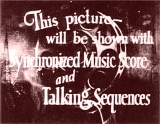
Phonofilm

Encyclopedia
In 1919, Lee De Forest
, inventor of the audion tube
, filed his first patent on a sound-on-film
process, DeForest Phonofilm, which recorded sound directly onto film as parallel lines. These parallel lines photographically recorded electrical waveforms from a microphone, which were translated back into sound waves when the movie was projected. Some sources say that DeForest improved on the work of Finnish inventor Eric Tigerstedt
— who was granted German patent 309.536 on 28 July 1914 for his sound-on-film work — and on the Tri-Ergon
process, patented in 1919 by German inventors Josef Engl, Hans Vogt, and Joseph Massole.
The Phonofilm system, which recorded synchronized sound directly onto film, was used to record vaudeville acts, musical numbers, political speeches, and opera singers. The quality of Phonofilm was poor at first, improved somewhat in later years, but was never able to match the fidelity of sound-on-disc
systems such as Vitaphone
, or later sound-on-film
systems such as RCA Photophone
or Fox Movietone
.
The films of DeForest were short films made primarily as demonstrations to try to interest major studios in Phonofilm. These films are particularly valuable to entertainment historians, as they include recordings of a wide variety of both well-known and less famous American vaudeville
and British music hall
acts which would otherwise have been forgotten. Some of the films, such as Flying Jenny Airplane
, Barking Dog, and a film of DeForest himself explaining the Phonofilm system (all 1921) were experimental films to test the system.
Some of the people filmed included vaudevillians Joe Weber
and Lew Fields
, Eva Puck
and Sammy White
, Eddie Cantor
, Ben Bernie
, Oscar Levant
, Phil Baker, Roy Smeck
, jazz
musicians Noble Sissle
and Eubie Blake
, "all-girl" bandleader Helen Lewis, harmonicist Borrah Minnevitch
, Nikita Balieff
's company La Chauve-Souris, opera singers Eva Leoni, Abbie Mitchell
, and Marie Rappold
, Broadway stars Helen Menken
and Fannie Ward
, folklorist Charles Ross Taggart
, copla
singer Concha Piquer
, and politicians Calvin Coolidge
, Robert La Follette
, Al Smith
, and Franklin D. Roosevelt
. Smith and Roosevelt were filmed during the 1924 Democratic National Convention
, held June 24 to July 9 at Madison Square Garden
in New York City. Coolidge became the first U. S. President to appear in a sound motion picture
when DeForest filmed him at the White House
on 11 August 1924.
In November 1922, De Forest founded the De Forest Phonofilm Corporation with studios at 314 East 48th Street in New York City, but was unable to interest any of the major Hollywood movie studios in his invention.
, and ballet
-- at the Rivoli Theater in New York City. The printed program for this presentation gave credit to the "DeForest-Case Patents". However, according to a letter written to DeForest immediately after the event by Theodore Case
, no credit was given to Case during DeForest's presentation. Case also states in the letter how displeased he is with DeForest crediting the "DeForest-Case Patents", as Phonofilm's success was fully due to the work of Case and his Case Research Lab.
DeForest was forced to show these films in independent theaters such as the Rivoli, since Hollywood movie studios controlled all major U.S. movie theater chains at the time. De Forest's decision to film primarily short films (one reel), not feature film
s, due to lack of Hollywood investment, limited the appeal of his process. All or part of the Paramount Pictures
features Bella Donna
(premiered 1 April 1923) and The Covered Wagon
(premiered 16 March 1923) were reportedly filmed with Phonofilm as an experiment, but, if so, were only shown this way at the premiere engagements, also at the Rivoli Theater in New York City. "Siegfried", the first part of the Fritz Lang
film Die Nibelungen
(1924) had a Phonofilm soundtrack, but only at the New York City premiere at the Century Theatre
on 23 August 1925.
One of the few two-reel films made by DeForest in the Phonofilm process was Love's Old Sweet Song (1923), starring Louis Wolheim
, Donald Gallaher
, and the 20-year-old Una Merkel
. DeForest kept to one-reel films because he was unable to solve the problem of reel changes—and the disruption in sound which would occur—when a projectionist in a movie theater changed reels.
and Dave Fleischer
used the Phonofilm process for their Song Car-Tunes
series of cartoons—all featuring the "Follow the Bouncing Ball
" gimmick—starting in May 1924. Of the 36 titles in the Song Car-Tunes series, 19 used Phonofilm. Also in 1924, the Fleischer brothers partnered with DeForest, Edwin Miles Fadiman, and Hugo Riesenfeld
to form Red Seal Pictures Corporation, which owned 36 theaters on the East Coast, extending as far west as Cleveland, Ohio
.
Red Seal Pictures and DeForest Phonofilm filed for bankruptcy in September 1926, and the Fleischers stopped releasing the Song Car-Tune films in Phonofilm shortly thereafter. Fleischer Studios
later re-released some of these titles from 1929 to 1932 through Paramount Pictures
, as part of a new series called Screen Songs
with new soundtracks using the RCA Photophone
sound-on-film process.
DeForest also worked with Theodore Case, using Case's patents to make the Phonofilm system workable. However, the two men had a falling out, shortly after DeForest filed suit in June 1923 against Freeman Harrison Owens
, another former collaborator of DeForest's. Case later went to movie mogul William Fox
of Fox Film Corporation, who bought Case's patents, the American rights to the German Tri-Ergon
patents, and the work of Owens to create Fox Movietone
.
. To record film, DeForest tried using a standard light bulb to expose amplified sound onto film. These bulbs quickly burned out, and, even while functioning, never produced a clear recording. To reproduce his nearly inaudible soundtracks, DeForest used a vacuum tube
that could not react quickly enough to the varying light coming to it as the soundtrack passed through the sound gate, causing an incomplete reproduction of sound from an essentially inaudible recording—a dual failure. DeForest's attempts to record and reproduce sound failed at every turn until he used inventions provided by Case.
Having failed to create a workable system of recording sound onto film by 1921, DeForest contacted Case to inquire about using the Case Research Lab's invention of the Thallofide (thallium
oxysulfide) Cell, for use in reproducing his recorded sound. Case provided DeForest with that invention from his lab, and later provided DeForest with the AEO Light, another Case Research Lab invention, used for reading the soundtrack of a finished film. Due to DeForest's continuing misuse of these inventions, the Case Research Lab proceeded to build its own camera. That camera was used by Case and Sponable to record President Coolidge on 11 August 1924, which was one of the films shown by DeForest and claimed by him to be the product of "his" inventions.
Seeing that DeForest was more concerned with his own fame and recognition than he was with actually creating a workable system of sound film, and because of DeForest's continuing attempts to downplay the contributions of the Case Research Lab in the creation of Phonofilm, Case severed his ties with DeForest in the fall of 1925. On 23 July 1926, William Fox of Fox Film Corporation bought Case's patents.
In June 1927, Powers made an unsuccessful takeover bid for DeForest's company. In the aftermath, Powers hired a former DeForest technician, William Garrity, to produce a cloned version of the Phonofilm system, which Powers dubbed Powers Cinephone. By now, DeForest was in too weak a financial position to mount a legal challenge against Powers for patent infringement
. Powers convinced Walt Disney
to use Cinephone for a few sound cartoons such as Steamboat Willie
(1928
) before Powers and Disney had a falling-out over money—and over Powers hiring away Disney animator Ub Iwerks
-- in 1930. Cinephone continued to be used in low-budget Westerns
through 1930, and in Disney's Mickey Mouse
and Silly Symphony cartoons—including Flowers and Trees
and The Whoopee Party
-- through 1932. (See list of Cinephone titles at IMDB in External Links below.)
process introduced by Warner Brothers as Vitaphone
-- which used a record disc synchronized with the film for sound. Warner Brothers released the feature film Don Juan
starring John Barrymore
on 6 August 1926 in Vitaphone, with music and sound effects only.
On 6 October 1927, Warner Brothers released The Jazz Singer
with Al Jolson
in Vitaphone and is often incorrectly credited as the first talking picture. The Jazz Singer was the first feature film
to use synchronized sound for talking sequences rather than just for music and sound effects, and thus launched the talkie era, but DeForest's sound-on-film system was in fact the basis for modern sound movies.
In 1927, producer William Fox introduced sound-on-film Fox Movietone with the film Sunrise
by F. W. Murnau, and in 1928, the sound-on-film process RCA Photophone was adopted by newly created studio RKO Radio Pictures and by Paramount Pictures
.
performers such as Marie Lloyd Jr.
and Billy Merson
-- along with famous stage actors such as Sybil Thorndike
reading excerpts of works by Shakespeare
, Shaw
, and Dickens
-- from September 1926 to May 1929. (In July 1925, The Gentleman, a comedy short directed by William J. Elliott in Phonofilm, was the first sound-on-film production made in England.)
On 4 October 1926, Phonofilm made its UK premiere with a program of short films presented at the Empire Cinema in London, including a short film with Sidney Bernstein welcoming Phonofilm to the UK. According to the British Film Institute
website, the UK division of DeForest Phonofilm was taken over in August 1928 by British Talking Pictures and its subsidiary British Sound Film Productions which was formed in September 1928.
In March 1929, a feature film The Clue of the New Pin
, a part-talkie based on an Edgar Wallace
novel, was trade-shown with The Crimson Circle, a German-UK coproduction which was also based on a Wallace novel. Crimson was filmed in DeForest Phonofilm, and Pin was made in British Phototone, a sound-on-disc
process using 12-inch phonograph records synchronized with the film. However, the UK divisions of both Phonofilm and British Phototone soon closed.
The last films made in the UK in Phonofilm were released in early 1929, due to competition from Vitaphone, and rival sound-on-film systems Fox Movietone and RCA Photophone. The release of Alfred Hitchcock
's sound feature film Blackmail
in June 1929, made in RCA Photophone, sealed the fate of Phonofilm in the UK.
. On 6 July 1925, the first program of Phonofilms in Australia were shown at the Piccadilly Theatre in Sydney. A program was also shown at the Prince Edward Theatre in November and December 1925.
On 6 April 1927, Minister for Trade
Herbert Pratten
appeared in a DeForest film to celebrate the opening of a Phonofilm studio in Rushcutters Bay
in Sydney. On 12 May 1927, a Phonofilm of the Duke and Dutchess of York arriving at Farm Cove, New South Wales
was shown at the Lyceum Theater in Sydney.
Unfortunately, Phonofilm had to close all of its operations in Australia by October 1927, and sold its remaining studio facilities to an Australian company in October 1928.
made in Spain. The feature film was released in Spain by Divina Home Video in 2005, after years of being thought a lost film
.
was made by the "Latin American division" of Phonofilm. No further information is known about this division of Phonofilm. In 1926, DeForest released a short film referred to as Cuban Sound Documentary which included the Cuban national anthem and excerpts from The Merry Widow
. However, little else is known of this film or whether other Phonofilms were made in Cuba.
(45 titles) and the British Film Institute
(98 titles). In 1976, five Phonofilm titles were discovered in a trunk in Australia, and these films have been restored by Australia's National Film and Sound Archive
.
(*) Included in program of Phonofilms at the Rivoli Theater in NYC on 15 April 1923
(**) Fleischer "Song Car-Tunes" series (some titles later re-released by the Fleischers in their "Screen Songs
" series, through Paramount Pictures, with new soundtracks recorded in RCA Photophone)
(***) Found in a trunk in Windsor, New South Wales
, Australia in early 1976, and restored by the National Film and Sound Archive of Australia
Lee De Forest
Lee De Forest was an American inventor with over 180 patents to his credit. De Forest invented the Audion, a vacuum tube that takes relatively weak electrical signals and amplifies them. De Forest is one of the fathers of the "electronic age", as the Audion helped to usher in the widespread use...
, inventor of the audion tube
Audion tube
The Audion is an electronic amplifying vacuum tube invented by Lee De Forest in 1906. It was the forerunner of the triode, in which the current from the filament to the plate was controlled by a third element, the grid...
, filed his first patent on a sound-on-film
Sound-on-film
Sound-on-film refers to a class of sound film processes where the sound accompanying picture is physically recorded onto photographic film, usually, but not always, the same strip of film carrying the picture. Sound-on-film processes can either record an analog sound track or digital sound track,...
process, DeForest Phonofilm, which recorded sound directly onto film as parallel lines. These parallel lines photographically recorded electrical waveforms from a microphone, which were translated back into sound waves when the movie was projected. Some sources say that DeForest improved on the work of Finnish inventor Eric Tigerstedt
Eric Tigerstedt
Eric Magnus Campbell Tigerstedt was one of the most significant inventors in Finland at the beginning of the 20th century, and has been called the "Thomas Edison of Finland"...
— who was granted German patent 309.536 on 28 July 1914 for his sound-on-film work — and on the Tri-Ergon
Tri-Ergon
The Tri-Ergon sound-on-film system was patented from 1919 on by German inventors Josef Engl , Hans Vogt , and Joseph Massolle . The name Tri-Ergon was derived from Greek and means "the work of three." In 1926, William Fox of Fox Film Corporation purchased the U. S...
process, patented in 1919 by German inventors Josef Engl, Hans Vogt, and Joseph Massole.
The Phonofilm system, which recorded synchronized sound directly onto film, was used to record vaudeville acts, musical numbers, political speeches, and opera singers. The quality of Phonofilm was poor at first, improved somewhat in later years, but was never able to match the fidelity of sound-on-disc
Sound-on-disc
The term Sound-on-disc refers to a class of sound film processes using a phonograph or other disc to record or playback sound in sync with a motion picture...
systems such as Vitaphone
Vitaphone
Vitaphone was a sound film process used on feature films and nearly 1,000 short subjects produced by Warner Bros. and its sister studio First National from 1926 to 1930. Vitaphone was the last, but most successful, of the sound-on-disc processes...
, or later sound-on-film
Sound-on-film
Sound-on-film refers to a class of sound film processes where the sound accompanying picture is physically recorded onto photographic film, usually, but not always, the same strip of film carrying the picture. Sound-on-film processes can either record an analog sound track or digital sound track,...
systems such as RCA Photophone
RCA Photophone
RCA Photophone was the trade name given to one of four major competing technologies that emerged in the American film industry in the late 1920s for synchronizing electrically recorded audio to a motion picture image. RCA Photophone was a sound-on-film, "variable-area" film exposure system, in...
or Fox Movietone
Movietone sound system
The Movietone sound system is a sound-on-film method of recording sound for motion pictures that guarantees synchronization between sound and picture. It achieves this by recording the sound as a variable-density optical track on the same strip of film that records the pictures...
.
The films of DeForest were short films made primarily as demonstrations to try to interest major studios in Phonofilm. These films are particularly valuable to entertainment historians, as they include recordings of a wide variety of both well-known and less famous American vaudeville
Vaudeville
Vaudeville was a theatrical genre of variety entertainment in the United States and Canada from the early 1880s until the early 1930s. Each performance was made up of a series of separate, unrelated acts grouped together on a common bill...
and British music hall
Music hall
Music Hall is a type of British theatrical entertainment which was popular between 1850 and 1960. The term can refer to:# A particular form of variety entertainment involving a mixture of popular song, comedy and speciality acts...
acts which would otherwise have been forgotten. Some of the films, such as Flying Jenny Airplane
Curtiss JN-4
The Curtiss JN-4 "Jenny" was one of a series of "JN" biplanes built by the Curtiss Aeroplane Company of Hammondsport, New York, later the Curtiss Aeroplane and Motor Company. Although the Curtiss JN series was originally produced as a training aircraft for the U.S...
, Barking Dog, and a film of DeForest himself explaining the Phonofilm system (all 1921) were experimental films to test the system.
Some of the people filmed included vaudevillians Joe Weber
Joe Weber (vaudevillian)
Joe Weber born Joseph Morris Weber was a vaudevillian who, along with Lew Fields, formed the comedy team of Weber and Fields....
and Lew Fields
Lew Fields
Lew Fields , born as Moses Schoenfeld, was an American actor, comedian, vaudeville star, theatre manager and producer....
, Eva Puck
Eva Puck
Eva Puck was a vaudeville headliner who later found success performing in Broadway musical comedies.-Early Life:...
and Sammy White
Sammy White (actor)
Sammy White was an American vaudeville song-and-dance comedian who appeared in a few films. He was born in Providence, Rhode Island. He appeared with Lew Clayton, as Clayton and White, in the Broadway show Schubert Gaieties of 1919.With his first wife, Eva Puck, White appeared in vaudeville as...
, Eddie Cantor
Eddie Cantor
Eddie Cantor was an American "illustrated song" performer, comedian, dancer, singer, actor and songwriter...
, Ben Bernie
Ben Bernie
Ben Bernie , born Bernard Anzelevitz, was an American jazz violinist and radio personality, often introduced as The Old Maestro. He was noted for his showmanship and memorable bits of snappy dialogue....
, Oscar Levant
Oscar Levant
Oscar Levant was an American pianist, composer, author, comedian, and actor. He was more famous for his mordant character and witticisms, on the radio and in movies and television, than for his music.-Life and career:...
, Phil Baker, Roy Smeck
Roy Smeck
Roy Smeck was an American musician. His skill on the banjo, guitar, steel guitar, and especially the ukulele earned him the nickname "Wizard of the Strings."-Background:...
, jazz
Jazz
Jazz is a musical style that originated at the beginning of the 20th century in African American communities in the Southern United States. It was born out of a mix of African and European music traditions. From its early development until the present, jazz has incorporated music from 19th and 20th...
musicians Noble Sissle
Noble Sissle
Noble Sissle was an American jazz composer, lyricist, bandleader, singer and playwright.-Early life:...
and Eubie Blake
Eubie Blake
James Hubert Blake was an American composer, lyricist, and pianist of ragtime, jazz, and popular music. In 1921, Blake and long-time collaborator Noble Sissle wrote the Broadway musical Shuffle Along, one of the first Broadway musicals to be written and directed by African Americans...
, "all-girl" bandleader Helen Lewis, harmonicist Borrah Minnevitch
Borrah Minnevitch
Borrah Minnevitch , born Bora Minjevic, was a notable harmonica player, actor, and leader of his group The Harmonica Rascals...
, Nikita Balieff
Nikita Balieff
Nikita Balieff , was an Armenian vaudevillian, stage performer, writer, impresario, and director best known as the master of ceremonies and creator of La Chauve-Souris theater group.-Theatrical career begins in Moscow:...
's company La Chauve-Souris, opera singers Eva Leoni, Abbie Mitchell
Abbie Mitchell
Abriea "Abbie" Mitchell , also billed as Abbey Mitchell, was an American soprano opera singer who sang the role of "Clara" in the premier production of George Gershwin's Porgy and Bess in 1935....
, and Marie Rappold
Marie Rappold
Marie Rappold, née Winterroth was an English-born American operatic soprano.-Early life:Rappold was born in London to German parents...
, Broadway stars Helen Menken
Helen Menken
Helen Menken was an American actress, born Helen Meinken to a German-French father, Frederick Meinken, and an Irish-born mother, Mary Madden....
and Fannie Ward
Fannie Ward
Fannie Ward was an American actress of stage and screen, known for comedic roles as well as The Cheat, a sexually–charged 1915 silent film directed by Cecil B. DeMille....
, folklorist Charles Ross Taggart
Charles Ross Taggart
Charles Ross Taggart was an American comedian and folklorist who appeared all over North America as "The Man From Vermont" and "The Old Country Fiddler" from 1895-1938...
, copla
Copla (music)
The copla or copla andaluza is a form of Spanish popular song, deriving from the poetic form of the same name. The genre arose in the 1940s, and is epitomized by songwriters Antonio Quintero, Rafael de León and Manuel Quiroga.One of the first singers of coplas was Raquel Meller...
singer Concha Piquer
Concha Piquer
Concha Piquer , born María de la Concepción Piquer López, was a Spanish singer and actress, sometimes billed as Conchita Piquer...
, and politicians Calvin Coolidge
Calvin Coolidge
John Calvin Coolidge, Jr. was the 30th President of the United States . A Republican lawyer from Vermont, Coolidge worked his way up the ladder of Massachusetts state politics, eventually becoming governor of that state...
, Robert La Follette
Robert M. La Follette, Sr.
Robert Marion "Fighting Bob" La Follette, Sr. , was an American Republican politician. He served as a member of the U.S. House of Representatives, was the Governor of Wisconsin, and was also a U.S. Senator from Wisconsin...
, Al Smith
Al Smith
Alfred Emanuel Smith. , known in private and public life as Al Smith, was an American statesman who was elected the 42nd Governor of New York three times, and was the Democratic U.S. presidential candidate in 1928...
, and Franklin D. Roosevelt
Franklin D. Roosevelt
Franklin Delano Roosevelt , also known by his initials, FDR, was the 32nd President of the United States and a central figure in world events during the mid-20th century, leading the United States during a time of worldwide economic crisis and world war...
. Smith and Roosevelt were filmed during the 1924 Democratic National Convention
1924 Democratic National Convention
The 1924 Democratic National Convention, also called the Klanbake, held at the Madison Square Garden in New York City from June 24 to July 9, took a record 103 ballots to nominate a presidential candidate. It was the longest continuously running convention in United States political history...
, held June 24 to July 9 at Madison Square Garden
Madison Square Garden
Madison Square Garden, often abbreviated as MSG and known colloquially as The Garden, is a multi-purpose indoor arena in the New York City borough of Manhattan and located at 8th Avenue, between 31st and 33rd Streets, situated on top of Pennsylvania Station.Opened on February 11, 1968, it is the...
in New York City. Coolidge became the first U. S. President to appear in a sound motion picture
Sound film
A sound film is a motion picture with synchronized sound, or sound technologically coupled to image, as opposed to a silent film. The first known public exhibition of projected sound films took place in Paris in 1900, but decades would pass before sound motion pictures were made commercially...
when DeForest filmed him at the White House
White House
The White House is the official residence and principal workplace of the president of the United States. Located at 1600 Pennsylvania Avenue NW in Washington, D.C., the house was designed by Irish-born James Hoban, and built between 1792 and 1800 of white-painted Aquia sandstone in the Neoclassical...
on 11 August 1924.
In November 1922, De Forest founded the De Forest Phonofilm Corporation with studios at 314 East 48th Street in New York City, but was unable to interest any of the major Hollywood movie studios in his invention.
Premiere of Phonofilm
On 15 April 1923, DeForest premiered 18 short films made in Phonofilm—presenting vaudeville acts, musical performers, operaOpera
Opera is an art form in which singers and musicians perform a dramatic work combining text and musical score, usually in a theatrical setting. Opera incorporates many of the elements of spoken theatre, such as acting, scenery, and costumes and sometimes includes dance...
, and ballet
Ballet
Ballet is a type of performance dance, that originated in the Italian Renaissance courts of the 15th century, and which was further developed in France and Russia as a concert dance form. The early portions preceded the invention of the proscenium stage and were presented in large chambers with...
-- at the Rivoli Theater in New York City. The printed program for this presentation gave credit to the "DeForest-Case Patents". However, according to a letter written to DeForest immediately after the event by Theodore Case
Theodore Case
Theodore Willard Case known for the invention of the Movietone sound-on-film sound film system, was born into a prominent family in Auburn, New York.-Family history:...
, no credit was given to Case during DeForest's presentation. Case also states in the letter how displeased he is with DeForest crediting the "DeForest-Case Patents", as Phonofilm's success was fully due to the work of Case and his Case Research Lab.
DeForest was forced to show these films in independent theaters such as the Rivoli, since Hollywood movie studios controlled all major U.S. movie theater chains at the time. De Forest's decision to film primarily short films (one reel), not feature film
Feature film
In the film industry, a feature film is a film production made for initial distribution in theaters and being the main attraction of the screening, rather than a short film screened before it; a full length movie...
s, due to lack of Hollywood investment, limited the appeal of his process. All or part of the Paramount Pictures
Paramount Pictures
Paramount Pictures Corporation is an American film production and distribution company, located at 5555 Melrose Avenue in Hollywood. Founded in 1912 and currently owned by media conglomerate Viacom, it is America's oldest existing film studio; it is also the last major film studio still...
features Bella Donna
Bella Donna
'Bella Donna or Belladonna is a name or alias used by two fictional characters in the Marvel Comics universe....
(premiered 1 April 1923) and The Covered Wagon
The Covered Wagon
The Covered Wagon is an American silent Western film released by Paramount Pictures. The film was directed by James Cruze based on a novel by Emerson Hough about a group of pioneers traveling through the old West from Kansas to Oregon. J...
(premiered 16 March 1923) were reportedly filmed with Phonofilm as an experiment, but, if so, were only shown this way at the premiere engagements, also at the Rivoli Theater in New York City. "Siegfried", the first part of the Fritz Lang
Fritz Lang
Friedrich Christian Anton "Fritz" Lang was an Austrian-American filmmaker, screenwriter, and occasional film producer and actor. One of the best known émigrés from Germany's school of Expressionism, he was dubbed the "Master of Darkness" by the British Film Institute...
film Die Nibelungen
Die Nibelungen
Die Nibelungen is a series of two silent fantasy films created by Austrian director Fritz Lang in 1924: Die Nibelungen: Siegfried and Die Nibelungen: Kriemhild's Revenge....
(1924) had a Phonofilm soundtrack, but only at the New York City premiere at the Century Theatre
Century Theatre
The Century Theatre, originally the New Theatre, was a theater located at 62nd Street and Central Park West in New York City. Opened on November 6, 1909, it was noted for its fine architecture but due to poor acoustics and an inconvenient location it was financially unsuccessful...
on 23 August 1925.
One of the few two-reel films made by DeForest in the Phonofilm process was Love's Old Sweet Song (1923), starring Louis Wolheim
Louis Wolheim
Louis Wolheim was an American character actor.His trademark broken nose was the result of an injury sustained while playing football for Cornell University. Despite his rugged visage, Wolheim was intelligent and cultivated, speaking French, German, Spanish, and Yiddish. He was also a mathematics...
, Donald Gallaher
Donald Gallaher
Donald Gallaher was an American actor.Gallaher was born in Quincy, Illinois. After moving to New York City as a child with his mother, he began acting in productions such as A Royal Family....
, and the 20-year-old Una Merkel
Una Merkel
Una Merkel was an American Tony Award-winning stage and film actress.-Life and career:Una Merkel was born in Covington, Kentucky, and grew up in Philadelphia and New York City. She bore a resemblance to actress Lillian Gish and began her career as a stand-in for Gish, most notably in the 1928...
. DeForest kept to one-reel films because he was unable to solve the problem of reel changes—and the disruption in sound which would occur—when a projectionist in a movie theater changed reels.
Development of Phonofilm
Max FleischerMax Fleischer
Max Fleischer was an American animator. He was a pioneer in the development of the animated cartoon and served as the head of Fleischer Studios...
and Dave Fleischer
Dave Fleischer
David "Dave" Fleischer was an American animator film director and film producer, best known as a co-owner of Fleischer Studios with his two older brothers Max Fleischer and Lou Fleischer...
used the Phonofilm process for their Song Car-Tunes
Sound Car-Tunes
Ko-Ko Song Car-Tunes, Song Car-Tunes, or Sound Car-Tunes, is a series of short three minute animation films produced by Max Fleischer and Dave Fleischer between May 1924 and September 1927, pioneering the use of the "Follow the Bouncing Ball" device used to lead audiences in theater sing-alongs...
series of cartoons—all featuring the "Follow the Bouncing Ball
Bouncing ball
The bouncing ball is a device used in video recordings to visually indicate the rhythm of a song, helping audiences to sing along with live or prerecorded music...
" gimmick—starting in May 1924. Of the 36 titles in the Song Car-Tunes series, 19 used Phonofilm. Also in 1924, the Fleischer brothers partnered with DeForest, Edwin Miles Fadiman, and Hugo Riesenfeld
Hugo Riesenfeld
Hugo Riesenfeld was a Jewish Austrian-American composer. As a film director, he began to write his own orchestral compositions for silent films in 1917, and co-created modern production techniques where film scoring serves an integral part of the action...
to form Red Seal Pictures Corporation, which owned 36 theaters on the East Coast, extending as far west as Cleveland, Ohio
Cleveland, Ohio
Cleveland is a city in the U.S. state of Ohio and is the county seat of Cuyahoga County, the most populous county in the state. The city is located in northeastern Ohio on the southern shore of Lake Erie, approximately west of the Pennsylvania border...
.
Red Seal Pictures and DeForest Phonofilm filed for bankruptcy in September 1926, and the Fleischers stopped releasing the Song Car-Tune films in Phonofilm shortly thereafter. Fleischer Studios
Fleischer Studios
Fleischer Studios, Inc., was an American corporation which originated as an Animation studio located at 1600 Broadway, New York City, New York...
later re-released some of these titles from 1929 to 1932 through Paramount Pictures
Paramount Pictures
Paramount Pictures Corporation is an American film production and distribution company, located at 5555 Melrose Avenue in Hollywood. Founded in 1912 and currently owned by media conglomerate Viacom, it is America's oldest existing film studio; it is also the last major film studio still...
, as part of a new series called Screen Songs
Screen Songs
Screen Songs is the name of a series of animated cartoons produced by the Fleischer Studios and distributed by Paramount Pictures between 1929 and 1938. They were revived by Famous Studios in 1945 starting with the Noveltoon Old MacDonald Had a Farm....
with new soundtracks using the RCA Photophone
RCA Photophone
RCA Photophone was the trade name given to one of four major competing technologies that emerged in the American film industry in the late 1920s for synchronizing electrically recorded audio to a motion picture image. RCA Photophone was a sound-on-film, "variable-area" film exposure system, in...
sound-on-film process.
DeForest also worked with Theodore Case, using Case's patents to make the Phonofilm system workable. However, the two men had a falling out, shortly after DeForest filed suit in June 1923 against Freeman Harrison Owens
Freeman Harrison Owens
Freeman Harrison Owens , born in Pine Bluff, Arkansas, the only child of Charles H. Owens and Christabel Harrison. He attended Pine Bluff High School in Pine Bluff, but quit in his senior year to work at a local movie theatre as a projectionist.Owens constructed his own 35mm movie camera at the age...
, another former collaborator of DeForest's. Case later went to movie mogul William Fox
William Fox (producer)
William Fox born Fried Vilmos was a pioneering Hungarian American motion picture executive who founded the Fox Film Corporation in 1915 and the Fox West Coast Theatres chain in the 1920s...
of Fox Film Corporation, who bought Case's patents, the American rights to the German Tri-Ergon
Tri-Ergon
The Tri-Ergon sound-on-film system was patented from 1919 on by German inventors Josef Engl , Hans Vogt , and Joseph Massolle . The name Tri-Ergon was derived from Greek and means "the work of three." In 1926, William Fox of Fox Film Corporation purchased the U. S...
patents, and the work of Owens to create Fox Movietone
Movietone sound system
The Movietone sound system is a sound-on-film method of recording sound for motion pictures that guarantees synchronization between sound and picture. It achieves this by recording the sound as a variable-density optical track on the same strip of film that records the pictures...
.
DeForest's Use of Case Patents
Case's falling out with DeForest was due to DeForest taking full credit for the work of Case and Earl I. Sponable (1895–1977) at the Case Research Lab in Auburn, New YorkAuburn, New York
Auburn is a city in Cayuga County, New York, United States of America. As of the 2010 census, the city had a population of 27,687...
. To record film, DeForest tried using a standard light bulb to expose amplified sound onto film. These bulbs quickly burned out, and, even while functioning, never produced a clear recording. To reproduce his nearly inaudible soundtracks, DeForest used a vacuum tube
Vacuum tube
In electronics, a vacuum tube, electron tube , or thermionic valve , reduced to simply "tube" or "valve" in everyday parlance, is a device that relies on the flow of electric current through a vacuum...
that could not react quickly enough to the varying light coming to it as the soundtrack passed through the sound gate, causing an incomplete reproduction of sound from an essentially inaudible recording—a dual failure. DeForest's attempts to record and reproduce sound failed at every turn until he used inventions provided by Case.
Having failed to create a workable system of recording sound onto film by 1921, DeForest contacted Case to inquire about using the Case Research Lab's invention of the Thallofide (thallium
Thallium
Thallium is a chemical element with the symbol Tl and atomic number 81. This soft gray poor metal resembles tin but discolors when exposed to air. The two chemists William Crookes and Claude-Auguste Lamy discovered thallium independently in 1861 by the newly developed method of flame spectroscopy...
oxysulfide) Cell, for use in reproducing his recorded sound. Case provided DeForest with that invention from his lab, and later provided DeForest with the AEO Light, another Case Research Lab invention, used for reading the soundtrack of a finished film. Due to DeForest's continuing misuse of these inventions, the Case Research Lab proceeded to build its own camera. That camera was used by Case and Sponable to record President Coolidge on 11 August 1924, which was one of the films shown by DeForest and claimed by him to be the product of "his" inventions.
Seeing that DeForest was more concerned with his own fame and recognition than he was with actually creating a workable system of sound film, and because of DeForest's continuing attempts to downplay the contributions of the Case Research Lab in the creation of Phonofilm, Case severed his ties with DeForest in the fall of 1925. On 23 July 1926, William Fox of Fox Film Corporation bought Case's patents.
Producer Pat Powers Attempts Takeover of Phonofilm
By 1926, DeForest gave up on trying to exploit the process—at least in the U.S. (see UK section below) -- and his company declared bankruptcy in September 1926. Without access to Case's inventions, DeForest was left with an incomplete system of sound film. Even so, producer Pat Powers invested in what remained of Phonofilm in the spring of 1927. DeForest was in financial difficulty due to his lawsuits against former associates Case and Owens. At this time, DeForest was selling cut-rate sound equipment to second-run movie theaters wanting to convert to sound on the cheap.In June 1927, Powers made an unsuccessful takeover bid for DeForest's company. In the aftermath, Powers hired a former DeForest technician, William Garrity, to produce a cloned version of the Phonofilm system, which Powers dubbed Powers Cinephone. By now, DeForest was in too weak a financial position to mount a legal challenge against Powers for patent infringement
Patent
A patent is a form of intellectual property. It consists of a set of exclusive rights granted by a sovereign state to an inventor or their assignee for a limited period of time in exchange for the public disclosure of an invention....
. Powers convinced Walt Disney
Walt Disney
Walter Elias "Walt" Disney was an American film producer, director, screenwriter, voice actor, animator, entrepreneur, entertainer, international icon, and philanthropist, well-known for his influence in the field of entertainment during the 20th century. Along with his brother Roy O...
to use Cinephone for a few sound cartoons such as Steamboat Willie
Steamboat Willie
Steamboat Willie is a 1928 American animated short film directed by Walt Disney and Ub Iwerks. It was produced in black-and-white by The Walt Disney Studio and released by Celebrity Productions. The cartoon is considered the debut of Mickey Mouse, and as his girlfriend Minnie, but the characters...
(1928
1928 in film
-Events:Although some movies released in 1928 had sound, most were still silent.* July 28 - Lights of New York is released by Warner Brothers. It is the first "100% Talkie" feature film, in that dialog is spoken throughout the film...
) before Powers and Disney had a falling-out over money—and over Powers hiring away Disney animator Ub Iwerks
Ub Iwerks
Ub Iwerks, A.S.C. was a two-time Academy Award winning American animator, cartoonist, character designer, inventor, creator of Mickey Mouse, and special effects technician, who was famous for his work for Walt Disney....
-- in 1930. Cinephone continued to be used in low-budget Westerns
Western (genre)
The Western is a genre of various visual arts, such as film, television, radio, literature, painting and others. Westerns are devoted to telling stories set primarily in the latter half of the 19th century in the American Old West, hence the name. Some Westerns are set as early as the Battle of...
through 1930, and in Disney's Mickey Mouse
Mickey Mouse
Mickey Mouse is a cartoon character created in 1928 by Walt Disney and Ub Iwerks at The Walt Disney Studio. Mickey is an anthropomorphic black mouse and typically wears red shorts, large yellow shoes, and white gloves...
and Silly Symphony cartoons—including Flowers and Trees
Flowers and Trees
Flowers and Trees is a 1932 Silly Symphonies cartoon produced by Walt Disney, directed by Burt Gillett, and released to theatres by United Artists on July 30, 1932...
and The Whoopee Party
The Whoopee Party
The Whoopee Party is a Mickey Mouse short animated film first released on September 17, 1932.-Plot:In this short Mickey Mouse and friends have a party which in Minnie Mouse is playing the piano while Mickey, Goofy , and Horace Horsecollar are preparing some snacks...
-- through 1932. (See list of Cinephone titles at IMDB in External Links below.)
Hollywood Chooses Other Sound Systems
While shunning Phonofilm, Hollywood studios introduced different systems for talkies. First up was the sound-on-discSound-on-disc
The term Sound-on-disc refers to a class of sound film processes using a phonograph or other disc to record or playback sound in sync with a motion picture...
process introduced by Warner Brothers as Vitaphone
Vitaphone
Vitaphone was a sound film process used on feature films and nearly 1,000 short subjects produced by Warner Bros. and its sister studio First National from 1926 to 1930. Vitaphone was the last, but most successful, of the sound-on-disc processes...
-- which used a record disc synchronized with the film for sound. Warner Brothers released the feature film Don Juan
Don Juan (1926 film)
Don Juan is a Warner Brothers film, directed by Alan Crosland. It was the first feature-length film with synchronized Vitaphone sound effects and musical soundtrack, though it has no spoken dialogue...
starring John Barrymore
John Barrymore
John Sidney Blyth , better known as John Barrymore, was an acclaimed American actor. He first gained fame as a handsome stage actor in light comedy, then high drama and culminating in groundbreaking portrayals in Shakespearean plays Hamlet and Richard III...
on 6 August 1926 in Vitaphone, with music and sound effects only.
On 6 October 1927, Warner Brothers released The Jazz Singer
The Jazz Singer (1927 film)
The Jazz Singer is a 1927 American musical film. The first feature-length motion picture with synchronized dialogue sequences, its release heralded the commercial ascendance of the "talkies" and the decline of the silent film era. Produced by Warner Bros. with its Vitaphone sound-on-disc system,...
with Al Jolson
Al Jolson
Al Jolson was an American singer, comedian and actor. In his heyday, he was dubbed "The World's Greatest Entertainer"....
in Vitaphone and is often incorrectly credited as the first talking picture. The Jazz Singer was the first feature film
Feature film
In the film industry, a feature film is a film production made for initial distribution in theaters and being the main attraction of the screening, rather than a short film screened before it; a full length movie...
to use synchronized sound for talking sequences rather than just for music and sound effects, and thus launched the talkie era, but DeForest's sound-on-film system was in fact the basis for modern sound movies.
In 1927, producer William Fox introduced sound-on-film Fox Movietone with the film Sunrise
Sunrise (film)
Sunrise: A Song of Two Humans, also known as Sunrise, is a 1927 American silent film directed by German film director F. W. Murnau. The story was adapted by Carl Mayer from the short story "Die Reise nach Tilsit" by Hermann Sudermann.Sunrise won an Academy Award for Unique and Artistic Production...
by F. W. Murnau, and in 1928, the sound-on-film process RCA Photophone was adopted by newly created studio RKO Radio Pictures and by Paramount Pictures
Paramount Pictures
Paramount Pictures Corporation is an American film production and distribution company, located at 5555 Melrose Avenue in Hollywood. Founded in 1912 and currently owned by media conglomerate Viacom, it is America's oldest existing film studio; it is also the last major film studio still...
.
Phonofilm in the UK
In 1926, the owner of a chain of cinemas in the UK, Isadore Schlesinger, acquired the UK rights to Phonofilm. DeForest and Schlesinger filmed short films of British music hallMusic hall
Music Hall is a type of British theatrical entertainment which was popular between 1850 and 1960. The term can refer to:# A particular form of variety entertainment involving a mixture of popular song, comedy and speciality acts...
performers such as Marie Lloyd Jr.
Marie Lloyd
Matilda Alice Victoria Wood was an English music hall singer, best known as Marie Lloyd. Her ability to add lewdness to the most innocent of lyrics led to frequent clashes with the guardians of morality...
and Billy Merson
Billy Merson
Billy Merson was an English music hall performer and songwriter. He began his career while working in a lace-making factory, and doing shows in the evenings. It took some time until he could make a living from his stage work. "For five or six years on the stage, I survived on a salary hardly...
-- along with famous stage actors such as Sybil Thorndike
Sybil Thorndike
Dame Agnes Sybil Thorndike CH DBE was a British actress.-Early life:She was born in Gainsborough, Lincolnshire to Arthur Thorndike and Agnes Macdonald. Her father was a Canon of Rochester Cathedral...
reading excerpts of works by Shakespeare
William Shakespeare
William Shakespeare was an English poet and playwright, widely regarded as the greatest writer in the English language and the world's pre-eminent dramatist. He is often called England's national poet and the "Bard of Avon"...
, Shaw
George Bernard Shaw
George Bernard Shaw was an Irish playwright and a co-founder of the London School of Economics. Although his first profitable writing was music and literary criticism, in which capacity he wrote many highly articulate pieces of journalism, his main talent was for drama, and he wrote more than 60...
, and Dickens
Charles Dickens
Charles John Huffam Dickens was an English novelist, generally considered the greatest of the Victorian period. Dickens enjoyed a wider popularity and fame than had any previous author during his lifetime, and he remains popular, having been responsible for some of English literature's most iconic...
-- from September 1926 to May 1929. (In July 1925, The Gentleman, a comedy short directed by William J. Elliott in Phonofilm, was the first sound-on-film production made in England.)
On 4 October 1926, Phonofilm made its UK premiere with a program of short films presented at the Empire Cinema in London, including a short film with Sidney Bernstein welcoming Phonofilm to the UK. According to the British Film Institute
British Film Institute
The British Film Institute is a charitable organisation established by Royal Charter to:-Cinemas:The BFI runs the BFI Southbank and IMAX theatre, both located on the south bank of the River Thames in London...
website, the UK division of DeForest Phonofilm was taken over in August 1928 by British Talking Pictures and its subsidiary British Sound Film Productions which was formed in September 1928.
In March 1929, a feature film The Clue of the New Pin
The Clue of the New Pin (1929 film)
The Clue of the New Pin is a British crime film directed by Arthur Maude and starring Benita Hume, Kim Peacock, and Donald Calthrop. The film was one of the few filmed in British Phototone, a sound-on-disc system which used 12-inch discs...
, a part-talkie based on an Edgar Wallace
Edgar Wallace
Richard Horatio Edgar Wallace was an English crime writer, journalist, novelist, screenwriter, and playwright, who wrote 175 novels, 24 plays, and numerous articles in newspapers and journals....
novel, was trade-shown with The Crimson Circle, a German-UK coproduction which was also based on a Wallace novel. Crimson was filmed in DeForest Phonofilm, and Pin was made in British Phototone, a sound-on-disc
Sound-on-disc
The term Sound-on-disc refers to a class of sound film processes using a phonograph or other disc to record or playback sound in sync with a motion picture...
process using 12-inch phonograph records synchronized with the film. However, the UK divisions of both Phonofilm and British Phototone soon closed.
The last films made in the UK in Phonofilm were released in early 1929, due to competition from Vitaphone, and rival sound-on-film systems Fox Movietone and RCA Photophone. The release of Alfred Hitchcock
Alfred Hitchcock
Sir Alfred Joseph Hitchcock, KBE was a British film director and producer. He pioneered many techniques in the suspense and psychological thriller genres. After a successful career in British cinema in both silent films and early talkies, Hitchcock moved to Hollywood...
's sound feature film Blackmail
Blackmail (1929 film)
Blackmail is a 1929 British thriller drama film directed by Alfred Hitchcock, starring Anny Ondra, John Longden, and Cyril Ritchard, and featuring Donald Calthrop, Sara Allgood and Charles Paton. The film is based on the play Blackmail by Charles Bennett, as adapted by Hitchcock, with dialogue by...
in June 1929, made in RCA Photophone, sealed the fate of Phonofilm in the UK.
Phonofilm in Australia
In June 1925, Phonofilm opened its first Australian office at 129 Bathurst Street in SydneySydney
Sydney is the most populous city in Australia and the state capital of New South Wales. Sydney is located on Australia's south-east coast of the Tasman Sea. As of June 2010, the greater metropolitan area had an approximate population of 4.6 million people...
. On 6 July 1925, the first program of Phonofilms in Australia were shown at the Piccadilly Theatre in Sydney. A program was also shown at the Prince Edward Theatre in November and December 1925.
On 6 April 1927, Minister for Trade
Minister for Trade (Australia)
The Australian Minister for Trade has been Dr. Craig Emerson since 14 September 2010.-Portfolio:Currently the Minister for Trade administers the Department of Foreign Affairs and Trade jointly with the Minister for Foreign Affairs, although prior to 1987 there was a separate Department of Trade...
Herbert Pratten
Herbert Pratten
Herbert Edward Pratten was an Australian politician.Pratten was born in Mangotsfield near Bristol, England, but made a fortune as a jam manufacturer in Western Sydney...
appeared in a DeForest film to celebrate the opening of a Phonofilm studio in Rushcutters Bay
Rushcutters Bay, New South Wales
Rushcutters Bay is a harbourside eastern suburb of Sydney, in the state of New South Wales, Australia. Rushcutters Bay is located 3 kilometres east of the Sydney central business district, in the local government area of the City of Sydney....
in Sydney. On 12 May 1927, a Phonofilm of the Duke and Dutchess of York arriving at Farm Cove, New South Wales
Farm Cove, New South Wales
Farm Cove is a tidal inlet and shallow bay in Sydney Harbour, separated from Sydney Cove by Bennelong Point . Known to the indigenous inhabitants of Sydney as Woccanmagully, Farm Cove was used by them as an initiation ground and for the "Kangaroo and Dog Dance".The land immediately adjacent to Farm...
was shown at the Lyceum Theater in Sydney.
Unfortunately, Phonofilm had to close all of its operations in Australia by October 1927, and sold its remaining studio facilities to an Australian company in October 1928.
Phonofilm in Spain
In 1928, Spanish producer Feliciano Manuel Vitores bought the rights to Phonofilm from DeForest and dubbed it "Fonofilm". He produced four films in the process, Cuando fui león (1928), En confesionario (1928), Va usted en punto con el banco (1928), and El misterio de la Puerta del Sol (1929). The first three were short films directed by Manuel Marín starring Spanish comedian Ramper, and the last was the first sound feature filmFeature film
In the film industry, a feature film is a film production made for initial distribution in theaters and being the main attraction of the screening, rather than a short film screened before it; a full length movie...
made in Spain. The feature film was released in Spain by Divina Home Video in 2005, after years of being thought a lost film
Lost film
A lost film is a feature film or short film that is no longer known to exist in studio archives, private collections or public archives such as the Library of Congress, where at least one copy of all American films are deposited and catalogued for copyright reasons...
.
Phonofilm in Latin America
The Maurice Zouary collection at the Library of Congress holds approximately 45 films made in Phonofilm. A DVD produced by Zouary about the history of Phonofilm says that a short film of opera singers performing the Sextet from Lucia di LammermoorLucia di Lammermoor
Lucia di Lammermoor is a dramma tragico in three acts by Gaetano Donizetti. Salvadore Cammarano wrote the Italian language libretto loosely based upon Sir Walter Scott's historical novel The Bride of Lammermoor....
was made by the "Latin American division" of Phonofilm. No further information is known about this division of Phonofilm. In 1926, DeForest released a short film referred to as Cuban Sound Documentary which included the Cuban national anthem and excerpts from The Merry Widow
The Merry Widow
The Merry Widow is an operetta by the Austro–Hungarian composer Franz Lehár. The librettists, Viktor Léon and Leo Stein, based the story – concerning a rich widow, and her countrymen's attempt to keep her money in the principality by finding her the right husband – on an 1861 comedy play,...
. However, little else is known of this film or whether other Phonofilms were made in Cuba.
Legacy of Phonofilm
More than 200 short films were made in the Phonofilm process, with many preserved in the collections of the Library of CongressLibrary of Congress
The Library of Congress is the research library of the United States Congress, de facto national library of the United States, and the oldest federal cultural institution in the United States. Located in three buildings in Washington, D.C., it is the largest library in the world by shelf space and...
(45 titles) and the British Film Institute
British Film Institute
The British Film Institute is a charitable organisation established by Royal Charter to:-Cinemas:The BFI runs the BFI Southbank and IMAX theatre, both located on the south bank of the River Thames in London...
(98 titles). In 1976, five Phonofilm titles were discovered in a trunk in Australia, and these films have been restored by Australia's National Film and Sound Archive
National Film and Sound Archive
The National Film and Sound Archive is Australia’s audiovisual archive, responsible for developing, preserving, maintaining, promoting and providing access to a national collection of audiovisual materials and related items...
.
List of Films Produced in Phonofilm
- A Boston Star: Borrah MinnevitchBorrah MinnevitchBorrah Minnevitch , born Bora Minjevic, was a notable harmonica player, actor, and leader of his group The Harmonica Rascals...
(1923) harmonicist* - A Few Moments With Eddie Cantor, Star of "Kid Boots"A Few Moments with Eddie CantorA Few Moments With Eddie Cantor also known as A Few Moments With Eddie Cantor, Star of "Kid Boots" is an early sound film made in Lee De Forest's sound-on-film Phonofilm process in late 1923 or early 1924 starring Eddie Cantor in an excerpt from the Broadway show Kid Boots. Some sources say the...
(late 1923, early 1924) - A Musical MonologueA Musical MonologueA Musical Monologue is a short film produced by Lee De Forest in his Phonofilm sound-on-film process. The film features Phil Baker, well-known vaudevillian, singing and playing the accordion. This film premiered with 17 other short Phonofilms on 15 April 1923 at the Rivoli Theater in New York City....
(1923) with Phil Baker and his accordion* - A. C. Astor with Sentimental Mac (1928) ventriloquist Astor with his dummy Sentimental Mac
- The Actors' Squad (1927) short with Lawrence Anderson
- The Antidote (1927) dramatic short directed by Thomas BentleyThomas BentleyThomas Bentley was a British film director. He directed 68 films between 1912 and 1941. He directed three films in the early DeForest Phonofilm sound-on-film process, The Man in the Street , The Antidote , and Acci-Dental Treatment .Bentley was born in London and originally trained as an engineer,...
, with Primrose Morgan, Walter Sondes, and Jameson ThomasJameson ThomasJameson Thomas was an English film actor. He appeared in 82 films between 1923 and 1939.He was born in London and died in Sierra Madre, California, it is said from Tuberculosis....
*** - Abraham Lincoln (1924) portrayal of Lincoln by actor Frank McGlynn
- Adolph ZukorAdolph ZukorAdolph Zukor , born Adolph Cukor, was a film mogul and founder of Paramount Pictures.-Early life:...
Introduces Phonofilm (1923) for release of The Covered WagonThe Covered WagonThe Covered Wagon is an American silent Western film released by Paramount Pictures. The film was directed by James Cruze based on a novel by Emerson Hough about a group of pioneers traveling through the old West from Kansas to Oregon. J...
and Bella Donna, two Paramount PicturesParamount PicturesParamount Pictures Corporation is an American film production and distribution company, located at 5555 Melrose Avenue in Hollywood. Founded in 1912 and currently owned by media conglomerate Viacom, it is America's oldest existing film studio; it is also the last major film studio still...
feature films with soundtracks filmed in Phonofilm - Ag and Bert (1929) with Mabel ConstandurosMabel ConstandurosMabel Constanduros , birth name Mabel Tilling, was an English actress and screenwriter. She achieved fame playing Mrs.Buggins on the radio programme The Buggins Family, which ran from 1928 to 1948. She played Earthy Mangold in the popular Worzel Gummidge radio serial on the BBC Children's Hour...
and Michael Hogan, directed by Bertram Phillips - Ain't She SweetAin't She SweetAin't She Sweet was an American album featuring four tracks recorded in Hamburg in 1961 by The Beatles featuring Tony Sheridan and cover versions of Beatles and British Invasion-era songs recorded by the Swallows...
(1928) ?same Phonofilm as "Pilbeam and His Band" - Al Herman (1926) comedian Herman (1887-1967) performing a comedy sketch
- Alexander's Ragtime BandAlexander's Ragtime Band"Alexander's Ragtime Band" is the name of a song by Irving Berlin. It was his first major hit, in 1911. There is some evidence, although inconclusive, that Berlin borrowed the melody from a draft of "A Real Slow Drag" submitted by Scott Joplin that had been submitted to a...
(1926)** - Alma Barnes the Internationally Famous Mimic (1926)
- Almost a Gentleman (1928) comedy short with Billy Bennett
- Alvin and Kelvin Keech (1926) brothers who are credited with the invention of the banjulele (banjo and ukulele)
- America's Flyers (1927) filmed at Roosevelt Field (29 June 1927) with Richard E. Byrd, George NovilleGeorge Otto NovilleGeorge Otto Noville also known as "Noville" and "Rex" was a pioneer in polar and trans-Atlantic aviation in the 1920s, and winner of the Distinguished Flying Cross. He served with Commander Richard E. Byrd on the historic 1926 flight to the North Pole, as third in command...
, and Bert AcostaBert AcostaBertrand Blanchard Acosta was a record setting aviator. With Clarence D. Chamberlin they set an endurance record of 51 hours, 11 minutes, and 25 seconds in the air. He later flew in the Spanish Civil War in the Yankee Squadron. He was known as the Bad Boy of the Air...
, with speech given by Grover WhalenGrover WhalenGrover Aloysius Whalen was a prominent politician, businessman, and public relations guru in New York City during the 1930s and 1940s.-Early years:Grover A. Whalen was born on June 2, 1886 in New York City...
(listed in BFI database) - An Attempted Duet (1928) comedy short with Beryl Beresford and Leslie Hinton
- Annie LaurieAnnie LaurieAnnie Laurie is an old Scottish song based on poem by William Douglas of Dumfries and Galloway. The words were modified and the tune was added by Alicia Scott in 1834/5. The song is also known as Maxwelton Braes.-William Douglas:...
(1926)** - Armistice Day of 1928 (1928) produced by Phonofilms (Singapore) and released by British Sound Film Corporation
- Arthur Roberts (1927) comedy and musical short with Arthur Roberts
- As We Lie (1927) comedy short with Lillian Hall-DavisLillian Hall-DavisLillian Hall-Davis was a British actress during the silent era.The daughter of a London taxi driver, her films included a part-color version of I Pagliacci , The Passionate Adventure , Quo Vadis , Blighty , The Ring and The Farmer's Wife , the latter two both directed by Alfred Hitchcock...
and Miles ManderMiles ManderMiles Mander , born Lionel Henry Mander , was a well-known and versatile English character actor of the early Hollywood cinema, also a film director and producer, and a playwright and novelist.-Early life:Miles Mander was the second son of Theodore Mander, builder of Wightwick Manor, of the prominent...
, directed by Mander - Barber and Jackson in The Long and the Short of It (1922) with Barber and Jackson (first names unknown)
- Barking Dog (1921) experimental film with barking dog
- Being All Alone (1927)
- Bella Donna (1923) Paramount PicturesParamount PicturesParamount Pictures Corporation is an American film production and distribution company, located at 5555 Melrose Avenue in Hollywood. Founded in 1912 and currently owned by media conglomerate Viacom, it is America's oldest existing film studio; it is also the last major film studio still...
feature film directed by George FitzmauriceGeorge FitzmauriceGeorge Fitzmaurice was a film director and producer. Fitzmaurice's career first started as a set designer on stage...
and starring Pola NegriPola NegriPola Negri was a Polish stage and film actress who achieved worldwide fame for her tragedienne and femme fatale roles from the 1910s through the 1940s during the Golden Era of Hollywood film. She was the first European film star to be invited to Hollywood, and became a great American star. She...
and Conway TearleConway TearleConway Tearle was an Anglo-American stage actor who went on to perform in silent and early sound films.-Early life:... - Ben Bernie and All the LadsBen Bernie and All the LadsBen Bernie and All the Lads is a short film made in 1923 by Lee De Forest in the DeForest Phonofilm sound-on-film process. The film features Ben Bernie conducting his band All The Lads, and features pianist Oscar Levant....
(1925) with Oscar LevantOscar LevantOscar Levant was an American pianist, composer, author, comedian, and actor. He was more famous for his mordant character and witticisms, on the radio and in movies and television, than for his music.-Life and career:...
on piano - Betty Chester the Well-Known Star of The Co-OptimistsThe Co-OptimistsThe Co-Optimists is the title of a stage variety revue which opened in London on 27 June 1921. The show was devised by Davy Burnaby. The piece was a co-operative venture by what The Times called "a group of well-known musical comedy and variety artists" presenting "an all-star 'pierrot'...
(1926) Chester sings "Pig-Tail Alley" - Billy MersonBilly MersonBilly Merson was an English music hall performer and songwriter. He began his career while working in a lace-making factory, and doing shows in the evenings. It took some time until he could make a living from his stage work. "For five or six years on the stage, I survived on a salary hardly...
Singing Desdemona (1926) - Billy Merson in Scotland's Whiskey (1927) parody of Sir Harry LauderHarry LauderSir Henry Lauder , known professionally as Harry Lauder, was an international Scottish entertainer, described by Sir Winston Churchill as "Scotland's greatest ever ambassador!"-Early life:...
- Billy Merson in Russian Opera (1927)
- Bleak HouseBleak HouseBleak House is the ninth novel by Charles Dickens, published in twenty monthly installments between March 1852 and September 1853. It is held to be one of Dickens's finest novels, containing one of the most vast, complex and engaging arrays of minor characters and sub-plots in his entire canon...
(1926) aka Grandfather Smallweed, the Miser (UK title) with Bransby WilliamsBransby WilliamsBransby Williams was a British actor, comedian and monologist. He became known as "The Irving of the Music Halls".-Early years:...
*** - Boat Race (1929) University Boat Race of 1929 (centenary year)
- Boheme Blue (1927) musical short
- The Bride (1929) comedy short with George RobeyGeorge RobeySir George Edward Wade , better known by his stage name, George Robey, was an English music hall comedian and star. He was marketed as the "Prime Minister of Mirth".-Early life:...
- Brooke Johns and Goodee Montgomery (1925) Johns plays ukulele and Montgomery sings "I'm in Love Again" and dances***
- The Burglar and the Girl (1928) comedy short with Moore MarriottMoore MarriottMoore Marriott was a British character actor most notable for a series of films he made with Will Hay in the 1930s.-Career:...
and Dorothy BoydDorothy BoydDorothy Boyd was an English film actress. She appeared in 38 films between 1926 and 1940. She was born in Sanderstead, Surrey and died in England.-Career:... - By the Light of the Silvery MoonBy the Light of the Silvery Moon (song)"By The Light of the Silvery Moon" is a popular song. The music was written by Gus Edwards, and the lyrics by Edward Madden. The song was published in 1909 and first performed on stage by Lillian Lorraine. It was one of a series of moon-related Tin Pan Alley songs of the era.The song has been used...
(1926) the last of the Fleischer "Song Car-Tunes" with Phonofilm, released August 1926 ** - Call Me Up Some Rainy Afternoon (1926)**
- Calm as the Night (1927) sung by Mary Cavanova (Marie Cavan)
- Canoodling (1928) Hal Jones sings song "Canoodling" from stage review Splinters
- Casey at the BatCasey at the Bat"Casey at the Bat: A Ballad of the Republic Sung in the Year 1888" is a baseball poem written in 1888 by Ernest Thayer. First published in The San Francisco Examiner on June 3, 1888, it was later popularized by DeWolf Hopper in many vaudeville performances.The poem was originally published...
(1922) famous poem read by actor DeWolf HopperDeWolf HopperWilliam DeWolf Hopper was an American actor, singer, comedian, and theatrical producer. Although a star of the musical stage, he was best-known for performing the popular baseball poem Casey at the Bat. -Biography:... - Cellist and Pianist (1928) two women play Saint-Saëns' "The Swan" from Carnival of the Animals
- Charles LindberghCharles LindberghCharles Augustus Lindbergh was an American aviator, author, inventor, explorer, and social activist.Lindbergh, a 25-year-old U.S...
(1927) filmed at Clapham Studios in London on Lindbergh's departure from the UK - Charles Lindbergh Reception (1927) Lindbergh receives Medal of Valor from NYC mayor Jimmy WalkerJimmy WalkerJames John Walker, often known as Jimmy Walker and colloquially as Beau James , was the mayor of New York City from 1926 to 1932...
- Charles Ross TaggartCharles Ross TaggartCharles Ross Taggart was an American comedian and folklorist who appeared all over North America as "The Man From Vermont" and "The Old Country Fiddler" from 1895-1938...
(1923) "The Old Country Fiddler at the Singing School" * - Charmaine (1928) musical short with Eric Marshall singing
- Chauncey DepewChauncey DepewChauncey Mitchell Depew was an attorney for Cornelius Vanderbilt's railroad interests, president of the New York Central Railroad System, and a United States Senator from New York from 1899 to 1911.- Biography:...
(1925) 91-year-old former legislator gives memories of Abraham Lincoln - Chorus Gentlemen (1926) or Chorus, Gentlemen!
- Clapham and Dwyer No. 1 (1929) Charles Clapham and Bill Dwyer
- Clapham and Dwyer No. 2 (1929) Charles Clapham and Bill Dwyer
- Clonk! (1928) musical short with Arty Ash and Leslie SaronyLeslie SaronyLeslie Sarony was a British entertainer, singer and songwriter. Sarony was born in Surbiton, Surrey and died in London.He began his stage career aged 14 with the group Park Eton's Boys...
- The Coffee Stall (1927) Mark Lupino (c. 1894-1930) and Company
- Cohen on the Telephone (1923) with monologist Monroe SilverMonroe SilverMonroe Silver was an American actor and singer who was also a comedian and monologist using a Jewish dialect-accent in his performances. For various record labels, he recorded 78rpm discs of parodies like Cohen on the Telephone and Cohen Phones to His Friend Levy. Lee De Forest recorded Silver...
* - Come Take a Trip in My Airship (1924) one of the first in the Fleischer "Song Car-Tune" series**
- Comin' Thro' the Rye (1926)**
- Conchita PiquerConcha PiquerConcha Piquer , born María de la Concepción Piquer López, was a Spanish singer and actress, sometimes billed as Conchita Piquer...
(1923) in dance sketch "From Far Seville"* - The Covered WagonThe Covered WagonThe Covered Wagon is an American silent Western film released by Paramount Pictures. The film was directed by James Cruze based on a novel by Emerson Hough about a group of pioneers traveling through the old West from Kansas to Oregon. J...
(1923) Paramount Pictures feature directed by James CruzeJames CruzeJames Cruze was a silent film actor and film director.-Life:Cruze was born as Jens Vera Cruz Bosen. The Vera Cruz middle name came from the battle of Vera Cruz. He was raised in The Church of Jesus Christ of Latter-day Saints, but did not practice the religion after his teenage years... - Cuando fui león (1928) Spanish producer purchased rights from DeForest for "Fonofilm"
- Cuban Sound Documentary (1926) with the Cuban national anthem and excerpts of The Merry WidowThe Merry WidowThe Merry Widow is an operetta by the Austro–Hungarian composer Franz Lehár. The librettists, Viktor Léon and Leo Stein, based the story – concerning a rich widow, and her countrymen's attempt to keep her money in the principality by finding her the right husband – on an 1861 comedy play,...
- Daisy BellDaisy Bell"Daisy Bell" is a popular song with the well-known chorus "Daisy, Daisy/Give me your answer do/I'm half crazy/all for the love of you" as well as the line "...a bicycle built for two".-History:"Daisy Bell" was composed by Harry Dacre in 1892...
(1925)** - Dandy George and Rosie (1927) Dandy George (Albert George Spink) and his dog Rosie
- Darling Nelly GrayNellie Gray"Darling Nelly Gray" is a 19th c. popular song composed by Benjamin Hanby, and as such, is a pseudo-African-American folksong. Hanby composed the song while attending Otterbein College in Westerville, Ohio in 1856, in response to the plight of a runaway slave named Joseph Selby or Shelby...
(1926)** - Der rote KreisDer rote Kreis (1929 film)Der rote Kreis is a 1929 British-German crime film directed by Frederic Zelnik and starring Lya Mara, Fred Louis Lerch, and Stewart Rome....
(1929) aka The Crimson Circle, UK-German feature based on Edgar WallaceEdgar WallaceRichard Horatio Edgar Wallace was an English crime writer, journalist, novelist, screenwriter, and playwright, who wrote 175 novels, 24 plays, and numerous articles in newspapers and journals....
novel, trade-shown in March 1929 in the UK - Dick HendersonDickie HendersonDickie Henderson, OBE was a London-born entertainer.-Early years:His father, Dick Henderson was a music hall comedian and singer famous for his short, rotund appearance, bowler hat and beautiful singing voice...
Sings "I Love Her All the More" (1926) - Dick Henderson Sings "Tripe" (1926)
- Dick Henderson Sings "There Are More Heavens Than One" (1927)
- Die Niebelungen (1924), part I, "Siegfried" (only at the U.S. premiere in NYC on August 23, 1925)
- DixieDixie (song)Countless lyrical variants of "Dixie" exist, but the version attributed to Dan Emmett and its variations are the most popular. Emmett's lyrics as they were originally intended reflect the mood of the United States in the late 1850s toward growing abolitionist sentiment. The song presented the point...
(1925)** - Doing His Duty (1929) Ernie LotingaErnie LotingaErnie Lotinga was a British comedian and film actor. Lotinga became known for the Josser series of comedy film in which he starred during the 1930s.-Selected filmography:...
playing "Jimmy Josser" - Dolly Gray (1926)**
- Domen (1924) Swedish language version of Retribution (1924), directed by Arthur Donaldson
- Donald BrianDonald BrianDonald Brian was an actor, dancer and singer born St. John's, Newfoundland , at the age of eighteen was crowned "King of Broadway" by the New York Times in 1907. Brian is noted for helping President Theodore Roosevelt act more relaxed in public and teaching Frank Sinatra to dance and entertain U.S...
(1925) in Peggy O'Hooligan - Doris Ashton and Billy Rawson (1928)
- Downey and Owens (1925) Morton DowneyMorton DowneyMorton Downey was a singer popular in the United States, enjoying his greatest success in the 1930s and 1940s. Downey was nicknamed "The Irish Nightingale".-Early years:...
(Sr.) and ?Owens sing "Show Me the Way to Go Home" and "There Is No One Like Myself" - The Duke and Duchess of York Arrive at Farm CoveFarm Cove, New South WalesFarm Cove is a tidal inlet and shallow bay in Sydney Harbour, separated from Sydney Cove by Bennelong Point . Known to the indigenous inhabitants of Sydney as Woccanmagully, Farm Cove was used by them as an initiation ground and for the "Kangaroo and Dog Dance".The land immediately adjacent to Farm...
(1927) film first shown 12 May 1927 at the Lyceum in SydneySydneySydney is the most populous city in Australia and the state capital of New South Wales. Sydney is located on Australia's south-east coast of the Tasman Sea. As of June 2010, the greater metropolitan area had an approximate population of 4.6 million people...
, AustraliaAustraliaAustralia , officially the Commonwealth of Australia, is a country in the Southern Hemisphere comprising the mainland of the Australian continent, the island of Tasmania, and numerous smaller islands in the Indian and Pacific Oceans. It is the world's sixth-largest country by total area... - Dunio and Gegna (1927) instrumental comedians
- Drink to Me OnlyDrink to Me Only with Thine Eyes"Drink to Me Only With Thine Eyes" is a popular English song, set to the lyrics of Ben Jonson's 1616 poem "Song. To Celia." John Addington Symonds demonstrated in The Academy 16 that almost every line has its counterpart in the Epistles of Philostratus, notably Epistle xxx...
(1926) Gwen Farrar sings title song - East Side, West Side (1925) also known as "The Sidewalks of New YorkThe Sidewalks of New York (cartoon)The Sidewalks of New York are two cartoon short films made by animation pioneers Max Fleischer and Dave Fleischer, both films using the 1894 song "The Sidewalks of New York"...
" ** - Edith Sitwell (1927) reads from her work
- El misterio de la Puerta del Sol (1929) first sound feature film made in Spain
- Elga Collins the Versatile Entertainer (1927) Collins sings "Ain't It Nice" and "Tonight You Belong to Me"
- Emmie Joyce Sings "I Need Love" (1927)
- Emmie Joyce Sings "Patience" (1927)
- En confesionario (1928)
- Ethel Hook (1926) song by contralto Ethel Hook, sister of classical singer Clara ButtClara ButtDame Clara Ellen Butt DBE , sometimes called Clara Butt-Rumford after her marriage, was an English contralto with a remarkably imposing voice and a surprisingly agile singing technique. Her main career was as a recitalist and concert singer.-Early life and career:Clara Butt was born in Southwick,...
- Eubie BlakeEubie BlakeJames Hubert Blake was an American composer, lyricist, and pianist of ragtime, jazz, and popular music. In 1921, Blake and long-time collaborator Noble Sissle wrote the Broadway musical Shuffle Along, one of the first Broadway musicals to be written and directed by African Americans...
Plays His "Fantasy on Swanee River" (1923) - Eva PuckEva PuckEva Puck was a vaudeville headliner who later found success performing in Broadway musical comedies.-Early Life:...
and Sammy WhiteSammy White (actor)Sammy White was an American vaudeville song-and-dance comedian who appeared in a few films. He was born in Providence, Rhode Island. He appeared with Lew Clayton, as Clayton and White, in the Broadway show Schubert Gaieties of 1919.With his first wife, Eva Puck, White appeared in vaudeville as...
(1923) doing their sketch "Opera vs. Jazz" * - Everybody's Doing It (1926) **
- The Fair Maid of PerthThe Fair Maid of PerthThe Fair Maid of Perth is a novel by Sir Walter Scott. Inspired by the strange story of the Battle of the North Inch, it is set in Perth and other parts of Scotland around 1400....
(1926) live-action UK film with Louise Maurel, directed by Miles Mander - False Colours (1927) dramatic short with Ursula JeansUrsula JeansUrsula Jean McMinn was a British actress on film, stage, and television.Ursula Jeans was born in Shimla, British India, to British parents, and brought up and educated in London. She was the youngest of three siblings...
and A. B. ImesonA.B. Imeson-Filmography:His first role was playing Satan in the silent film The Picture of Dorian Gray .*Bonnie Prince Charlie * The Virgin Queen * The White Shadow * The Notorious Mrs. Carrick -Portrait:...
(dir. Miles Mander) - Fannie Ward (1924) Fannie WardFannie WardFannie Ward was an American actress of stage and screen, known for comedic roles as well as The Cheat, a sexually–charged 1915 silent film directed by Cecil B. DeMille....
sings "Father Time" - Fannie Ward (1924) performs comedy sketch as the "Perennial Flapper"
- Farewell Message of Mr. Levine and Captain Hinchcliffe, Just Before Their Departure on Their Return Flight to America (1927) with Charles A. Levine and Capt. W. G. R. Hinchcliffe (1894–1928)
- Femina Quartette Nr. 1 (1928) woman pianist, cellist, and vocalist perform
- Five Minutes with Al SmithAl SmithAlfred Emanuel Smith. , known in private and public life as Al Smith, was an American statesman who was elected the 42nd Governor of New York three times, and was the Democratic U.S. presidential candidate in 1928...
(1924) Franklin D. RooseveltFranklin D. RooseveltFranklin Delano Roosevelt , also known by his initials, FDR, was the 32nd President of the United States and a central figure in world events during the mid-20th century, leading the United States during a time of worldwide economic crisis and world war...
introduces Smith at 1924 Democratic Convention - The Flat CharlestonCharleston (dance)The Charleston is a dance named for the harbor city of Charleston, South Carolina. The rhythm was popularized in mainstream dance music in the United States by a 1923 tune called "The Charleston" by composer/pianist James P. Johnson which originated in the Broadway show Runnin' Wild and became one...
(1926) with Santos Casani and Josie Lennard - Flying Jenny Airplane (1921) experimental film with Curtiss JN-4 ("Jenny") airplane
- Franklin D. RooseveltFranklin D. RooseveltFranklin Delano Roosevelt , also known by his initials, FDR, was the 32nd President of the United States and a central figure in world events during the mid-20th century, leading the United States during a time of worldwide economic crisis and world war...
Speech (1924) filmed at 1924 Democratic National Convention1924 Democratic National ConventionThe 1924 Democratic National Convention, also called the Klanbake, held at the Madison Square Garden in New York City from June 24 to July 9, took a record 103 ballots to nominate a presidential candidate. It was the longest continuously running convention in United States political history...
in NYC - Frivolous Fragments (1927) comedy sketch with Alec Daimler and Dora Eadie
- The Gentleman (1925) first sound-on-film UK film, directed by William J. Elliott
- George Bernard ShawGeorge Bernard ShawGeorge Bernard Shaw was an Irish playwright and a co-founder of the London School of Economics. Although his first profitable writing was music and literary criticism, in which capacity he wrote many highly articulate pieces of journalism, his main talent was for drama, and he wrote more than 60...
(1927) one year before similar film by Fox Movietone News - George JackleyNat JackleyNat Jackley was an English comic actor starring in variety, film and pantomime from the late 1940s to the mid 1980s whose trademark rubber-neck dance, skeletal frame and peculiar speech impediment made him a formidable and funny pantomime dame.His later years were spent as a character actor in...
(1885-1950), the Indignant Comedian in "A Doggy Ditty" (1927) - George JesselGeorge Jessel (actor)George Albert Jessel was an American illustrated song "model," actor, singer, songwriter, and Academy Award-winning movie producer. He was famous in his lifetime as a multitalented comedic entertainer, achieving a level of recognition that transcended his limited roles in movies...
(1924) comedy sketch by Jessel - Gilland Singer (1927) M. Gilland from France sings, dressed as wounded World War I soldier
- Gimme the Net (1927)
- Gloria Swanson Dialogue (1922), Gloria SwansonGloria SwansonGloria Swanson was an American actress, singer and producer. She was one of the most prominent stars during the silent film era as both an actress and a fashion icon, especially under the direction of Cecil B. DeMille, made dozens of silents and was nominated for the first Academy Award in the...
and Thomas MeighanThomas MeighanThomas Meighan was an American actor of silent films and early talkies. He played several leading man roles opposite popular actresses of the day including Mary Pickford and Gloria Swanson. At one point he commanded $10,000 a week.... - Goodbye My Lady Love (1924)**
- Gorno's Italian Marionettes (1928) aka Die singenden Marionetten
- Gwen Farrar (1899-1944) cellist Farrar performs "Drink to Me Only With Thine EyesDrink to Me Only with Thine Eyes"Drink to Me Only With Thine Eyes" is a popular English song, set to the lyrics of Ben Jonson's 1616 poem "Song. To Celia." John Addington Symonds demonstrated in The Academy 16 that almost every line has its counterpart in the Epistles of Philostratus, notably Epistle xxx...
" (1926) - Gwen Farrar and songwriter Billy MayerlBilly MayerlBilly Joseph Mayerl , was an English pianist and composer who built a career in music hall and musical theatre and became an acknowledged master of light music. Best known for his syncopated novelty piano solos, he wrote over 300 piano pieces, many of which were named after flowers and trees,...
perform "I've Got a Sweetie on the Radio" (1926) - Hal Brown Lancashire Comedian (1928)
- Harry and Max Nesbitt (1927) film sometimes listed as "Yid Nesbitt" (Max's nickname), brothers from South Africa in "vocal, verbal, and terpsichorean tidbits"
- Harry Shalson the Popular Entertainer (1927) Shalson sings "You Go Too Far"
- Has Anybody Here Seen Kelly?Has Anybody Here Seen Kelly?"Has Anybody Here Seen Kelly?", music and lyrics by C.W. Murphy and Will Letters , is a British music hall song, originally titled "Kelly From the Isle of Man". It was adapted for American audiences by William McKenna in 1909 for the American musical The Jolly Bachelors...
(1926) Fleischer cartoon originally with green and orange tinting ** - The Hawaiian Revellers (1928) with Kahola Marsh and His Hawaiian Orchestra
- Hedicashun (1929) monologue by A. W. Goodwin
- Helen Lewis and Her All-Girl Jazz Syncopators (1925) Lewis leads her "all-girl" band
- Helen MenkenHelen MenkenHelen Menken was an American actress, born Helen Meinken to a German-French father, Frederick Meinken, and an Irish-born mother, Mary Madden....
(1925) Broadway star Helen Menken - Henry CassHenry CassHenry Cass was an English film director, particularly prolific in the horror and comedy genres.-Filmography:*Lancashire Luck *29 Acacia Avenue *The Glen Is Ours *The Glass Mountain...
Demonstration Film (1923)* also at the Engineers Society Auditorium in NYC on April 12, 1923 - Her Unborn Child (1930) last feature filmFeature filmIn the film industry, a feature film is a film production made for initial distribution in theaters and being the main attraction of the screening, rather than a short film screened before it; a full length movie...
made in Phonofilm (screen debut of Elisha Cook) - His Rest Day (1927) comedy short with Matthew Boulton as Bill Gosling
- Hot Water and Vegetabuel (1928) Leslie Sarony sings "When You're Up to Your Neck in Hot Water (Think of the Kettle and Sing)"
- The Houston Sisters (1926) musical short with Billie and Renee HoustonRenee HoustonRenée Houston was a Scottish comedy actor and revue artist who appeared in television and film roles.Born in Johnstone, Renfrewshire, as Katherina Houston Gibbin, she toured music halls and revue with her sister Billie Houston as the Houston Sisters.In 1926, the sisters made a short musical film,...
- I Can't Take You Out of My Dreams (1926) Winnie Collins and Walter Williams sing title song
- I Don't Believe You're in Love With Me (1926) Winnie Collins and Walter Williams sing title song
- I Don't Care What You Used to Be (1927) Dick Henderson sings title song
- I Don't Know (1928) Emmie Joyce sings title song
- I Love a Lassie (1925) **
- I Want a Pie with a Plum In (1926) Dick Henderson sings title song by Wal Clifford
- In the Good Old Summer TimeIn the Good Old Summer Time"In the Good Old Summer Time" is an American Tin Pan Alley song first published in 1902 with music by George Evans and lyrics by Ren Shields.Shields and Evans were at first unsuccessfully trying to sell the song to one of New York's big sheet music publishers. The publishers thought the topic of...
(1926) ** - I've Never Seen a Straight BananaI've Never Seen a Straight Banana"I've Never Seen a Straight Banana" is a novelty song from 1926, written by Ted Waite. A short film was made in 1926 in the Phonofilm sound-on-film process with music hall comedian Dick Henderson singing it....
(1926) sung by Dick Henderson, song by Ted Waite - J. H. Squires' Celesta Octet (1928) aka "Memories of Tschaikovsky" w/The Squires Octet
- Jack PearlJack PearlJack Pearl, born Jack Perlman , was a vaudeville performer and a star of early radio.Born in New York, Pearl made an easy transition from vaudeville to broadfcasting when he introduced his character Baron Munchausen on The Ziegfeld Follies of the Air in 1932. His creation was loosely based on the...
and Ben BardBen BardBen Bard was a movie actor, stage actor, and acting teacher. With comedian Jack Pearl, Bard worked in a comedy duo in vaudeville...
(1926) with Bard, Pearl, and Sascha Beaumont - Joe Termini the Somnolent Melodist (1926) specialty musician performs on violin and banjo
- Joe Theiss Saxotette (1929)
- John Citizen's Lament (1927) Charles PatonCharles PatonCharles Paton was an English film actor. He appeared in 105 films between 1927 and 1951, including Freedom of the Seas...
performs song "If Your Face Wants to Smile, We'll Let It In" from revue John Citizen's Lament - John W. DavisJohn W. DavisJohn William Davis was an American politician, diplomat and lawyer. He served as a United States Representative from West Virginia , then as Solicitor General of the United States and US Ambassador to the UK under President Woodrow Wilson...
Campaign Speech (1924), Democratic candidate who lost to Coolidge - Josephine Earle (1929) musical short
- Josser, KC (1929) Ernie Lotinga playing "Jimmy Josser" (poss. dupe of Doing His Duty)
- The Jubilee Four (1924) gospel quartet
- Julius CaesarJulius Caesar (play)The Tragedy of Julius Caesar, also known simply as Julius Caesar, is a tragedy by William Shakespeare, believed to have been written in 1599. It portrays the 44 BC conspiracy against...
(1926) excerpt from the Shakespeare play, with Basil GillBasil GillBasil Gill was a British film actor whose film career started with Henry VIII , a short silent film. In 1926, Gill appeared in two short films made in the DeForest Phonofilm sound-on-film process, Santa Claus as the title character, and Julius Caesar as Brutus.-Selected filmography:* The Admirable...
as Brutus and Malcolm KeenMalcolm KeenMalcolm Keen was an English film and television actor.Born in Bristol, Keen was an early collaborator with the director Alfred Hitchcock, starring in his silent films The Mountain Eagle, The Lodger and The Manxman.Keen was the father of actor Geoffrey Keen, and the two both played Iachimo in...
as Cassius - Knee Deep in Daisies (1926) song "I'm Knee-Deep in Daisies (and Head Over Heels in Love)" sung by Paul England and Dorothy BoydDorothy BoydDorothy Boyd was an English film actress. She appeared in 38 films between 1926 and 1940. She was born in Sanderstead, Surrey and died in England.-Career:...
- Kollege Kapers (1929) comedy short written and directed by Bobby Harmon
- La Chauve-Souris (1923) Nikita BalieffNikita BalieffNikita Balieff , was an Armenian vaudevillian, stage performer, writer, impresario, and director best known as the master of ceremonies and creator of La Chauve-Souris theater group.-Theatrical career begins in Moscow:...
's group La Chauve-Souris performing their sketch "Parade of the Wooden SoldiersParade of the Wooden SoldiersParade of the Wooden Soldiers is a 1933 Fleischer Studios animated short film starring Betty Boop. It is now public domain.The instrumental title theme, "Parade of the Wooden Soldiers" , was composed by Leon Jessel.-Synopsis:A large factory complex struggles to produce a single package, which is...
" (? with Technicolor sequence)* - Lee DeForest (1922) DeForest standing in front of a curtain and explaining Phonofilm
- Lillian Powell Bubble Dance (1923)* also shown at the Engineers Society Auditorium in NYC April 12, 1923***
- Lincoln, the Man of the People (1923) Edwin MarkhamEdwin MarkhamCharles Edwin Anson Markham was an American poet. From 1923 to 1931 he was Poet Laureate of Oregon.-Life:Edwin Markham was born in Oregon City, Oregon and was the youngest of 10 children; his parents divorced shortly after his birth...
reads his poem "Lincoln, the Man of the People" - The London Four (1927) male voice quartet
- The Long and the Short of It (1923) with ?Barber and Jackson, man and woman vaudevillian
- Love's Old Sweet Song (1923) two-reeler with Louis WolheimLouis WolheimLouis Wolheim was an American character actor.His trademark broken nose was the result of an injury sustained while playing football for Cornell University. Despite his rugged visage, Wolheim was intelligent and cultivated, speaking French, German, Spanish, and Yiddish. He was also a mathematics...
, Donald GallaherDonald GallaherDonald Gallaher was an American actor.Gallaher was born in Quincy, Illinois. After moving to New York City as a child with his mother, he began acting in productions such as A Royal Family....
, and Una MerkelUna MerkelUna Merkel was an American Tony Award-winning stage and film actress.-Life and career:Una Merkel was born in Covington, Kentucky, and grew up in Philadelphia and New York City. She bore a resemblance to actress Lillian Gish and began her career as a stand-in for Gish, most notably in the 1928...
, cinemotography by Freeman Harrison OwensFreeman Harrison OwensFreeman Harrison Owens , born in Pine Bluff, Arkansas, the only child of Charles H. Owens and Christabel Harrison. He attended Pine Bluff High School in Pine Bluff, but quit in his senior year to work at a local movie theatre as a projectionist.Owens constructed his own 35mm movie camera at the age... - Lulu (1928) musical short
- Luna-cy! (1925) 1922 experimental 3-D film by Frederick Ives and Jacob Leventhal re-released with Phonofilm soundtrack 18 May 1925
- Madelon (1927) Camille Gillard in "Madelon", directed by Widgey Newman
- The Man in the Street (1926) short based on Louis N. Parker play, directed by Thomas BentleyThomas BentleyThomas Bentley was a British film director. He directed 68 films between 1912 and 1941. He directed three films in the early DeForest Phonofilm sound-on-film process, The Man in the Street , The Antidote , and Acci-Dental Treatment .Bentley was born in London and originally trained as an engineer,...
, with Wilbur Lenton, John MacAndrews, and Bunty O'Nolan (UK title: Man of Mystery) - MargieMargie (song)"Margie", also known as "My Little Margie", is a 1920 popular song. It was composed in collaboration by vaudeville performer and pianist Con Conrad and ragtime pianist J. Russel Robinson, a member of the Original Dixieland Jazz Band. Lyrics were written by Benny Davis, a vaudeville performer and...
(1926)** - Marie Lloyd Jr.Marie LloydMatilda Alice Victoria Wood was an English music hall singer, best known as Marie Lloyd. Her ability to add lewdness to the most innocent of lyrics led to frequent clashes with the guardians of morality...
(1926) daughter of music hall star Marie Lloyd - Marie RappoldMarie RappoldMarie Rappold, née Winterroth was an English-born American operatic soprano.-Early life:Rappold was born in London to German parents...
(1922) Metropolitan Opera star - Mark Griver and His Scottish Revellers (1927) perform "She Was Just a Sailor's Sweetheart" and "Ain't She Sweet"
- Medevedeff's Balalaika Orchestra (1929)
- The Merchant of VeniceThe Merchant of VeniceThe Merchant of Venice is a tragic comedy by William Shakespeare, believed to have been written between 1596 and 1598. Though classified as a comedy in the First Folio and sharing certain aspects with Shakespeare's other romantic comedies, the play is perhaps most remembered for its dramatic...
(1927) the trial scene, with Joyce Lyons and Lewis CassonLewis CassonSir Lewis Thomas Casson MC was a British actor and theatre director and the husband of Dame Sybil Thorndike.-Early life:... - Mickey (1927) **
- Miss Edith Kelly-Lange (1927) violin solo
- Miss Lalla Dodd, the Modern Soubrette (1927)
- Mirth and Magic (1928) unidentified magician performs his magic act
- Mother, Mother, Mother Pin a Rose on MeMother, Mother, Mother Pin a Rose on MeMother, Mother, Mother Pin a Rose on Me is a film, produced by Out of the Inkwell Studios, Inc. and released in June 1924, as part of the Song Car-Tunes series. Early titles in the Song Car-Tunes series were Oh Mabel, Come Take A Trip in My Airship, and Goodbye My Lady Love, all released in May...
(1924) ** - Mr. George Mozart the Famous Comedian (1928) comedy short
- Mr. Smith Wakes Up (1929) comedy short with Elsa LanchesterElsa LanchesterElsa Sullivan Lanchester was an English-American character actress with a long career in theatre, film and television....
- Mrs. Mephistopheles (1929) comedy short with George RobeyGeorge RobeySir George Edward Wade , better known by his stage name, George Robey, was an English music hall comedian and star. He was marketed as the "Prime Minister of Mirth".-Early life:...
as title character - My Bonnie (1925) aka My Bonnie Lies Over the OceanMy Bonnie Lies over the Ocean"My Bonnie Lies over the Ocean" is a traditional Scottish folk songwhich remains popular in Western culture.-History:The origin of the song is unknown, though it is often suggested that the subject of the song may be...
** - My Old Kentucky HomeMy Old Kentucky Home (film)My Old Kentucky Home is a short animation film originally released on 13 April 1926, by Max and Dave Fleischer of Fleischer Studios as one of the Song Car-Tunes series...
(1926) first to use "Follow the Bouncing Ball" ** - My Wife's Gone to the Country (1926)**
- Nervo and KnoxNervo and KnoxJimmy Nervo and Teddy Knox were part of the original Crazy Gang. They started the stage careers as an acrobatic dancing team. They used this ability in many of the earlier Crazy Gang shows. Among their many routines, a slow motion wrestling act was developed into a humorous show stopper...
(1926) perform their song "The Love of Phtohtenese" - The New Paris Lido Club Band (1928)
- The Nightingale's Courtship (1927) French clowns, the Plattier Brothers
- Noble SissleNoble SissleNoble Sissle was an American jazz composer, lyricist, bandleader, singer and playwright.-Early life:...
and Eubie BlakeEubie BlakeJames Hubert Blake was an American composer, lyricist, and pianist of ragtime, jazz, and popular music. In 1921, Blake and long-time collaborator Noble Sissle wrote the Broadway musical Shuffle Along, one of the first Broadway musicals to be written and directed by African Americans...
(1923) perform their song "Affectionate Dan" and "All God's Chillen Got Shoes" - Noble Sissle and Eubie Blake Sing Snappy Songs (1923) sing "Sons of Old Black Joe" and "My Swanee Home"
- Norah Blaney (1927) Blaney plays piano and sings "He's Funny That Way" and "How About Me"
- Nutcracker Suite (1925) **
- Oh! How I Hate to Get Up in the MorningOh! How I Hate to Get Up in the Morning"Oh! How I Hate to Get Up in the Morning" is a song written by Irving Berlin in 1918 that gives a comic perspective on military life. Berlin composed the song as an expression of protest against the indignities of Army routine shortly after being drafted into the United States Army in 1918...
(1926) ** - Oh I Wish I Was in Michigan (1927) **
- Oh Mabel (1924) early entry in the Fleischer "Sound Car-Tune" series **
- Oh What a Pal Was Mary (1926)**
- Oh Suzanna (1925)**
- Oh, You Beautiful DollOh, You Beautiful Doll"Oh, You Beautiful Doll" is a ragtime love song published in 1911 with words by Seymour Brown and music by Nat D. Ayer. The song was one of the first with a twelve-bar opening. It is well-known by its chorus:*...
(1926) ** - Old Black JoeOld Black Joe"Old Black Joe" is a parlor song by Stephen Foster . It was published by Firth, Pond & Co. of New York in 1853. Ken Emerson, author of Doo-Dah!, indicates that Foster's fictional Joe was inspired by a servant in the home of his father-in-law, Dr. McDowell of Pittsburgh...
(1926) ** - Old Folks at HomeOld Folks at Home"Old Folks at Home" is a minstrel song written by Stephen Foster in 1851. It was intended to be performed by the New York blackface troupe Christy's Minstrels. E. P. Christy, the troupe's leader, appears on early printings of the sheet music as the song's creator...
(1925) ?dupe of "Swanee" entry below ** - Old Pal (1926) ?possible dupe of title below, also sometimes listed as "My Old Pal" of "Dear Old Pal"
- Old Pal Why Don't You Answer Me (1926)
- Pack Up Your Troubles in Your Old Kit-BagPack Up Your Troubles in Your Old Kit-Bag"Pack Up Your Troubles in Your Old Kit-Bag, and Smile, Smile, Smile" is the full name of a World War I marching song, published in 1915 in London. It was written by George Henry Powell under the pseudonym of "George Asaf", and set to music by his brother Felix Powell...
(1926) Fleischer cartoon ** - Packing Up (1927) dramatic short with Mary ClareMary ClareMary Clare was a British actress who performed in films, on the stage, and later on television.-Biography:...
and Malcolm KeenMalcolm KeenMalcolm Keen was an English film and television actor.Born in Bristol, Keen was an early collaborator with the director Alfred Hitchcock, starring in his silent films The Mountain Eagle, The Lodger and The Manxman.Keen was the father of actor Geoffrey Keen, and the two both played Iachimo in... - Paul SpechtPaul SpechtPaul Specht was an American dance bandleader popular in the 1920s.Born in Sinking Spring, Pennsylvania, Specht was a violinist, having been taught by his father Charles G. Specht, a violinist, organist, and bandleader in his own right...
Musical Number (1925) - Peace and Quiet (1929) with Ralph LynnRalph LynnRalph Lynn was a British stage and screen actor.Lynn was born in Manchester and began his acting career in Wigan in 1900 in King of Terrors. After years spent touring regional theatres and a spell in America he made his West End debut in 1915 at the Empire theatre in By Jingo...
and Winifred ShotterWinifred ShotterWinifred Florence Shotter was a British film actress. She was the sister of the actress Constance Shotter and the wife of Gilbert Davis....
, play by Ronald Jeans - Percival and Hill (1927)
- The Percival Mackey Trio (1929)
- Percy Pryde and His Phonofiddle on the Phonofilm (1928)
- Philip Ritte and His Revellers (1927)
- Phonofilm (1923) with Binnie BarnesBinnie BarnesGertrude Maud "Binnie" Barnes was an English-American actress. She was born in Islington to a Jewish father and an Italian mother and was brought up Jewish, although she converted to Catholicism later in life....
- Pilbeam and His Band With Specialty Dance by the Misses Tosch (1927) jazzy version of "Ain't She Sweet?" (?Arnold Pilbeam, father of Nova PilbeamNova PilbeamNova Margery Pilbeam is a British film and stage actress. She was born in Wimbledon. Her father was RADA-trained actor Arnold Pilbeam.-Career:Pilbeam had widely noted roles as a child stage actress...
); ?same as other "Ain't She Sweet" film - Plastigrams (1924) 1922 experimental 3-D film by Frederick Ives and Jacob Leventhal, re-released with Phonofilm soundtrack on 22 September 1924
- President Calvin CoolidgeCalvin CoolidgeJohn Calvin Coolidge, Jr. was the 30th President of the United States . A Republican lawyer from Vermont, Coolidge worked his way up the ladder of Massachusetts state politics, eventually becoming governor of that state...
, Taken on the White House Grounds (1924) filmed 11 August 1924 - Punch and Judy (1928)
- The Radio Bug (1926) comedy short, produced by Jack WhiteJack White (film producer)Jack White was an American film producer, director and writer. His career with film began in the late 1910s and continued until the early 1960s. White produced over 300 films; directed more than 60 of these, and wrote more than 50...
, directed by Stephen RobertsStephen Roberts (director)Stephen Roberts was an American film director. He directed 105 films between 1923 and 1936.He was born in Summersville, West Virginia, and died in Los Angeles, California from a heart attack.-Selected filmography:...
and co-starring Phil Dunham, Toy Gallagher and Clem BeauchampClem BeauchampClement Hoyt "Clem" Beauchamp , also known as Jerry Drew in his 20s and early 30s acting career, first worked as a second unit director in 1935, netting the Academy Award for Best Assistant Director for his work on The Lives of a Bengal Lancer...
, about delivery of a new radio, released in sound and silent versions by Educational PicturesEducational PicturesEducational Pictures was a film distribution company founded in 1919 by Earle Hammons . Educational primarily distributed short subjects, and today is probably best known for its series of 1930s comedies starring Buster Keaton, as well as for a series of one-reel comedies featuring Shirley... - The Radio Franks (1926) NYC radio stars Frank Bessinger and Frank Wright sing "Remember" and "Hooray for Radio" ***
- Raymond HitchcockRaymond Hitchcock (actor)Raymond Hitchcock was a silent film actor, stage actor, and stage producer, who appeared in or produced 30 plays on Broadway from 1898 to 1928, and who became famous in silent films of the 1920s.-Biography:...
Sketch (1924) - RigolettoRigolettoRigoletto is an opera in three acts by Giuseppe Verdi. The Italian libretto was written by Francesco Maria Piave based on the play Le roi s'amuse by Victor Hugo. It was first performed at La Fenice in Venice on March 11, 1851...
, Act Two (1923) with opera singer Eva Leoni (1895–1972) * - Robert M. LaFollette, Sr. (1924) speech given during 1924 presidential campaign
- Rocky Road to DublinRocky Road To Dublin"Rocky Road to Dublin" is a fast-paced 19th century song about a man's experiences as he travels to Liverpool, England from his home in Tuam. The tune has a typical Irish rhythm, classified as a slip jig in 9/8 timing, and is often performed instrumentally.- Origin :The words were written by D.K...
(1927) ** - Roger Wolfe KahnRoger Wolfe KahnRoger Wolfe Kahn was an American jazz and popular musician, composer, and bandleader ....
Musical Number (1925) - Romeo et JulietteRoméo et JulietteRoméo et Juliette is an opéra in five acts by Charles Gounod to a French libretto by Jules Barbier and Michel Carré, based on The Tragedy of Romeo and Juliet by William Shakespeare. It was first performed at the Théâtre Lyrique , Paris on 27 April 1867...
(1927) tenor Otakar Marak and soprano Mary Cavanova (Marie Cavan) - Safety First (1928) comedy short with George Robey
- Sailing, SailingSailing, Sailing"Sailing, Sailing" is a children's song about sailing on the ocean. It was written in 1880 by Godfrey Marks, a pseudonym of British organist and composer James Frederick Swift .-Lyrics:The familiar chorus is"Sailing, Sailing" "Sailing, Sailing" (also known by its first line "Sailing, sailing,...
(1925) ?dupe of title below ** - Sailing, Sailing, Over the Bounding Main (1925)
- Saint JoanSaint Joan (play)Saint Joan is a play by George Bernard Shaw, based on the life and trial of Joan of Arc. Published not long after the canonization of Joan of Arc by the Roman Catholic Church, the play dramatises what is known of her life based on the substantial records of her trial. Shaw studied the transcripts...
(1927) cathedral scene from ShawGeorge Bernard ShawGeorge Bernard Shaw was an Irish playwright and a co-founder of the London School of Economics. Although his first profitable writing was music and literary criticism, in which capacity he wrote many highly articulate pieces of journalism, his main talent was for drama, and he wrote more than 60...
's play, with Sybil ThorndikeSybil ThorndikeDame Agnes Sybil Thorndike CH DBE was a British actress.-Early life:She was born in Gainsborough, Lincolnshire to Arthur Thorndike and Agnes Macdonald. Her father was a Canon of Rochester Cathedral... - Sammy FainSammy FainSammy Fain was an American composer of popular music.-Biography:Sammy Fain was born in New York City. In 1923, Fain appeared with Artie Dunn in a short film directed by Lee De Forest filmed in DeForest's Phonofilm sound-on-film process. In 1925, Fain left the Fain-Dunn act to devote himself to...
and Artie Dunn (1923) before Fain quit to become full-time songwriter - Santa Claus (1926) with Basil GillBasil GillBasil Gill was a British film actor whose film career started with Henry VIII , a short silent film. In 1926, Gill appeared in two short films made in the DeForest Phonofilm sound-on-film process, Santa Claus as the title character, and Julius Caesar as Brutus.-Selected filmography:* The Admirable...
as Santa Claus - The Saventini Trio (1927) two ballads and Hungarian dance performed by male trio
- Scovell and Wheldon (1926) sing "Ukulele Lullaby" and "Fresh Milk Comes From Cows" (?Phillip Scovell and Phyllis Wheldon)
- Scrooge (1928) with Bransby Williams as Scrooge
- Sensations of 1927 (1927) Thorpe Bates in excerpt of Lawrence WrightLawrence Wright (composer)Lawrence Wright was a British popular music composer and publisher. He was born in Leicester and opened a music shop in the city in 1906...
's Sensations of 1927 - The Sentence of Death (1927) dramatic short directed by Miles ManderMiles ManderMiles Mander , born Lionel Henry Mander , was a well-known and versatile English character actor of the early Hollywood cinema, also a film director and producer, and a playwright and novelist.-Early life:Miles Mander was the second son of Theodore Mander, builder of Wightwick Manor, of the prominent...
and starring Dorothy BoydDorothy BoydDorothy Boyd was an English film actress. She appeared in 38 films between 1926 and 1940. She was born in Sanderstead, Surrey and died in England.-Career:...
(US title: His Great Moment) - Sextet from Lucia di LammermoorLucia di LammermoorLucia di Lammermoor is a dramma tragico in three acts by Gaetano Donizetti. Salvadore Cammarano wrote the Italian language libretto loosely based upon Sir Walter Scott's historical novel The Bride of Lammermoor....
(1923) DVD by Zouary shows it to be produced by the ?"Latin American division" of Phonofilm - The Sheik of Araby (1926) Fleischer cartoon **
- The Sheik of Araby (1926) live-action short directed in the UK by Miles Mander
- Sidney Bernstein Welcomes Phonofilm (1926) shown 4 October 1926 at the Empire Cinema in London
- So Blue (1927) with ?Delys and Clark
- Songs of Yesterday (1922) spirituals sung by Abbie (Abbey) MitchellAbbie MitchellAbriea "Abbie" Mitchell , also billed as Abbey Mitchell, was an American soprano opera singer who sang the role of "Clara" in the premier production of George Gershwin's Porgy and Bess in 1935....
- Sonia Serova Dancers (1924) modern dance group performs to Edvard GriegEdvard GriegEdvard Hagerup Grieg was a Norwegian composer and pianist. He is best known for his Piano Concerto in A minor, for his incidental music to Henrik Ibsen's play Peer Gynt , and for his collection of piano miniatures Lyric Pieces.-Biography:Edvard Hagerup Grieg was born in...
's "Song of Spring" - The Stage Hands (1928)
- Stringed Harmony (1923) with ukulele and banjo player Roy SmeckRoy SmeckRoy Smeck was an American musician. His skill on the banjo, guitar, steel guitar, and especially the ukulele earned him the nickname "Wizard of the Strings."-Background:...
* - The Sugar Step (1928)
- Swanee River (1925)**
- Sweet Adeline (1926) **
- Syncopation and Song (1927) with The Coney Island Six
- Ta-Ra-Ra-Boom-Dee-AyeTa-ra-ra Boom-de-ay"Ta-ra-ra Boom-de-ay" is a vaudeville and music hall song, copyrighted by Henry J. Sayers, and introduced in Boston, Massachusetts in Tuxedo in 1891. The song was best known in the version sung by Lottie Collins in London music halls in 1892....
(1926)** - Teddy BrownTeddy BrownTeddy Brown was an American entertainer who spent the latter part of his life performing in Britain. He was born Abraham Himmelbrand in 1900, and first played in the New York Philharmonic Orchestra, but moved to the field of popular music in the 1920s.He was noted for his rotund appearance,...
(1927) - Teddy Brown, Xylophonist (1929)
- Thorpe Bates (1926)
- The Three Rascals and a Piano (1927)
- To See If My Dreams Come True (1927) Jack Hodges sings title song
- Tommy LorneTommy LorneTommy Lorne was a Scottish music hall comedian of the 1920s.Born Hugh Gallagher Corcoran in Kirkintilloch, he grew up in Glasgow....
and "Dumplings" (1927) - Tommy Lorne (1927) sings "The Lard Song"
- Toot Toot (1926) Fleischer cartoon ("Toot Toot Tootsie"?)**
- Topsey-Turvey (1927) comedian Arthur Roberts sings "Topsey-Turvey"
- The Toy Shop (1928)
- The Trail of the Lonesome PineThe Trail of the Lonesome Pine (song)"The Trail of the Lonesome Pine" is a popular song published in 1913, with lyrics by Ballard MacDonald and music by Harry Carroll. In the song the singer expresses his love for June who lives in the Blue Ridge Mountains of Virginia. The chorus is:...
(1927) ** - Tramp, Tramp, Tramp the Boys Are Marching (1926) **
- Tumbledown Shack in Athlone (1927) **
- Unmasked (1929) mystery feature film (released by Weiss Brothers Artclass Films)
- Va usted en punto con el banco (1928)
- Ventriloquist (1927) with William FrawleyWilliam FrawleyWilliam Clement "Bill" Frawley was an American stage entertainer, screen and television actor. Although Frawley acted in over 100 films, he achieved his greatest fame playing landlord Fred Mertz for the situation comedy I Love Lucy.-Early life:William was born to Michael A. Frawley and Mary E....
and girl who becomes the dummy (BFI database) - Vicarage Trio—Kerbstone Entertainment (1928)
- The Victoria Girls (1928) perform "The Doll Dance", their "famous dancing medley"
- Waiting for the Robert E. Lee (1927) **
- WeberJoe Weber (vaudevillian)Joe Weber born Joseph Morris Weber was a vaudevillian who, along with Lew Fields, formed the comedy team of Weber and Fields....
and FieldsLew FieldsLew Fields , born as Moses Schoenfeld, was an American actor, comedian, vaudeville star, theatre manager and producer....
(1923) doing their pool hall sketch * - Westminster Glee Singers (1927) group directed by Edward Branscombe
- When I Leave This World Behind (1926) **
- When I Lost YouWhen I Lost You"When I Lost You" is a song with music and lyrics by Irving Berlin written in 1912 after his wife of five months, the former Dorothy Goetz, died of typhoid fever. In it he poured out the grief of his loss, the only song that he ever admitted had such a connection to his own life...
(1926) ** - When That Yiddisher Band Played an Irish Tune (1926) with Teddy Elben and His Irish Jewzaleers
- When the Midnight Choo-Choo Leaves for Alabam' (1926)**
- The Whistler (1926) dramatic short with Louise Maurel, John Hamilton, and Reginald Fox directed by Miles ManderMiles ManderMiles Mander , born Lionel Henry Mander , was a well-known and versatile English character actor of the early Hollywood cinema, also a film director and producer, and a playwright and novelist.-Early life:Miles Mander was the second son of Theodore Mander, builder of Wightwick Manor, of the prominent...
- Why Bananas? (1926) with Teddy Elben
- Wyn Gladwyn, One Person Two Personalities (1928)
- Yak-A-Hula-Hick-A-Doola (1926) **
- You and I and My Gondola (1927)
- Yvette Darnac (1929) radio star Darnac sings Gershwin tune "The Man I LoveThe Man I Love (song)"The Man I Love" is a popular standard, with music by George Gershwin and lyrics by his brother Ira. Originally part of the 1924 score for the Gershwin government satire Lady, Be Good as "The Girl I Love", the song was deleted from the show as well as from both the 1927 anti-war satire Strike Up...
"
(*) Included in program of Phonofilms at the Rivoli Theater in NYC on 15 April 1923
(**) Fleischer "Song Car-Tunes" series (some titles later re-released by the Fleischers in their "Screen Songs
Screen Songs
Screen Songs is the name of a series of animated cartoons produced by the Fleischer Studios and distributed by Paramount Pictures between 1929 and 1938. They were revived by Famous Studios in 1945 starting with the Noveltoon Old MacDonald Had a Farm....
" series, through Paramount Pictures, with new soundtracks recorded in RCA Photophone)
(***) Found in a trunk in Windsor, New South Wales
Windsor, New South Wales
Windsor is a town in the state of New South Wales, Australia. Windsor is located in the local government area of the City of Hawkesbury. It sits on the Hawkesbury River, on the north-western outskirts of the Sydney metropolitan area. At the 2006 census, Windsor had a population of...
, Australia in early 1976, and restored by the National Film and Sound Archive of Australia
See also
- VitaphoneVitaphoneVitaphone was a sound film process used on feature films and nearly 1,000 short subjects produced by Warner Bros. and its sister studio First National from 1926 to 1930. Vitaphone was the last, but most successful, of the sound-on-disc processes...
- MovietoneMovietone sound systemThe Movietone sound system is a sound-on-film method of recording sound for motion pictures that guarantees synchronization between sound and picture. It achieves this by recording the sound as a variable-density optical track on the same strip of film that records the pictures...
- RCA PhotophoneRCA PhotophoneRCA Photophone was the trade name given to one of four major competing technologies that emerged in the American film industry in the late 1920s for synchronizing electrically recorded audio to a motion picture image. RCA Photophone was a sound-on-film, "variable-area" film exposure system, in...
- PhotokinemaPhotokinemaPhoto-Kinema was a sound-on-disc system for motion pictures invented by Orlando Kellum.-1921 introduction:The system was first used for a small number of short films, mostly made in 1921...
- A Few Moments With Eddie Cantor, Star of "Kid Boots"A Few Moments with Eddie CantorA Few Moments With Eddie Cantor also known as A Few Moments With Eddie Cantor, Star of "Kid Boots" is an early sound film made in Lee De Forest's sound-on-film Phonofilm process in late 1923 or early 1924 starring Eddie Cantor in an excerpt from the Broadway show Kid Boots. Some sources say the...
- Theodore Case Sound Test: Gus Visser and his Singing DuckTheodore Case Sound Test: Gus Visser and his Singing DuckTheodore Case Sound Test: Gus Visser and his Singing Duck , also known as Gus Visser and His Singing Duck, is an early sound film, directed by Theodore Case while perfecting his variable density sound-on-film process. Case began working on his sound film process at the Case Research Lab in Auburn,...
- Eric TigerstedtEric TigerstedtEric Magnus Campbell Tigerstedt was one of the most significant inventors in Finland at the beginning of the 20th century, and has been called the "Thomas Edison of Finland"...
- Tri-ErgonTri-ErgonThe Tri-Ergon sound-on-film system was patented from 1919 on by German inventors Josef Engl , Hans Vogt , and Joseph Massolle . The name Tri-Ergon was derived from Greek and means "the work of three." In 1926, William Fox of Fox Film Corporation purchased the U. S...
- Joseph Tykociński-Tykociner
- Sound filmSound filmA sound film is a motion picture with synchronized sound, or sound technologically coupled to image, as opposed to a silent film. The first known public exhibition of projected sound films took place in Paris in 1900, but decades would pass before sound motion pictures were made commercially...
- Sound-on-discSound-on-discThe term Sound-on-disc refers to a class of sound film processes using a phonograph or other disc to record or playback sound in sync with a motion picture...
- List of film formats
External links
- Link to list of DeForest Phonofilm titles at IMDB
- List of Cinephone films (includes earlier Cinephone system not related to Powers Cinephone) at IMDB
- History of DeForest inventions including Phonofilm
- Copy of DeForest Phonofilm Corporation stock certificate with section of film from The Covered Wagon (1923) showing soundtrack
- Australian National Film Archive website
- Link to movie Ben Bernie and All the Lads (1924) led by Ben Bernie with Oscar Levant on piano, made in Phonofilm
- President Coolidge, Taken on the White House Lawn (filmed on 11 August 1924) at Archive.org
- A Few Moments With Eddie Cantor, Star of "Kid Boots" (premiere of Broadway show Kid Boots in late 1923 or early 1924 in NYC) at Archive.org
- Sissle and Blake Sing Snappy Songs (1923)
- The Victoria Girls (1928) performing "The Doll Dance" at YouTube (clip has incorrect date of 1930) filmed at Phonofilm Clapham Studios in London
- Mark Griver and His Scottish Revellers (1927) filmed at the Phonofilm Clapham Studios in London
- Dick Henderson Sings I Love Her All the More (1926) filmed at the Phonofilm Clapham Studios in London
- Billy Merson Sings Desdemona (1927) filmed at Clapham Studios in London
- List of Early Sound Films 1894-1929 at Silent Era website