

Philitas of Cos

Encyclopedia
Philitas of Cos sometimes spelled Philetas (faɪˈliːtəs; , Philētas; see Bibliography below), was a scholar and poet during the early Hellenistic period
of ancient Greece
. A Greek associated with Alexandria
, he flourished in the second half of the 4th century BC and was appointed tutor to the heir to the throne of Ptolemaic Egypt
. He was thin and frail; Athenaeus
later caricatured him as an academic so consumed by his studies that he wasted away and died.
Philitas was the first major Greek writer who was both a scholar and a poet. His reputation continued for centuries, based on both his pioneering study of words and his verse in elegiac
meter. His vocabulary Disorderly Words described the meanings of rare literary words, including those used by Homer
. His poetry, notably his elegiac poem Demeter, was highly respected by later ancient poets. However, almost all his work has since been lost.
, one of the Dodecanese
islands in the Aegean Sea
just off the coast of Asia. His student Theocritus
wrote that Philetas' father was Telephos (Τήλεφος, ) and his mother, assuming the manuscript is supplemented correctly, Euctione (Εὐκτιόνη, ). From a comment about Philitas in the Suda
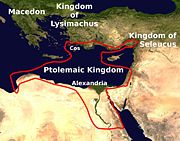
, a 10th century AD historical encyclopedia, it is estimated he was born , and that he might have established a reputation in Cos by . During the Wars of the Diadochi
that followed the death of Alexander the Great and divided Alexander's empire, Ptolemy
had captured Cos from his rival successor, Antigonus
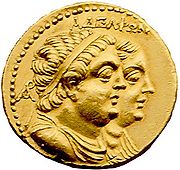
, in 310 BC; his son, Ptolemy II Philadelphus
, was born there in 308 BC. It was a favorite retreat for men of letters weary of Alexandria.
 Philetas was appointed Philadelphus' preceptor
, or tutor, which suggests he moved to Alexandria
and moved back to Cos in the later 290s BC. He may also have tutored Arsinoe II
, Philadelphus' older sister and eventual wife. Later tutors of royal offspring in Ptolemaic Egypt generally headed the Library of Alexandria
, but it is unknown whether Philitas held that position. Philitas also taught the poets Hermesianax
and Theocritus and the grammarian Zenodotus
, and after he returned to Cos he seems to have spent at least ten years leading a brotherhood of intellectuals and poets that included Aratus
, Hermesianax, and Theocritus.
Hermesianax wrote of "Philitas, singing of nimble Bittis", and Ovid
twice calls her "Battis". It is commonly thought that Bittis or Battis was Philitas' mistress, and that Hermesianax referred to love poetry; another possibility is that her name connoted "chatterbox", and that she was a humorous personification of Philitas' passion for words.
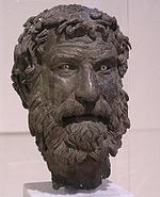
Philitas was thin and frail, and may have suffered and died from a wasting disease. He seems to have died in Cos sometime in the 280s BC. His pupil Hermesianax wrote that a statue of him was erected under a plane tree by the people of Cos, depicting him as "frail with all the glosses". His contemporary Posidippus
wrote that Philadelphus commissioned a bronze of Philitas in old age from the sculptor Hecataeus
, which "included nothing from the physique of heroes. No, ... he cast the old man full of cares." The 3rd century AD Roman author Aelian
skeptically passed along a story that Philitas was so thin that he put lead weights in the soles of his shoes to avoid being blown away by a stiff wind.
A 2nd century AD Greek author, Athenaeus of Naucratis, wrote that Philitas studied false arguments and erroneous word-usage so intensely that he wasted away and starved to death, and that his epitaph
read:
St. George Stock analyzed the story as saying Philitas studied the Megarian school of philosophy
, which cultivated and studied paradox
es such as the liar paradox
: if someone says "I am lying", is what he says true or false? Stock wrote that Philitas worried so much over the liar paradox that he died of insomnia
, and translated the epitaph as follows:
A more literal translation suggests that the invented epitaph pokes fun at Philitas' focus on using the right words:
Stranger, I am Philitas. The lying word and nights' evening cares destroyed me.
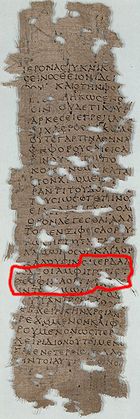 Philitas wrote a vocabulary explaining the meanings of rare literary words, words from local dialects, and technical terms; it probably took the form of a lexicon. The vocabulary, called Disorderly Words (Ἄτακτοι γλῶσσαι, ), has been lost, with only a few fragments quoted by later authors. One example, quoted in Athenaeus
, is that the word πέλλα () meant "wine cup" in the ancient Greek region of Boeotia
; this was evidently contrasted to the same word meaning "milk pail" in Homer
's Iliad
. Hermeneia, another scholarly work, probably contained Philitas' versions and critical interpretations
of Homer and other authors.
About thirty fragments of Philitas' poetry are known, along with four definite titles:
Another possible poem is Telephus, which may have been a companion to Demeter.
At most fifty verses of Philitas survive. Below is an example fragment of two verses, which was quoted in the Collection of Paradoxical Stories, whose putative author Antigonus (often identified with Antigonus of Carystus
, a near-contemporary) does not specify which work they came from; indirect evidence suggests Demeter. These two verses show the confluence of Philitas' interests in poetry and obscure words:
According to Antigonus, the "cactus" (κάκτος, ) was a thorny plant from Sicily, and "When a deer steps on it and is pricked, its bones remain soundless and unusable for flutes. For that reason Philitas spoke of it." Antigonus quotes one more passage, and the 5th century AD anthologist Stobaeus
quotes eleven passages from Philitas; the remaining fragments are derived from ancient commentators who quoted Philitas when discussing rare words or names used by other authors.
 Philitas was the most important intellectual figure in the early years of Hellenistic civilization
. He gained instant recognition in both poetry and literary scholarship, and, as far as is known, was the first person called "poet as well as scholar" (ποιητὴς ἅμα καὶ κριτικός, poiētḕs [h]áma kaì kritikós). As tutor to Philadelphus he is assumed to have had great influence on the development of the Mouseion at Alexandria, a scholarly institution that included the famous Library of Alexandria
. A statue was erected of him, possibly at a Mouseion at Cos, and his work was explicitly acknowledged as a classic by both Theocritus and Callimachus
.
His reputation for scholarship endured for at least a century. In Athens, the comic playwright Strato made jokes that assumed audiences knew about Philitas' vocabulary, and the vocabulary was criticized more than a century later by the influential Homeric scholar Aristarchus of Samothrace
in his Against Philitas (Πρὸς Φιλίταν, ). The geographer Strabo
described him three centuries later as "simultaneously a poet and a critic".
Philitas was the first writer whose works represent the combination of qualities now regarded as Hellenistic: variety, scholarship, and use of Homeric sources in non-epic
works. He directly influenced the major Hellenistic poets Callimachus and Apollonius of Rhodes
. His poetry was mentioned or briefly quoted by his rival Callimachus and by other ancient authors, and his poetic reputation endured for at least three centuries, as Augustan poets identified his name with great elegiac writing. Propertius linked him to his rival with the following well-known couplet:
The 1st century AD rhetorician Quintilian
ranked Philitas second only to Callimachus among the elegiac poets. Philitas' influence has been found or suspected in a wide range of ancient writing; Longus
' 2nd century AD novel Daphnis and Chloe
contains a character likely named after him. Almost all that he wrote seems to have disappeared within two centuries, though, so it is unlikely that any writer later than the 2nd century BC read any but a few of his lines.
Hellenistic period
The Hellenistic period or Hellenistic era describes the time which followed the conquests of Alexander the Great. It was so named by the historian J. G. Droysen. During this time, Greek cultural influence and power was at its zenith in Europe and Asia...
of ancient Greece
Ancient Greece
Ancient Greece is a civilization belonging to a period of Greek history that lasted from the Archaic period of the 8th to 6th centuries BC to the end of antiquity. Immediately following this period was the beginning of the Early Middle Ages and the Byzantine era. Included in Ancient Greece is the...
. A Greek associated with Alexandria
Alexandria
Alexandria is the second-largest city of Egypt, with a population of 4.1 million, extending about along the coast of the Mediterranean Sea in the north central part of the country; it is also the largest city lying directly on the Mediterranean coast. It is Egypt's largest seaport, serving...
, he flourished in the second half of the 4th century BC and was appointed tutor to the heir to the throne of Ptolemaic Egypt
Ptolemaic Egypt
Ptolemaic Egypt began when Ptolemy I Soter invaded Egypt and declared himself Pharaoh of Egypt in 305 BC and ended with the death of queen Cleopatra VII of Egypt and the Roman conquest in 30 BC. The Ptolemaic Kingdom was a powerful Hellenistic state, extending from southern Syria in the east, to...
. He was thin and frail; Athenaeus
Athenaeus
Athenaeus , of Naucratis in Egypt, Greek rhetorician and grammarian, flourished about the end of the 2nd and beginning of the 3rd century AD...
later caricatured him as an academic so consumed by his studies that he wasted away and died.
Philitas was the first major Greek writer who was both a scholar and a poet. His reputation continued for centuries, based on both his pioneering study of words and his verse in elegiac
Elegiac
Elegiac refers either to those compositions that are like elegies or to a specific poetic meter used in Classical elegies. The Classical elegiac meter has two lines, making it a couplet: a line of dactylic hexameter, followed by a line of dactylic pentameter...
meter. His vocabulary Disorderly Words described the meanings of rare literary words, including those used by Homer
Homer
In the Western classical tradition Homer , is the author of the Iliad and the Odyssey, and is revered as the greatest ancient Greek epic poet. These epics lie at the beginning of the Western canon of literature, and have had an enormous influence on the history of literature.When he lived is...
. His poetry, notably his elegiac poem Demeter, was highly respected by later ancient poets. However, almost all his work has since been lost.
Life
Little is known of Philitas' life. Ancient sources refer to him as a Coan, a native or long-time inhabitant of CosKos
Kos or Cos is a Greek island in the south Sporades group of the Dodecanese, next to the Gulf of Gökova/Cos. It measures by , and is from the coast of Bodrum, Turkey and the ancient region of Caria. Administratively the island forms a separate municipality within the Kos peripheral unit, which is...
, one of the Dodecanese
Dodecanese
The Dodecanese are a group of 12 larger plus 150 smaller Greek islands in the Aegean Sea, of which 26 are inhabited. Τhis island group generally defines the eastern limit of the Sea of Crete. They belong to the Southern Sporades island group...
islands in the Aegean Sea
Aegean Sea
The Aegean Sea[p] is an elongated embayment of the Mediterranean Sea located between the southern Balkan and Anatolian peninsulas, i.e., between the mainlands of Greece and Turkey. In the north, it is connected to the Marmara Sea and Black Sea by the Dardanelles and Bosporus...
just off the coast of Asia. His student Theocritus
Theocritus
Theocritus , the creator of ancient Greek bucolic poetry, flourished in the 3rd century BC.-Life:Little is known of Theocritus beyond what can be inferred from his writings. We must, however, handle these with some caution, since some of the poems commonly attributed to him have little claim to...
wrote that Philetas' father was Telephos (Τήλεφος, ) and his mother, assuming the manuscript is supplemented correctly, Euctione (Εὐκτιόνη, ). From a comment about Philitas in the Suda
Suda
The Suda or Souda is a massive 10th century Byzantine encyclopedia of the ancient Mediterranean world, formerly attributed to an author called Suidas. It is an encyclopedic lexicon, written in Greek, with 30,000 entries, many drawing from ancient sources that have since been lost, and often...
, a 10th century AD historical encyclopedia, it is estimated he was born , and that he might have established a reputation in Cos by . During the Wars of the Diadochi
Wars of the Diadochi
The Wars of the Diadochi were a series of conflicts fought between Alexander the Great's generals over the rule of his empire between 322 and 275 BC.-Background:...
that followed the death of Alexander the Great and divided Alexander's empire, Ptolemy
Ptolemy I Soter
Ptolemy I Soter I , also known as Ptolemy Lagides, c. 367 BC – c. 283 BC, was a Macedonian general under Alexander the Great, who became ruler of Egypt and founder of both the Ptolemaic Kingdom and the Ptolemaic Dynasty...
had captured Cos from his rival successor, Antigonus
Antigonus I Monophthalmus
Antigonus I Monophthalmus , son of Philip from Elimeia, was a Macedonian nobleman, general, and satrap under Alexander the Great. During his early life he served under Philip II, and he was a major figure in the Wars of the Diadochi after Alexander's death, declaring himself king in 306 BC and...
, in 310 BC; his son, Ptolemy II Philadelphus
Ptolemy II Philadelphus
Ptolemy II Philadelphus was the king of Ptolemaic Egypt from 283 BCE to 246 BCE. He was the son of the founder of the Ptolemaic kingdom Ptolemy I Soter and Berenice, and was educated by Philitas of Cos...
, was born there in 308 BC. It was a favorite retreat for men of letters weary of Alexandria.
Preceptor
A preceptor is a teacher responsible to uphold a certain law or tradition, a precept.-Christian military orders:A preceptor was historically in charge of a preceptory, the headquarters of certain orders of monastic Knights, such as the Knights Hospitaller and Knights Templar, within a given...
, or tutor, which suggests he moved to Alexandria
Alexandria
Alexandria is the second-largest city of Egypt, with a population of 4.1 million, extending about along the coast of the Mediterranean Sea in the north central part of the country; it is also the largest city lying directly on the Mediterranean coast. It is Egypt's largest seaport, serving...
and moved back to Cos in the later 290s BC. He may also have tutored Arsinoe II
Arsinoe II of Egypt
For other uses see, ArsinoeArsinoë II was a Ptolemaic Greek Princess of Ancient Egypt and through marriage was of Queen Thrace, Asia Minor and Macedonia as wife of King Lysimachus and later co-ruler of Egypt with her brother-husband Ptolemy II Philadelphus For other uses see, ArsinoeArsinoë II...
, Philadelphus' older sister and eventual wife. Later tutors of royal offspring in Ptolemaic Egypt generally headed the Library of Alexandria
Library of Alexandria
The Royal Library of Alexandria, or Ancient Library of Alexandria, in Alexandria, Egypt, was the largest and most significant great library of the ancient world. It flourished under the patronage of the Ptolemaic dynasty and functioned as a major center of scholarship from its construction in the...
, but it is unknown whether Philitas held that position. Philitas also taught the poets Hermesianax
Hermesianax
Hermesianax of Colophon was an Ancient Greek elegiac poet of the Hellenistic period, said to be a pupil of Philitas of Cos; the dates of his life and work are all but lost, but Philitas is supposed to have been born c. 340....
and Theocritus and the grammarian Zenodotus
Zenodotus
Zenodotus was a Greek grammarian, literary critic, and Homeric scholar. A native of Ephesus and a pupil of Philitas of Cos, he was the first librarian of the Library of Alexandria...
, and after he returned to Cos he seems to have spent at least ten years leading a brotherhood of intellectuals and poets that included Aratus
Aratus
Aratus was a Greek didactic poet. He is best known today for being quoted in the New Testament. His major extant work is his hexameter poem Phaenomena , the first half of which is a verse setting of a lost work of the same name by Eudoxus of Cnidus. It describes the constellations and other...
, Hermesianax, and Theocritus.
Hermesianax wrote of "Philitas, singing of nimble Bittis", and Ovid
Ovid
Publius Ovidius Naso , known as Ovid in the English-speaking world, was a Roman poet who is best known as the author of the three major collections of erotic poetry: Heroides, Amores, and Ars Amatoria...
twice calls her "Battis". It is commonly thought that Bittis or Battis was Philitas' mistress, and that Hermesianax referred to love poetry; another possibility is that her name connoted "chatterbox", and that she was a humorous personification of Philitas' passion for words.
Philitas was thin and frail, and may have suffered and died from a wasting disease. He seems to have died in Cos sometime in the 280s BC. His pupil Hermesianax wrote that a statue of him was erected under a plane tree by the people of Cos, depicting him as "frail with all the glosses". His contemporary Posidippus
Posidippus
Posidippus of Pella was an Ancient Greek epigrammatic poet.-Life:Posidippus was born in the city of Pella, capital of the kingdom of Macedon. He lived for some time in Samos before moving permanently to the court of Ptolemy I Soter and later Ptolemy II Philadelphus in Alexandria, Egypt...
wrote that Philadelphus commissioned a bronze of Philitas in old age from the sculptor Hecataeus
Hecataeus
Hecataeus of Miletus , named after the Greek goddess Hecate, was an early Greek historian of a wealthy family. He flourished during the time of the Persian invasion. After having travelled extensively, he settled in his native city, where he occupied a high position, and devoted his time to the...
, which "included nothing from the physique of heroes. No, ... he cast the old man full of cares." The 3rd century AD Roman author Aelian
Claudius Aelianus
Claudius Aelianus , often seen as just Aelian, born at Praeneste, was a Roman author and teacher of rhetoric who flourished under Septimius Severus and probably outlived Elagabalus, who died in 222...
skeptically passed along a story that Philitas was so thin that he put lead weights in the soles of his shoes to avoid being blown away by a stiff wind.
A 2nd century AD Greek author, Athenaeus of Naucratis, wrote that Philitas studied false arguments and erroneous word-usage so intensely that he wasted away and starved to death, and that his epitaph
Epitaph
An epitaph is a short text honoring a deceased person, strictly speaking that is inscribed on their tombstone or plaque, but also used figuratively. Some are specified by the dead person beforehand, others chosen by those responsible for the burial...
read:
St. George Stock analyzed the story as saying Philitas studied the Megarian school of philosophy
Megarian school of philosophy
The Megarian school of philosophy , which flourished in the 4th century BC, was founded by Euclid of Megara, one of the pupils of Socrates. Its ethical teachings were derived from Socrates, recognizing a single good, which was apparently combined with the Eleatic doctrine of Unity...
, which cultivated and studied paradox
Paradox
Similar to Circular reasoning, A paradox is a seemingly true statement or group of statements that lead to a contradiction or a situation which seems to defy logic or intuition...
es such as the liar paradox
Liar paradox
In philosophy and logic, the liar paradox or liar's paradox , is the statement "this sentence is false"...
: if someone says "I am lying", is what he says true or false? Stock wrote that Philitas worried so much over the liar paradox that he died of insomnia
Insomnia
Insomnia is most often defined by an individual's report of sleeping difficulties. While the term is sometimes used in sleep literature to describe a disorder demonstrated by polysomnographic evidence of disturbed sleep, insomnia is often defined as a positive response to either of two questions:...
, and translated the epitaph as follows:
A more literal translation suggests that the invented epitaph pokes fun at Philitas' focus on using the right words:
Stranger, I am Philitas. The lying word and nights' evening cares destroyed me.
Works
Athenaeus
Athenaeus , of Naucratis in Egypt, Greek rhetorician and grammarian, flourished about the end of the 2nd and beginning of the 3rd century AD...
, is that the word πέλλα () meant "wine cup" in the ancient Greek region of Boeotia
Boeotia
Boeotia, also spelled Beotia and Bœotia , is one of the regional units of Greece. It is part of the region of Central Greece. It was also a region of ancient Greece. Its capital is Livadeia, the second largest city being Thebes.-Geography:...
; this was evidently contrasted to the same word meaning "milk pail" in Homer
Homer
In the Western classical tradition Homer , is the author of the Iliad and the Odyssey, and is revered as the greatest ancient Greek epic poet. These epics lie at the beginning of the Western canon of literature, and have had an enormous influence on the history of literature.When he lived is...
's Iliad
Iliad
The Iliad is an epic poem in dactylic hexameters, traditionally attributed to Homer. Set during the Trojan War, the ten-year siege of the city of Troy by a coalition of Greek states, it tells of the battles and events during the weeks of a quarrel between King Agamemnon and the warrior Achilles...
. Hermeneia, another scholarly work, probably contained Philitas' versions and critical interpretations
Exegesis
Exegesis is a critical explanation or interpretation of a text, especially a religious text. Traditionally the term was used primarily for exegesis of the Bible; however, in contemporary usage it has broadened to mean a critical explanation of any text, and the term "Biblical exegesis" is used...
of Homer and other authors.
About thirty fragments of Philitas' poetry are known, along with four definite titles:
- Demeter, Philitas' most famous work, consisted of elegiac coupletElegiac coupletThe elegiac couplet is a poetic form used by Greek lyric poets for a variety of themes usually of smaller scale than the epic. Roman poets, particularly Ovid, adopted the same form in Latin many years later...
s, or couplets in the elegiacElegiacElegiac refers either to those compositions that are like elegies or to a specific poetic meter used in Classical elegies. The Classical elegiac meter has two lines, making it a couplet: a line of dactylic hexameter, followed by a line of dactylic pentameter...
meter. Its few surviving fragments suggest that it narrated the grain goddess DemeterDemeterIn Greek mythology, Demeter is the goddess of the harvest, who presided over grains, the fertility of the earth, and the seasons . Her common surnames are Sito as the giver of food or corn/grain and Thesmophoros as a mark of the civilized existence of agricultural society...
's hunt for her daughter PersephonePersephoneIn Greek mythology, Persephone , also called Kore , is the daughter of Zeus and the harvest-goddess Demeter, and queen of the underworld; she was abducted by Hades, the god-king of the underworld....
. The fragments describe Demeter's arrival on Cos and warm welcome by its royal family of Meropids, or humans twice normal size, thus presenting the founding mythFounding mythA national myth is an inspiring narrative or anecdote about a nation's past. Such myths often serve as an important national symbol and affirm a set of national values. A national myth may sometimes take the form of a national epic...
of a local cult of Demeter on Cos. - Hermes was an epyllionEpic poetryAn epic is a lengthy narrative poem, ordinarily concerning a serious subject containing details of heroic deeds and events significant to a culture or nation. Oral poetry may qualify as an epic, and Albert Lord and Milman Parry have argued that classical epics were fundamentally an oral poetic form...
, or brief mythological narrative, written in hexameterHexameterHexameter is a metrical line of verse consisting of six feet. It was the standard epic metre in classical Greek and Latin literature, such as in the Iliad and Aeneid. Its use in other genres of composition include Horace's satires, and Ovid's Metamorphoses. According to Greek mythology, hexameter...
. It had the structure of a hymnHymnA hymn is a type of song, usually religious, specifically written for the purpose of praise, adoration or prayer, and typically addressed to a deity or deities, or to a prominent figure or personification...
, with a central narrative telling of OdysseusOdysseusOdysseus or Ulysses was a legendary Greek king of Ithaca and the hero of Homer's epic poem the Odyssey. Odysseus also plays a key role in Homer's Iliad and other works in the Epic Cycle....
' visit to the island of the king Aeolus, keeper of the winds, and of Odysseus' secret affair with the king's daughter Polymele. It is also possible that Hermes was a collection of such stories, with the patronage of Hermes himself as the common thread. - Playthings (Παίγνια) had two shorter collections. These poems had the structure of epigramEpigramAn epigram is a brief, interesting, usually memorable and sometimes surprising statement. Derived from the epigramma "inscription" from ἐπιγράφειν epigraphein "to write on inscribe", this literary device has been employed for over two millennia....
s and their themes may have included eroticaEroticaErotica are works of art, including literature, photography, film, sculpture and painting, that deal substantively with erotically stimulating or sexually arousing descriptions...
. The only surviving poem contains two elegiac couplets and has a puzzle or riddle structure characteristic of some ancient Greek drinking-party songsSkolionNot to be confused with scholionSkolion , also scolion , were songs sung by invited guests at banquets in ancient Greece. Often extolling the virtues of the gods or heroic men, skolia were improvised to suit the occasion and accompanied by a lyre, which was handed about from singer to singer as the...
. - Only one of the Epigrams has been fully reconstructed.
Another possible poem is Telephus, which may have been a companion to Demeter.
At most fifty verses of Philitas survive. Below is an example fragment of two verses, which was quoted in the Collection of Paradoxical Stories, whose putative author Antigonus (often identified with Antigonus of Carystus
Antigonus of Carystus
Antigonus of Carystus , Greek writer on various subjects, flourished in the 3rd century BC. After some time spent at Athens and in travelling, he was summoned to the court of Attalus I of Pergamum...
, a near-contemporary) does not specify which work they came from; indirect evidence suggests Demeter. These two verses show the confluence of Philitas' interests in poetry and obscure words:
According to Antigonus, the "cactus" (κάκτος, ) was a thorny plant from Sicily, and "When a deer steps on it and is pricked, its bones remain soundless and unusable for flutes. For that reason Philitas spoke of it." Antigonus quotes one more passage, and the 5th century AD anthologist Stobaeus
Stobaeus
Joannes Stobaeus , from Stobi in Macedonia, was the compiler of a valuable series of extracts from Greek authors. The work was originally divided into two volumes containing two books each...
quotes eleven passages from Philitas; the remaining fragments are derived from ancient commentators who quoted Philitas when discussing rare words or names used by other authors.
Influence
Hellenistic civilization
Hellenistic civilization represents the zenith of Greek influence in the ancient world from 323 BCE to about 146 BCE...
. He gained instant recognition in both poetry and literary scholarship, and, as far as is known, was the first person called "poet as well as scholar" (ποιητὴς ἅμα καὶ κριτικός, poiētḕs [h]áma kaì kritikós). As tutor to Philadelphus he is assumed to have had great influence on the development of the Mouseion at Alexandria, a scholarly institution that included the famous Library of Alexandria
Library of Alexandria
The Royal Library of Alexandria, or Ancient Library of Alexandria, in Alexandria, Egypt, was the largest and most significant great library of the ancient world. It flourished under the patronage of the Ptolemaic dynasty and functioned as a major center of scholarship from its construction in the...
. A statue was erected of him, possibly at a Mouseion at Cos, and his work was explicitly acknowledged as a classic by both Theocritus and Callimachus
Callimachus
Callimachus was a native of the Greek colony of Cyrene, Libya. He was a noted poet, critic and scholar at the Library of Alexandria and enjoyed the patronage of the Egyptian–Greek Pharaohs Ptolemy II Philadelphus and Ptolemy III Euergetes...
.
His reputation for scholarship endured for at least a century. In Athens, the comic playwright Strato made jokes that assumed audiences knew about Philitas' vocabulary, and the vocabulary was criticized more than a century later by the influential Homeric scholar Aristarchus of Samothrace
Aristarchus of Samothrace
Aristarchus of Samothrace was a grammarian noted as the most influential of all scholars of Homeric poetry. He was the librarian of the library of Alexandria and seems to have succeeded his teacher Aristophanes of Byzantium in that role.He established the most historically important critical...
in his Against Philitas (Πρὸς Φιλίταν, ). The geographer Strabo
Strabo
Strabo, also written Strabon was a Greek historian, geographer and philosopher.-Life:Strabo was born to an affluent family from Amaseia in Pontus , a city which he said was situated the approximate equivalent of 75 km from the Black Sea...
described him three centuries later as "simultaneously a poet and a critic".
Philitas was the first writer whose works represent the combination of qualities now regarded as Hellenistic: variety, scholarship, and use of Homeric sources in non-epic
Epic poetry
An epic is a lengthy narrative poem, ordinarily concerning a serious subject containing details of heroic deeds and events significant to a culture or nation. Oral poetry may qualify as an epic, and Albert Lord and Milman Parry have argued that classical epics were fundamentally an oral poetic form...
works. He directly influenced the major Hellenistic poets Callimachus and Apollonius of Rhodes
Apollonius of Rhodes
Apollonius Rhodius, also known as Apollonius of Rhodes , early 3rd century BCE – after 246 BCE, was a poet, and a librarian at the Library of Alexandria...
. His poetry was mentioned or briefly quoted by his rival Callimachus and by other ancient authors, and his poetic reputation endured for at least three centuries, as Augustan poets identified his name with great elegiac writing. Propertius linked him to his rival with the following well-known couplet:
The 1st century AD rhetorician Quintilian
Quintilian
Marcus Fabius Quintilianus was a Roman rhetorician from Hispania, widely referred to in medieval schools of rhetoric and in Renaissance writing...
ranked Philitas second only to Callimachus among the elegiac poets. Philitas' influence has been found or suspected in a wide range of ancient writing; Longus
Longus
Longus, sometimes Longos , was the author of an ancient Greek novel or romance, Daphnis and Chloe. Very little is known of his life, and it is assumed that he lived on the isle of Lesbos during the 2nd century AD...
' 2nd century AD novel Daphnis and Chloe
Daphnis and Chloe
Daphnis and Chloe is the only known work of the 2nd century AD Greek novelist and romancer Longus.-Setting and style:It is set on the isle of Lesbos during the 2nd century AD, which is also assumed to be the author's home. Its style is rhetorical and pastoral; its shepherds and shepherdesses are...
contains a character likely named after him. Almost all that he wrote seems to have disappeared within two centuries, though, so it is unlikely that any writer later than the 2nd century BC read any but a few of his lines.