
All Topics  
Philippine peso


   Email Print
   Bookmark   Link


Philippine peso


The peso (Filipino
Filipino language

The Filipino language is the national language and an official language of the Philippines as designated in the 1987 Philippine Constitution. It is an Austronesian language that is the de facto standard language of Tagalog language....
: piso) (sign
Currency sign

A currency sign is a graphic symbol often used as a shorthand for a currency's name. Internationally, ISO 4217 codes are used instead of currency signs, though currency signs may be in common use in their respective countries....
: ?; code
ISO 4217

ISO 4217 is the international standard describing three-letter codes to define the names of currency established by the International Organization for Standardization ....
: PHP) is the currency of the Philippines
Philippines

The Philippines, officially known as the Republic of the Philippines, is a country in Southeast Asia with Manila as its capital city. It comprises 7,107 islands in the western Pacific Ocean....
. It is subdivided into 100 centavos (Spanish) or sentimo (Filipino). Before 1967, the language used on the banknotes and coins was English
English language

English is a West Germanic language that originated in Anglo-Saxon England and has lingua franca status in many parts of the world as a result of the military, economic, scientific, political and cultural influence of the British Empire in the 18th, 19th and early 20th centuries and that of the United States from the mid 20th century onwa...
 and so "peso" was the name used. The language was then changed to Tagalog (the name of the Filipino language
Filipino language

The Filipino language is the national language and an official language of the Philippines as designated in the 1987 Philippine Constitution. It is an Austronesian language that is the de facto standard language of Tagalog language....
 then) and so the currency as written on the banknotes and coins is piso.

The peso is usually denoted by the symbol "".


Discussion
Ask a question about 'Philippine peso'
Start a new discussion about 'Philippine peso'
Answer questions from other users
Full Discussion Forum


Encyclopedia


The peso (Filipino
Filipino language

The Filipino language is the national language and an official language of the Philippines as designated in the 1987 Philippine Constitution. It is an Austronesian language that is the de facto standard language of Tagalog language....
: piso) (sign
Currency sign

A currency sign is a graphic symbol often used as a shorthand for a currency's name. Internationally, ISO 4217 codes are used instead of currency signs, though currency signs may be in common use in their respective countries....
: ?; code
ISO 4217

ISO 4217 is the international standard describing three-letter codes to define the names of currency established by the International Organization for Standardization ....
: PHP) is the currency of the Philippines
Philippines

The Philippines, officially known as the Republic of the Philippines, is a country in Southeast Asia with Manila as its capital city. It comprises 7,107 islands in the western Pacific Ocean....
. It is subdivided into 100 centavos (Spanish) or sentimo (Filipino). Before 1967, the language used on the banknotes and coins was English
English language

English is a West Germanic language that originated in Anglo-Saxon England and has lingua franca status in many parts of the world as a result of the military, economic, scientific, political and cultural influence of the British Empire in the 18th, 19th and early 20th centuries and that of the United States from the mid 20th century onwa...
 and so "peso" was the name used. The language was then changed to Tagalog (the name of the Filipino language
Filipino language

The Filipino language is the national language and an official language of the Philippines as designated in the 1987 Philippine Constitution. It is an Austronesian language that is the de facto standard language of Tagalog language....
 then) and so the currency as written on the banknotes and coins is piso.

The peso is usually denoted by the symbol "
Philippinepeso
". This symbol was added to the Unicode
Unicode

Unicode is a computing industry standard allowing computers to consistently represent and manipulate Character expressed in most of the world's writing systems....
 standard in version 3.2 and is assigned U+20B1 (). Due to the lack of font support, the symbol is often substituted with a simple "P", a P with one horizontal line instead of two (available as the peseta sign, U+20A7 , in some fonts), as "PHP", or "PhP".

The coins are minted at the Security Plant Complex
Bangko Sentral ng Pilipinas

The Bangko Sentral ng Pilipinas is the central bank of the Republic of the Philippines. It was rechartered on July 3, 1993, pursuant to the provisions of the Constitution of the Philippines and the New Central Bank Act of 1993....
. Banknotes, passport
Philippine passport

A Philippine passport is a travel document and is a Primary National ID issued to citizens of the Philippines. It is issued by the Department of Foreign Affairs and Philippine diplomatic missions of the Philippines abroad, with certain exceptions....
s, seaman's identification record book
Philippine passport

A Philippine passport is a travel document and is a Primary National ID issued to citizens of the Philippines. It is issued by the Department of Foreign Affairs and Philippine diplomatic missions of the Philippines abroad, with certain exceptions....
s, land titles, checks
Cheque

A cheque or check is a negotiable instrument instructing a financial institution to pay a specific amount of a specific currency from a specified demand account held in the maker/depositor's name with that institution....
, official ballot
Ballot

A ballot is a device used to record choices made by voters. Each voter uses one ballot, and ballots are not shared. In the simplest elections, a ballot may be a simple scrap of paper on which each voter writes in the name of a candidate, but governmental elections use pre-printed to protect the secret ballot....
s, official election returns, passbook
Passbook

A passbook or bankbook is a paper book used to record bank transactions on a deposit account. Depending on the country or the financial institution, it can be of the dimensions of a chequebook or a passport....
s, postal money order
Money order

A money order is a payment order for a pre-specified amount of money. Because it is required that the funds be prepaid for the amount shown on it, it is a more trusted method of payment than a cheque....
s, revenue stamp
Revenue stamp

A revenue stamp, tax stamp or fiscal stamp is a type of adhesive label used to collect taxes or fees on various items. Many countries of the world have used them, for documents , tobacco products, liquor, medication, playing cards, hunting licenses and other kinds of things....
s, government bond
Government bond

A government bond is a Bond issued by a national government denominated in the country's own currency. Bonds issued by national governments in foreign currencies are normally referred to as sovereign bonds....
s and other government documents are printed in the Security Plant Complex
Bangko Sentral ng Pilipinas

The Bangko Sentral ng Pilipinas is the central bank of the Republic of the Philippines. It was rechartered on July 3, 1993, pursuant to the provisions of the Constitution of the Philippines and the New Central Bank Act of 1993....
 or the National Printing Office
Office of the Press Secretary (Philippines)

The Office of the Press Secretary is the agency of the Government of the Republic of the Philippines, which is responsible for planning, programming, and coordinating the activities that will most effectively collect information about what is happening in the Executive branch of the government and getting that information to the Mass media....
.

History

The Philippine peso derived from the Spanish silver coin Real de a Ocho or Spanish dollar
Spanish dollar

The Spanish dollar is a silver coin, worth eight Spanish real, that was minted in the Spanish Empire after a Spanish currency reform in 1497. It was legal tender in the United States until an Act of the United States Congress discontinued the practice in 1857....
, in wide circulation in the Americas and South-East Asia during the 17th and 18th centuries, through its use in the Spanish colonies and even in the US and Canada.

Peso fuerte


The Philippine peso was established on May 1, 1852, when the Banco Español-Filipino de Isabel II a (now the Bank of the Philippine Islands
Bank of the Philippine Islands

The Bank of the Philippine Islands or BPI is the oldest bank in the Philippines still in operation and is the third largest bank in the country in terms of assets....
) introduced notes denominated in pesos fuertes ("strong pesos", written as "PF"). Until October 17, 1854, when a royal decree confirmed Banco Español-Filipino's by-laws, the notes were in limited circulation and were usually used for bank transactions. The peso replaced the real
Philippine real

The real was the currency of the Philippines until 1852. Sixteen silver real were equal to one gold escudo....
 at a rate of 8 reales = 1 peso. Until 1886, the peso circulated alongside Mexican coins, some of which were still denominated in reales and escudos (worth 2 pesos).

Coin production commenced in 1861 and, in 1864, the Philippines decimalized, dividing the peso into 100 centimos de peso. The peso was equal to 22 grains of gold. In 1886, Philippine colonial authorities started the gradual phase-out of all Mexican coins in circulation in the Philippines, citing that Mexican coins were by then of lesser value than the coins minted in Manila.

Revolutionary period

Asserting its independence after the Philippine Declaration of Independence
Philippine Declaration of Independence

The Philippine Declaration of Independence occurred on June 12, 1898 in the Philippines, where Filipino revolutionary forces under General Emilio Aguinaldo proclaimed the sovereignty and independence of the Philippine Islands from the colonial rule of Spain after the latter was defeated at the Battle of Manila Bay during the Spanish-America...
 on June 12, 1898, the República Filipina (Philippine Republic) under General Emilio Aguinaldo
Emilio Aguinaldo

General Emilio Aguinaldo y Famy was a Philippines general, politician, and independence leader. He played an instrumental role in Philippine independence during the Philippine Revolution against Spain and the Philippine-American War that resisted United States occupation....
 issued its own coins and paper currency backed by the country’s natural resources. The coins were the first to use the name centavo for the subdivision of the peso. After Aguinaldo's capture by American forces in Palanan, Isabela
Palanan, Isabela

Palanan is a remote 3rd class Philippine municipality in the Philippine province of Isabela province, Philippines. According to the 2000 census, it has a population of 15,317 people in 2,837 households....
 on March 23, 1901, the revolutionary peso ceased to exist.

American Colonial period

After the United States
United States

The United States of America is a Federal government constitutional republic comprising U.S. state and a federal district. The country is situated mostly in central North America, where its Contiguous United States and Washington, D.C., the Capital districts and territories, lie between the Pacific Ocean and Atlantic Oceans, Borders of the U...
 took control of the Philippines, the United States Congress
United States Congress

The United States Congress is the Bicameralism legislature of the Federal government of the United States of the United States of America, consisting of two houses, the United States Senate and the United States House of Representatives....
 passed the Philippine Coinage Act (March 3, 1903), which fixed the weight and fineness of Philippine coins. The peso was defined as being equal to exactly half the gold content of the U.S. dollar. A similar state of affairs existed in both Japan and Mexico. The 50 cents Peso continued in both Mexico and the Philippines right up until the 1960s.

Shortly after the introduction of the 50 cent (US) Peso, a problem occurred which was paralled in the Straits Settlements
Straits Settlements

The Straits Settlements were a collection of territories of the British East India Company in Southeast Asia, which were given collective administration in 1826 as a crown colony, as distinct from the native princely states, some of which later formed the Federated Malay States....
. The price of silver rose so high that the Philippine Peso coins, and the new Straits dollar
Straits dollar

The Straits dollar was the currency used in the United Kingdom colonies and protectorates in British Malaya and Borneo, including the Straits Settlements until 1939....
 coins became less valuable than their actual silver content. There was a danger in both cases that these coins would be melted down for their silver. In both cases, in 1907, new smaller coins were introduced with their silver values reduced to a safer level.

Second World War

In 1942, the Japan
Japan

Japan is an island country in East Asia. Located in the Pacific Ocean, it lies to the east of the Sea of Japan, People's Republic of China, North Korea, South Korea and Russia, stretching from the Sea of Okhotsk in the north to the East China Sea and Taiwan in the south....
ese occupiers introduced notes
Japanese government-issued Philippine fiat peso

During World War II in the Philippines, the occupying Japanese government issued fiat currency in several denominations known as Japanese government-issued Philippine fiat peso....
 for use in the Philippines. Emergency circulating notes
Emergency circulating notes

Emergency circulating notes were currency printed by the Philippine Commonwealth Government in exile during World War II. These "guerrilla pesos" were printed by local government units and banks using crude inks and materials....
 (also termed "guerrilla pesos") were also issued by banks and local governments, using crude inks and materials, which were redeemable in silver pesos after the end of the war. The Japanese-sponsored Second Philippine Republic
Second Philippine Republic

The Second Philippine Republic, officially known as the Republic of the Philippines , was a state in the Philippines established in October 14, 1943 under Japanese occupation of the Philippines....
 under Jose P. Laurel
Jose P. Laurel

Jos? Paciano Laurel y Garc?a was the president of the Japanese-Sponsored Republic of the Philippines during World War II, from 1943 to 1945.Laurel was not subsequently officially recognized as a Philippine president until the administration of Diosdado Macapagal....
 outlawed possession of guerrilla currency and declared a monopoly
Monopoly

In economics, a monopoly exists when a specific individual or enterprise has sufficient control over a particular product or service to determine significantly the terms on which other individuals shall have access to it....
 on the issuance of money and anyone found to possess guerrilla notes could be arrested. Because of the fiat nature of the currency, the Philippine economy felt the effects of hyperinflation
Hyperinflation

File:Bundesarchiv Bild 102-00104, Inflation, Tapezieren mit Geldscheinen.jpgIn economics, hyperinflation is inflation that is very high or "out of control", a condition in which prices increase rapidly as a currency loses its value....
.

U.S. and Philippine forces continued printing Philippine pesos, so that, from October 1944 to September 1945, all earlier issues except for the emergency guerrilla notes were considered illegal and were no longer legal tender.

Independence

Republic Act
Republic Acts of the Philippines

This article contains a partial list of Philippine laws. Philippine laws have had various nomenclature designations at different periods in the history of the Philippines, as shown in the following table:...
 No. 265 created the Central Bank of the Philippines
Bangko Sentral ng Pilipinas

The Bangko Sentral ng Pilipinas is the central bank of the Republic of the Philippines. It was rechartered on July 3, 1993, pursuant to the provisions of the Constitution of the Philippines and the New Central Bank Act of 1993....
 (CBP, now the Bangko Sentral ng Pilipinas) on January 3, 1949, in which was vested the power of administering the banking & credit system of the country. Under the act, all powers in the printing and mintage of Philippine currency was vested in the CBP, taking away the rights of the banks such as Bank of the Philippine Islands and the Philippine National Bank to issue currency.

In 1967, the language used on all coins and banknotes was changed to Pilipino
Filipino language

The Filipino language is the national language and an official language of the Philippines as designated in the 1987 Philippine Constitution. It is an Austronesian language that is the de facto standard language of Tagalog language....
. As a consequence, the wordings of the currency changed from centavo and peso to sentimo and piso.

In a repeat of Japanese wartime monetary policy, the government defaulted on its promises to redeem its banknotes in silver or gold coin while promising to maintain the two-to-one peso to dollar parity. This decision, compounded with the deliberate overprinting of fiat banknotes, resulted in the peso dropping in value by almost 300% against the US dollar within the first three hours of opening day. The government effort to maintain the peg devastated the gold, silver and dollar reserves of the country.

By 1964, the bullion value of the old silver pesos was worth almost twelve times their face value and were being hoarded by Filipinos rather than being surrendered to the government at face value. In desperation, then-President Diosdado Macapagal
Diosdado Macapagal

Diosdado Pangan Macapagal was a Filipino statesman who served as the 9th President of the Philippines of the Philippines. He was elected in 1961, defeating the re-election bid of Carlos P....
 demonetized the old silver coins and floated the currency. The peso has been a floating currency
Floating currency

A floating currency is a currency that uses a floating exchange rate as its exchange rate regime. A floating currency is contrasted with a fixed currency....
 ever since, which means that the currency is a physical representation of the domestic debt and whose value directly tied to people's perception of the stability of the current regime and its ability to repay the debt.

From the opening of the Bangko Sentral ng Pilipinas in 1949, successive governments have continued to devalue the currency in order to lower the accumulated domestic debt in real terms, which in December 2005 reached PHP 4.02 trillion. Many Filipinos perceive the peso's value in relation to the US dollar and tend to blame whatever regime is in power for the worsening exchange rate
Exchange rate

In finance, the exchange rates between two currency specifies how much one currency is worth in terms of the other. It is the value of a foreign nation?s currency in terms of the home nation?s currency....
.

Current economy


Based on the current price of gold, the Philippine peso has now lost 99.9998% of its original 1903-1949 value. As of July 20, 2008, the value of the 1903-1949 Philippine Commonwealth peso, as per definition 12.9 grains of pure gold (or 0.026875 XAU
XAU

XAU can mean multiple things:* A currency code under the ISO 4217 standard, denominating one troy ounce of gold as an investment.* A symbol for the Philadelphia Gold and Silver Index, an index fund of precious metal mining company stocks that are traded on the Philadelphia Stock Exchange....
), would now cost ?1,136.09 on the international commodity markets.

As of October 2005, the Philippine money supply
Money supply

In economics, money supply, or money stock, is the total amount of money available in an economy at a particular point in time. There are several ways to define "money", but standard measures usually include currency in circulation and demand deposits....
 (M1) totaled about 569.2 billion pesos (about US$11.5 billion). As of October 15, 2008, the PHP is traded at 47.650 per US-Dollar.

Coins

In 1861, gold coins were issued for 1, 2 and 4 pesos. These were equal in gold content to the earlier Spanish coins of ½, 1 and 2 escudos. Silver coins were minted from 1864 in denominations of 10, 20 and 50 centimos de peso, with silver 1-peso coins issued in 1897. During the Revolutionary period, coins were issued in copper for 1 and 2 centavos and 2 centimos de peso.

In 1903, a new coinage was introduced. It consisted of bronze ½ and 1 centavo, cupro-nickel 5 centavos and silver 10, 20 and 50 centavos and 1 peso. The silver coins were weight related to the peso which was minted in .900 fineness and contained 374.4 grains of silver. U.S. gold coins and ½ and 1 peso coins were legal tender for any amount, with 10 and 20 centavos coins being legal tender up to 20 pesos and smaller coins up to 2 pesos. The sizes and finenesses of the silver coins were reduced in 1907, with the peso now a 20 gram coin minted in .750 silver. Production of the 1 peso coin ceased in 1912 and that of the 50 centavos in 1921.

The American Government deemed it more economical and convenient to mint silver coins in the Philippines, hence, the re-opening of the Manila Mint in 1920, which produced coins until the Commonwealth period.

In 1937, coin designs were changed to reflect the establishment of the Commonwealth. No coins were minted in the years 1942 and 1943 due to the Japanese occupation, but minting resumed in 1944, including production of 50 centavos coins. Due to the large number of coins issued between 1944 and 1947, coins were not minted again until 1958.

In 1958, a new, entirely base metal coinage was introduced, consisting of bronze 1 centavo, brass 5 centavos and nickel-brass 10, 25 and 50 centavos. In 1967, the coinage was altered to reflect the use of Filipino names for the currency units. This was the "Ang Bagong Lipunan" series. Aluminium replaced bronze and cupro-nickel replaced nickel-brass that year. 1-piso coins were introduced in 1972, followed by 5-piso coins in 1975. The Flora and Fauna series was introduced in 1983 which included 2-piso coins. The sizes of the coins were reduced in 1991, with production of 50-sentimo and 2-piso coins ceasing in 1994. The current series of coins was introduced in 1995, with 10-piso coins added in 2000.

Coins currently circulating are:
  • 5 sentimo
  • 10 sentimo
  • 25 sentimo
  • 1 piso
  • 5 piso
  • 10 piso


Denominations below 1 piso are still issued but are not in wide use. In December 2008 a Philippine Congress resolution called for the retirement and demonetization of all coins less than one peso.

Banknotes


In 1852, the Banco Español-Filipino de Isabel 2a issued notes for 10, 25 and 50 pesos fuertes. In 1896, the bank added 5 pesos fuertes notes. The treasury issued notes for 1, 4 and 25 pesos fuertes in 1877.

During the Spanish-American
Spanish-American War

The Spanish?American War was an armed military conflict between Spain and the United States that took place between April and August 1898, over the issues of the liberation of Cuba....
 and Philippine-American
Philippine-American War

The Philippine?American War was an armed military conflict between the United States and the Philippines, which arose from the First Philippine Republic struggle against U.S....
 wars, 1 and 5 pesos notes were issued in the name of the República Filipina.

Between 1903 and 1918, silver certificates were issued, in denominations of 2, 5, 10, 20, 50, 100 and 500 pesos. These were replaced with Treasury Certificates, issued between 1918 and 1941 in denominations of 1, 2, 5, 10, 20, 50, 100 and 500 pesos.

In 1904, the Banco Español-Filipino introduced notes in denominations of 5, 10, 25, 50, 100 and 200 pesos. In 1912, this bank changed its name to the Bank of the Philippine Islands (BPI), continuing to issue notes until 1933. The Philippine National Bank (PNB) issued notes in 1916 in denominations of 2, 5 and 10 pesos, with emergency notes issued in 1917 for 10, 20 and 50 centavos, 1, 5, 10 and 20 pesos. Between 1918 and 1937, the PNB issued notes in denominations of 1, 2, 5, 10, 20, 50 and 100 pesos. These notes were in circulation until 1947.

The Japanese issued two series of notes. The first was issued in 1942 in denominations of 1, 5, 10 and 50 centavos, 1, 5 and 10 pesos. The second, from 1943, was in denominations of 1, 5, 10, 100, 500 and 1000 pesos.

In 1944, Treasury Certificates, featuring the word "Victory" printed on the reverse, were issued to replace all the earlier notes. These were in denominations of 1, 2, 5, 10, 20, 50, 100 and 500 pesos.

In 1949, the Central Bank of the Philippines took over paper money issue. Its first notes were overprints on the Victory Treasury Certificates. These were followed in 1951 by regular issues in denominations of 5, 10, 20 and 50 centavos, 1, 2, 5, 10, 20, 50, 100, 200 and 500 pesos. The centavo notes (except for the 50-centavo note, which would be later known into the half-peso note) were discontinued in 1958 when the English Series coins were first minted.

In 1967, the CBP adopted the Filipino language
Filipino language

The Filipino language is the national language and an official language of the Philippines as designated in the 1987 Philippine Constitution. It is an Austronesian language that is the de facto standard language of Tagalog language....
 on its currency, using the name Bangko Sentral ng Pilipinas, and in 1969 introduced the "Pilipino Series" of notes in denominations of 1, 5, 10, 20, 50 and 100 piso. The "Ang Bagong Lipunan Series" was introduced in 1973 and included 2-peso notes. A radical change occurred in 1985, when the CBP issued the "New Design Series" with 500-piso notes introduced in 1987, 1000-peso notes (for the first time) in 1991 and 200-piso notes in 2002.

Philippine banknotes are currently issued in the following denominations:
  • 5 piso*
  • 10 piso*
  • 20 piso
  • 50 piso
  • 100 piso
  • 200 piso
  • 500 piso
  • 1000 piso
(* not printed but still legal tender)

Current Circulating Banknotes
Image Value Main Color Description Year of First Issue
Obverse Reverse Obverse Reverse
Php Bill 5 Front
Php Bill 5 Back
5 pesos* Green Emilio Aguinaldo
Emilio Aguinaldo

General Emilio Aguinaldo y Famy was a Philippines general, politician, and independence leader. He played an instrumental role in Philippine independence during the Philippine Revolution against Spain and the Philippine-American War that resisted United States occupation....
Declaration of Philippine Independence
Philippine Declaration of Independence

The Philippine Declaration of Independence occurred on June 12, 1898 in the Philippines, where Filipino revolutionary forces under General Emilio Aguinaldo proclaimed the sovereignty and independence of the Philippine Islands from the colonial rule of Spain after the latter was defeated at the Battle of Manila Bay during the Spanish-America...
1985
Php Bill 10 Front
Php Bill 10 Back
10 pesos* Brown Apolinario Mabini
Apolinario Mabini

Apolinario Mabini y Maranan was a Philippines political philosopher and revolutionary who wrote the Philippine constitution for the of 1899-1901, and served as its first Prime Minister of the Philippines in 1899....
 and Andres Bonifacio
Andres Bonifacio

Andr?s Bonifacio y de Castro , was a Philippines revolutionary leader and the founder of the Philippine Revolution....
Barasoain Church
Barasoain Church

Barasoain Church is a Roman Catholic Church church built in 1630 in Malolos City, Bulacan. Having earned the title as the Cradle of Democracy in the East, most important religious buildings in the Philippines , and the site of the First Philippine Republic, the Church is proverbial for its historical importance among Filipino pe...
 and Blood Compact of the Katipuneros
Katipunan

The Katipunan was a Philippine revolutionary organization founded by Philippines rebels in Manila, in 1892, which aimed to gain independence from Spain....
1985 (first version), 1998 (second version)
Php Bill 20 Front
Php Bill 20 Back
20 pesos Orange Manuel L. Quezon
Manuel L. Quezon

Manuel Luis Quezon y Molina was the first Filipino people president of the Commonwealth of the Philippines under U.S. occupation rule in the early period of the 20th century....
Malacañang Palace
Malacañang Palace

Malaca?ang Palace, or officially, Malaca?an Palace, is the official residence of the President of the Philippines. The palace is located along the north bank of the Pasig River in Manila....
1986
Php Bill 50 Front
Php Bill 50 Back
50 pesos Red Sergio Osmeña
Sergio Osmeña

Sergio Osme?a was the second President of the Philippines of the Commonwealth of the Philippines. He was Vice President under Manuel L. Quezon, and rose to the presidency upon Quezon's death in 1944....
National Museum (historically and formerly the Old Congress Building) 1987
Php Bill 100 Front
Php Bill 100 Back
100 pesos Purple Manuel Roxas
Manuel Roxas

Manuel Acu?a Roxas was the first president of the independent Republic of the Philippines. He served as president from the granting of independence in 1946 until his abrupt death in 1948....
Bangko Sentral ng Pilipinas

The Bangko Sentral ng Pilipinas is the central bank of the Republic of the Philippines. It was rechartered on July 3, 1993, pursuant to the provisions of the Constitution of the Philippines and the New Central Bank Act of 1993....
1987
Php Bill 200 Front
Php Bill 200 Back
200 pesos Green Diosdado Macapagal
Diosdado Macapagal

Diosdado Pangan Macapagal was a Filipino statesman who served as the 9th President of the Philippines of the Philippines. He was elected in 1961, defeating the re-election bid of Carlos P....
Philippine EDSA Revolution 2 2002
Php Bill 500 Front
Php Bill 500 Back
500 pesos Yellow Benigno Aquino, Jr.
Benigno Aquino, Jr.

Benigno Servillano Aquino, Jr. , popularly known as Ninoy Aquino or Benigno S. Aquino, Jr., was a former Philippine Senate of the Philippines, governor, vice governor and mayor and a leader of the opposition to the rule of Ferdinand Marcos....
Philippine Unity 1987
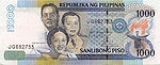
Php Bill 1000 Front
Php Bill 1000 Back
1000 pesos Blue Jose Abad Santos
José Abad Santos

| name=Jose Abad Santos| image name=| order=5th| term start=December 24, 1941| term end= May 2, 1942| predecessor= Ramon Avance?a| successor= Jose Yulo...
, Gen. Vicente Lim
Vicente Lim

Brigadier General Vicente Lim was a World War II general.    He was born in Calamba City, Laguna , Philippines, which is also the birthplace of Jos? Rizal, the country's national hero....
, and Josefa Llanes Escoda
Josefa Llanes Escoda

Josefa Llanes Escoda was a well-known Philippines advocate of women's right of suffrage and founder of the Girl Scouts of the Philippines....
Banaue Rice Terraces

The Banaue Rice Terraces are 2000-year old Terrace s that were carved into the mountains of Ifugao in the Philippines by ancestors of the Batad indigenous people....
, Manunggul Jar
Manunggul Jar

The Manunggul Jar is a National Treasure of the Philippines. A secondary burial jar, it is designated item 64-MO-74 in the National Museum of the Philippines, Manila....
, and Langgal Hut
1991


(* not printed but still legal tender)

Recent issues


"Arrovo" banknotes

In 2005, several 100-peso notes where President Gloria Arroyo's surname name was misspelled "Arrovo" were in circulation. Days after this was first found out, the BSP ordered an investigation.

Fraud problem with the 1-piso coin


By August 2006, it became publicly known that the 1-piso coin has the same size as the 1 United Arab Emirates dirham
United Arab Emirates dirham

The dirham is the currency of the United Arab Emirates. The ISO 4217 code for the United Arab Emirates dirham is AED. Unofficial abbreviations include DH or Dhs....
 coin. However, 1 peso is only worth 7 fils (0.07 dirham), leading to dispensing machine fraud in the U.A.E.

The 10 peso coin is also similar to the 2 Euro coin making it easy to pass for a Euro in some establishments in the EU.

See also

  • Economy of the Philippines
    Economy of the Philippines

    The economy of the Philippines has a mixed economy, and one of the newly industrialized country emerging markets economies of the world. In 2007, it was ranked as the 37th List of countries by GDP by the International Monetary Fund according to purchasing power parity....


External links

  • Philippine Coin News ..")
Money]