
Home      Discussion      Topics      Dictionary      Almanac
Signup       Login
Philadelphia Museum of Art

Philadelphia Museum of Art

Overview
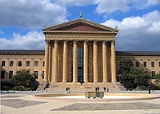
The Philadelphia Museum of Art is among the largest art museums in the United States. It is located at the west end of the Benjamin Franklin Parkway
Benjamin Franklin Parkway
Benjamin Franklin Parkway is a scenic boulevard that runs through the cultural heart of Philadelphia, Pennsylvania. Named for favorite son Benjamin Franklin, the mile-long Parkway cuts diagonally across the grid plan pattern of Center City's Northwest quadrant...

 in Philadelphia's Fairmount Park
Fairmount Park
Fairmount Park is the municipal park system of Philadelphia, Pennsylvania. It consists of 63 parks, with , all overseen by the Philadelphia Department of Parks and Recreation, successor to the Fairmount Park Commission in 2010.-Fairmount Park proper:...

. The Museum was established in 1876 in conjunction with the Centennial Exposition
Centennial Exposition
The Centennial International Exhibition of 1876, the first official World's Fair in the United States, was held in Philadelphia, Pennsylvania, from May 10 to November 10, 1876, to celebrate the 100th anniversary of the signing of the Declaration of Independence in Philadelphia. It was officially...

 of the same year. Originally called the Pennsylvania Museum and School of Industrial Art, its founding was inspired by the South Kensington Museum (now the Victoria and Albert Museum
Victoria and Albert Museum
The Victoria and Albert Museum , set in the Brompton district of The Royal Borough of Kensington and Chelsea, London, England, is the world's largest museum of decorative arts and design, housing a permanent collection of over 4.5 million objects...

) in London
London
London is the capital city of :England and the :United Kingdom, the largest metropolitan area in the United Kingdom, and the largest urban zone in the European Union by most measures. Located on the River Thames, London has been a major settlement for two millennia, its history going back to its...

, which grew out of the Great Exhibition of 1851. The Museum, at that time housed in the Centennial Exposition's Memorial Hall
Memorial Hall (Philadelphia)
Memorial Hall, designed by Herman J. Schwarzmann for the 1876 Centennial Exposition in Philadelphia, Pennsylvania, is an early example of monumental Beaux-Arts architecture in the United States. Schwarzmann, the chief engineer of the Fairmount Park Commission, also designed the temporary...

, opened its doors to the public on May 10, 1877. While this location was adequate, it was remote from the vast majority of the city's inhabitants.
Discussion
Ask a question about 'Philadelphia Museum of Art'
Start a new discussion about 'Philadelphia Museum of Art'
Answer questions from other users
Full Discussion Forum
 
Unanswered Questions
Encyclopedia
The Philadelphia Museum of Art is among the largest art museums in the United States. It is located at the west end of the Benjamin Franklin Parkway
Benjamin Franklin Parkway
Benjamin Franklin Parkway is a scenic boulevard that runs through the cultural heart of Philadelphia, Pennsylvania. Named for favorite son Benjamin Franklin, the mile-long Parkway cuts diagonally across the grid plan pattern of Center City's Northwest quadrant...

 in Philadelphia's Fairmount Park
Fairmount Park
Fairmount Park is the municipal park system of Philadelphia, Pennsylvania. It consists of 63 parks, with , all overseen by the Philadelphia Department of Parks and Recreation, successor to the Fairmount Park Commission in 2010.-Fairmount Park proper:...

. The Museum was established in 1876 in conjunction with the Centennial Exposition
Centennial Exposition
The Centennial International Exhibition of 1876, the first official World's Fair in the United States, was held in Philadelphia, Pennsylvania, from May 10 to November 10, 1876, to celebrate the 100th anniversary of the signing of the Declaration of Independence in Philadelphia. It was officially...

 of the same year. Originally called the Pennsylvania Museum and School of Industrial Art, its founding was inspired by the South Kensington Museum (now the Victoria and Albert Museum
Victoria and Albert Museum
The Victoria and Albert Museum , set in the Brompton district of The Royal Borough of Kensington and Chelsea, London, England, is the world's largest museum of decorative arts and design, housing a permanent collection of over 4.5 million objects...

) in London
London
London is the capital city of :England and the :United Kingdom, the largest metropolitan area in the United Kingdom, and the largest urban zone in the European Union by most measures. Located on the River Thames, London has been a major settlement for two millennia, its history going back to its...

, which grew out of the Great Exhibition of 1851. The Museum, at that time housed in the Centennial Exposition's Memorial Hall
Memorial Hall (Philadelphia)
Memorial Hall, designed by Herman J. Schwarzmann for the 1876 Centennial Exposition in Philadelphia, Pennsylvania, is an early example of monumental Beaux-Arts architecture in the United States. Schwarzmann, the chief engineer of the Fairmount Park Commission, also designed the temporary...

, opened its doors to the public on May 10, 1877. While this location was adequate, it was remote from the vast majority of the city's inhabitants.

Construction of the current building began in 1919 when Mayor Thomas B. Smith
Thomas B. Smith
Thomas B. Smith was an American politician who served as the Mayor of Philadelphia, Pennsylvania, from 1916 until 1920. He was a Republican....

 laid the cornerstone in a Masonic ceremony on the former reservoir land of the decommissioned Fairmount Water Works
Fairmount Water Works
The Fairmount Water Works in Philadelphia, Pennsylvania was Philadelphia's second municipal waterworks. Designed in 1812 by Frederick Graff and built between 1812 and 1872, it operated until 1909, winning praise for its design and becoming a popular tourist attraction...

 covering 10 acres (40,468.6 m²) of ground. The first section was completed in early 1928. The quasi-Greek Revival design was produced by Horace Trumbauer
Horace Trumbauer
Horace Trumbauer was a prominent American architect of the Gilded Age, known for designing residential manors for the wealthy. Later in his career he also designed hotels, office buildings, and much of the campus of Duke University...

 and the firm of Zantzinger, Borie and Medary
Zantzinger, Borie and Medary
Zantzinger, Borie and Medary was an early to mid-twentieth-century American architecture firm based in Philadelphia, Pennsylvania specializing in institutional and civic projects, and active under that name from 1910 through 1929, and continuing until 1950. The partners were Clarence C. Zantzinger,...

. The facade
Facade
A facade or façade is generally one exterior side of a building, usually, but not always, the front. The word comes from the French language, literally meaning "frontage" or "face"....

 of the building is of Minnesota dolomite
Dolomite
Dolomite is a carbonate mineral composed of calcium magnesium carbonate CaMg2. The term is also used to describe the sedimentary carbonate rock dolostone....

. The pediment
Pediment
A pediment is a classical architectural element consisting of the triangular section found above the horizontal structure , typically supported by columns. The gable end of the pediment is surrounded by the cornice moulding...

 facing the parkway is adorned with sculptures by C. Paul Jennewein
C. Paul Jennewein
Carl Paul Jennewein was a German-born American sculptor.-Early career:Jennewein was born in Stuttgart in Germany. He immigrated to the United States in 1907....

 depicting Greek gods and goddesses. There is also a collection of griffins, which were adopted as the symbol of the museum in the 1970s. The Museum's building is fondly nicknamed the Parthenon
Parthenon
The Parthenon is a temple on the Athenian Acropolis, Greece, dedicated to the Greek goddess Athena, whom the people of Athens considered their virgin patron. Its construction began in 447 BC when the Athenian Empire was at the height of its power. It was completed in 438 BC, although...

 on the Parkway
Benjamin Franklin Parkway
Benjamin Franklin Parkway is a scenic boulevard that runs through the cultural heart of Philadelphia, Pennsylvania. Named for favorite son Benjamin Franklin, the mile-long Parkway cuts diagonally across the grid plan pattern of Center City's Northwest quadrant...

.

For the better part of a century the McIlhenny family held an important relationship with the Museum. Henry P. McIlhenny
Henry P. McIlhenny
Henry Plumer McIlhenny was an American connoisseur of art and antiques, world traveler, socialite, philanthropist and the chairman of the Philadelphia Art Museum....

 was involved for almost half a century, first as curator from 1939 to 1964, then as chairman of the board in 1976 until his death in 1986, when he left the bulk of his estate to the Museum.

The institution describes itself as "one of the largest museums in the United States", and its collections comprise more than 225,000 objects. Though the Museum houses over 200 galleries spanning 2,000 years, it does not have any galleries devoted to Egyptian
Art of Ancient Egypt
Ancient Egyptian art is the painting, sculpture, architecture and other arts produced by the civilization in the lower Nile Valley from 5000 BC to 300 AD. Ancient Egyptian art reached a high level in painting and sculpture, and was both highly stylized and symbolic...

, Roman
Roman art
Roman art has the visual arts made in Ancient Rome, and in the territories of the Roman Empire. Major forms of Roman art are architecture, painting, sculpture and mosaic work...

, or Pre-Columbian art
Pre-Columbian art
Pre-Columbian art is the visual arts of indigenous peoples of the Caribbean, North, Central, and South Americas until the late 15th and early 16th centuries, and the time period marked by Christopher Columbus' arrival in the Americas....

. This is because a partnership between the Museum and the University of Pennsylvania
University of Pennsylvania
The University of Pennsylvania is a private, Ivy League university located in Philadelphia, Pennsylvania, United States. Penn is the fourth-oldest institution of higher education in the United States,Penn is the fourth-oldest using the founding dates claimed by each institution...

 had been enacted early in the Museum's history. The University loaned the Museum its collection of Chinese porcelain, and the Museum loaned a majority of its Roman, Pre-Columbian, and Egyptian pieces to the University. However, the Museum keeps a few important pieces for special exhibitions.

Collections


Each year the Museum puts on 15 to 20 special exhibitions and is visited by 800,000 people. Some of the larger and more famous special exhibitions, which have attracted hundreds of thousands of people from every state and around the world, include shows featuring Paul Cézanne
Paul Cézanne
Paul Cézanne was a French artist and Post-Impressionist painter whose work laid the foundations of the transition from the 19th century conception of artistic endeavour to a new and radically different world of art in the 20th century. Cézanne can be said to form the bridge between late 19th...

 (in 1996, attracting 548,000, and 2009, still ongoing) and Salvador Dalí
Salvador Dalí
Salvador Domènec Felip Jacint Dalí i Domènech, Marquis de Púbol , commonly known as Salvador Dalí , was a prominent Spanish Catalan surrealist painter born in Figueres,Spain....

 (in 2005, attracting 370,000).

Widely regarded as a world-class art institution, the Philadelphia Museum of Art includes not only its iconic Main Building, but also the Rodin Museum
Rodin Museum
The Rodin Museum is a museum located in Philadelphia, Pennsylvania which contains the largest collection of sculptor Auguste Rodin's works outside Paris.-Founding:...

 (also on the Benjamin Franklin Parkway), Perelman Building
Perelman Building
The Ruth and Raymond G. Perelman Building—originally the Fidelity Mutual Life Insurance Company Building—is an annex of the Philadelphia Museum of Art, containing exhibition galleries, offices, conservation labs and PMA's library. An Art Deco building featuring cathedral-like entrances and adorned...

, and several other historic sites. The recently acquired Ruth and Raymond G. Perelman Building (across the street from the Main Building) opened in 2007 and houses for public display a few of the Museum's more popular collections. It includes five new exhibition spaces, a sky lit galleria, and a cafe overlooking a landscaped terrace.

In the 18th century, Philadelphia was one of the most important cities in North America and was a center of style and culture. The museum is particularly known for its important collections of Pennsylvania German art, 18th- and 19th-century furniture and silver by early Philadelphia and Pennsylvania
Pennsylvania
The Commonwealth of Pennsylvania is a U.S. state that is located in the Northeastern and Mid-Atlantic regions of the United States. The state borders Delaware and Maryland to the south, West Virginia to the southwest, Ohio to the west, New York and Ontario, Canada, to the north, and New Jersey to...

 craftsmen, and works by prominent Philadelphia artist Thomas Eakins
Thomas Eakins
Thomas Cowperthwait Eakins was an American realist painter, photographer, sculptor, and fine arts educator...

. The museum houses the most important Eakins collection in the world.

Overview of the collections


As one of the nation's great artistic and historic resources, the Museum houses more than 225,000 objects highlighting the creative achievements of the Western world since the first century A.D. and those of Asia since the third millennium B.C.

Highlights of the Asian collections include paintings and sculpture from China, Japan, and India; furniture and decorative arts, including major collections of Chinese, Japanese, and Korean ceramics; a large and distinguished group of Persian and Turkish carpets; and rare and authentic architectural assemblages such as a Chinese palace hall, a Japanese teahouse, and a sixteenth-century Indian temple hall.

The European collections, dating from the medieval era to the present, encompass Italian and Flemish early-Renaissance masterworks; strong representations of later European paintings, including French Impressionism and Post-Impressionism
Post-Impressionism
Post-Impressionism is the term coined by the British artist and art critic Roger Fry in 1910 to describe the development of French art since Manet. Fry used the term when he organized the 1910 exhibition Manet and Post-Impressionism...

; sculpture, with a special concentration in the works of Auguste Rodin
Auguste Rodin
François-Auguste-René Rodin , known as Auguste Rodin , was a French sculptor. Although Rodin is generally considered the progenitor of modern sculpture, he did not set out to rebel against the past...

; decorative arts; tapestries; furniture; the second-largest collection of arms and armor in the United States; and period rooms and architectural settings ranging from the facade of a medieval church in Burgundy to a superbly decorated English drawing room by Robert Adam
Robert Adam
Robert Adam was a Scottish neoclassical architect, interior designer and furniture designer. He was the son of William Adam , Scotland's foremost architect of the time, and trained under him...

.

The museum's American collections, surveying three centuries of painting, sculpture, and decorative arts, are among the finest in the United States, with outstanding strengths in 18th- and 19th-century Philadelphia furniture and silver, rural Pennsylvania furniture and ceramics, and the paintings of Thomas Eakins
Thomas Eakins
Thomas Cowperthwait Eakins was an American realist painter, photographer, sculptor, and fine arts educator...

.

Modern artwork includes extraordinary concentrations of work by such artists as Pablo Picasso
Pablo Picasso
Pablo Diego José Francisco de Paula Juan Nepomuceno María de los Remedios Cipriano de la Santísima Trinidad Ruiz y Picasso known as Pablo Ruiz Picasso was a Spanish expatriate painter, sculptor, printmaker, ceramicist, and stage designer, one of the greatest and most influential artists of the...

, Marcel Duchamp
Marcel Duchamp
Marcel Duchamp was a French artist whose work is most often associated with the Dadaist and Surrealist movements. Considered by some to be one of the most important artists of the 20th century, Duchamp's output influenced the development of post-World War I Western art...

, and Constantin Brâncuşi
Constantin Brancusi
Constantin Brâncuşi was a Romanian-born sculptor who made his career in France. As a child he displayed an aptitude for carving wooden farm tools. Formal studies took him first to Bucharest, then to Munich, then to the École des Beaux-Arts in Paris...

, as well as American modernists, making the museum one of the best in the world in which to see modern art
Modern art
Modern art includes artistic works produced during the period extending roughly from the 1860s to the 1970s, and denotes the style and philosophy of the art produced during that era. The term is usually associated with art in which the traditions of the past have been thrown aside in a spirit of...

. The expanding collection of contemporary art
Contemporary art
Contemporary art can be defined variously as art produced at this present point in time or art produced since World War II. The definition of the word contemporary would support the first view, but museums of contemporary art commonly define their collections as consisting of art produced...

 includes major works by Cy Twombly
Cy Twombly
Edwin Parker "Cy" Twombly, Jr. was an American artist well known for his large-scale, freely scribbled, calligraphic-style graffiti paintings, on solid fields of mostly gray, tan, or off-white colors...

, Jasper Johns
Jasper Johns
Jasper Johns, Jr. is an American contemporary artist who works primarily in painting and printmaking.-Life:Born in Augusta, Georgia, Jasper Johns spent his early life in Allendale, South Carolina with his paternal grandparents after his parents' marriage failed...

, and Sol LeWitt
Sol LeWitt
Solomon "Sol" LeWitt was an American artist linked to various movements, including Conceptual art and Minimalism....

, among many others.

In addition to these collections, the museum houses encyclopedic holdings of costume and textiles, as well as prints, drawings, and photographs that are displayed in rotation for reasons of preservation.

The Carl Otto Kretzschmar von Kienbusch Collection


The museum also houses the armor collection of Carl Otto Kretzschmar von Kienbusch. The Von Kienbusch collection was bequeathed by the celebrated collector to the museum in 1976, the Bicentennial Anniversary of the American Revolution
American Revolution
The American Revolution was the political upheaval during the last half of the 18th century in which thirteen colonies in North America joined together to break free from the British Empire, combining to become the United States of America...

. The Von Kienbusch holdings are comprehensive and include European arms and armor spanning several centuries.

On May 30, 2000, the museum and the State Art Collections
Staatliche Kunstsammlungen Dresden
Staatliche Kunstsammlungen Dresden is a cultural institution in Dresden, Germany, owned by the State of Saxony. It belongs to the most renowned and oldest museum institutions in the world, originating from the collections of the Saxon electors in the 16th century .Today, the Dresden State Art...

 in Dresden
Dresden
Dresden is the capital city of the Free State of Saxony in Germany. It is situated in a valley on the River Elbe, near the Czech border. The Dresden conurbation is part of the Saxon Triangle metropolitan area....

, Germany (Staatliche Kunstsammlungen Dresden), announced an agreement for the return of five pieces of armor stolen from Dresden during World War II
World War II
World War II, or the Second World War , was a global conflict lasting from 1939 to 1945, involving most of the world's nations—including all of the great powers—eventually forming two opposing military alliances: the Allies and the Axis...

. In 1953, Von Kienbusch had unsuspectingly purchased the armor, which was part of his 1976 bequeathal. Von Kienbusch published catalogs of his collection, which eventually led Dresden authorities to bring the matter up with the museum.

Gallery expansion


Due to overwhelming popularity and overflowing collections, it was announced in October 2006 that Frank Gehry
Frank Gehry
Frank Owen Gehry, is a Canadian American Pritzker Prize-winning architect based in Los Angeles, California.His buildings, including his private residence, have become tourist attractions...

 would be designing an expansion to the museum. The 80000 ft2 gallery will be built entirely underground behind the "Rocky Steps
Rocky Steps
The 72 stone steps before the entrance of the Philadelphia Museum of Art in Philadelphia, Pennsylvania have become known as the "Rocky Steps" as a result of their appearance in the triple-Oscar-winning film Rocky and four of its sequels, Rocky II, III, V and Rocky Balboa, in which the eponymous...

" and will not alter any of the museum's existing Greek revival facade. Though the date for construction to begin has not been announced, the construction is projected to last a decade and cost $500 million. It will increase the museum's available display space by sixty percent and house mostly contemporary sculpture, Asian art, and special exhibitions. Uncertainty was cast on the plans after the sudden death of Anne d'Harnoncourt
Anne d'Harnoncourt
Anne d'Harnoncourt was an American museum director and historian of modern art. She was the Director and CEO of the Philadelphia Museum of Art, a post she held from 1982 until her sudden and unexpected death in 2008...

, but new director Timothy Rub
Timothy Rub
Timothy F. Rub is an American museum director and art historian. He currently holds the position of the George D. Widener Director and Chief Executive Officer at the Philadelphia Museum of Art, one of the largest museums in the United States.- Biography :...

, who had initiated a 350-million dollar expansion at the Cleveland Museum of Art
Cleveland Museum of Art
The Cleveland Museum of Art is an art museum situated in the Wade Park District, in the University Circle neighborhood on Cleveland's east side. Internationally renowned for its substantial holdings of Asian and Egyptian art, the museum houses a diverse permanent collection of more than 43,000...

, will be carrying out the plans as scheduled.


While the museum itself is expanding, some 200,000 books and periodicals and 1.6 million other documents are moving from the Main Building to the art deco
Art Deco
Art deco , or deco, is an eclectic artistic and design style that began in Paris in the 1920s and flourished internationally throughout the 1930s, into the World War II era. The style influenced all areas of design, including architecture and interior design, industrial design, fashion and...

 former headquarters of the Fidelity Mutual Life Insurance Company across the street at Fairmount and Pennsylvania avenues. It has been renamed the Perelman Building. The Fidelity Mutual Life Insurance Company Building was constructed in 1927 by Philadelphia-based architects Zantzinger, Borie and Medary
Zantzinger, Borie and Medary
Zantzinger, Borie and Medary was an early to mid-twentieth-century American architecture firm based in Philadelphia, Pennsylvania specializing in institutional and civic projects, and active under that name from 1910 through 1929, and continuing until 1950. The partners were Clarence C. Zantzinger,...

 and was adorned by sculptors Lee Lawrie
Lee Lawrie
Lee Oscar Lawrie was one of the United States' foremost architectural sculptors and a key figure in the American art scene preceding World War II...

 and Samuel Yellin
Samuel Yellin
Samuel Yellin , American master blacksmith, was born in Galicia Poland where at the age of eleven he was apprenticed to an iron master. By the age of sixteen he had completed his apprenticeship. During that period he gained the nickname of "Devil," both for his work habits and his sense of humor...

. In 1982 it was restored and later acquired by the Reliance Standard Life Insurance Company.

Relationship to Philadelphia


Besides being known for its architecture and collections, the Philadelphia Museum of Art has in recent decades become an icon of American culture, thanks to the symbolic role it has played in the Rocky
Rocky
Rocky is a 1976 American sports drama film directed by John G. Avildsen and both written by and starring Sylvester Stallone. It tells the rags to riches American Dream story of Rocky Balboa, an uneducated but kind-hearted debt collector for a loan shark in the city of Philadelphia, Pennsylvania...

films--Rocky (1976) and four of its five sequels, II
Rocky II
Rocky II is a 1979 American film that is the sequel to Rocky, a motion picture in which an unknown boxer had been given a chance to go the distance with the World Heavyweight Champion. Sylvester Stallone, Carl Weathers, Tony Burton, Burgess Meredith, Burt Young and Talia Shire reprised their...

, III
Rocky III
Rocky III is a 1982 American film that is the third installment in the Rocky film series. It is written and directed by and stars Sylvester Stallone as the title character, with Carl Weathers as former boxing rival Apollo Creed, Burgess Meredith as Rocky's trainer Mickey, and Talia Shire as Rocky's...

, V
Rocky V
Rocky V is an American film released as the fifth film in the Rocky series in 1990. It stars Sylvester Stallone, Talia Shire, Stallone's real life son Sage, and real life boxer Tommy Morrison as boxer Tommy Gunn, a talented yet raw boxer...

and Rocky Balboa
Rocky Balboa (film)
Rocky Balboa is the sixth and final film in the Rocky franchise, directed by and starring Sylvester Stallone. The film, which was also written by Stallone who plays underdog boxer Rocky Balboa, is the sixth film in the Rocky series that began with the Academy Award-winning Rocky thirty years...

. Visitors to the museum can frequently be seen mimicking Rocky's famous run up the front steps, now known widely as the "Rocky Steps
Rocky Steps
The 72 stone steps before the entrance of the Philadelphia Museum of Art in Philadelphia, Pennsylvania have become known as the "Rocky Steps" as a result of their appearance in the triple-Oscar-winning film Rocky and four of its sequels, Rocky II, III, V and Rocky Balboa, in which the eponymous...

".

A bronze statue of Rocky was briefly placed at the top of the steps for the filming of Rocky III
Rocky III
Rocky III is a 1982 American film that is the third installment in the Rocky film series. It is written and directed by and stars Sylvester Stallone as the title character, with Carl Weathers as former boxing rival Apollo Creed, Burgess Meredith as Rocky's trainer Mickey, and Talia Shire as Rocky's...

. The statue was later moved to the Spectrum due to a furious debate over the meaning of "art
Art
Art is the product or process of deliberately arranging items in a way that influences and affects one or more of the senses, emotions, and intellect....

". The statue was returned to the steps for the filming of Rocky V, and also appears there in the movies Philadelphia
Philadelphia (film)
Philadelphia is a 1993 American drama film that was one of the first mainstream Hollywood films to acknowledge HIV/AIDS, homosexuality and homophobia. It was written by Ron Nyswaner and directed by Jonathan Demme. The film stars Tom Hanks and Denzel Washington...

and Mannequin
Mannequin (1987 film)
Mannequin is a 1987 romantic comedy film, starring Andrew McCarthy, Kim Cattrall, Meshach Taylor, James Spader, G. W. Bailey, and Estelle Getty...

. On September 8, 2006, a ceremony celebrated its relocation to a base at the foot of the steps in the gardens adjacent to Eakins Oval, the terminus of the Ben Franklin Parkway, as the Spectrum was due to be demolished starting in late 2010.


Because of its location at the end of the Parkway, the museum also provides the backdrop for many public events, including concerts and parades. On July 2, 2005, the steps of the museum played host to the Philadelphia venue of Live 8
Live 8
Live 8 was a string of benefit concerts that took place on 2 July 2005, in the G8 states and in South Africa. They were timed to precede the G8 Conference and summit held at the Gleneagles Hotel in Auchterarder, Scotland from 6–8 July 2005; they also coincided with the 20th anniversary of Live Aid...

, where artists such as Dave Matthews Band
Dave Matthews Band
Dave Matthews Band, sometimes shortened to DMB, is a U.S. rock band formed in Charlottesville, Virginia in 1991. The founding members were singer-songwriter and guitarist Dave Matthews, bassist Stefan Lessard, drummer/backing vocalist Carter Beauford and saxophonist LeRoi Moore. Boyd Tinsley was...

, Linkin Park
Linkin Park
Linkin Park is an American rock band from Agoura Hills, California. Formed in 1996, the band rose to international fame with their debut album, Hybrid Theory, which was certified Diamond by the RIAA in 2005 and multi-platinum in several other countries...

 and Maroon 5
Maroon 5
Maroon 5 is an American pop rock band from Los Angeles, California. While they were in high school, lead vocalist and rhythm guitarist Adam Levine, keyboardist Jesse Carmichael, bass guitarist Mickey Madden, and drummer Ryan Dusick formed a garage band called Kara's Flowers and released one album...

 performed. The museum closed for Live 8
Live 8 concert, Philadelphia
On 2 July 2005, a Live 8 concert was held in Philadelphia, Pennsylvania, United States in front of the Philadelphia Museum of Art, with a densely packed audience stretched out for one mile along the Benjamin Franklin Parkway...

, but reopened at regular hours the following day. The Philadelphia Freedom Concert
Philadelphia Freedom Concert
The Philadelphia Freedom Concert and Ball was an HIV/AIDS awareness fund raising event that was held in Philadelphia, USA, on July 4, 2005.The ball was held at the Philadelphia Museum of Art prior to the multi-act concert. Tickets were $1,000 each and included numerous celebrities, including, the...

 was held two days later, with a Ball beforehand at the museum.

Special exhibitions


Arshile Gorky
Arshile Gorky
Arshile Gorky was an Armenian-born American painter who had a seminal influence on Abstract Expressionism. As such, his works were often speculated to have been informed by the suffering and loss he experienced of the Armenian genocide.-Early life:...

: A Retrospective
was shown at the Dorrance Special Exhibition Galleries, October 21, 2009 through January 10, 2010, followed by Tate Modern
Tate Modern
Tate Modern is a modern art gallery located in London, England. It is Britain's national gallery of international modern art and forms part of the Tate group . It is the most-visited modern art gallery in the world, with around 4.7 million visitors per year...

, London
London
London is the capital city of :England and the :United Kingdom, the largest metropolitan area in the United Kingdom, and the largest urban zone in the European Union by most measures. Located on the River Thames, London has been a major settlement for two millennia, its history going back to its...

 and The Museum of Contemporary Art
Museum of Contemporary Art, Los Angeles
The Museum of Contemporary Art, Los Angeles is a contemporary art museum with three locations in greater Los Angeles, California. The main branch is located on Grand Avenue in Downtown Los Angeles, near Walt Disney Concert Hall...

, Los Angeles
Los Ángeles
Los Ángeles is the capital of the province of Biobío, in the commune of the same name, in Region VIII , in the center-south of Chile. It is located between the Laja and Biobío rivers. The population is 123,445 inhabitants...

.

External links