
All Topics  
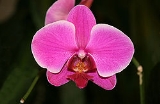
Phalaenopsis

 
Phalaenopsis

   Email Print
   Bookmark   Link


Phalaenopsis


Phalaenopsis (Blume
Carl Ludwig Blume

Charles Ludwig de Blume or Karl Ludwig von Blume was a Germany-Netherlands botanist.He was born at Braunschweig in Germany, but spent most of his professional life working in the Netherlands, where he was Director of the Rijksherbarium at Leiden....
 1825) is a genus
Genus

A genus is a low-level taxonomic rank used in the classification of living and fossil organisms. The taxonomic ranks are domain , kingdom , phylum, class , order , family , genus, and species....
 of approximately 60 species of orchids
Orchidaceae

Orchidaceae is the largest Family of the flowering plants . Its name is derived from the genus Orchis.The Royal Botanic Gardens, Kew list 880 genus and nearly 22,000 accepted species, but the exact number is unknown because of taxonomic disputes....
 (family Orchidaceae). The abbreviation in the horticultural trade is Phal. Phalaenopsis is one of the most popular orchids in the trade, through the development of many artificial hybrids.

Description
The generic name means "Phalaen[a]-like" and is probably a reference to the genus Phalaena, the name given by Carolus Linnaeus
Carolus Linnaeus

Carl Linnaeus was a Sweden botanist, physician, and zoologist, who laid the foundations for the modern scheme of binomial nomenclature. He is known as the father of modern alpha taxonomy, and is also considered one of the fathers of modern ecology....
 to a group of large moths; the flowers of some species supposedly resemble moth
Moth

A moth is an insect closely related to the butterfly, both being of the Order Lepidoptera. The differences between butterflies and moths are more than just taxonomy....
s in flight.


Discussion
Ask a question about 'Phalaenopsis'
Start a new discussion about 'Phalaenopsis'
Answer questions from other users
Full Discussion Forum


Recent Posts


Encyclopedia


Phalaenopsis (Blume
Carl Ludwig Blume

Charles Ludwig de Blume or Karl Ludwig von Blume was a Germany-Netherlands botanist.He was born at Braunschweig in Germany, but spent most of his professional life working in the Netherlands, where he was Director of the Rijksherbarium at Leiden....
 1825) is a genus
Genus

A genus is a low-level taxonomic rank used in the classification of living and fossil organisms. The taxonomic ranks are domain , kingdom , phylum, class , order , family , genus, and species....
 of approximately 60 species of orchids
Orchidaceae

Orchidaceae is the largest Family of the flowering plants . Its name is derived from the genus Orchis.The Royal Botanic Gardens, Kew list 880 genus and nearly 22,000 accepted species, but the exact number is unknown because of taxonomic disputes....
 (family Orchidaceae). The abbreviation in the horticultural trade is Phal. Phalaenopsis is one of the most popular orchids in the trade, through the development of many artificial hybrids.

Description


The generic name means "Phalaen[a]-like" and is probably a reference to the genus Phalaena, the name given by Carolus Linnaeus
Carolus Linnaeus

Carl Linnaeus was a Sweden botanist, physician, and zoologist, who laid the foundations for the modern scheme of binomial nomenclature. He is known as the father of modern alpha taxonomy, and is also considered one of the fathers of modern ecology....
 to a group of large moths; the flowers of some species supposedly resemble moth
Moth

A moth is an insect closely related to the butterfly, both being of the Order Lepidoptera. The differences between butterflies and moths are more than just taxonomy....
s in flight. For this reason, the species are sometimes called Moth orchids.

They are native throughout southeast Asia
Asia

Asia is the world's largest and most populous continent. It covers 8.6% of the Earth's total surface area and, with over 4 billion people, it contains more than 60% of the world's current human population....
 from the Himalayan
Himalayas

The Himalaya Range or Himalayas for short , meaning "abode of snow" ), is a mountain range in Asia, separating the Indian subcontinent from the Tibetan Plateau....
 mountains to the islands of Polillo
Polillo

Polilio may refer to:* Polillo, Quezon, a municipality in the Philippines* Polillo Island, an island in the Philippines* Polillo Strait, a strait of water in the Northeastern part of the Philippines...
 and Palawan
Palawan

Palawan is an island province of the Philippines located in the MIMAROPA Regions of the Philippines. Its capital is Puerto Princesa City, and it is the largest province in the country in terms of total area of jurisdiction....
 of the Philippines
Philippines

The Philippines, officially known as the Republic of the Philippines, is a country in Southeast Asia with Manila as its capital city. It comprises 7,107 islands in the western Pacific Ocean....
 and northern Australia
Australia

Australia, officially the Commonwealth of Australia, is a country in the southern hemisphere comprising the Australia of the world's smallest continent, the major island of Tasmania, and numerous list of islands of Australia in the Indian Ocean and Pacific Oceans....
. Orchid Island
Orchid Island

Orchid Island is a 45-km? volcanic island off the southeastern coast of Taiwan island and separated from the Batanes of the Philippines by the Bashi Channel of the Luzon Strait....
 off Taiwan
Taiwan

Taiwan is an island in East Asia. "Taiwan" is also commonly used to refer to the country governed by the Republic of China and to the ROC itself, which governs the island of Taiwan, Orchid Island and Green Island, Taiwan in the Pacific Ocean off the Taiwan coast, the Penghu islands in the Taiwan Strait, and Kinmen and the Matsu Islands...
 is named after this orchid. Little is known about their habitat and their ecology in nature since little field research has been done in the last decades.

Phalaenopsis
Most are epiphytic
Epiphyte

File:Cadzow oak epiphyte 2.JPGAn epiphyte is an organism that grows upon or attaches to a living plant. Epiphyte is one of the subdivisions of the Raunki?r plant life-form....
 shade plants; a few are lithophyte
Lithophyte

Lithophytes are a type of plant that grows in or on Rock . Lithophytes feed off moss, nutrients in rain water, litter, and even their own dead tissue....
s. In the wild they are typically found below the canopies of moist and humid lowland forests, protected against direct sunlight, but equally in seasonally dry or cool environments. The species have adapted individually to these three habitats.

Phalaenopsis shows a monopodial
Monopodial

Vascular plants with monopodial growth habits grow upward from a single point. They add leaves to the apex each year and the stem grows longer accordingly....
 growth habit. An erect growing rhizome
Rhizome

In botany, a rhizome is a characteristically horizontal plant stem of a plant that is usually found underground, often sending out roots and shoots from its nodes....
 produces from the top one or two alternate, thick and fleshy, elliptical leaves
Leaf

In botany, a leaf is an above-ground plant Organ specialized for photosynthesis. For this purpose, a leaf is typically flat and thin, to expose the cells containing chloroplast to light over a broad area, and to allow light to penetrate fully into the tissues....
 a year. The older, basal leaves drop off at the same rate. The plant retains in this way four to five leaves. If very healthy, they can have up to ten or more leaves. They have no pseudobulb
Pseudobulb

The pseudobulb is a storage organ derived from the part of a stem between two leaf nodes.It applies to the orchid family , specifically certain groups of epiphyte orchids, and may be single or composed of several internodes with evergreen or deciduous leaves along its length....
s. The raceme
Raceme

A raceme is a type of inflorescence that is unbranched and indeterminate growth and bears pedicellate flowers — flowers having short floral stalks called Pedicel s — along the axis....
 appears from the stem
Plant stem

A stem is one of two main structural axes of a vascular plant. The stem is normally divided into nodes and internodes, the nodes hold buds which grow into one or more leaf, inflorescence , conifer cones or other stems etc....
 between the leaves. They bloom in their full glory for several weeks. If kept in the home, they usually last two to three months.

Some Phalaenopsis species in Malaysia
Malaysia

Malaysia is a federation that consists of States of Malaysia in Southeast Asia with a total landmass of . The capital city is Kuala Lumpur, while Putrajaya is the seat of the federal government....
 are known to use subtle weather cues to coordinate mass flowering.

Classification

The species can be classified into two groups :
  • A group with a long, branched inflorescence (up to 1 m long) and large, almost round flowers with rose or white tints.
  • A group with short stems and less rounded, waxy flowers with more pronounced colors.
In terms of particular lifeform terminology, one can also characterize these plants as hemicryptophyte or chamerophyte :
  • hemicryptophyte (abbr.: hemicr.) : biennial or perennial plants with herbaceous stems. These stems die off after the growing season, while the shoots survive at soil level. The resting buds are just above or below soil level.
  • chamaephyte
    Chamaephyte

    A Chamaephyte or dwarf-shrub is a plant that bears hibernating buds on persistent shoots near the ground ? woody plants with Perennating organ buds borne close to the ground, no more than above soil surface....
     (abbr. cham.) : low-growing plants with herbaceous and/or woody stems, that persist for several years. Their buds are on soil level or just above; but never above 50 cm.


The genera Doritis Lindl. and Kingidium P.F.Hunt are now included in Phalaneopsis, based on DNA-evidence (according to the World Checklist of Monocotyledons, Royal Botanical Gardens, Kew) (See also ref 1). However this is not implicitly accepted by every specialist in this field.

Intensive cross-fertilization has produced a great number of hybrids in all colors and variations. These are usually more adaptable to artificial conditions than their botanical ancestors. Most are hybrids of Phalaenopsis amabilis with Phalaenopsis schilleriana or Phalaenopsis stuartiana.

Species

Phalaenopsis Barbara Moler X Johanna 52 24x
*Phalaenopsis amabilis
Phalaenopsis amabilis

Moon Orchid is a species of the genus Phalaenopsis. It is one of Indonesia's national flowers , discovered the first time by a Netherlands botanist Dr....
 (Moon Orchid; East Malaysia to Papuasia)
    • Phalaenopsis amabilis subsp. amabilis (East Malaysia to Papuasia).
    • Phalaenopsis amabilis subsp. moluccana (Northeastern Borneo to the Moluccas).
    • Phalaenopsis amabilis subsp. rosenstromii (New Guinea to Queensland).
  • Phalaenopsis amboinensis (Sulawesi to the Moluccas).
    • Phalaenopsis amboinensis var. amboinensis (the Moluccas).
    • Phalaenopsis amboinensis var. flavida (Sulawesi)
  • Phalaenopsis aphrodite (Southeastern Taiwan to the Philippines).
    • Phalaenopsis aphrodite subsp. aphrodite (the Philippines).
    • Phalaenopsis aphrodite subsp. formosana (Southeastern Taiwan).
  • Phalaenopsis appendiculata (Malaya to northeastern Borneo).
  • Phalaenopsis bastianii (Philippines - Sulu Archipelago).
  • Phalaenopsis bellina (Borneo).
  • Phalaenopsis borneensis (Borneo).
  • Phalaenopsis braceana (Eastern Himalayas to China - Yunnan
    Yunnan

    is a political divisions of China of the People's Republic of China, located in the far southwest of the country spanning approximately 394,000 square kilometers ....
    ).
  • Phalaenopsis buyssoniana (Indochina).
  • Phalaenopsis celebensis (Sulawesi).
  • Phalaenopsis chibae (Vietnam).
  • Phalaenopsis cochlearis (Malaya to Borneo).
  • Phalaenopsis corningiana (Borneo).
  • Phalaenopsis cornu-cervi (Indochina to southern Philippines).
  • Phalaenopsis deliciosa (Indian subcontinent to Malesia).
    • Phalaenopsis deliciosa subsp. deliciosa (Indian subcontinent to Malesia
    • Phalaenopsis deliciosa subsp. hookeriana (Eastern Himalayas to southwestern China).
  • Phalaenopsis doweryënsis (Northeastern Borneo).
  • Phalaenopsis equestris
    Phalaenopsis equestris

    Phalaenopsis equestris is a plant of the orchid genus Phalaenopsis and native to Philippines and Taiwan. The inflorescence has 10 to 15 flowers of about 25 mm diameter....
     (Taiwan - Hsiao Lan Yü to the Philippines).
  • Phalaenopsis fasciata (the Philippines).
  • Phalaenopsis fimbriata (Sumatra, Java and Borneo).
  • Phalaenopsis floresensis (Lesser Sunda Islands).
  • Phalaenopsis fuscata (Borneo)
  • Phalaenopsis gibbosa (Vietnam).
  • Phalaenopsis gigantea (Borneo to Java).
  • Phalaenopsis hainanensis
    Phalaenopsis hainanensis

    Phalaenopsis hainanensis is a species of plant in the Orchidaceae family. It is Endemism to China....
     (China - Hainan and Yunnan).
  • Phalaenopsis hieroglyphica
    Phalaenopsis hieroglyphica

    Zebrinae is an orchid native of Philippines, and this plant has creamy white flowers covered with markings.External links...
     (the Philippines).
  • Phalaenopsis honghenensis (China - Yunnan).
  • Phalaenopsis inscriptiosinensis (Central Sumatra
  • Phalaenopsis javanica (Western Java).
  • Phalaenopsis kunstleri (Myanmar to Malaya).
  • Phalaenopsis lamelligera (Northeastern Borneo).
  • Phalaenopsis lindenii
    Phalaenopsis lindenii

    Phalaenopsis lindenii is a species of plant in the Orchidaceae family. It is Endemism to the Philippines. Its natural habitat is subtropical or tropical moist lowland forests....
     (the Philippines - Luzon).
  • Phalaenopsis lobbii (Eastern Himalayas to Myanmar).
  • Phalaenopsis lowii (Southern Myanmar to western Thailand).
  • Phalaenopsis lueddemanniana (the Philippines).
Phalaenopsis Mambo
*Phalaenopsis luteola (Northwestern Borneo).
  • Phalaenopsis maculata (Malaya to Borneo).
  • Phalaenopsis malipoensis Z.J.Liu & S.C.Chen (China - Yunnan)
  • Phalaenopsis mannii (Eastern Himalayas to China - Yunnan).
  • Phalaenopsis mariae (Northeastern Borneo to the Philippines).
  • Phalaenopsis micholitzii
    Phalaenopsis micholitzii

    Phalaenopsis micholitzii is a species of plant in the Orchidaceae family. It is Endemism to the Philippines. Its natural habitat is subtropical or tropical moist lowland forests....
     (the Philippines - Mindanao).
  • Phalaenopsis modesta (Borneo).
  • Phalaenopsis mysorensis (Indian subcontinent).
  • Phalaenopsis pallens (the Philippines).
  • Phalaenopsis pantherina (Borneo).
  • Phalaenopsis parishii (Eastern Himalayas to Myanmar).
  • Phalaenopsis petelotii (Vietnam)
  • Phalaenopsis philippinensis (the Philippines - Luzon).
  • Phalaenopsis pulcherrima (Indochina to Borneo).
  • Phalaenopsis pulchra (the Philippines).
  • Phalaenopsis regnieriana (Indochina).
  • Phalaenopsis reichenbachiana (the Philippines).
Phalaenopsis Nivacolor
*Phalaenopsis robinsonii (the Moluccas).
  • Phalaenopsis sanderiana (the Philippines - Mindanao).
  • Phalaenopsis schilleriana
    Phalaenopsis schilleriana

    Phalaenopsis schilleriana is a plant of the orchid genus Phalaenopsis and native to Philippines. It has lilac flowers....
     (the Philippines).
  • Phalaenopsis speciosa (Andaman and Nicobar Islands).
  • Phalaenopsis stobartiana (China - southeastern Tibet to Guangxi)
  • Phalaenopsis stuartiana (the Philippines - Mindanao).
  • Phalaenopsis sumatrana (Indochina to Borneo).
  • Phalaenopsis taenialis (Eastern Himalayas to China - Yunnan)
  • Phalaenopsis tetraspsis (Andaman and Nicobar Islands to northwestern Sumatra).
  • Phalaenopsis venosa (Sulawesi).
  • Phalaenopsis violacea (Malaya to Sumatra).).
  • Phalaenopsis viridis (Sumatra).
  • Phalaenopsis wilsonii (China - southeastern Tibet to Guangxi).
  • Phalaenopsis zebrina (Borneo).


Natural hybrids

Phal Hybrid1
*Phalaenopsis × amphitrita (P. sanderiana × P. stuartiana; Philippines).
  • Phalaenopsis × gersenii (P. sumatrana × P. violacea; Borneo, Sumatra).
  • Phalaenopsis × intermedia (P. aphrodite × P. equestris; Star of Leyte; Philippines) (First recognized Phalaenopsis hybrid)
  • Phalaenopsis × leucorrhoda (P. aphrodite × P. schilleriana; Philippines).
  • Phalaenopsis × singuliflora (P. bellina × P. sumatrana; Borneo).
  • Phalaenopsis × veitchiana (P. equestris × P. schilleriana; Philippines).


Intergeneric hybrids

  • xAeridopsis (Aerides x Phalaenopsis)
  • xArachnopsis (Arachnis x Phalaenopsis)
  • xAsconopsis (Ascocentrum x Phalaenopsis)
  • xBeardara (Ascocentrum x Doritis x Phalaenopsis)
  • xBogardara (Ascocentrum x Phalaenopsis x Vanda x Vandopsis)
  • xBokchoonara (Arachnis x Ascocentrum x Phalaenopsis x Vanda)
  • xCleisonopsis (Cleisocentron x Phalaenopsis)
  • xDevereuxara (Ascocentrum x Phalaenopsis x Vanda)
  • xDiplonopsis (Diploprora x Phalaenopsis)
  • xDoriellaopsis (Doritis x Kingiella x Phalaenopsis)
  • xDoritaenopsis (Doritis x Phalaenopsis)
  • xDresslerara (Ascoglossum x Phalaenopsis x Renanthera )
  • xEdeara (Arachnis x Phalaenopsis x Renanthera x Vandopsis)
  • xErnestara (Phalaenopsis x Renanthera x Vandopsis)
  • xEurynopsis (Eurychone x Phalaenopsis)
  • xHagerara (Doritis x Phalaenopsis x Vanda)
  • xHausermannara (Doritis x Phalaenopsis x Vandopsis)
  • xHimoriara (Ascocentrum x Phalaenopsis x Rhynchostylis x Vanda)
  • xIsaoara (Aerangis x Ascocentrum x Phalaenopsis x Vanda)
  • xLaycockara (Arachnis x Phalaenopsis x Vandopsis)
  • xLichtara (Doritis x Gastrochilus x Phalaenopsis)
  • xLuinopsis (Luisia x Phalaenopsis)
  • xLutherara (Phalaenopsis x Renanthera x Rhynchostylis )
  • xMacekara (Arachnis x Phalaenopsis x Renanthera x Vanda x Vandopsis)
  • xMeechaiara (Ascocentrum x Doritis x Phalaenopsis x Rhynchostylis x Vanda)
  • xMoirara (Phalaenopsis x Renanthera x Vanda)
  • xNakagawaara (Aerides x Doritis x Phalaenopsis)
  • xOwensara (Doritis x Phalaenopsis x Renanthera )
  • xParnataara (Aerides x Arachnis x Phalaenopsis)
  • xPaulara (Ascocentrum x Doritis x Phalaenopsis x Renanthera x Vanda)
  • xPepeara (Ascocentrum x Doritis x Phalaenopsis x Renanthera )
  • xPhalaerianda (Aerides x Phalaenopsis x Vanda)
  • xPhalandopsis (Phalaenopsis x Vandopsis)
  • xPhalanetia (Neofinetia x Phalaenopsis)
  • xPhaliella (Kingiella x Phalaenopsis)
  • xPooleara (Ascocentrum x Ascoglossum x Phalaenopsis x Renanthera )
  • xRenanthopsis (Phalaenopsis x Renanthera )
  • xRhynchonopsis (Phalaenopsis x Rhynchostylis)
  • xRhyndoropsis (Doritis x Phalaenopsis x Rhynchostylis)
  • xRichardmizutaara (Ascocentrum x Phalaenopsis x Vandopsis)
  • xRoseara (Doritis x Kingiella x Phalaenopsis x Renanthera )
  • xSappanara (Arachnis x Phalaenopsis x Renanthera)
  • xSarconopsis (Phalaenopsis x Sarcochilus)
  • xSidranara (Ascocentrum x Phalaenopsis x Renanthera)
  • xSladeara (Doritis x Phalaenopsis x Sarcochilus)
  • xStamariaara (Ascocentrum x Phalaenopsis x Renanthera x Vanda)
  • xSutingara (Arachnis x Ascocentrum x Phalaenopsis x Vanda x Vandopsis)
  • xTrautara (Doritis x Luisia x Phalaenopsis)
  • xTrevorara (Arachnis x Phalaenopsis x Vanda)
  • xTrichonopsis (Phalaenopsis x Trichoglottis)
  • xUptonara (Phalaenopsis x Rhynchostylis x Sarcochilus)
  • xVandaenopsis (Phalaenopsis x Vanda)
  • xVandewegheara (Ascocentrum x Doritis x Phalaenopsis x Vanda)
  • xYapara (Phalaenopsis x Rhynchostylis x Vanda)
  • xYeepengara (Aerides x Phalaenopsis x Rhynchostylis x Vanda)
There is no true intergeneric hybrid between Phalaenopsis and the closely related Paraphalaenopsis
Paraphalaenopsis

The genus Paraphalaenopsis, abbreviated as Prphln in horticultural trade, is a member of the Orchid family , consisting of 4 species Endemism to Borneo and one natural hybrid, Paraphalaenopsis ? thorntonii ....
. However, according to the RHS
Royal Horticultural Society

The Royal Horticultural Society was founded in 1804 in London, England as the Horticultural Society of London, and gained its present name in a Royal Charter granted in 1861 by Prince Albert of Saxe-Coburg-Gotha....
, the grex
Grex (horticulture)

The term grex , derived from the Latin language noun grex, gregis meaning flock, has been coined to expand the Linnean binomial system to include horticultural hybrids....
 Phalphalaenopsis Doris Thornton, registered in 1977 as a cross between Paraphalaenopsis x thorntonii and Phalaenopsis Doris is just such a hybrid. Therefore, strictly speaking, the genetic barrier between these two closely related genera has not been crossed. But, since there are only very few true Phalaenopsis species in cultivation (most are hybrids), the possibility of a true intergeneric hybrid is not to be excluded.

Post-pollination changes in Phalaenopsis orchids

Phalaenopsis are not only outstanding in their beauty, but also unique in that in some species, the flowers turn into green leaves after pollination. As in many other plants, the petals of the orchid flowers serve to attract pollinating insects and protect essential organs. Following pollination, petals will usually undergo senescence (i.e. wilt and disintegrate) because it is metabolically expensive to maintain them. In many Phalaenopsis species such as P.violacea, the petals and sepals find new uses following pollination and thus escaping programmed cell death. By inducing the formation of chloroplast
Chloroplast

Chloroplasts are organelles found in plant cells and other eukaryote organisms that conduct photosynthesis. Chloroplasts capture light energy to conserve Thermodynamic free energy in the form of Adenosine triphosphate and reduce NADP to NADPH through a complex set of processes called photosynthesis....
s, they turn green, become fleshy and apparently start to photosynthesize, just like leaves.

Growing Phalaenopsis

Violacea
Phalaenopsis are among the most popular orchids sold as potted plants owing to the ease of propagation and flowering under artificial conditions. They were among the first tropical orchids in Victorian
Victorian era

The Victorian Era of the United Kingdom of Great Britain and Ireland was the period of Victoria of the United Kingdom reign from June 1837 to January 1901....
 collections. Since the advent of the tetrapoloid hybrid
Phalaenopsis Doris, they have become extremely easy to grow and flower in the home, as long as some care is taken to provide them with conditions that approximate their native habitats. Their production has become a commercial industry.

In nature, they are typically fond of warm temperatures (20 to 35 °C
Celsius

Celsius is a temperature scale that is named after the Swedish astronomer Anders Celsius , who developed a similar temperature scale two years before his death....
), but are adaptable to conditions more comfortable for human habitation in temperate zones (15 to 30 °C); at temperatures below 18 °C overwatering causes root rot.
Phalaenopsis requires high humidity (60-70%) and low light of 12,000 to 20,000 lux
Lux

The lux is the SI unit of illuminance and luminous emittance. It is used in photometry as a measure of the apparent intensity of light hitting or passing through a surface....
. Flowering is triggered by a night-time drop in temperature of around 5 to 6 degrees over 2 to 4 consecutive weeks, usually in the fall, and a day-time drop in temperature to below 29 °C.

The flower spikes appear from the pockets near the base of each leaf. The first sign is a light green "mitten-like" object that protrudes from the leaf tissue. In about three months, the spike elongates until it begins to swell fat buds which will bloom.

Using two
Phalaenopsis clones, Matthew G. Blanchard and Erik S. Runkle (2006) established that, other culture conditions being optimal, flower initiation is controlled by daytime temperatures declining below 27°C, with a definite inhibition of flowering at temperatures exceeding 29°C. The long-held traditional belief that reduced evening temperatures control flower initiation in Phalaenopsis appears to be false.

External links


Footnotes