

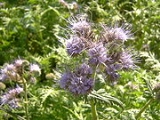
Phacelia

Encyclopedia
Phacelia is a genus
of about 200 species
of annual
or perennial
herbaceous
plants
, native to North
and South America
.
The genus is traditionally placed at family
rank with the waterleaves (Hydrophyllaceae
) in the order
Boraginales
. The Angiosperm Phylogeny Group
, recognizing that the traditional Boraginaceae and Hydrophyllaceae are paraphyletic with respect to each other merges the latter into the former and considers the family basal
in the Euasterids I clade
. Other botanists continue to recognize the Hydrophyllaceae and Boraginales, but to make them monophyletic the present genus be moved to the Boraginaceae.
Many species are cultivated as garden plants and honey plants.
As with many species in the Boraginaceae, contact with the hairs of some species of Phacelia can cause a very unpleasant rash similar to that from poison oak
and poison ivy
in sensitive individuals. The major contact allergen of Phacelia crenulata
has been identified as geranylhydroquinone
. The similar-appearing single-species genus Turricula (poodle-dog bush), a common chaparral plant of Southern California, is also a frequent cause of skin irritation.
Genus
In biology, a genus is a low-level taxonomic rank used in the biological classification of living and fossil organisms, which is an example of definition by genus and differentia...
of about 200 species
Species
In biology, a species is one of the basic units of biological classification and a taxonomic rank. A species is often defined as a group of organisms capable of interbreeding and producing fertile offspring. While in many cases this definition is adequate, more precise or differing measures are...
of annual
Annual plant
An annual plant is a plant that usually germinates, flowers, and dies in a year or season. True annuals will only live longer than a year if they are prevented from setting seed...
or perennial
Perennial plant
A perennial plant or simply perennial is a plant that lives for more than two years. The term is often used to differentiate a plant from shorter lived annuals and biennials. The term is sometimes misused by commercial gardeners or horticulturalists to describe only herbaceous perennials...
herbaceous
Herbaceous plant
A herbaceous plant is a plant that has leaves and stems that die down at the end of the growing season to the soil level. They have no persistent woody stem above ground...
plants
Flowering plant
The flowering plants , also known as Angiospermae or Magnoliophyta, are the most diverse group of land plants. Angiosperms are seed-producing plants like the gymnosperms and can be distinguished from the gymnosperms by a series of synapomorphies...
, native to North
North America
North America is a continent wholly within the Northern Hemisphere and almost wholly within the Western Hemisphere. It is also considered a northern subcontinent of the Americas...
and South America
South America
South America is a continent situated in the Western Hemisphere, mostly in the Southern Hemisphere, with a relatively small portion in the Northern Hemisphere. The continent is also considered a subcontinent of the Americas. It is bordered on the west by the Pacific Ocean and on the north and east...
.
The genus is traditionally placed at family
Family (biology)
In biological classification, family is* a taxonomic rank. Other well-known ranks are life, domain, kingdom, phylum, class, order, genus, and species, with family fitting between order and genus. As for the other well-known ranks, there is the option of an immediately lower rank, indicated by the...
rank with the waterleaves (Hydrophyllaceae
Hydrophyllaceae
Hydrophylloideae is a subfamily of the Boraginaceae family of flowering plants. Their taxonomic position is somewhat uncertain. Traditionally, and under the Cronquist system, they were given family rank under the name Hydrophyllaceae, and treated as part of the order Solanales...
) in the order
Order (biology)
In scientific classification used in biology, the order is# a taxonomic rank used in the classification of organisms. Other well-known ranks are life, domain, kingdom, phylum, class, family, genus, and species, with order fitting in between class and family...
Boraginales
Boraginales
Boraginales is a valid taxonomic name at the rank of order for a group of flowering plants. When recognised, it is includes Boraginaceae and closely related asterid families....
. The Angiosperm Phylogeny Group
Angiosperm Phylogeny Group
The Angiosperm Phylogeny Group, or APG, refers to an informal international group of systematic botanists who came together to try to establish a consensus on the taxonomy of flowering plants that would reflect new knowledge about plant relationships discovered through phylogenetic studies., three...
, recognizing that the traditional Boraginaceae and Hydrophyllaceae are paraphyletic with respect to each other merges the latter into the former and considers the family basal
Basal (phylogenetics)
In phylogenetics, a basal clade is the earliest clade to branch in a larger clade; it appears at the base of a cladogram.A basal group forms an outgroup to the rest of the clade, such as in the following example:...
in the Euasterids I clade
Clade
A clade is a group consisting of a species and all its descendants. In the terms of biological systematics, a clade is a single "branch" on the "tree of life". The idea that such a "natural group" of organisms should be grouped together and given a taxonomic name is central to biological...
. Other botanists continue to recognize the Hydrophyllaceae and Boraginales, but to make them monophyletic the present genus be moved to the Boraginaceae.
Many species are cultivated as garden plants and honey plants.
As with many species in the Boraginaceae, contact with the hairs of some species of Phacelia can cause a very unpleasant rash similar to that from poison oak
Poison oak
Poison oak may refer to* Toxicodendron diversilobum, grows on West Coast of North America* Toxicodendron pubescens, grows in the Eastern United Statesdamnnnnn tissss is terribleee...
and poison ivy
Poison ivy
Toxicodendron radicans, better known as poison ivy , is a poisonous North American plant that is well known for its production of urushiol, a clear liquid compound found within the sap of the plant that causes an itching rash in most people who touch it...
in sensitive individuals. The major contact allergen of Phacelia crenulata
Phacelia crenulata
Phacelia crenulata is a species of phacelia native to the southwestern United States and northern Mexico. Its common names include notch-leaved phacelia and cleftleaf wild heliotrope....
has been identified as geranylhydroquinone
Hydroquinone
Hydroquinone, also benzene-1,4-diol or quinol, is an aromatic organic compound that is a type of phenol, having the chemical formula C6H42. Its chemical structure, shown in the table at right, has two hydroxyl groups bonded to a benzene ring in a para position. It is a white granular solid...
. The similar-appearing single-species genus Turricula (poodle-dog bush), a common chaparral plant of Southern California, is also a frequent cause of skin irritation.
Selected species
|
Phacelia inyoensis Phacelia inyoensis, the common name Inyo phacelia, is an uncommon species of phacelia. It is endemic to California, where it is known only from the mountains at the eastern margin of the Sierra Nevada in Inyo and Mono Counties.... Inyo Phacelia Phacelia ivesiana Phacelia ivesiana is a species of phacelia known by the common name Ives' phacelia. It is native to California and the Western United States, except for Oregon and Washington. It grows in many types of open, sandy habitat.-Description:... Ives' Phacelia Phacelia lemmonii Phacelia lemmonii is a species of phacelia known by the common name Lemmon's phacelia. It is native to the Southwestern United States, where it grows in mountain and sandy desert habitat.-Description:... Lemmon's Phacelia Phacelia leonis Phacelia leonis is a rare species of phacelia known by the common name Siskiyou phacelia. It is endemic to the Klamath Mountains of southern Oregon and far northern California, where it grows in serpentine soils in the coniferous forests.... Siskiyou Phacelia Phacelia linearis Phacelia linearis, with the common name Threadleaf phacelia, is a species of phacelia. It is native to western North America from western Canada to Wyoming to northern California, where it grows in forest, woodland, open scrub, and other habitat.... Threadleaf Phacelia Phacelia longipes Phacelia longipes is a species of phacelia known by the common name longstalk phacelia. It is endemic to California, where it grows in the Transverse Ranges and adjacent western Mojave Desert... Longstalk Phacelia Phacelia malvifolia Phacelia malvifolia, with the common name Stinging phacelia, is a species of phacelia. It is native to California, where it grows along the northern and central Coast and Coast Ranges. its distribution extends north along the coast just into southwestern Oregon... Stinging Phacelia Phacelia marcescens Phacelia marcescens is a species of phacelia known by the common name persistentflower phacelia. It is endemic to the Sierra Nevada and its foothills in California, where it grows in meadows, forests, and other mountain habitat.-Description:... Persistentflower Phacelia Whitlavia, Wild Canterbury Bells Phacelia mohavensis Phacelia mohavensis is a species of phacelia known by the common name Mojave phacelia. It is endemic to southern California, where it is mostly limted to the San Gabriel Mountains and San Bernardino Mountains... Mojave Phacelia Phacelia monoensis Phacelia monoensis is an uncommon species of phacelia known by the common name Mono County phacelia. It is native to the plateaus of central western Nevada and a few locations over the border in Mono County, California, where it grows in sagebrush, on wooded slopes, and on open expanses of alkaline... Mono Phacelia Phacelia mustelina Phacelia mustelina is an uncommon species of phacelia known by the common names Weasel phacelia and Death Valley round-leaved phacelia... Weasel Phacelia, Death Valley Round-leaved Phacelia Phacelia mutabilis Phacelia mutabilis is a species of phacelia known by the common name changeable phacelia. It is native to the western United States, where it can be found in mountains and foothills, in forested and open habitat types, and deserts.... Changeable Phacelia Phacelia nashiana Phacelia nashiana is a species of phacelia known by the common name Charlotte's phacelia. It is endemic to California, where it is known only from the area where the Sierra Nevada junctions with the Mojave Desert... Charlotte's Phacelia Phacelia neglecta Phacelia neglecta is a species of phacelia known by the common name alkali phacelia. It is native to the deserts of the southwestern United States in Nevada, Arizona and southeastern California, where it grows in varied desert habitat, including areas with alkali soils.It is a mostly erect annual... Alkali Phacelia Phacelia nemoralis Phacelia nemoralis is a species of phacelia known by the common name shade phacelia. It is native to the west coast of the United States from Washington to central California, where it grows in moist, usually forested areas along the coastline and in the coastal mountain ranges.It is a perennial... Shade Phacelia Phacelia orogenes Phacelia orogenes is an uncommon species of phacelia known by the common name mountain phacelia. It is endemic to California, where it is known only from the southern High Sierra, particularly around Mineral King.... Mountain Phacelia Phacelia pachyphylla Phacelia pachyphylla is a species of phacelia known by the common name blacktack phacelia. It is native to the deserts of California and Baja California, where it grows in sandy alkali flats and scrub.... Blacktack Phacelia Phacelia parishii Phacelia parishii is an uncommon species of phacelia known by the common name Parish's phacelia. It is native to the desert southwest of the United States, where it is known from scattered occurrences in Nevada and Arizona, and about two occurrences in California... Parish's Phacelia Phacelia parryi Phacelia parryi is a species of phacelia known by the common name Parry's phacelia. It is native to southern California and Baja California, where it grows in coastal and inland mountain ranges and deserts. Its range may extend into Arizona... Parry's Phacelia Phacelia pedicellata Phacelia pedicellata is a species of phacelia known by the common names Pedicellate phacelia and Specter phacelia. It is native to the deserts of California and the Southwestern United States and Baja California, where it can be found in several types of desert habitat.It is an annual herb growing... Pedicellate Phacelia Panamint Phacelia Phacelia phacelioides Phacelia phacelioides, the Mt. Diablo phacelia, is a species of phacelia. It is endemic to California, where it is known from about 20 occurrences in the coastal mountain ranges of the inner San Francisco Bay Area, including Mount Diablo. It is a resident of chaparral and woodland habitat.The Mt... Mt. Diablo Phacelia Phacelia platyloba Phacelia platyloba is a species of phacelia known by the common name broadlobe phacelia. It is endemic to California, where it is known only from a section of the central Sierra Nevada foothills. It is a resident of chaparral, woodland, and other local habitat.It is an annual herb producing a... Broadlobe Phacelia Phacelia pringlei Phacelia pringlei is a species of phacelia known by the common name Pringle's phacelia. It is endemic to far northern California, where it is known only from the southern Klamath Mountains. It grows in coniferous forest and open mountain slopes.... Pringle's Phacelia Phacelia procera Phacelia procera is a species of phacelia known by the common name tall phacelia. It is native to the northwestern United States as far south as the Sierra Nevada, where it grows in mountainous habitat, such as forests, meadows, and talus.... Tall Phacelia Phacelia purpusii Phacelia purpusii is a species of phacelia known by the common name Purpus' phacelia that is endemic to California where it can be found in forests and other habitats within Sierra Nevada or farther north in the southernmost portion of the Cascades and adjacent Modoc Plateau.It is a glandular and... Purpus' Phacelia Phacelia purshii Miami Mist is a spring flowering member of the genus Phacelia native to eastern North America. It can be found in the Great Smoky Mountains north into the Great Lakes region.-External links:**... Miami Mist Phacelia quickii Phacelia quickii is a species of phacelia known by the common name Quick's phacelia.-Description:Phacelia quickii is an annual herb growing decumbent or erect with a stem reaching up to 18 centimeters long. It is hairy and sometimes glandular. The leaves are linear or lance-shaped and up to 5... Quick's Phacelia Phacelia racemosa Phacelia racemosa is a species of phacelia known by the common name racemose phacelia. It is endemic to California, where it can be found in the Sierra Nevada and adjacent slopes and peaks in the southernmost Cascade Range. It grows in coniferous forests in gravelly and rocky substrates. It is an... Racemose Phacelia Phacelia ramosissima Phacelia ramosissima is a species of phacelia known by the common name branching phacelia. It is native to western North America from British Columbia to California and the Southwestern United States, where it can be found in many types of habitat.... Branching Phacelia Phacelia rattanii Phacelia rattanii is a species of phacelia known by the common name Rattan's phacelia. It is native to the western United States, where it can be found in mountain and foothill habitat.... Rattan's Phacelia Phacelia rotundifolia Phacelia rotundifolia is a species of phacelia known by the common name Roundleaf phacelia. It is native to the deserts and plateaus of California and the Southwestern United States, where it can be found in scrub, woodland, and rocky slope habitat.... Roundleaf Phacelia Phacelia saxicola Phacelia saxicola is a species of phacelia known by the common name stonecrop phacelia. It is native to the deserts, hills, and mountain slopes of far eastern California and adjacent sections of western Nevada and Arizona.... Stonecrop Phacelia Phacelia sericea Phacelia sericea, the Silky Phacelia, Blue Alpine Phacelia, or Sky-pilot, is a showy perennial species of Phacelia endemic to western North America. Uncommon, it grows mainly at subalpine to alpine elevations in forest openings or above treeline among rocks and sand... Silky Phacelia Phacelia stebbinsii Phacelia stebbinsii is an uncommon species of phacelia known by the common name Stebbins' phacelia. It is endemic to California, where it is known only from a northern section of the Sierra Nevada, growing in forests and meadows and on rocky slopes.... Stebbins' Phacelia Phacelia stellaris Phacelia stellaris is a rare species of phacelia known by the common names star phacelia and Brand's phacelia.-Endangered habitat:... Star Phacelia, Brand's Phacelia Phacelia tanacetifolia Phacelia tanacetifolia is a species of phacelia known by the common name Lacy phacelia.-Beneficial insects:It was originally native to the Southwestern United States and northern Mexico, but it is now used in many places in agriculture as a cover crop, a bee plant, an attractant for other... Lacy Phacelia Phacelia thermalis Phacelia thermalis is a species of phacelia known by the common names heated phacelia and hot spring phacelia. It is native to the western United States from northeastern California to Idaho, with a disjunct population in Montana.... Heated Phacelia Phacelia vallicola Phacelia vallicola is a species of phacelia known by the common name Mariposa phacelia. It is endemic to California, where it is known only from the Sierra Nevada and adjacent southermost slopes of the Cascade Range. It grows in coniferous forest, chaparral, and other mountain and foothill... Mariposa Phacelia Phacelia vallis-mortae Phacelia vallis-mortae is a species of phacelia known by the common name Death Valley phacelia. It is native to the Southwestern United States, where it grows in deserts such as Death Valley, mountains, plateau, and valley scrub habitat.... Death Valley Phacelia Phacelia viscida Phacelia viscida is a species of phacelia known by the common names sticky phacelia and tacky phacelia. It is native to the coastal hills and mountains of central and southern California and Baja California, where it grows in local habitat types such as coastal sage scrub, chaparral, and recently... Tacky Phacelia |
External links
- Panorama of a Phacelia Field (QuickTime required)