

Petroleum industry

Encyclopedia
The petroleum industry includes the global processes of exploration, extraction
, refining
, transporting (often by oil tanker
s and pipelines
), and marketing petroleum
products. The largest volume products of the industry are fuel oil
and gasoline
(petrol). Petroleum is also the raw material for many chemical products
, including pharmaceuticals, solvents, fertilizers, pesticides, and plastics. The industry is usually divided into three major components: upstream
, midstream
and downstream
. Midstream operations are usually included in the downstream category.
Petroleum is vital to many industries, and is of importance to the maintenance of industrial civilization
itself, and thus is a critical concern for many nations. Oil accounts for a large percentage of the world’s energy consumption, ranging from a low of 32% for Europe
and Asia, up to a high of 53% for the Middle East
.
Other geographic regions’ consumption patterns are as follows: South
and Central America
(44%), Africa
(41%), and North America
(40%). The world consumes 30 billion barrels
(4.8 km³) of oil per year, with developed nations being the largest consumers. The United States
consumed 25% of the oil produced in 2007. The production, distribution, refining, and retailing of petroleum taken as a whole represents the world's largest industry in terms of dollar value.
Governments such as the United States government provide a heavy public subsidy to petroleum companies, with major tax breaks at virtually every stage of oil exploration and extraction, including for the costs of oil field leases and drilling equipment.
in an unrefined state has been utilized by humans for over 5000 years. Oil in general has been used since early human history to keep fires ablaze, and also for war
fare.
Its importance in the world economy
evolved slowly, with whale oil
used for lighting into the 19th century, and wood and coal used for heating and cooking well into the 20th Century. A petroleum industry emerged in North America
in Canada
and the United States
. The Industrial Revolution
generated an increasing need for energy which was fueled mainly by coal, with other sources including whale oil. However, it was discovered that kerosene could be extracted from crude oil and used as a light and heating fuel. Petroleum was in great demand, and by the twentieth century had become the most valuable commodity traded on the world market.
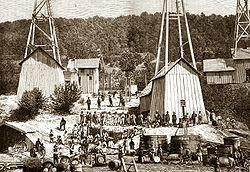 Imperial Russia produced 3,500 tons of oil in 1825 and doubled its output by mid-century. After oil drilling began in what is now Azerbaijan
in 1848, two large pipelines were built in the Russian Empire
: the 833 km long pipeline to transport oil from the Caspian to the Black Sea
port of Batumi
(Baku-Batumi pipeline
), completed in 1906, and the 162 km long pipeline to carry oil from Chechnya
to the Caspian.
At the turn of the 20th century, Imperial Russia's output of oil, almost entirely from the Apsheron Peninsula, accounted for half of the world's production and dominated international markets. Nearly 200 small refineries operated in the suburbs of Baku by 1884. As a side effect of these early developments, the Apsheron Peninsula emerged as the world's "oldest legacy of oil pollution and environmental negligence." In 1878, Ludvig Nobel
and his Branobel
company "revolutionized oil transport" by commissioning the first oil tanker
and launching it on the Caspian Sea
.
The first modern oil refineries were built by Ignacy Łukasiewicz near Jasło (then in the dependent Kingdom of Galicia and Lodomeria
in Central European Galicia), Poland from 1854–56. These were initially small as demand for refined fuel was limited. The refined products were used in artificial asphalt, machine oil and lubricants, in addition to Łukasiewicz's kerosene lamp. As kerosene lamps gained popularity, the refining industry grew in the area.
In Canada, oil extraction began in 1858 in Oil Springs, Ontario.
The first oil drilling in the United States began in 1859, when oil was successfully drilled in Titusville
, Pennsylvania
. In the first quarter of the 20th century, the United States overtook Russia as the world's largest oil producer.
By the 1920s, oil fields had been established in many countries including Canada, Poland, Sweden, the Ukraine, the United States, Peru and Venezuela.
In the early 1930s the Texas Company
developed the first mobile steel barges for drilling in the brackish coastal areas of the Persian Gulf
.
In 1937 Pure Oil Company (now part of Chevron Corporation
) and its partner Superior Oil Company
(now part of ExxonMobil Corporation) used a fixed platform to develop a field in 14 feet (4.3 m) of water, one mile (1.6 km) offshore of Calcasieu Parish, Louisiana
.
In early 1947 Superior Oil erected a drilling/production oil platform
in 20 ft (6.1 m) of water some 18 miles off Vermilion Parish, Louisiana
. But it was Kerr-McGee
Oil Industries (now Anadarko Petroleum Corporation
), as operator for partners Phillips Petroleum
(ConocoPhillips
) and Stanolind Oil & Gas (BP
), that completed its historic Ship Shoal Block 32 well in October 1947, months before Superior actually drilled a discovery from their Vermilion platform farther offshore. In any case, that made Kerr-McGee's well the first oil discovery drilled out of sight of land.
After World War II
ended, the countries of the Middle East
took the lead in oil production from the United States.
divides the petroleum industry into five sectors:
Oil companies used to be classified by sales as "supermajor
s" (BP
, Chevron
, ExxonMobil
, ConocoPhillips
, Shell
, Eni
and Total S.A.
), "majors", and "independents" or "jobbers". In recent years however, National Oil Companies (NOC, as opposed to IOC, International Oil Companies) have come to control the rights over the largest oil reserves; by this measure the top ten companies all are NOC. The following table shows the ten largest oil companies ranked by reserves and by production.
Most upstream work in the oil field
or on an oil well
is contract
ed out to drilling contractors and oil field service companies.
. For example, while the Deepwater Horizon
oil rig was registered in the Marshall Islands
, since registering off-shore lowered the U.S. tax liability, the U.S. government was giving the rig's owner, British Petroleum (BP), a major tax break when BP leased the rig: 70% of the rent was written off in the form of a tax break used only by the oil industry, for a tax deduction of more than $225,000 per day from the day the lease began.
through by-products of refining and oil spill
s.
The combustion of fossil fuels produces greenhouse gases and other air pollutants as by-products. Pollutants include nitrogen oxide
s, sulphur dioxide, volatile organic compound
s and heavy metals.
As petroleum is a non-renewable natural resource
the industry is faced with an inevitable eventual depletion of the world's oil supply. The BP Statistical Review of World Energy 2007 listed the reserve/production ratio
for proven resources worldwide. The study placed the prospective life span of proven reserves in the Middle East at 79.5 years, Latin America at 41.2 years and North America at only 12 years.
The Hubbert peak theory
, which introduced the concept of peak oil
, questions the sustainability of oil production. It suggests that after a peak in oil production rates, a period of oil depletion
will ensue. Since virtually all economic sectors rely heavily on petroleum, peak oil could lead to a partial or complete failure of markets.
According to research by IBISWorld, biofuels (primarily ethanol, but also biodiesel) will continue to supplement petroleum. However output levels are low, and these fuels will not displace local oil production. More than 90% of the ethanol used in the US is blended with gasoline to produce a 10% ethanol mix, lifting the oxygen content of the fuel.
Environmental issues
Financial and political
Oil geology
Oil-producing areas
Industry Research Projects
Extraction of petroleum
The extraction of petroleum is the process by which usable petroleum is extracted and removed from the earth.-Locating the oil field:Geologists use seismic surveys to search for geological structures that may form oil reservoirs...
, refining
Oil refinery
An oil refinery or petroleum refinery is an industrial process plant where crude oil is processed and refined into more useful petroleum products, such as gasoline, diesel fuel, asphalt base, heating oil, kerosene, and liquefied petroleum gas...
, transporting (often by oil tanker
Oil tanker
An oil tanker, also known as a petroleum tanker, is a merchant ship designed for the bulk transport of oil. There are two basic types of oil tankers: the crude tanker and the product tanker. Crude tankers move large quantities of unrefined crude oil from its point of extraction to refineries...
s and pipelines
Pipeline transport
Pipeline transport is the transportation of goods through a pipe. Most commonly, liquids and gases are sent, but pneumatic tubes that transport solid capsules using compressed air are also used....
), and marketing petroleum
Petroleum
Petroleum or crude oil is a naturally occurring, flammable liquid consisting of a complex mixture of hydrocarbons of various molecular weights and other liquid organic compounds, that are found in geologic formations beneath the Earth's surface. Petroleum is recovered mostly through oil drilling...
products. The largest volume products of the industry are fuel oil
Fuel oil
Fuel oil is a fraction obtained from petroleum distillation, either as a distillate or a residue. Broadly speaking, fuel oil is any liquid petroleum product that is burned in a furnace or boiler for the generation of heat or used in an engine for the generation of power, except oils having a flash...
and gasoline
Gasoline
Gasoline , or petrol , is a toxic, translucent, petroleum-derived liquid that is primarily used as a fuel in internal combustion engines. It consists mostly of organic compounds obtained by the fractional distillation of petroleum, enhanced with a variety of additives. Some gasolines also contain...
(petrol). Petroleum is also the raw material for many chemical products
Petrochemical
Petrochemicals are chemical products derived from petroleum. Some chemical compounds made from petroleum are also obtained from other fossil fuels, such as coal or natural gas, or renewable sources such as corn or sugar cane....
, including pharmaceuticals, solvents, fertilizers, pesticides, and plastics. The industry is usually divided into three major components: upstream
Upstream (oil industry)
The oil and gas industry is usually divided into three major components: Upstream, midstream and downstream, though midstream operations are usually included in the downstream category....
, midstream
Midstream
The petroleum industry is usually divided into three major components: upstream, midstream and downstream. Midstream operations are usually included in the downstream category....
and downstream
Downstream (oil industry)
The petroleum industry is usually divided into three major components: Upstream, midstream and downstream. Midstream operations are usually included in the downstream category....
. Midstream operations are usually included in the downstream category.
Petroleum is vital to many industries, and is of importance to the maintenance of industrial civilization
Civilization
Civilization is a sometimes controversial term that has been used in several related ways. Primarily, the term has been used to refer to the material and instrumental side of human cultures that are complex in terms of technology, science, and division of labor. Such civilizations are generally...
itself, and thus is a critical concern for many nations. Oil accounts for a large percentage of the world’s energy consumption, ranging from a low of 32% for Europe
Europe
Europe is, by convention, one of the world's seven continents. Comprising the westernmost peninsula of Eurasia, Europe is generally 'divided' from Asia to its east by the watershed divides of the Ural and Caucasus Mountains, the Ural River, the Caspian and Black Seas, and the waterways connecting...
and Asia, up to a high of 53% for the Middle East
Middle East
The Middle East is a region that encompasses Western Asia and Northern Africa. It is often used as a synonym for Near East, in opposition to Far East...
.
Other geographic regions’ consumption patterns are as follows: South
South America
South America is a continent situated in the Western Hemisphere, mostly in the Southern Hemisphere, with a relatively small portion in the Northern Hemisphere. The continent is also considered a subcontinent of the Americas. It is bordered on the west by the Pacific Ocean and on the north and east...
and Central America
Central America
Central America is the central geographic region of the Americas. It is the southernmost, isthmian portion of the North American continent, which connects with South America on the southeast. When considered part of the unified continental model, it is considered a subcontinent...
(44%), Africa
Africa
Africa is the world's second largest and second most populous continent, after Asia. At about 30.2 million km² including adjacent islands, it covers 6% of the Earth's total surface area and 20.4% of the total land area...
(41%), and North America
North America
North America is a continent wholly within the Northern Hemisphere and almost wholly within the Western Hemisphere. It is also considered a northern subcontinent of the Americas...
(40%). The world consumes 30 billion barrels
Barrel (unit)
A barrel is one of several units of volume, with dry barrels, fluid barrels , oil barrel, etc...
(4.8 km³) of oil per year, with developed nations being the largest consumers. The United States
United States
The United States of America is a federal constitutional republic comprising fifty states and a federal district...
consumed 25% of the oil produced in 2007. The production, distribution, refining, and retailing of petroleum taken as a whole represents the world's largest industry in terms of dollar value.
Governments such as the United States government provide a heavy public subsidy to petroleum companies, with major tax breaks at virtually every stage of oil exploration and extraction, including for the costs of oil field leases and drilling equipment.
Natural history
Petroleum is a naturally occurring liquid found in rock formations. It consists of a complex mixture of hydrocarbons of various molecular weights, plus other organic compounds. It is generally accepted that oil is formed mostly from the carbon rich remains of ancient plankton after exposure to heat and pressure in the Earth's crust over hundreds of millions of years. Over time, the decayed residue was covered by layers of mud and silt, sinking further down into the Earth’s crust and preserved there between hot and pressured layers, gradually transforming into oil reservoirs.Early history
PetroleumPetroleum
Petroleum or crude oil is a naturally occurring, flammable liquid consisting of a complex mixture of hydrocarbons of various molecular weights and other liquid organic compounds, that are found in geologic formations beneath the Earth's surface. Petroleum is recovered mostly through oil drilling...
in an unrefined state has been utilized by humans for over 5000 years. Oil in general has been used since early human history to keep fires ablaze, and also for war
War
War is a state of organized, armed, and often prolonged conflict carried on between states, nations, or other parties typified by extreme aggression, social disruption, and usually high mortality. War should be understood as an actual, intentional and widespread armed conflict between political...
fare.
Its importance in the world economy
World economy
The world economy, or global economy, generally refers to the economy, which is based on economies of all of the world's countries, national economies. Also global economy can be seen as the economy of global society and national economies – as economies of local societies, making the global one....
evolved slowly, with whale oil
Whale oil
Whale oil is the oil obtained from the blubber of various species of whales, particularly the three species of right whale and the bowhead whale prior to the modern era, as well as several other species of baleen whale...
used for lighting into the 19th century, and wood and coal used for heating and cooking well into the 20th Century. A petroleum industry emerged in North America
North America
North America is a continent wholly within the Northern Hemisphere and almost wholly within the Western Hemisphere. It is also considered a northern subcontinent of the Americas...
in Canada
Canada
Canada is a North American country consisting of ten provinces and three territories. Located in the northern part of the continent, it extends from the Atlantic Ocean in the east to the Pacific Ocean in the west, and northward into the Arctic Ocean...
and the United States
United States
The United States of America is a federal constitutional republic comprising fifty states and a federal district...
. The Industrial Revolution
Industrial Revolution
The Industrial Revolution was a period from the 18th to the 19th century where major changes in agriculture, manufacturing, mining, transportation, and technology had a profound effect on the social, economic and cultural conditions of the times...
generated an increasing need for energy which was fueled mainly by coal, with other sources including whale oil. However, it was discovered that kerosene could be extracted from crude oil and used as a light and heating fuel. Petroleum was in great demand, and by the twentieth century had become the most valuable commodity traded on the world market.
Modern history
Azerbaijan
Azerbaijan , officially the Republic of Azerbaijan is the largest country in the Caucasus region of Eurasia. Located at the crossroads of Western Asia and Eastern Europe, it is bounded by the Caspian Sea to the east, Russia to the north, Georgia to the northwest, Armenia to the west, and Iran to...
in 1848, two large pipelines were built in the Russian Empire
Russian Empire
The Russian Empire was a state that existed from 1721 until the Russian Revolution of 1917. It was the successor to the Tsardom of Russia and the predecessor of the Soviet Union...
: the 833 km long pipeline to transport oil from the Caspian to the Black Sea
Black Sea
The Black Sea is bounded by Europe, Anatolia and the Caucasus and is ultimately connected to the Atlantic Ocean via the Mediterranean and the Aegean seas and various straits. The Bosphorus strait connects it to the Sea of Marmara, and the strait of the Dardanelles connects that sea to the Aegean...
port of Batumi
Batumi
Batumi is a seaside city on the Black Sea coast and capital of Adjara, an autonomous republic in southwest Georgia. Sometimes considered Georgia's second capital, with a population of 121,806 , Batumi serves as an important port and a commercial center. It is situated in a subtropical zone, rich in...
(Baku-Batumi pipeline
Baku-Batumi pipeline
The Baku–Batumi pipeline is the name given to several pipelines and pipeline projects to transport kerosene and crude oil from the Caspian region to the Georgian Batumi oil terminal at the Black Sea...
), completed in 1906, and the 162 km long pipeline to carry oil from Chechnya
Chechnya
The Chechen Republic , commonly referred to as Chechnya , also spelled Chechnia or Chechenia, sometimes referred to as Ichkeria , is a federal subject of Russia . It is located in the southeastern part of Europe in the Northern Caucasus mountains. The capital of the republic is the city of Grozny...
to the Caspian.
At the turn of the 20th century, Imperial Russia's output of oil, almost entirely from the Apsheron Peninsula, accounted for half of the world's production and dominated international markets. Nearly 200 small refineries operated in the suburbs of Baku by 1884. As a side effect of these early developments, the Apsheron Peninsula emerged as the world's "oldest legacy of oil pollution and environmental negligence." In 1878, Ludvig Nobel
Ludvig Nobel
Ludvig Immanuel Nobel was an engineer, a noted businessman and a humanitarian. One of the most prominent members of the Nobel family, he was the son of Immanuel Nobel and Alfred Nobel's older brother...
and his Branobel
Branobel
The Petroleum Production Company Nobel Brothers, Limited,or Branobel , was an oil company set up by Ludvig Nobel and Baron Peter von Bilderling, in Baku, Azerbaijan...
company "revolutionized oil transport" by commissioning the first oil tanker
Oil tanker
An oil tanker, also known as a petroleum tanker, is a merchant ship designed for the bulk transport of oil. There are two basic types of oil tankers: the crude tanker and the product tanker. Crude tankers move large quantities of unrefined crude oil from its point of extraction to refineries...
and launching it on the Caspian Sea
Caspian Sea
The Caspian Sea is the largest enclosed body of water on Earth by area, variously classed as the world's largest lake or a full-fledged sea. The sea has a surface area of and a volume of...
.
The first modern oil refineries were built by Ignacy Łukasiewicz near Jasło (then in the dependent Kingdom of Galicia and Lodomeria
Kingdom of Galicia and Lodomeria
The Kingdom of Galicia and Lodomeria was a crownland of the Habsburg Monarchy, the Austrian Empire, and Austria–Hungary from 1772 to 1918 .This historical region in eastern Central Europe is currently divided between Poland and Ukraine...
in Central European Galicia), Poland from 1854–56. These were initially small as demand for refined fuel was limited. The refined products were used in artificial asphalt, machine oil and lubricants, in addition to Łukasiewicz's kerosene lamp. As kerosene lamps gained popularity, the refining industry grew in the area.
In Canada, oil extraction began in 1858 in Oil Springs, Ontario.
The first oil drilling in the United States began in 1859, when oil was successfully drilled in Titusville
Titusville, Pennsylvania
Titusville is a city in Crawford County, Pennsylvania, United States. The population was 6,146 at the 2000 census. In 1859, oil was successfully drilled in Titusville, resulting in the birth of the modern oil industry.-History:...
, Pennsylvania
Pennsylvania
The Commonwealth of Pennsylvania is a U.S. state that is located in the Northeastern and Mid-Atlantic regions of the United States. The state borders Delaware and Maryland to the south, West Virginia to the southwest, Ohio to the west, New York and Ontario, Canada, to the north, and New Jersey to...
. In the first quarter of the 20th century, the United States overtook Russia as the world's largest oil producer.
By the 1920s, oil fields had been established in many countries including Canada, Poland, Sweden, the Ukraine, the United States, Peru and Venezuela.
In the early 1930s the Texas Company
Texaco
Texaco is the name of an American oil retail brand. Its flagship product is its fuel "Texaco with Techron". It also owns the Havoline motor oil brand....
developed the first mobile steel barges for drilling in the brackish coastal areas of the Persian Gulf
Persian Gulf
The Persian Gulf, in Southwest Asia, is an extension of the Indian Ocean located between Iran and the Arabian Peninsula.The Persian Gulf was the focus of the 1980–1988 Iran-Iraq War, in which each side attacked the other's oil tankers...
.
In 1937 Pure Oil Company (now part of Chevron Corporation
Chevron Corporation
Chevron Corporation is an American multinational energy corporation headquartered in San Ramon, California, United States and active in more than 180 countries. It is engaged in every aspect of the oil, gas, and geothermal energy industries, including exploration and production; refining,...
) and its partner Superior Oil Company
Superior Oil Company
Superior Oil Company was an independent American oil company that is now part of ExxonMobil. Superior Oil was founded in 1921 in Coalinga, California by William Myron Keck, also founder of the W. M. Keck Foundation....
(now part of ExxonMobil Corporation) used a fixed platform to develop a field in 14 feet (4.3 m) of water, one mile (1.6 km) offshore of Calcasieu Parish, Louisiana
Calcasieu Parish, Louisiana
Calcasieu Parish[p] is a parish located in the U.S. state of Louisiana. The parish seat is Lake Charles. As of 2010, the parish population was 192,768...
.
In early 1947 Superior Oil erected a drilling/production oil platform
Oil platform
An oil platform, also referred to as an offshore platform or, somewhat incorrectly, oil rig, is a lаrge structure with facilities to drill wells, to extract and process oil and natural gas, and to temporarily store product until it can be brought to shore for refining and marketing...
in 20 ft (6.1 m) of water some 18 miles off Vermilion Parish, Louisiana
Vermilion Parish, Louisiana
Vermilion Parish is a parish located in the U.S. state of Louisiana. The parish seat is Abbeville. As of the 2010 census, the population was 57,999....
. But it was Kerr-McGee
Kerr-McGee
The Kerr-McGee Corporation, founded in 1929, was an energy company involved in the exploration and production of oil and gas. On June 23, 2006, Houston-based Anadarko Petroleum Corporation agreed to acquire Kerr-McGee in an all-cash transaction totaling $16.5 billion plus the assumption of $2.6...
Oil Industries (now Anadarko Petroleum Corporation
Anadarko Petroleum Corporation
Anadarko Petroleum Corporation is one of the world’s largest independent oil and gas exploration and production companies, with approximately 2.3 billion barrels of oil equivalent of proved reserves and production of 206 million BOE as of December 31, 2008. Anadarko employs a worldwide...
), as operator for partners Phillips Petroleum
Phillips Petroleum
Phillips Petroleum Company was founded in 1917 by L.E. Phillips and Frank Phillips, of Bartlesville, Oklahoma. Their younger brother Waite Phillips was the benefactor of Philmont Scout Ranch....
(ConocoPhillips
ConocoPhillips
ConocoPhillips Company is an American multinational energy corporation with its headquarters located in the Energy Corridor district of Houston, Texas in the United States...
) and Stanolind Oil & Gas (BP
BP
BP p.l.c. is a global oil and gas company headquartered in London, United Kingdom. It is the third-largest energy company and fourth-largest company in the world measured by revenues and one of the six oil and gas "supermajors"...
), that completed its historic Ship Shoal Block 32 well in October 1947, months before Superior actually drilled a discovery from their Vermilion platform farther offshore. In any case, that made Kerr-McGee's well the first oil discovery drilled out of sight of land.
After World War II
World War II
World War II, or the Second World War , was a global conflict lasting from 1939 to 1945, involving most of the world's nations—including all of the great powers—eventually forming two opposing military alliances: the Allies and the Axis...
ended, the countries of the Middle East
Middle East
The Middle East is a region that encompasses Western Asia and Northern Africa. It is often used as a synonym for Near East, in opposition to Far East...
took the lead in oil production from the United States.
Industry structure
The American Petroleum InstituteAmerican Petroleum Institute
The American Petroleum Institute, commonly referred to as API, is the largest U.S trade association for the oil and natural gas industry...
divides the petroleum industry into five sectors:
- upstreamUpstream (oil industry)The oil and gas industry is usually divided into three major components: Upstream, midstream and downstream, though midstream operations are usually included in the downstream category....
(explorationOil explorationHydrocarbon exploration is the search by petroleum geologists and geophysicists for hydrocarbon deposits beneath the Earth's surface, such as oil and natural gas...
, development and production of crude oil or natural gas) - downstreamDownstream (oil industry)The petroleum industry is usually divided into three major components: Upstream, midstream and downstream. Midstream operations are usually included in the downstream category....
(oil tankersTanker (ship)A tanker is a ship designed to transport liquids in bulk. Major types of tankship include the oil tanker, the chemical tanker, and the liquefied natural gas carrier.-Background:...
, refinersOil refineryAn oil refinery or petroleum refinery is an industrial process plant where crude oil is processed and refined into more useful petroleum products, such as gasoline, diesel fuel, asphalt base, heating oil, kerosene, and liquefied petroleum gas...
, retailers and consumers) - pipelinePipeline transportPipeline transport is the transportation of goods through a pipe. Most commonly, liquids and gases are sent, but pneumatic tubes that transport solid capsules using compressed air are also used....
- marine
- service and supply
Oil companies used to be classified by sales as "supermajor
Supermajor
Supermajor is a name commonly used to describe the world's five largest publicly owned oil and gas companies.-Composition:Trading under various names around the world, the supermajors are considered to be:* BP p.l.c...
s" (BP
BP
BP p.l.c. is a global oil and gas company headquartered in London, United Kingdom. It is the third-largest energy company and fourth-largest company in the world measured by revenues and one of the six oil and gas "supermajors"...
, Chevron
Chevron Corporation
Chevron Corporation is an American multinational energy corporation headquartered in San Ramon, California, United States and active in more than 180 countries. It is engaged in every aspect of the oil, gas, and geothermal energy industries, including exploration and production; refining,...
, ExxonMobil
ExxonMobil
Exxon Mobil Corporation or ExxonMobil, is an American multinational oil and gas corporation. It is a direct descendant of John D. Rockefeller's Standard Oil company, and was formed on November 30, 1999, by the merger of Exxon and Mobil. Its headquarters are in Irving, Texas...
, ConocoPhillips
ConocoPhillips
ConocoPhillips Company is an American multinational energy corporation with its headquarters located in the Energy Corridor district of Houston, Texas in the United States...
, Shell
Royal Dutch Shell
Royal Dutch Shell plc , commonly known as Shell, is a global oil and gas company headquartered in The Hague, Netherlands and with its registered office in London, United Kingdom. It is the fifth-largest company in the world according to a composite measure by Forbes magazine and one of the six...
, Eni
Eni
Eni S.p.A. is an Italian multinational oil and gas company, present in 70 countries, and currently Italy's largest industrial company with a market capitalization of 87.7 billion euros , as of July 24, 2008...
and Total S.A.
Total S.A.
Total S.A. is a French multinational oil company and one of the six "Supermajor" oil companies in the world.Its businesses cover the entire oil and gas chain, from crude oil and natural gas exploration and production to power generation, transportation, refining, petroleum product marketing, and...
), "majors", and "independents" or "jobbers". In recent years however, National Oil Companies (NOC, as opposed to IOC, International Oil Companies) have come to control the rights over the largest oil reserves; by this measure the top ten companies all are NOC. The following table shows the ten largest oil companies ranked by reserves and by production.
| Rank | Company | Worldwide Liquids Reserves (109 bbl) | Worldwide Natural Gas Reserves (1012 ft3) | Total Reserves in Oil Equivalent Barrels (109 bbl) | Company | Production (106 bbl/d) |
|---|---|---|---|---|---|---|
| 1 | Saudi Aramco Saudi Aramco Saudi Aramco , officially the Saudi Arabian Oil Company, is the national oil company of Saudi Arabia.Saudi Aramco is the world's largest and most valuable privately-held company, with estimates of its value in 2011 to be $7 trillion USD.Saudi Aramco has both the largest proven crude oil reserves,... |
260 | 254 | 303 | Saudi Aramco Saudi Aramco Saudi Aramco , officially the Saudi Arabian Oil Company, is the national oil company of Saudi Arabia.Saudi Aramco is the world's largest and most valuable privately-held company, with estimates of its value in 2011 to be $7 trillion USD.Saudi Aramco has both the largest proven crude oil reserves,... |
11.0 |
| 2 | National Iranian Oil Company National Iranian Oil Company The National Iranian Oil Company , a government-owned corporation under the direction of the Ministry of Petroleum of Iran, is an oil and natural gas producer and distributor headquartered in Tehran. It was established in 1948... |
138 | 948 | 300 | National Iranian Oil Company National Iranian Oil Company The National Iranian Oil Company , a government-owned corporation under the direction of the Ministry of Petroleum of Iran, is an oil and natural gas producer and distributor headquartered in Tehran. It was established in 1948... |
4.0 |
| 3 | Qatar Petroleum Qatar Petroleum Qatar Petroleum is a state owned petroleum company in Qatar. The company operates all oil and gas activities in Qatar, including exploration, production, refining, transport, and storage. QP's Chairman Abdullah Bin Hamad Al-Attiyah, is also the head of the Ministry of Energy and Industry and, as... |
15 | 905 | 170 | Kuwait Petroleum Corporation Kuwait Petroleum Corporation Kuwait Petroleum Corporation is Kuwait's national oil company, headquartered in Kuwait City. It was founded on January 27, 1980 as an umbrella company, integrating KOC, KNPC, KOTC and PIC and effectively placing them under government control.... |
3.7 |
| 4 | Iraq National Oil Company Iraq National Oil Company The Iraq National Oil Company was founded in 1966 by the Iraqi government. It was empowered to operate all aspects of the oil industry in Iraq except for refining which was already being run by the Oil Refineries Administration and local distribution which was also already under government... |
116 | 120 | 134 | Iraq National Oil Company Iraq National Oil Company The Iraq National Oil Company was founded in 1966 by the Iraqi government. It was empowered to operate all aspects of the oil industry in Iraq except for refining which was already being run by the Oil Refineries Administration and local distribution which was also already under government... |
2.7 |
| 5 | Petróleos de Venezuela | 99 | 171 | 129 | Petróleos de Venezuela | 2.6 |
| 6 | Abu Dhabi National Oil Company ADNOC The Abu Dhabi National Oil Company or ADNOC is the state-owned oil company of the United Arab Emirates . It is considered to be the world's fourth largest oil company with access to country's oil and gas reserves, .-Operations:... |
92 | 199 | 126 | Abu Dhabi National Oil Company ADNOC The Abu Dhabi National Oil Company or ADNOC is the state-owned oil company of the United Arab Emirates . It is considered to be the world's fourth largest oil company with access to country's oil and gas reserves, .-Operations:... |
2.6 |
| 7 | Kuwait Petroleum Corporation Kuwait Petroleum Corporation Kuwait Petroleum Corporation is Kuwait's national oil company, headquartered in Kuwait City. It was founded on January 27, 1980 as an umbrella company, integrating KOC, KNPC, KOTC and PIC and effectively placing them under government control.... |
102 | 56 | 111 | Petróleos Mexicanos | 2.5 |
| 8 | Nigerian National Petroleum Corporation Nigerian National Petroleum Corporation The Nigerian National Petroleum Corporation is the state oil corporation through which the federal government of Nigeria regulates and participates in the country's petroleum industry.-History:... |
36 | 184 | 68 | Nigerian National Petroleum Corporation Nigerian National Petroleum Corporation The Nigerian National Petroleum Corporation is the state oil corporation through which the federal government of Nigeria regulates and participates in the country's petroleum industry.-History:... |
2.3 |
| 9 | Libya NOC National Oil Corporation The National Oil Corporation is the national oil company of Libya. It dominates Libya's oil industry, along with a number of smaller subsidiaries, which combined account for around 70% the country's oil output... |
41 | 50 | 50 | Libya NOC National Oil Corporation The National Oil Corporation is the national oil company of Libya. It dominates Libya's oil industry, along with a number of smaller subsidiaries, which combined account for around 70% the country's oil output... |
2.1 |
| 10 | Sonatrach Sonatrach Sonatrach is an Algerian government-owned company formed to exploit the hydrocarbon resources of the country. Its diversified activities cover all aspects of production: exploration, extraction, transport, and refining... |
12 | 159 | 39 | Lukoil LUKoil Lukoil/LUKoil ; ) is Russia's second largest oil company and its second largest producer of oil. In 2009, the company produced 97.615 million tons of oil; .... |
1.9 |
Most upstream work in the oil field
Oil field
An oil field is a region with an abundance of oil wells extracting petroleum from below ground. Because the oil reservoirs typically extend over a large area, possibly several hundred kilometres across, full exploitation entails multiple wells scattered across the area...
or on an oil well
Oil well
An oil well is a general term for any boring through the earth's surface that is designed to find and acquire petroleum oil hydrocarbons. Usually some natural gas is produced along with the oil. A well that is designed to produce mainly or only gas may be termed a gas well.-History:The earliest...
is contract
Contract
A contract is an agreement entered into by two parties or more with the intention of creating a legal obligation, which may have elements in writing. Contracts can be made orally. The remedy for breach of contract can be "damages" or compensation of money. In equity, the remedy can be specific...
ed out to drilling contractors and oil field service companies.
Public subsidy
The United States government provides a large subsidy to oil companies, with major tax breaks at virtually every stage of oil exploration and extraction. Revenue attributable to capital investment, including the costs of oil field leases and drilling equipment, are taxed at an effective rate of nine percent, which is a much lower rate than the 25% rate for general business taxes and lower than the taxes of virtually any other industry, according to a 2005 study by the non-partisan Congressional Budget OfficeCongressional Budget Office
The Congressional Budget Office is a federal agency within the legislative branch of the United States government that provides economic data to Congress....
. For example, while the Deepwater Horizon
Deepwater Horizon
Deepwater Horizon was an ultra-deepwater, dynamically positioned, semi-submersible offshore oil drilling rig owned by Transocean. Built in 2001 in South Korea by Hyundai Heavy Industries, the rig was commissioned by R&B Falcon, which later became part of Transocean, registered in Majuro, Marshall...
oil rig was registered in the Marshall Islands
Marshall Islands
The Republic of the Marshall Islands , , is a Micronesian nation of atolls and islands in the middle of the Pacific Ocean, just west of the International Date Line and just north of the Equator. As of July 2011 the population was 67,182...
, since registering off-shore lowered the U.S. tax liability, the U.S. government was giving the rig's owner, British Petroleum (BP), a major tax break when BP leased the rig: 70% of the rent was written off in the form of a tax break used only by the oil industry, for a tax deduction of more than $225,000 per day from the day the lease began.
Environmental impact and future shortages
Some petroleum industry operations have been responsible for water pollutionWater pollution
Water pollution is the contamination of water bodies . Water pollution occurs when pollutants are discharged directly or indirectly into water bodies without adequate treatment to remove harmful compounds....
through by-products of refining and oil spill
Oil spill
An oil spill is the release of a liquid petroleum hydrocarbon into the environment, especially marine areas, due to human activity, and is a form of pollution. The term is mostly used to describe marine oil spills, where oil is released into the ocean or coastal waters...
s.
The combustion of fossil fuels produces greenhouse gases and other air pollutants as by-products. Pollutants include nitrogen oxide
Nitrogen oxide
Nitrogen oxide can refer to a binary compound of oxygen and nitrogen, or a mixture of such compounds:* Nitric oxide, also known as nitrogen monoxide, , nitrogen oxide* Nitrogen dioxide , nitrogen oxide...
s, sulphur dioxide, volatile organic compound
Volatile organic compound
Volatile organic compounds are organic chemicals that have a high vapor pressure at ordinary, room-temperature conditions. Their high vapor pressure results from a low boiling point, which causes large numbers of molecules to evaporate or sublimate from the liquid or solid form of the compound and...
s and heavy metals.
As petroleum is a non-renewable natural resource
Natural resource
Natural resources occur naturally within environments that exist relatively undisturbed by mankind, in a natural form. A natural resource is often characterized by amounts of biodiversity and geodiversity existent in various ecosystems....
the industry is faced with an inevitable eventual depletion of the world's oil supply. The BP Statistical Review of World Energy 2007 listed the reserve/production ratio
Reserves-to-production ratio
The Reserves-to-production ratio is the remaining amount of a non-renewable resource, expressed in years. While applicable to all natural resources, the RPR is most commonly applied to fossil fuels, particularly petroleum and natural gas...
for proven resources worldwide. The study placed the prospective life span of proven reserves in the Middle East at 79.5 years, Latin America at 41.2 years and North America at only 12 years.
The Hubbert peak theory
Hubbert peak theory
The Hubbert peak theory posits that for any given geographical area, from an individual oil-producing region to the planet as a whole, the rate of petroleum production tends to follow a bell-shaped curve...
, which introduced the concept of peak oil
Peak oil
Peak oil is the point in time when the maximum rate of global petroleum extraction is reached, after which the rate of production enters terminal decline. This concept is based on the observed production rates of individual oil wells, projected reserves and the combined production rate of a field...
, questions the sustainability of oil production. It suggests that after a peak in oil production rates, a period of oil depletion
Oil depletion
Oil depletion occurs in the second half of the production curve of an oil well, oil field, or the average of total world oil production. The Hubbert peak theory makes predictions of production rates based on prior discovery rates and anticipated production rates. Hubbert curves predict that the...
will ensue. Since virtually all economic sectors rely heavily on petroleum, peak oil could lead to a partial or complete failure of markets.
According to research by IBISWorld, biofuels (primarily ethanol, but also biodiesel) will continue to supplement petroleum. However output levels are low, and these fuels will not displace local oil production. More than 90% of the ethanol used in the US is blended with gasoline to produce a 10% ethanol mix, lifting the oxygen content of the fuel.
Petroleum industry in popular culture
The petroleum industry's influence on modern society has made it a favorite subject in contemporary literature.See also
- Instrumentation in petrochemical industriesInstrumentation in petrochemical industriesInstrumentation in petrochemical industries are basically flowmeters, pressure transmitters, level meters, temperature instruments, and analysis instruments, etc.-Temperature Indicator:...
- List of crude oil products
- List of petroleum companies
- Oil depotOil depotAn oil depot is an industrial facility for the storage of oil and/or petrochemical products and from which these products are usually transported to end users or further storage facilities...
- Oil refineryOil refineryAn oil refinery or petroleum refinery is an industrial process plant where crude oil is processed and refined into more useful petroleum products, such as gasoline, diesel fuel, asphalt base, heating oil, kerosene, and liquefied petroleum gas...
- Oil supplies
- Oil wellOil wellAn oil well is a general term for any boring through the earth's surface that is designed to find and acquire petroleum oil hydrocarbons. Usually some natural gas is produced along with the oil. A well that is designed to produce mainly or only gas may be termed a gas well.-History:The earliest...
- Integrated operationsIntegrated operationsIn the Petroleum industry, Integrated operations refers to new work processes and ways of doing oil and gas exploration and production, which has been facilitated by new information and communication technology. Multi-discipline collaboration in plant operation is one example...
- Standardisation in oil industryStandardisation in oil industryPurpose This site seeks to promote deeper standardization within the oil and energy industry by highlighting areas where standardization has worked very well and where it has not and why, and provoking discussions on the path forward for better standardization.The overall purpose of the document is...
Environmental issues
- Greenhouse gasGreenhouse gasA greenhouse gas is a gas in an atmosphere that absorbs and emits radiation within the thermal infrared range. This process is the fundamental cause of the greenhouse effect. The primary greenhouse gases in the Earth's atmosphere are water vapor, carbon dioxide, methane, nitrous oxide, and ozone...
es - Petroleum disasters
- Renewable energyRenewable energyRenewable energy is energy which comes from natural resources such as sunlight, wind, rain, tides, and geothermal heat, which are renewable . About 16% of global final energy consumption comes from renewables, with 10% coming from traditional biomass, which is mainly used for heating, and 3.4% from...
Financial and political
- Chronology of world oil market events (1970-2005)Chronology of world oil market events (1970-2005)-1970:*January 1: U.S. Federal oil depletion allowance reduced from 27.5 to 22.0 percent.*May 3: TAP line from Saudi Arabia to the Mediterranean interrupted in Syria, creating all-time tanker rate highs from June to December....
- Energy crisisEnergy crisisAn energy crisis is any great bottleneck in the supply of energy resources to an economy. In popular literature though, it often refers to one of the energy sources used at a certain time and place, particularly those that supply national electricity grids or serve as fuel for vehicles...
: 1973 energy crisis, 1979 energy crisis1979 energy crisisThe 1979 oil crisis in the United States occurred in the wake of the Iranian Revolution. Amid massive protests, the Shah of Iran, Mohammad Reza Pahlavi, fled his country in early 1979 and the Ayatollah Khomeini soon became the new leader of Iran. Protests severely disrupted the Iranian oil... - Energy developmentEnergy developmentEnergy development is the effort to provide sufficient primary energy sources and secondary energy forms for supply, cost, impact on air pollution and water pollution, mitigation of climate change with renewable energy....
- Petroleum politicsPetroleum politicsPetroleum politics have been an increasingly important aspect of diplomacy since the rise of the petroleum industry in the Middle East in the early 20th century...
- Oil imperialism
- Oil price increases since 2003
- Oil-storage tradeOil-storage tradeThe oil-storage trade is a trading strategy where oil tank owners and companies that lease storage buy oil for immediate delivery and hold it in their storage tanks, then sell contracts for future delivery at a higher price. When delivery dates approach, they close out existing contracts and sell...
- OPECOPECOPEC is an intergovernmental organization of twelve developing countries made up of Algeria, Angola, Ecuador, Iran, Iraq, Kuwait, Libya, Nigeria, Qatar, Saudi Arabia, the United Arab Emirates, and Venezuela. OPEC has maintained its headquarters in Vienna since 1965, and hosts regular meetings...
- Peak oilPeak oilPeak oil is the point in time when the maximum rate of global petroleum extraction is reached, after which the rate of production enters terminal decline. This concept is based on the observed production rates of individual oil wells, projected reserves and the combined production rate of a field...
- Oil and gas law in the United StatesOil and gas law in the United StatesOil and gas law in the United States is the branch of law that pertains to the acquisition and ownership rights in oil and gas both under the soil before discovery and after its capture, and adjudication regarding those rights.- Overview :...
Oil geology
- Abiogenic petroleum originAbiogenic petroleum originAbiogenic petroleum origin is a largely abandoned hypothesis that was proposed as an alternative to theory of biological petroleum origin. It was relatively popular in the past, but it went largely forgotten at the end of the 20th century after it failed to predict the location of new wells.The...
- Fossil fuelFossil fuelFossil fuels are fuels formed by natural processes such as anaerobic decomposition of buried dead organisms. The age of the organisms and their resulting fossil fuels is typically millions of years, and sometimes exceeds 650 million years...
- Oil sands
- Petroleum geologyPetroleum geologyPetroleum geology refers to the specific set of geological disciplines that are applied to the search for hydrocarbons .-Sedimentary basin analysis:...
- Thermal depolymerizationThermal depolymerizationThermal depolymerization is a depolymerization process using hydrous pyrolysis for the reduction of complex organic materials into light crude oil. It mimics the natural geological processes thought to be involved in the production of fossil fuels...
Oil-producing areas
- History of the petroleum industry in CanadaHistory of the petroleum industry in CanadaThe Canadian petroleum industry arose in parallel with that of the United States. Because of Canada's unique geography, geology, resources and patterns of settlement, however, it developed in different ways...
- History of the petroleum industry in the United States
- List of oil fields
- Oil MegaprojectsOil megaprojects-Megaprojects predicted for individual years:-New supply addition per country from oil megaprojects:Volumes shown are in thousand barrels per day. The summary table below is produced by a Perl script parsing each annual table...
- List of oil-producing states
- Oil industry in AzerbaijanOil Industry in AzerbaijanThe petroleum industry in Azerbaijan produces about of oil per day and 1 bcma of gas. Azerbaijan is one of the birthplaces of the oil industry, its history is linked to the fortunes of petroleum. It is poised to become an important oil and gas producer once again.- Early history:There is evidence...
Industry Research Projects
- TaskForceMajellaTaskForceMajellaThe TaskForceMajella is an industry funded geoscientific research project conducted between the years 1998 and 2005. The project involved numerous universities distributed worldwide, and was sponsored by a number of international major oil companies...
Further reading
- Ordons Oil & Gas Information & News http://www.ordons.com
- Robert SobelRobert SobelRobert Sobel was an American professor of history at Hofstra University, and a well-known and prolific writer of business histories.- Biography :...
The Money Manias: The Eras of Great Speculation in America, 1770-1970 (1973) reprinted (2000). - Daniel YerginDaniel YerginDaniel Howard Yergin is an American author, speaker, and economic researcher. Yergin is the co-founder and chairman of Cambridge Energy Research Associates, an energy research consultancy. It was acquired by IHS Inc...
, The Prize: The Epic Quest for Oil, Money, and PowerThe Prize: The Epic Quest for Oil, Money, and PowerThe Prize: The Epic Quest for Oil, Money, and Power is Daniel Yergin's 800-page history of the global oil industry from the 1850s through 1990...
, (Simon and Schuster 1991; paperback, 1993), ISBN 0-671-79932-0. - Matthew R. Simmons, Twilight in the Desert The Coming Saudi Oil Shock and the World Economy, John Wiley & Sons, 2005, ISBN 0-471-73876-X.
- Matthew Yeomans, Oil: Anatomy of an Industry (New Press, 2004), ISBN 1-56584-885-3.
- Smith, GO (1920): Where the World Gets Its Oil: National Geographic, February 1920, pp 181–202