

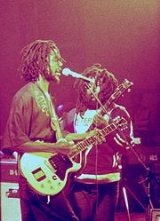
Peter Tosh

Encyclopedia
Peter Tosh, born Winston Hubert McIntosh (19 October 1944 – 11 September 1987), was a Jamaica
n reggae
musician who was a core member of the band The Wailers (1963–1974), and who afterward had a successful solo career as well as being a promoter of Rastafari
.
Peter Tosh was born in Grange Hill, Jamaica
, an illegitimate child to a mother too young to care for him properly. He was raised by his aunt. He began to sing and learn guitar
at an early age, inspired by American radio stations. After a notable career with The Wailers and as a solo musician, he was murdered at his home during a robbery.
. He first picked up a guitar by watching a man in the country play a song that captivated him. He watched the man play the same song for half a day, memorizing everything his fingers were doing. He then picked up the guitar and played the song back to the man whom then asked him who taught him to play and he told him that he did. During the early 1960s Tosh met Robert Nesta Marley, Bob Marley
, and Neville O'Reilly Livingston, Bunny Wailer
and went to vocal teacher, Joe Higgs
, who gave out free vocal lessons to young people, in hopes to form a new band. He to changed his name to become Peter Tosh and the trio started singing together in 1962. Higgs taught the trio to harmonize and while developing their music, they would often play on the street corners of Trenchtown. In 1964, he helped organize the band The Wailing Wailers, with Junior Braithwaite
, a falsetto singer, and backup singers Beverley Kelso
and Cherry Smith
. Initially, Tosh was the only one in the group who could play musical instruments. According to Bunny Wailer
, Tosh was critical to the band because he was a self-taught guitarist and keyboardist, and thus became an inspiration for the other band members to learn to play. The Wailing Wailers had a major ska
hit with their first single, "Simmer Down", and recorded several more successful singles before Braithwaite, Kelso and Smith left the band in late 1965. Marley spent much of 1966 in Delaware
in the United States of America with his mother, Cedella (Malcolm) Marley-Booker and for a brief time was working at a nearby Chrysler
factory. He then returned to Jamaica in early 1967 with a renewed interest in music and a new spirituality. Tosh and Bunny were already Rastafarians when Marley returned from the U.S., and the three became very involved with the Rastafari faith. Soon afterwards, they renamed the musical group The Wailers. Tosh would explain later that they chose the name Wailers because to "wail" means to mourn or to, as he put it, "...express ones feelings vocally". He also claims that he was the beginning of the group and that it he who first taught Bob Marley the guitar. The latter claim may very well be true, for according to Bunny Wailer
, they early wailers learned to play instruments from Tosh.
Rejecting the up-tempo dance of ska, the band slowed their music to a rocksteady
pace, and infused their lyrics with political and social messages inspired by their new found faith. The Wailers composed several songs for the American-born singer Johnny Nash
before teaming with producer Lee Perry to record some of the earliest well-known reggae songs, including "Soul Rebel", "Duppy Conqueror", and "Small Axe". The collaboration had given birth to reggae music and later, bassist Aston "Family Man" Barrett
and his brother, drummer Carlton Barrett
would later join the group in 1970. The band signed a recording contract with Chris Blackwell
and Island Records
company and released their debut, Catch a Fire
, in 1973, following it with Burnin' the same year. The Wailers had moved from many producers after 1970 and there were instances where producers would record rehearsal sessions that Tosh did and release them in England under the name "Peter Touch".
In 1973, Tosh was driving home with his girlfriend Evonne when his car was hit by another car driving on the wrong side of the road. The accident killed Evonne and severely fractured Tosh's skull. He survived, but became more difficult to deal with. After Island Records
president Chris Blackwell
refused to issue his solo album in 1974, Tosh and Bunny Wailer left the Wailers, citing the unfair treatment they received from Blackwell, to whom Tosh often referred with a derogatory play on Blackwell's surname, 'Whiteworst'. Tosh had written many of the Wailers' hit songs such as "Get Up, Stand Up", "400 Years", and "No Sympathy".
, in 1976 with CBS Records
company. The title track soon became popular among endorsers of marijuana legalization, reggae music lovers and Rastafarians all over the world, and was a favourite at Tosh's concerts. As Marley preached his "One Love" message, Tosh criticized the hypocritical "shitstem". He released the album Equal Rights in 1977.
Tosh organized a backing band, Word, Sound and Power
, who were to accompany him on tour for the next few years, and many of whom performed on his albums of this period. In 1978 Rolling Stones Records contracted with Tosh, and the album Bush Doctor
was released, introducing Tosh to a larger audience. The single from the album, a cover version of The Temptations
song Don't Look Back
, performed as a duet with Rolling Stones singer Mick Jagger, made Tosh one of the best-known reggae artists.
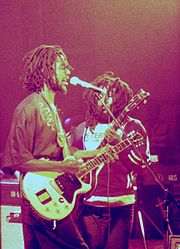 During Bob Marley's free One Love Peace Concert
of 1978, Tosh lit a marijuana spliff
and lectured about legalizing cannabis, lambasting attending dignitaries Michael Manley
and Edward Seaga
for their failure to enact such legislation. Several months later he was apprehended by police as he left Skateland dance hall in Kingston and was beaten severely while in police custody.
Mystic Man
(1979), and Wanted Dread and Alive
(1981) followed. Released on the Rolling Stones' own record label
, Tosh tried to gain some mainstream success while keeping his militant views, but was largely unsuccessful, especially compared to Marley's achievements. That same year, Tosh appeared in the Rolling Stones' video Waiting on a Friend
.
In 1984, after the release of 1983's album Mama Africa
, Tosh went into self-imposed exile, seeking the spiritual advice of traditional medicine men in Africa, and trying to free himself from recording agreements that distributed his records in South Africa.
Tosh had been at odds for several years with his label, EMI
, over a perceived lack of promotion for his music.
Tosh also participated in the international opposition to South African apartheid by appearing at Anti-Apartheid concerts and by conveying his opinion in various songs like "Apartheid" (1977, re-recorded 1987), "Equal Rights" (1977), "Fight On" (1979), and "Not Gonna Give It Up" (1983). In 1991 Stepping Razor - Red X was released, a documentary film by Nicholas Campbell, produced by Wayne Jobson and based upon a series of spoken-word recordings of Tosh himself, which chronicled the story of the artist's life, music and untimely death. In 1987, Peter Tosh seemed to be having a career revival. He was awarded a Grammy Award for Best Reggae Performance in 1987 for No Nuclear War
, his last record.
and Bunny Wailer
during the late 1960s, Peter Tosh became a devotee of Rastafari. Tosh, like Marley, subsequently became a member of the Ethiopian Orthodox Tewahedo Church
.
s and knitting; he became an accomplished unicycle rider, being able to ride forwards and backwards and hop. He often amused his audiences by riding onto the stage on his unicycle for his shows. His teacher for unicycling was Kelly Carrigan. They rode side by side for years.
in 1995 and he remains in jail.
Jamaica
Jamaica is an island nation of the Greater Antilles, in length, up to in width and 10,990 square kilometres in area. It is situated in the Caribbean Sea, about south of Cuba, and west of Hispaniola, the island harbouring the nation-states Haiti and the Dominican Republic...
n reggae
Reggae
Reggae is a music genre first developed in Jamaica in the late 1960s. While sometimes used in a broader sense to refer to most types of Jamaican music, the term reggae more properly denotes a particular music style that originated following on the development of ska and rocksteady.Reggae is based...
musician who was a core member of the band The Wailers (1963–1974), and who afterward had a successful solo career as well as being a promoter of Rastafari
Rastafari movement
The Rastafari movement or Rasta is a new religious movement that arose in the 1930s in Jamaica, which at the time was a country with a predominantly Christian culture where 98% of the people were the black descendants of slaves. Its adherents worship Haile Selassie I, Emperor of Ethiopia , as God...
.
Peter Tosh was born in Grange Hill, Jamaica
Grange Hill, Jamaica
Grange Hill is a settlement in Jamaica. It has a population of 7,190 as of 2009....
, an illegitimate child to a mother too young to care for him properly. He was raised by his aunt. He began to sing and learn guitar
Guitar
The guitar is a plucked string instrument, usually played with fingers or a pick. The guitar consists of a body with a rigid neck to which the strings, generally six in number, are attached. Guitars are traditionally constructed of various woods and strung with animal gut or, more recently, with...
at an early age, inspired by American radio stations. After a notable career with The Wailers and as a solo musician, he was murdered at his home during a robbery.
Early Music and With The Wailers
At the age of fifteen, McIntosh's aunt died and he moved to the slums of Kingston, Jamaica, also known as TrenchtownTrenchtown
Trench Town is a neighborhood located in the parish of St. Andrew which shares municipality with Kingston, the capital and largest city of Jamaica. In the 1960s Trench Town was known as the Hollywood of Jamaica. Today Trench Town boasts the Trench Town Culture Yard Museum, a visitor friendly...
. He first picked up a guitar by watching a man in the country play a song that captivated him. He watched the man play the same song for half a day, memorizing everything his fingers were doing. He then picked up the guitar and played the song back to the man whom then asked him who taught him to play and he told him that he did. During the early 1960s Tosh met Robert Nesta Marley, Bob Marley
Bob Marley
Robert Nesta "Bob" Marley, OM was a Jamaican singer-songwriter and musician. He was the rhythm guitarist and lead singer for the ska, rocksteady and reggae band Bob Marley & The Wailers...
, and Neville O'Reilly Livingston, Bunny Wailer
Bunny Wailer
Bunny Wailer, , also known as Bunny Livingston and affectionately as Jah B, is a singer songwriter and percussionist and was an original member of reggae group The Wailers along with Bob Marley and Peter Tosh...
and went to vocal teacher, Joe Higgs
Joe Higgs
Joe Higgs was a reggae musician from Jamaica. In the late 1950s and 1960s he was part of the duo Higgs and Wilson together with Roy Wilson...
, who gave out free vocal lessons to young people, in hopes to form a new band. He to changed his name to become Peter Tosh and the trio started singing together in 1962. Higgs taught the trio to harmonize and while developing their music, they would often play on the street corners of Trenchtown. In 1964, he helped organize the band The Wailing Wailers, with Junior Braithwaite
Junior Braithwaite
Franklin Delano Alexander Braithwaite, better known as Junior Braithwaite, was a reggae musician from Kingston, Jamaica, the youngest member of the vocal group, The Wailing Wailers. The Wailing Wailers was a vocal group Bob Marley and Bunny Wailer started in 1963, together with Braithwaite, when...
, a falsetto singer, and backup singers Beverley Kelso
Beverley Kelso
Beverley Kelso is a Jamaican singer. She was a backing vocalist, and one of the founding members of The Wailers . The death of Junior Braithwaite in 1999 and the death of Cherry Smith in 2008 left Kelso and Bunny Wailer as the only surviving founding members of the Wailers Beverley Kelso is a...
and Cherry Smith
Cherry Smith
Cherry Smith was a backing vocalist for the original Wailers from 1963 to 1966.Smith was also called Cherry Green , but was born Ermine Ortense Bramwell in the Trench Town district of Kingston. She was nicknamed "Cherry" as a girl due to her light complexion...
. Initially, Tosh was the only one in the group who could play musical instruments. According to Bunny Wailer
Bunny Wailer
Bunny Wailer, , also known as Bunny Livingston and affectionately as Jah B, is a singer songwriter and percussionist and was an original member of reggae group The Wailers along with Bob Marley and Peter Tosh...
, Tosh was critical to the band because he was a self-taught guitarist and keyboardist, and thus became an inspiration for the other band members to learn to play. The Wailing Wailers had a major ska
Ska
Ska |Jamaican]] ) is a music genre that originated in Jamaica in the late 1950s, and was the precursor to rocksteady and reggae. Ska combined elements of Caribbean mento and calypso with American jazz and rhythm and blues...
hit with their first single, "Simmer Down", and recorded several more successful singles before Braithwaite, Kelso and Smith left the band in late 1965. Marley spent much of 1966 in Delaware
Delaware
Delaware is a U.S. state located on the Atlantic Coast in the Mid-Atlantic region of the United States. It is bordered to the south and west by Maryland, and to the north by Pennsylvania...
in the United States of America with his mother, Cedella (Malcolm) Marley-Booker and for a brief time was working at a nearby Chrysler
Chrysler
Chrysler Group LLC is a multinational automaker headquartered in Auburn Hills, Michigan, USA. Chrysler was first organized as the Chrysler Corporation in 1925....
factory. He then returned to Jamaica in early 1967 with a renewed interest in music and a new spirituality. Tosh and Bunny were already Rastafarians when Marley returned from the U.S., and the three became very involved with the Rastafari faith. Soon afterwards, they renamed the musical group The Wailers. Tosh would explain later that they chose the name Wailers because to "wail" means to mourn or to, as he put it, "...express ones feelings vocally". He also claims that he was the beginning of the group and that it he who first taught Bob Marley the guitar. The latter claim may very well be true, for according to Bunny Wailer
Bunny Wailer
Bunny Wailer, , also known as Bunny Livingston and affectionately as Jah B, is a singer songwriter and percussionist and was an original member of reggae group The Wailers along with Bob Marley and Peter Tosh...
, they early wailers learned to play instruments from Tosh.
Rejecting the up-tempo dance of ska, the band slowed their music to a rocksteady
Rocksteady
Rocksteady is a music genre that originated in Jamaica around 1966. A successor to ska and a precursor to reggae, rocksteady was performed by Jamaican vocal harmony groups such as The Gaylads, The Maytals and The Paragons. The term rocksteady comes from a dance style that was mentioned in the Alton...
pace, and infused their lyrics with political and social messages inspired by their new found faith. The Wailers composed several songs for the American-born singer Johnny Nash
Johnny Nash
John Lester "Johnny" Nash, Jr. is an American pop singer-songwriter, best known in the US for his 1972 hit, "I Can See Clearly Now". He was also the first non-Jamaican to record reggae music in Kingston, Jamaica.-Life and career:...
before teaming with producer Lee Perry to record some of the earliest well-known reggae songs, including "Soul Rebel", "Duppy Conqueror", and "Small Axe". The collaboration had given birth to reggae music and later, bassist Aston "Family Man" Barrett
Aston Barrett
Aston Barrett , often called "Family Man" or "Fams" for short, is a Jamaican bass player and Rastafarian.-Biography:...
and his brother, drummer Carlton Barrett
Carlton Barrett
Carlton "Carly" Barrett was an influential reggae drummer and percussion player. His musical development in the early years were with his brother Aston "Family Man" Barrett as a member of Lee "Scratch" Perry's "house band" The Upsetters. The brothers joined Bob Marley and The Wailers around 1970...
would later join the group in 1970. The band signed a recording contract with Chris Blackwell
Chris Blackwell
Christopher Percy Gordon "Chris" Blackwell is a British record producer and businessman, who was the founder of Island Records, acknowledged as the most successful and groundbreaking independent record company in history. Blackwell has been a music industry mogul for over fifty years...
and Island Records
Island Records
Island Records is a record label that was founded by Chris Blackwell in Jamaica. It was based in the United Kingdom for many years and is now owned by Universal Music Group...
company and released their debut, Catch a Fire
Catch a Fire
Catch a Fire is the major-label-debut album for Jamaican reggae band The Wailers, released on Island Records on 13 April 1973. The album established the band as international superstars. Leader Bob Marley in particular became world-famous...
, in 1973, following it with Burnin' the same year. The Wailers had moved from many producers after 1970 and there were instances where producers would record rehearsal sessions that Tosh did and release them in England under the name "Peter Touch".
In 1973, Tosh was driving home with his girlfriend Evonne when his car was hit by another car driving on the wrong side of the road. The accident killed Evonne and severely fractured Tosh's skull. He survived, but became more difficult to deal with. After Island Records
Island Records
Island Records is a record label that was founded by Chris Blackwell in Jamaica. It was based in the United Kingdom for many years and is now owned by Universal Music Group...
president Chris Blackwell
Chris Blackwell
Christopher Percy Gordon "Chris" Blackwell is a British record producer and businessman, who was the founder of Island Records, acknowledged as the most successful and groundbreaking independent record company in history. Blackwell has been a music industry mogul for over fifty years...
refused to issue his solo album in 1974, Tosh and Bunny Wailer left the Wailers, citing the unfair treatment they received from Blackwell, to whom Tosh often referred with a derogatory play on Blackwell's surname, 'Whiteworst'. Tosh had written many of the Wailers' hit songs such as "Get Up, Stand Up", "400 Years", and "No Sympathy".
Solo career
Tosh began recording and released his solo debut, Legalize ItLegalize It
Legalize It is an album by Peter Tosh. It was his debut album as a solo artist. The album was recorded at Treasure Isle and Randy's, Kingston, Jamaica in 1975 and released in 1976....
, in 1976 with CBS Records
CBS Records
CBS Records is a record label founded by CBS Corporation in 2006 to take advantage of music from its entertainment properties owned by CBS Television Studios. The initial label roster consisted of only three artists; rock band Señor Happy and singer/songwriters Will Dailey and P.J...
company. The title track soon became popular among endorsers of marijuana legalization, reggae music lovers and Rastafarians all over the world, and was a favourite at Tosh's concerts. As Marley preached his "One Love" message, Tosh criticized the hypocritical "shitstem". He released the album Equal Rights in 1977.
Tosh organized a backing band, Word, Sound and Power
Word, Sound and Power (Reggae Band)
Word, Sound and Power are a Jamaican reggae band, formed in 1976 as Peter Tosh's backing band after Tosh left The Wailers. They toured with Tosh in America in 1976, and backed him at the One Love Peace Concert...
, who were to accompany him on tour for the next few years, and many of whom performed on his albums of this period. In 1978 Rolling Stones Records contracted with Tosh, and the album Bush Doctor
Bush Doctor
Bush Doctor is an album by Peter Tosh. It was released in 1978.A British record retailer banned the album upon its release because of a scratch-n-sniff sticker on its cover, that apparently smelled of ganja .-Track listing:...
was released, introducing Tosh to a larger audience. The single from the album, a cover version of The Temptations
The Temptations
The Temptations is an American vocal group having achieved fame as one of the most successful acts to record for Motown Records. The group's repertoire has included, at various times during its five-decade career, R&B, doo-wop, funk, disco, soul, and adult contemporary music.Formed in Detroit,...
song Don't Look Back
Don't Look Back (Temptations song)
"Don't Look Back" is a 1965 song recorded by The Temptations for the Gordy label. The flip side to their Top 20 hit "My Baby", "Don't Look Back" broke out and became a hit among the R&B audience on its own, reaching #14 on the R&B charts...
, performed as a duet with Rolling Stones singer Mick Jagger, made Tosh one of the best-known reggae artists.
One Love Peace Concert
The One Love Peace Concert was a large concert held on April 22, 1978 at The National Stadium in Kingston, Jamaica.This concert was held during a political civil war in Jamaica between opposing parties Jamaican Labour Party and the People's National Party...
of 1978, Tosh lit a marijuana spliff
Joint (cannabis)
Joint is a slang term for a cigarette rolled using cannabis. Rolling papers are the most common rolling medium among industrialized countries, however brown paper, cigarettes with the tobacco removed, and newspaper are commonly used in developing countries. Modern papers are now made from a wide...
and lectured about legalizing cannabis, lambasting attending dignitaries Michael Manley
Michael Manley
Michael Norman Manley ON OCC was the fourth Prime Minister of Jamaica . Manley was a democratic socialist....
and Edward Seaga
Edward Seaga
Edward Philip George Seaga ON PC was the fifth Prime Minister of Jamaica from 1980 to 1989 and Leader of the Jamaica Labour Party from 1974 to 2005. He served as leader of the opposition from 1974 to 1980 and again from 1989 until January 2005...
for their failure to enact such legislation. Several months later he was apprehended by police as he left Skateland dance hall in Kingston and was beaten severely while in police custody.
Mystic Man
Mystic Man
Mystic Man is an album by Peter Tosh. All songs were composed by Peter Tosh. It was released in 1979 .-Track listing:All tracks composed by Peter Tosh#"Mystic Man"#"Recruiting Soldiers"#"Can't You See"#"Jah Seh No" #"Fight On"...
(1979), and Wanted Dread and Alive
Wanted Dread and Alive
Wanted Dread And Alive is an album by Peter Tosh. It was released in 1981 in two different versions; one for USA and one for Europe . Reissued by Capitol in 2002 with bonus tracks...
(1981) followed. Released on the Rolling Stones' own record label
Record label
In the music industry, a record label is a brand and a trademark associated with the marketing of music recordings and music videos. Most commonly, a record label is the company that manages such brands and trademarks, coordinates the production, manufacture, distribution, marketing and promotion,...
, Tosh tried to gain some mainstream success while keeping his militant views, but was largely unsuccessful, especially compared to Marley's achievements. That same year, Tosh appeared in the Rolling Stones' video Waiting on a Friend
Waiting On A Friend
"Waiting on a Friend" is a song by The Rolling Stones from their 1981 album Tattoo You. Released as the album's second single, it reached #13 on the US singles chart.-History:...
.
In 1984, after the release of 1983's album Mama Africa
Mama Africa (album)
Mama Africa is an album by Peter Tosh. It was released in 1983 .-Track listing:All tracks composed by Peter Tosh; except where indicated#"Mama Africa" - 7:56#"Glass House" - 5:53#"Not Gonna Give It Up" - 5:45...
, Tosh went into self-imposed exile, seeking the spiritual advice of traditional medicine men in Africa, and trying to free himself from recording agreements that distributed his records in South Africa.
Tosh had been at odds for several years with his label, EMI
EMI
The EMI Group, also known as EMI Music or simply EMI, is a multinational music company headquartered in London, United Kingdom. It is the fourth-largest business group and family of record labels in the recording industry and one of the "big four" record companies. EMI Group also has a major...
, over a perceived lack of promotion for his music.
Tosh also participated in the international opposition to South African apartheid by appearing at Anti-Apartheid concerts and by conveying his opinion in various songs like "Apartheid" (1977, re-recorded 1987), "Equal Rights" (1977), "Fight On" (1979), and "Not Gonna Give It Up" (1983). In 1991 Stepping Razor - Red X was released, a documentary film by Nicholas Campbell, produced by Wayne Jobson and based upon a series of spoken-word recordings of Tosh himself, which chronicled the story of the artist's life, music and untimely death. In 1987, Peter Tosh seemed to be having a career revival. He was awarded a Grammy Award for Best Reggae Performance in 1987 for No Nuclear War
No Nuclear War
No Nuclear War is his seventh and final studio album by Peter Tosh. It was released in 1987 . It received a Grammy for Best Reggae Performance the same year.-Track listing:All tracks composed and arranged by Peter Tosh...
, his last record.
Religion
Along with Bob MarleyBob Marley
Robert Nesta "Bob" Marley, OM was a Jamaican singer-songwriter and musician. He was the rhythm guitarist and lead singer for the ska, rocksteady and reggae band Bob Marley & The Wailers...
and Bunny Wailer
Bunny Wailer
Bunny Wailer, , also known as Bunny Livingston and affectionately as Jah B, is a singer songwriter and percussionist and was an original member of reggae group The Wailers along with Bob Marley and Peter Tosh...
during the late 1960s, Peter Tosh became a devotee of Rastafari. Tosh, like Marley, subsequently became a member of the Ethiopian Orthodox Tewahedo Church
Ethiopian Orthodox Tewahedo Church
The Ethiopian Orthodox Tewahedo Church is the predominant Oriental Orthodox Christian church in Ethiopia. The Ethiopian Church was administratively part of the Coptic Orthodox Church until 1959, when it was granted its own Patriarch by Coptic Orthodox Pope of Alexandria and Patriarch of All...
.
Unicycling
At some point after his departure from the Wailers, Tosh developed an interest in unicycleUnicycle
A unicycle is a human-powered, single-track vehicle with one wheel. Unicycles resemble bicycles, but are less complex.-History:One theory of the advent of the unicycle stems from the popularity of the penny-farthing during the late 19th century...
s and knitting; he became an accomplished unicycle rider, being able to ride forwards and backwards and hop. He often amused his audiences by riding onto the stage on his unicycle for his shows. His teacher for unicycling was Kelly Carrigan. They rode side by side for years.
Death
On 11 September 1987, just after Tosh had returned to his home in Jamaica, a three-man gang came to his house demanding money. Tosh replied that he did not have any with him but the gang did not believe him. They stayed at his residence for several hours in an attempt to extort money from Tosh and tortured him. During this time, many of Tosh's friends came to his house to greet him because of his return to Jamaica. As people arrived, the gunmen became more and more frustrated, especially the chief thug, Dennis 'Leppo' Lobban, a man whom Tosh had previously befriended and tried to help find work after a long jail sentence. Tosh said he did not have any money in the house, after which Lobban put a gun to Tosh's head and shot once, killing him. The other gunmen began shooting, wounding several other people and also killing disc jockey Jeff "Free I" Dixon. Leppo surrendered to the authorities. He was sentenced to death, but his sentence was commutedCommutation of sentence
Commutation of sentence involves the reduction of legal penalties, especially in terms of imprisonment. Unlike a pardon, a commutation does not nullify the conviction and is often conditional. Clemency is a similar term, meaning the lessening of the penalty of the crime without forgiving the crime...
in 1995 and he remains in jail.
Studio albums
- Legalize ItLegalize ItLegalize It is an album by Peter Tosh. It was his debut album as a solo artist. The album was recorded at Treasure Isle and Randy's, Kingston, Jamaica in 1975 and released in 1976....
(1976) - Equal RightsEqual Rights (album)Equal Rights is an album by Peter Tosh. It was released in 1977 .-Track listing:All Songs by Peter Tosh except "Stepping Razor" by Joe Higgs#"Get Up, Stand Up" – 3:29 #"Downpressor Man" – 6:25...
(1977) - Bush DoctorBush DoctorBush Doctor is an album by Peter Tosh. It was released in 1978.A British record retailer banned the album upon its release because of a scratch-n-sniff sticker on its cover, that apparently smelled of ganja .-Track listing:...
(1978) - Mystic ManMystic ManMystic Man is an album by Peter Tosh. All songs were composed by Peter Tosh. It was released in 1979 .-Track listing:All tracks composed by Peter Tosh#"Mystic Man"#"Recruiting Soldiers"#"Can't You See"#"Jah Seh No" #"Fight On"...
(1979) - Wanted Dread And AliveWanted Dread and AliveWanted Dread And Alive is an album by Peter Tosh. It was released in 1981 in two different versions; one for USA and one for Europe . Reissued by Capitol in 2002 with bonus tracks...
(1981) - Mama AfricaMama Africa (album)Mama Africa is an album by Peter Tosh. It was released in 1983 .-Track listing:All tracks composed by Peter Tosh; except where indicated#"Mama Africa" - 7:56#"Glass House" - 5:53#"Not Gonna Give It Up" - 5:45...
(1983) - No Nuclear WarNo Nuclear WarNo Nuclear War is his seventh and final studio album by Peter Tosh. It was released in 1987 . It received a Grammy for Best Reggae Performance the same year.-Track listing:All tracks composed and arranged by Peter Tosh...
(1987)
Live albums
- Captured Live (1984)
- Live at the One Love Peace Concert (2000)
- Live & Dangerous: Boston 1976 (2001)
- Live At The Jamaica World Music Festival 1982 (2002)
- Complete Captured Live (2004)
Compilations
Listed are compilations containing material previously unreleased outside of Jamaica.- The Toughest (Heartbeat) (1996)
- Honorary Citizen (1997)
- Scrolls Of The Prophet: The Best of Peter Tosh (1999)
- Arise Black Man (1999)
- Black Dignity (Early Works Of The Stepping Razor) (2001)
- I Am That I Am (2001)
- The Best Of Peter Tosh 1978-1987 (2003)
- Can't Blame The Youth (2004)
- Black Dignity (JAD) (2004)
- Talking Revolution (2005)
- The Ultimate Peter Tosh Experience (2009)
Appears on
- NegrilNegril (Peter Tosh album)Negril is an instrumental album originally released in 1975 from a session produced, arranged and mostly composed by Eric Gale, and including some of Jamaica's best-known musicians...
(Eric GaleEric GaleEric J. Gale was a leading American jazz and session guitarist.Born in Brooklyn, New York, Gale began playing guitar at the age of 12. Although he majored in chemistry at Niagara University, Gale was determined to pursue a musical career, and began contributing to accompaniments for such stars as...
, 1975) - Blackheart ManBlackheart ManBlackheart Man is the first solo album by Bunny Wailer, originally released on 8 September 1976, in Jamaica on Solomonic Records and internationally on Island Records.-Overview:...
(Bunny WailerBunny WailerBunny Wailer, , also known as Bunny Livingston and affectionately as Jah B, is a singer songwriter and percussionist and was an original member of reggae group The Wailers along with Bob Marley and Peter Tosh...
, 1976) - Protest, (Bunny Wailer, 1977)
See also
- Bob MarleyBob MarleyRobert Nesta "Bob" Marley, OM was a Jamaican singer-songwriter and musician. He was the rhythm guitarist and lead singer for the ska, rocksteady and reggae band Bob Marley & The Wailers...
- Bob Marley and the Wailers
- List of Rastafarians
- List of reggae musicians
- List of vegetarians
- ReggaeReggaeReggae is a music genre first developed in Jamaica in the late 1960s. While sometimes used in a broader sense to refer to most types of Jamaican music, the term reggae more properly denotes a particular music style that originated following on the development of ska and rocksteady.Reggae is based...