

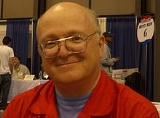
Peter Laird

Encyclopedia
Peter Alan Laird is an American
comic book writer and artist. He is best known for co-creating Teenage Mutant Ninja Turtles
with writer and artist Kevin Eastman
.
, Massachusetts
. Toward the end of 1983, Laird was earning "the princely sum of ten dollars an illustration from a local newspaper in Northampton, Massachusetts
."
self-published the first black & white issue of Teenage Mutant Ninja Turtles, at an initial print run of 3000 copies for the forty-page oversized comic.
It was largely funded by a loan from Eastman's uncle, Quentin (which experience had a profund impact on Laird, and led indirectly to his later work with the Xeric Foundation
), and published by the duos Mirage Studios
, a name chosen because "there wasn’t an actual studio, only kitchen tables and couches with lap boards." That first issue received a number of subsequent printings over the next few years, as the Turtles phenomenon began to take off.
Laird's newspaper experience led to the duo creating "a four-page press kit," that, according to Flaming Carrot-creator Bob Burden
's own Mystery Men
press-kit
included "a story outline and artwork that they sent to 180 TV and radio stations," as well as both the Associated Press
and United Press International
. This led to widespread press coverage of both the TMNT property and Mirage Studios itself, creating "a demand for the interestingly-titled comic that caught everyone by surprise." With the solicitation of their second issue, Eastman and Laird's Turtles comic began a meteoric rise to success, bringing in advance orders of 15,000 copies - five times the initial print run of the first issue. This, Eastman has been quoted as saying:
The Turtles phenomenon saw the duo invited to their first comics convention
at the tenth annual Atlanta Fantasy Fair in 1984, where they mingled with the likes of Larry Niven
, Forrest J Ackerman
and Fred Hembeck
(among others).
With their (November 1985) fifth issue, Teenage Mutant Ninja Turtles downsized to the more "normal" American comics-format and size, and the previous four issues were also reprinted in this size and format with new, color, covers. Also in 1985, Solson Publishing released a "How to draw" volume entitled How to draw Eastman and Laird's Teenage Mutant Ninja Turtles (Solson would also produce six issues of a TMNT "Authorized Training Manual" as well as a "Teenage Mutant Ninja Turtles Teach Karate" volume in 1987.)
This led to increased pressures on the two creators (and the team which they formed to help them), including a prolonged period (about a year) of artist's block
in Laird. The "incredible growth and complexity of the business" that sprang up around their instantly-successful Turtles properties, led to Laird:
Laird and Eastman's creations went on to become a popular cultural phenomenon, forcing both of them to take regular sabbaticals from the comic to deal with the day to day pressures of running what became a multimedia franchise. Eastman eventually sold his share of the franchise to Laird (and the Mirage Group) on June 1, 2000, except for a small continuing income participation. On March 1, 2008, Laird and Mirage bought out the remaining rights and interest of Eastman, and the two went their completely separate ways.
Laird believes that the reasoning was simply that Eastman "was just tired of it. He wanted to move on and has other things to spend more time on."
On October 19, 2009, Laird sold the franchise to Viacom
/Nickelodeon
, but still retains the rights to do up 18 black-and-white TMNT comics per year.
canon of the franchise with "Volume Four" (the third published by Mirage Studios), with artwork supplied by fellow TMNT writer, friend, and Rat King
creator Jim Lawson
. When the new series proved a success, Laird relaunched Tales of the TMNT
to accompany the fourth volume.
Following a successful deal to revive the Turtles theatrically, Laird put Volume Four on hold to develop the new movie; he has yet to return to the comic, leaving several plot lines unresolved. Tales of the TMNT was thought to go on hiatus in 2008, and the franchise's future beyond its on-screen presence was uncertain, but staff confirmed that this was not the case. It was confirmed on Steve Murphy's blog that Peter Laird was intending to return to Volume 4 and that the title would return, distributed digitally by Mirage.
, brought on in 1984 as a letterer
.
In 1985, Eastman and Laird hired Cleveland
artist Ryan Brown
to assist them as an inker
, and a year later penciler Jim Lawson
cover painter Michael Dooney
joined the studio. These six individuals would allow Mirage to expand into a number of spin-off and companion titles, starting with Tales of the Teenage Mutant Ninja Turtles
, designed to fill in continuity gaps in the main title. Operating from a renovated factory space in Florence, Massachusetts
, the Mirage team produced most of their work in-house, including the Playmates toy designs and the Archie TMNT comic series, until Tundra Publishing took over the building.
Eastman and Laird along with Brown, Dooney, Lavigne and Lawson toured extensively over the years, making personal appearances and attending many comic book conventions. As the Turtles' popularity increased, further people were added to the studio, including Eric Talbot
(who attended Eastman and Lavigne's old high school), writer Stephen Murphy, and Brown's friend, Dan Berger
, who was brought in from Ohio to ink the Teenage Mutant Ninja Turtles Adventures
title from Archie Comics
. Aside from Eastman (whose creative differences and other pursuits saw him leave and sell his interest to Laird and Mirage), these individuals have remained with Mirage to the present. Stephen Murphy stepped down from his position as Managing Editor in summer, 2007 in favor of Dan Berger; Murphy remains as Creative Director.
In 1988
, Mirage Studios participated in the drafting of the Creator's Bill of Rights
for comic book creators.
to embody the ideals of the Creator's Bill of Rights
from a publishers standpoint, Laird's vision involved funding rather than actively publishing individuals' work. His reasoning for this decision was in part simply due to him having "far too much to do as it is with Mirage
." He "preferred to do something where it was more of a transfer of capital," with "all the worries... on other people's shoulders." The foundation itself, he explains is:
That later half is perhaps what the foundation is best known for, working much the same as any benevolent fund, involving an applicatory process detailing how much money is being applied for and why.
, Dave Sim
and others had (which led directly to the formalising of the "Creator's Bill of Rights," setting out in writing the necessary working arrangements that comics creator's felt ought to be met regarding ownership of their work and proper remuneration, etc.) in informing his decision to set up the Foundation, but also notes that he received "many requests for money," necessitating the creation of the Xeric Foundation's charitable end simply to deal with such requests "in an organized fashion."
Indeed, when asked in an interview on the Project Fanboy
website, Laird was quoted as saying:
Laird recalled that the publication of the first issue of his and Eastman's Teenage Mutant Ninja Turtles comic came about thanks to a loan the two secured from Quentin Eastman, Kevin's uncle. Although the two were able to pay him back swiftly, it led Laird to speculate about what could have been:
It occurred to him that "there must be so many times where a self-publishing venture can sink or float on the strength of" a relatively small amount of money, so he felt a desire to use some of his "good fortune, in the financial sense, to help people out" (and, in addition to the creators, the Foundation also aids those "involved in charitable organizations").
Moreover, he cites "[a] big difference" between his and Eastman's personal Turtles situation and the charitable foundation as being "that the Xeric grants are not loans, which have to be paid back, but actual grants, which do not." He "credit[s] Kendall Clark, who has run the foundation for me from the beginning, as one of the main reasons it has worked as well as it has... she's done a wonderful job."
game with [Laird's] brother Don," "Xeric" simply being "a word [he] like[d]" ostensibly meaning dry and desertlike - but which ultimately "has absolutely no direct connection with the foundation."
The creative side of the Foundation involves the usual application process, but in addition, the Foundation began with "an advisory committee made up of three... people working in the industry" whose input is sought on how best to proceed with each application. Submissions are evaluated prior to Laird's involvement, and then he makes the ultimate decisions based on their recommendations. Laird stated in 1993 that:
He hoped that ultimately the figure can be raised from "thousands of dollars" to "hundreds of thousands of dollars," to support an increasing number of large and small projects.
(1993), David Lasky
(1993), Jason Lutes
(1993), Adrian Tomine
(1993), Tom Hart
(1994), Jessica Abel
(1995), James Sturm
(1996), Ellen Forney
(1997), Jim Ottaviani
(1997), Gene Yang
(1997), Jason Little
(1998), David Choe
(1999), Nick Bertozzi
(1999), Jason Shiga
(1999), Farel Dalrymple
(2000), Anders Nilsen
(2000), Leland Purvis
(2000), Jordan Crane
(2001), Brian Ralph
(2001), Hans Rickheit
(2001), Donna Barr
(2002), Derek Kirk Kim (2002), Lauren Weinstein
(2002), Josh Neufeld
(2004), Karl Stevens
(2004), and David Heatley
(2005).
Since that time, Laird has been able to find time to pursue some other comic book work, including publishing the graphic novel trilogy, Planet Racer, with Jim Lawson. Even this ties into the TMNT, however, since in season 3 of the 2003 TMNT series, an episode was based on the Planet Racer' s theme.
United States
The United States of America is a federal constitutional republic comprising fifty states and a federal district...
comic book writer and artist. He is best known for co-creating Teenage Mutant Ninja Turtles
Teenage Mutant Ninja Turtles
The Teenage Mutant Ninja Turtles are a fictional team of four teenage anthropomorphic turtles, who were trained by their anthropomorphic rat sensei in the art of ninjutsu and named after four Renaissance artists...
with writer and artist Kevin Eastman
Kevin Eastman
Kevin Brooks Eastman is an American comic book artist and writer, best known as the creator of the Teenage Mutant Ninja Turtles. Eastman is also the current owner, editor and publisher of the magazine Heavy Metal.-Early life:Eastman was born on May 30, 1962 in Springvale, Maine...
.
Early life and career
Peter Laird was born on January 27, 1954 in North AdamsNorth Adams, Massachusetts
North Adams is a city in Berkshire County, Massachusetts, United States. It is part of the Pittsfield, Massachusetts Metropolitan Statistical Area. The population was 13,708 as of the 2010 census, making it the least populous city in the state...
, Massachusetts
Massachusetts
The Commonwealth of Massachusetts is a state in the New England region of the northeastern United States of America. It is bordered by Rhode Island and Connecticut to the south, New York to the west, and Vermont and New Hampshire to the north; at its east lies the Atlantic Ocean. As of the 2010...
. Toward the end of 1983, Laird was earning "the princely sum of ten dollars an illustration from a local newspaper in Northampton, Massachusetts
Northampton, Massachusetts
The city of Northampton is the county seat of Hampshire County, Massachusetts, United States. As of the 2010 census, the population of Northampton's central neighborhoods, was 28,549...
."
Teenage Mutant Ninja Turtles
In May 1984, Laird and Kevin EastmanKevin Eastman
Kevin Brooks Eastman is an American comic book artist and writer, best known as the creator of the Teenage Mutant Ninja Turtles. Eastman is also the current owner, editor and publisher of the magazine Heavy Metal.-Early life:Eastman was born on May 30, 1962 in Springvale, Maine...
self-published the first black & white issue of Teenage Mutant Ninja Turtles, at an initial print run of 3000 copies for the forty-page oversized comic.
It was largely funded by a loan from Eastman's uncle, Quentin (which experience had a profund impact on Laird, and led indirectly to his later work with the Xeric Foundation
Xeric Foundation
The Xeric Foundation is a private, nonprofit corporation based in Northampton, Massachusetts, which for twenty years awarded self-publishing grants to comic book creators, as well as qualified charitable and nonprofit organizations...
), and published by the duos Mirage Studios
Mirage Studios
Mirage Studios is an independent American comic book company founded in 1983 by Kevin Eastman and Peter Laird, based in Northampton, Massachusetts and best known for the Teenage Mutant Ninja Turtles comic book series.-History:...
, a name chosen because "there wasn’t an actual studio, only kitchen tables and couches with lap boards." That first issue received a number of subsequent printings over the next few years, as the Turtles phenomenon began to take off.
Laird's newspaper experience led to the duo creating "a four-page press kit," that, according to Flaming Carrot-creator Bob Burden
Bob Burden
Bob Burden is an American comic book artist and writer, best known as the creator of Flaming Carrot Comics and the Mystery Men.-Early life:Burden grew up in the industrial rust belt of the Northeast United States...
's own Mystery Men
Mystery Men
Mystery Men is a 1999 comedy film based on a Dark Horse comic book series feature in Flaming Carrot Comics by Bob Burden, directed by TV commercial director Kinka Usher. It stars William H. Macy, Ben Stiller, and Hank Azaria as a trio of lesser superheroes with fairly unimpressive superpowers who...
press-kit
Press kit
A press kit, often referred to as a media kit in business environments, is a pre-packaged set of promotional materials of a person, company, or organization distributed to members of the media for promotional use...
included "a story outline and artwork that they sent to 180 TV and radio stations," as well as both the Associated Press
Associated Press
The Associated Press is an American news agency. The AP is a cooperative owned by its contributing newspapers, radio and television stations in the United States, which both contribute stories to the AP and use material written by its staff journalists...
and United Press International
United Press International
United Press International is a once-major international news agency, whose newswires, photo, news film and audio services provided news material to thousands of newspapers, magazines and radio and television stations for most of the twentieth century...
. This led to widespread press coverage of both the TMNT property and Mirage Studios itself, creating "a demand for the interestingly-titled comic that caught everyone by surprise." With the solicitation of their second issue, Eastman and Laird's Turtles comic began a meteoric rise to success, bringing in advance orders of 15,000 copies - five times the initial print run of the first issue. This, Eastman has been quoted as saying:
- "basically ended up with us clearing a profit of two thousand dollars apiece. Which allowed us to write and draw stories full time: it was enough to pay the rent, pay the bills, and buy enough macaroni and cheese and pencils to live on."
The Turtles phenomenon saw the duo invited to their first comics convention
Fan convention
A fan convention, or con , is an event in which fans of a particular film, television series, comic book, actor, or an entire genre of entertainment such as science fiction or anime and manga, gather to participate and hold programs and other events, and to meet experts, famous personalities, and...
at the tenth annual Atlanta Fantasy Fair in 1984, where they mingled with the likes of Larry Niven
Larry Niven
Laurence van Cott Niven / ˈlæri ˈnɪvən/ is an American science fiction author. His best-known work is Ringworld , which received Hugo, Locus, Ditmar, and Nebula awards. His work is primarily hard science fiction, using big science concepts and theoretical physics...
, Forrest J Ackerman
Forrest J Ackerman
Forrest J Ackerman was an American collector of science fiction books and movie memorabilia and a science fiction fan...
and Fred Hembeck
Fred Hembeck
Fred Hembeck is an American cartoonist best known for his parodies of characters from major American comic book publishers. His work has frequently been published by the firms whose characters he spoofs. His characters are always drawn with curlicues at the elbows and knees...
(among others).
With their (November 1985) fifth issue, Teenage Mutant Ninja Turtles downsized to the more "normal" American comics-format and size, and the previous four issues were also reprinted in this size and format with new, color, covers. Also in 1985, Solson Publishing released a "How to draw" volume entitled How to draw Eastman and Laird's Teenage Mutant Ninja Turtles (Solson would also produce six issues of a TMNT "Authorized Training Manual" as well as a "Teenage Mutant Ninja Turtles Teach Karate" volume in 1987.)
Unexpected success
That the Teenage Mutant Ninja Turtles became such a success (and in such a short space of time) came as a surprise to both Eastman and Laird. Laird has stated on several occasions that:This led to increased pressures on the two creators (and the team which they formed to help them), including a prolonged period (about a year) of artist's block
Writer's block
Writer's block is a condition, primarily associated with writing as a profession, in which an author loses the ability to produce new work. The condition varies widely in intensity. It can be trivial, a temporary difficulty in dealing with the task at hand. At the other extreme, some "blocked"...
in Laird. The "incredible growth and complexity of the business" that sprang up around their instantly-successful Turtles properties, led to Laird:
- "suddenly discover[ing] to my horror that I no longer enjoyed drawing. It was a real shock, because if I ever had anything that I could rely on... it was that I loved to draw."
Laird and Eastman's creations went on to become a popular cultural phenomenon, forcing both of them to take regular sabbaticals from the comic to deal with the day to day pressures of running what became a multimedia franchise. Eastman eventually sold his share of the franchise to Laird (and the Mirage Group) on June 1, 2000, except for a small continuing income participation. On March 1, 2008, Laird and Mirage bought out the remaining rights and interest of Eastman, and the two went their completely separate ways.
Laird believes that the reasoning was simply that Eastman "was just tired of it. He wanted to move on and has other things to spend more time on."
On October 19, 2009, Laird sold the franchise to Viacom
Viacom
Viacom Inc. , short for "Video & Audio Communications", is an American media conglomerate with interests primarily in, but not limited to, cinema and cable television...
/Nickelodeon
Nickelodeon (TV channel)
Nickelodeon, often simply called Nick and originally named Pinwheel, is an American children's channel owned by MTV Networks, a subsidiary of Viacom International. The channel is primarily aimed at children ages 7–17, with the exception of their weekday morning program block aimed at preschoolers...
, but still retains the rights to do up 18 black-and-white TMNT comics per year.
Animation
Although ostensibly over-seeing the animated Turtles projects through Mirage, Laird had minimal hands-on involvement in the development of the original animated series, and even less with the Next Mutation series. However, he took a more active role in the next - TMNT - animated venture, acting as "a consultant, and... working with the guy I consider the head writer, Lloyd Goldfine." In this role, he says "[f]rom the get-go I've been looking at everything, from day one. Story premises, outlines, the full scripts and the sketching and designing of characters and settings. I've been doing a little drawing myself. Lots of suggestions. I've seen a few of the episodes, and it's neat to see a lot of the stuff I've worked on." While final preparations were underway, he relaunched the official comicsTeenage Mutant Ninja Turtles (Mirage Studios)
Teenage Mutant Ninja Turtles is an American comic book published by Mirage Studios from 1984 to 2009. Originally conceived by Kevin Eastman and Peter Laird as a one-off parody, the comic's popularity has gone on to inspire a major pop culture franchise, including three television series, four...
canon of the franchise with "Volume Four" (the third published by Mirage Studios), with artwork supplied by fellow TMNT writer, friend, and Rat King
Rat King
The Rat King is a fictional character from the Teenage Mutant Ninja Turtles multimedia franchise. The character was created by Jim Lawson and first appeared in the comic Tales of the Teenage Mutant Ninja Turtles #4 written by Kevin Eastman and Peter Laird and has made various appearances since, in...
creator Jim Lawson
Jim Lawson
Jim Lawson is an American comic book artist best known for his work on the Teenage Mutant Ninja Turtles series. Lawson created the Rat King and also co-created the series Planet Racers with Peter Laird. He is also the writer/artist of the black-and white-comic series Paleo: Tales of the Late...
. When the new series proved a success, Laird relaunched Tales of the TMNT
Tales of the Teenage Mutant Ninja Turtles
Tales of the Teenage Mutant Ninja Turtles is an anthology comic book series published by Mirage Studios presenting additional stories featuring the Teenage Mutant Ninja Turtles and their supporting cast as a companion book to the main Turtles series filling in the gaps of continuity in the TMNT...
to accompany the fourth volume.
Following a successful deal to revive the Turtles theatrically, Laird put Volume Four on hold to develop the new movie; he has yet to return to the comic, leaving several plot lines unresolved. Tales of the TMNT was thought to go on hiatus in 2008, and the franchise's future beyond its on-screen presence was uncertain, but staff confirmed that this was not the case. It was confirmed on Steve Murphy's blog that Peter Laird was intending to return to Volume 4 and that the title would return, distributed digitally by Mirage.
Mirage Studios
The name "Mirage Studios" was chosen because of Eastman and Laird's lack of a professional art studio at the start of their career, before their creation made them both multi-millionaires. With the success of the Teenage Mutant Ninja Turtles, Eastman and Laird hired a core group of artists to help with the increasing workload, beginning with Eastman's high school friend Steve LavigneSteve Lavigne
Steve Lavigne is an American comic book illustrator best known for his lettering and coloring on the Teenage Mutant Ninja Turtles title for Mirage Studios. He is the creator of Cudley the Cowlick, Sgt...
, brought on in 1984 as a letterer
Letterer
A letterer is a member of a team of comic book creators responsible for drawing the comic book's text. The letterer's use of typefaces, calligraphy, letter size, and layout all contribute to the impact of the comic. The letterer crafts the comic's "display lettering": the story title lettering and...
.
In 1985, Eastman and Laird hired Cleveland
Cleveland, Ohio
Cleveland is a city in the U.S. state of Ohio and is the county seat of Cuyahoga County, the most populous county in the state. The city is located in northeastern Ohio on the southern shore of Lake Erie, approximately west of the Pennsylvania border...
artist Ryan Brown
Ryan Brown (comics)
Ryan Brown is a comic book artist best known for his work on Teenage Mutant Ninja Turtles.-Career:Brown began inking the Teenage Mutant Ninja Turtles in 1985 and continued until 1988, when he and partner Steve Lavigne began producing artwork for licensed TMNT products...
to assist them as an inker
Inker
The inker is one of the two line artists in a traditional comic book or graphic novel. After a pencilled drawing is given to the inker, the inker uses black ink to produce refined outlines over the pencil lines...
, and a year later penciler Jim Lawson
Jim Lawson
Jim Lawson is an American comic book artist best known for his work on the Teenage Mutant Ninja Turtles series. Lawson created the Rat King and also co-created the series Planet Racers with Peter Laird. He is also the writer/artist of the black-and white-comic series Paleo: Tales of the Late...
cover painter Michael Dooney
Michael Dooney
Michael Dooney is an American comic book artist and toy designer best known for his works on the Teenage Mutant Ninja Turtles series. Dooney also created the comic book series, Gizmo in 1986 under Mirage Studios.-External links:...
joined the studio. These six individuals would allow Mirage to expand into a number of spin-off and companion titles, starting with Tales of the Teenage Mutant Ninja Turtles
Tales of the Teenage Mutant Ninja Turtles
Tales of the Teenage Mutant Ninja Turtles is an anthology comic book series published by Mirage Studios presenting additional stories featuring the Teenage Mutant Ninja Turtles and their supporting cast as a companion book to the main Turtles series filling in the gaps of continuity in the TMNT...
, designed to fill in continuity gaps in the main title. Operating from a renovated factory space in Florence, Massachusetts
Florence, Massachusetts
Florence is a village in the northwestern portion of the city of Northampton, near Westhampton and Williamsburg in the U.S. state of Massachusetts.-The naming of Florence, Massachusetts:The name "Florence" was suggested by neurologist Dr...
, the Mirage team produced most of their work in-house, including the Playmates toy designs and the Archie TMNT comic series, until Tundra Publishing took over the building.
Eastman and Laird along with Brown, Dooney, Lavigne and Lawson toured extensively over the years, making personal appearances and attending many comic book conventions. As the Turtles' popularity increased, further people were added to the studio, including Eric Talbot
Eric Talbot
Eric Talbot is an American comic book artist known for his work on the Teenage Mutant Ninja Turtles series under Mirage Studios.Talbot co-wrote the graphic novel The Melting Pot along with Kevin Eastman and Simon Bisley, which was used as the basis for the film Heavy Metal 2000.-External links:* *...
(who attended Eastman and Lavigne's old high school), writer Stephen Murphy, and Brown's friend, Dan Berger
Dan Berger
Dan Berger is an American comic book artist best known for his work on the Teenage Mutant Ninja Turtles series.Berger began his career working on the TMNT Adventures series published by Archie Comics and officially began working on TMNT in August 1989...
, who was brought in from Ohio to ink the Teenage Mutant Ninja Turtles Adventures
Teenage Mutant Ninja Turtles Adventures
Teenage Mutant Ninja Turtles Adventures was a comic book series published from August 1988 to October 1995 by Archie Comics. It is mainly based on the stories of the mutant turtles Donatello, Leonardo, Michaelangelo, Raphael, and their rat sensei Splinter...
title from Archie Comics
Archie Comics
Archie Comics is an American comic book publisher headquartered in the Village of Mamaroneck, Town of Mamaroneck, New York, known for its many series featuring the fictional teenagers Archie Andrews, Betty Cooper, Veronica Lodge, Reggie Mantle and Jughead Jones. The characters were created by...
. Aside from Eastman (whose creative differences and other pursuits saw him leave and sell his interest to Laird and Mirage), these individuals have remained with Mirage to the present. Stephen Murphy stepped down from his position as Managing Editor in summer, 2007 in favor of Dan Berger; Murphy remains as Creative Director.
In 1988
1988 in comics
-Events and publications:* Jack Binder, creator of the original Daredevil, dies at c. age 86.* Tarpé Mills, creator Miss Fury, dies at c. age 73....
, Mirage Studios participated in the drafting of the Creator's Bill of Rights
Creator's Bill of Rights
The Creator's Bill of Rights was a document drafted in November 1988 by a number of independent comic book artists and writers, designed to protect their rights as creators and aid against their exploitation by corporate work for hire practices...
for comic book creators.
The Xeric Foundation
In addition to his other interests, Laird founded the Xeric Foundation, a nonprofit organization created after considerable thought, as "an appropriate way to give back something extra to the comics world," by providing grants for self-publishers. While Eastman founded Tundra PublishingTundra Publishing
Tundra Publishing was a Northampton, Massachusetts-based comic book publisher founded by Kevin Eastman in 1990.-Overview:Tundra was meant to provide a venue for high-quality work by talented cartoonists and illustrators. Its publications were noted in the trade for their high production values,...
to embody the ideals of the Creator's Bill of Rights
Creator's Bill of Rights
The Creator's Bill of Rights was a document drafted in November 1988 by a number of independent comic book artists and writers, designed to protect their rights as creators and aid against their exploitation by corporate work for hire practices...
from a publishers standpoint, Laird's vision involved funding rather than actively publishing individuals' work. His reasoning for this decision was in part simply due to him having "far too much to do as it is with Mirage
Mirage Studios
Mirage Studios is an independent American comic book company founded in 1983 by Kevin Eastman and Peter Laird, based in Northampton, Massachusetts and best known for the Teenage Mutant Ninja Turtles comic book series.-History:...
." He "preferred to do something where it was more of a transfer of capital," with "all the worries... on other people's shoulders." The foundation itself, he explains is:
That later half is perhaps what the foundation is best known for, working much the same as any benevolent fund, involving an applicatory process detailing how much money is being applied for and why.
Origins
Laird's "experience with the Turtles and self-publishing" was a learning process that, he felt "would be very valuable to other people to go through" as well, "in teaching creators about themselves, about life [and] about the hard reality of business." He cites the summits he, Eastman, Scott McCloudScott McCloud
Scott McCloud is an American cartoonist and theorist on comics as a distinct literary and artistic medium...
, Dave Sim
Dave Sim
David Victor Sim is an award-winning Canadian comic book writer and artist.A pioneer of self-published comics and creators' rights, Sim is best known as the creator of Cerebus the Aardvark, a comic book published from 1977 to 2004, which chronicles its main character in a 6,000-page self-contained...
and others had (which led directly to the formalising of the "Creator's Bill of Rights," setting out in writing the necessary working arrangements that comics creator's felt ought to be met regarding ownership of their work and proper remuneration, etc.) in informing his decision to set up the Foundation, but also notes that he received "many requests for money," necessitating the creation of the Xeric Foundation's charitable end simply to deal with such requests "in an organized fashion."
Indeed, when asked in an interview on the Project Fanboy
Project Fanboy
Project Fanboy is an American website that publishes news, interviews and reviews about the American comic book industry. In addition, the site is host to comic-book fan voted awards...
website, Laird was quoted as saying:
"The initial impetus for creating the Xeric Foundation was frustration -- when the Turtle thing started getting really huge, people started coming out of the woodwork to ask for money. Many of them were legitimate charitable organizations or creators needing funding, but there were also quite a few ridiculous things -- like the total stranger who asked me for a quarter of a million dollars to fund his general store. It got to the point where I was getting overwhelmed with making these kinds of decisions, and it was suggested to me that a foundation might be a good way to "separate the wheat from the chaff", providing official and clearly delineated channels through which people looking for money had to make their way."
Laird recalled that the publication of the first issue of his and Eastman's Teenage Mutant Ninja Turtles comic came about thanks to a loan the two secured from Quentin Eastman, Kevin's uncle. Although the two were able to pay him back swiftly, it led Laird to speculate about what could have been:
- "if we hadn't gotten that loan from him at that point in our lives, it might have taken us a couple more months to raise that money from other sources, and who knows what might have happened differently as a result of that delay?"
It occurred to him that "there must be so many times where a self-publishing venture can sink or float on the strength of" a relatively small amount of money, so he felt a desire to use some of his "good fortune, in the financial sense, to help people out" (and, in addition to the creators, the Foundation also aids those "involved in charitable organizations").
Moreover, he cites "[a] big difference" between his and Eastman's personal Turtles situation and the charitable foundation as being "that the Xeric grants are not loans, which have to be paid back, but actual grants, which do not." He "credit[s] Kendall Clark, who has run the foundation for me from the beginning, as one of the main reasons it has worked as well as it has... she's done a wonderful job."
Naming and process
The naming of the Foundation "originated out of a ScrabbleScrabble
Scrabble is a word game in which two to four players score points by forming words from individual lettered tiles on a game board marked with a 15-by-15 grid. The words are formed across and down in crossword fashion and must appear in a standard dictionary. Official reference works provide a list...
game with [Laird's] brother Don," "Xeric" simply being "a word [he] like[d]" ostensibly meaning dry and desertlike - but which ultimately "has absolutely no direct connection with the foundation."
The creative side of the Foundation involves the usual application process, but in addition, the Foundation began with "an advisory committee made up of three... people working in the industry" whose input is sought on how best to proceed with each application. Submissions are evaluated prior to Laird's involvement, and then he makes the ultimate decisions based on their recommendations. Laird stated in 1993 that:
He hoped that ultimately the figure can be raised from "thousands of dollars" to "hundreds of thousands of dollars," to support an increasing number of large and small projects.
Xeric Grant winners
Notable past winners of the Xeric Grant include Megan KelsoMegan Kelso
Megan Kelso is an American comic book artist and writer.Kelso started working in the 1990s, with the minicomic Girlhero, which won her a Xeric Foundation grant in 1993. She has since published several other projects including Queen of the Black Black and The Squirrel Mother...
(1993), David Lasky
David Lasky
David Lasky is an alternative cartoonist based in Seattle, Washington.After spending the bulk of his life in Virginia, and graduating from the College of William & Mary, Lasky moved to Seattle in 1992...
(1993), Jason Lutes
Jason Lutes
Jason Lutes is an American comics creator. His work is mainly historical fiction, but he also works in traditional fiction...
(1993), Adrian Tomine
Adrian Tomine
Adrian Tomine , a popular contemporary cartoonist, is best known for his ongoing comic book series Optic Nerve and his periodical illustrations in The New Yorker.- Biography :...
(1993), Tom Hart
Tom Hart (comics)
Tom Hart is an American comics creator best known for his Hutch Owen series of comics.-Career:Tom Hart began making mini-comics while living in Seattle in the early 1990s...
(1994), Jessica Abel
Jessica Abel
Jessica Abel is an American comic book writer and artist, known as the creator of such works as Life Sucks, Drawing Words & Writing Pictures, Soundtrack, La Perdida, Mirror, Window, Radio: An Illustrated Guide , and the omnibus series Artbabe.Abel has stated that her major work is not...
(1995), James Sturm
James Sturm
James Sturm is an American cartoonist, Xeric Award-winner, and co-founder of the Center for Cartoon Studies in White River Junction, Vermont...
(1996), Ellen Forney
Ellen Forney
Ellen Forney is a cartoonist and teacher based in Seattle, Washington, whose work has been published by Fantagraphics Books and The Stranger , among other publications. Her most recent collection is called Lust...
(1997), Jim Ottaviani
Jim Ottaviani
Jim Ottaviani is the author of several comic books about the history of science. His best-known work, Two-Fisted Science: Stories About Scientists, features biographical stories about Galileo Galilei, Isaac Newton, Niels Bohr, and several stories about physicist Richard Feynman...
(1997), Gene Yang
Gene Yang
Gene Luen Yang is an American comics artist whose graphic novel American Born Chinese was named a 2006 finalist for the National Book Award in the young people's literature category and was awarded the 2007 Members' Choice Award from the Asian American Literary Awards...
(1997), Jason Little
Jason Little (cartoonist)
Jason Palmer Little is an American cartoonist.He grew up in Binghamton, New York, studied photography at Oberlin College, and now lives in Brooklyn with writer Myla Goldberg and their two daughters....
(1998), David Choe
David Choe
David Choe is an American painter, muralist, graffiti artist and graphic novelist of Korean descent. He achieved art world success with his "dirty style" figure paintings—raw, frenetic works which combine themes of desire, degradation, and exaltation...
(1999), Nick Bertozzi
Nick Bertozzi
Nick Bertozzi is an American comic book writer and artist, as well as a commercial illustrator and teacher of cartooning. His series Rubber Necker from Alternative Comics won the 2003 Harvey Awards for best new talent and best new series. His project, The Salon Nick Bertozzi (born May 26, 1970)...
(1999), Jason Shiga
Jason Shiga
Jason Shiga is an Asian American cartoonist who incorporates puzzles, mysteries and unconventional narrative techniques into his work.-Early life:...
(1999), Farel Dalrymple
Farel Dalrymple
Farel Dalrymple is an American artist and alternative comics creator. He is best known for his award-winning comics series Pop Gun War.-Career:...
(2000), Anders Nilsen
Anders Nilsen
Anders Nilsen is a popular artist and graphic novelist who grew up in Minneapolis and lives in Chicago, IL.He works on an ongoing comic series, Big Questions , which has been nominated several times for the Ignatz Award. In addition, his comics have appeared in the anthologies Kramers Ergot and Mome...
(2000), Leland Purvis
Leland Purvis
Leland Purvis is a comic book writer and artist, best known for his black and white series Vóx and Pubo.-Awards:Purvis was nominated for the 2004 Ignatz Award for Promising New Talent for his work on Suspended in Language...
(2000), Jordan Crane
Jordan Crane
Jordan Crane is an American comics creator.Crane first emerged in 1996 with the anthology NON, which he edited, contributed to, and published. This anthology combines influences from Art Spiegelman’s RAW and newer comics artists...
(2001), Brian Ralph
Brian Ralph
Brian Ralph is a U.S. alternative cartoonist. His illustrations have appeared in Wired and the New York Post. His debut graphic novel Cave-In was nominated for three Harvey Awards, one Eisner Award, and listed as one of the Comics Journals "five best comics of 1999". His second graphic novel...
(2001), Hans Rickheit
Hans Rickheit
-Profile:Rickheit was originally a resident of Ashburnham, Massachusetts. He originally self-published minicomics which presented dark vignettes and short stories, many of them directly inspired by dreams. He also produced short films....
(2001), Donna Barr
Donna Barr
Donna Barr is an American comic book author and cartoonist.She was born in Everett, Washington, the second child in a family of six siblings....
(2002), Derek Kirk Kim (2002), Lauren Weinstein
Lauren Weinstein (comic book artist)
Lauren R. Weinstein is an American comic book artist. Her surrealist alternative comics detail a complex world where a pall of mystery, sexual intrigue and violent death hangs over the animal kingdom, outer space and suburban America alike...
(2002), Josh Neufeld
Josh Neufeld
Josh Neufeld is an alternative cartoonist known for his nonfiction comics on subjects like Hurricane Katrina, international travel, and finance, as well as his collaborations with writers like Harvey Pekar and Brooke Gladstone...
(2004), Karl Stevens
Karl Stevens
Karl Stevens is a graphic novelist and painter. His first book, Guilty, was published in 2004 with a grant from the Xeric Foundation. He is also the author of Whatever and The Lodger...
(2004), and David Heatley
David Heatley
David Heatley is an American cartoonist, illustrator, graphic designer and musician.- Education :Born in Teaneck, New Jersey, Heatley graduated from Teaneck High School in 1993. He graduated from the San Francisco Art Institute in 2000.-Comics:Though he studied painting and filmmaking at Oberlin,...
(2005).
Other work
In a 1993 interview with Stephen Bissette and Stanley Wiater, interviewer-editors of Comic Book Rebels, Laird commented:Since that time, Laird has been able to find time to pursue some other comic book work, including publishing the graphic novel trilogy, Planet Racer, with Jim Lawson. Even this ties into the TMNT, however, since in season 3 of the 2003 TMNT series, an episode was based on the Planet Racer