
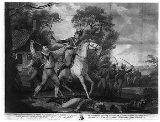
Peter Francisco known variously as the "
VirginiaThe Commonwealth of Virginia , is a U.S. state on the Atlantic Coast of the Southern United States. Virginia is nicknamed the "Old Dominion" and sometimes the "Mother of Presidents" after the eight U.S. presidents born there...
Giant" or the "Giant of the Revolution" (and occasionally as the "Virginia
HerculesHercules is the Roman name for Greek demigod Heracles, son of Zeus , and the mortal Alcmene...
"), was an American patriot and soldier in the
American Revolutionary WarThe American Revolutionary War , the American War of Independence, or simply the Revolutionary War, began as a war between the Kingdom of Great Britain and thirteen British colonies in North America, and ended in a global war between several European great powers.The war was the result of the...
. The cover page of a 2006 issue of
Military HistoryMilitary history is a humanities discipline within the scope of general historical recording of armed conflict in the history of humanity, and its impact on the societies, their cultures, economies and changing intra and international relationships....
suggested he may have been the greatest soldier in American history. General
George WashingtonGeorge Washington was the dominant military and political leader of the new United States of America from 1775 to 1799. He led the American victory over Great Britain in the American Revolutionary War as commander-in-chief of the Continental Army from 1775 to 1783, and presided over the writing of...
once said that Francisco's prowess directly enabled American victories in two battles, and said the war might have been lost without his participation.
Biography
Francisco's origins are shrouded in mystery. It is believed he was born on July 9, 1760 at
Porto JudeuPorto Judeu, which means "Jewish Port" in Portuguese, is a parish in the municipality of Angra do Heroísmo on the island of Terceira in the Azores. The population in 2001 was 2425, its population density was 80.11/km², and the land area is 30.27 km²....
on the island of
Terceira, in the
AzoresThe Archipelago of the Azores is composed of nine volcanic islands situated in the middle of the North Atlantic Ocean, and is located about west from Lisbon and about east from the east coast of North America. The islands, and their economic exclusion zone, form the Autonomous Region of the...
. According to the traditional version of his biography, he was found at about age five on the docks at
City Point, VirginiaHopewell is an independent city in the Commonwealth of Virginia. The population was 22,591 at the 2010 Census . It is in Tri-Cities area of the Richmond-Petersburg region and is a portion of the Richmond Metropolitan Statistical Area...
, in 1765. Peter was taken to the Prince George County Poorhouse. Not speaking English, he repeated the name "Pedro Francisco". The locals called him Peter. The locals discovered the boy spoke
PortuguesePortuguese is a Romance language that arose in the medieval Kingdom of Galicia, nowadays Galicia and Northern Portugal. The southern part of the Kingdom of Galicia became independent as the County of Portugal in 1095...
and noted his clothing was of good quality.
When able to communicate, Pedro said that he had lived in a mansion near the ocean. His mother spoke French and his father spoke another language which he did not know. He and his sister were kidnapped from the grounds, but his sister escaped, while Francisco was bound and taken to a ship. Historians believe it is possible that the kidnappers intended to hold the children for ransom or that they always intended to sell them as indentured servants at their destination port in North America, but changed their minds. The Azorean legend says the Francisco family had many political enemies and set up Peter's abduction to protect him from accident or death by his parents' foes.
Peter was soon taken in by the judge Anthony Winston of
Buckingham County, Virginia, an uncle of
Patrick HenryPatrick Henry was an orator and politician who led the movement for independence in Virginia in the 1770s. A Founding Father, he served as the first and sixth post-colonial Governor of Virginia from 1776 to 1779 and subsequently, from 1784 to 1786...
. Francisco lived with Winston and his family until the beginning of the
American RevolutionThe American Revolution was the political upheaval during the last half of the 18th century in which thirteen colonies in North America joined together to break free from the British Empire, combining to become the United States of America...
and was tutored by them. When he was old enough to work, he was apprenticed as a
blacksmithA blacksmith is a person who creates objects from wrought iron or steel by forging the metal; that is, by using tools to hammer, bend, and cut...
, a profession chosen because of his massive size and strength (he grew to be well over six feet six inches tall, or 198 centimeters, and weigh some 260 pounds, or 118 kilograms, especially large at the time). Francisco became part of the movement for American independence; he attended Patrick Henry's famous "Liberty or Death" speech outside St. John's Church in
RichmondRichmond is the capital of the Commonwealth of Virginia, in the United States. It is an independent city and not part of any county. Richmond is the center of the Richmond Metropolitan Statistical Area and the Greater Richmond area...
.
American Revolution
At the age of 16, Francisco joined the 10th Virginia Regiment in 1777, and soon gained notoriety for his size and strength. He fought with distinction at numerous engagements, including the
Battle of BrandywineThe Battle of Brandywine, also known as the Battle of the Brandywine or the Battle of Brandywine Creek, was fought between the American army of Major General George Washington and the British-Hessian army of General Sir William Howe on September 11, 1777. The British defeated the Americans and...
in September. He fought a few skirmishes under Colonel Morgan, before transferring to the regiment of Colonel Mayo of Powhatan. In October, Francisco rejoined his regiment and fought in the
Battle of GermantownThe Battle of Germantown, a battle in the Philadelphia campaign of the American Revolutionary War, was fought on October 4, 1777, at Germantown, Pennsylvania between the British army led by Sir William Howe and the American army under George Washington...
, and also appeared with the troops at
Fort MifflinFort Mifflin, originally called Fort Island Battery and also known as Mud Island Fort, was commissioned in 1771 and sits on Mud Island on the Delaware River below Philadelphia, Pennsylvania near Philadelphia International Airport...
on Port Island in the
Delaware RiverThe Delaware River is a major river on the Atlantic coast of the United States.A Dutch expedition led by Henry Hudson in 1609 first mapped the river. The river was christened the South River in the New Netherland colony that followed, in contrast to the North River, as the Hudson River was then...
. Hospitalized at
Valley ForgeValley Forge in Pennsylvania was the site of the military camp of the American Continental Army over the winter of 1777–1778 in the American Revolutionary War.-History:...
for two weeks following these skirmishes, he shared a room with the 20-year-old Marquis de Lafayette, with whom he became friends. At Lafayette's request,
George WashingtonGeorge Washington was the dominant military and political leader of the new United States of America from 1775 to 1799. He led the American victory over Great Britain in the American Revolutionary War as commander-in-chief of the Continental Army from 1775 to 1783, and presided over the writing of...
authorized the crafting of a special sword for Francisco, measuring some five feet long.
Over the next three years, Francisco became the most well-known private soldier of the war. On June 28, 1778, he fought at
Monmouth Court House, New JerseyThe Battle of Monmouth was an American Revolutionary War battle fought on June 28, 1778 in Monmouth County, New Jersey. The Continental Army under General George Washington attacked the rear of the British Army column commanded by Lieutenant General Sir Henry Clinton as they left Monmouth Court...
, where a musket ball tore through his right thigh. He never fully recovered from this wound, but fought at
CowpensThe Battle of Cowpens was a decisive victory by Patriot Revolutionary forces under Brigadier General Daniel Morgan, in the Southern campaign of the American Revolutionary War...
and other battles.
He was part of General "Mad"
Anthony WayneAnthony Wayne was a United States Army general and statesman. Wayne adopted a military career at the outset of the American Revolutionary War, where his military exploits and fiery personality quickly earned him a promotion to the rank of brigadier general and the sobriquet of Mad Anthony.-Early...
's attack on the British fort,
Stony PointThe Battle of Stony Point was a battle of the American Revolutionary War fought on the night of July 15–16, 1779. A select force of Continental Army infantry made a coordinated surprise night attack and stormed a fortified position of the British Army on the Hudson River south of West Point, New...
, on the
Hudson RiverThe Hudson is a river that flows from north to south through eastern New York. The highest official source is at Lake Tear of the Clouds, on the slopes of Mount Marcy in the Adirondack Mountains. The river itself officially begins in Henderson Lake in Newcomb, New York...
. Upon attacking the fort, Francisco suffered a nine-inch gash in his stomach, but continued to fight; he was second to enter the fort. He killed three British grenadiers and captured the enemy flag. Francisco's entry into the fort is mentioned in Wayne's report on the battle to General Washington, dated July 17, 1779, and in a letter written by Captain William Evans to accompany Francisco's letter to the Virginia General Assembly in November 1820 for pay.
Following the
Battle of CamdenThe Battle of Camden was a major victory for the British in the Southern theater of the American Revolutionary War...
,
South CarolinaSouth Carolina is a state in the Deep South of the United States that borders Georgia to the south, North Carolina to the north, and the Atlantic Ocean to the east. Originally part of the Province of Carolina, the Province of South Carolina was one of the 13 colonies that declared independence...
, Francisco noticed the Americans were leaving behind one of their valuable cannons, mired in mud. Legend says he freed and picked up the approximately 1,100-pound cannon and carried it on his shoulder to keep it from falling into the hands of the enemy. In a petition Francisco wrote 11 November 1820 to the Virginia Legislature
in his own words, he said that at Camden, he had shot a grenadier who had tried to shoot his Colonel (Mayo); he escaped by bayoneting one of
Banastre TarletonGeneral Sir Banastre Tarleton, 1st Baronet, GCB was a British soldier and politician.He is today probably best remembered for his military service during the American War of Independence. He became the focal point of a propaganda campaign claiming that he had fired upon surrendering Continental...
's cavalrymen and fled on the horse making cries to make the British think he was a
LoyalistLoyalists were American colonists who remained loyal to the Kingdom of Great Britain during the American Revolutionary War. At the time they were often called Tories, Royalists, or King's Men. They were opposed by the Patriots, those who supported the revolution...
, and gave the horse to Mayo.
Hearing that Colonel Watkins was headed on a march through the Carolinas, Francisco joined him, seeing action at Guilford Courthouse, North Carolina. He killed eleven men on the field of battle, including one who wounded him severely in the thigh with a bayonet. The feat is commemorated with a monument to Francisco at the
National Military ParkNational Military Park, National Battlefield, National Battlefield Park, and National Battlefield Site are four designations for 24 battle sites preserved by the United States federal government because of their national importance...
. Francisco in his own accounts claimed that he killed two men of the enemy-including one who bayoneted him in the leg-and mentions striking "panes" to others.
Francisco was sent home to
BuckinghamBuckingham is a census-designated place in and the county seat of Buckingham County, Virginia, United States...
to recuperate. He volunteered to spy on Tarleton and his horsemen, who were operating in the area. It was on this journey that he performed his best-known action,
Francisco's FightFrancisco's Fight is the name commonly given to an alleged skirmish between a detachment of Tarleton's Raiders and Peter Francisco, a Continental Army soldier with a long service record, during the American Revolutionary War in July 1781...
. He claims to have defeated a band of
Tarleton's RaidersThe British Legion was the name given to a British provincial regiment established during the American Revolution and composed of Loyalist American infantry and cavalry...
and escaped with their horses by his own actions. Legend has it that he killed or mortally wounded 3 of 11 raiders. One night, nine of Tarleton's men surrounded Francisco outside of a tavern and ordered him to be arrested. They told him to give over his silver shoe buckles. Francisco told Tarleton's men to take the buckles themselves. When they began to seize his shoe buckles, Francisco took a soldier's saber and struck him on the head. The wounded soldier fired his pistol, grazing Francisco's side; the American nearly cut off the soldier's hand. Another enemy soldier aimed a musket at Francisco, but the musket misfired. Francisco grabbed it from the soldier's hands, knocked him off his mount, and escaped with the horse.
In later accounts, the numbers vary. In Francisco's petition in 1820 to the Virginia Legislature, he reported having killed one and wounded eight of the nine raiders, and capturing eight of their nine horses. In his 1829 petition to the
United States CongressThe United States Congress is the bicameral legislature of the federal government of the United States, consisting of the Senate and the House of Representatives. The Congress meets in the United States Capitol in Washington, D.C....
, he claimed to have dispatched or killed three Tarleton raiders and frightened the other six away. Francisco was ordered by his commanding officer to join the army in 1781 at Yorktown; he did not fight but was witness to the British surrender.
Post-war activities
Following
CornwallisCharles Cornwallis, 1st Marquess Cornwallis KG , styled Viscount Brome between 1753 and 1762 and known as The Earl Cornwallis between 1762 and 1792, was a British Army officer and colonial administrator...
' surrender at Yorktown, Francisco pursued his basic education. He went to school with young children, who were fascinated by his stories of the war. Legends of Francisco's strength abounded during his lifetime. In addition to wartime exploits, he was said to have thrown two men, along with their horses, over a fence near his farm when they annoyed him.
Marriage and Family
Peter met his first wife Susannah Anderson outside of St. John's Church in
Richmond, VirginiaRichmond is the capital of the Commonwealth of Virginia, in the United States. It is an independent city and not part of any county. Richmond is the center of the Richmond Metropolitan Statistical Area and the Greater Richmond area...
, while traveling with Lafayette. In December 1784, Peter married Susannah Anderson of Cumberland County, Virginia. She was the daughter of Captain James Anderson and his wife Elizabeth Tyler Baker Anderson. The Andersons were of social distinction and owned a plantation called "The Mansion."
Peter and Susannah had two children: a son, James Anderson, born in the log house in 1786; and a daughter, Polly, born in 1788. Peter sold the 250 acres on Louse Creek in 1788. His wife Susannah died in 1790.
In December 1794, Peter married Catherine Fauntleroy Brooke, who was a relative of his first wife's, and they moved to Peter's home in Cumberland. Peter and Catherine had four children: Susan Brooke Francisco (born 1796), Benjamin M. Francisco (born 1803), Peter II, and Catherine Fauntleroy Francisco. After she died in 1819, he married in 1821 for the third time, to Mary Grymes West.
Death
In his later years Francisco was poor, and petitioned Congress and the Virginia legislature for support. He spent the last three years of his life working as the Sergeant-at-Arms to the Virginia State Senate. He died of
appendicitisAppendicitis is a condition characterized by inflammation of the appendix. It is classified as a medical emergency and many cases require removal of the inflamed appendix, either by laparotomy or laparoscopy. Untreated, mortality is high, mainly because of the risk of rupture leading to...
, in January 1831; he was buried with full military honors in
Shockoe Hill CemeteryThe Shockoe Hill Cemetery is a historic cemetery located on Shockoe Hill in Richmond, Virginia.-History:Established in 1820, with the initial burial in 1822, Shockoe Hill Cemetery was the first city-owned municipal burial ground in Richmond. The cemetery expanded in 1833, 1850, and 1870, but now is...
in Richmond. The state legislature adjourned for the day, and many legislators attended the funeral.
Legacy and honors

- 1975, Francisco was commemorated on a stamp by the US Postal Service in its "Contributors to the Cause" Bicentennial
The United States Bicentennial was a series of celebrations and observances during the mid-1970s that paid tribute to the historical events leading up to the creation of the United States as an independent republic...
series. The image shows his saving the cannon at Camden.
- A park in the Ironbound
The Ironbound is a large working-class neighborhood in Newark, New Jersey. This close-knit, multi-ethnic community covers approximately four square miles . Historically, the area was called "Dutch Neck," "Down Neck," or simply "the Neck," because of the way the Passaic River curved to form what...
section of Newark, New JerseyNewark is the largest city in the American state of New Jersey, and the seat of Essex County. As of the 2010 United States Census, Newark had a population of 277,140, maintaining its status as the largest municipality in New Jersey. It is the 68th largest city in the U.S...
, where most of the population is ethnic Portuguese, was named for him. The community also erected a monument to Francisco there.
- His farmhouse, Locust Grove
Locust Grove is a historic house located between Dillwyn and Buckingham, Virginia, constructed before 1794. It is remembered for its connection to the Revolutionary soldier Peter Francisco, and as the Peter Francisco House it was added to the National Register of Historic Places on March 16,...
, still stands outside the town of Buckingham.
- One of his swords (though not the special broadsword commissioned for him by General Washington) is displayed in the Buckingham County Historical Museum.
- Peter Francisco Square, marked by a monument honoring his life and service, was named at the corner of Hill Street and Mill Street in New Bedford, Massachusetts
New Bedford is a city in Bristol County, Massachusetts, United States, located south of Boston, southeast of Providence, Rhode Island, and about east of Fall River. As of the 2010 census, the city had a total population of 95,072, making it the sixth-largest city in Massachusetts...
, which has a large ethnic Portuguese community. The monument includes a Sons of the American RevolutionThe National Society of the Sons of the American Revolution is a Louisville, Kentucky-based fraternal organization in the United States...
(SAR) medallion of honor.
- The state of Virginia has named March 15 as Peter Francisco Day in his honor.
In popular culture
- A fiddle tune is named "Peter Francisco".
Featured in the book "Badass" by Ben Thompson
External links